


2 Kings 22:13
Bible text: King James Version (1769 Blayney text) · Public domain
Bible text: King James Version with Strong's numbers · Public domain
Bible text: Berean Standard Bible · Public domain
Bible text: American Standard Version (1901) · Public domain
Bible text: World English Bible, Messianic edition · Public domain
Bible text: Geneva Bible (1599) · Public domain
Bible text: Young's Literal Translation · Public domain
- לְכוּle·KhugoH1980V-Qal-Imp-2mpVerb Qal Imperative 2nd Plural Masculine
- דִרְשׁוּdir·ShuconsultH1875V-Qal-Imp-2mpVerb Qal Imperative 2nd Plural Masculine
- אֶת'et<obj.>H853DirObjMParticle Object Indicator
- יְהוָהYah·wehYahwehH3068N-properNoun Proper Title
- בַּעֲדִיba·'a·Difor meH1157Adj-csc ¦ 1csAdjective Numerical Singular common gender Constructבַּעֲדִforיme
- וּבְעַדu·ve·'adand forH1157Conj-w ¦ Adj-cscAdjective Numerical Singular common gender Constructוּandבְעַדfor
- הָעָםha·'Amthe peopleH5971Art ¦ N-msNoun Singular Masculine Absoluteהָtheעָםpeople
- וּבְעַדu·ve·'Adand forH1157Conj-w ¦ Adj-cscAdjective Numerical Singular common gender Constructוּandבְעַדfor
- כָּלkolallH3605N-mscNoun Singular Masculine Construct
- יְהוּדָהye·hu·DahJudahH3063N-properNoun Proper Location
- עַל'alonH5921PrepPreposition
- דִּבְרֵיdiv·Rei[the] words ofH1697N-mpcNoun Plural Masculine Construct
- הַסֵּפֶרha·Se·ferthe scrollH5612Art ¦ N-msNoun Singular Masculine Absoluteהַtheסֵּפֶרscroll
- הַנִּמְצָאha·nim·Tza'which had been foundH4672Art ¦ V-Niphal-Prtcpl-msVerb Niphal Participle Singular Masculine Absoluteהַwhichנִּמְצָאhad been found
- הַזֶּהha·Zeh<the> thisH2088Art ¦ PrtParticle Demonstrativeהַ<the>זֶּהthis
- כִּיkiforH3588PrtParticle Conditional
- גְדוֹלָהge·do·Lah[is] greatH1419Adj-fsAdjective Singular Feminine Absolute
- חֲמַתcha·Mat[the] anger ofH2534N-fscNoun Singular Feminine Construct
- יְהוָהYah·wehYahwehH3068N-properNoun Proper Title
- אֲשֶׁר'a·SherwhichH834RelParticle Relative
- הִיאhi'itH1931Pro-3fsPronoun Personal 3rd Singular Feminine
- נִצְּתָהni·tze·Tahit has been kindledH3341V-Niphal-Perf-3fsVerb Niphal Perfect 3rd Singular Feminine
- בָנוּVa·nuin usPrep-b ¦ 1cpSuffix Personal 1st Plural common genderבָinנוּus
- עַל'alonH5921PrepPreposition
- אֲשֶׁר'a·SherthatH834RelParticle Relative
- לֹאlo'notH3808NegParticle Negative
- שָׁמְעוּsha·me·'Uthey listenedH8085V-Qal-Perf-3cpVerb Qal Perfect 3rd Plural common gender
- אֲבֹתֵינוּ'a·vo·Tei·nuour ancestorsH1N-fpc ¦ 1cpNoun Plural Feminine Constructאֲבֹתֵיancestorsנוּour
- עַל'altoH5921PrepPreposition
- דִּבְרֵיdiv·Rei[the] words ofH1697N-mpcNoun Plural Masculine Construct
- הַסֵּפֶרha·Se·ferthe scrollH5612Art ¦ N-msNoun Singular Masculine Absoluteהַtheסֵּפֶרscroll
- הַזֶּהha·Zeh<the> thisH2088Art ¦ PrtParticle Demonstrativeהַ<the>זֶּהthis
- לַעֲשׂוֹתla·'a·Sotto doH6213Prep-l ¦ V-Qal-InfVerb Qal Infinitive Constructלַtoעֲשׂוֹתdo
- כְּכָלke·kholaccording to everyH3605Prep-k ¦ N-msNoun Singular Masculine Absoluteכְּaccording toכָלevery
- הַכָּתוּבha·ka·Tuv<the> [thing] writtenH3789Art ¦ V-Qal-PassPrtcpl-msVerb Qal Participle Passive Singular Masculine Absoluteהַ<the>כָּתוּב[thing] written
- עָלֵינוּ'a·Lei·nuon usH5921Prep ¦ 1cpPreposition Definiteעָלֵיonנוּus
English is a literal word-by-word gloss of the Hebrew, not the KJV's wording. Why?
This is the original text the KJV's translators worked from — each Hebrew word with its own literal English meaning in this verse, prepared by scholars at Tyndale House, Cambridge. The KJV translates whole sentences, not word by word, so its wording differs: one Hebrew word can become several English words, and the KJV may choose “the LORD” where the gloss reads “Yahweh”. Both are faithful — they answer different questions. For the KJV's own rendering, switch to the KJV text.
Details
See on the biblical-era map
Study this verse
Public-domain commentary
Matthew Henry
From his Commentary on the Whole Bible. Henry comments on passages, not single verses — this entry covers 2 Kings 22:11–20. His three-level outline is real structure in the source text, so it is rendered as structure.
We hear no more of the repairing of the temple: no doubt that good work went on well; but the book of the law that was found in it occupies us now, and well it may. It is not laid up in the king's cabinet as a piece of antiquity, a rarity to be admired, but it is read before the king. Those put the truest honour upon their Bibles that study them and converse with them daily, feed on that bread and walk by that light. Men of honour and business must look upon an acquaintance with God's word to be their best business and honour. Now here we have,
I.The impressions which the reading of the law made upon Josiah.
He rent his clothes, as one ashamed of the sin of his people and afraid of the wrath of God; he had long thought the case of his kingdom bad, by reason of the idolatries and impieties that had been found among them, but he never thought it so bad as he perceived it to be by the book of the law now read to him. The rending of his clothes signified the rending of his heart for the dishonour done to God, and the ruin he saw coming upon his people.
II.The application he made to God hereupon: Go, enquire of the Lord for me, Kg2 22:13.
1.Two things we may suppose he desired to know: - "Enquire, (1.) What we shall do; what course we shall take to turn away God's wrath and prevent the judgments which our sins have deserved." Convictions of sin and wrath should put us upon this enquiry, What shall we do to be saved? Wherewithal shall we come before the Lord? If you will thus enquire, enquire quickly, before it be too late. (2.) "What we may expect and must provide for." He acknowledges, "Our fathers have not hearkened to the words of this book; if this be the rule of right, certainly our fathers have been much in the wrong." Now that the commandment came sin revived, and appeared sin; in the glass of the law, he saw the sins of his people more numerous and more heinous than he had before seen them, and more exceedingly sinful. He infers hence, "Certainly great is the wrath that is kindled against us; if this be the word of God, as no doubt it is, and he will be true to his word, as no doubt he will be, we are all undone. I never thought the threatenings of the law so severe, and the curses of the covenant so terrible, as now I find them to be; it is time to look about us if these be in force against us." Note, Those who are truly apprehensive of the weight of God's wrath cannot but be very solicitous to obtain his favour, and inquisitive how they may make their peace with him. Magistrates should enquire for their people, and study how to prevent the judgments of God that they see hanging over them.
2.This enquiry Josiah sent,
(1.)By some of his great men, who are named Kg2 22:12, and again Kg2 22:14. Thus he put an honour upon the oracle, by employing those of the first rank to attend it.
(2.)To Huldah the prophetess, Kg2 22:14. The spirit of prophecy, that inestimable treasure, was sometimes put not only into earthen vessels, but into the weaker vessels, that the excellency of the power might be of God. Miriam helped to lead Israel out of Egypt (Mic 6:4), Deborah judged them, and now Huldah instructed them in the mind of God, and her being a wife was no prejudice at all to her being a prophetess; marriage is honourable in all. It was a mercy to Jerusalem that when Bibles were scarce they had prophets, as afterwards, when prophecy ceased, that they had more Bibles; for God never leaves himself without witness, because he will leave sinners without excuse. Jeremiah and Zephaniah prophesied at this time, yet the king's messengers made Huldah their oracle, probably because her husband having a place at court (for he was keeper of the wardrobe) they had had more and longer acquaintance with her and greater assurances of her commission than of any other; they had, it is likely, consulted her upon other occasions, and had found that the word of God in her mouth was truth. She was near, for she dwelt at Jerusalem, in a place called Mishneh, the second rank of buildings from the royal palace. The Jews say that she prophesied among the women, the court ladies, being herself one of them, who it is probable had their apartments in that place. Happy the court that had a prophetess within the verge of it, and knew how to value her.
III.The answer he received from God to his enquiry.
Huldah returned it not in the language of a courtier - "Pray give my humble service to his Majesty, and let him know that this is the message I have for him from the God of Israel;" but in the dialect of a prophetess, speaking from him before whom all stand upon the same level - Tell the man that sent you to me, Kg2 22:15. Even kings, though gods to us, are men to God, and shall so be dealt with; for with him there is no respect of persons.
1.She let him know what judgments God had in store for Judah and Jerusalem (Kg2 22:16, Kg2 22:17): My wrath shall be kindled against this place; and what is hell itself but the fire of God's wrath kindled against sinners? Observe,
(1.)The degree and duration of it. It is so kindled that it shall not be quenched; the decree has gone forth; it is too late now to think of preventing it; the iniquity of Jerusalem shall not be purged with sacrifice or offering. Hell is unquenchable fire.
(2.)The reference it has, [1.] To their sins: "They have committed them, as it were, with design, and on purpose to provoke me to anger. It is a fire of their own kindling; they would provoke me, and at length I am provoked." [2.] To God's threatenings: "The evil I bring is according to the words of the book which the king of Judah has read; the scripture is fulfilled in it. Those that would not be bound by the precept shall be bound by the penalty." God will be found no less terrible to impenitent sinners than his word makes him to be.
2.She let him know what mercy God had in store for him.
(1.)Notice is taken of his great tenderness and concern for the glory of God and the welfare of his kingdom (Kg2 22:19): Thy heart was tender. Note, God will distinguish those that distinguish themselves. The generality of the people were hardened and their hearts unhumbled, so were the wicked kings his predecessors, but Josiah's heart was tender. He received the impressions of God's word, trembled at it and yielded to it; he was exceedingly grieved for the dishonour done to God by the sins of his fathers and of his people; he was afraid of the judgments of God, which he saw coming upon Jerusalem, and earnestly deprecated them. This is tenderness of heart, and thus he humbled himself before the Lord, and expressed these pious affections by rending his clothes and weeping before God, probably in his closet; but he that sees in secret says it was before him, and he heard it, and put every tear of tenderness into his bottle. Note, Those that most fear God's wrath are least likely to feel it. It should seem that those words (Lev 26:32) much affected Josiah, I will bring the land into desolation; for when he heard of the desolation and of the curse, that is, that God would forsake them and separate them to evil (for till it came to that they were neither desolate nor accursed), then he rent his clothes: the threatening went to his heart.
(2.)A reprieve is granted till after his death (Kg2 22:20): I will gather thee to thy fathers. The saints then, no doubt, had a comfortable prospect of happiness on the other side death, else being gathered to their fathers would not have been so often made the matter of a promise as we find it was. Josiah could not prevail to prevent the judgment itself, but God promised him he should not live to see it, which (especially considering that he died in the midst of his days, before he was forty years old) would have been but a small reward for his eminent piety if there had not been another world in which he should be abundantly recompensed, Heb 11:16. When the righteous is taken away from the evil to come he enters into peace, Isa 57:1, Isa 57:2. This is promised to Josiah here: Thou shalt go to thy grave in peace, which refers not to the manner of his death (for he was killed in a battle), but to the time of it; it was a little before the captivity in Babylon, that great trouble, in comparison with which the rest were as nothing, so that he might be truly said to die in peace that did not live to share in that. He died in the love and favour of God, which secure such a peace as no circumstances of dying, no, not dying in the field of war, could alter the nature of, or break in upon.
Historical interpretation
Four Centuries of Reception
2 surviving comments on this verse. Each one is dated, so this reads as a timeline rather than a list.
Select a marker to jump to its quote. Markers stagger vertically where authors wrote within a few decades of each other.
We need not wonder that Huldah, the prophet and wife of Shallum, was consulted by Josiah, king of Judah, when the captivity was approaching and the wrath of the Lord was falling on Jerusalem: since it is the rule of Scripture, when holy men fail, to praise women to the reproach of men.
“They went to the prophet Huldah,” and not to Jeremiah, even though he was already well known as a prophet, probably because Jeremiah was not there at the moment, or maybe because this woman surpassed him with the power of her gift of prophecy.
Continue studying 2 Kings 22:13 across the web’s major study libraries — every link below opens this exact verse, chapter, or book on the destination site.
Read & Compare
 BibleGatewayThis verse in more than 200 translations and 70 languages.
 Bible.comThe YouVersion reader — hundreds of translations, reading plans, and highlights.
 ESV.orgCrossway's official English Standard Version reader.
 NET BibleThe NET translation with 60,000+ translators' notes on every rendering decision.
 STEP BibleTyndale House's free study tool — original text, vocabulary, and scholarly resources.
 BibliaLogos Bible Software's free web reader.
 USCCBThe New American Bible (Revised Edition) with the U.S. bishops' study notes.
Commentaries
 BibleHub CommentariesDozens of classic commentaries on this verse, gathered on one page.
 StudyLightMore than 100 commentary sets — the largest collection on the web.
 BibleRefPlain-English commentary on what this verse means, verse by verse.
 Enduring WordDavid Guzik's free commentary on this chapter, widely used by Bible teachers.
 Bible Study ToolsVerse commentary alongside Greek and Hebrew study aids.
Original Language & Research
- BibleHub InterlinearThe verse word by word — original language, transliteration, and English.
- BibleHub LexiconEvery word's original-language definition and Strong's entry.
 Blue Letter BibleDeep-study tools — Strong's numbers, concordance, and word studies.
 SefariaThe Hebrew text with Rashi and centuries of Jewish commentary.
Sermons, Hymns & Audio


TrulyRandomVerse is not affiliated with these sites and doesn’t control their content. They’re linked because they’re genuinely useful.
Summary
King Josiah, upon hearing the recently discovered "Book of the Law," is profoundly convicted by Judah's generations of persistent disobedience to God's covenant commands. Recognizing the severe spiritual negligence of his ancestors and the imminent divine judgment it portends, he urgently dispatches his trusted officials to seek the Lord's counsel on behalf of himself, the people, and all Judah. This pivotal moment underscores the transformative power of God's revealed Word to expose sin, ignite national repentance, and prompt a desperate search for divine mercy in the face of impending wrath.
Context
ShowHideLiterary Context
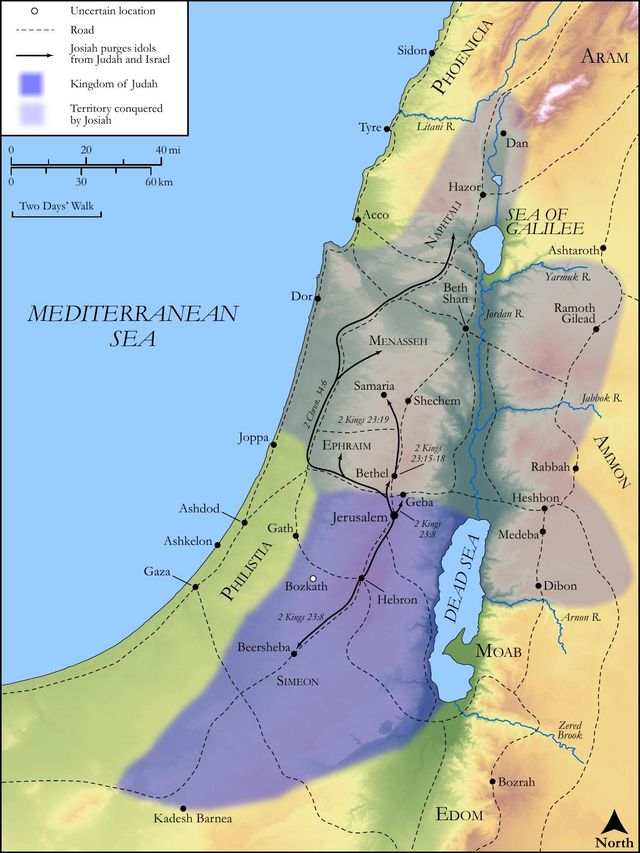
This verse is deeply embedded within the narrative of King Josiah's reign, specifically in 2 Kings 22. It immediately follows the momentous discovery of the "Book of the Law" (likely a significant portion of Deuteronomy) by Hilkiah the high priest during Temple repairs (2 Kings 22:8). When Shaphan the scribe reads its contents to Josiah, the king's reaction is one of profound grief and alarm—he tears his clothes (2 Kings 22:11). This verse, 2 Kings 22:13, is Josiah's immediate and decisive command to his trusted officials, including Hilkiah and Shaphan, to "enquire of the LORD" on behalf of himself, the people, and all Judah. It sets the stage for the prophetic inquiry that follows with the prophetess Huldah in 2 Kings 22:14-20. The urgency of Josiah's command highlights the immediate and overwhelming impact of the rediscovered divine revelation.
Historical & Cultural Context
Josiah reigned over Judah from 640-609 BC, a period of significant geopolitical flux as the Assyrian Empire declined and the Babylonian Empire rose. Unlike many of his predecessors, Josiah was a righteous king who sought to reverse generations of idolatry and apostasy, particularly under his grandfather Manasseh. The discovery of the Book of the Law around 622 BC (Josiah's 18th year) was not merely an archaeological find but a theological earthquake. It brought to light the forgotten covenant stipulations and the severe curses promised for disobedience, as outlined in texts like Deuteronomy 28. The act of tearing clothes was a customary, visceral expression of deep distress, grief, or repentance in Israel. Josiah's immediate call to "enquire of the LORD" through a prophet or priest reflects the common practice of seeking divine guidance in times of national crisis or spiritual uncertainty, indicating a profound reliance on divine revelation for national direction.
Key Themes
ShowHideThis verse powerfully contributes to several overarching themes within 2 Kings and the broader Deuteronomistic History. Firstly, it highlights the Authority and Power of God's Word, demonstrating how divine revelation, even when long neglected, can convict, transform, and provoke a national reckoning. The rediscovered "Book of the Law" serves as the catalyst for Josiah's profound spiritual awakening and subsequent reforms, underscoring the enduring relevance and convicting power of Scripture. Secondly, it underscores the theme of Divine Judgment and Wrath against covenant unfaithfulness, as Josiah explicitly acknowledges the "great wrath of the LORD" kindled against them due to their fathers' disobedience. This wrath is portrayed as a righteous and just response to generations of idolatry and oppression, a recurring motif throughout the prophetic books and historical narratives. Thirdly, the verse exemplifies Humility and Repentance, as Josiah's personal distress immediately translates into a corporate call for seeking God's face, demonstrating true leadership in the face of national sin. Finally, it touches upon Intergenerational Sin and its Consequences, recognizing that the cumulative disobedience of previous generations has brought the current generation to the brink of divine judgment, emphasizing the lasting impact of faithfulness or unfaithfulness, a concept explored in passages like Lamentations 5:7.
Exposition and Analysis
ShowHideKey Word Analysis
ShowHideThis verb signifies an earnest, diligent, and often urgent seeking, searching, or inquiring. According to the provided Strong's data (H1875), it means "properly, to tread or frequent; usually to follow (for pursuit or search); by implication, to seek or ask; specifically to worship." When used in a religious context, as here, it denotes seeking God's will, guidance, or revelation, often through a prophet, priest, or the Urim and Thummim. It implies a deep desire to understand God's perspective and to act in accordance with His desires, often in a context of crisis or a need for direction. Josiah's command is not a casual request but a desperate, sincere pursuit of divine counsel, highlighting his commitment to aligning the nation with God's revealed standards.
This noun, often paired with YHWH (the LORD), describes a burning, intense anger or indignation. Based on Strong's H2534, it denotes "heat; figuratively, anger, poison (from its fever); anger, bottles, hot displeasure, furious(-ly, -ry), heat, indignation, poison, rage, wrath(-ful)." It is a strong term, denoting a fierce, hot displeasure, often leading to destructive consequences. In the Old Testament, God's "wrath" is consistently portrayed as a righteous and just response to human sin, rebellion, and covenant unfaithfulness, rather than an arbitrary outburst. Here, Josiah recognizes the severity and justness of God's indignation against Judah's persistent idolatry and disobedience, understanding it as a righteous heat of divine displeasure.
While seemingly simple, this verb carries significant theological weight. Strong's H8085 defines it as "to hear intelligently (often with implication of attention, obedience, etc.; causatively, to tell, etc.)." It means "to hear," but more profoundly, "to listen attentively," "to obey," or "to heed." In the context of the covenant, "to hearken to the words" of God implies not just intellectual understanding but active, obedient compliance. The failure of "our fathers" was not merely a lack of hearing, but a profound failure to obey the clear commands of God's revealed Word, leading to the "wrath" Josiah now perceives. This emphasizes that true hearing involves responsive action.
Verse Breakdown
ShowHide"Go ye, enquire of the LORD for me, and for the people, and for all Judah, concerning the words of this book that is found:"
Josiah's immediate and urgent command to his trusted officials (Hilkiah, Ahikam, Achbor, Shaphan, Asaiah) demonstrates his personal humility and recognition of the corporate nature of their sin. He seeks divine counsel not just for himself as king, but for the entire nation—the "people" (common citizens) and "all Judah" (the entire kingdom), emphasizing a collective responsibility. The object of their inquiry is the "words of this book that is found," highlighting the profound impact of the rediscovered Law and the desperate need to understand its implications for their present situation and the future of the nation.
"for great [is] the wrath of the LORD that is kindled against us,"
Josiah articulates the profound and urgent reason for his inquiry: a deep awareness of God's righteous indignation. The phrase "kindled against us" uses a vivid metaphor of fire, indicating a consuming, active, and severe divine anger that has been ignited. This is not a speculative fear but a conviction rooted in the covenant curses outlined in the very book they have found, recognizing that their cumulative sin has provoked a just and terrible response from the holy God. The adjective "great" (H1419, gâdôwl') underscores the immense magnitude and severity of this divine displeasure.
"because our fathers have not hearkened unto the words of this book, to do according unto all that which is written concerning us."
This clause identifies the direct and historical root cause of God's wrath: the sustained disobedience of previous generations. The phrase "our fathers" acknowledges a long history of national apostasy, emphasizing that the current generation is inheriting the consequences of cumulative unfaithfulness. Their failure was not merely in passively hearing the words but in actively "doing according unto all that which is written," underscoring the covenantal demand for active, obedient compliance. The concluding phrase "concerning us" reiterates that the Law's commands and consequences were directly applicable to them as God's covenant people, making the judgment intensely personal and inescapable.
Literary Devices
ShowHideThe verse employs several powerful Literary Devices to convey its urgent message and Josiah's profound conviction. The most prominent is Covenant Language, as the entire premise revolves around the rediscovered "Book of the Law" and the nation's failure to "hearken unto the words" and "do according unto all that which is written," directly referencing the stipulations and curses of the Mosaic covenant. The phrase "wrath of the LORD that is kindled against us" utilizes a vivid Metaphor of fire, portraying God's anger as a consuming, active force, emphasizing its intensity and destructive potential. There is also an element of Hyperbole in "great is the wrath," which, while perhaps literally true in its theological context, serves to underscore the profound and overwhelming nature of the divine judgment, amplifying Josiah's distress. The Repetition of "words of this book" emphasizes the centrality and ultimate authority of the rediscovered Law as the catalyst for Josiah's distress and decisive action. The structure of the verse, moving from a command to a justification ("for great is the wrath... because our fathers have not hearkened"), demonstrates a clear Cause and Effect relationship, highlighting the direct and inevitable link between disobedience and divine judgment.
Theological and Thematic Connections
ShowHideThis verse serves as a profound theological statement on the nature of God's justice, the authority of His Word, and the corporate responsibility of a nation under covenant. Josiah's response exemplifies true repentance, recognizing that God's wrath is not arbitrary but a just consequence of generations of unfaithfulness to His revealed will. It underscores that God's Word is not merely informative but transformative and convicting, exposing sin and demanding a response. The acknowledgment of "our fathers'" sin highlights the concept of intergenerational consequences, where the cumulative disobedience of a people can lead to national judgment, even impacting subsequent generations. Yet, Josiah's immediate action to "enquire of the LORD" also points to the possibility of divine mercy and a path to reconciliation, even in the face of deserved judgment, demonstrating that even when judgment is certain, seeking God's face is the appropriate and hopeful response.
Reflection and Application
ShowHideThe profound impact of the rediscovered "Book of the Law" on King Josiah serves as a powerful reminder of the living and active nature of God's Word in our lives today. Like Josiah, we are called to allow the Scriptures to deeply penetrate our hearts, exposing our own sin and the areas where we, individually and corporately, have strayed from God's commands. This verse challenges us to move beyond mere intellectual assent to the Bible's truths and to embrace a humble, repentant posture when confronted by its convicting power. It teaches us that genuine spiritual revival often begins with a sober recognition of our unfaithfulness and a desperate, earnest seeking of God's face. In a world that often dismisses sin or divine judgment, Josiah's immediate and unreserved acknowledgment of "great... the wrath of the LORD" calls us to a realistic understanding of God's holy character and the serious consequences of disobedience. Our response to God's Word should always be one of reverent submission, leading us to "enquire of the LORD" for guidance, mercy, and the strength to obey all that is written concerning us, trusting in His ultimate faithfulness.
Questions for Reflection
ShowHideFAQ
ShowHideWhat was the "Book of the Law" discovered by Hilkiah?
ShowHideWhile the text simply calls it "the Book of the Law," scholarly consensus largely identifies it as a significant portion, if not the entirety, of the book of Deuteronomy. This conclusion is supported by the emphasis on covenant stipulations, blessings, and curses found in Deuteronomy, which align perfectly with Josiah's distressed reaction and the subsequent reforms he initiated. The book's rediscovery after generations of neglect was a pivotal moment, re-establishing the foundational covenant document for Judah and serving as the catalyst for a national spiritual awakening.
Why was Josiah so distressed by the book's contents?
ShowHideJosiah's distress, evidenced by tearing his clothes (2 Kings 22:11), stemmed from the immediate realization that the nation of Judah, including his own ancestors, had profoundly failed to "hearken unto the words of this book" and live according to its commands. The Book of the Law, particularly Deuteronomy 28, details severe curses and judgments for covenant disobedience. Josiah understood that generations of idolatry, injustice, and spiritual neglect had accumulated a massive spiritual debt, leading to the "great... wrath of the LORD" that was now "kindled against" them, threatening imminent national catastrophe. His reaction was one of profound conviction, humility, and a righteous fear of the Lord, recognizing the gravity of their collective sin.
Christ-Centered Fulfillment
ShowHideWhile 2 Kings 22:13 reveals the severity of God's righteous wrath against sin and the desperate need for humanity to "enquire of the LORD," it ultimately points forward to the ultimate and perfect fulfillment found in Jesus Christ. The "wrath of the LORD" that Josiah feared, a just consequence for the accumulated sin of generations, was fully and completely poured out upon Christ on the cross. He became the Lamb of God who takes away the sin of the world, bearing the curse of the Law that humanity could not fulfill (Galatians 3:13). Where Judah's "fathers" failed to "hearken unto the words of this book" and "do according unto all that which is written," Jesus perfectly embodied and fulfilled the Law, not one jot or tittle passing away until all was accomplished (Matthew 5:17). Furthermore, the desperate need to "enquire of the LORD" for guidance and mercy finds its ultimate answer in Christ, who is the Way, the Truth, and the Life, the very wisdom of God, and our great High Priest through whom we can boldly approach the throne of grace, finding mercy and grace to help in time of need (Hebrews 4:16). Thus, the fear of wrath and the search for mercy in 2 Kings 22:13 are resolved in the person and redemptive work of Jesus, who offers full atonement and access to God for all who believe.