


Old Testament · Major Prophets · Book 24 of 66
Jeremiah
The prophecies of Jeremiah, of the priests of Anathoth, who warned Judah for some forty years that Babylon would take Jerusalem, and foretold a new covenant.
- 52 chapters
- 1,364 verses
- About 3.2 hours to read
- The Hebrew Prophets, c. 800–400 BC
Jeremiah was known and sanctified before he was born, and ordained “a prophet unto the nations” (Jeremiah 1:5). He was sent to Judah in its last forty years with a word it would not hear: the LORD was bringing Babylon against Jerusalem. His charge had six verbs, “to root out, and to pull down, and to destroy, and to throw down, to build, and to plant” (1:10), and the first four fill most of the book. The people, the LORD says, “have forsaken me the fountain of living waters” (2:13), and they trust in “lying words, saying, The temple of the LORD” (7:4). The city falls in Zedekiah’s eleventh year.
The last two verbs are the promises, given in the same years and often in the same chapters. The LORD will raise unto David “a righteous Branch” (23:5), bring the exiles home after seventy years (29:10), and make a new covenant, writing his law “in their hearts” (31:33). Hebrews quotes that promise whole, as the covenant Christ mediates (Hebrews 8:6–13).
But this shall be the covenant that I will make with the house of Israel; After those days, saith the LORD, I will put my law in their inward parts, and write it in their hearts; and will be their God, and they shall be my people.
Jeremiah 31:33 KJV
Before you read
- Who wrote it
- Jeremiah the son of Hilkiah, “of the priests that were in Anathoth” (1:1). Baruch the scribe wrote his words “from the mouth of Jeremiah” (36:4), and wrote them again, with “many like words” added, after the king burned the roll (36:32). Chapter 52 comes after “Thus far are the words of Jeremiah” (51:64).
- When it was written
- Over some forty years, from “the thirteenth year” of Josiah to “the carrying away of Jerusalem captive” in Zedekiah’s eleventh year (1:2–3), and on in Egypt after the fall (43:8). The chapters are not in date order: the Rechabites, under Jehoiakim (35:1), follow chapters set under Zedekiah.
- When it happens
- The reigns of Judah’s last kings: Josiah; his sons Shallum, Jehoiakim and Zedekiah; and Jehoiakim’s son, called Coniah, Jeconiah and Jehoiachin. In Jehoiakim’s fourth year Nebuchadrezzar defeated Pharaoh-necho at Carchemish (46:2). Jeremiah speaks in Jerusalem until its fall, and afterwards among the remnant and in Egypt.
How Jeremiah is laid out
8 movements · 227 passages · 1,364 verses
The call and the first sermons
Chapters 1–10 · 280 verses
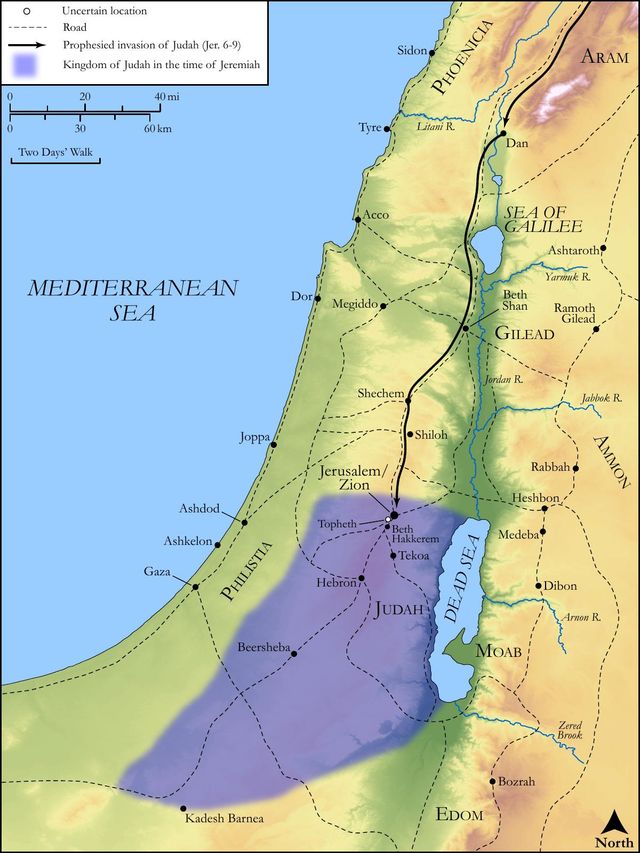
In Josiah’s thirteenth year the LORD calls Jeremiah, touches his mouth, and shows him an almond rod and a seething pot: evil will break forth out of the north. The first sermons charge Judah with forsaking the fountain of living waters and call backsliding Israel to return. At the temple gate he warns against trusting in the house itself; idols are mocked beside the living God.
10 chapters
- 1 The Prophet and His Ministry's Timeframe
- 2 God Recalls Israel's Early Love
- 3 God's Plea to the Harlot Nation
- 4 A Call for True Repentance
- 5 The Search for a Righteous Man
- 6 Jerusalem Under Siege: The Warning
- 7 The Temple Sermon
- 8 Judgment on the Idolatrous Dead
- 9 Jeremiah's Grief for His People
- 10 Warning Against Idolatry and Pagan Ways
The covenant broken, the prophet opposed
Chapters 11–20 · 214 verses
Judah has broken the covenant with their fathers, and the men of Anathoth seek Jeremiah’s life. Signs carry the word: a marred girdle, a prophet forbidden to marry, the potter’s clay, a bottle broken in the valley of Hinnom. The LORD forbids him to pray for the people. Pashur puts him in the stocks, and Jeremiah complains to God until he curses the day he was born.
10 chapters
- 11 The Broken Covenant and Imminent Judgment
- 12 Jeremiah Questions God's Justice
- 13 The Sign of the Ruined Girdle
- 14 The Great Drought
- 15 God Rejects Intercession for Judah
- 16 Jeremiah's Symbolic Life: A Sign of Judgment
- 17 Judah's Engraved Sin and Impending Punishment
- 18 The Potter and the Clay
- 19 Judgment Proclaimed in the Valley of Hinnom
- 20 Pashur Punishes Jeremiah
Kings, prophets and seventy years
Chapters 21–29 · 227 verses
Zedekiah asks for a word and hears that the LORD himself will fight against the city. Oracles condemn the last kings and the shepherds who scatter the flock, and promise David a righteous Branch. Judah and the nations will serve Babylon seventy years. Jeremiah is tried for his life, wears a yoke that Hananiah breaks, and writes to the exiles to build houses and seek Babylon’s peace.
9 chapters
- 21 Zedekiah Seeks an Oracle
- 22 A Call to Justice for the King
- 23 Condemnation of Bad Shepherds (Leaders)
- 24 The Vision of the Two Baskets of Figs
- 25 Prophecy Dated: 23 Years of Warning
- 26 Jeremiah's Temple Sermon
- 27 A Sign to the Nations: Submit to Babylon
- 28 Hananiah's False Prophecy of Peace
- 29 Jeremiah Sends a Letter to the Exiles
Healing, return and a new covenant
Chapters 30–33 · 134 verses
Jeremiah is told to write in a book the promise of return. After the time of Jacob’s trouble the LORD will heal Zion, gather the remnant, and make a new covenant, writing his law in their hearts. With the Chaldeans at the walls, Jeremiah buys his cousin’s field at Anathoth as a pledge that fields will again be bought, and the promise of the Branch is renewed.
24 passages
- 30:1–4 Command to Write the Book of Consolation
- 30:5–7 The Time of Jacob's Trouble
- 30:8–11 Promise of Deliverance and the Davidic King
- 30:12–17 The Incurable Wound and Divine Healing
- 30:18–22 Restoration of the Land and People
- 30:23–24 Final Judgment on the Wicked
- 31:1–6 Restoration of Israel and Judah
- 31:7–14 The Joyous Global Gathering
- 31:15–17 Rachel Weeps, God Comforts
- 31:18–22 Ephraim's Repentance and Restoration
- 31:23–26 Prosperity in Judah
- 31:27–30 Seeds of Future Growth
- 31:31–34 The New Covenant
- 31:35–37 The Everlasting Nature of the Covenant
- 31:38–40 The Rebuilding of Jerusalem
- 32:1–5 Jeremiah Imprisoned During the Siege
- 32:6–15 The Symbolic Purchase of the Field
- 32:16–25 Jeremiah's Prayer of Faith and Doubt
- 32:26–36 The Lord's Answer: Judgment Confirmed, Restoration Promised
- 32:37–44 The Promise of Everlasting Covenant
- 33:1–13 A Call to Prayer and Promise of Restoration
- 33:14–16 The Promise of the Righteous Branch
- 33:17–22 The Eternal Covenants of Kingship and Priesthood
- 33:23–26 God Reaffirms the Covenant with Israel
The roll burned, the city taken
Chapters 34–39 · 140 verses
Under siege, Jerusalem proclaims liberty to its Hebrew servants, then takes them back. The Rechabites keep their father’s command, as Judah has not kept God’s. Jehoiakim burns the roll Baruch has read, and Jeremiah dictates it again. Seized as a deserter, Jeremiah is beaten, imprisoned and let down into a dungeon of mire. Ebed-melech draws him out, and the city falls in Zedekiah’s eleventh year.
The remnant goes down to Egypt
Chapters 40–45 · 104 verses
Freed from his chains, Jeremiah stays at Mizpah with Gedaliah, the governor, until Ishmael murders Gedaliah. The remnant asks the LORD’s will and is told to stay in the land. They answer, “Thou speakest falsely,” and go down to Egypt, taking Jeremiah and Baruch. At Tahpanhes he foretells Babylon’s coming, and the people vow to burn incense to the queen of heaven. A word to Baruch closes.
Against the nations
Chapters 46–51 · 231 verses
The word against the nations begins with Egypt, beaten at Carchemish, and goes on to the Philistines, Moab, Ammon, Edom, Damascus, Kedar, Hazor and Elam. Babylon, “the hammer of the whole earth,” takes two long chapters: her day is coming, and Israel will be brought home. Seraiah reads the book in Babylon and sinks it in the Euphrates: “Thus shall Babylon sink.”
The fall of Jerusalem retold
Chapter 52 · 34 verses
After “Thus far are the words of Jeremiah,” the book records the fall: Zedekiah’s rebellion and flight, his sons slain before his eyes at Riblah, the temple burned and its brass carried to Babylon, and the numbers taken captive. In the thirty-seventh year of his captivity Jehoiachin is brought out of prison and his throne set above the kings with him.
The words Jeremiah turns on
The word came; Judah would not hear it and trusted falsehood. The call is to return, and the promise a new covenant in the heart.
What Jeremiah teaches
shûwb · return
Return, ye backsliding children
The early sermons summon Israel back: “Return, thou backsliding Israel, saith the LORD; and I will not cause mine anger to fall upon you” (3:12), and “Return, ye backsliding children, and I will heal your backslidings” (3:22). Backsliding is a word from the same root: Israel has turned away, and is called to turn back. The LORD asks, “Shall they fall, and not arise? shall he turn away, and not return?” Yet Jerusalem is “slidden back by a perpetual backsliding … they refuse to return” (8:4–5). Called again after the sign of the potter, they answer, “There is no hope” (18:12). So the promise turns to what God will do in them: “I will give them an heart to know me … for they shall return unto me with their whole heart” (24:7), and Ephraim prays, “turn thou me, and I shall be turned” (31:18).
sheqer · falsehood
Peace, peace; when there is no peace
Against Jeremiah stand prophets and priests who promise safety. They “have healed also the hurt of the daughter of my people slightly, saying, Peace, peace; when there is no peace” (6:14). The people trust in “lying words” (7:4), as if the temple would shield them, and are sent to Shiloh to see what God did to the place where he first set his name (7:12). Of the prophets the LORD says, “I have not sent these prophets, yet they ran” (23:21). His own word is of another kind: “Is not my word like as a fire? saith the LORD; and like a hammer that breaketh the rock in pieces?” (23:29). When Hananiah breaks the yoke and promises the exiles back within two years, Jeremiah answers, “thou makest this people to trust in a lie” (28:15), and Hananiah dies that year.
lêb · heart
Written in their hearts
Jeremiah finds Judah’s sin “graven upon the table of their heart” (17:1), and the heart itself “deceitful above all things, and desperately wicked” (17:9). They broke the covenant made when God brought them out of Egypt, “although I was an husband unto them” (31:32). The new covenant answers at the same place, “I will put my law in their inward parts, and write it in their hearts” (31:33), and rests on pardon: “I will remember their sin no more” (31:34). Hebrews reads it as made in Christ: “he hath made the first old” (Hebrews 8:13). Some Christians look for a day when Israel as a people is brought into it, when “all Israel shall be saved” (Romans 11:26–27); others read Paul’s Israel there as the whole people of God (Galatians 6:16).
dâbâr · word
A fire shut up in his bones
Jeremiah tells more of his own life than any other prophet, most of it the cost of the word. He is forbidden to marry (16:2), the men of his own town seek his life (11:21), and Pashur puts him in the stocks (20:2). He takes it to God: “Wherefore doth the way of the wicked prosper?” (12:1). “O LORD, thou hast deceived me, and I was deceived: thou art stronger than I, and hast prevailed” (20:7). The verb is used of enticing (Exodus 22:16): he was won over and overpowered into his office. Jerome took it that at his call he believed that none of this was spoken against the people of Judea, but only against the various nations surrounding them
. He resolved to be silent, but the word was “in mine heart as a burning fire shut up in my bones” (20:9).
Christ in Jeremiah
When Jesus drove the traders out of the temple he used Jeremiah’s temple sermon. “Is this house, which is called by my name, become a den of robbers in your eyes?” (Jeremiah 7:11) became “ye have made it a den of thieves” (Matthew 21:13). Some said Jesus was “Jeremias, or one of the prophets” (Matthew 16:14). Matthew writes that Jeremiah’s word of Rachel weeping in Ramah “was fulfilled” when Herod slew the children of Bethlehem (Matthew 2:17–18).
At the supper Jesus took the cup: “This cup is the new testament in my blood” (Luke 22:20). Hebrews quotes the promise of Jeremiah 31:31–34 whole and calls Jesus “the mediator of a better covenant” (Hebrews 8:6). The king Jeremiah foretold is a righteous Branch raised unto David, and “this is his name whereby he shall be called, THE LORD OUR RIGHTEOUSNESS” (Jeremiah 23:5–6). Paul writes that Christ “of God is made unto us wisdom, and righteousness,” and then quotes Jeremiah: “He that glorieth, let him glory in the Lord” (1 Corinthians 1:30–31; Jeremiah 9:24).
People
By how many verses name them
- JeremiahA son of Hilkiah115
- ZedekiahSon of Josiah and Hamutal; a brother of Jehoahaz; half-brother of: Jehoiakim and Shallum44
- NebuchadrezzarFather of Belshazzar37
- JehoiakimA son of Josiah and Zebidah; half-brother of: Jehoahaz, Zedekiah and Shallum23
- GedaliahA son of Ahikam22
- BaruchSon of Neriah; a brother of Seraiah; a servant of Jeremiah21
- IshmaelA son of Nethaniah19
- AhikamSon of Shaphan; a brother of Elasah and Gemariah; father of Gedaliah16
119 more are named.
Places
118 named
- BabylonNebuchadrezzar’s city, God’s instrument against Judah, then itself judged150
- JerusalemWarned, besieged, and taken in Zedekiah’s eleventh year97
- EgyptJudah’s false hope, and the remnant’s refuge after Gedaliah’s murder54
- MoabJudged at length in chapter 48, then promised a return33
- ZionWailing in the siege; the ransomed sing there on their return17
- MizpahGedaliah’s seat as governor, where Ishmael murdered him12
- EdomJudged in chapter 49: wisdom gone from Teman, Esau made bare8
- EuphratesWhere the girdle was hidden, and the book against Babylon sunk8
Where Jeremiah reaches
The passages it leans on, and the ones that lean on it
Jesus cleanses the temple with Jeremiah’s words: the house called by God’s name made “a den of thieves.”
The elders defend Jeremiah by citing Micah, who had foretold that Zion would be plowed like a field.
Jeremiah 25:11–12 Daniel 9:2 2 Chronicles 36:21
The seventy years: Daniel learns them “by books”, and the Chronicler sees them kept as the land’s sabbaths.
Jeremiah 17:1 2 Corinthians 3:3 Jeremiah 31:33
Sin graven on the table of the heart, the law written in the heart, and Christ’s epistle written “in fleshy tables of the heart.”
Jeremiah 51:63–64 Revelation 18:21
A book sunk in the Euphrates, and a millstone cast into the sea: Babylon goes down and does not rise.
Books Jeremiah links to most
The Church Fathers on Jeremiah
1,148 quotations from 56 writers before AD 800 · the ten most quoted, in date order
- Clement215
- Origen253
- Basil379
- Ambrose397
- Chrysostom407
- Jerome420
- Augustine430
- John Cassian435
- Cyril444
- Theodoret458
Jerome on the six verbs of the call: building comes after pulling down.
It is important to observe here that two joys succeed four sorrows. The good cannot be built up unless the evil is destroyed, nor can the best be planted unless the worst is eradicated.
Pacian of Barcelona heard Jeremiah’s question as an open door for the penitent.
Behold, he says, “I do not wish the death of the sinner as much as I prefer that he turn about and live.” And again he says, “Shall he who has fallen not arise, and shall he who has turned away not return?”
Augustine found the new covenant named here, and hardly anywhere else in the Old Testament.
Nowhere, or hardly anywhere, except in this passage of the prophet, do we find in the Old Testament Scriptures any mention so made of the New Testament as to indicate it by its name. It is no doubt often referred to and foretold as about to be given, but not so plainly as to have its name mentioned. Consider, then, carefully what difference God has testified as existing between the two Testaments—the old covenant and the new.
Theodoret on the burned roll, written again at God’s command.
The God of all orders Jeremiah to write the former words in another book. The sheet of paper was burned, but the divine law remained unharmed. So also when the body assumed by the Word suffered, the Word remained free from suffering.
Keep studying
Articles