


New Testament · Revelation · Book 66 of 66
Revelation
The prophecy God gave Jesus Christ to show his servants, sent to John on Patmos: seven letters, then the throne, the Lamb, judgment and all things new.
- 22 chapters
- 404 verses
- About 55 minutes to read
- The Revelation, c. AD 95
Revelation names itself in its first verse: “The Revelation of Jesus Christ, which God gave unto him, to shew unto his servants things which must shortly come to pass” (Revelation 1:1). Christ sent it by his angel to John, on Patmos “for the testimony of Jesus Christ” (1:9). It is prophecy: it opens with a blessing on “he that readeth, and they that hear the words of this prophecy” (1:3) and closes with a warning against adding to it or taking from it (22:18–19).
Its visions speak in the words of the prophets before it: Daniel’s beasts and Son of man, Ezekiel’s living creatures and river, Isaiah’s new heavens and new earth, the plagues of Egypt. Watch the throne, set in heaven in chapter 4 and standing in the city at the end. Watch the sevens: seals, trumpets and vials. Watch the two cities, each shown by one of the seven angels: Babylon the great whore (17:1) and the bride, the Lamb’s wife (21:9). Scripture began with the tree of life in a garden (Genesis 2:9). It ends with the tree of life in a city, and “no more curse” (22:3).
And they sung a new song, saying, Thou art worthy to take the book, and to open the seals thereof: for thou wast slain, and hast redeemed us to God by thy blood out of every kindred, and tongue, and people, and nation;
Revelation 5:9 KJV
Before you read
- Who wrote it
- John, who names himself four times (1:1, 1:4, 1:9, 22:8): Christ’s servant, the churches’ brother, on Patmos “for the word of God, and for the testimony of Jesus Christ.” Traditionally the apostle John, son of Zebedee.
Justin Martyr, Irenaeus and Jerome The apostle John, son of Zebedee. Justin calls him
one of the apostles of Christ
, and Jeromethe apostle whom Jesus most loved, the son of Zebedee and brother of James
.Grounds Justin Martyr 165 · Dialogue with Trypho, Chapter LXXXIIrenaeus 202 · Against Heresies 4.30.4Jerome 420 · De Viris Illustribus (On Illustrious Men), Section 9
Dionysius of Alexandria A John, as the book says, and
the work of some holy and inspired man
, but not the apostle: the Gospel and the epistle never name their writer, and the style of this book differs from theirs.Grounds Dionysius of Alexandria 264 · From the Two Books on the PromisesDionysius of Alexandria 264 · From the Two Books on the Promises
- When it was written
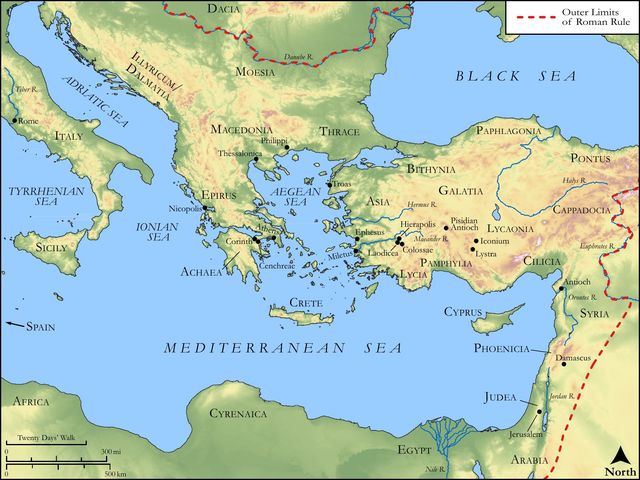
- On Patmos, where John was the churches’ “companion in tribulation” (1:9). The early testimony places it late in Domitian’s reign, c. AD 95; some date it before AD 70.
Irenaeus, Victorinus and Jerome Late in Domitian’s reign, c. AD 95. Irenaeus says the vision was seen
almost in our day, towards the end of Domitian's reign
. Victorinus and Jerome say Domitian banished John to Patmos, and Victorinus counts Domitian as the king who “is” (17:10).Grounds Irenaeus 202 · Against Heresies (Book V, Chapter 30)Victorinus of Pettau 304 · Commentary on the Apocalypse of the Blessed JohnVictorinus of Pettau 304 · Commentary on the Apocalypse of the Blessed JohnJerome 420 · De Viris Illustribus (On Illustrious Men), Section 9
Apringius of Beja, and others who date it before AD 70 Before the temple fell in AD 70. Apringius records a tradition that Claudius sent John to Patmos. Others place the book under Nero, reading the temple John is told to measure (11:1–2) as still standing.
Grounds Apringius of Beja 600 · Tractate On The Apocalypse 1:9Revelation 11:1–2
How Revelation is laid out
8 movements · 70 passages · 404 verses · gold dots mark key verses
Christ among the seven churches
Chapters 1–3 · 71 verses
John, on Patmos for the testimony of Jesus, hears a voice like a trumpet and sees one like the Son of man among seven golden candlesticks, holding seven stars. He is told to write to seven churches in Asia. Each letter opens with a title of Christ, most from that vision, weighs the church’s works, and promises a reward “to him that overcometh.”
11 passages
- 1:1–3 The Revelation of Jesus Christ
- 1:4–8 Greeting to the Seven Churches
- 1:9–11 John’s Vision on Patmos
- 1:12–20 Vision of the Glorified Son of Man
- 2:1–7 The Letter to the Church in Ephesus
- 2:8–11 Message to the Church in Smyrna
- 2:12–17 Message to the Church in Pergamum
- 2:18–29 Message to the Church in Thyatira
- 3:1–6 The Letter to the Church in Sardis
- 3:7–13 Message to Philadelphia: The Faithful Church
- 3:14–22 The Letter to the Church in Laodicea
The throne and the Lamb
Chapters 4–5 · 25 verses
A door opens in heaven, and John sees a throne, and around it four and twenty elders and four beasts crying “Holy, holy, holy.” The one on the throne holds a book sealed with seven seals, and no one is worthy to open it. An elder announces the Lion of the tribe of Juda; John sees a Lamb as it had been slain, and every creature praises him.
7 passages
The Lamb opens the seals
Chapters 6–7 · 34 verses
Four horsemen ride out at the first four seals: a crowned rider conquering, then war, famine and death. Under the altar the souls of the slain cry “How long, O Lord.” The sixth seal shakes heaven and earth, and kings hide from the wrath of the Lamb. Then a hundred and forty-four thousand of Israel are sealed, and a multitude of all nations stands before the throne.
Seven trumpets
Chapters 8–11 · 64 verses
The seventh seal brings silence in heaven, and the prayers of the saints rise with incense before God. Four trumpets strike a third of earth, sea, rivers and sky; the fifth and sixth loose locusts from the pit and horsemen from the Euphrates, yet the rest of men repent not. John eats a little book, two witnesses prophesy, die and rise, and at the seventh trumpet heaven proclaims Christ’s reign.
12 passages
- 8:1–2 The Seventh Seal and Heavenly Silence
- 8:3–6 Prayers of the Saints and Preparation for Judgment
- 8:7–13 The First Four Trumpets and the Three Woes
- 9:1–12 The Fifth Trumpet: Demonic Locusts Released
- 9:13–19 The Sixth Trumpet: The Euphrates Army
- 9:20–21 Humanity Refuses to Repent
- 10:1–4 The Mighty Angel and the Little Scroll
- 10:5–7 The Angel Swears an Oath
- 10:8–11 John Eats the Scroll and Is Commissioned
- 11:1–2 Measuring the Temple and the Holy City
- 11:3–14 The Two Witnesses Prophesy
- 11:15–19 The Seventh Trumpet Sounds
The woman, the dragon, the beasts
Chapters 12–14 · 55 verses
A woman clothed with the sun bears a man child, caught up to God’s throne. Michael casts the dragon out of heaven, and he wars on her seed. A beast rises from the sea; a second, from the earth, makes men worship the first and take his mark. The Lamb stands on mount Sion with the redeemed, angels proclaim the gospel and Babylon’s fall, and the earth is reaped.
8 passages
- 12:1–6 The Woman, the Dragon, and the Man-Child
- 12:7–12 Satan Thrown Down to Earth
- 12:13–17 The Dragon Persecutes the Remnant
- 13:1–10 The Beast from the Sea Rises
- 13:11–18 The Beast from the Earth (The False Prophet)
- 14:1–5 The Lamb and the 144,000 on Mount Zion
- 14:6–13 The Three Angels and the Blessing of the Faithful Dead
- 14:14–20 The Harvest and the Winepress of God’s Wrath
Seven vials, and Babylon’s fall
15:1–19:10 · 81 verses
Those who overcame the beast sing the song of Moses and of the Lamb. Seven angels pour out the vials of God’s wrath on earth, sea, rivers, sun, the beast’s seat, the Euphrates and the air, and a voice from the throne says, “It is done.” Babylon the great whore is judged; kings and merchants lament her, heaven sings Alleluia, and the marriage of the Lamb is come.
The rider and the white throne
19:11–20:15 · 26 verses
Heaven opens on a rider called Faithful and True, The Word of God, King of kings. The beast and the false prophet are cast into the lake of fire. Satan is bound a thousand years while the martyrs live and reign with Christ; loosed, he gathers Gog and Magog and is cast into the lake. The dead, small and great, are judged before a great white throne.
All things new
Chapters 21–22 · 48 verses
John sees a new heaven and a new earth, and the new Jerusalem coming down as a bride. God dwells with men and wipes away all tears. The city has no temple, for God and the Lamb are its temple; the river and tree of life are in it, and there is no more curse. Jesus says, “Surely I come quickly,” and John answers, “Even so, come, Lord Jesus.”
The words Revelation turns on
Throne and Lamb run thick from chapters 4 and 5 on; seal fills chapters 5–9 and beast chiefly 13–20; testimony and overcome are what the saints hold.
What Revelation teaches
arníon · Lamb
The Lamb that was slain
An elder tells John to behold “the Lion of the tribe of Juda” (5:5), and John sees “a Lamb as it had been slain” (5:6). From then on Lamb is the book’s commonest name for Christ: arníon stands in twenty-seven verses here and in one other verse of the New Testament (John 21:15). The new song says why he is worthy to open it: “for thou wast slain, and hast redeemed us to God by thy blood” (5:9). The kings of the earth hide from “the wrath of the Lamb” (6:16), the multitude have made their robes “white in the blood of the Lamb” (7:14), and when ten kings make war with him, “the Lamb shall overcome them” (17:14). The book moves toward “the marriage of the Lamb” (19:7) and a city where “the Lamb is the light thereof” (21:23).
nikáō · overcome
To him that overcometh
Each of the seven letters carries a promise to him that overcometh, and the last chapters keep them. The tree of life promised at Ephesus (2:7) stands by the river (22:2). The overcomer at Smyrna “shall not be hurt of the second death” (2:11), and over those in the first resurrection “the second death hath no power” (20:6). Those promised a seat on Christ’s throne (3:21) “shall reign for ever and ever” (22:5). The victory is Christ’s first: “even as I also overcame” (3:21). The beast is given power “to make war with the saints, and to overcome them” (13:7), yet the saints stand on the sea of glass, having “gotten the victory over the beast” (15:2). They overcame “by the blood of the Lamb, and by the word of their testimony” (12:11).
thrónos · throne
The throne and its judgments
The first thing John sees through the open door is that “a throne was set in heaven, and one sat on the throne” (4:2). Thrónos stands in thirty-six verses of this book, more than in the rest of the New Testament together. The judgments go out from before it: the Lamb takes the sealed book from the right hand of him that sits there, and the last vial ends with a voice “from the throne, saying, It is done” (16:17). They answer the martyrs’ cry, “How long, O Lord, holy and true, dost thou not judge and avenge our blood” (6:10), and from the altar a voice says, “true and righteous are thy judgments” (16:7). The dead are judged before “a great white throne” (20:11), and in the new city it is “the throne of God and of the Lamb” (22:3).
chílioi · thousand
The thousand years
An angel binds Satan in the bottomless pit, “that he should deceive the nations no more, till the thousand years should be fulfilled” (20:3). The martyrs “lived and reigned with Christ a thousand years” (20:4), and John calls this “the first resurrection” (20:5). Christians have read the thousand years in two ways. Papias held that after the resurrection the kingdom of Christ will be set up in material form on this very earth
, and Justin looked for a thousand years in Jerusalem, which will then be built, adorned, and enlarged
. Augustine read them as the span between Christ’s first and second coming
, and concluded that even now, in time, the church reigns with Christ
. Both readings confess what the chapter says: Satan bound and then destroyed, the saints reigning with Christ, and the dead judged before the throne.
How Christians have read it
Faithful readers have differed; each reading is given with its grounds
Fulfilled in the first centuries
The book promised “things which must shortly come to pass” (1:1), “for the time is at hand” (22:10). On this reading most of its visions were fulfilled in the church’s first centuries, in the powers that persecuted it. Andreas reports that Some consider this harlot to be old Rome, since she sits on seven hills
. Christ’s coming, the resurrection and the last judgment remain to come.
Grounds Revelation 1:1Revelation 22:10Andreas of Caesarea 614 · Commentary On The Apocalypse 17:1-3Victorinus of Pettau 304 · Commentary on the Apocalypse of the Blessed John
The church’s history in order
The seals, trumpets and vials are read as a prophecy of the church’s course from John’s day to Christ’s return, each series following the one before in time. The days of the prophecy, “a thousand two hundred and threescore days” (12:6), are counted as years, “each day for a year” (Ezekiel 4:6), and the beast and Babylon are traced in the powers that have opposed the church through its history.
Still to come at the end
From chapter 4, “things which must be hereafter” (4:1), the visions are read as events still future: a last persecution under the beast, the judgments of the seals, trumpets and vials, and Christ’s return. Irenaeus expected the beast to reign three years and six months, and then the Lord will come from heaven in the clouds, in the glory of the Father
.
Grounds Revelation 4:1Irenaeus 202 · Against Heresies (Book V, Chapter 30)
The church’s warfare in every age
The visions are read as one conflict, of Christ and his church against Satan and the world, shown again and again from different sides through the whole time between Christ’s two comings. Bede wrote that John repeats the entire time of the Church in various figures in this book
, and Augustine read the thousand years as this same age.
Grounds Bede 735 · Commentary on RevelationVictorinus of Pettau 304 · Commentary on the Apocalypse of the Blessed JohnAugustine of Hippo 430 · City of God 20.9
Christ in Revelation
Christ is the giver of this revelation (Revelation 1:1) and its first speaker. The one like unto the Son of man takes the name the LORD gave himself in Isaiah, “I am the first and the last” (1:17; Isaiah 44:6), and adds what no prophet could say: “I am he that liveth, and was dead” (1:18).
The Lamb is also the Lion of the tribe of Juda and the Root of David (5:5): the lion of Jacob’s blessing on Judah (Genesis 49:9–10) and the root of Jesse that Paul reads as Christ (Isaiah 11:10; Romans 15:12). The rider of chapter 19 bears the name John’s Gospel opens with: “his name is called The Word of God” (19:13; John 1:1). At the end Jesus calls himself “the root and the offspring of David, and the bright and morning star” (22:16), the Star Balaam saw coming out of Jacob (Numbers 24:17). His last words in the book are “Surely I come quickly,” and John answers, “Even so, come, Lord Jesus” (22:20).
People
By how many verses name them
- Satan7
- JohnSon of Zebedee; a brother of James5
- DavidSon of Jesse3
- IsraelSon of Isaac and Rebekah; a brother of Esau3
- Antipas1
- Apollyon1
- AserSon of Israel and Zilpah; a brother of Gad1
- BalaamA son of Beor1
15 more are named.
Places
18 named
- Babylon“Mystery, Babylon the great,” the city that reigns over kings6
- JerusalemThe new Jerusalem, coming down out of heaven from God3
- SardisIt has a name that it lives, and is dead3
- ThyatiraGrowing in works, yet suffering that woman Jezebel3
- EphesusFirst letter: it tried false apostles but left its first love2
- EuphratesIts angels loosed at the sixth trumpet; dried at the sixth vial2
- LaodiceaLukewarm, rich in its own eyes; Christ knocks at the door2
- PergamosWhere Satan’s seat is, and Antipas was slain2
Where Revelation reaches
The passages it leans on, and the ones that lean on it
Revelation 1:7 Daniel 7:13 Zechariah 12:10
The Son of man coming with clouds, and the pierced one looked upon and mourned: two prophecies joined in one verse.
Ezekiel 3:1–3 Revelation 10:8–11
Ezekiel eats the roll, “in my mouth as honey for sweetness,” and is sent to speak; John eats the book and must prophesy again.
Daniel 7:2–7 Revelation 13:1–2
Daniel’s four beasts rise from the sea; John’s one beast from the sea has the leopard, bear and lion together, and ten horns.
Revelation 21:1–4 Isaiah 65:17 Isaiah 25:8
Isaiah’s new heavens and new earth, and his promise that the Lord GOD “will wipe away tears from off all faces.”
Genesis 2:9 Revelation 22:1–3 Ezekiel 47:12
The tree of life from Eden grows again by a river like Ezekiel’s, its leaves “for the healing of the nations.”
Books Revelation links to most
The Church Fathers on Revelation
1,828 quotations from 44 writers before AD 800 · the ten most quoted, in date order
- Tertullian220
- Cyprian258
- Victorinus304
- Ticonius390
- Augustine430
- Caesarius542
- Primasius560
- Apringius600
- Andreas614
- Bede735
Apringius of Beja, on why the book is called a revelation.
From this we learn that this [book] is called an Apocalypse, that is, ‘revelation,’ which manifests those secrets which are hidden and unknown to the senses, and that unless [Christ] himself reveals them, he who perceives [the revelation] will not have the strength to understand what he sees.
Victorinus, on the blessing promised to those who read and keep it.
The beginning of the book promises blessing to him that reads and hears and keeps, that he who takes pains about the reading may thence learn to do works, and may keep the precepts.
Irenaeus, citing those who saw John face to face, would not pronounce on the name of the beast.
It is therefore more certain, and less hazardous, to await the fulfilment of the prophecy, than to be making surmises, and casting about for any names that may present themselves … We will not, however, incur the risk of pronouncing positively as to the name of Antichrist
Primasius, on the words “It is done.”
It is necessary that these [words] be believed not explained, especially since he said ‘It is done!’ concerning the past so that no one might doubt concerning the future.
Keep studying
Articles