


Old Testament · Major Prophets · Book 27 of 66
Daniel
Daniel, a captive in Babylon, serves its kings without forsaking his God, and sees the kingdoms of men give way to the kingdom of the Son of man.
- 12 chapters
- 357 verses
- About 53 minutes to read
- The Babylonian Exile, c. 605–538 BC
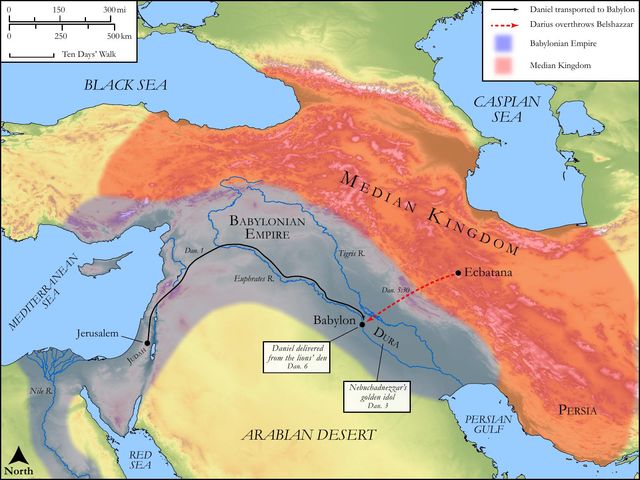
Daniel was carried to Babylon in “the third year of the reign of Jehoiakim” (1:1), and was still serving there under Cyrus the Persian. The first six chapters tell what he and three companions did at the court. They would not eat the king’s meat, bow to his image, or stop praying, and one king after another is brought to confess their God (2:47; 3:28; 6:26). The lesson is given in the watchers’ decree: “the most High ruleth in the kingdom of men, and giveth it to whomsoever he will” (4:17).
The last six chapters are Daniel’s own visions: four beasts from the sea, a ram and a goat, seventy weeks, and the wars of the kings of the north and the south. In the first, the beasts are judged and dominion is given to “one like the Son of man” coming “with the clouds of heaven” (7:13–14). Jesus took those words for himself before the high priest (Mark 14:62). The book ends with the promise that many who sleep in the dust shall awake (12:2).
I saw in the night visions, and, behold, one like the Son of man came with the clouds of heaven, and came to the Ancient of days, and they brought him near before him.
Daniel 7:13 KJV
Before you read
- Who wrote it
- Daniel. He “wrote the dream” of chapter 7 (7:1) and tells the visions of chapters 7–12 in the first person. Ezekiel, in the same captivity, names him with Noah and Job (Ezekiel 14:14), and Christ calls him “Daniel the prophet” (Matthew 24:15).
- When it was written
- Across the captivity. The first date is “the third year of the reign of Jehoiakim” (1:1), the last “the third year of Cyrus king of Persia” (10:1). The visions are dated by the reigns of Belshazzar, Darius and Cyrus (7:1; 8:1; 9:1).
- Where
- Babylon, at the courts of Nebuchadnezzar, Belshazzar, Darius the Median and Cyrus. Two visions are set by rivers: the Ulai at Shushan (8:2) and the Hiddekel (10:4).
- About the text
- From the Chaldeans’ reply “in Syriack” (2:4) to the end of chapter 7 the book is in Aramaic, the rest in Hebrew. The Greek copies carry more: a prayer and song of the three in the furnace, and the accounts of Susanna and of Bel and the dragon. Protestant Bibles that print them set them among the Apocrypha.
Jerome, and the Reformation churches after him The book is the Hebrew and Aramaic text. Answering an objection drawn from Bel and the dragon, Jerome replied that
this particular story is not contained in the Hebrew of the Book of Daniel
.Grounds Jerome 420 · St. Jerome, Commentary on Daniel, CHAPTER FOURTEEN
Hippolytus, and the Catholic and Orthodox churches The Greek passages belong to the book. Hippolytus expounded Susanna as Scripture and answered those who would remove it, since
the sacred Scriptures, without qualification and with all frankness, tell us everything
.Grounds Hippolytus of Rome 235 · Commentary On Daniel 1:14.2-4Hippolytus of Rome 235 · Commentary On Daniel 1:14.5-6
How Daniel is laid out
8 movements · 56 passages · 357 verses · gold dots mark key verses
Captives at the king’s table
Chapter 1 · 21 verses
Nebuchadnezzar besieges Jerusalem and carries vessels of the house of God to Shinar. Youths of the king’s seed are chosen to learn the Chaldeans’ tongue, and Daniel, Hananiah, Mishael and Azariah are given new names. Daniel purposes not to defile himself with the king’s meat. After ten days of pulse and water the four look fairer, and the king finds them “ten times better” than his magicians.
The image and the stone
Chapter 2 · 49 verses
Nebuchadnezzar demands that his wise men tell his dream and its interpretation, and when they cannot he orders them all destroyed. Daniel and his fellows seek mercies of the God of heaven, and the secret is revealed to Daniel in a night vision. He shows the king an image of gold, silver, brass, iron and clay, broken by a stone “cut out without hands” that fills the whole earth.
The burning fiery furnace
Chapter 3 · 30 verses
Nebuchadnezzar sets up an image of gold in the plain of Dura and commands all peoples to worship it at the sound of the music. Shadrach, Meshach and Abednego will not. Their God is able to deliver them, and “if not,” they still will not serve his gods. Cast bound into the furnace, they are seen walking loose in the fire with a fourth, and come out unharmed.
Two proud kings brought low
Chapters 4–5 · 68 verses
Nebuchadnezzar’s own decree tells of his dream of a great tree hewn down. For his pride he is driven from men to eat grass as oxen until he knows that the most High rules, and is restored. Belshazzar drinks from the vessels of God’s house; a hand writes on the wall, Daniel reads it, and that night Belshazzar is slain and Darius the Median takes the kingdom.
11 passages
- 4:1–3 Nebuchadnezzar’s Decree and Praise
- 4:4–18 The King’s Troubling Dream
- 4:19–27 Daniel Interprets the Tree
- 4:28–33 The Prophecy is Fulfilled
- 4:34–37 Nebuchadnezzar’s Restoration and Final Praise
- 5:1–4 Belshazzar’s Sacrilegious Feast
- 5:5–9 The Writing on the Wall Appears
- 5:10–16 Daniel Is Summoned
- 5:17–24 Daniel Rebukes the King
- 5:25–29 The Interpretation: Mene, Tekel, Upharsin
- 5:30–31 Babylon Falls
The den of lions
Chapter 6 · 28 verses
Darius makes Daniel first of his three presidents, and his rivals can find no fault in him except concerning the law of his God. They obtain a decree that none ask a petition of any God or man but the king for thirty days. Daniel prays three times a day as before, is cast to the lions and taken up unhurt, and his accusers are cast in instead.
One like the Son of man
Chapter 7 · 28 verses
In Belshazzar’s first year Daniel sees four great beasts come up from the sea; the fourth has ten horns, and a little horn speaks great things. The Ancient of days sits in judgment, the beast is slain, and one like the Son of man receives an everlasting dominion. The beasts are four kings, and the kingdom is given to the saints of the most High.
Ram and goat; seventy weeks
Chapters 8–9 · 54 verses
At Shushan Daniel sees a two-horned ram cast down by a goat whose great horn is broken and replaced by four; from one comes a little horn that takes away the daily sacrifice. Gabriel names the ram Media and Persia, the goat Grecia. In the first year of Darius, Daniel reads Jeremiah’s seventy years and confesses Israel’s sin, and Gabriel returns with seventy weeks.
9 passages
- 8:1–2 The Vision at Shushan
- 8:3–8 The Ram and the Goat
- 8:9–14 The Rise of the Little Horn
- 8:15–19 Gabriel Interprets the Vision
- 8:20–27 Interpretation: Media-Persia, Greece, and the Little Horn
- 9:1–2 Daniel Studies Jeremiah’s Prophecy
- 9:3–19 Daniel’s Prayer of Confession
- 9:20–23 Gabriel Appears to Daniel
- 9:24–27 The Prophecy of Seventy Weeks
The time of the end
Chapters 10–12 · 79 verses
In the third year of Cyrus, after three weeks of mourning, Daniel sees a man clothed in linen by the Hiddekel. The messenger foretells kings of Persia and Grecia, wars between the kings of the north and the south, and a vile person whose forces pollute the sanctuary. Then Michael stands up, many who sleep in the dust awake, and Daniel is told to go his way and rest.
13 passages
- 10:1–4 Daniel’s Preparation and Vision Setting
- 10:5–9 The Appearance of the Divine Messenger
- 10:10–15 The Explanation of the Delay
- 10:16–19 Daniel Strengthened to Receive the Message
- 10:20–21 The Purpose of the Revelation and Future Conflict
- 11:1–4 Persia and the Rise of Greece
- 11:5–20 The Kings of the South and North
- 11:21–30 The Rise of the Vile Person
- 11:31–35 The Abomination of Desolation
- 11:36–39 The King of the End Times
- 11:40–45 The Final Campaign
- 12:1–4 The Great Tribulation and Resurrection
- 12:5–13 Dialogue on the End Times
The words Daniel turns on
The court chapters turn on interpretation, rule and serve; kingdom runs through to 7:27; in the visions Daniel seeks to understand, and Gabriel counts in weeks.
What Daniel teaches
shallîyṭ · rule
The most High ruleth
Daniel blesses the God who “removeth kings, and setteth up kings” (2:21), and the court accounts show him doing it. Nebuchadnezzar is told that “the God of heaven hath given thee a kingdom” (2:37), yet he boasts of “great Babylon, that I have built” (4:30). He is driven from men “till thou know that the most High ruleth in the kingdom of men” (4:25), and when his understanding returns he confesses that “none can stay his hand” (4:35). Daniel then tells Belshazzar, “thou his son, O Belshazzar, hast not humbled thine heart, though thou knewest all this” (5:22). The writing gives the verdict, “Thou art weighed in the balances, and art found wanting” (5:27), and that night the kingdom passes to Darius the Median.
pᵉlach · serve
Whom they serve
The charge against the three Jews is that “they serve not thy gods” (3:12), and their answer turns on the same word: “our God whom we serve is able to deliver us,” and “if not, be it known unto thee, O king, that we will not serve thy gods” (3:17–18). Their obedience does not wait on the outcome. The king then blesses the God whose servants “yielded their bodies, that they might not serve nor worship any god, except their own God” (3:28), and Darius speaks to Daniel of “Thy God whom thou servest continually” (6:16). In chapter 7 the same word is used of the Son of man: “all people, nations, and languages, should serve him” (7:14). The kings who demanded worship give way to the one to whom it is due.
malkûw · kingdom
Four kingdoms and a fifth
Nebuchadnezzar’s image and Daniel’s four beasts show four kingdoms in turn (2:37–40; 7:17), and both end in a kingdom not raised by men: the stone “cut out without hands” (2:34), and the dominion given to the Son of man and to “the saints of the most High” (7:18). The text names the first, “Thou art this head of gold” (2:38), and later names Media and Persia and Grecia (8:20–21), but it does not name the fourth. Jerome read it as Rome: The fourth empire is the Roman Empire
. Ephrem read the fourth beast as the kingdom of the Greeks, This is Alexander, king of the Greeks
, and its little horn as Antiochus, the persecutor of the Jews
. Either way the end is the same: the kingdom the God of heaven sets up “shall never be destroyed” (2:44).
shâbûwaʻ · weeks
Seventy weeks
Daniel prays over Jeremiah’s seventy years (9:2), and Gabriel answers with a longer reckoning: “Seventy weeks are determined upon thy people and upon thy holy city” (9:24). Sixty-nine of the weeks run “unto the Messiah the Prince” (9:25), and after them “shall Messiah be cut off, but not for himself” (9:26). The last week has been read in two ways. Julius Africanus held that Christ appeared to the world at the end of seventy weeks
, and Bede that Christ was crucified in that week
, in whose midst the sacrifice and oblation cease (9:27). Others set the seventieth week apart, at the close of the age: Jerome reports that Hippolytus places the final week at the end of the world
, with the sacrifice taken away under Antichrist. Both readings count the weeks to the Messiah.
Christ in Daniel
“The Son of man” was Jesus’ own name for himself, and before the high priest he joined it to Daniel’s vision. Asked whether he was the Christ, he answered, “I am: and ye shall see the Son of man sitting on the right hand of power, and coming in the clouds of heaven” (Mark 14:61–62). The one Daniel saw received “dominion, and glory, and a kingdom” (7:14); the risen Christ says, “All power is given unto me in heaven and in earth” (Matthew 28:18). John sees him with hair “white like wool, as white as snow,” as Daniel saw the Ancient of days (Revelation 1:14; Daniel 7:9), and with feet of brass like the man clothed in linen (10:6).
Jesus also took up the stone. After “The stone which the builders rejected” he warned, “on whomsoever it shall fall, it will grind him to powder” (Matthew 21:42–44), as the stone cut out without hands broke the image (2:34–35). And Gabriel, who brought Daniel the seventy weeks, was sent to Mary to announce the Son of whose kingdom “there shall be no end” (Luke 1:26–33).
People
By how many verses name them
- Daniel67
- NebuchadnezzarFather of Belshazzar29
- Shadrach18
- Meshach18
- Abed-nego18
- BelshazzarA son of Nebuchadnezzar8
- DariusSon of Ahasuerus, of the seed of the Medes (Daniel 9:1)8
- Arioch4
9 more are named.
Places
16 named
- BabylonThe king’s city, where Daniel serves from youth to Cyrus15
- JerusalemBesieged in 1:1; Daniel prays toward it, and for it9
- PersiaIts kings follow Babylon’s; its prince withstands the messenger5
- EgyptIn Daniel’s prayer (9:15) and the wars of chapter 114
- GreeceGrecia, the rough goat, whose first king is the great horn3
- UlaiThe river by Shushan, where Gabriel is called2
- DuraThe plain where the image of gold is set up1
- EdomWith Moab, escapes the king of the north (11:41)1
Where Daniel reaches
The passages it leans on, and the ones that lean on it
Daniel 7:13 Mark 14:62 Revelation 1:7
The Son of man coming with the clouds: Jesus’ answer to the high priest, and the first vision of Revelation.
Daniel 9:2 Jeremiah 25:11 Jeremiah 29:10
The seventy years Daniel “understood by books”, which send him to prayer and bring Gabriel with the seventy weeks.
Daniel 9:27 Matthew 24:15 Daniel 12:11
“The abomination of desolation, spoken of by Daniel the prophet”: Christ sends his hearers back to this book.
Some to everlasting life, some to contempt: Christ speaks of the hour when all in the graves shall hear his voice.
Daniel 6:22 Hebrews 11:33–34 Daniel 3:27
Hebrews counts among the faithful those who “stopped the mouths of lions” and “Quenched the violence of fire.”
Books Daniel links to most
The Church Fathers on Daniel
747 quotations from 57 writers before AD 800 · the ten most quoted, in date order
- Tertullian220
- Hippolytus235
- Origen253
- Ammonius300
- Ephrem373
- Cyril386
- Chrysostom407
- Jerome420
- Augustine430
- Theodoret458
Hippolytus on the fourth man in the fire, whom the king could not name.
‘And he said, Shadrach, Meshach, and Abednego.’ The three youths he thus called by name. But he found no name by which to call the fourth. For He was not yet that Jesus born of the Virgin.
Jerome on the ten days of pulse and water.
His faith was so incredibly great that he not only promised he would be in good flesh by eating the humbler food, but he even set a time-limit. Therefore it was not a matter of temerity but of faith, for the sake of which he despised the sumptuous fare of the king.
Theodoret on why Daniel’s windows opened toward Jerusalem.
When blessed Daniel in Babylon prayed, he opened the windows facing Jerusalem, not under the impression that God was confined there but from his knowledge that the divine manifestation occurred there.
Justin Martyr, in the second century, on the glorious advent Daniel foretold.
For He shall come on the clouds as the Son of man, so Daniel foretold, and His angels shall come with Him.
Keep studying
Articles