


Daniel 8:2
- וָאֶרְאֶהva·'er·'Ehand I sawH7200Conj-w ¦ V-Qal-ConsecImperf-1csVerb Qal Consecutive Imperfect 1st Singular common genderוָandאֶרְאֶהI saw
- בֶּחָזוֹןbe·cha·zOnin the visionH2377Prep-b ¦ N-msNoun Singular Masculine Absoluteבֶּin theחָזוֹןvision
- וַיְהִיvay·Hiand it wasH1961Conj-w ¦ V-Qal-ConsecImperf-3msVerb Qal Consecutive Imperfect 3rd Singular Masculineוַandיְהִיit was
- בִּרְאֹתִיbir·'o·Tiwhen I sawH7200Prep-b ¦ V-Qal-Inf ¦ 1csVerb Qal Infinitive ConstructבִּwhenרְאֹתִsawיI
- וַאֲנִיva·'a·Niand IH589Conj-w ¦ Pro-1csPronoun Personal 1st Singular common genderוַandאֲנִיI
- בְּשׁוּשַׁןbe·shu·Shan[was] in SusaH7800Prep-b ¦ N-properNoun Proper Locationבְּ[was] inשׁוּשַׁןSusa
- הַבִּירָהha·bi·Rahthe citadelH1002Art ¦ N-fsNoun Singular Feminine Absoluteהַtheבִּירָהcitadel
- אֲשֶׁר'a·SherwhichH834RelParticle Relative
- בְּעֵילָםbe·'ei·Lam[is] in ElamH5867Prep-b ¦ N-properNoun Proper Locationבְּ[is] inעֵילָםElam
- הַמְּדִינָהha·me·di·Nahthe provinceH4082Art ¦ N-fsNoun Singular Feminine Absoluteהַtheמְּדִינָהprovince
- וָאֶרְאֶהva·'er·'Ehand I sawH7200Conj-w ¦ V-Qal-ConsecImperf-1csVerb Qal Consecutive Imperfect 1st Singular common genderוָandאֶרְאֶהI saw
- בֶּחָזוֹןbe·cha·Zonin the visionH2377Prep-b ¦ N-msNoun Singular Masculine Absoluteבֶּin theחָזוֹןvision
- וַאֲנִיva·'a·Niand IH589Conj-w ¦ Pro-1csPronoun Personal 1st Singular common genderוַandאֲנִיI
- הָיִיתִיha·Yi·tiI wasH1961V-Qal-Perf-1csVerb Qal Perfect 1st Singular common gender
- עַל'alatH5921PrepPreposition
- אוּבַל'u·Val[the] canal ofH180N-mscNoun Singular Masculine Construct
- אוּלָי'u·LaiUlaiH195N-properNoun Proper Location
English is a literal word-by-word gloss of the Hebrew, not the KJV's wording. Why?
This is the original text the KJV's translators worked from — each Hebrew word with its own literal English meaning in this verse, prepared by scholars at Tyndale House, Cambridge. The KJV translates whole sentences, not word by word, so its wording differs: one Hebrew word can become several English words, and the KJV may choose “the LORD” where the gloss reads “Yahweh”. Both are faithful — they answer different questions. For the KJV's own rendering, switch to the KJV text.
Details
See on the biblical-era map
Study this verse
Public-domain commentary
Matthew Henry
From his Commentary on the Whole Bible. Henry comments on passages, not single verses — this entry covers Daniel 8:1–14. His four-level outline is real structure in the source text, so it is rendered as structure.
Here is, I. The date of this vision, Dan 8:1. It was in the third year of the reign of Belshazzar, which proved to be his last year, as many reckon; so that this chapter also should be, in order of time, before the fifth. That Daniel might not be surprised at the destruction of Babylon, now at hand, God gives him a foresight of the destruction of other kingdoms hereafter, which in their day had been as potent as that of Babylon. Could we foresee the changes that shall be hereafter, when we are gone, we should the less admire, and be less affected with, the changes in our own day; for that which is done is that which shall be done, Ecc 1:9. Then it was that a vision appeared to me, even to me, Daniel. Here he solemnly attests the truth of it: it was to him, even to him, that the vision was shown; he was the eye-witness of it. And this vision puts him in mind of a former vision which appeared to him at the first, in the first year of this reign, which he makes mention of because this vision was an explication and confirmation of that, and points at many of the same events. That seems to have been a dream, a vision in his sleep; this seems to have been when he was awake.
II.The scene of this vision.
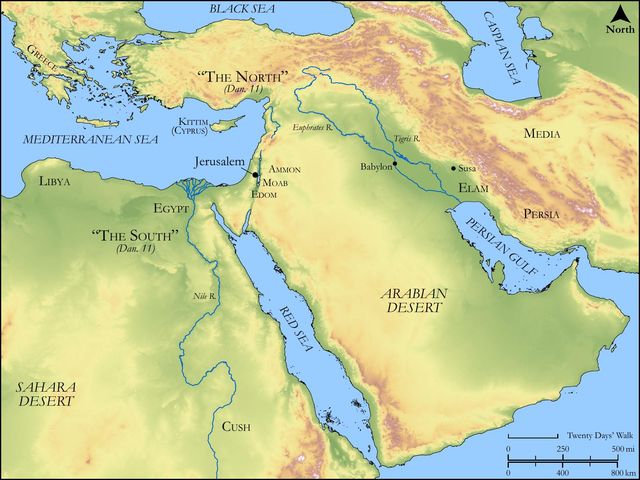
The place where that was laid was in Shushan the palace, one of the royal seats of the kings of Persia, situated on the banks of the river Ulai, which surrounded the city; it was in the province of Elam, that part of Persia which lay next to Babylon. Daniel was not there in person, for he was now in Babylon, a captive, in some employment under Belshazzar, and might not go to such a distant country, especially being now an enemy's country. But he was there in vision; as Ezekiel, when a captive in Babylon, was often brought, in the spirit, to the land of Israel. Note, The soul may be a liberty when the body is in captivity; for, when we are bound, the Spirit of the Lord is not bound. The vision related to that country, and therefore there he was made to fancy himself to be as strongly as if he had really been there.
III.The vision itself and the process of it.
1.He saw a ram with two horns, Dan 8:3. This was the second monarchy, of which the kingdoms of Media and Persia were the two horns. The horns were very high; but that which came up last was the higher, and got the start of the former. So the last shall be first, and the first last. The kingdom of Persia, which rose last, in Cyrus, became more eminent than that of the Medes.
2.He saw this ram pushing all about him with his horns (Dan 8:4), westward (towards Babylon, Syria, Greece, and Asia the less), northward (towards the Lydians, Armenians, and Scythians), and southward (towards Arabia, Ethiopia, and Egypt), for all these nations did the Persian empire, one time or other, make attempts upon for the enlarging of their dominion. And at last he became so powerful that no beasts might stand before him. This ram, though of a species of animal often preyed upon, became formidable even to the beasts of prey themselves, so that there was no standing before him, no escaping him, none that could deliver out of his hand, but all must yield to him: the kings of Persia did according to their will, prospered in all their ways abroad, had an uncontrollable power at home, and became great. He thought himself great because he did what he would; but to do good is that which makes men truly great.
3.He saw this ram overcome by a he-goat. He was considering the ram (wondering that so weak an animal should come to be so prevalent) and thinking what would be the issue; and, behold, a he-goat came, Dan 8:5. This was Alexander the Great, the son of Philip king of Macedonia. He came from the west, from Greece, which lay west from Persia. He fetched a great compass with his army: he came upon the face of the whole earth; he did in effect conquer the world, and then sat down and wept because there was not another world to be conquered. Unus Pellaeo juveni non sufficit orbis - One world was too little for the youth of Pellae. This he-goat (a creature famed for comeliness in going, Pro 30:31) went on with incredible swiftness, so that he touched not the ground, so lightly did he move; he rather seemed to fly above the ground than to go upon the ground; or none touched him in the earth, that is, he met with little or no opposition. This he-goat, or buck, had a notable horn between his eyes, like a unicorn. He had strength, and knew his own strength; he saw himself a match for all his neighbours. Alexander pushed his conquests on so fast, and with so much fury, that none of the kingdoms he attacked had courage to make a stand, or give check to the progress of his victorious arms. In six years he made himself master of the greatest part of the then known world. Well might he be called a notable horn, for his name still lives in history as the name of one of the most celebrated commanders in war that ever the world knew. Alexander's victories and achievements are still the entertainment of the ingenious. This he-goat came to the ram that had two horns, Dan 8:6. Alexander with his victorious army attacked the kingdom of Persia, an army consisting of no more than 30,000 foot and 5000 horse. He ran unto him, to surprise him ere he could get intelligence of his motions, in the fury of his power. He came close to the ram. Alexander with his army came up with Darius Codomannus, then emperor of Persia, being moved with choler against him, Dan 8:7. It was with the greatest violence that Alexander pushed on his war against Darius, who, though he brought vast numbers into the field, yet, for want of skill, was an unequal match for him, so that Alexander was too hard for him whenever he engaged him, smote him, cast him down to the ground, and stamped upon him, which three expressions, some think, refer to the three famous victories that Alexander obtained over Darius, at Granicus, at Issus, and at Arbela, by which he was at length totally routed, having, in the last battle, had 600,000 men killed, so that Alexander became absolute master of all the Persian empire, broke his two horns, the kingdoms of Media and Persia. The ram that had destroyed all before him (Dan 8:4) now is himself destroyed; Darius has no power to stand before Alexander, not has he any friends or allies to help to deliver him out of his hand. Note, Those kingdoms which, when they had power, abused it, and, because none could oppose them, withheld not themselves from the doing of any wrong, may expect to have their power at length taken from them, and to be served in their own kind, Isa 33:1.
4.He saw the he-goat made hereby very considerable; but the great horn, that had done all this execution, was broken, Dan 8:8. Alexander was about twenty years old when he began his wars. When he was about twenty-six he conquered Darius, and became master of the whole Persian empire; but when he was about thirty-two or thirty-three years of age, when he was strong, in his full strength, he was broken. He was not killed in war, in the bed of honour, but died of a drunken surfeit, or, as some suspect, by poison and left no child living behind him to enjoy that which he had endlessly laboured for, but left a lasting monument of the vanity of worldly pomp and power, and their insufficiency to make a man happy.
5.He saw this kingdom divided into four parts, and that instead of that one great horn there came up four notable ones, Alexander's four captains, to whom he bequeathed his conquests; and he had so much that, when it was divided among four, they had each of them enough for any one man. These four notable horns were towards the four winds of heaven, the same with the four heads of the leopard (Dan 7:6), the kingdoms of Syria and Egypt, Asia and Greece - Syria lying to the east, Greece to the west, Asia Minor to the north, and Egypt to the south. Note, Those that heap up riches know not who shall gather them, nor whose all those things shall be which they have provided.
6.He saw a little horn which became a great persecutor of the church and people of God; and this was the principal thing that was intended to be shown to him in this vision, as afterwards, Dan 11:30, etc. All agree that this was Antiochus Epiphanes (so he called himself) - the illustrious, but others called him Antiochus Epimanes - Antiochus the furious. He is called here (as before, Dan 7:8), a little horn, because he was in his original contemptible; there were others between him and the kingdom, and he was of a base servile disposition, had nothing in him of princely qualities, and had been for some time a hostage and prisoner at Rome, whence he made his escape, and, though, the youngest brother, and his elder living, got the kingdom. He waxed exceedingly great towards the south, for he seized upon Egypt, and towards the east, for he invaded Persia and Armenia. But that which is here especially taken notice of is the mischief that he did to the people of the Jews. They are not expressly named, or prophecies must not be too plain; but they are here so described that it would be easy for those who understood scripture-language to know who were meant; and the Jews, having notice of this before, might be awakened to prepare themselves and their children beforehand for these suffering trying times.
(1.)He set himself against the pleasant land, the land of Israel, so called because it was the glory of all lands, for fruitfulness and all the delights of human life, but especially for the tokens of God's presence in it, and its being blessed with divine revelations and institutions; it was Mount Zion that was beautiful for situation, the joy of the whole earth, Psa 48:2. The pleasantness of that land was that there the Messiah was to be born, who would be both the consolation and the glory of his people Israel. Note, We have reason to reckon that a pleasant place which is a holy place, in which God dwells, and where we may have opportunity of communing with him. Surely, It is good to be here.
(2.)He fought against the host of heaven, that is, the people of God, the church, which is the kingdom of heaven, the church-militant here on earth. The saints, being born from above, and citizens of heaven, and doing the will of God, by his grace, in some measure, as the angels of heaven do it, may be well called a heavenly host. Or the priests and Levites, who were employed in the service of the tabernacle, and there warred a good warfare, were this host of heaven. These Antiochus set himself against; he waxed great to the host of heaven, in opposition to them and in defiance of them.
(3.)He cast down some of the host (that is, of the stars, for they are called the host of heaven) to the ground, and stamped upon them. Some of those that were most eminent both in church and state, that were burning and shining lights in their generation, he either forced to comply with his idolatries or put them to death; he got them into his hands, and then trampled upon them and triumphed over them; as good old Eleazar, and the seven brethren, whom he put to death with cruel tortures, because they would not eat swine's flesh, 2 Macc. 6:7. He gloried in it that herein he insulted Heaven itself and exalted his throne above the stars of God, Isa 14:13.
(4.)He magnified himself even to the prince of the host. He set himself against the high priest, Onias, whom he deprived of his dignity, or rather against God himself, who was Israel's King of old, who reigns for ever Zion's King, who himself heads his own host that fight his battles. Against him Antiochus magnified himself; as Pharaoh, when he said, Who is the Lord? Note, Those who persecute the people of God persecute God himself.
(5.)He took away the daily sacrifice. The morning and evening lamb, which God appointed to be offered every day upon his altar to his honour, Antiochus forbade and restrained the offering of. No doubt he took away all other sacrifices, but only the daily sacrifice is mentioned, because that was the greatest loss of all, for in that they kept up their constant communion with God, which they preferred before that which is only occasional. God's people reckon their daily sacrifices, their morning and evening exercises of devotion, the most needful of their daily business and the most delightful of their daily comforts, and would not for all the world part with them.
(6.)He cast down the place of his sanctuary. He did not burn and demolish the temple, but he cast it down, when he profaned it, made it the temple of Jupiter Olympius, and set up his image in it. He also cast down the truth to the ground, trampled upon the book of the law, that word of truth, tore it, and burnt it, and did what he could to destroy it quite, that it might be lost and forgotten for ever. These were the projects of that wicked prince. In these he practised. And (would you think it?) in these he prospered. He carried the matter very far, seemed to have gained his point, and went near to extirpate that holy religion which God's right hand had planted. But lest he or any other should triumph, as if herein he had prevailed against God himself and been too hard for him, the matter is here explained and set in a true light.
[1.]He could not have done this if God had not permitted him to do it, could have had no power against Israel unless it had been given him from above. God put this power into his hand, and gave him a host against the daily sacrifice. God's providence put that sword into his hand by which he was enabled thus to bear down all before him. Note, We ought to eye and own the hand of God in all the enterprises and all the successes of the church's enemies against the church. They are but the rod in God's hand.
[2.]God would not have permitted it if his people had not provoked him to do so. It is by reason of transgression, the transgression of Israel, to correct them for that, that Antiochus is employed to give them all this trouble. Note, When the pleasant land and all its pleasant things are laid waste, it must be acknowledged that sin is the procuring cause of all the desolation. Who gave Jacob to the spoil? Did not the Lord, he against whom we have sinned? Isa 42:24. The great transgression of the Jews after the captivity (when they were cured of idolatry) was a contempt and profanation of the holy things, snuffing at the service of God, bringing the torn and the lame for sacrifice, as if the table of the Lord were a contemptible thing (so we find Mal 1:7, Mal 1:8, etc., and that the priests were guilty of this Mal 2:1, Mal 2:8), and therefore God sent Antiochus to take away the daily sacrifice and cast down the place of his sanctuary. Note, It is just with God to deprive those of the privileges of his house who despise and profane them, and to make those know the worth of ordinances by the want of them who would not know it by the enjoyment of them.
7.He heard the time of this calamity limited and determined, not the time when it should come (that is not here fixed, because God would have his people always prepared for it), but how long it should last, that, when they had no more any prophets to tell them how long (Psa 74:9, which psalm seems to have been calculated for this dark and doleful day), they might have this prophecy to give them a prospect of deliverance in due time. Now concerning this we have here,
(1.)The question asked concerning it, Dan 8:13. Observe [1.] By whom the question was put: I heard one saint speaking to this purport, and then another saint seconded him. "O that we knew how long this trouble will last!" The angels here are called saints, for they are holy ones (Dan 4:13), the holy myriads, Jde 1:14. The angels concern themselves in the affairs of the church, and enquire concerning them, if, as here, concerning its temporal salvations, much more do they desire to look into the great salvation, Pe1 1:12. One saint spoke of the thing, and another enquired concerning it. Thus John, who lay in Christ's bosom, was beckoned to by Peter to ask Christ a question, Joh 13:23, Joh 13:24. [2.] To whom the question was put. He said unto Palmoni that spoke. Some make this certain saint to be a superior angel who understood more than the rest, to whom therefore they came with their enquiries. Others make it to be the eternal Word, the Son of God. He is the unknown One. Palmoni seems to be compounded of Peloni Almoni, which is used (Rut 4:1) for Ho, such a one, and (Kg2 6:8) for such a place. Christ was yet the nameless One. Wherefore asked thou after my name, seeing it is secret? Jdg 13:18. He is the numberer of secrets (as some translate it), for from him there is nothing hidden - the wonderful numberer, so others; his name is called Wonderful. Note, If we would know the mind of God, we must apply to Jesus Christ, who lay in the bosom of the Father, and in whom are hidden all the treasures of wisdom and knowledge, not hidden from us, but hidden for us. [3.] The question itself that was asked: "How long shall be the vision concerning the daily sacrifice? How long shall the prohibition of it continue? How long shall the pleasant land be made unpleasant by that severe interdict? How long shall the transgression of desolation (the image of Jupiter), that great transgression which makes all our sacred things desolate, how long shall that stand in the temple? How long shall the sanctuary and the host, the holy place and the holy persons that minister in it, be trodden under foot by the oppressor?" Note, Angels are concerned for the prosperity of the church on earth and desirous to see an end of its desolations. The angels asked, for the satisfaction of Daniel, not doubting but he was desirous to know, how long these calamities should last? The question takes it for granted that they should not last always. The rod of the wicked shall not rest upon the lot of the righteous, though it may come upon their lot. Christ comforted himself in his sufferings with this, The things concerning me have an end (Luk 22:37), and so may the church in hers. But it is desirable to know how long they shall last, that we may provide accordingly.
(2.)The answer given to this question, Dan 8:14. Christ gives instruction to the holy angels, for they are our fellow-servants; but here the answer was given to Daniel, because for his sake the question was asked: He said unto me. God sometimes gives in great favours to his people, in answer to the enquiries and requests of their friends for them. Now,
[1.]Christ assures him that the trouble shall end; it shall continue 2300 days and no longer, so many evenings and mornings (so the word is), so many nuchthēmerai, so many natural days, reckoned, as in the beginning of Genesis, by the evenings and mornings, because it was the evening and the morning sacrifice that they most lamented the loss of, and thought the time passed very slowly while they were deprived of them. Some make the morning and the evening, in this number, to stand for two, and then 2300 evenings and as many mornings will make but 1150 days; and about so many days it was that the daily sacrifice was interrupted: and this comes nearer to the computation (Dan 7:25) of a time, times, and the dividing of a time. But it is less forced to understand them of so many natural days; 2300 days make six years and three months, and about eighteen days; and just so long they reckon from the defection of the people, procured by Menelaus the high priest in the 142nd year of the kingdom of the Seleucidae, the sixth month of that year, and the 6th day of the month (so Josephus dates it), to the cleansing of the sanctuary, and the reestablishment of religion among them, which was in the 148th year, the 9th month, and the 25th day of the month, 1 Macc. 4:52. God reckons the time of his people's afflictions he is afflicted. Rev 2:10, Thou shalt have tribulation ten days.
[2.]He assures him that they shall see better days afterwards: Then shall the sanctuary be cleansed. Note, The cleansing of the sanctuary is a happy token for good to any people; when they begin to be reformed they will soon be relieved. Though the righteous God may, for the correction of his people, suffer his sanctuary to be profaned for a while, yet the jealous God will, for his own glory, see to the cleansing of it in due time. Christ died to cleanse his church, and he will so cleanse it as at length to present it blameless to himself.
Historical interpretation
Four Centuries of Reception
3 surviving comments on this verse. Each one is dated, so this reads as a timeline rather than a list.
Select a marker to jump to its quote. Markers stagger vertically where authors wrote within a few decades of each other.
Verse 2. "I saw in my vision while I was in the castle of Susa, which is in the region of Elam" (Vulgate: "city of Elam"). Or else we may render, as Symmachus has translated it, "...in the city of Elam," from which of course the region took its name, just as the Babylonians were named from Babylon. So also the Elamites were thus named from Elam, in consequence of which the Septuagint translates it: "the region of Elamais." And Susis is the chief city of the region of the Elamites, and there, according to Josephus' account, Daniel erected a lofty tower fashioned of square blocks of marble, and of such outstanding beauty that it seems newly built even up to the present day. There also the remains of the kings of the Persians and Medes lie buried, and the custodian or sacristan and priest of that locality is a Jew. "While I was in the castle at Susa..." Not that the city itself is a castle, for as we have stated, it is a chief city of great power; but rather that the city is so solidly built that it looks like a castle.
"And I saw in the vision that I was over the gate of Ulai." Instead of this Aquila translated:"...over the Ubal of Ulai"; Theodotion rendered: "above Ubal"; Symmachus: "above the swamp of Ulai"; the Septuagint: "above the gate of Ulai." But it should be understood that Ulai is the name of a place, or else of a gate, just as there was in Troy a gate called the Skaia, and among the Romans there is one called Carmentalis. In each case the name has originated from special circumstances.
“I saw in a vision” means I was not awake, nor did I see it during the day: the God of all showed it to me in a dream.
That is, before the vestibule and the gate where the river Ulai passed, that is, the gate that opens on the river Ulai.
Continue studying Daniel 8:2 across the web’s major study libraries — every link below opens this exact verse, chapter, or book on the destination site.
Read & Compare
 BibleGatewayThis verse in more than 200 translations and 70 languages.
 Bible.comThe YouVersion reader — hundreds of translations, reading plans, and highlights.
 ESV.orgCrossway's official English Standard Version reader.
 NET BibleThe NET translation with 60,000+ translators' notes on every rendering decision.
 STEP BibleTyndale House's free study tool — original text, vocabulary, and scholarly resources.
 BibliaLogos Bible Software's free web reader.
 USCCBThe New American Bible (Revised Edition) with the U.S. bishops' study notes.
Commentaries
 BibleHub CommentariesDozens of classic commentaries on this verse, gathered on one page.
 StudyLightMore than 100 commentary sets — the largest collection on the web.
 BibleRefPlain-English commentary on what this verse means, verse by verse.
 Enduring WordDavid Guzik's free commentary on this chapter, widely used by Bible teachers.
 Bible Study ToolsVerse commentary alongside Greek and Hebrew study aids.
Original Language & Research
- BibleHub InterlinearThe verse word by word — original language, transliteration, and English.
- BibleHub LexiconEvery word's original-language definition and Strong's entry.
 Blue Letter BibleDeep-study tools — Strong's numbers, concordance, and word studies.
 SefariaThe Hebrew text with Rashi and centuries of Jewish commentary.
Sermons, Hymns & Audio


TrulyRandomVerse is not affiliated with these sites and doesn’t control their content. They’re linked because they’re genuinely useful.
Summary
Daniel 8:2 inaugurates a profound prophetic vision, detailing the prophet's supernatural relocation to a precise geographical setting to receive a divine revelation concerning the succession of future empires. This verse establishes the authenticity and divine origin of the vision by emphasizing Daniel's repeated "seeing in a vision" and firmly anchors the unfolding prophecy within a tangible historical and geographical context: the ancient city of Shushan, situated within the province of Elam, specifically by the river Ulai. This meticulous setting prepares the reader for the detailed prophecies of the Medo-Persian and Greek empires that follow, powerfully highlighting God's sovereign control over nations and the course of human history.
Context
ShowHideLiterary Context
Daniel 8:2 immediately follows the conclusion of Daniel's vision of the four beasts in Daniel 7, which broadly depicted the succession of world empires culminating in the eternal kingdom of God. Chapter 8 shifts to a more focused and detailed prophecy concerning two specific empires—Medo-Persia and Greece—represented by a ram and a goat. The opening verse of chapter 8, "In the third year of the reign of King Belshazzar a vision appeared to me, Daniel, after that which appeared to me at the first," sets the chronological and thematic stage, indicating that the vision introduced in verse 2 is a distinct, yet related, divine communication. Thus, Daniel 8:2 serves as the precise geographical and experiential introduction to this new, highly detailed prophetic sequence, grounding the supernatural within a concrete, verifiable location before the symbolic imagery begins to unfold.
Historical & Cultural Context
At the time of this vision (c. 550-548 BC), Daniel was likely still in Babylon, serving under the waning Neo-Babylonian Empire. The Medo-Persian Empire, which would soon conquer Babylon, was rapidly rising to prominence. The city of Shushan (Susa), mentioned in the verse, was an ancient city in the Elamite region, located east of Babylon. Historically, it had served as a capital of the Elamite kingdom and would later become one of the prominent capital cities of the Persian Empire under Cyrus the Great and Darius I, known for its strategic importance on vital trade routes and its fertile plains. The river Ulai (or Eulaeus) was a significant waterway flowing near Shushan, providing essential water and facilitating transport. Daniel's supernatural placement in Shushan, a future capital of the empire that would succeed Babylon, is highly significant, as the vision itself concerns the rise and fall of the Medo-Persian and Greek empires, directly linking the prophetic content to its historical fulfillment in a geographically relevant setting.
Key Themes
ShowHideThis verse contributes significantly to several overarching themes within the book of Daniel. Firstly, it powerfully reiterates the theme of Divine Revelation and Sovereignty, emphasizing that God directly communicates His plans for human history to His chosen servants. The repeated phrase "I saw in a vision" underscores that this knowledge is not human speculation but divinely imparted truth, a concept echoed in Amos 3:7. Secondly, the precise geographical details of Shushan, Elam, and the Ulai river highlight the theme of Historical Specificity and Fulfillment. By anchoring the vision in real-world locations, the prophecy gains credibility and prepares the reader for its literal historical outworking, demonstrating God's meticulous control over the rise and fall of nations, as seen in Daniel 2:21. Finally, the verse subtly introduces the theme of Prophetic Foreshadowing, as Daniel is placed in the future capital of the Medo-Persian Empire, which is the primary subject of the vision that immediately follows, setting the stage for the detailed symbolic narrative of the ram and the goat in Daniel 8:3-8.
Exposition and Analysis
ShowHideKey Word Analysis
ShowHideA primitive root meaning "to see," literally or figuratively. In this context, it denotes a direct visual perception of a divine manifestation, emphasizing the active reception of a prophetic revelation rather than a passive dream. The repetition of this verb ("And I saw... when I saw... and I saw") intensifies the reality and vividness of Daniel's experience, underscoring the authenticity and clarity of the vision's divine origin.
Derived from the root "to see," this noun refers to a sight, specifically a prophetic revelation, dream, or oracle. It signifies a divinely granted insight into future events or spiritual realities, often accompanied by a profound spiritual experience. The use of châzôwn here distinguishes Daniel's experience from ordinary dreams, marking it as an authoritative, God-given revelation that demands attention and belief.
A proper noun referring to the city of Susa, a significant ancient city in Persia. Its mention here is crucial for grounding the vision geographically and historically. Shushan was one of the capital cities of the Achaemenid Persian Empire, directly linking the setting of Daniel's vision to the empire that would soon dominate the ancient Near East and be a primary subject of the prophecy in Daniel 8. This specific detail enhances the prophecy's credibility and foreshadows its historical fulfillment.
Verse Breakdown
ShowHide"And I saw in a vision; and it came to pass, when I saw"
This opening phrase immediately establishes the supernatural nature of Daniel's experience. The repetition of "I saw" (Hebrew, râʼâh) and the explicit mention of "in a vision" (Hebrew, châzôwn) serve to emphasize the divine origin and authoritative character of the revelation. This is not a dream or a mere thought, but a direct, divinely orchestrated perception of future events, underscoring the reliability and certainty of the prophecy that follows.
"that I [was] at Shushan [in] the palace, which [is] in the province of Elam"
This clause provides the precise geographical setting for Daniel's visionary experience. While Daniel was physically in Babylon, he was supernaturally transported in his vision to Shushan (Susa), a future capital of the Persian Empire. The "palace" (Hebrew, bîyrâh, H1002) suggests a place of royal authority and significance, further highlighting the political and historical relevance of the location. Shushan's placement within the "province of Elam" (Hebrew, mᵉdîynâh, H4082, and ʻÊylâm, H5867) anchors the vision in a verifiable, historically significant region, emphasizing the tangible reality of the empires God would reveal.
"and I saw in a vision, and I was by the river of Ulai"
This final clause reiterates the visionary nature of the experience and further refines the geographical location within Shushan. The repetition of "I saw in a vision" reinforces the divine source and the prophet's active reception of it. Being "by the river of Ulai" (Hebrew, ʼûwbâl, H180, and ʼÛwlay, H195) adds another layer of specific detail, making the setting even more concrete and verifiable. This precision in location serves to authenticate the prophecy, linking the symbolic vision to real-world geography where future events would unfold, lending credibility to the extraordinary divine communication.
Literary Devices
ShowHideDaniel 8:2 employs several key literary devices to underscore the significance of the vision. The most prominent is Repetition, with the phrase "I saw in a vision" appearing twice. This repetition serves to emphasize the divine origin and supernatural nature of Daniel's experience, affirming that the revelation is not a product of human imagination but a direct, authoritative communication from God. This also lends a sense of urgency and importance to the vision. Setting is another crucial device; the meticulous naming of Shushan, Elam, and the Ulai river provides a concrete and historically verifiable backdrop for the abstract prophetic imagery that follows. This precise geographical detail functions as Foreshadowing, as Shushan would become a key capital of the Persian Empire, the very empire that forms the initial focus of the vision. The detailed geographical description also serves as a form of Realism, grounding the extraordinary supernatural event in a tangible, recognizable world, thereby enhancing the prophecy's credibility and its connection to actual historical unfolding.
Theological and Thematic Connections
ShowHideDaniel 8:2 powerfully testifies to God's absolute sovereignty over human history and His meticulous plan for the ages. It reveals that God is not a distant deity but one who actively intervenes in the affairs of nations, orchestrating their rise and fall according to His divine purpose. The detailed geographical setting underscores that God's prophecies are not vague pronouncements but precise declarations with real-world implications and historical fulfillment. This verse invites believers to trust in God's overarching plan, even when world events seem chaotic, knowing that He holds the future in His hands and graciously reveals His secrets to His servants. It instills confidence that God's Word is reliable and His purposes will ultimately prevail.
Reflection and Application
ShowHideDaniel 8:2 reminds us that God is actively engaged in the unfolding of history, even amidst political turmoil and shifting empires. For Daniel, a captive in a foreign land, this vision provided profound assurance of God's continued control and His ultimate plan for the nations. For us today, this verse offers immense comfort and a compelling call to faith. It encourages us to look beyond the immediate circumstances of our world—the conflicts, the political shifts, the uncertainties—and to recognize that a sovereign God is meticulously at work, orchestrating events according to His eternal purposes. This divine perspective liberates us from anxiety and empowers us to live with steadfast hope, knowing that God's Word is true and His promises will be fulfilled. It also challenges us to be attentive to how God reveals His truth, whether through the inspired Scriptures, through prayer, or through the unfolding of history itself, and to respond with obedience, trust, and a willingness to participate in His divine plan.
Questions for Reflection
ShowHideFAQ
ShowHideWhy was Daniel supernaturally transported to Shushan in the vision, rather than remaining in Babylon?
ShowHideDaniel's supernatural transportation to Shushan (Susa) in the vision is highly symbolic and prophetically significant. While he was physically in Babylon, Shushan was destined to become one of the capital cities of the Medo-Persian Empire, which is the primary focus of the vision in Daniel 8. By placing Daniel in this future capital, the vision immediately connects the prophetic revelation to the specific geographical and political context of the empires it describes. It emphasizes the historical accuracy and future fulfillment of the prophecy, grounding the supernatural experience in real-world locations that would be central to the unfolding events. This detail serves to authenticate the vision and underscore God's precise knowledge of future history, demonstrating that His plans are anchored in the tangible realities of human geopolitical shifts.
Christ-Centered Fulfillment
ShowHideWhile Daniel 8:2 directly sets the stage for visions of earthly empires, its underlying theme of divine revelation and God's sovereign control over history finds its ultimate and most profound fulfillment in Jesus Christ. The "vision" Daniel received, a direct insight into God's future plans, foreshadows the ultimate revelation of God in the person of Jesus, who is the very Word of God made flesh (John 1:14). Just as Daniel was supernaturally placed in Shushan to witness future events, so too did God, in the fullness of time, send His Son into the world at a specific historical and geographical juncture to accomplish His redemptive plan (Galatians 4:4). The temporary empires Daniel saw rise and fall ultimately point to the eternal, unshakable kingdom of God established by Christ, a kingdom that will never be destroyed but will stand forever (Daniel 2:44). Jesus, as the "Alpha and the Omega," is the one who holds all history in His hands, bringing God's prophetic purposes to their glorious culmination and ensuring that every knee will bow and every tongue confess His Lordship (Revelation 1:8 and Philippians 2:10-11). Thus, Daniel's vision, grounded in a specific earthly location, ultimately points beyond earthly kingdoms to the universal and everlasting reign of the Lamb of God.