


Isaiah 42:24
Bible text: King James Version (1769 Blayney text) · Public domain
Bible text: King James Version with Strong's numbers · Public domain
Bible text: Berean Standard Bible · Public domain
Bible text: American Standard Version (1901) · Public domain
Bible text: World English Bible, Messianic edition · Public domain
Bible text: Geneva Bible (1599) · Public domain
Bible text: Young's Literal Translation · Public domain
- מִיmiwho?H4310InterrogPronoun Interrogative
- נָתַןna·Tanhas he givenH5414V-Qal-Perf-3msVerb Qal Perfect 3rd Singular Masculine
- לִמְשִׁסָּהlim·sho·sehto plunderH4933Prep-l ¦ N-fsNoun Singular Feminine Absoluteלִtoמְשִׁסָּהplunder
- יַעֲקֹבya·'a·KoJacobH3290N-proper-mNoun Proper Masculine
- וְיִשְׂרָאֵלve·Yis·ra·'Eland IsraelH3478Conj-w ¦ N-properNoun Proper LocationוְandיִשְׂרָאֵלIsrael
- לְבֹזְזִיםle·vo·ze·Zimto despoilersH962Prep-l ¦ V-Qal-Prtcpl-mpVerb Qal Participle Plural Masculine Absoluteלְtoבֹזְזִיםdespoilers
- הֲלוֹאha·Lo'¿ notH3808Interrog ¦ NegParticle Negativeהֲ¿לוֹאnot
- יְהוָהYah·weh[was it] YahwehH3068N-properNoun Proper Title
- זוּzuwhomH2098RelParticle Relative
- חָטָאנוּcha·Ta·nuwe have sinnedH2398V-Qal-Perf-1cpVerb Qal Perfect 1st Plural common gender
- לוֹloto himPrep-l ¦ 3msSuffix Personal 3rd Singular Masculineלtoוֹhim
- וְלֹאve·lo'and notH3808Conj-w ¦ NegParticle Negativeוְandלֹאnot
- אָבוּ'a·Vuthey were willingH14V-Qal-Perf-3cpVerb Qal Perfect 3rd Plural common gender
- בִדְרָכָיוvid·ra·Khavin his waysH1870Prep-b ¦ N-mpc ¦ 3msNoun Plural Masculine Constructבִinדְרָכָיwaysוhis
- הָלוֹךְha·Lokhto walkH1980V-Qal-InfAbsVerb Qal Infinitive Absolute
- וְלֹאve·Lo'and notH3808Conj-w ¦ NegParticle Negativeוְandלֹאnot
- שָׁמְעוּsha·me·'Uthey listenedH8085V-Qal-Perf-3cpVerb Qal Perfect 3rd Plural common gender
- בְּתוֹרָתוֹbe·to·ra·Toto his lawH8451Prep-b ¦ N-fsc ¦ 3msNoun Singular Feminine Constructבְּtoתוֹרָתlawוֹhis
English is a literal word-by-word gloss of the Hebrew, not the KJV's wording. Why?
This is the original text the KJV's translators worked from — each Hebrew word with its own literal English meaning in this verse, prepared by scholars at Tyndale House, Cambridge. The KJV translates whole sentences, not word by word, so its wording differs: one Hebrew word can become several English words, and the KJV may choose “the LORD” where the gloss reads “Yahweh”. Both are faithful — they answer different questions. For the KJV's own rendering, switch to the KJV text.
Details
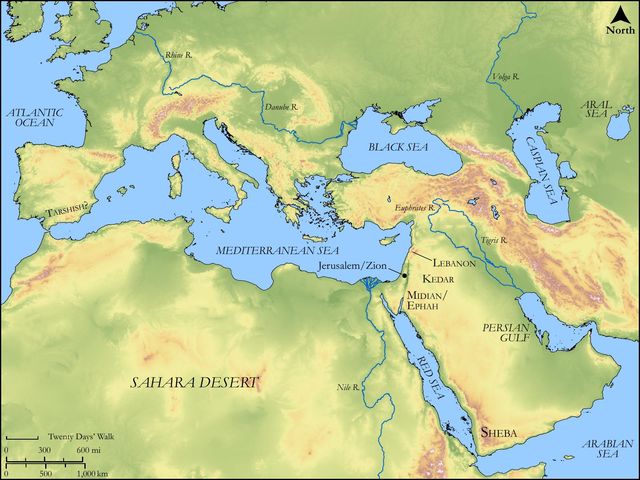
See on the biblical-era map
Study this verse
Public-domain commentary
Matthew Henry
From his Commentary on the Whole Bible. Henry comments on passages, not single verses — this entry covers Isaiah 42:18–25. His three-level outline is real structure in the source text, so it is rendered as structure.
The prophet, having spoken by way of comfort and encouragement to the believing Jews who waited for the consolation of Israel, here turns to those among them who were unbelieving, for their conviction and humiliation. Among those who were in captivity in Babylon there were some who were as the evil figs in Jeremiah's vision, who were sent thither for their hurt, to be removed into all the kingdoms of the earth, for a reproach and a proverb, Jer 24:9. In them there was a type of the Jews who rejected Christ and were rejected by him, and then fell more than ever under the curse, when those who believed were inheriting the blessing; for they were broken, and ruined, and remain dispersed unto this day. Observe,
I.The call that is given to this people (Isa 42:18):
"Hear, you deaf, and attend to the joyful sound, and look you blind, that you may see the joyful light." There is no absurdity in this command, nor is it unbecoming the wisdom and goodness of God to call us to do that good which yet of ourselves we are not sufficient for; for those have natural powers which they may employ so as to do better than they do, and may have supernatural grace if it be not their own fault, who yet labour under a moral impotency to that which is good. This call to the deaf to hear and the blind to see is like the command given to the man that had the withered hand to stretch it forth; though he could not do this, because it was withered, yet, if he had not attempted to do it, he would not have been healed, and his being healed thereupon was owing, not to his act, but to the divine power.
II.The character that is given of them (Isa 42:19, Isa 42:20):
Who is blind, but my servant, or deaf as my messenger? The people of the Jews were in profession God's servants, and their priests and elders his messengers (Mal 2:7); but they were deaf and blind. The verse before may be understood as spoken to the Gentile idolaters, whom he calls deaf and blind, because they worshipped gods that were so. "But," says he, "no wonder you are deaf and blind when my own people are as bad as you, and many of them as much set upon idolatry."
1.He complains of their sottishness - they are blind; and of their stubbornness - they are deaf. They were even worse than the Gentiles themselves. Corruptio optimi est pessima - What is best becomes, when corrupted, the worst. "Who is so wilfully, so scandalously, blind and deaf as my servant and my messenger, as Jacob who is my servant (Isa 41:8), and as their prophets and teachers who are my messengers? Who is blind as he that in profession and pretension is perfect, that should come nearer to perfection than other people, their priests and prophets? The one prophesies falsely, and the other bears rule by their means; and who so blind as those that will not see when they have the light shining in their faces?" Note,
(1.)It is a common thing, but a very sad thing, for those that in profession are God's servants and messengers to be themselves blind and deaf in spiritual things, ignorant, erroneous, and very careless.
(2.)Blindness and deafness in spiritual things are worse in those that profess themselves to be God's servants and messengers than in others. It is in them the greater sin and shame, the greater dishonour to God, and to themselves a greater damnation.
2.The prophet goes on (Isa 42:20) to describe the blindness and obstinacy of the Jewish nation, just as our Saviour describes it in his time (Mat 13:14, Mat 13:15): Seeing many things, but thou observest not. Multitudes are ruined for want of observing that which they cannot but see; they perish, not through ignorance, but mere carelessness. The Jews in our Saviour's time saw many proofs of his divine mission, but they did not observe them; they seemed to open their ears to him, but they did not hear, that is, they did not heed, did not understand, or believe, or obey, and then it was all one as if they had not heard.
III.The care God will take of the honour of his own name, notwithstanding their blindness and deafness, especially of his word, which he has magnified above all his name. Shall the unbelief and obstinacy of men make the promise of God of no effect? God forbid, Rom 3:3, Rom 3:4. No, though they are blind and deaf, God will be no loser in his glory (Isa 42:21): The Lord is well pleased for his righteousness' sake; not well pleased with their sin, but well pleased in the manifestation of his own righteousness, in rejecting them for rejecting the great salvation. He speaks as one well pleased, Isa 1:24 : Ah! I will ease me of my adversaries; and Eze 5:13, I will be comforted. The scripture was fulfilled in the casting off of the Jews as well as in the calling in of the Gentiles, and therein the Lord will be well pleased. He will magnify the law (divine revelation in all the parts of it) and will make it honourable. The law is truly honourable, and the things of it are great things; and, if men will not magnify it by their obedience to it, God will magnify it himself by punishing them for their disobedience. He will magnify the law by accomplishing what is written in it, will magnify its authority, its efficacy, its equity. He will do it at last, when all men shall be judged by the law of liberty, Jam 2:12. He is doing it every day. What is it that God is doing in the world, but magnifying the law and making it honourable?
IV.The calamities God will bring upon the Jewish nation for their wilful blindness and deafness, Isa 42:22.
They are robbed and spoiled. Those that were impenitent and unreformed in Babylon were sentenced to perpetual captivity. It was for their sins that they were spoiled of all their possessions, not only in their own land, but in the land of their enemies. They were some of them snared in holes, and others hidden in prison-houses. They cannot help themselves, for they are snared. Their friends cannot help them, for they are hidden; and their enemies have forgotten them in their prisons. They, and all they have, are for a prey and for a spoil; and there is none that delivers either by force or ransom, nor any that dares say to the proud oppressors, Restore. There they lie, and there they are likely to lie. This had its full accomplishment in the final destruction of the Jewish nation by the Romans, which God brought upon them for rejecting the gospel of Christ.
V.The counsel given them in order to their relief; for, though their case be sad, it is not desperate.
1.The generality of them are deaf; they will not hearken to the voice of God's word. He will therefore try his rod, and see who among them will give ear to that, Isa 42:23. We must not despair concerning those who have been long reasoned with in vain; some of them may, at length, give ear and hearken. If one method not take effect, another may, and sinners shall be left inexcusable. Observe,
(1.)We may all of us, if we will, hear the voice of God, and we are called and invited to hear it.
(2.)It is worth while to enquire who they are that perceive God speaking to them and are willing to hear him.
(3.)Of the many that hear the voice of God there are very few that hearken to it or heed it, that hear it with attention and application.
(4.)In hearing the word we must have an eye to the time to come. We must hear for hereafter, for what may occur between us and the grave; we must especially hear for eternity. We must hear the word with another world in our eye.
2.The counsel is, (1.) To acknowledge the hand of God in their afflictions, and, whoever were the instruments, to have an eye to him as the principal agent (Isa 42:24): "Who gave Jacob and Israel, that people that used to have such an interest in heaven and such a dominion on earth, who gave them for a spoil to the robbers, as they are now to the Babylonians and to the Romans? Did not the Lord? You know he did; consider it then, and hear his voice in these judgments." (2.) To acknowledge that they had provoked God thus to abandon them, and had brought all these calamities upon themselves. [1.] These punishments were first inflicted on them for their disobedience to the laws of God: It is he against whom we have sinned; the prophet puts himself into the number of the sinners, As Dan 9:7, Dan 9:8. "We have sinned; we have all brought fuel to the fire; and there are those among us that have wilfully refused to walk in his ways." Jacob and Israel would never have been given up to the robbers if they had not by their iniquities sold themselves. Therefore it is, because they have violated the commands of the law, that God has brought upon them the curses of the law; he has not dropped, but poured upon him the fury of his anger and the strength of battle, all the desolations of war, which have set him on fire round about; for God surrounds the wicked with his favours. See the power of God's anger; there is no resisting it, no escaping it. See the mischief that sin makes; it provokes God to anger against a people, and so kindles a universal conflagration, sets all on fire. [2.] These judgments were continued upon them for their senselessness and incorrigibleness under the rod of God. The fire of God's wrath kindled upon him, and he knew it not, was not aware of it, took no notice of the judgments, at least not of the hand of God in them. Nay, it burned him, and, though he could not then but know it and feel it, yet he laid it not to heart, was not awakened by the fiery rebukes he was under nor at all affected with them. Those who are not humbled by less judgments must expect greater; for when God judges he will overcome.
Historical interpretation
Two Centuries of Reception
4 surviving comments on this verse. Each one is dated, so this reads as a timeline rather than a list.
Select a marker to jump to its quote. Markers stagger vertically where authors wrote within a few decades of each other.
In this part of the Lord’s Prayer, [Christ] shows that the enemy is powerless against us without God’s prior permission. During temptation, consequently, all our fear and devotion and attention should be focused on God, since evil has only such force as he himself permits. … Moreover, evil is given power over us according to our [willful] sins. As Isaiah writes, “Who gave Jacob up to the looters and Israel to the ponderers.” It was the Lord, against whom we sinned, in whose ways we would not walk and whose law we refused to obey. So he unleashed the fury of his anger against us. And again, when Solomon strayed from the precepts and paths of the Lord, it was recorded, “The Lord stirred up Satan against Solomon himself.”
Since God had been addressing people who could not hear him, he now speaks of them as helpless and weak.… For the outcome of the matter was no longer an issue but would be accomplished very soon.… He sent on them the fury of his anger, and battle overtook them. Those who were already wearied by war once more took it on themselves so as to hold on to Jerusalem and their rule over it. But war was unleashed on them, and not only in an external sense but also in that which afflicted their souls.
But Scripture declares that these evils are not by nature made by God but rather come from causes dwelling within humans. Sins against the Lord are the source of trials and pressures of various persecutions that with God’s permission rise up against those sinning, as it is written, “who gives Israel up to the spoil.” Is it not the Lord against whom they sinned and his ways in which they did not want to walk? For Scripture elsewhere states that God did not make evil things. In the book of Genesis, which speaks of the creation of the world, it states that all God made was very good.… So evils are not naturally caused by God’s creating but by human will.
(Verse 18, 19 onwards) The deaf, hear! And the blind, look to see. Who is blind, if not my servant? And who is deaf, if not the one to whom I send my messengers? Who is blind, if not the one who has been sold? And who is blind, if not the servant of the Lord? You who see many things, will you not observe? You who have open ears, will you not hear? And the Lord desired to sanctify him, and to magnify the law, and to exalt it. But the people are plundered and devastated: all the youth are trapped in snares, and hidden in prison houses. They have become a prey, and there is no one to deliver them; a spoil, and no one says, 'Restore them.' Who among you hears this, pays attention, and listens to the future? Who has given Jacob over to plunder, and Israel to the plunderers? Is it not the Lord himself, whom we have sinned against? And they have refused to walk in his ways and have not listened to his law. So he poured out his wrath on them, and the fierceness of battle: and he set them on fire all around, but they did not understand; and he burned them, but they did not comprehend. LXX: Hear, you deaf! Look, you blind, that you may see. Who is blind, but my children? And deaf, but those who rule over them? Who is blind (According to the Complutensian edition of the Septuagint) but he who receives: and the servants of God were made blind. You have seen many things, but you have not observed them: your ears are open, but you do not hear. The Lord God was pleased for the sake of his justice, that he might magnify his law. And I saw, and behold a people is destroyed and taken captive. For there was a snare in the hidden places, and a net over their houses. They have become a prey: and there was no one to deliver the spoil: and there was no one to say, Restore. Who is among you that will hear this, and will consider the future? Who hath given Jacob for a spoil, and Israel to robbers? hath not the LORD, he against whom we have sinned? and they would not walk in his ways, neither would they hearken to his law. And he hath poured out upon him the fury of his anger, and the strength of battle: and it hath set him on fire round about, yet he knew not, and it burned him, yet he laid it not to heart. Lest anyone think that what is said, 'Hear, you deaf; look, you blind,' applies to the Gentile people, who were previously deaf and blind (as the Jews foolishly claim to approve by interpretation), the prophetic speech itself shows that the deaf and blind should be understood. 'Who is blind but my servant, and deaf like the messenger I send? Who is blind like the one in covenant with me, blind like Israel?' Who is blind, but the one who was previously a servant of the Lord? To whom it is said: O Israel, who sees many things, and has many prophets through whom you may know the commandments of God, will you not keep the precepts that have been given to you? You who have open ears, will you not hear what is being said, of which we also read above: You will hear with your ears, and will not understand; and seeing you will see, and will not perceive: for the heart of this people has grown dull (Isa. VI, 9). The Lord, he said, wanted to sanctify him, and magnify his Law, and lift up and comfort his suffering people. But he did not want to do God's will: and therefore he was plundered and devastated by his adversaries, whom we should understand as either demons or enemies. The snares of young men, and those hidden in the houses of prisons. Or as the LXX translated, snares in every hiding place, and in the houses where they concealed them: signifying the scribes and the Pharisees, who deceived the miserable people, and everywhere set traps against the Lord Savior and his Apostles (Luke 11): having the key of knowledge, neither entering in themselves, nor allowing others who wanted to enter. Their beautiful hearts in which they lived were called prisons of evil thoughts. Therefore, they became a prey and a plunder: and there was no one to deliver them, and to speak for them. At the same time, the Prophet encourages them, so that if everyone cannot hear, at least a few would know and understand what they have endured. And they would recognize the reasons for their desolation, who neither wanted to hear nor to do what was commanded by the Law. Therefore the Lord poured out upon them all his wrath and the fury of his anger; uttering also against them exceeding hard words, behold how he incenses them with the Roman Empire he newly built. He burns them completely and leaves nothing healthy in them, yet they do not understand the reason for their punishment, that they have not received the Son of God.
Continue studying Isaiah 42:24 across the web’s major study libraries — every link below opens this exact verse, chapter, or book on the destination site.
Read & Compare
 BibleGatewayThis verse in more than 200 translations and 70 languages.
 Bible.comThe YouVersion reader — hundreds of translations, reading plans, and highlights.
 ESV.orgCrossway's official English Standard Version reader.
 NET BibleThe NET translation with 60,000+ translators' notes on every rendering decision.
 STEP BibleTyndale House's free study tool — original text, vocabulary, and scholarly resources.
 BibliaLogos Bible Software's free web reader.
 USCCBThe New American Bible (Revised Edition) with the U.S. bishops' study notes.
Commentaries
 BibleHub CommentariesDozens of classic commentaries on this verse, gathered on one page.
 StudyLightMore than 100 commentary sets — the largest collection on the web.
 BibleRefPlain-English commentary on what this verse means, verse by verse.
 Enduring WordDavid Guzik's free commentary on this chapter, widely used by Bible teachers.
 Bible Study ToolsVerse commentary alongside Greek and Hebrew study aids.
Original Language & Research
- BibleHub InterlinearThe verse word by word — original language, transliteration, and English.
- BibleHub LexiconEvery word's original-language definition and Strong's entry.
 Blue Letter BibleDeep-study tools — Strong's numbers, concordance, and word studies.
 SefariaThe Hebrew text with Rashi and centuries of Jewish commentary.
Sermons, Hymns & Audio


TrulyRandomVerse is not affiliated with these sites and doesn’t control their content. They’re linked because they’re genuinely useful.
Summary
Isaiah 42:24 presents a profound theological interrogation regarding the source of Israel's subjugation and plunder. Through a rhetorical question, the prophet challenges the reader to identify who delivered Jacob (Israel) into such dire circumstances. The verse then provides the unequivocal divine answer: it was the LORD Himself, acting in righteous judgment. This severe discipline was a direct consequence of Israel's persistent and deliberate disobedience, specifically their refusal to walk in God's ways and their failure to heed His law, thereby revealing God's unwavering commitment to His covenant and His perfect justice.
Context
ShowHideLiterary Context
Isaiah 42:24 is situated within a pivotal section of Isaiah, immediately following the first of the "Servant Songs" (Isaiah 42:1-9), which introduces the ideal, obedient Servant of the LORD. However, verses 18-25 serve as a stark and sobering contrast, shifting the prophetic focus from the Servant's perfect faithfulness to Israel's profound spiritual deafness and blindness. While the Servant is depicted as bringing justice and light to the nations, Israel, the corporate "servant" (though flawed and rebellious), is portrayed as unresponsive to God's instruction. This immediate context establishes that the nation's suffering is not arbitrary but a direct and inevitable consequence of their covenant unfaithfulness, providing the theological rationale for the judgment described in the preceding verses and culminating in the burning fury and war mentioned in Isaiah 42:25. The passage thus sets the stage for understanding God's righteous judgment as an integral part of His ultimate plan, which will eventually be fulfilled through the perfect Servant.
Historical & Cultural Context
The historical backdrop for Isaiah's prophecies often includes the looming threat of Assyrian invasion and the eventual Babylonian exile, periods marked by immense national upheaval. In that day, being "given for a spoil" and "to the robbers" vividly describes the brutal reality of military conquest, where defeated nations were plundered, their people enslaved or exiled, and their resources confiscated. This was a common consequence of war, but for Israel, it carried deeper theological implications. As a covenant people, their relationship with Yahweh was governed by specific stipulations, including blessings for obedience and curses for disobedience, as meticulously outlined in the Mosaic Law (e.g., Deuteronomy 28). Therefore, their subjugation was not merely a geopolitical event but a divine act of discipline, a direct outworking of the covenant curses for their persistent idolatry, oppression, and moral corruption. The "robbers" would have been the invading armies, serving as instruments of God's righteous judgment.
Key Themes
ShowHideThis verse powerfully contributes to several overarching themes prominent in Isaiah and the broader biblical narrative. Firstly, it underscores Divine Sovereignty and Justice, emphatically declaring that God Himself, the LORD, is the one who orchestrates the destinies of nations, even His own chosen people. Their suffering is not a sign of His weakness or indifference but of His unwavering commitment to righteousness and His active involvement in human history. Secondly, the verse highlights the Consequences of Disobedience, explicitly stating that Israel's failure to "walk in his ways" and be "obedient unto his law" was the direct cause of their plight. This reinforces the biblical principle that sin inevitably leads to negative outcomes and divine discipline, a truth echoed throughout the prophetic literature (e.g., Jeremiah 2:19). Lastly, it implicitly reminds Israel of their Covenant Fidelity, or rather, their profound lack thereof. Their disloyalty to the covenant stipulations disrupted their sacred bond with God, leading to the painful experiences of being plundered and oppressed, emphasizing the reciprocal nature of the covenant relationship.
Exposition and Analysis
ShowHideKey Word Analysis
ShowHideA primitive root meaning "to give," but used with immense latitude of application, including to "put," "make," "allow," or "deliver up." In this context, it signifies God's active permission or direct involvement in delivering Jacob/Israel into the hands of their enemies. It is not a passive allowance but a decisive, sovereign act of judgment, demonstrating that even calamity can be an instrument of divine will, serving His righteous purposes.
A primitive root meaning "to miss" a mark, and figuratively, "to sin." It implies a deviation from a prescribed path or standard. Here, it refers to Israel's moral and spiritual failure to adhere to God's commands and covenant stipulations. This "missing the mark"—a comprehensive failure to meet God's righteous requirements—is explicitly identified as the direct cause of God's action in delivering them over to plunder and affliction.
A primitive root meaning "to hear intelligently," often implying attention and obedience. It encompasses not just the act of hearing, but the subsequent response of heeding and complying. The negation "neither were they obedient" underscores Israel's deliberate and persistent refusal to listen to and act upon God's divine instruction, the Torah (law), which was the very foundation of their covenant relationship and the pathway to blessing.
Verse Breakdown
ShowHide"Who gave Jacob for a spoil, and Israel to the robbers?"
This is a powerful rhetorical question, designed not to seek information but to provoke contemplation and to elicit a specific, undeniable answer. "Jacob" and "Israel" are synonymous terms for the nation, emphasizing their identity as God's chosen people. "For a spoil" and "to the robbers" vividly depict the national humiliation, economic devastation, and physical suffering incurred through military defeat and plunder. The question implies that such a profound calamity could not have happened without a significant, underlying cause, and it points to a higher, sovereign authority.
"did not the LORD, he against whom we have sinned?"
This is the emphatic and self-evident answer to the rhetorical question. The "LORD" (Yahweh), the covenant God of Israel, is explicitly identified as the one who allowed or ordained this suffering. The phrase "he against whom we have sinned" immediately connects the divine action to Israel's moral culpability. It removes any doubt that their suffering was random, unjust, or beyond divine control, firmly linking it to their own rebellion and covenant breaking against their holy God.
"for they would not walk in his ways, neither were they obedient unto his law."
This clause provides the specific, damning indictment against Israel, detailing the nature of their sin. "Walk in his ways" is a common biblical idiom for living a life in accordance with God's moral and ethical principles, aligning one's conduct with His character and commands. "Obedient unto his law" (Torah) refers to their failure to heed and comply with the divine instructions and statutes given through Moses. This double negation ("would not walk," "neither were they obedient") emphasizes the deliberate, persistent, and comprehensive nature of their disobedience, which ultimately provoked God's righteous judgment.
Literary Devices
ShowHideIsaiah 42:24 employs several potent literary devices to convey its message with striking impact. The most prominent is the Rhetorical Question ("Who gave Jacob for a spoil...?"), which is not intended to be answered by the audience but rather to set up the powerful, self-evident truth that immediately follows. This technique engages the listener, compels introspection, and emphasizes the gravity and undeniable source of Israel's plight. Parallelism is also prominently featured, particularly in the synonymous pairing of "Jacob" and "Israel," and the complementary phrases "for a spoil" and "to the robbers." This repetition reinforces the identity of the suffering nation and the nature of their calamity, adding rhythm and emphasis to the prophetic declaration. Furthermore, the verse uses Personification by referring to Jacob/Israel as a collective entity that can "walk in his ways" and be "obedient unto his law," attributing human actions, choices, and responsibilities to the nation as a whole. This highlights the corporate responsibility for sin and its dire consequences.
Theological and Thematic Connections
ShowHideIsaiah 42:24 is a profound theological statement on God's character and His dynamic relationship with humanity, particularly His covenant people. It affirms God's absolute sovereignty, demonstrating that even national calamity and suffering are under His ultimate control and serve His righteous purposes. This verse underscores the biblical truth that sin is not merely a moral failing or a private matter, but a direct offense against a holy and just God, which carries real, often painful, and divinely ordained consequences. It reveals God as both loving and just, capable of disciplining those He loves for their ultimate good and for the vindication of His own holy name. The suffering of Israel, therefore, is not a sign of God's abandonment or weakness, but a severe form of divine pedagogy, intended to lead them back to repentance, restoration, and covenant fidelity. This principle of divine discipline for disobedience is a recurring and foundational theme throughout Scripture, serving as both a solemn warning and a compassionate call to humility and obedience for all who claim to follow God.
Reflection and Application
ShowHideIsaiah 42:24 offers a timeless and sobering lesson for believers today, serving as a powerful reminder that God is not indifferent to our actions, and while His grace is boundless, genuine obedience to His Word remains paramount. Just as ancient Israel faced severe consequences for their persistent rebellion and disregard for God's covenant, so too can individual believers and the church corporately experience spiritual barrenness, a lack of divine blessing, or even corrective discipline when we disregard God's commands and choose our own paths. This verse calls us to a deep and honest self-examination: Are we truly walking in God's ways, aligning our lives with His revealed will, or are we merely hearers of the Word without being diligent doers? Do we prioritize His law and His will above our own desires, cultural norms, or fleeting conveniences? Our faithfulness is not a means to earn salvation, which is by grace through faith alone, but rather a natural outflow and tangible evidence of a heart transformed by that very grace, demonstrating our love for God. Embracing radical obedience is not about legalism, but about aligning our lives with the one who gives life and peace, understanding that true freedom and abundant life are found in submission to His perfect and good will.
Questions for Reflection
ShowHideFAQ
ShowHideDoes this verse imply that all suffering is a direct result of personal sin?
ShowHideWhile Isaiah 42:24 clearly links Israel's national suffering to their corporate sin and disobedience within the context of their covenant relationship, the Bible presents a more nuanced view of suffering in general. Not all suffering is a direct, punitive consequence of individual sin. For example, the book of Job profoundly explores the suffering of a righteous man, and John 9:1-3 shows Jesus explicitly refuting the idea that a man's blindness was due to his or his parents' sin. However, this verse specifically addresses the unique covenant relationship between God and Israel, where disobedience to God's law was explicitly stated to bring about curses and judgment (e.g., Deuteronomy 28). Therefore, in this particular context, the suffering described is indeed presented as a direct consequence of their unfaithfulness and rebellion against their covenant God.
How does God's role in "giving" Israel for a spoil reconcile with His love for His people?
ShowHideThis verse highlights a profound tension that runs throughout Scripture: God's steadfast love for His people coexists with His perfect justice, holiness, and unwavering commitment to His own character. God's "giving" Israel for a spoil was not an act of arbitrary malice or abandonment, but a righteous judgment in response to their persistent and deliberate rebellion against His covenant and His commands. It was a severe form of divine discipline, intended not to destroy, but to bring His people to repentance, purify them, and ultimately restore their relationship with Him. Just as a loving and responsible parent disciplines a wayward child for their ultimate good, God's discipline, though painful, is ultimately redemptive, aiming to purify His people and draw them back to Himself (e.g., Hebrews 12:5-11). This act underscores His commitment to His own character and His covenant faithfulness, even when it involves painful correction.
Christ-Centered Fulfillment
ShowHideIsaiah 42:24, with its stark portrayal of Israel's corporate failure and the resulting divine judgment, sets the stage for understanding the profound necessity and glory of Christ. Israel, as God's chosen "servant," proved disobedient, failing to walk in God's ways and obey His law, leading to their being "given for a spoil." In striking contrast, Jesus Christ emerges as the perfect, obedient Servant of the LORD, the one who fully embodies the ideal described in the earlier verses of Isaiah 42. He perfectly fulfilled the law, not sinning against God in any way, being "without sin" (Hebrews 4:15). Where Israel failed, Christ succeeded, perfectly walking in God's ways and being utterly obedient to His law, even to the point of death on the cross (Philippians 2:8). Furthermore, Christ did not merely avoid being "given for a spoil" Himself; He became the ultimate spoil, the Lamb of God given over to death, not for His own sin, but for the sins of the world (1 Peter 2:24). Through His perfect obedience and sacrificial death, He vicariously bore the judgment that humanity deserved, transforming the consequences of sin into an offer of redemption and reconciliation to all who believe. Thus, what Israel experienced as a consequence of their disobedience, Christ experienced on behalf of His people, demonstrating God's ultimate plan to redeem a people for Himself through the perfect obedience and atoning sacrifice of His Son.