


Nehemiah 1:1
- דִּבְרֵיdiv·Rei[the] words ofH1697N-mpcNoun Plural Masculine Construct
- נְחֶמְיָהne·chem·YahNehemiahH5166N-proper-mNoun Proper Masculine
- בֶּןben[the] son ofH1121N-mscNoun Singular Masculine Construct
- חֲכַלְיָהcha·khal·YahHacaliahH2446N-proper-mNoun Proper Masculine
- וַיְהִיvay·Hiand it wasH1961Conj-w ¦ V-Qal-ConsecImperf-3msVerb Qal Consecutive Imperfect 3rd Singular Masculineוַandיְהִיit was
- בְחֹדֶשׁve·cho·deshin [the] month ofH2320Prep-b ¦ N-mscNoun Singular Masculine Constructבְinחֹדֶשׁ[the] month of
- כִּסְלֵיוkis·levKislevH3691N-properNoun Proper Title
- שְׁנַתshe·NatyearH8141N-fscNoun Singular Feminine Construct
- עֶשְׂרִים'es·RimtwentyH6242Adj-mpAdjective Numerical Plural Masculine Absolute
- וַאֲנִיva·'a·Niand IH589Conj-w ¦ Pro-1csPronoun Personal 1st Singular common genderוַandאֲנִיI
- הָיִיתִיha·Yi·tiI wasH1961V-Qal-Perf-1csVerb Qal Perfect 1st Singular common gender
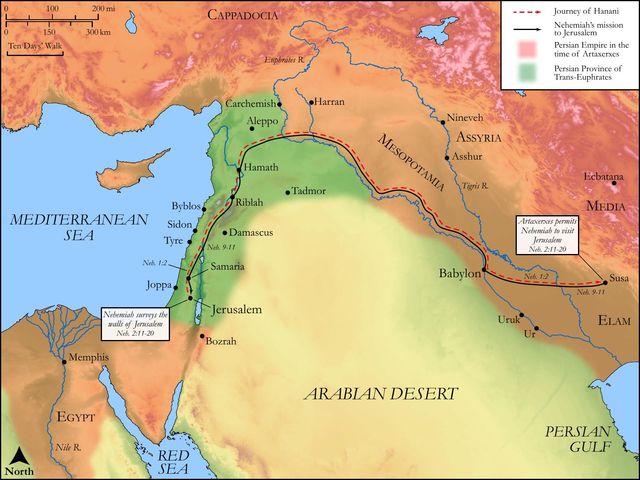
- בְּשׁוּשַׁןbe·shu·Shanin SusaH7800Prep-b ¦ N-properNoun Proper LocationבְּinשׁוּשַׁןSusa
- הַבִּירָהha·bi·Rahthe citadelH1002Art ¦ N-fsNoun Singular Feminine Absoluteהַtheבִּירָהcitadel
English is a literal word-by-word gloss of the Hebrew, not the KJV's wording. Why?
This is the original text the KJV's translators worked from — each Hebrew word with its own literal English meaning in this verse, prepared by scholars at Tyndale House, Cambridge. The KJV translates whole sentences, not word by word, so its wording differs: one Hebrew word can become several English words, and the KJV may choose “the LORD” where the gloss reads “Yahweh”. Both are faithful — they answer different questions. For the KJV's own rendering, switch to the KJV text.
Details
See on the biblical-era map
Study this verse
Public-domain commentary
Matthew Henry
From his Commentary on the Whole Bible. Henry comments on passages, not single verses — this entry covers Nehemiah 1:1–4. His three-level outline is real structure in the source text, so it is rendered as structure.
What tribe Nehemiah was of does nowhere appear; but, if it be true (which we are told by the author of the Maccabees, 2 Macc. 1:18) that he offered sacrifice, we must conclude him to have been a priest. Observe,
I.Nehemiah's station at the court of Persia.
We are here told that he was in Shushan the palace, or royal city, of the king of Persia, where the court was ordinarily kept (Neh 1:1), and (Neh 1:11) that he was the king's cup-bearer. Kings and great men probably looked upon it as a piece of state to be attended by those of other nations. By this place at court he would be the better qualified for the service of his country in that post for which God had designed him, as Moses was the fitter to govern for being bred up in Pharaoh's court, and David in Saul's. He would also have the fairer opportunity of serving his country by his interest in the king and those about him. Observe, He is not forward to tell us what great preferment he had at court; it is not till the end of the chapter that he tells us he was the king's cup-bearer (a place of great trust, as well as of honour and profit), when he could not avoid the mentioning of it because of the following story; but at first he only said, I was in Shushan the palace. We may hence learn to be humble and modest, and slow to speak of our own advancements. But in the providences of God concerning him we may observe, to our comfort,
1.That when God has work to do he will never want instruments to do it with.
2.That those whom God designs to employ in his service he will find out proper ways both to fit for it and to call to it.
3.That God has his remnant in all places; we read of Obadiah in the house of Ahab, saints in Caesar's household, and a devout Nehemiah in Shushan the palace.
4.That God can make the courts of princes sometimes nurseries and sometimes sanctuaries to the friends and patrons of the church's cause.
II.Nehemiah's tender and compassionate enquiry concerning the state of the Jews in their own land, Neh 1:2.
It happened that a friend and relation of his came to the court, with some other company, by whom he had an opportunity of informing himself fully how it went with the children of the captivity and what posture Jerusalem, the beloved city, was in. Nehemiah lived at ease, in honour and fulness, himself, but could not forget that he was an Israelite, nor shake off the thoughts of his brethren in distress, but in spirit (like Moses, Act 7:23) he visited them and looked upon their burdens. As distance of place did not alienate his affections from them (though they were out of sight, yet not out of mind), so neither did,
1.The dignity to which he was advanced. Though he was a great man, and probably rising higher, yet he did not think it below him to take cognizance of his brethren that were low and despised, nor was he ashamed to own his relation to them and concern for them.
2.The diversity of their sentiments from his, and the difference of their practice accordingly. Though he did not go to settle at Jerusalem himself (as we think he ought to have done now that liberty was proclaimed), but conformed to the court, and staid there, yet he did not therefore judge nor despise those that had returned, nor upbraid them as impolitic, but kindly concerned himself for them, was ready to do them all the good offices he could, and, that he might know which way to do them a kindness, asked concerning them. Note, It is lawful and good to enquire, "What news?" We should enquire especially concerning the state of the church and religion, and how it fares with the people of God; and the design of our enquiry must be, not that, like the Athenians, we may have something to talk of, but that we may know how to direct our prayers and our praises.
III.The melancholy account which is here given him of the present state of the Jews and Jerusalem, Neh 1:3.
Hanani, the person he enquired of, has this character given of him (Neh 7:2), that he feared God above many, and therefore would not only speak truly, but, when he spoke of the desolations of Jerusalem, would speak tenderly. It is probable that his errand to court at this time was to solicit some favour, some relief or other, that they stood in need of. Now the account he gives is,
1.That the holy seed was miserably trampled on and abused, in great affliction and reproach, insulted upon all occasions by their neighbours, and filled with the scorning of those that were at ease.
2.That the holy city was exposed and in ruins. The wall of Jerusalem was still broken down, and the gates were, as the Chaldeans left them, in ruins. This made the condition of the inhabitants both very despicable under the abiding marks of poverty and slavery, and very dangerous, for their enemies might when they pleased make an easy prey of them. The temple was built, the government settled, and a work of reformation brought to some head, but here was one good work yet undone; this was still wanting. Every Jerusalem, on this side the heavenly one, will have some defect or other in it, for the making up of which it will required the help and service of its friends.
IV.The great affliction this gave to Nehemiah and the deep concern it put him into, Neh 1:4.
1.He wept and mourned. It was not only just when he heard the news that he fell into a passion of weeping, but his sorrow continued certain days. Note, The desolations and distresses of the church ought to be the matter of our grief, how much soever we live at ease.
2.He fasted and prayed; not in public (he had no opportunity of doing that), but before the God of heaven, who sees in secret, and will reward openly. By his fasting and praying,
(1.)He consecrated his sorrows, and directed his tears aright, sorrowed after a godly sort, with an eye to God, because his name was reproached in the contempt cast on his people, whose cause therefore he thus commits to him.
(2.)He eased his sorrows, and unburdened his spirit, by pouring out his complaint before God and leaving it with him.
(3.)He took the right method of fetching in relief for his people and direction for himself in what way to serve them. Let those who are forming any good designs for the service of the public take God along with them for the first conception of them, and utter all their projects before him; this is the way to prosper in them.
Historical interpretation
Fourteen Centuries of Reception
3 surviving comments on this verse. Each one is dated, so this reads as a timeline rather than a list.
Select a marker to jump to its quote. Markers stagger vertically where authors wrote within a few decades of each other.
[Synopsis on Nehemiah] In the second book he says the same things (as the book of Ezra) concerning the return from Babylon, except the riddles. On the other hand, he relates more things concerning Nehemiah the eunuch, how he too asked for the building of the temple, and how Ezra performed the function of a scribe, while Josue, Baneas and Habia instructed the people. He relates that Ezra explained the knowledge of the Lord by reading; that the people, through his reading, understood what things must be done and celebrated the phase. They also observed a fast in the seventh month, and the feast of the Tabernacles, as is written. "They had not done so since the days of Josue the son of Nun", he says. When Ezra saw Azotian women married to Hebrews, he mourned and cried, and made everyone promise to keep God's law, and he cast out those women, as being joined by unlawful union, and everyone swore to keep the law. And, thus sanctified and cleansed, they rejoiced, and each man went away to his house. It is also told about Ezra that, when the books had been lost owing to the people's negligence and the long captivity, he, being a man fond of virtue, industrious, and a scribe, kept them all with him, and eventually brought them forth and transmitted them to all, and thus preserved the Bible.
The words of Nehemiah, the son of Hacaliah, etc. Nehemiah is interpreted in Latin as "the Lord comforts," or "comforter from the Lord"; who, when he had renewed the walls of Jerusalem and freed the people of God from the insults of their enemies, elevated observance of the divine law; it is evident that in both name and deed and person he fittingly designates the Mediator of God and men, the man Christ Jesus, who declares himself sent for the comfort of the poor in spirit, when about to ascend to heaven, he says to his disciples: I will pray to the Father, and he will give you another Comforter, that is, consoler (John 14). The Psalmist shows that it is He who builds up the city of God, namely the holy Church, and comforts the mourners when he says: The Lord builds up Jerusalem, and gathers the dispersed of Israel. He heals the brokenhearted (Psalm 147), etc. The figure of Nehemiah also suits the holy preachers, through whose ministry heavenly consolation is conferred upon us, while, after the fall into sin, they promise penitent ones hope of divine pardon and propitiation, as they rebuild the walls of Jerusalem destroyed by enemies. The month of Chislev is the same we call December, and is the ninth month among the Hebrews, the last month of the year with us; whose name, interpreted in Latin "his hope," most clearly matches the desires of him who directed his mind to raising up the ruins of the holy city. For the first foundation of good action is that we have undoubted hope of the Lord's assistance in accomplishing what we desire. It is the same month in which our Lord was born in the flesh, beautifully prefiguring long beforehand by its name that in it the true Nehemiah, that is the comforter from God the Father, so long hoped for by the chosen, would come into the world for the building of the holy Church. But that Nehemiah writes that he was in the citadel of Susa when men came who reported about Jerusalem. Susa is the metropolis of the kingdom of the Persians, as we read in the history of Esther (Esther 1); which Nehemiah calls a citadel, as does the prophet Daniel (Daniel 8); not because the city is a citadel, but because it is built with such strength that it seems to be one. Susa is interpreted as “horsemanship” or “returning”, a name suitably adapted to the fortification of the faithful minds of those especially concerned with the captivity of Jerusalem, that is, the salvation of those who, once snatched from the Church by the devil's snares, have now by penance been brought back to the Church through the grace of God. Such are in the returning citadel, that is, in the strength of a mind called back from weak delights to the desire for the heavenly homeland, from which they fell in the first parent. Such are in the strong host of holy hearts, who bear God as rider. As the prophet says: Riding upon your horses, and your ridership is salvation. The Lord indeed ascends upon his horses when he enlightens the hearts of preachers which he governs with the grace of his piety; and his ridership is salvation, because he leads to eternal salvation those whom he governs, and he makes others too, through them, who are equally governed, partakers of the same eternal salvation. Therefore, Nehemiah inquiring about those who had remained from the captivity of Jerusalem, let us see what follows:
This Book takes its name from the writer, who was cupbearer to Artaxerxes (surnamed Longimanus) king of Persia, and was sent by him with a commission to rebuild the walls of Jerusalem. It is also called the second book of Esdras; because it is a continuation of the history, begun by Esdras, of the state of the people of God after their return from captivity.
Continue studying Nehemiah 1:1 across the web’s major study libraries — every link below opens this exact verse, chapter, or book on the destination site.
Read & Compare
 BibleGatewayThis verse in more than 200 translations and 70 languages.
 Bible.comThe YouVersion reader — hundreds of translations, reading plans, and highlights.
 ESV.orgCrossway's official English Standard Version reader.
 NET BibleThe NET translation with 60,000+ translators' notes on every rendering decision.
 STEP BibleTyndale House's free study tool — original text, vocabulary, and scholarly resources.
 BibliaLogos Bible Software's free web reader.
 USCCBThe New American Bible (Revised Edition) with the U.S. bishops' study notes.
Commentaries
 BibleHub CommentariesDozens of classic commentaries on this verse, gathered on one page.
 StudyLightMore than 100 commentary sets — the largest collection on the web.
 BibleRefPlain-English commentary on what this verse means, verse by verse.
 Enduring WordDavid Guzik's free commentary on this chapter, widely used by Bible teachers.
 Bible Study ToolsVerse commentary alongside Greek and Hebrew study aids.
Original Language & Research
- BibleHub InterlinearThe verse word by word — original language, transliteration, and English.
- BibleHub LexiconEvery word's original-language definition and Strong's entry.
 Blue Letter BibleDeep-study tools — Strong's numbers, concordance, and word studies.
 SefariaThe Hebrew text with Rashi and centuries of Jewish commentary.
Sermons, Hymns & Audio


TrulyRandomVerse is not affiliated with these sites and doesn’t control their content. They’re linked because they’re genuinely useful.
Summary
Nehemiah 1:1 serves as the precise and pivotal opening to the Book of Nehemiah, immediately establishing the author's identity, the exact historical and chronological context, and the initial geographical setting. This foundational verse sets the stage for a profound narrative of divine providence, courageous leadership, fervent prayer, and the monumental task of rebuilding Jerusalem's walls, signaling the beginning of a crucial chapter in the post-exilic restoration of God's people and the fulfillment of His covenant promises.
Context
ShowHideLiterary Context
Nehemiah 1:1 functions as a direct and immediate prologue, introducing the reader to the first-person account of Nehemiah. It seamlessly continues the narrative of the post-exilic period, following the returns to Jerusalem under Zerubbabel (recorded in Ezra 1) and Ezra (detailed in Ezra 7). Unlike the more detached historical accounts found elsewhere in the Old Testament, this verse immediately immerses the reader into Nehemiah's personal experience, setting a highly intimate and authentic tone for the entire book, which reads much like a personal memoir or diary. The phrase "The words of Nehemiah" immediately precedes his profound prayer in Nehemiah 1:4-11, indicating that this opening is not merely biographical but a prelude to the deep spiritual burden that drives the subsequent narrative and actions.
Historical & Cultural Context
The verse firmly places the events within the vast Persian Empire during the reign of King Artaxerxes I Longimanus, specifically in his "twentieth year," which corresponds to 445 BC. This period is crucial for understanding the geopolitical landscape, as the Jewish people were living under Persian suzerainty, allowed to return to their homeland but still subject to imperial authority. "Shushan the palace" (Susa) was one of the four major capital cities of the Persian Empire, serving as a prominent administrative and royal center. Nehemiah's presence there, likely in his influential role as the king's cupbearer (as revealed in Nehemiah 2:1), highlights his proximity to power and his strategic placement within the imperial court. This setting is also famously featured in the Book of Esther, underscoring Susa's significance for the Jewish diaspora. The condition of Jerusalem, particularly its broken walls and gates, was not just a matter of security but of national identity, religious honor, and the fulfillment of God's promises for the returning exiles.
Key Themes
ShowHideThis opening verse, though brief, introduces several foundational themes that permeate the Book of Nehemiah. It immediately highlights the theme of Divine Sovereignty and Human Responsibility, as God's overarching plan for His people's restoration is about to unfold through the specific actions and burden of an individual, Nehemiah. The identification of "Nehemiah the son of Hachaliah" underscores the theme of Leadership and Vision, presenting a specific individual called and equipped for a monumental task. Furthermore, Nehemiah's location in "Shushan the palace" while his heart is clearly with Jerusalem foreshadows the theme of Burden for God's People and City, which will drive his fervent prayer and subsequent actions. The precise historical anchoring ("in the month Chisleu, in the twentieth year") also emphasizes the biblical truth that God works within real, verifiable history, not abstract concepts, thereby reinforcing the theme of God's Faithfulness to His Covenant Promises through tangible historical events.
Exposition and Analysis
ShowHideKey Word Analysis
ShowHideWhile the KJV translates this as "words" (plural), the Hebrew root dâbâr often refers to a "matter," "thing," "affair," or "report," beyond just spoken utterances. In this context, "The words of Nehemiah" signifies not merely his spoken statements but a comprehensive account of his actions, experiences, and the events surrounding his mission. It implies an authoritative and significant record of God's dealings through him, akin to a chronicle or a divinely inspired narrative.
This identifies the ninth month of the Jewish civil calendar, corresponding to late November or early December. The precise mention of "Chisleu" is crucial for the book's chronology. It marks the specific time when Nehemiah received the distressing news about Jerusalem's desolate state, initiating his period of intense prayer and mourning. This precise dating highlights the providential timing of God's unfolding plan, as Nehemiah would not approach the king until four months later, in Nisan (Nehemiah 2:1).
This term refers to a "castle" or "fortress," specifically a royal residence or citadel. Its use here, in conjunction with "Shushan," emphasizes Nehemiah's high-ranking position within the Persian imperial court. His presence within the fortified royal complex signifies his direct access to the king and his influential status, which would prove instrumental in securing the necessary decrees and resources for his mission to rebuild Jerusalem's walls. This detail contrasts sharply with the broken walls of his homeland, setting up the central tension of the narrative.
Verse Breakdown
ShowHide"The words of Nehemiah the son of Hachaliah."
This opening clause immediately identifies the author and protagonist of the book, establishing it as a first-person account. The inclusion of his father's name, Hachaliah, provides lineage and authenticity, rooting Nehemiah within the community of returning exiles and setting the stage for a personal, rather than purely historical, narrative. This phrase signals that the ensuing text is a direct testimony of Nehemiah's experiences and God's work through him.
"And it came to pass in the month Chisleu, in the twentieth year,"
This phrase provides the precise chronological setting for the events that are about to unfold. "The twentieth year" refers to the reign of Artaxerxes I Longimanus (445 BC), anchoring the narrative in a specific historical period and demonstrating the biblical account's rootedness in verifiable history. The mention of "Chisleu" pinpoints the exact month when Nehemiah received the news that ignited his burden and subsequent actions, emphasizing the providential timing of God's work.
"as I was in Shushan the palace,"
This final clause establishes Nehemiah's geographical location at the outset of the narrative. His presence in the Persian capital, particularly "the palace," underscores his prominent position within the empire. This detail is significant because it highlights the contrast between his comfortable and influential life in a foreign court and the dire condition of his homeland, setting the stage for his deep burden and willingness to sacrifice for Jerusalem. It reveals God's strategic placement of His servant.
Literary Devices
ShowHideNehemiah 1:1 employs several literary devices to effectively introduce its narrative. The most prominent is Autobiographical Narrative, immediately signaled by the first-person pronoun "I" and the declaration "The words of Nehemiah." This establishes an intimate, personal perspective, inviting the reader into the protagonist's direct experience and emotional journey and lending a strong sense of authenticity to the account. The verse also utilizes Precise Chronological and Geographical Anchoring, grounding the spiritual and historical events in verifiable time ("in the month Chisleu, in the twentieth year") and space ("in Shushan the palace"). This technique lends credibility and realism to the account, emphasizing God's work within concrete historical circumstances. Furthermore, there is an implicit Juxtaposition at play; Nehemiah's comfortable and powerful position in the heart of the Persian Empire is subtly contrasted with the implied desolation of Jerusalem, which will become the central focus of his burden and mission. This sets up the tension and motivation for the entire book, highlighting the sacrifice and commitment required for God's redemptive purposes.
Theological and Thematic Connections
ShowHideNehemiah 1:1, as a foundational verse, profoundly illustrates God's sovereign hand in orchestrating history and raising up leaders for specific redemptive purposes. It reveals that God can place His chosen servants in positions of influence, even within seemingly secular or foreign environments, to accomplish His will. Nehemiah's high office in the Persian court was not an accident but a strategic placement by divine providence, preparing him for the monumental task of rebuilding Jerusalem. This highlights the theological truth that God works through individuals who are both burdened by His concerns and strategically positioned to act, demonstrating that no location or circumstance is outside the scope of His redemptive plan. The verse also implicitly introduces the theme of God's faithfulness to His covenant promises, as the restoration of Jerusalem was a fulfillment of prophecies regarding the return from exile and the reestablishment of His people.
Reflection and Application
ShowHideNehemiah 1:1 serves as a powerful reminder that God often calls and uses individuals who are strategically placed, even in environments that seem far removed from "spiritual" work. Nehemiah, serving as a cupbearer in the heart of the Persian Empire, was deeply connected to his heritage and burdened by the condition of his people and their distant homeland. This verse challenges us to consider our own current circumstances and positions, no matter how ordinary or secular they may appear, as potential platforms for God's purposes. It encourages us to cultivate a heart sensitive to the needs of God's kingdom and His people, allowing ourselves to be burdened by what burdens Him. Just as Nehemiah's initial location set the stage for a powerful story of leadership, fervent prayer, and divine provision, this verse demonstrates that God's grand plans unfold within specific times and places, often through the faithfulness and obedience of dedicated individuals who respond to His call to participate in His redemptive work in the world.
Questions for Reflection
ShowHideFAQ
ShowHideWhat is the significance of the "twentieth year" mentioned in Nehemiah 1:1?
ShowHideThe "twentieth year" refers to the twentieth year of the reign of King Artaxerxes I Longimanus, which corresponds to 445 BC. This precise dating is highly significant for several reasons. Firstly, it firmly anchors the events of Nehemiah's mission within verifiable historical chronology, demonstrating the Bible's historical accuracy and God's engagement with real human history. Secondly, it places Nehemiah's work approximately 13 years after Ezra's return to Jerusalem (Ezra returned in Artaxerxes' seventh year, Ezra 7:7), indicating that despite Ezra's reforms, Jerusalem's physical defenses remained in a dire state. This specific date sets the stage for Nehemiah's request to the king in Nehemiah 2:1, highlighting the time lapse between his initial burden and his opportunity to act, showcasing God's perfect timing.
Why is Nehemiah's location in "Shushan the palace" important?
ShowHideShushan (Susa) was one of the four major capital cities of the vast Persian Empire, serving as a primary royal residence and administrative center. Nehemiah's presence "in Shushan the palace" is crucial because it establishes his high position and proximity to the center of imperial power. As the king's cupbearer (a role revealed in the next chapter), Nehemiah held a position of significant trust and influence, with direct access to Artaxerxes I. This strategic placement, far from Jerusalem, highlights God's sovereign hand in positioning His servant where he could best serve His purposes. It also underscores the contrast between Nehemiah's comfortable and influential life in the palace and the broken state of his homeland, which would fuel his burden and motivate his extraordinary mission. The city of Susa is also famously the primary setting for the Book of Esther, further emphasizing its importance in the history of the Jewish diaspora and God's providence.
Christ-Centered Fulfillment
ShowHideNehemiah 1:1, by introducing a divinely appointed leader burdened for his people and city, powerfully foreshadows the ultimate leader, Jesus Christ. Just as Nehemiah, from a position of comfort and influence in Shushan, was moved by the brokenness of Jerusalem and felt a divine compulsion to act, so too did Christ, from His eternal glory, "empty himself, by taking the form of a servant" (Philippians 2:7) to address the brokenness of humanity and restore His people. Nehemiah's mission to rebuild the physical walls of Jerusalem, though significant, points to Christ's far greater work in building His spiritual temple, the Church, with Himself as the cornerstone (Ephesians 2:20-22). The deep compassion Nehemiah felt for his people mirrors the profound compassion of Jesus for the lost sheep of Israel and for all humanity, seeing them "harassed and helpless, like sheep without a shepherd" (Matthew 9:36). Ultimately, the restoration initiated by Nehemiah finds its complete and eternal fulfillment in the New Jerusalem, where Christ reigns supreme, and there is no more brokenness, sorrow, or separation from God (Revelation 21:1-4). Nehemiah's story is a testament to God's faithfulness through a human agent, a faithfulness perfectly embodied and eternally secured in Jesus Christ, who not only rebuilds but redeems and transforms.