


Nehemiah 1:2
- וַיָּבֹאvai·ya·Vo'and he cameH935Conj-w ¦ V-Qal-ConsecImperf-3msVerb Qal Consecutive Imperfect 3rd Singular Masculineוַandיָּבֹאhe came
- חֲנָנִיcha·Na·niHananiH2607N-proper-mNoun Proper Masculine
- אֶחָד'e·ChadoneH259Adj-fsAdjective Numerical Singular Feminine Absolute
- מֵאַחַיme·'a·Chaiof my brothersH251Prep-m ¦ N-mpc ¦ 1csNoun Plural Masculine Constructמֵofאַחַbrothersיmy
- הוּאhu'heH1931Pro-3msPronoun Personal 3rd Singular Masculine
- וַאֲנָשִׁיםva·'a·na·Shimand peopleH582Conj-w ¦ N-mpNoun Plural Masculine Absoluteוַandאֲנָשִׁיםpeople
- מִיהוּדָהmi·hu·Dahfrom JudahH3063Prep-m ¦ N-properNoun Proper LocationמִfromיהוּדָהJudah
- וָאֶשְׁאָלֵםva·'esh·'a·Lemand I asked themH7592Conj-w ¦ V-Qal-ConsecImperf-1cs ¦ 3mpVerb Qal Consecutive Imperfect 1st Singular common genderוָandאֶשְׁאָלֵI askedםthem
- עַל'alaboutH5921PrepPreposition
- הַיְּהוּדִיםhai·ye·hu·Dimthe JewsH3064Art ¦ N-mpNoun Gentilic Plural Masculine AbsoluteהַtheיְּהוּדִיםJews
- הַפְּלֵיטָהha·pe·lei·Tahthe escaped remnantH6413Art ¦ N-fsNoun Singular Feminine Absoluteהַtheפְּלֵיטָהescaped remnant
- אֲשֶׁר'a·SherwhoH834RelParticle Relative
- נִשְׁאֲרוּnish·'a·Ruthey had survivedH7604V-Niphal-Perf-3cpVerb Niphal Perfect 3rd Plural common gender
- מִןminfromH4480PrepPreposition
- הַשֶּׁבִיha·She·vithe captivityH7628Art ¦ N-msNoun Singular Masculine Absoluteהַtheשֶּׁבִיcaptivity
- וְעַלve·'aland onH5921Conj-w ¦ PrepPrepositionוְandעַלon
- יְרוּשָׁלִָםye·ru·sha·LimJerusalemH3389N-properNoun Proper Location
English is a literal word-by-word gloss of the Hebrew, not the KJV's wording. Why?
This is the original text the KJV's translators worked from — each Hebrew word with its own literal English meaning in this verse, prepared by scholars at Tyndale House, Cambridge. The KJV translates whole sentences, not word by word, so its wording differs: one Hebrew word can become several English words, and the KJV may choose “the LORD” where the gloss reads “Yahweh”. Both are faithful — they answer different questions. For the KJV's own rendering, switch to the KJV text.
Details
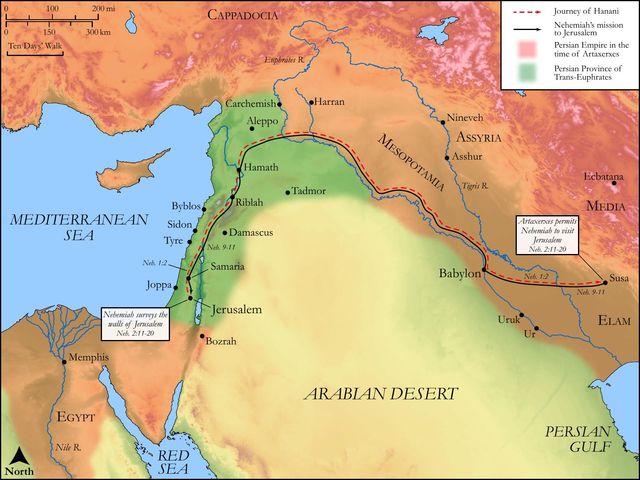
See on the biblical-era map
Study this verse
Public-domain commentary
Matthew Henry
From his Commentary on the Whole Bible. Henry comments on passages, not single verses — this entry covers Nehemiah 1:1–4. His three-level outline is real structure in the source text, so it is rendered as structure.
What tribe Nehemiah was of does nowhere appear; but, if it be true (which we are told by the author of the Maccabees, 2 Macc. 1:18) that he offered sacrifice, we must conclude him to have been a priest. Observe,
I.Nehemiah's station at the court of Persia.
We are here told that he was in Shushan the palace, or royal city, of the king of Persia, where the court was ordinarily kept (Neh 1:1), and (Neh 1:11) that he was the king's cup-bearer. Kings and great men probably looked upon it as a piece of state to be attended by those of other nations. By this place at court he would be the better qualified for the service of his country in that post for which God had designed him, as Moses was the fitter to govern for being bred up in Pharaoh's court, and David in Saul's. He would also have the fairer opportunity of serving his country by his interest in the king and those about him. Observe, He is not forward to tell us what great preferment he had at court; it is not till the end of the chapter that he tells us he was the king's cup-bearer (a place of great trust, as well as of honour and profit), when he could not avoid the mentioning of it because of the following story; but at first he only said, I was in Shushan the palace. We may hence learn to be humble and modest, and slow to speak of our own advancements. But in the providences of God concerning him we may observe, to our comfort,
1.That when God has work to do he will never want instruments to do it with.
2.That those whom God designs to employ in his service he will find out proper ways both to fit for it and to call to it.
3.That God has his remnant in all places; we read of Obadiah in the house of Ahab, saints in Caesar's household, and a devout Nehemiah in Shushan the palace.
4.That God can make the courts of princes sometimes nurseries and sometimes sanctuaries to the friends and patrons of the church's cause.
II.Nehemiah's tender and compassionate enquiry concerning the state of the Jews in their own land, Neh 1:2.
It happened that a friend and relation of his came to the court, with some other company, by whom he had an opportunity of informing himself fully how it went with the children of the captivity and what posture Jerusalem, the beloved city, was in. Nehemiah lived at ease, in honour and fulness, himself, but could not forget that he was an Israelite, nor shake off the thoughts of his brethren in distress, but in spirit (like Moses, Act 7:23) he visited them and looked upon their burdens. As distance of place did not alienate his affections from them (though they were out of sight, yet not out of mind), so neither did,
1.The dignity to which he was advanced. Though he was a great man, and probably rising higher, yet he did not think it below him to take cognizance of his brethren that were low and despised, nor was he ashamed to own his relation to them and concern for them.
2.The diversity of their sentiments from his, and the difference of their practice accordingly. Though he did not go to settle at Jerusalem himself (as we think he ought to have done now that liberty was proclaimed), but conformed to the court, and staid there, yet he did not therefore judge nor despise those that had returned, nor upbraid them as impolitic, but kindly concerned himself for them, was ready to do them all the good offices he could, and, that he might know which way to do them a kindness, asked concerning them. Note, It is lawful and good to enquire, "What news?" We should enquire especially concerning the state of the church and religion, and how it fares with the people of God; and the design of our enquiry must be, not that, like the Athenians, we may have something to talk of, but that we may know how to direct our prayers and our praises.
III.The melancholy account which is here given him of the present state of the Jews and Jerusalem, Neh 1:3.
Hanani, the person he enquired of, has this character given of him (Neh 7:2), that he feared God above many, and therefore would not only speak truly, but, when he spoke of the desolations of Jerusalem, would speak tenderly. It is probable that his errand to court at this time was to solicit some favour, some relief or other, that they stood in need of. Now the account he gives is,
1.That the holy seed was miserably trampled on and abused, in great affliction and reproach, insulted upon all occasions by their neighbours, and filled with the scorning of those that were at ease.
2.That the holy city was exposed and in ruins. The wall of Jerusalem was still broken down, and the gates were, as the Chaldeans left them, in ruins. This made the condition of the inhabitants both very despicable under the abiding marks of poverty and slavery, and very dangerous, for their enemies might when they pleased make an easy prey of them. The temple was built, the government settled, and a work of reformation brought to some head, but here was one good work yet undone; this was still wanting. Every Jerusalem, on this side the heavenly one, will have some defect or other in it, for the making up of which it will required the help and service of its friends.
IV.The great affliction this gave to Nehemiah and the deep concern it put him into, Neh 1:4.
1.He wept and mourned. It was not only just when he heard the news that he fell into a passion of weeping, but his sorrow continued certain days. Note, The desolations and distresses of the church ought to be the matter of our grief, how much soever we live at ease.
2.He fasted and prayed; not in public (he had no opportunity of doing that), but before the God of heaven, who sees in secret, and will reward openly. By his fasting and praying,
(1.)He consecrated his sorrows, and directed his tears aright, sorrowed after a godly sort, with an eye to God, because his name was reproached in the contempt cast on his people, whose cause therefore he thus commits to him.
(2.)He eased his sorrows, and unburdened his spirit, by pouring out his complaint before God and leaving it with him.
(3.)He took the right method of fetching in relief for his people and direction for himself in what way to serve them. Let those who are forming any good designs for the service of the public take God along with them for the first conception of them, and utter all their projects before him; this is the way to prosper in them.
Continue studying Nehemiah 1:2 across the web’s major study libraries — every link below opens this exact verse, chapter, or book on the destination site.
Read & Compare
 BibleGatewayThis verse in more than 200 translations and 70 languages.
 Bible.comThe YouVersion reader — hundreds of translations, reading plans, and highlights.
 ESV.orgCrossway's official English Standard Version reader.
 NET BibleThe NET translation with 60,000+ translators' notes on every rendering decision.
 STEP BibleTyndale House's free study tool — original text, vocabulary, and scholarly resources.
 BibliaLogos Bible Software's free web reader.
 USCCBThe New American Bible (Revised Edition) with the U.S. bishops' study notes.
Commentaries
 BibleHub CommentariesDozens of classic commentaries on this verse, gathered on one page.
 StudyLightMore than 100 commentary sets — the largest collection on the web.
 BibleRefPlain-English commentary on what this verse means, verse by verse.
 Enduring WordDavid Guzik's free commentary on this chapter, widely used by Bible teachers.
 Bible Study ToolsVerse commentary alongside Greek and Hebrew study aids.
Original Language & Research
- BibleHub InterlinearThe verse word by word — original language, transliteration, and English.
- BibleHub LexiconEvery word's original-language definition and Strong's entry.
 Blue Letter BibleDeep-study tools — Strong's numbers, concordance, and word studies.
 SefariaThe Hebrew text with Rashi and centuries of Jewish commentary.
Sermons, Hymns & Audio


TrulyRandomVerse is not affiliated with these sites and doesn’t control their content. They’re linked because they’re genuinely useful.
Summary
Nehemiah 1:2 serves as the pivotal moment that ignites the entire narrative of Nehemiah, revealing the catalyst for his profound burden and subsequent mission. While serving in a position of privilege and influence as cupbearer to King Artaxerxes in Susa, Nehemiah receives a critical report from Hanani, identified as one of his brethren, and other men from Judah. This inquiry, initiated by Nehemiah himself, uncovers the dire state of Jerusalem and the remnant of the Jewish people who had returned from Babylonian captivity, setting the stage for Nehemiah's lament, prayer, and ultimately, his divinely appointed task to rebuild the city walls and restore the dignity of his people.
Context
ShowHideLiterary Context
Nehemiah 1:2 immediately follows the opening verse, which identifies the author and the timeframe ("the words of Nehemiah the son of Hachaliah... in the twentieth year"). This verse masterfully transitions from the general introduction to the specific, inciting incident that triggers Nehemiah's call to action. The dire news about Jerusalem's broken walls and the distress of its inhabitants provides the essential background for Nehemiah's subsequent deep grief, fasting, and fervent prayer recorded in Nehemiah 1:4-11. This foundational report directly leads to Nehemiah's bold petition to King Artaxerxes in Nehemiah 2:1-8, where he articulates his request for permission and resources to undertake the monumental task of rebuilding. The book of Nehemiah, along with Ezra, chronicles the post-exilic restoration efforts, with Nehemiah specifically focusing on the physical rebuilding of Jerusalem's defenses, thereby complementing Ezra's emphasis on spiritual and legal reform and completing a crucial phase of the return from exile.
Historical & Cultural Context
The events of Nehemiah 1:2 are set in the mid-5th century BC, specifically during the reign of Artaxerxes I (465-424 BC) of the Persian Empire. This period is several decades after the initial return of Jews from Babylonian captivity under Zerubbabel (c. 538 BC), who oversaw the rebuilding of the Temple (Ezra 3:8). It also follows Ezra's later return (c. 458 BC) for spiritual and legal restoration (Ezra 7:6). Despite these earlier efforts, Jerusalem remained vulnerable and disgraced. Its walls were still in ruins, and its gates burned, leaving the city exposed to enemies and a perpetual symbol of shame among surrounding nations. Nehemiah's position as cupbearer in Susa (Shushan), one of the Persian capitals, was one of immense trust and proximity to the king, affording him influence and access that few exiles possessed. His proactive inquiry reveals a deep-seated connection to his heritage and a profound concern for the welfare of his people, even from a distance, embodying a true leader's heart.
Key Themes
ShowHideNehemiah 1:2 introduces several foundational themes that permeate the entire book and resonate throughout biblical history. Firstly, it highlights Compassion and Burden for God's People and City. Nehemiah, despite his personal comfort and high status, is deeply moved by the plight of his brethren and the desolation of Jerusalem, echoing the sentiment found in Psalm 122:6 to "Pray for the peace of Jerusalem." Secondly, the verse underscores the theme of Divine Providence and Timing. The timely arrival of Hanani and the men of Judah, coupled with Nehemiah's specific inquiry, is not mere coincidence but a divinely orchestrated moment that sets God's plan for Jerusalem's restoration into motion. This echoes God's sovereign hand in the affairs of His people, as seen in Esther 4:14. Thirdly, it reveals the Reality of Post-Exilic Hardship and Shame. Even after returning from captivity, the "escaped" Jews faced significant challenges, including vulnerability and reproach, emphasizing that physical return did not immediately equate to full restoration or security, a reality also lamented in Lamentations 2:2. Finally, the verse subtly introduces the theme of Informed Action and Intercession, as Nehemiah's inquiry directly leads to his fervent prayer and subsequent courageous leadership.
Exposition and Analysis
ShowHideKey Word Analysis
ShowHideThe name means "Gracious" or "Yahweh has been gracious." While his exact relationship to Nehemiah (literal brother or close kinsman/compatriot) is debated, the text explicitly states "one of my brethren," implying a deep personal connection and trust. This familial or close bond makes the report Hanani delivers all the more impactful and credible to Nehemiah, underscoring the personal nature of the burden Nehemiah feels. The name itself, meaning "gracious," subtly foreshadows God's gracious intervention through Nehemiah.
This term refers to the "remnant" or "survivors." It does not merely mean those who physically fled, but rather those who survived the Babylonian exile and its aftermath, and who had returned to Judah. It highlights their precarious existence and the ongoing struggles they faced despite being back in their homeland. The word often carries a connotation of divine preservation, a small group preserved by God for His purposes, a "deliverance" from utter destruction.
This word denotes the state of being exiled or the exiles themselves. It refers specifically to the Babylonian captivity, a traumatic period in Israel's history. The phrase "left of the captivity" emphasizes that even those who had returned were still deeply marked by the experience of exile and its lingering consequences, including the vulnerability of their homeland and the psychological scars of being "captured" and displaced.
Verse Breakdown
ShowHide"That Hanani, one of my brethren, came, he and [certain] men of Judah;"
This clause introduces the messengers and the source of the critical information that will transform Nehemiah's life. The arrival of Hanani, explicitly identified as "one of my brethren," immediately establishes a personal and trustworthy connection, lending immense weight and credibility to the news he carries. The presence of "certain men of Judah" suggests an official or at least a representative delegation, indicating that the news was not mere rumor but a firsthand, verified report from those living in the land. Their arduous journey from Judah to Susa underscores the urgency and profound significance of their message, implying that the situation in Jerusalem was dire enough to warrant such a long and dangerous trip.
"and I asked them concerning the Jews that had escaped, which were left of the captivity, and concerning Jerusalem."
This part of the verse reveals Nehemiah's proactive and deeply concerned posture, demonstrating his leadership qualities even before his formal mission begins. He doesn't passively wait for news; he actively "asked them," indicating a pre-existing burden or an immediate recognition of the importance of these visitors. His inquiry is twofold: first, concerning "the Jews that had escaped, which were left of the captivity"—referring to the remnant who had returned to Judah and were attempting to re-establish life there. This demonstrates his profound concern for the welfare and conditions of his people, highlighting their precarious status as survivors of a devastating exile. Second, he asks "concerning Jerusalem"—the holy city, the heart of their national and spiritual identity, the place where God's name dwelt. This dual focus shows Nehemiah's comprehensive burden for both the people and the place, recognizing their interconnectedness in God's covenant plan and their shared vulnerability.
Literary Devices
ShowHideNehemiah 1:2 functions primarily as a Catalyst or Inciting Incident for the entire book. It is the specific event that sets the plot in motion, transforming Nehemiah from a comfortable court official into a burdened leader called to action. The verse also employs Foreshadowing, as Nehemiah's deep concern and specific inquiry about Jerusalem's state directly foreshadow his subsequent mission to rebuild its walls and restore its dignity and security. The subtle Juxtaposition between Nehemiah's privileged and secure position in the Persian capital of Susa and the desperate distress of his people and the desolation of Jerusalem highlights the stark contrast that fuels his burden and sense of responsibility. Furthermore, the narrative employs Personal Inquiry as a driving device; Nehemiah's active questioning, rather than a passive reception of news, underscores his character, commitment, and proactive nature, making him an active participant in the unfolding divine drama from its very inception.
Theological and Thematic Connections
ShowHideNehemiah 1:2 powerfully illustrates the theological principle that God often uses human initiative, compassion, and concern to advance His redemptive purposes. Nehemiah's burden for Jerusalem and its inhabitants is not merely a personal sentiment but a reflection of God's own covenant faithfulness and His enduring desire for the restoration of His people and city. This verse sets the stage for a narrative of divine provision and human cooperation, where a leader's compassion, fueled by accurate information, leads to fervent prayer and decisive action. It underscores the importance of being attuned to the needs of God's people and the state of His kingdom, recognizing that such awareness can be the very spark God uses to ignite significant movements of restoration and revival. This deep concern for Jerusalem and its people resonates throughout Scripture, serving as a call to intercession and practical engagement for God's purposes, reminding believers that God often works through those who are burdened by the brokenness they observe.
Reflection and Application
ShowHideNehemiah 1:2 provides a profound model for believers today, challenging us to cultivate a heart of active compassion and informed engagement. Like Nehemiah, we are called to be attentive to the "news" from our spiritual brethren and communities, whether near or far. This isn't about idle curiosity, but a genuine, proactive inquiry into the spiritual, emotional, and physical needs of others, particularly within the body of Christ and the broader world. When confronted with hardship, vulnerability, or spiritual decay, our response should move beyond mere sympathy to a deep, personal burden that compels us to prayer and, ultimately, to tangible action. Nehemiah's immediate inquiry led to his lament and prayer in Nehemiah 1:4, and eventually to his courageous leadership in rebuilding Jerusalem's walls (Nehemiah 2:17). This verse reminds us that God often uses seemingly ordinary interactions—a question asked, a report received—as the divine trigger for His extraordinary work, inviting us to be His hands and feet in addressing the brokenness of our world, just as He did through Nehemiah.
Questions for Reflection
ShowHideFAQ
ShowHideWho was Hanani, and why was his report so significant?
ShowHideHanani is identified as "one of my brethren," suggesting he was either Nehemiah's literal brother or a very close, trusted kinsman or compatriot. His name, meaning "Yahweh has been gracious," might subtly foreshadow the gracious work God was about to do through Nehemiah. His report was profoundly significant because it was a direct, firsthand account from Jerusalem, delivered by a trustworthy source, that revealed the dire state of the city and its inhabitants. This news served as the immediate catalyst for Nehemiah's deep grief, fervent prayer, and ultimately, his divinely appointed mission to rebuild Jerusalem's walls, as detailed throughout the book of Nehemiah. Without Hanani's report, Nehemiah might never have become aware of the urgent need that propelled him into action, demonstrating God's use of specific individuals and events to initiate His plans.
What was the state of Jerusalem at this time, and why was it a concern?
ShowHideAt the time of Nehemiah 1:2, Jerusalem was in a deplorable state, despite previous returns of exiles under Zerubbabel and Ezra. While the Temple had been rebuilt (Ezra 6:15), the city's defensive walls remained in ruins, and its gates were burned, a lingering consequence of the Babylonian destruction over a century prior. This left the Jewish remnant vulnerable to attacks from surrounding hostile peoples and exposed them to constant shame and reproach among the nations (Nehemiah 1:3). The broken walls symbolized not just physical insecurity but also a spiritual and national disgrace, as Jerusalem was meant to be a city of strength and a beacon of God's presence. For Nehemiah, this was a deep concern because Jerusalem was the holy city, the center of Jewish identity and worship, and its desolate state reflected poorly on God's people and His covenant promises, hindering their ability to live securely and worship freely.
Christ-Centered Fulfillment
ShowHideNehemiah's profound burden for Jerusalem and his people, ignited by the news of their distress and the city's brokenness in Nehemiah 1:2, powerfully foreshadows the ultimate compassion of Jesus Christ. Just as Nehemiah, from a place of privilege and access to the king, was moved to intercede and act for his people, so too did Christ, from His divine glory, humble Himself to take on human flesh and bear the burden of a broken humanity. Jesus' laments over Jerusalem (Matthew 23:37; Luke 19:41-44) reveal a heart that grieved over the spiritual desolation and vulnerability of His people, far surpassing Nehemiah's concern for physical walls. While Nehemiah rebuilt physical walls to provide security and restore dignity, Christ came to rebuild the spiritual temple of God – His Church – from the ruins of sin and death. He is the ultimate builder, the cornerstone (Ephesians 2:19-22), who not only intercedes for His people as our High Priest (Hebrews 7:25) but also lays down His life to secure their true and eternal restoration. Through His sacrifice, He establishes the New Jerusalem, a city with foundations whose architect and builder is God (Revelation 21:2), where no walls will ever be broken down, no inhabitant will ever again be left to the shame of captivity, and God Himself will dwell with His people forever (Revelation 21:3).