


Ezra 9:8
Bible text: King James Version (1769 Blayney text) · Public domain
Bible text: King James Version with Strong's numbers · Public domain
Bible text: Berean Standard Bible · Public domain
Bible text: American Standard Version (1901) · Public domain
Bible text: World English Bible, Messianic edition · Public domain
Bible text: Geneva Bible (1599) · Public domain
Bible text: Young's Literal Translation · Public domain
- וְעַתָּהve·'a·Tahand nowH6258Conj-w ¦ AdvAdverbוְandעַתָּהnow
- כִּמְעַטkim·'atlike a little ofH4592Prep-k ¦ N-mscNoun Singular Masculine Constructכִּlikeמְעַטa little of
- רֶגַעre·Ga'a momentH7281N-msNoun Singular Masculine Absolute
- הָיְתָהha·ye·Tahit has comeH1961V-Qal-Perf-3fsVerb Qal Perfect 3rd Singular Feminine
- תְחִנָּהte·chi·NahfavorH8467N-fsNoun Singular Feminine Absolute
- מֵאֵתme·'Etfrom withH854Prep-m ¦ PrepPrepositionמֵfromאֵתwith
- יְהוָהYah·wehYahwehH3068N-properNoun Proper Title
- אֱלֹהֵינוּ'e·lo·Hei·nuour GodH430N-mpc ¦ 1cpNoun Plural Masculine ConstructאֱלֹהֵיGodנוּour
- לְהַשְׁאִירle·hash·'Irto leaveH7604Prep-l ¦ V-Hiphil-InfVerb Hiphil Infinitive Constructלְtoהַשְׁאִירleave
- לָנוּla·nuto usPrep-l ¦ 1cpSuffix Personal 1st Plural common genderלָtoנוּus
- פְּלֵיטָהpe·lei·Tahan escaped remnantH6413N-fsNoun Singular Feminine Absolute
- וְלָתֶתve·la·tetand to giveH5414Conj-w ¦ Prep-l ¦ V-Qal-InfVerb Qal Infinitive Constructוְandלָtoתֶתgive
- לָנוּLa·nuto usPrep-l ¦ 1cpSuffix Personal 1st Plural common genderלָtoנוּus
- יָתֵדya·Teda tent pegH3489N-fsNoun Singular Feminine Absolute
- בִּמְקוֹםbim·Komin [the] place ofH4725Prep-b ¦ N-mscNoun Singular Masculine Constructבִּinמְקוֹם[the] place of
- קָדְשׁוֹka·de·Shohis holinessH6944N-msc ¦ 3msNoun Singular Masculine Constructקָדְשׁholinessוֹhis
- לְהָאִירle·ha·'Irto light upH215Prep-l ¦ V-Hiphil-InfVerb Hiphil Infinitive Constructלְtoהָאִירlight up
- עֵינֵינוּ'ei·Nei·nuour eyesH5869N-fdc ¦ 1cpNoun Dual Feminine Constructעֵינֵיeyesנוּour
- אֱלֹהֵינוּ'e·lo·Hei·nuour GodH430N-mpc ¦ 1cpNoun Plural Masculine ConstructאֱלֹהֵיGodנוּour
- וּלְתִתֵּנוּu·le·ti·Te·nuand to give to usH5414Conj-w ¦ Prep-l ¦ V-Qal-Inf ¦ 1cpVerb Qal Infinitive Constructוּandלְtoתִתֵּgive toנוּus
- מִחְיָהmich·YahrevivingH4241N-fsNoun Singular Feminine Absolute
- מְעַטme·'Ata littleH4592N-msNoun Singular Masculine Absolute
- בְּעַבְדֻתֵנוּbe·'av·du·Te·nuin our servitudeH5659Prep-b ¦ N-fsc ¦ 1cpNoun Singular Feminine Constructבְּinעַבְדֻתֵservitudeנוּour
English is a literal word-by-word gloss of the Hebrew, not the KJV's wording. Why?
This is the original text the KJV's translators worked from — each Hebrew word with its own literal English meaning in this verse, prepared by scholars at Tyndale House, Cambridge. The KJV translates whole sentences, not word by word, so its wording differs: one Hebrew word can become several English words, and the KJV may choose “the LORD” where the gloss reads “Yahweh”. Both are faithful — they answer different questions. For the KJV's own rendering, switch to the KJV text.
Details
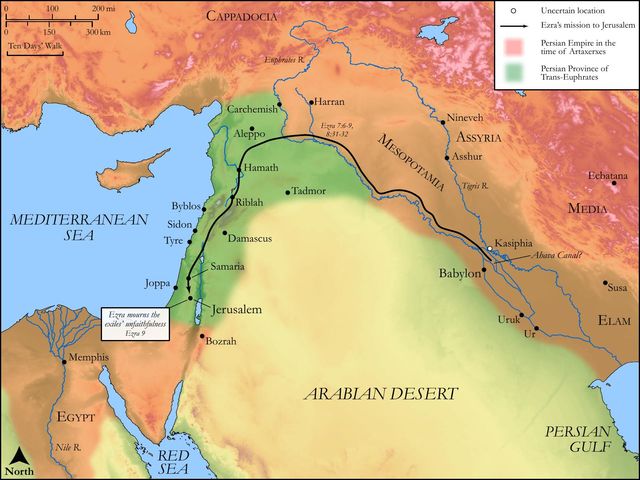
See on the biblical-era map
Study this verse
Public-domain commentary
Matthew Henry
From his Commentary on the Whole Bible. Henry comments on passages, not single verses — this entry covers Ezra 9:5–15. His four-level outline is real structure in the source text, so it is rendered as structure.
What the meditations of Ezra's heart were, while for some hours he sat down astonished, we may guess by the words of his mouth when at length he spoke with his tongue; and a most pathetic address he here makes to Heaven upon this occasion. Observe,
I.The time when he made this address - at the evening sacrifice, Ezr 9:5.
Then (it is likely) devout people used to come into the courts of the temple, to grace the solemnity of the sacrifice and to offer up their own prayers to God in concurrence with it. In their hearing Ezra chose to make this confession, that they might be made duly sensible of the sins of their people, which hitherto they had either not taken notice of or had made light of. Prayer may preach. The sacrifice, and especially the evening sacrifice, was a type of the great propitiation, that blessed Lamb of God which in the evening of the world was to take away sin by the sacrifice of himself, to which we may suppose Ezra had an eye of faith in this penitential address to God; he makes confession with his hand, as it were, upon the head of that great sacrifice, through which we receive the atonement. Certainly Ezra was no stranger to the message which the angel Gabriel had some years ago delivered to Daniel, at the time of the evening sacrifice, and as it were in explication of it, concerning Messiah the Prince (Dan 9:21, Dan 9:24); and perhaps he had regard to that in choosing this time.
II.His preparation for this address.
1.He rose up from his heaviness, and so far shook off the burden of his grief as was necessary to the lifting up of his heart to God. He recovered from his astonishment, got the tumult of his troubled spirits somewhat stilled and his spirit composed for communion with God.
2.He fell upon his knees, put himself into the posture of a penitent humbling himself and a petitioner suing for mercy, in both representing the people for whom he was now an intercessor.
3.He spread out his hands, as one affected with what he was going to say, offering it up unto God, waiting, and reaching out, as it were, with an earnest expectation, to receive a gracious answer. In this he had an eye to God as the Lord, and as his God, a God of power, but a God of grace.
III.The address itself.
It is not properly to be called a prayer, for there is not a word of petition in it; but, if we give prayer its full latitude, it is the offering up of pious and devout affections to God, and very devout, very pious, are the affections which Ezra here expresses. His address is a penitent confession of sin, not his own (from a conscience burdened with its own guilt and apprehensive of his own danger), but the sin of his people, from a gracious concern for the honour of God and the welfare of Israel. Here is a lively picture of ingenuous repentance. Observe in this address,
1.The confession he makes of the sin and the aggravations of it, which he insists upon, to affect his own heart and theirs that joined with him with holy sorrow and shame and fear, in the consideration of it, that they might be deeply humbled for it. And it is observable that, though he himself was wholly clear from this guilt, yet he puts himself into the number of the sinners, because he was a member of the same community - our sins and our trespass. Perhaps he now remembered it against himself, as his fault, that he had staid so long after his brethren in Babylon, and had not separated himself so soon as he might have done from the people of those lands. When we are lamenting the wickedness of the wicked, it may be, if we duly reflect upon ourselves and give our own hearts leave to deal faithfully with us, we may find something of the same nature, though in a lower degree, that we also have been guilty of. However, he speaks that which was, or should have been, the general complaint.
(1.)He owns their sins to have been very great: "Our iniquities are increased over our heads (Ezr 9:6); we are ready to perish in them as in keep waters;" so general was the prevalency of them, so violent the power of them, and so threatening were they of the most pernicious consequences. "Iniquity has grown up to such a height among us that it reaches to the heavens, so very impudent that it dares heaven, so very provoking that, like the sin of Sodom, it cries to heaven for vengeance." But let this be the comfort of true penitents that though their sins reach to the heavens God's mercy is in the heavens, Psa 36:5. Where sin abounds grace will much more abound.
(2.)Their sin had been long persisted in (Ezr 9:7): Since the days of our fathers have we been in a great trespass. The example of those that had gone before them he thought so far from excusing their fault that it aggravated it. "We should have taken warning not to stumble at the same stone. The corruption is so much the worse that it has taken deep root and begins to plead prescription, but by this means we have reason to fear that the measure of the iniquity is nearly full."
(3.)The great and sore judgments which God had brought upon them for their sins did very much aggravate them: "For our iniquities we have been delivered to the sword and to captivity (Ezr 9:7), and yet not reformed, yet not reclaimed - brayed in the mortar, and yet the folly not gone (Pro 27:22) - corrected, but not reclaimed."
(4.)The late mercies God had bestowed upon them did likewise very much aggravate their sins. This he insists largely upon, Ezr 9:8, Ezr 9:9. Observe,
[1.]The time of mercy: Now for a little space, that is, "It is but a little while since we had our liberty, and it is not likely to continue long." This greatly aggravated their sin, that they were so lately in the furnace and that they knew not how soon they might return to it again; and could they yet be secure?
[2.]The fountain of mercy: Grace has been shown us from the Lord. The kings of Persia were the instruments of their enlargement; but he ascribes it to God and to his grace, his free grace, without any merit of theirs.
[3.]The streams of mercy, - that they were not forsaken in their bondage, but even in Babylon had the tokens of God's presence, - that they were a remnant of Israelites left, a few out of many, and those narrowly escaped out of the hands of their enemies, by the favour of the kings of Persia, - and especially that they had a nail in his holy place, that is (as it is explained, Ezr 9:9), that they had set up the house of God. They had their religion settled and the service of the temple in a constant method. We are to reckon it a great comfort and advantage to have stated opportunities of worshipping God. Blessed are those that dwell in God's house, like Anna that departed not from the temple. This is my rest for ever, says the gracious soul.
[4.]The effects of all this. It enlightened their eyes, and it revived their hearts; that is, it was very comfortable to them, and the more sensibly so because it was in their bondage: it was life from the dead to them. Though but a little reviving, it was a great favour, considering that they deserved none and the day of small things was an earnest of greater. "Now," says Ezra, "how ungrateful are we to offend a God that has been so kind to us! how disingenuous to mingle in sin with those nations from whom we have been, in wonderful mercy, delivered! how unwise to expose ourselves to God's displeasure when we are tried with the returns of his favour and are upon our good behaviour for the continuance of it!"
(5.)It was a great aggravation of the sin that it was against an express command: We have forsaken thy commandments, Ezr 9:10. It seems to have been an ancient law of the house of Jacob not to match with the families of the uncircumcised, Gen 34:14. But, besides that, God had strictly forbidden it. He recites the command, Ezr 9:11, Ezr 9:12. For sin appears sin, appears exceedingly sinful, when we compare it with the law which is broken by it. Nothing could be more express: Give not your daughters to their sons, nor take their daughters to your sons. The reason given is because, if they mingled with those nations, they would pollute themselves. It was an unclean land, and they were a holy people; but if they kept themselves distinct from them it would be their honour and safety, and the perpetuating of their prosperity. Now to violate a command so express, backed with such reasons, and a fundamental law of their constitution, was very provoking to the God of heaven.
(6.)That in the judgments by which they had already smarted for their sins God had punished them less than their iniquities deserved, so that he looked upon them to be still in debt upon the old account. "What! and yet shall we run up a new score? Has God dealt so gently with us in correcting us, and shall we thus abuse his favour and turn his grace into wantonness?" God, in his grace and mercy, had said concerning Sion's captivity, She hath received of the Lord's hand double for all her sins (Isa 40:2); but Ezra, in a penitential sense of the great malignity that was in their sin, acknowledged that, though the punishment was very great, it was less than they deserved.
2.The devout affections that were working in him, in making this confession. Speaking of sin,
(1.)He speaks as one much ashamed. With this he begins (Ezr 9:6), O my God! I am ashamed and blush, O my God! (so the words are placed) to lift up my face unto thee. Note,
[1.]Sin is a shameful thing; as soon as ever our first parents had eaten forbidden fruit they were ashamed of themselves.
[2.]Holy shame is as necessary an ingredient in true and ingenuous repentance as holy sorrow.
[3.]The sins of others should be our shame, and we should blush for those who do not blush for themselves. We may well be ashamed that we are any thing akin to those who are so ungrateful to God and unwise for themselves. This is clearing ourselves, Co2 7:11.
[4.]Penitent sinners never see so much reason to blush and be ashamed as when they come to lift up their faces before God. A natural sense of our own honour which we have injured will make us ashamed, when we have done a wrong thing, to look men in the face; but a gracious concern for God's honour will make us much more ashamed to look him in the face. The publican, when he went to the temple to pray, hung down his head more than ever, as one ashamed, Luk 18:13.
[5.]An eye to God as our God will be of great use to us in the exercise of repentance. Ezra begins, O my God! and again in the same breath, My God. The consideration of our covenant-relation to God as ours will help to humble us, and break our hearts for sin, that we should violate both his precepts to us and our promises to him; it will also encourage us to hope for pardon upon repentance. "He is my God, notwithstanding this;" and every transgression in the covenant does not throw us out of covenant.
(2.)He speaks as one much amazed (Ezr 9:10) "What shall we say after this? For my part I know not what to say: if God do not help us, we are undone." The discoveries of guilt excite amazement: the more we think of sin the worse it looks. The difficulty of the case excites amazement. How shall we recover ourselves? Which way shall we make our peace with God?
[1.]True penitents are at a loss what to say. Shall we say, We have not sinned, or, God will not require it? If we do, we deceive ourselves, and the truth is not in us. Shall we say, Have patience with us and we will pay thee all, with thousands of rams, or our first-born for our transgression? God will not thus be mocked: he knows we are insolvent. Shall we say, There is no hope, and let come on us what will? That is but to make bad worse.
[2.]True penitents will consider what to say, and should, as Ezra, beg of God to teach them. What shall we say? Say, "I have sinned; I have done foolishly; God be merciful to me a sinner;" and the like. See Hos 14:2.
(3.)He speaks as one much afraid, Ezr 9:13, Ezr 9:14. "After all the judgments that have come upon us to reclaim us from sin, and all the deliverances that have been wrought for us to engage us to God and duty, if we should again break God's commandments, by joining in affinity with the children of disobedience and learning their ways, what else could we expect but that God should be angry with us till he had consumed us, and there should not be so much as a remnant left, nor any to escape the destruction?" There is not a surer nor sadder presage of ruin to any people than revolting to sin, to the same sins again, after great judgments and great deliverances. Those that will be wrought upon neither by the one nor by the other are fit to be rejected, as reprobate silver, for the founder melteth in vain.
(4.)He speaks as one much assured of the righteousness of God, and resolved to acquiesce in that and to leave the matter with him whose judgment is according to truth (Ezr 9:15): "Thou art righteous, wise, just, and good; thou wilt neither do us wrong nor be hard upon us; and therefore behold we are before thee, we lie at thy feet, waiting our doom; we cannot stand before thee, insisting upon any righteousness of our own, having no plea to support us or bring us off, and therefore we fall down before thee, in our trespass, and cast ourselves on thy mercy. Do unto us whatsoever seemeth good unto thee, Jdg 10:15. We have nothing to say, nothing to do, but to make supplication to our Judge," Job 9:15. Thus does this good man lay his grief before God and then leave it with him.
Historical interpretation
Historical reception
1 surviving comment on this verse from the historical church.
A pin: or nail, here signifies a small settlement or holding; which Esdras begs for, to preserve even a part of the people, who, by their great iniquity had incurred the anger of God.
Continue studying Ezra 9:8 across the web’s major study libraries — every link below opens this exact verse, chapter, or book on the destination site.
Read & Compare
 BibleGatewayThis verse in more than 200 translations and 70 languages.
 Bible.comThe YouVersion reader — hundreds of translations, reading plans, and highlights.
 ESV.orgCrossway's official English Standard Version reader.
 NET BibleThe NET translation with 60,000+ translators' notes on every rendering decision.
 STEP BibleTyndale House's free study tool — original text, vocabulary, and scholarly resources.
 BibliaLogos Bible Software's free web reader.
 USCCBThe New American Bible (Revised Edition) with the U.S. bishops' study notes.
Commentaries
 BibleHub CommentariesDozens of classic commentaries on this verse, gathered on one page.
 StudyLightMore than 100 commentary sets — the largest collection on the web.
 BibleRefPlain-English commentary on what this verse means, verse by verse.
 Enduring WordDavid Guzik's free commentary on this chapter, widely used by Bible teachers.
 Bible Study ToolsVerse commentary alongside Greek and Hebrew study aids.
Original Language & Research
- BibleHub InterlinearThe verse word by word — original language, transliteration, and English.
- BibleHub LexiconEvery word's original-language definition and Strong's entry.
 Blue Letter BibleDeep-study tools — Strong's numbers, concordance, and word studies.
 SefariaThe Hebrew text with Rashi and centuries of Jewish commentary.
Sermons, Hymns & Audio


TrulyRandomVerse is not affiliated with these sites and doesn’t control their content. They’re linked because they’re genuinely useful.
Summary
Ezra 9:8 encapsulates a profound moment in Ezra's prayer of confession, revealing the astonishing and undeserved grace of the LORD our God extended to a people who had repeatedly deviated from His covenant. Despite Israel's persistent sin, particularly their forbidden intermarriage after returning from Babylonian exile, the verse powerfully highlights God's unwavering faithfulness in preserving a small remnant, providing a secure foothold in His holy place, and granting spiritual enlightenment and a measure of revival even amidst their continued political subjugation. It serves as a poignant reminder of God's commitment to His covenant promises, offering hope and a path to restoration through His sovereign mercy.
Context
ShowHideLiterary Context
This verse is a pivotal part of Ezra's deeply emotional and profound prayer of confession, recorded in Ezra 9:5-15. Immediately preceding this prayer, Ezra is utterly devastated upon learning that the returned exiles, including priests and Levites, have engaged in forbidden intermarriage with the surrounding pagan peoples (Ezra 9:1-2). His reaction is one of profound grief and shock, tearing his garments, pulling out hair and beard, and sitting appalled until the evening sacrifice (Ezra 9:3-4). This prayer, offered at the time of the evening sacrifice, is not a request for forgiveness but a humble, shame-filled acknowledgment of Israel's pervasive sin and God's just judgment, yet also a recognition of His enduring mercy. Ezra's prayer sets the stage for the subsequent communal repentance and reforms detailed in Ezra 10.
Historical & Cultural Context
The events of Ezra 9 occur approximately 80 years after the first wave of exiles returned to Judah under Zerubbabel and Joshua, following Cyrus's decree in 538 BC. Ezra, a priest and scribe, arrived in Jerusalem in 458 BC, during the reign of Artaxerxes I of Persia. The people of Israel had just experienced the devastating consequences of national disobedience, culminating in the seventy years of Babylonian captivity. The prohibition against intermarriage with pagan nations was a foundational covenant command, reiterated in passages like Deuteronomy 7:3-4 and Exodus 34:15-16. This law was not merely about ethnic purity but spiritual preservation, designed to prevent Israel from adopting the idolatrous practices and immoral ways of the surrounding peoples, thereby safeguarding their unique relationship with Yahweh. Despite their return to the land, they remained "in our bondage," meaning they were still under the political dominion of the vast Persian Empire, highlighting their vulnerable and dependent status.
Key Themes
ShowHideEzra 9:8 powerfully contributes to several overarching themes within the book of Ezra and the broader biblical narrative. Firstly, it underscores the Divine Grace and Mercy of God, who, despite Israel's persistent rebellion and rapid relapse into sin, extends "a little space grace." This highlights God's undeserved favor and patience, preventing complete annihilation and offering a window for repentance and restoration. Secondly, the verse emphasizes the enduring biblical concept of The Remnant, as God preserves "a remnant to escape." This theme, found throughout prophetic literature (e.g., Isaiah 1:9 and Micah 2:12), signifies God's faithfulness to His covenant, ensuring a continuous line through whom His redemptive purposes will be fulfilled, even through judgment. Thirdly, the metaphor of "a nail in his holy place" speaks to Security and Stability, representing God's provision of a firm, albeit modest, foundation for His people in Jerusalem and the rebuilt Temple, a point of stability after decades of displacement and exile. This echoes the imagery of a nail in a sure place found in Isaiah. Finally, "lighten our eyes" and "a little reviving in our bondage" highlight themes of Spiritual Enlightenment, Hope, and Revival in Adversity. These phrases convey God's desire to grant spiritual understanding, renewed vigor, and a measure of life and restoration, even when His people are politically subjugated and spiritually weary.
Exposition and Analysis
ShowHideKey Word Analysis
ShowHideThis term signifies graciousness or, causatively, entreaty. In Ezra 9:8, it emphasizes that God's actions toward Israel are not based on their deservingness but solely on His benevolent character and covenant faithfulness. It is a gift, a demonstration of His compassion and unmerited favor despite their egregious sin, representing a divine act of kindness.
This word literally means a peg, pin, or stake. Used metaphorically here, it refers to a securely driven tent peg or a nail in a wall that provides stability and support. Thus, "a nail in his holy place" symbolizes a secure, stable, and permanent foothold or foundation. It represents God providing a fixed, reliable point of existence and security for His people, particularly in Jerusalem and the Temple, after their return from exile.
This noun denotes the preservation of life, sustenance, or the quickening of live flesh. It implies a measure of spiritual and physical renewal, a breath of life, or a means of survival. Even in their "bondage" (political subjugation), God grants them a degree of vitality and restoration, preventing complete despair and extinction and offering a way to preserve their life and recover themselves.
Verse Breakdown
ShowHide"And now for a little space grace hath been [shewed] from the LORD our God"
Ezra begins by acknowledging the immediate, albeit temporary, outpouring of God's unmerited favor. The phrase "a little space" (מְעַט, mᵉʻaṭ, from H4592) suggests a brief window of opportunity or a limited measure of time, highlighting the urgency and the preciousness of this divine mercy. The source of this grace is unequivocally "the LORD our God" (יְהֹוָה אֱלֹהִים, Yᵉhôvâh ʼĕlôhîym, from H3068 and H430), emphasizing His sovereign initiative and benevolent character, even in the face of His people's profound unfaithfulness.
"to leave us a remnant to escape"
This clause reveals the purpose of God's grace: to preserve a surviving portion of His people from complete destruction. The concept of the "remnant" (פְּלֵיטָה, pᵉlêyṭâh, from H6413, derived from H7604 "to leave") is a recurring theological theme, signifying God's faithfulness to His covenant promises by ensuring a continuous line of His chosen people, even through periods of judgment and exile. This remnant is not preserved due to their righteousness but by God's sovereign choice and mercy, allowing them to "escape" the full consequences of their sin.
"and to give us a nail in his holy place"
This powerful metaphor illustrates God's provision of stability and security. "His holy place" (קֹדֶשׁ מָקוֹם, qôdesh mâqôwm, from H6944 and H4725) refers primarily to Jerusalem and the rebuilt Temple, which served as the spiritual and communal center for the returned exiles. The "nail" (יָתֵד, yâthêd, from H3489) signifies a secure, fixed point, a firm foundation. It means God has granted them a stable, albeit humble, position and a secure dwelling in the land, a place where they can re-establish their identity and worship, preventing them from being utterly uprooted again.
"that our God may lighten our eyes"
This phrase expresses a desire for spiritual and perhaps physical revitalization. To "lighten the eyes" (לְהָאִיר עֵינֵינוּ, ləhaʾîr ʻênênû, from H215 and H5869) implies receiving understanding, renewed hope, clarity of vision, and vitality. It suggests that God's grace enables them to see His truth, His purposes, and their own path forward more clearly, dispelling the darkness of despair and spiritual blindness caused by sin.
"and give us a little reviving in our bondage"
Despite their return to the land, the people remained under the dominion of the Persian Empire, hence "in our bondage" (עַבְדּוּת, ʻabdûwth, from H5659). Yet, even in this state of political subjugation and limited freedom, God grants them "a little reviving" (מִחְיָה, michyâh, from H4241, and מְעַט, mᵉʻaṭ, from H4592). This signifies a measure of spiritual and physical refreshment, a quickening of life, or a means of sustenance that prevents them from succumbing to utter despondency. It points to God's ability to provide life and restoration even in the most challenging and constrained circumstances.
Literary Devices
ShowHideEzra 9:8 is rich in Metaphor, primarily seen in the phrase "a nail in his holy place." The "nail" (yâthêd) serves as a powerful image for stability, security, and a fixed point, representing God's provision of a firm foundation for His people in Jerusalem and the Temple. This contrasts with their previous state of displacement and exile, emphasizing God's re-establishment of their presence. Another metaphor is "lighten our eyes," which uses physical sight to represent spiritual understanding, renewed hope, and vitality. The verse also employs Theological Language, particularly the concept of the remnant, which is a recurring theme throughout the Old Testament, denoting God's faithful preservation of a portion of His people through judgment. There is an implicit Contrast between the people's deservingness of judgment due to their sin and God's undeserved "grace" and "reviving," highlighting the tension between divine justice and divine mercy.
Theological and Thematic Connections
ShowHideEzra 9:8 stands as a profound testament to God's unwavering covenant faithfulness and His persistent mercy, even in the face of His people's repeated rebellion. It illustrates that divine grace is not earned but freely given, often in "a little space," a window of opportunity for repentance and restoration. This verse underscores the biblical truth that while God judges sin, His ultimate desire is to preserve and restore His people, always leaving a "remnant" through whom His redemptive plan will continue. The provision of "a nail in his holy place" speaks to God's commitment to establish a secure spiritual and physical foundation for His people, a place of identity and worship, even when they are politically vulnerable. It reveals that God's purpose is not merely survival but spiritual enlightenment and revival, enabling His people to see His truth and experience His life-giving power, even "in our bondage." This dynamic tension between human sin and divine grace is central to the biblical narrative, pointing to a God who is both just and merciful, always providing a way for His people to return to Him.
Reflection and Application
ShowHideEzra 9:8 offers profound and enduring lessons for believers today. It calls us to a deep and honest acknowledgment of our own sin and shortcomings, mirroring Ezra's profound grief and confession. Just as Israel repeatedly fell short of God's commands, we too often find ourselves straying from His path. Yet, this verse assures us that even in our failures, God's "grace" is always available, offering "a little space" for repentance and restoration. It reminds us that God is faithful to preserve His people, providing a "nail" – a secure and stable foundation – in His presence, which for us is found ultimately in Christ and His church. This gives us immense hope, knowing that even when we feel "in our bondage" to circumstances, sin, or worldly pressures, God desires to "lighten our eyes" with spiritual understanding and grant us "a little reviving." This encourages us to seek His face, confess our sins, and trust in His unfailing mercy to grant us new mercies and spiritual refreshing, regardless of our limitations or past failures. Our response should be one of humble gratitude and renewed commitment to walk in His ways, empowered by His ever-present grace.
Questions for Reflection
ShowHideFAQ
ShowHideWhat does "a nail in his holy place" mean in Ezra 9:8?
ShowHideThe phrase "a nail in his holy place" is a powerful metaphor for stability, security, and a firm foundation. In ancient times, a "nail" (Hebrew: yâthêd, from H3489) referred to a tent peg or a sturdy peg driven into a wall, used to hang valuable items or provide structural support. In this context, "his holy place" refers to Jerusalem and the rebuilt Temple, which served as the spiritual and communal center for the returned exiles. Therefore, God providing "a nail" meant He was granting them a secure, fixed, and stable foothold in their land and in His presence, preventing them from being completely uprooted again after the exile. It signifies God's commitment to re-establish His people and provide a place of worship and identity, even though they remained under foreign rule. This imagery is also found in Isaiah 22:23, where a "nail in a sure place" symbolizes a reliable and honorable leader.
How does "lighten our eyes" relate to spiritual understanding?
ShowHideTo "lighten our eyes" (Hebrew: lĕhaʾîr ʻênênû, from H215 and H5869) is an idiomatic expression that goes beyond mere physical sight. It primarily signifies receiving spiritual understanding, renewed hope, clarity of divine purpose, and renewed vitality. When one's eyes are "lightened," it implies emerging from spiritual darkness, despair, or blindness into a state of clear perception and vigor. In Ezra 9:8, it means that God's grace enables the people to truly comprehend their situation, His will, and His goodness, dispelling the spiritual lethargy and hopelessness that can accompany prolonged sin and suffering. It's a prayer for discernment, renewed hope, and a fresh perspective on God's ongoing work in their lives. This concept is echoed in other biblical passages, such as Psalm 13:3 where the psalmist prays for God to "lighten my eyes, lest I sleep the sleep of death."
What is the significance of "reviving in our bondage"?
ShowHideThe phrase "reviving in our bondage" (Hebrew: michyâh bəʿaḇdūṯēnū, from H4241 and H5659) highlights God's ability to provide spiritual and physical refreshment, restoration, and a measure of life even in circumstances of severe limitation and subjugation. "Bondage" refers to their political status as a people under the dominion of the Persian Empire, meaning they did not have full national sovereignty. Despite this external constraint and their internal spiritual malaise due to sin, God grants them "a little reviving." This signifies that God's grace is not limited by external circumstances or human failings. He can quicken their spirits, sustain their existence, and provide a measure of hope and vitality, preventing complete despair and extinction. It demonstrates God's persistent care for His people, offering a taste of restoration and new life even when full freedom or prosperity is not yet realized. It is a testament to God's power to work within and through difficult situations, providing sustenance and hope.
Christ-Centered Fulfillment
ShowHideEzra 9:8, while rooted in the historical experience of post-exilic Israel, finds its ultimate and most profound fulfillment in Jesus Christ. The "grace" extended to a rebellious Israel foreshadows the ultimate, boundless grace poured out through Christ, who is full of grace and truth. While Israel received "a little space grace," believers in Christ receive grace upon grace, leading to salvation and eternal life (Titus 2:11). The concept of "a remnant to escape" finds its perfect realization in the church, the spiritual Israel, composed of all who are called out of darkness into Christ's marvelous light (1 Peter 2:9). Jesus himself is the ultimate "nail in his holy place," the secure and unshakeable foundation upon whom God's new temple, the church, is built (Ephesians 2:20), the cornerstone that provides ultimate stability and security for all who believe (Isaiah 28:16). Furthermore, the desire for God to "lighten our eyes" is fulfilled through the Holy Spirit, who illuminates the eyes of our hearts to know the hope of God's calling and the riches of His glorious inheritance (Ephesians 1:18). Finally, the "little reviving in our bondage" points to the new life and spiritual vitality found in Christ, who came that we might have life and have it more abundantly, even while we await our full redemption from the "bondage" of sin and death in this fallen world (Romans 8:21). Thus, Ezra 9:8 serves as a poignant Old Testament shadow of the greater realities of grace, security, and spiritual life found in the person and work of Jesus Christ.