


Ezra 3:8
- וּבַשָּׁנָהu·va·sha·Nahand in the yearH8141Conj-w ¦ Prep-b ¦ N-fsNoun Singular Feminine Absoluteוּandבַin theשָּׁנָהyear
- הַשֵּׁנִיתha·she·Nit<the> secondH8145Art ¦ Adj-fsAdjective Numerical Position Singular Feminine Absoluteהַ<the>שֵּׁנִיתsecond
- לְבוֹאָםle·vo·'Amof coming theirH935Prep-l ¦ V-Qal-Inf ¦ 3mpVerb Qal Infinitive Constructלְofבוֹאָcomingםtheir
- אֶל'eltoH413PrepPreposition
- בֵּיתbeit[the] house ofH1004N-mscNoun Singular Masculine Construct
- הָאֱלֹהִיםha·'E·lo·Him<the> GodH430Art ¦ N-mpNoun Plural Masculine Absoluteהָ<the>אֱלֹהִיםGod
- לִירוּשָׁלִַםli·Ru·sha·Limto JerusalemH3389Prep-l ¦ N-properNoun Proper LocationלִtoירוּשָׁלִַםJerusalem
- בַּחֹדֶשׁba·Cho·deshin the monthH2320Prep-b ¦ N-msNoun Singular Masculine Absoluteבַּin theחֹדֶשׁmonth
- הַשֵּׁנִיha·she·Ni<the> secondH8145Art ¦ Adj-msAdjective Numerical Position Singular Masculine Absoluteהַ<the>שֵּׁנִיsecond
- הֵחֵלּוּhe·Che·luthey beganH2490V-Hiphil-Perf-3cpVerb Hiphil Perfect 3rd Plural common gender
- זְרֻבָּבֶלze·ru·ba·VelZerubbabelH2216N-proper-mNoun Proper Masculine
- בֶּןbe·noSh[the] son ofH1121N-mscNoun Singular Masculine Construct
- שְׁאַלְתִּיאֵלShe·'al·ti·'elShealtielH7597N-proper-mNoun Proper Masculine
- וְיֵשׁוּעַve·ye·Shu·a'and JeshuaH3442Conj-w ¦ N-proper-mNoun Proper MasculineוְandיֵשׁוּעַJeshua
- בֶּןben[the] son ofH1121N-mscNoun Singular Masculine Construct
- יוֹצָדָקyo·tza·DakJozadakH3136N-proper-mNoun Proper Masculine
- וּשְׁאָרu·she·'Arand [the] rest ofH7605Conj-w ¦ N-mscNoun Singular Masculine Constructוּandשְׁאָר[the] rest of
- אֲחֵיהֶם'a·chei·Hemtheir brothersH251N-mpc ¦ 3mpNoun Plural Masculine Constructאֲחֵיbrothersהֶםtheir
- הַכֹּהֲנִיםha·ko·ha·Nimthe priestsH3548Art ¦ N-mpNoun Plural Masculine Absoluteהַtheכֹּהֲנִיםpriests
- וְהַלְוִיִּםve·hal·vi·Yimand the LevitesH3881Conj-w ¦ Art ¦ N-mpNoun Gentilic Plural Masculine AbsoluteוְandהַtheלְוִיִּםLevites
- וְכָלve·kholand allH3605Conj-w ¦ N-mscNoun Singular Masculine Constructוְandכָלall
- הַבָּאִיםha·ba·'Imthose [who] had comeH935Art ¦ V-Qal-Prtcpl-mpVerb Qal Participle Plural Masculine Absoluteהַthoseבָּאִים[who] had come
- מֵהַשְּׁבִיme·ha·she·Vifrom the captivityH7628Prep-m ¦ Art ¦ N-msNoun Singular Masculine Absoluteמֵfromהַtheשְּׁבִיcaptivity
- יְרוּשָׁלִַםye·ru·sha·LimJerusalemH3389N-properNoun Proper Location
- וַיַּעֲמִידוּvai·ya·'a·Mi·duand they appointedH5975Conj-w ¦ V-Hiphil-ConsecImperf-3mpVerb Hiphil Consecutive Imperfect 3rd Plural Masculineוַandיַּעֲמִידוּthey appointed
- אֶת'et<obj.>H853DirObjMParticle Object Indicator
- הַלְוִיִּםhal·vi·Yimthe LevitesH3881Art ¦ N-mpNoun Gentilic Plural Masculine AbsoluteהַtheלְוִיִּםLevites
- מִבֶּןmi·Benfrom a son ofH1121Prep-m ¦ N-mscNoun Singular Masculine Constructמִfromבֶּןa son of
- עֶשְׂרִים'es·RimtwentyH6242Adj-mpAdjective Numerical Plural Masculine Absolute
- שָׁנָהsha·Nahyear[s]H8141N-fsNoun Singular Feminine Absolute
- וָמַעְלָהva·Ma'·lahand up -wardsH4605Conj-w ¦ Adj-cs ¦ SfxAdjective Numerical Singular common gender Absoluteוָandמַעְלָupה-wards
- לְנַצֵּחַle·na·Tze·achto act as overseersH5329Prep-l ¦ V-Piel-InfVerb Piel Infinitive Constructלְtoנַצֵּחַact as overseers
- עַל'aloverH5921PrepPreposition
- מְלֶאכֶתme·Le·khet[the] work ofH4399N-fscNoun Singular Feminine Construct
- בֵּיתbeit[the] house ofH1004N-mscNoun Singular Masculine Construct
- יְהוָהYah·wehYahwehH3068N-properNoun Proper Title
English is a literal word-by-word gloss of the Hebrew, not the KJV's wording. Why?
This is the original text the KJV's translators worked from — each Hebrew word with its own literal English meaning in this verse, prepared by scholars at Tyndale House, Cambridge. The KJV translates whole sentences, not word by word, so its wording differs: one Hebrew word can become several English words, and the KJV may choose “the LORD” where the gloss reads “Yahweh”. Both are faithful — they answer different questions. For the KJV's own rendering, switch to the KJV text.
Details
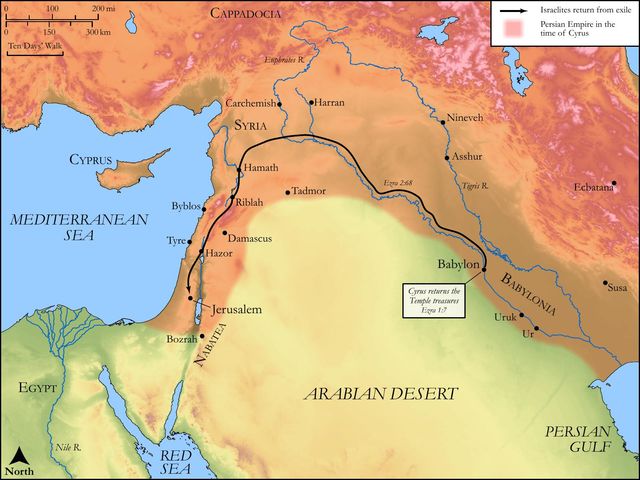
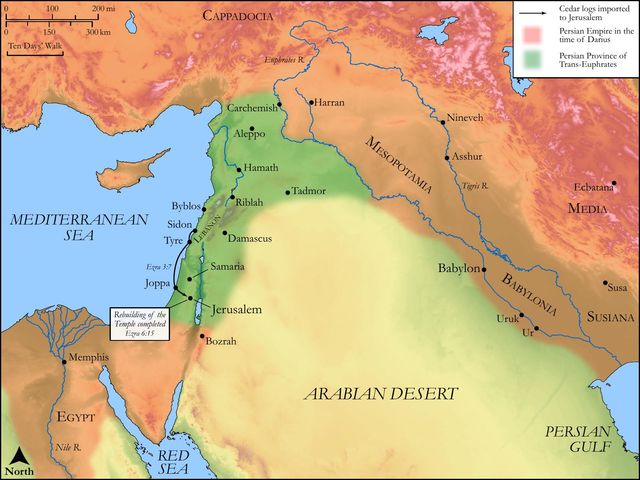
See on the biblical-era maps
Study this verse
Public-domain commentary
Matthew Henry
From his Commentary on the Whole Bible. Henry comments on passages, not single verses — this entry covers Ezra 3:8–13. His three-level outline is real structure in the source text, so it is rendered as structure.
There was no dispute among the returned Jews whether they should build the temple or no; that was immediately resolved on, and that it should be done with all speed; what comfort could they take in their own land if they had not that token of God's presence with them and the record of his name among them? We have here therefore an account of the beginning of that good work. Observe,
I.When it was begun-in the second month of the second year, as soon as ever the season of the year would permit (Ezr 3:8), and when they had ended the solemnities of the passover. They took little more than half a year for making preparation of the ground and materials; so much were their hearts upon it. Note, When any good work is to be done it will be our wisdom to set about it quickly, and not to lose time, yea, though we foresee difficulty and opposition in it. Thus we engage ourselves to it, and engage God for us. Well begun (we say) is half ended.
II.Who began it - Zerubbabel, and Jeshua, and their brethren.
Then the work of God is likely to go on well when magistrates, ministers, and people, are hearty for it, and agree in their places to promote it. It was God that gave them one heart for this service, and it boded well.
III.Who were employed to further it.
They appointed the Levites to set forward the work (Ezr 3:8), and they did it by setting forward the workmen (Ezr 3:9), and strengthening their hands with good and comfortable words. Note, Those that do not work themselves may yet do good service by quickening and encouraging those that do work.
IV.How God was praised at the laying of the foundation of the temple (Ezr 3:10, Ezr 3:11); the priests with the trumpets appointed by Moses, and the Levites with the cymbals appointed by David, made up a concert of music, not to please the ear, but to assist the singing of that everlasting hymn which will never be out of date, and to which our tongues should never be out of tune, God is good, and his mercy endureth for ever, the burden of Ps. 136. Let all the streams of mercy be traced up to the fountain. Whatever our condition is, how many soever our griefs and fears, let it be owned that God is good; and, whatever fails, that his mercy fails not. Let this be sung with application, as here; not only his mercy endures for ever, but it endures for ever towards Israel, Israel when captives in a strange land and strangers in their own land. However it be, yet God is good to Israel (Psa 73:1), good to us. Let the reviving of the church's interests, when they seemed dead, be ascribed to the continuance of God's mercy for ever, for therefore the church continues.
V.How the people were affected.
A remarkable mixture of various affections there was upon this occasion. Different sentiments there were among the people of God, and each expressed himself according to his sentiments, and yet there was no disagreement among them, their minds were not alienated from each other nor the common concern retarded by it.
1.Those that only knew the misery of having no temple at all praised the Lord with shouts of joy when they saw but the foundation of one laid, Ezr 3:11. To them even this foundation seemed great, and was as life from the dead; to their hungry souls even this was sweet. They shouted, so that the noise was heard afar off. Note, We ought to be thankful for the beginnings of mercy, though we have not yet come to the perfection of it; and the foundations of a temple, after long desolations, cannot but be fountains of joy to every faithful Israelite.
2.Those that remembered the glory of the first temple which Solomon built, and considered how far this was likely to be inferior to that, perhaps in dimensions, certainly in magnificence and sumptuousness, wept with a loud voice, Ezr 3:12. If we date the captivity with the first, from the fourth of Jehoiakim, it was about fifty-two years since the temple was burnt; if from Jeconiah's captivity, it was but fifty-nine. So that many now alive might remember it standing; and a great mercy it was to the captives that they had the lives of so many of their priests and Levites lengthened out, who could tell them what they themselves remembered of the glory of Jerusalem, to quicken them in their return. These lamented the disproportion between this temple and the former. And,
(1.)There was some reason for it; and if they turned their tears into the right channel, and bewailed the sin that was the cause of this melancholy change, they did well. Sin sullies the glory of any church or people, and, when they find themselves diminished and brought low, that must bear the blame.
(2.)Yet it was their infirmity to mingle those tears with the common joys and so to cast a damp upon them. They despised the day of small things, and were unthankful for the good they enjoyed, because it was not so much as their ancestors had, though it was much more than they deserved. In the harmony of public joys, let not us be jarring strings. It was an aggravation of the discouragement they hereby gave to the people that they were priests and Levites, who should have known and taught others how to be duly affected under various providences, and not to let the remembrance of former afflictions drown the sense of present mercies. This mixture of sorrow and joy here is a representation of this world. Some are bathing in rivers of joy, while others are drowned in floods of tears. In heaven all are singing, and none sighing; in hell all are weeping and wailing, and none rejoicing; but here on earth we can scarcely discern the shouts of joy from the noise of the weeping. Let us learn to rejoice with those that do rejoice and weep with those that weep, and ourselves to rejoice as though we rejoiced not, and weep as though we wept not.
Historical interpretation
Four Centuries of Reception
2 surviving comments on this verse. Each one is dated, so this reads as a timeline rather than a list.
Select a marker to jump to its quote. Markers stagger vertically where authors wrote within a few decades of each other.
When Jerusalem was demolished by Nebuchadnezzar, the kingdom was destroyed, and no longer were there hereditary successions to the sovereignty as formerly; at that time, moreover, being out of power, the posterity of David were living in captivity. But, when the followers of Salathiel and Zerubbabel returned, they led the people more democratically, transferring the rule henceforth to the priesthood because of the intermingling of the priestly and royal tribes.
In the second year of their coming, etc. He says they came to the temple of God, not because they found it already built, since it was foretold that it had not yet been founded; but it is said that they came to the temple of God, to the place of the temple of God, to the work they desired to rebuild as a temple. Modern Jews are mistaken, who are accustomed to say that the walls of the temple were never overthrown, but only the roof by the Chaldeans; since Ezra clearly writes that the children of the captivity made the temple from its foundations. However, when it is said above that they came to Jerusalem in the seventh month, and here it is added that in the second year of their coming, in the second month, they began the work of the temple; it is clear indeed that in seven months they prepared stones, cement, wood, and other necessary works; and at the beginning of the eighth month they began to apply themselves eagerly to the desired work. For six months were of the first year and the seventh of the following; which, indeed, anyone learned can easily find was done in a great mystery. For the seven pertain to the sabbath, in which the Lord either rested from all His works after creating the world or rested in the tomb after redeeming the world through His passion. The eight pertain to the first of the sabbath, in which He Himself rose from the dead. The seven refer to our hope of a sabbath after death. The eight look forward to the joy of our eternal blessedness after the resurrection. Therefore, because the work of all the elect, who are the temple and house of God, is begun and perfected by the grace of the Holy Spirit and is carried out with every regard and intention of future rest and immortality; it is rightly considered that those who search out the temple, having offered holocausts to God from the seventh month, began to prepare the expenses for building, and, with the preparations made in seven months, commenced the work itself in the eighth. Neither is any other number found at all in the preparation of such a great work than that which symbolically denotes either the sevenfold grace of the Holy Spirit, by which we are assisted while working, or the rest of souls, or the resurrection of bodies, which we, hoping well, work for. Moreover, what the time of forty-six years signifies, in which the temple was built, as also the scripture of the Gospel testifies, is explained in its own place. However, the great devotion of that entire people is shown to us as well to be diligently imitated, since not only the elders, namely Zerubbabel and Joshua, and the remaining priests and Levites, but also all who came from captivity to Jerusalem from the greatest to the least, appointed Levites to hasten the work of the Lord. For they rejoiced to have returned from Babylonian captivity to Jerusalem; and as much as they had loathed the idols and wickedness of the proud city they had escaped, they desired to see the beauty of the city consecrated to the Lord, to which they had merited to come. As much as they abominated the temples of idols, among which they had long been present, they desired the temple of their Creator, which they mourned to be destroyed and from which they had been exiled as captives for so long, to be quickly restored. In the same order, even now, not only bishops and priests but also the congregation of the faithful, that is, the house of God, should diligently teach and appoint those teachers who diligently fulfill the holy work of the Word by counseling. Also, the people themselves, called from the captivity of vices to the vision of true peace, should demand the ministry of the Word from those who know how to impart it. These ministers of the word, that is, Levites, are said to be appointed from twenty years old and above; because it is fitting that those who are presented to preach the word of God to the people should not only show the example of the law by work in action but also keep it undefiled in the purity and integrity of heart before their Creator. Nor should there be any doubt that the state of the Church will take prosperous progress where both the prelates rightly keep their grade by regularly appointing teachers of truth to the people who will instruct them, and the people compel the appointed teachers, by diligently listening and obeying their teachings, not to cease from speaking. But alas, alas! the negligence of our times offends both the greater and the lesser, hindering them, the former from preaching the word, the latter from hearing it, and both from doing it, because we consider less diligently either how great the bitterness of the demonic captivity from which we are rescued is, or how great the solemnity to which we are called, the heavenly Jerusalem, the mother of us all, of which we have already received a pledge in the present Church. Let us, however, consider the excellent works of the Fathers, that we may the more be confounded by our own smallness in action. It follows:
Continue studying Ezra 3:8 across the web’s major study libraries — every link below opens this exact verse, chapter, or book on the destination site.
Read & Compare
 BibleGatewayThis verse in more than 200 translations and 70 languages.
 Bible.comThe YouVersion reader — hundreds of translations, reading plans, and highlights.
 ESV.orgCrossway's official English Standard Version reader.
 NET BibleThe NET translation with 60,000+ translators' notes on every rendering decision.
 STEP BibleTyndale House's free study tool — original text, vocabulary, and scholarly resources.
 BibliaLogos Bible Software's free web reader.
 USCCBThe New American Bible (Revised Edition) with the U.S. bishops' study notes.
Commentaries
 BibleHub CommentariesDozens of classic commentaries on this verse, gathered on one page.
 StudyLightMore than 100 commentary sets — the largest collection on the web.
 BibleRefPlain-English commentary on what this verse means, verse by verse.
 Enduring WordDavid Guzik's free commentary on this chapter, widely used by Bible teachers.
 Bible Study ToolsVerse commentary alongside Greek and Hebrew study aids.
Original Language & Research
- BibleHub InterlinearThe verse word by word — original language, transliteration, and English.
- BibleHub LexiconEvery word's original-language definition and Strong's entry.
 Blue Letter BibleDeep-study tools — Strong's numbers, concordance, and word studies.
 SefariaThe Hebrew text with Rashi and centuries of Jewish commentary.
Sermons, Hymns & Audio


TrulyRandomVerse is not affiliated with these sites and doesn’t control their content. They’re linked because they’re genuinely useful.
Summary
Ezra 3:8 marks a profound milestone in the post-exilic restoration of Jerusalem, precisely dating the commencement of the Temple's reconstruction to the second year and second month following the Jewish exiles' return. Under the unified leadership of Zerubbabel, the civil governor, and Jeshua, the high priest, this verse details the critical organizational step of appointing Levites, aged twenty and older, to meticulously oversee and advance the monumental work of rebuilding the "house of God." This act signifies not merely a physical construction project but a deep communal commitment to re-establishing the spiritual heart of their nation after decades of Babylonian captivity, laying the groundwork for renewed covenant worship and identity.
Context
ShowHideLiterary Context
Ezra 3:8 serves as a crucial bridge in the narrative, following the initial resettlement of the returnees in their towns and, more importantly, the re-establishment of the altar and the resumption of daily sacrifices during the seventh month of their first year back (as detailed in Ezra 3:1-7). This verse signifies a significant progression from the restoration of worship practices to the ambitious, long-term endeavor of rebuilding the physical Temple structure itself. The preceding verses highlight the initial vulnerability of the exiles and their immediate priority of spiritual reconciliation through worship. Verse 8 then meticulously sets the stage for the highly anticipated laying of the Temple's foundation in the subsequent verses (Ezra 3:9-13), underscoring a deliberate, methodical, and divinely-guided process of restoration that moves from spiritual renewal to tangible reconstruction.
Historical & Cultural Context
The events described in Ezra 3:8 transpire approximately 70 years after the devastating destruction of the First Temple by Nebuchadnezzar in 586 BC, and roughly two years after the initial wave of Jewish exiles returned to Jerusalem following Cyrus the Great's decree in 538 BC (as recorded in Ezra 1:1-4). This period was fraught with immense challenges, including a desolate city, hostile neighbors, and the daunting task of rebuilding lives and a national identity. The "house of God" was far more than a mere edifice; it was the symbolic nucleus of their covenant relationship with Yahweh, the sacred space where His presence was believed to dwell among His people. Culturally, the specific appointment of Levites from twenty years old and upward for service resonates deeply with ancient Mosaic traditions concerning the age of readiness for Temple duties (compare Numbers 4:3). This meticulous detail underscores the returnees' profound desire to adhere to established, divinely ordained practices, signaling a commitment to proper order and obedience to the Law.
Key Themes
ShowHideThis verse profoundly contributes to several overarching themes woven throughout the book of Ezra and the broader post-exilic narrative. Firstly, Restoration and Reconstruction is paramount, focusing on the physical rebuilding of the Temple as a tangible manifestation of God's unwavering faithfulness to His covenant people and their spiritual renewal. Secondly, Divine Sovereignty and Providence is vividly demonstrated as God orchestrates the return from exile and empowers His people to rebuild, thereby fulfilling ancient prophecies such as those found in Jeremiah 29:10. Thirdly, the theme of Unified Leadership is powerfully highlighted through the collaborative partnership of Zerubbabel (representing civil authority) and Jeshua (embodying spiritual authority), illustrating the indispensable necessity of collaboration for the successful execution of God's work. Finally, Community Participation and Organized Effort underscores that the rebuilding was not an isolated individual endeavor but a collective responsibility, demanding the active involvement and structured deployment of all who had returned from captivity, particularly the Levites, who were specifically appointed to "set forward the work" of the house of the LORD.
Exposition and Analysis
ShowHideKey Word Analysis
ShowHideThis term (H1004) refers to a dwelling place or building, but in this context, specifically to the Temple in Jerusalem. More than a mere physical structure, it was the central place of worship, sacrifice, and the perceived dwelling place of God's presence among His people. Its destruction was a profound theological and national trauma, and its rebuilding symbolized the restoration of God's covenant relationship with Israel and the re-establishment of their national identity and spiritual life.
This term (H7605) is highly significant in biblical theology, referring to the surviving portion of Israel after judgment or exile. It carries profound connotations of God's faithfulness in preserving a portion of His people, through whom His covenant promises will be fulfilled. In Ezra, it signifies those who responded to God's call to return and rebuild, representing the continuity of God's people despite severe discipline and the preservation of the covenant line.
This verb (H5329) can mean "to excel" or "to be victorious," but in this specific context, particularly in the Piel stem, it means "to oversee," "to supervise," "to direct," or "to lead the work." It indicates that the Levites were not merely laborers but were appointed as managers and facilitators, responsible for organizing, directing, and ensuring the efficient progress of the Temple construction. This highlights the crucial administrative and organizational aspect of their divinely appointed role.
Verse Breakdown
ShowHide"Now in the second year of their coming unto the house of God at Jerusalem, in the second month,"
This precise chronological marker provides a clear and deliberate timeline for the initiation of the Temple rebuilding project. It signifies that after their initial return and the re-establishment of the altar for sacrifices in the seventh month of the first year (Ezra 3:1-2), the community took several months to organize, gather resources, and prepare for the monumental task of constructing the Temple itself, beginning in the spring of the following year. This indicates a well-planned and methodical approach to God's work.
"began Zerubbabel the son of Shealtiel, and Jeshua the son of Jozadak, and the remnant of their brethren the priests and the Levites, and all they that were come out of the captivity unto Jerusalem;"
This clause identifies the key leadership figures and the broad community involvement in the project. Zerubbabel, the civil governor, and Jeshua, the High Priest, represent the essential dual secular and spiritual authority, crucial for a unified national effort. The inclusion of "the remnant of their brethren the priests and the Levites" and "all they that were come out of the captivity" profoundly emphasizes that this was a collective undertaking, involving the entire community of returnees, from spiritual leaders to the common people, signifying a unified commitment to the restoration.
"and appointed the Levites, from twenty years old and upward, to set forward the work of the house of the LORD."
This final clause details the specific organizational step taken: the formal appointment of Levites for a supervisory role. The age requirement ("from twenty years old and upward") aligns with certain aspects of Levitical service in the Mosaic Law, underscoring a return to proper order and consecrated service. Their specific role was not merely physical labor but to "set forward the work," meaning to supervise, direct, and manage the construction, ensuring its efficient, orderly, and God-honoring progress.
Literary Devices
ShowHideEzra 3:8 masterfully employs several literary devices to convey its message of organized restoration. The prominent use of Chronological Markers ("in the second year... in the second month") provides a sense of historical precision and deliberate progression, emphasizing the methodical and intentional nature of the rebuilding effort rather than a haphazard undertaking. The explicit naming of specific leaders, Zerubbabel and Jeshua, highlights the critical importance of individual agency and Leadership in God's redemptive plan, underscoring the necessity of both civil and spiritual guidance. The phrase "the remnant of their brethren the priests and the Levites, and all they that were come out of the captivity" functions as a form of Synecdoche, where a part (the remnant) represents the whole community of returnees, emphasizing the collective and unified nature of the task. Furthermore, the explicit statement that the Levites were appointed "to set forward the work" serves as a powerful Emphasis on their crucial organizational and supervisory role, distinguishing them from mere laborers and highlighting the structured, divinely-ordained approach to this monumental undertaking.
Theological and Thematic Connections
ShowHideEzra 3:8 stands as a profound testament to God's unwavering faithfulness in bringing His people back from exile and empowering them to rebuild, not merely a physical structure, but their spiritual and national identity. It underscores the divine imperative for corporate worship and the centrality of God's dwelling place among His people as a visible sign of His presence and covenant. The organized effort, unified leadership, and community participation depicted in this verse serve as an enduring model for any significant work undertaken for God's kingdom. It powerfully reveals that God works through human agents, calling them to diligent planning, collaborative effort, and consecrated service to fulfill His sovereign purposes, even in the face of daunting challenges. The re-establishment of the Temple was not merely an architectural project but a profound act of spiritual renewal, signifying the restoration of proper worship and a renewed covenant relationship with Yahweh.
Reflection and Application
ShowHideEzra 3:8 offers profound and enduring lessons for contemporary believers and the church today. It serves as a powerful reminder that significant spiritual undertakings, whether personal growth or corporate ministry, demand not only fervent zeal but also meticulous planning, organized effort, and dedicated, collaborative leadership. Just as Zerubbabel and Jeshua worked in tandem, effective ministry often thrives when spiritual visionaries and practical administrators collaborate seamlessly, fostering unity, clarity of purpose, and efficient direction. The appointment of the Levites to "set forward the work" illustrates the vital importance of identifying, equipping, and empowering individuals for specific roles within the body of Christ, recognizing that every member has unique gifts and a vital contribution to make to the collective mission. This verse calls us to consider our own indispensable part in the ongoing work of God's kingdom, whether through direct service, faithful financial support, intercessory prayer, or diligent oversight, understanding that true spiritual "rebuilding" requires the collective commitment and active participation of the entire community of faith. It encourages perseverance in the face of daunting tasks, trusting that God sovereignly provides the means and the people to accomplish His will, even when the initial steps seem small or the challenges appear immense.
Questions for Reflection
ShowHideFAQ
ShowHideWhy is the "second year, second month" so precisely mentioned in Ezra 3:8?
ShowHideThe precise dating ("in the second year of their coming... in the second month") is highly significant because it highlights the methodical and deliberate nature of the Temple rebuilding project. It indicates that after their initial return and the re-establishment of the altar for sacrifices in the seventh month of the first year (as described in Ezra 3:1-7), the community took several months to organize, gather resources, and prepare for the monumental task of constructing the Temple structure itself. This meticulous timeline demonstrates that the work was not haphazard but a well-planned undertaking, reflecting a deep commitment to order, proper timing, and diligent preparation in God's work.
What was the significance of Zerubbabel and Jeshua's joint leadership?
ShowHideZerubbabel, as the civil governor, represented the political and administrative authority, while Jeshua, the High Priest, embodied the spiritual and religious authority. Their joint leadership was absolutely crucial for the success of the rebuilding project. It powerfully symbolized the essential unity of purpose between secular governance and spiritual devotion, both of which were indispensable for the holistic restoration of the Jewish community. Their collaboration ensured that the physical rebuilding of the Temple was intricately intertwined with the spiritual renewal of the people, demonstrating that God's work requires both practical organization and consecrated worship, a theme evident throughout the book of Ezra.
Why were Levites specifically appointed, and what does "set forward the work" mean in this context?
ShowHideThe Levites were traditionally responsible for the care, maintenance, and service of the Tabernacle and later the Temple. Their specific appointment in Ezra 3:8, from twenty years old and upward, reflects a conscious return to established Mosaic principles concerning their age of service (Numbers 4:3). The phrase "to set forward the work" (Hebrew: natsach) means "to oversee," "to supervise," or "to direct." This indicates that the Levites were not merely common laborers but were given a managerial and organizational role in the construction. They were tasked with ensuring the efficient progress and proper execution of the Temple rebuilding, leveraging their historical connection to Temple service for this new, vital phase of restoration.
Christ-Centered Fulfillment
ShowHideEzra 3:8, detailing the diligent rebuilding of the physical Temple in Jerusalem, powerfully foreshadows the ultimate Temple and the new covenant reality found supremely in Jesus Christ. While the returned exiles meticulously worked to restore a stone structure, the New Testament profoundly reveals that Jesus Himself is the true and ultimate Temple, the very dwelling place of God among humanity, a truth He dramatically declared when speaking of His resurrection (as recorded in John 2:19-21). The diligent organization, unified leadership, and communal effort seen in Ezra point to the far greater work of Christ, who, through His sacrificial death and glorious resurrection, builds His Church—a spiritual Temple composed of living stones, believers from every tribe, tongue, people, and nation (1 Peter 2:5). The dual leadership of Zerubbabel and Jeshua, representing civil and spiritual authority, finds its perfect, singular embodiment in Christ, who is both the promised King and the eternal High Priest, establishing a new covenant and an everlasting kingdom (Hebrews 8:1-2). The "remnant" returning from physical exile prefigures the spiritual remnant, the Church, called out of the exile of sin and darkness into God's marvelous light, to be a holy habitation for God by the Spirit (Ephesians 2:19-22). Thus, the physical restoration in Ezra serves as a tangible, historical type of the profound spiritual restoration and new creation accomplished through Christ, the true and ultimate builder of His Church.