


Ezra 10:9
- וַיִּקָּבְצוּvai·yi·ka·ve·Tzuand they assembledH6908Conj-w ¦ V-Niphal-ConsecImperf-3mpVerb Niphal Consecutive Imperfect 3rd Plural Masculineוַandיִּקָּבְצוּthey assembled
- כָלkholallH3605N-mscNoun Singular Masculine Construct
- אַנְשֵׁי'an·shei[the] people ofH582N-mpcNoun Plural Masculine Construct
- יְהוּדָהye·hu·DahJudahH3063N-properNoun Proper Location
- וּבִנְיָמִןu·vin·ya·Minand BenjaminH1144Conj-w ¦ N-proper-mNoun Proper MasculineוּandבִנְיָמִןBenjamin
- יְרוּשָׁלִַםye·ru·sha·LimJerusalemH3389N-properNoun Proper Location
- לִשְׁלֹשֶׁתlish·Lo·shetto [the] threeH7969Prep-l ¦ Adj-cscAdjective Numerical Singular common gender Constructלִtoשְׁלֹשֶׁת[the] three
- הַיָּמִיםhai·ya·Mimthe daysH3117Art ¦ N-mpNoun Plural Masculine Absoluteהַtheיָּמִיםdays
- הוּאhu'itH1931Pro-3msPronoun Personal 3rd Singular Masculine
- חֹדֶשׁCho·desh[was the] monthH2320N-msNoun Singular Masculine Absolute
- הַתְּשִׁיעִיha·te·shi·'I<the> ninthH8671Art ¦ Adj-msAdjective Numerical Position Singular Masculine Absoluteהַ<the>תְּשִׁיעִיninth
- בְּעֶשְׂרִיםbe·'es·Rimon [day] twentyH6242Prep-b ¦ Adj-mpAdjective Numerical Plural Masculine Absoluteבְּonעֶשְׂרִים[day] twenty
- בַּחֹדֶשׁba·Cho·deshin the monthH2320Prep-b ¦ N-msNoun Singular Masculine Absoluteבַּin theחֹדֶשׁmonth
- וַיֵּשְׁבוּvai·ye·she·Vuand they satH3427Conj-w ¦ V-Qal-ConsecImperf-3mpVerb Qal Consecutive Imperfect 3rd Plural Masculineוַandיֵּשְׁבוּthey sat
- כָלkholallH3605N-mscNoun Singular Masculine Construct
- הָעָםha·'Amthe peopleH5971Art ¦ N-msNoun Singular Masculine Absoluteהָtheעָםpeople
- בִּרְחוֹבbir·chOvin [the] open place ofH7339Prep-b ¦ N-fscNoun Singular Feminine Constructבִּinרְחוֹב[the] open place of
- בֵּיתbeit[the] house ofH1004N-mscNoun Singular Masculine Construct
- הָאֱלֹהִיםha·'E·lo·Him<the> GodH430Art ¦ N-mpNoun Plural Masculine Absoluteהָ<the>אֱלֹהִיםGod
- מַרְעִידִיםmar·'i·DimtremblingH7460V-Hiphil-Prtcpl-mpVerb Hiphil Participle Plural Masculine Absolute
- עַל'alonH5921PrepPreposition
- הַדָּבָרha·da·Varthe matterH1697Art ¦ N-msNoun Singular Masculine Absoluteהַtheדָּבָרmatter
- וּמֵהַגְּשָׁמִיםu·me·ha·ge·sha·Mimand from the rainsH1653Conj-w ¦ Prep-m ¦ Art ¦ N-mpNoun Plural Masculine Absoluteוּandמֵfromהַtheגְּשָׁמִיםrains
English is a literal word-by-word gloss of the Hebrew, not the KJV's wording. Why?
This is the original text the KJV's translators worked from — each Hebrew word with its own literal English meaning in this verse, prepared by scholars at Tyndale House, Cambridge. The KJV translates whole sentences, not word by word, so its wording differs: one Hebrew word can become several English words, and the KJV may choose “the LORD” where the gloss reads “Yahweh”. Both are faithful — they answer different questions. For the KJV's own rendering, switch to the KJV text.
Details
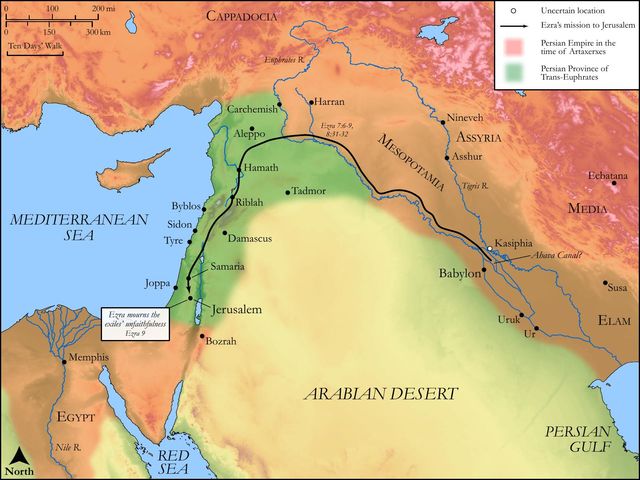
See on the biblical-era map
Study this verse
Public-domain commentary
Matthew Henry
From his Commentary on the Whole Bible. Henry comments on passages, not single verses — this entry covers Ezra 10:6–14.
We have here an account of the proceedings upon the resolutions lately taken up concerning the strange wives; no time was lost; they struck when the iron was hot, and soon set the wheels of reformation a-going. 1. Ezra went to the council-chamber where, it is probable, the priests used to meet upon public business; and till he came thither (so bishop Patrick thinks it should be read), till he saw something done, and more likely to be done, for the redress of this grievance, he did neither eat nor drink, but continued mourning. Sorrow for sin should be abiding sorrow; be sure to let it continue till the sin be put away. 2. He sent orders to all the children of the captivity to attend him at Jerusalem within three days (Ezr 10:7, Ezr 10:8); and, being authorized by the king to enforce his orders with penalties annexed (Ezr 7:26), he threatened that whosoever refused to obey the summons should forfeit his estate and be outlawed. The doom of him that would not attend on this religious occasion should be that his substance should, in his stead, be for ever after appropriated to the service of their religion, and he himself, for his contempt, should for ever after be excluded from the honours and privileges of their religion; he should be excommunicated. 3. Within the time limited the generality of the people met at Jerusalem and made their appearance in the street of the house of God, Ezr 10:9. Those that had no zeal for the work they were called to, nay, perhaps had a dislike to it, being themselves delinquents, yet paid such a deference to Ezra's authority, and were so awed by the penalty, that they durst not stay away. 4. God gave them a token of his displeasure in the great rain that happened at that time (Ezr 10:9 and again Ezr 10:13), which perhaps kept some away, and was very grievous to those that met in the open street. When they wept the heavens wept too, signifying that, though God was angry with them for their sin, yet he was well pleased with their repentance, and (as it is said, Jdg 10:16) his soul was grieved for the misery of Israel; it was also an indication of the good fruits of their repentance, for the rain makes the earth fruitful. 5. Ezra gave the charge at this great assize. He told them upon what account he called them together now, that it was because he found that since their return out of captivity they had increased the trespass of Israel by marrying strange wives, had added to their former sins this new transgression, which would certainly be a means of again introducing idolatry, the very sin they had smarted for and which he hoped they had been cured of in their captivity; and he called them together that they might confess their sin to God, and, having done that, might declare themselves ready and willing to do his pleasure, as it should be made known to them (which all those will do that truly repent of what they have done to incur his displeasure), and particularly that they might separate themselves from all idolaters, especially idolatrous wives, Ezr 10:10, Ezr 10:11. On these heads, we may suppose, he enlarged, and probably made such another confession of the sin now as he made Ezr 9:1-15, to which he required them to say Amen. 6. The people submitted not only to Ezra's jurisdiction in general, but to his inquisition and determination in this matter: "As thou hast said, so must we do, Ezr 10:12. We have sinned in mingling with the heathen, and have thereby been in danger, not only of being corrupted by them, for we are frail, but of being lost among them, for we are few; we are therefore convinced that there is an absolute necessity of our separating from them again." There is hope concerning people when they are convinced, not only that it is good to part with their sins, but that it is indispensably necessary: we must do it, or we are undone. 7. It was agreed that this affair should be carried on, not in a popular assembly, nor that they should think to go through with it all on a sudden, but that a court of delegates should be appointed to receive complaints and to hear and determine upon them. It could not be done at this time, for it was not put into a method, nor could the people stand out because of the rain. The delinquents were many, and it would require time to discover and examine them. Nice cases would arise, which could not be adjudged without debate and deliberation, Ezr 10:13. "And therefore let the crowd be dismissed, and the rulers stand to receive informations; let them proceed city by city, and let the offenders be convicted before them in the presence of the judges and elders of their own city; and let them be entrusted to see the orders executed. Thus take time and we shall have done the sooner; whereas, if we do it in a hurry, we shall do it by halves, Ezr 10:14. If, in this method, a thorough reformation be made, the fierce wrath of God will be turned from us, which, we are sensible, is ready to break forth against us for this transgression." Ezra was willing that his zeal should be guided by the people's prudence, and put the matter into this method; he was not ashamed to own that the advice came from them, any more than he was to comply with it.
Historical interpretation
Five Centuries of Reception
4 surviving comments on this verse. Each one is dated, so this reads as a timeline rather than a list.
Select a marker to jump to its quote. Markers stagger vertically where authors wrote within a few decades of each other.
If these things are so, it is certain that believers contracting marriages with Gentiles are guilty of fornication, and are to be excluded from all communication with the brotherhood, in accordance with the letter of the apostle, who says that “with persons of that kind there is to be no taking of food even.” [To His Wife 2.3 ANF v.4]
I will say what the Apostle has taught me, that they are not on the side of righteousness, but of iniquity: not of light, but of darkness: that they do not belong to Christ, but to Belial: that they are not temples of the living God, but shrines and idols of the dead. And, if you wish to see more clearly how utterly unlawful it is for a Christian woman to marry a Gentile, consider what the same Apostle says, [1 Corinthians 7:39] "A wife is bound for so long time as her husband lives: but if the husband be dead, she is free to be married to whom she will; only in the Lord," that is, to a Christian. He who allows second and third marriages in the Lord, forbids first marriages with a Gentile. Whence Abraham also makes his servant swear upon his thigh, that is, on Christ, Who was to spring from his seed, that he would not bring an alien-born as a wife for his son Isaac. And Ezra checked an offense of this kind against God by making his countrymen put away their wives.
If this is the Lord's commandment, in both the Old Testament and the New, and this is what the Lord commands, and this is what the apostle teaches, namely, that only spouses of the same religions and faith may remain joined. [De coniugiis adulterinis, PL 40.25.465]
He is the new moon, on the twentieth day of the month, etc. The ninth month is the same which the Hebrews call Casleu, and the Romans call December, which comes in the middle of winter and is rainy and stormy, as anyone would know. Therefore, it should be noted more diligently that when the people gathered in mid-winter, they were reminded to tremble from sin and rains. For when they saw that rains were falling even more than usual during the season of rains, they returned to their conscience and understood this to be due to their crimes and feared the celestial wrath that would come, being warned by the disturbance in the atmosphere. Therefore, they did not presume to conduct their affairs in private houses but gathered in the square of the house of the Lord, having assumed the habit of penitence and humility. This is mentioned for those who, although the elements are disturbed, and either by the noise of the winds, the flooding of the rains, the heaps of snow, the heat of drought, or even the ruin of men or animals increasing from above, and with the same Judge by clear signs threatening the force of His wrath, do not inquire at all about the correction of morals, by which they might please the Judge and evade the impending plague, but only diligently consider by what skill they might either avoid or overcome the adversities that rage outside due to sins. But the people sat in the square of the house of God, that is, around the priest’s court, which was surrounded everywhere by the house of God itself, as we taught above; having around it on every side in a square the spacious houses of the courts, in which the people could stand when necessary due to the rains and still see what was happening at the temple gates or around the temple. For the inner walls were made with columns up to the ground, and the outer walls were solid.
Continue studying Ezra 10:9 across the web’s major study libraries — every link below opens this exact verse, chapter, or book on the destination site.
Read & Compare
 BibleGatewayThis verse in more than 200 translations and 70 languages.
 Bible.comThe YouVersion reader — hundreds of translations, reading plans, and highlights.
 ESV.orgCrossway's official English Standard Version reader.
 NET BibleThe NET translation with 60,000+ translators' notes on every rendering decision.
 STEP BibleTyndale House's free study tool — original text, vocabulary, and scholarly resources.
 BibliaLogos Bible Software's free web reader.
 USCCBThe New American Bible (Revised Edition) with the U.S. bishops' study notes.
Commentaries
 BibleHub CommentariesDozens of classic commentaries on this verse, gathered on one page.
 StudyLightMore than 100 commentary sets — the largest collection on the web.
 BibleRefPlain-English commentary on what this verse means, verse by verse.
 Enduring WordDavid Guzik's free commentary on this chapter, widely used by Bible teachers.
 Bible Study ToolsVerse commentary alongside Greek and Hebrew study aids.
Original Language & Research
- BibleHub InterlinearThe verse word by word — original language, transliteration, and English.
- BibleHub LexiconEvery word's original-language definition and Strong's entry.
 Blue Letter BibleDeep-study tools — Strong's numbers, concordance, and word studies.
 SefariaThe Hebrew text with Rashi and centuries of Jewish commentary.
Sermons, Hymns & Audio


TrulyRandomVerse is not affiliated with these sites and doesn’t control their content. They’re linked because they’re genuinely useful.
Summary
Ezra 10:9 presents a powerful tableau of national repentance, depicting the immediate and solemn assembly of the men of Judah and Benjamin in Jerusalem. This pivotal gathering, convened within three days of Ezra's profound prayer of confession, occurred in the open square before the Temple during the cold, rainy ninth month. The verse vividly captures the deep spiritual distress and conviction of the people, evidenced by their collective "trembling" in the face of their widespread sin of intermarriage, a spiritual turmoil amplified by the physical discomfort of the "great rain," thereby setting the stage for a dramatic act of covenant renewal and purification.
Context
ShowHideLiterary Context
Ezra 10:9 serves as the crucial turning point following Ezra's agonizing prayer of confession and lament in Ezra 9:5-15, where he passionately intercedes for the people's egregious sin of intermarriage. This prayer, offered in profound humility before the Temple, catalyzes a corporate response from the community. The preceding chapters, particularly Ezra 9, detail Ezra's shock and despair upon discovering that the returned exiles, including priests and Levites, had defiled themselves by marrying foreign women, a direct violation of God's explicit commands designed to preserve Israel's covenant purity. Verse 9 marks the transition from Ezra's individual distress and intercession to the people's collective conviction and willingness to act. It initiates the process of national purification and covenant renewal that unfolds throughout the remainder of Ezra 10, demonstrating a profound shift from passive acknowledgment to active, corporate repentance.
Historical & Cultural Context
This significant event transpired during the post-exilic period, around 458 BC, approximately 80 years after the first wave of exiles returned from Babylon under Zerubbabel. The community in Jerusalem was still fragile, striving to re-establish its identity and fidelity as God's covenant people in the land. The prohibition against intermarriage was not a mere social custom but a foundational theological imperative, deeply embedded in the Mosaic Law (e.g., Deuteronomy 7:3-4), intended to safeguard Israel's spiritual distinctiveness and prevent assimilation into pagan idolatry and practices. The gathering "in the street of the house of God" underscores the public and communal nature of the sin and the required repentance, occurring in a sacred public space that emphasized the national scope of the transgression. The mention of the "ninth month" (Kislev, corresponding to November-December) is crucial, as this was the height of the rainy season in Judah, making the assembly physically uncomfortable. This environmental detail may have amplified the sense of divine displeasure or the severity of the situation, suggesting that even the elements bore witness to their spiritual turmoil and the gravity of their sin.
Key Themes
ShowHideEzra 10:9 powerfully articulates several critical themes pertinent to the post-exilic community and beyond. First, Urgency and Obedience are vividly portrayed by the swift gathering "within three days," highlighting the people's immediate and serious response to Ezra's profound conviction and their recognition of the gravity of their sin. This rapid assembly demonstrates a profound willingness to obey God's commands. Second, Profound Conviction and Repentance are central, underscored by the people's collective "trembling." This is not merely physical discomfort from the rain but a deep spiritual fear and awe in the presence of God, a genuine sorrow over their disobedience that serves as a necessary precursor to true repentance and a turning back to God, as seen in passages like Psalm 51:17. Third, Community Accountability is paramount, as "all the men of Judah and Benjamin" gather, emphasizing that the sin of intermarriage was a collective failing requiring a communal effort for spiritual cleansing and restoration, reflecting the corporate nature of the covenant relationship with God (Joshua 7:1-12). Finally, the theme of Divine Presence and Discomfort is conveyed by the setting at the "house of God" and the "great rain," which can be interpreted as both a physical challenge and a symbolic reflection of the spiritual turmoil, creating an atmosphere conducive to humility and confession before a holy God.
Exposition and Analysis
ShowHideKey Word Analysis
ShowHideThis verb (H7460) signifies a deep, inward shuddering or shaking, often associated with fear, awe, or anxiety in the presence of a powerful, overwhelming, or divine entity. It transcends mere physical shivering from the cold rain, denoting a profound spiritual apprehension and conviction regarding their sin. This "trembling" indicates a broken and contrite spirit, a holy dread that acknowledges God's holiness and the gravity of their disobedience, serving as a necessary precursor to genuine repentance and change.
This phrase specifically refers to the Jerusalem Temple, the central place of worship and divine presence for the Israelites. The gathering "in the street of the house of God" indicates a public, solemn assembly convened in the most sacred of spaces, the avenue or area (H7339, rᵉchôb) directly in front of the Temple. This location reinforces the spiritual nature of the crisis and the need for God's intervention and forgiveness, underscoring that the sin was against God and the covenant, and therefore, repentance must occur in His immediate presence.
The term "great rain" refers to heavy, abundant rainfall. In the context of the ninth month (Kislev), this was the typical rainy season in Judah. While physically uncomfortable, the "great rain" serves multiple functions. It might symbolize divine displeasure or the weight of their spiritual burden, mirroring the internal turmoil with external discomfort. It also adds to the solemnity and urgency of the occasion, perhaps even preventing distractions and focusing the people's minds on the serious "matter" (H1697, dâbâr) at hand, creating an atmosphere conducive to deep introspection and confession.
Verse Breakdown
ShowHide"Then all the men of Judah and Benjamin gathered themselves together unto Jerusalem within three days."
This opening clause highlights the immediate and comprehensive response to Ezra's public lament and the subsequent call to action initiated by Shecaniah (Ezra 10:2-4). The inclusion of "all the men of Judah and Benjamin" emphasizes the national, corporate nature of the sin and the collective commitment to address it, representing the entire post-exilic community. The swiftness of their assembly "within three days" underscores the urgency and seriousness with which the community perceived the matter, indicating a profound conviction and willingness to obey. Jerusalem, as the religious and political capital, was the natural and necessary place for such a national convocation.
"It [was] the ninth month, on the twentieth [day] of the month;"
This precise dating (the 20th day of Kislev, roughly November/December) grounds the narrative in a specific historical moment, adding verisimilitude to the account. The ninth month was known for its cold, wet weather, a detail that becomes significant in the subsequent clause, setting the atmospheric conditions for the dramatic scene that follows and contributing to the overall sense of solemnity and gravity.
"and all the people sat in the street of the house of God, trembling because of [this] matter, and for the great rain."
This final clause paints a vivid picture of the assembly. "All the people" reiterates the widespread participation, signifying a unified national response. To "sat in the street of the house of God" indicates a public gathering in the open area or plaza directly in front of the Temple, a sacred and prominent location, underscoring the spiritual nature of their assembly. The key emotional and spiritual state is "trembling," which signifies deep spiritual conviction and awe in the face of their sin. This trembling is attributed to two factors: "because of [this] matter" (the grave sin of intermarriage and its covenant implications) and "for the great rain." The physical discomfort of the heavy rain likely intensified their sense of vulnerability and solemnity, perhaps even being perceived as a divine sign or a mirror of their internal distress, creating an atmosphere ripe for repentance and confession before a holy God.
Literary Devices
ShowHideEzra 10:9 masterfully employs several literary devices to convey the gravity and emotional intensity of the scene. The repeated use of "all" in phrases like "all the men of Judah and Benjamin" and "all the people" functions as Hyperbole, emphasizing the widespread and unified nature of the assembly, suggesting a near-universal response to Ezra's call and the collective weight of the sin, even if not every single individual was literally present. Imagery is richly employed, painting a vivid sensory picture of the gathered multitude "sitting in the street of the house of God," exposed to the "great rain," and "trembling." This sensory detail allows the reader to viscerally experience the physical discomfort and the profound spiritual distress of the moment. The "great rain" itself functions as potent Symbolism, potentially representing divine displeasure, the cleansing power of repentance, or simply mirroring the internal turmoil, sorrow, and conviction of the people. The powerful Juxtaposition of the sacred location ("house of God") with the physical discomfort of the rain and the spiritual trembling creates a profound sense of Pathos, evoking empathy for the people's plight and highlighting the severe impact of their sin on their relationship with God and their covenant identity.
Theological and Thematic Connections
ShowHideEzra 10:9 profoundly underscores the theological truth that sin, particularly corporate sin, carries tangible and often uncomfortable consequences. The people's "trembling" and their endurance of the "great rain" in the sacred presence of God's house vividly illustrate the immense weight of their covenant transgression. The sin of intermarriage was not a minor social issue but a direct and egregious violation of God's commands, which were meticulously designed to preserve Israel's holiness and distinctiveness as a separated people, thereby preventing spiritual idolatry and assimilation into pagan practices. This solemn gathering signifies a crucial moment of national repentance, where the community collectively acknowledges its profound failure to uphold God's covenant and earnestly seeks to realign itself with His divine will. It powerfully highlights God's unwavering expectation of holiness from His people and His readiness to respond with grace to genuine, corporate contrition. The severity of their response reflects a deep understanding that their very identity, spiritual purity, and future as God's chosen nation were inextricably dependent upon their fidelity to Him.
Reflection and Application
ShowHideEzra 10:9 offers timeless and profound lessons for believers today, both individually and corporately. The swift and decisive response of the people to Ezra's conviction highlights the critical importance of not delaying when confronted with sin, but rather addressing it with urgency and seriousness. Their "trembling" and willingness to endure significant physical discomfort in the "great rain" demonstrate that true repentance often involves deep emotional conviction, a profound sense of brokenness, and a readiness to embrace discomfort or sacrifice for the sake of spiritual purity and restoration. This passage challenges us to engage in a rigorous self-examination of our own lives and our faith communities for any areas of compromise that might dilute our spiritual identity or lead us away from God's explicit commands. Just as the Israelites were called to maintain distinctiveness from the surrounding pagan cultures, so too are believers called to be "in the world but not of the world," carefully avoiding entanglements that could compromise our exclusive devotion to Christ and His kingdom. The corporate nature of this repentance reminds us that sin, even when seemingly individual, often has repercussions for the entire body of Christ, and therefore, collective confession and decisive action are sometimes necessary for the health, vitality, and witness of the church. We are called to actively support and participate in communal efforts to uphold biblical standards, even when such commitment requires difficult decisions or personal sacrifice.
Questions for Reflection
ShowHideFAQ
ShowHideWhy was intermarriage considered such a grave sin in Ezra's time?
ShowHideIntermarriage was considered a grave sin primarily because it fundamentally threatened the spiritual purity and distinct identity of Israel as God's covenant people. The Mosaic Law explicitly forbade it (e.g., Deuteronomy 7:3-4), not out of racial prejudice, but because foreign spouses inevitably brought their pagan gods and idolatrous practices into the Israelite community. This inevitably led to spiritual syncretism and apostasy, drawing the Israelites away from exclusive worship of Yahweh. After the Babylonian exile, the returned remnant was particularly vulnerable to such influences, having just suffered divine judgment for past idolatry. Maintaining a distinct, holy identity was crucial for their survival and their mission as a light to the nations. The sin of intermarriage directly undermined the covenant relationship and the very purpose of their existence as God's chosen people, jeopardizing their spiritual future.
What is the significance of the "great rain" mentioned in the verse?
ShowHideThe "great rain" (Hebrew: geshem gadol) serves multiple layers of significance in Ezra 10:9. Physically, it grounds the event in historical reality, indicating that the assembly took place during the cold, wet season (the ninth month, Kislev), which was typical for that time of year. Symbolically, it can be interpreted as mirroring the internal turmoil and distress of the people, a physical manifestation of their spiritual discomfort and the immense weight of their sin. Some commentators suggest it might even be a divine sign, a tangible expression of God's displeasure or a means of intensifying the solemnity and urgency of the occasion, preventing distractions. The discomfort it caused likely focused the people's minds on the gravity of the "matter" at hand, fostering an atmosphere conducive to genuine repentance and confession before God, demonstrating their earnestness even in adverse conditions.
How does this corporate repentance in Ezra relate to individual faith and responsibility today?
ShowHideThe corporate repentance in Ezra 10:9 highlights the profound interconnectedness of individual and communal faith. While salvation is ultimately personal, sin often has communal repercussions, and spiritual health is a shared responsibility within the body of Christ. The emphasis on "all" in the verse underscores that even if individuals felt their intermarriage was a private matter, its collective prevalence impacted the entire nation's covenant standing before God. For believers today, this means recognizing that our individual choices and spiritual disciplines contribute significantly to the overall spiritual atmosphere and purity of our families, churches, and even broader society. Just as the Israelites gathered to address a collective sin, the church is called to corporate repentance when it deviates from God's standards or compromises its witness. This involves individuals taking personal responsibility for their sins while also actively participating in and supporting communal efforts to uphold biblical truth, purity, and accountability. It serves as a powerful reminder that true spiritual revival often begins with individual conviction that blossoms into corporate transformation and renewed commitment to Christ.
Christ-Centered Fulfillment
ShowHideEzra 10:9, with its vivid depiction of a people trembling under the crushing weight of sin and enduring the physical discomfort of the "great rain" before the "house of God," powerfully foreshadows the ultimate and perfect solution to humanity's pervasive sin problem found exclusively in Jesus Christ. The Old Covenant, with its rigorous laws and sacrificial rituals, could effectively expose sin and demand repentance, but it could never provide a perfect, complete, and lasting cleansing. The "trembling" of the people before the Temple underscores their inherent inability to stand perfectly righteous or pure before a holy God on their own merits. This poignant scene of both physical and spiritual discomfort points directly to the profound and desperate need for a divine mediator who could truly bridge the infinite gap between a sinful humanity and a perfectly holy God. Jesus, as the true and ultimate Lamb of God who takes away the sin of the world, perfectly fulfills the Law's demands and offers the definitive, once-for-all sacrifice. His precious blood, shed on the cross, cleanses us from all unrighteousness, providing a purity and reconciliation that external rituals, physical discomfort, or the cleansing power of rain could never achieve (Hebrews 9:11-14). Through Him, we are no longer left to tremble in fear and judgment, but are graciously invited to approach God's throne with boldness and confidence, having been made righteous and acceptable by His grace (Hebrews 4:16). The deep desire for spiritual purity and separation from the world's defilements, so powerfully evident in Ezra's time, finds its complete and perfect realization in Christ, who lovingly sanctifies and cleanses His church to be "holy and blameless" (Ephesians 5:25-27). He is the true "house of God" (John 2:19-21), the living temple where genuine cleansing, reconciliation, and eternal restoration are found, not through physical discomfort or human effort, but through His perfect, sufficient, and eternal sacrifice.