


Ezra 10:14
Bible text: King James Version (1769 Blayney text) · Public domain
Bible text: King James Version with Strong's numbers · Public domain
Bible text: Berean Standard Bible · Public domain
Bible text: American Standard Version (1901) · Public domain
Bible text: World English Bible, Messianic edition · Public domain
Bible text: Geneva Bible (1599) · Public domain
Bible text: Young's Literal Translation · Public domain
- יַעֲמְדוּya·'am·dulet them standH5975V-Qal-Imperf-3mpVerb Qal Imperfect 3rd Plural Masculine
- נָאna'pleaseH4994PrtParticle Interjection
- שָׂרֵינוּSa·rei·nuour leadersH8269N-mpc ¦ 1cpNoun Plural Masculine Constructשָׂרֵיleadersנוּour
- לְכָלle·kholfor allH3605Prep-l ¦ N-mscNoun Singular Masculine Constructלְforכָלall
- הַקָּהָלha·ka·Halthe assemblyH6951Art ¦ N-msNoun Singular Masculine Absoluteהַtheקָּהָלassembly
- וְכֹלve·Kholand every [one]H3605Conj-w ¦ N-msNoun Singular Masculine Absoluteוְandכֹלevery [one]
- אֲשֶׁר'a·SherwhoH834RelParticle Relative
- בֶּעָרֵינוּbe·'a·Rei·nu[is] in <the> our citiesH5892Prep-b ¦ N-mpc ¦ 1cpNoun Plural Masculine Constructבֶּ[is] in <the>עָרֵיcitiesנוּour
- הַהֹשִׁיבha·ho·Shivwho he has marriedH3427Art ¦ V-Hiphil-Perf-3msVerb Hiphil Perfect 3rd Singular Masculineהַwhoהֹשִׁיבhe has married
- נָשִׁיםna·ShimwomenH802N-mpNoun Plural Masculine Absolute
- נָכְרִיּוֹתna·khe·ri·yOtforeignH5237Adj-fpAdjective Plural Feminine Absolute
- יָבֹאya·Vo'let him comeH935V-Qal-Imperf-3msVerb Qal Imperfect 3rd Singular Masculine
- לְעִתִּיםle·'i·Timto timesH6256Prep-l ¦ N-cpNoun Plural common gender Absoluteלְtoעִתִּיםtimes
- מְזֻמָּנִיםme·zu·ma·NimappointedH2163V-Pual-PassPrtcpl-mpVerb Pual Participle Passive Plural Masculine Absolute
- וְעִמָּהֶםve·'i·ma·Hemand with themH5973Conj-w ¦ Prep ¦ 3mpPrepositionוְandעִמָּwithהֶםthem
- זִקְנֵיzik·nei[the] elders ofH2205Adj-mpcAdjective Plural Masculine Construct
- עִיר'ira cityH5892N-fsNoun Singular Feminine Absolute
- וָעִירva·'Irand a cityH5892Conj-w ¦ N-fsNoun Singular Feminine Absoluteוָandעִירa city
- וְשֹׁפְטֶיהָve·sho·fe·Tei·haand its judgesH8199Conj-w ¦ V-Qal-Prtcpl-mp ¦ 3fsVerb Qal Participle Plural Masculine Constructוְandשֹׁפְטֶיjudgesהָits
- עַד'aduntilH5704PrepPreposition
- לְהָשִׁיבle·ha·Shiv<to> turn backH7725Prep-l ¦ V-Hiphil-InfVerb Hiphil Infinitive Constructלְ<to>הָשִׁיבturn back
- חֲרוֹןcha·Ron[the] burning ofH2740N-mscNoun Singular Masculine Construct
- אַף'af[the] anger ofH639N-mscNoun Singular Masculine Construct
- אֱלֹהֵינוּ'e·lo·Hei·nuour GodH430N-mpc ¦ 1cpNoun Plural Masculine ConstructאֱלֹהֵיGodנוּour
- מִמֶּנּוּmi·Me·nufrom usH4480Prep ¦ 1cpPrepositionמִמֶּfromנּוּus
- עַד'aduntilH5704PrepPreposition
- לַדָּבָרla·da·Varto the matterH1697Prep-l ¦ N-msNoun Singular Masculine Absoluteלַto theדָּבָרmatter
- הַזֶּהha·Zeh<the> thisH2088Art ¦ PrtParticle Demonstrativeהַ<the>זֶּהthis
English is a literal word-by-word gloss of the Hebrew, not the KJV's wording. Why?
This is the original text the KJV's translators worked from — each Hebrew word with its own literal English meaning in this verse, prepared by scholars at Tyndale House, Cambridge. The KJV translates whole sentences, not word by word, so its wording differs: one Hebrew word can become several English words, and the KJV may choose “the LORD” where the gloss reads “Yahweh”. Both are faithful — they answer different questions. For the KJV's own rendering, switch to the KJV text.
Details
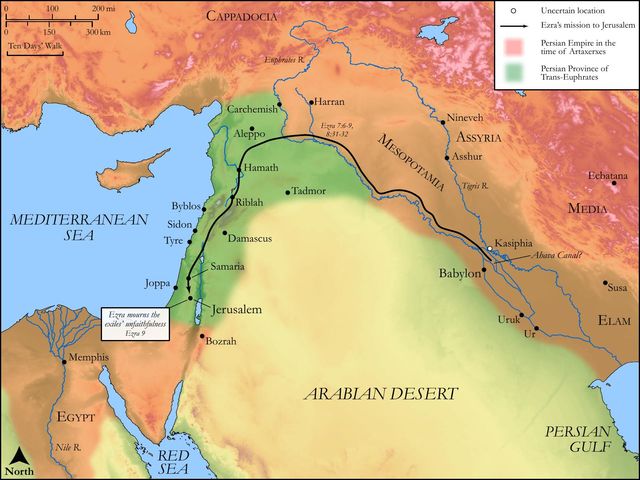
See on the biblical-era map
Study this verse
Public-domain commentary
Matthew Henry
From his Commentary on the Whole Bible. Henry comments on passages, not single verses — this entry covers Ezra 10:6–14.
We have here an account of the proceedings upon the resolutions lately taken up concerning the strange wives; no time was lost; they struck when the iron was hot, and soon set the wheels of reformation a-going. 1. Ezra went to the council-chamber where, it is probable, the priests used to meet upon public business; and till he came thither (so bishop Patrick thinks it should be read), till he saw something done, and more likely to be done, for the redress of this grievance, he did neither eat nor drink, but continued mourning. Sorrow for sin should be abiding sorrow; be sure to let it continue till the sin be put away. 2. He sent orders to all the children of the captivity to attend him at Jerusalem within three days (Ezr 10:7, Ezr 10:8); and, being authorized by the king to enforce his orders with penalties annexed (Ezr 7:26), he threatened that whosoever refused to obey the summons should forfeit his estate and be outlawed. The doom of him that would not attend on this religious occasion should be that his substance should, in his stead, be for ever after appropriated to the service of their religion, and he himself, for his contempt, should for ever after be excluded from the honours and privileges of their religion; he should be excommunicated. 3. Within the time limited the generality of the people met at Jerusalem and made their appearance in the street of the house of God, Ezr 10:9. Those that had no zeal for the work they were called to, nay, perhaps had a dislike to it, being themselves delinquents, yet paid such a deference to Ezra's authority, and were so awed by the penalty, that they durst not stay away. 4. God gave them a token of his displeasure in the great rain that happened at that time (Ezr 10:9 and again Ezr 10:13), which perhaps kept some away, and was very grievous to those that met in the open street. When they wept the heavens wept too, signifying that, though God was angry with them for their sin, yet he was well pleased with their repentance, and (as it is said, Jdg 10:16) his soul was grieved for the misery of Israel; it was also an indication of the good fruits of their repentance, for the rain makes the earth fruitful. 5. Ezra gave the charge at this great assize. He told them upon what account he called them together now, that it was because he found that since their return out of captivity they had increased the trespass of Israel by marrying strange wives, had added to their former sins this new transgression, which would certainly be a means of again introducing idolatry, the very sin they had smarted for and which he hoped they had been cured of in their captivity; and he called them together that they might confess their sin to God, and, having done that, might declare themselves ready and willing to do his pleasure, as it should be made known to them (which all those will do that truly repent of what they have done to incur his displeasure), and particularly that they might separate themselves from all idolaters, especially idolatrous wives, Ezr 10:10, Ezr 10:11. On these heads, we may suppose, he enlarged, and probably made such another confession of the sin now as he made Ezr 9:1-15, to which he required them to say Amen. 6. The people submitted not only to Ezra's jurisdiction in general, but to his inquisition and determination in this matter: "As thou hast said, so must we do, Ezr 10:12. We have sinned in mingling with the heathen, and have thereby been in danger, not only of being corrupted by them, for we are frail, but of being lost among them, for we are few; we are therefore convinced that there is an absolute necessity of our separating from them again." There is hope concerning people when they are convinced, not only that it is good to part with their sins, but that it is indispensably necessary: we must do it, or we are undone. 7. It was agreed that this affair should be carried on, not in a popular assembly, nor that they should think to go through with it all on a sudden, but that a court of delegates should be appointed to receive complaints and to hear and determine upon them. It could not be done at this time, for it was not put into a method, nor could the people stand out because of the rain. The delinquents were many, and it would require time to discover and examine them. Nice cases would arise, which could not be adjudged without debate and deliberation, Ezr 10:13. "And therefore let the crowd be dismissed, and the rulers stand to receive informations; let them proceed city by city, and let the offenders be convicted before them in the presence of the judges and elders of their own city; and let them be entrusted to see the orders executed. Thus take time and we shall have done the sooner; whereas, if we do it in a hurry, we shall do it by halves, Ezr 10:14. If, in this method, a thorough reformation be made, the fierce wrath of God will be turned from us, which, we are sensible, is ready to break forth against us for this transgression." Ezra was willing that his zeal should be guided by the people's prudence, and put the matter into this method; he was not ashamed to own that the advice came from them, any more than he was to comply with it.
Continue studying Ezra 10:14 across the web’s major study libraries — every link below opens this exact verse, chapter, or book on the destination site.
Read & Compare
 BibleGatewayThis verse in more than 200 translations and 70 languages.
 Bible.comThe YouVersion reader — hundreds of translations, reading plans, and highlights.
 ESV.orgCrossway's official English Standard Version reader.
 NET BibleThe NET translation with 60,000+ translators' notes on every rendering decision.
 STEP BibleTyndale House's free study tool — original text, vocabulary, and scholarly resources.
 BibliaLogos Bible Software's free web reader.
 USCCBThe New American Bible (Revised Edition) with the U.S. bishops' study notes.
Commentaries
 BibleHub CommentariesDozens of classic commentaries on this verse, gathered on one page.
 StudyLightMore than 100 commentary sets — the largest collection on the web.
 BibleRefPlain-English commentary on what this verse means, verse by verse.
 Enduring WordDavid Guzik's free commentary on this chapter, widely used by Bible teachers.
 Bible Study ToolsVerse commentary alongside Greek and Hebrew study aids.
Original Language & Research
- BibleHub InterlinearThe verse word by word — original language, transliteration, and English.
- BibleHub LexiconEvery word's original-language definition and Strong's entry.
 Blue Letter BibleDeep-study tools — Strong's numbers, concordance, and word studies.
 SefariaThe Hebrew text with Rashi and centuries of Jewish commentary.
Sermons, Hymns & Audio


TrulyRandomVerse is not affiliated with these sites and doesn’t control their content. They’re linked because they’re genuinely useful.
Summary
Ezra 10:14 presents the practical, systematic resolution proposed by the gathered assembly to address the pervasive sin of intermarriage with foreign women among the returned exiles. This verse outlines the establishment of a formal, communal judicial process, mandating that rulers, elders, and judges from every city convene at appointed times to hear individual cases. The overarching purpose of this rigorous and painful undertaking was to appease the "fierce wrath" of God, which the community recognized had been justly incurred by their covenant disobedience, thereby seeking to restore divine favor and secure the spiritual and physical well-being of the nascent post-exilic community in Judah.
Context
ShowHideLiterary Context
Ezra 10:14 is situated at a critical juncture in the book of Ezra, specifically within the broader narrative of national repentance and reform detailed in Ezra chapter 10. Following Ezra's profound prayer of confession and lament in Ezra chapter 9, the people, deeply moved and led by Shecaniah, acknowledge their widespread sin of intermarriage and propose a radical solution. Verse 14 transitions from the emotional outpouring of repentance to concrete, organized action, detailing the practical, procedural steps necessary to implement this resolution. It sets the stage for the subsequent verses (Ezra 10:15-17), which describe the appointment of specific individuals to oversee this complex and sensitive judicial process, underscoring the community's commitment to systematically address the issue.
Historical & Cultural Context
The events of Ezra 10 unfold in the post-exilic period, approximately 458 BC, after the second wave of Jewish exiles had returned from Babylon under Ezra's leadership. The community was fragile, striving to re-establish its identity and covenant relationship with Yahweh in the land of Judah. A foundational aspect of their covenant identity, repeatedly emphasized in the Torah (e.g., Deuteronomy 7:3-4), was the strict prohibition against intermarriage with surrounding pagan peoples. This command was not merely about ethnic purity but spiritual preservation, designed to prevent Israel from being led into idolatry and syncretism, which had been a primary cause of their Babylonian exile. The "strange wives" (Hebrew: nashim nokhriyot) were non-Israelite women who had not converted to the worship of the God of Israel, thus posing a direct threat to the spiritual integrity of the community and inviting divine judgment, as tragically seen in previous instances of Israel's unfaithfulness (e.g., Numbers 25:1-9).
Key Themes
ShowHideThis verse powerfully contributes to several central themes within Ezra and the broader biblical narrative. Firstly, it underscores the theme of corporate repentance and accountability. The sin of intermarriage was widespread, and the proposed solution involved the entire "congregation," emphasizing that sin affects the whole community and necessitates a collective, structured response. Secondly, the phrase "fierce wrath of our God" highlights the theme of divine justice and the consequences of disobedience. The people understood that their sin had incurred God's righteous anger, and that active, demonstrable repentance was necessary to avert further judgment and restore divine favor. Finally, the entire episode reinforces the theme of covenant fidelity and the preservation of spiritual identity. The drastic measures taken were aimed at maintaining Israel's distinctiveness as God's holy people, separated from pagan influences, a vital step in rebuilding their spiritual foundation after the devastation of the exile, as seen in the warnings of Exodus 34:15-16.
Exposition and Analysis
ShowHideKey Word Analysis
ShowHideThis adjective, derived from a root meaning "to be strange" or "alien," describes something foreign, non-relative, or different. In this context, it specifically refers to women who were not part of the covenant community of Israel, implying not just ethnic difference but, more critically, a distinct religious and cultural identity that stood in opposition to the worship of Yahweh. The concern was that these "strange" wives would introduce idolatry and syncretism, compromising Israel's unique spiritual identity.
This noun denotes an "assemblage," "company," or "multitude," specifically referring to the organized community of Israel. Its use here emphasizes the corporate nature of the sin and the collective responsibility for its resolution. The decision and the subsequent actions were not merely individual but involved the entire body of returned exiles, highlighting the communal impact of sin and the need for communal repentance and action.
This term, often used in conjunction with 'aph (nose/anger), signifies a "burning of anger," "sore displeasure," or "fury." When attributed to God, as here, it describes His intense, righteous indignation in response to severe sin and disobedience. In this context, it signifies God's just anger against Israel's breach of covenant, particularly the intermarriage that threatened their spiritual purity. The people understood that this divine wrath, if unaddressed, could bring further judgment upon them, mirroring past divine judgments for similar transgressions.
Verse Breakdown
ShowHide"Let now our rulers of all the congregation stand"
This opening clause initiates the proposed solution, calling for the authorized leaders—those with administrative and judicial authority over the entire assembly—to take their positions. This signifies the formal, public, and official nature of the process, ensuring that the resolution would be carried out with proper governance and accountability, reflecting the collective will of the people.
"and let all them which have taken strange wives in our cities come at appointed times"
This specifies the individuals who are to be held accountable: those Jewish men who had violated the covenant by marrying foreign women. The phrase "at appointed times" (Hebrew: zâman 'êth) indicates an orderly, scheduled process, preventing chaos and ensuring that each case could be heard systematically and fairly, rather than in a single, rushed event.
"and with them the elders of every city, and the judges thereof"
This further details the composition of the judicial body. The inclusion of "elders of every city" and "judges thereof" underscores the local and decentralized nature of the implementation, ensuring that the process would be carried out by respected, knowledgeable figures within each community, familiar with the specific circumstances and individuals involved. This also implies a thorough and comprehensive approach across all settlements.
"until the fierce wrath of our God for this matter be turned from us"
This final clause states the ultimate purpose and profound motivation behind the entire, drastic undertaking. The people recognized that their sin had provoked God's intense anger, and their actions were a desperate attempt to appease His wrath, demonstrate genuine repentance, and restore divine favor. It highlights their understanding of the serious consequences of covenant disobedience and their fervent desire for reconciliation and the removal of divine judgment.
Literary Devices
ShowHideEzra 10:14 employs several significant literary devices that amplify its message and underscore the gravity of the situation. Legal Language and Procedural Language are highly prominent, reflecting the establishment of a formal judicial process. Phrases like "rulers...stand," "come at appointed times," and the explicit mention of "elders" and "judges" evoke the solemnity and structured nature of a court or official inquiry. There is an element of Synecdoche where "rulers of all the congregation" stands for the entire governing body, representing the collective will and authority of the people. The powerful phrase "fierce wrath of our God" is a vivid example of Metonymy, where "wrath" (an emotion) stands for the divine judgment and consequences that flow from it, emphasizing the dire spiritual stakes. The verse also demonstrates Emphasis through the detailed enumeration of the various authority figures (rulers, elders, judges), underscoring the communal and comprehensive nature of the proposed solution and the gravity of the sin being addressed.
Theological and Thematic Connections
ShowHideEzra 10:14 powerfully articulates the profound biblical truth that sin, especially corporate sin, incurs the righteous "fierce wrath" of God, and that true repentance necessitates concrete, often costly, action to turn away from disobedience and back to covenant fidelity. This passage underscores God's holiness and His unwavering demand for His people to be set apart, demonstrating that spiritual compromise has severe consequences for both individuals and the community. The willingness of the people to undergo such a public and painful process highlights their desperate desire for reconciliation with God and the restoration of His blessing, recognizing that their very existence as a covenant people depended on their obedience. This commitment to holiness, even at great personal cost, serves as a powerful example of what it means to take God's commands seriously and to prioritize His honor above all else, acknowledging that God's justice is a terrifying reality when His covenant is broken.
Reflection and Application
ShowHideEzra 10:14 serves as a stark reminder that sin, particularly that which compromises our spiritual identity and devotion to God, has communal ramifications and can provoke divine displeasure. While the specific cultural context of intermarriage and the legalistic solution of divorce are not directly transferable to the New Covenant era, the underlying principles remain profoundly relevant. This passage challenges us to consider the seriousness with which we treat sin in our own lives and within our communities. It calls for a corporate and individual commitment to holiness, urging us to identify and decisively address practices or relationships that threaten our spiritual purity and devotion to Christ. Just as the Israelites sought to turn away God's wrath through concrete action, believers today are called to active repentance, demonstrating a willingness to make difficult choices for the sake of God's honor and the spiritual well-being of the church. This may involve severing ties with ungodly influences, pursuing reconciliation, or submitting to spiritual authority for guidance and accountability, always with the aim of living lives that honor God and reflect His glory.
Questions for Reflection
ShowHideFAQ
ShowHideWas the divorce of foreign wives a just or compassionate solution?
ShowHideFrom a purely human perspective, the command to divorce foreign wives, especially those with children, appears harsh and lacking in compassion. However, within the specific theological and historical context of post-exilic Israel, it was understood as a necessary, albeit painful, measure to preserve the very spiritual identity and existence of the covenant community. The prohibition against intermarriage (e.g., Deuteronomy 7:3-4) was not arbitrary; it was designed to prevent the nation from falling back into idolatry, which had led to their exile. The "fierce wrath" of God was a real and present danger, and the people believed that only radical obedience could avert further divine judgment. While difficult, this act was seen as an act of corporate repentance and a desperate attempt to restore their covenant relationship with God and ensure the future of the faithful remnant. It was a legal and spiritual necessity for the survival of the nation's unique identity as God's chosen people, not a general principle for all times and cultures.
Why was intermarriage such a severe sin in Ezra's time?
ShowHideIntermarriage with non-Israelites was a severe sin primarily because it represented a direct violation of God's covenant commands and posed an existential threat to Israel's spiritual purity and distinctiveness. The Mosaic Law explicitly forbade such unions (e.g., Exodus 34:15-16), not out of racial prejudice, but because foreign spouses typically brought their pagan gods and practices into Israelite homes, leading to syncretism and idolatry. This had been a recurring problem throughout Israel's history and a major cause of their exile. In the fragile post-exilic community, preserving their unique identity as the people of Yahweh was paramount. Intermarriage threatened to dilute their faith, corrupt their worship, and lead them away from the God who had delivered them, thereby incurring His "fierce wrath" and jeopardizing their future in the land.
Christ-Centered Fulfillment
ShowHideEzra 10:14, with its intense focus on averting God's "fierce wrath" through a rigorous process of separation and repentance, finds its ultimate and perfect fulfillment in the person and work of Jesus Christ. The "fierce wrath" that Israel feared and sought to appease through their painful, legalistic actions was the righteous judgment of God against sin—a wrath that was fully and finally absorbed by Christ on the cross. The New Testament declares that through faith in Jesus, we are "justified by His blood, we shall be saved from the wrath of God through Him" (Romans 5:9). The elaborate, costly process of separating from "strange wives" in Ezra foreshadows the radical separation from sin and the world that Christ accomplishes in His followers, not through legalistic divorce, but through spiritual transformation and a new identity. Believers are called to be a "new creation" in Christ (2 Corinthians 5:17), set apart unto God, and united to Christ as His pure bride (Ephesians 5:25-27). The pursuit of holiness and the turning away from spiritual compromise, which was a burdensome legal requirement in Ezra, becomes a joyful response of love and obedience to the One who has already borne the full weight of God's wrath, enabling us to live in true reconciliation and purity before Him, not by our own works, but by His perfect, once-for-all sacrifice (Hebrews 10:10).