


Ezra 10:13
- אֲבָל'a·ValbutH61PrtParticle Interjection
- הָעָםha·'Amthe peopleH5971Art ¦ N-msNoun Singular Masculine Absoluteהָtheעָםpeople
- רָבrav[is] numerousH7227Adj-msAdjective Singular Masculine Absolute
- וְהָעֵתve·ha·'Etand the timeH6256Conj-w ¦ Art ¦ N-csNoun Singular common gender Absoluteוְandהָtheעֵתtime
- גְּשָׁמִיםge·sha·Mim[is] rainsH1653N-mpNoun Plural Masculine Absolute
- וְאֵיןve·'Einand there notH369Conj-w ¦ N-mscNoun Singular Masculine Constructוְandאֵיןthere not
- כֹּחַKo·ach[is] abilityH3581N-msNoun Singular Masculine Absolute
- לַעֲמוֹדla·'a·Modto standH5975Prep-l ¦ V-Qal-InfVerb Qal Infinitive Constructלַtoעֲמוֹדstand
- בַּחוּץba·Chutzon the outsideH2351Prep-b ¦ N-msNoun Singular Masculine Absoluteבַּon theחוּץoutside
- וְהַמְּלָאכָהve·ha·me·la·Khahand the businessH4399Conj-w ¦ Art ¦ N-fsNoun Singular Feminine Absoluteוְandהַtheמְּלָאכָהbusiness
- לֹאlo'notH3808NegParticle Negative
- לְיוֹםle·Yom[belongs] to a dayH3117Prep-l ¦ N-msNoun Singular Masculine Absoluteלְ[belongs] toיוֹםa day
- אֶחָד'e·ChadoneH259Adj-fsAdjective Numerical Singular Feminine Absolute
- וְלֹאve·Lo'and notH3808Conj-w ¦ NegParticle Negativeוְandלֹאnot
- לִשְׁנַיִםlish·Na·yimto twoH8147Prep-l ¦ Adj-cdAdjective Numerical Dual common gender Absoluteלִtoשְׁנַיִםtwo
- כִּיkiforH3588PrtParticle Conditional
- הִרְבִּינוּhir·Bi·nuwe have increasedH7235V-Hiphil-Perf-1cpVerb Hiphil Perfect 1st Plural common gender
- לִפְשֹׁעַlif·Sho·a'to transgressH6586Prep-l ¦ V-Qal-InfVerb Qal Infinitive Constructלִtoפְשֹׁעַtransgress
- בַּדָּבָרba·da·Varin the matterH1697Prep-b ¦ N-msNoun Singular Masculine Absoluteבַּin theדָּבָרmatter
- הַזֶּהha·Zeh<the> thisH2088Art ¦ PrtParticle Demonstrativeהַ<the>זֶּהthis
English is a literal word-by-word gloss of the Hebrew, not the KJV's wording. Why?
This is the original text the KJV's translators worked from — each Hebrew word with its own literal English meaning in this verse, prepared by scholars at Tyndale House, Cambridge. The KJV translates whole sentences, not word by word, so its wording differs: one Hebrew word can become several English words, and the KJV may choose “the LORD” where the gloss reads “Yahweh”. Both are faithful — they answer different questions. For the KJV's own rendering, switch to the KJV text.
Details
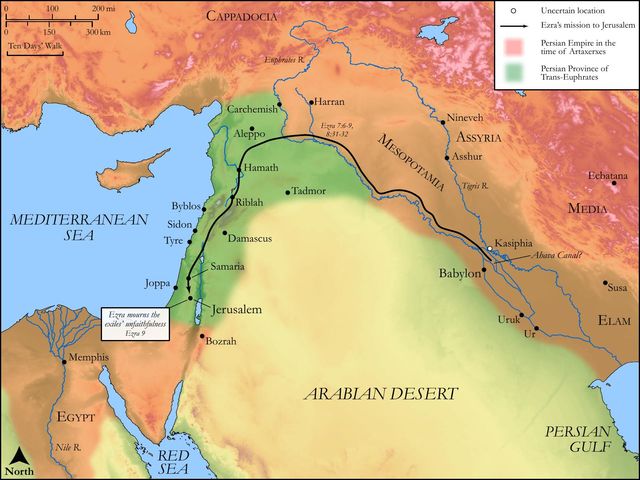
See on the biblical-era map
Study this verse
Public-domain commentary
Matthew Henry
From his Commentary on the Whole Bible. Henry comments on passages, not single verses — this entry covers Ezra 10:6–14.
We have here an account of the proceedings upon the resolutions lately taken up concerning the strange wives; no time was lost; they struck when the iron was hot, and soon set the wheels of reformation a-going. 1. Ezra went to the council-chamber where, it is probable, the priests used to meet upon public business; and till he came thither (so bishop Patrick thinks it should be read), till he saw something done, and more likely to be done, for the redress of this grievance, he did neither eat nor drink, but continued mourning. Sorrow for sin should be abiding sorrow; be sure to let it continue till the sin be put away. 2. He sent orders to all the children of the captivity to attend him at Jerusalem within three days (Ezr 10:7, Ezr 10:8); and, being authorized by the king to enforce his orders with penalties annexed (Ezr 7:26), he threatened that whosoever refused to obey the summons should forfeit his estate and be outlawed. The doom of him that would not attend on this religious occasion should be that his substance should, in his stead, be for ever after appropriated to the service of their religion, and he himself, for his contempt, should for ever after be excluded from the honours and privileges of their religion; he should be excommunicated. 3. Within the time limited the generality of the people met at Jerusalem and made their appearance in the street of the house of God, Ezr 10:9. Those that had no zeal for the work they were called to, nay, perhaps had a dislike to it, being themselves delinquents, yet paid such a deference to Ezra's authority, and were so awed by the penalty, that they durst not stay away. 4. God gave them a token of his displeasure in the great rain that happened at that time (Ezr 10:9 and again Ezr 10:13), which perhaps kept some away, and was very grievous to those that met in the open street. When they wept the heavens wept too, signifying that, though God was angry with them for their sin, yet he was well pleased with their repentance, and (as it is said, Jdg 10:16) his soul was grieved for the misery of Israel; it was also an indication of the good fruits of their repentance, for the rain makes the earth fruitful. 5. Ezra gave the charge at this great assize. He told them upon what account he called them together now, that it was because he found that since their return out of captivity they had increased the trespass of Israel by marrying strange wives, had added to their former sins this new transgression, which would certainly be a means of again introducing idolatry, the very sin they had smarted for and which he hoped they had been cured of in their captivity; and he called them together that they might confess their sin to God, and, having done that, might declare themselves ready and willing to do his pleasure, as it should be made known to them (which all those will do that truly repent of what they have done to incur his displeasure), and particularly that they might separate themselves from all idolaters, especially idolatrous wives, Ezr 10:10, Ezr 10:11. On these heads, we may suppose, he enlarged, and probably made such another confession of the sin now as he made Ezr 9:1-15, to which he required them to say Amen. 6. The people submitted not only to Ezra's jurisdiction in general, but to his inquisition and determination in this matter: "As thou hast said, so must we do, Ezr 10:12. We have sinned in mingling with the heathen, and have thereby been in danger, not only of being corrupted by them, for we are frail, but of being lost among them, for we are few; we are therefore convinced that there is an absolute necessity of our separating from them again." There is hope concerning people when they are convinced, not only that it is good to part with their sins, but that it is indispensably necessary: we must do it, or we are undone. 7. It was agreed that this affair should be carried on, not in a popular assembly, nor that they should think to go through with it all on a sudden, but that a court of delegates should be appointed to receive complaints and to hear and determine upon them. It could not be done at this time, for it was not put into a method, nor could the people stand out because of the rain. The delinquents were many, and it would require time to discover and examine them. Nice cases would arise, which could not be adjudged without debate and deliberation, Ezr 10:13. "And therefore let the crowd be dismissed, and the rulers stand to receive informations; let them proceed city by city, and let the offenders be convicted before them in the presence of the judges and elders of their own city; and let them be entrusted to see the orders executed. Thus take time and we shall have done the sooner; whereas, if we do it in a hurry, we shall do it by halves, Ezr 10:14. If, in this method, a thorough reformation be made, the fierce wrath of God will be turned from us, which, we are sensible, is ready to break forth against us for this transgression." Ezra was willing that his zeal should be guided by the people's prudence, and put the matter into this method; he was not ashamed to own that the advice came from them, any more than he was to comply with it.
Continue studying Ezra 10:13 across the web’s major study libraries — every link below opens this exact verse, chapter, or book on the destination site.
Read & Compare
 BibleGatewayThis verse in more than 200 translations and 70 languages.
 Bible.comThe YouVersion reader — hundreds of translations, reading plans, and highlights.
 ESV.orgCrossway's official English Standard Version reader.
 NET BibleThe NET translation with 60,000+ translators' notes on every rendering decision.
 STEP BibleTyndale House's free study tool — original text, vocabulary, and scholarly resources.
 BibliaLogos Bible Software's free web reader.
 USCCBThe New American Bible (Revised Edition) with the U.S. bishops' study notes.
Commentaries
 BibleHub CommentariesDozens of classic commentaries on this verse, gathered on one page.
 StudyLightMore than 100 commentary sets — the largest collection on the web.
 BibleRefPlain-English commentary on what this verse means, verse by verse.
 Enduring WordDavid Guzik's free commentary on this chapter, widely used by Bible teachers.
 Bible Study ToolsVerse commentary alongside Greek and Hebrew study aids.
Original Language & Research
- BibleHub InterlinearThe verse word by word — original language, transliteration, and English.
- BibleHub LexiconEvery word's original-language definition and Strong's entry.
 Blue Letter BibleDeep-study tools — Strong's numbers, concordance, and word studies.
 SefariaThe Hebrew text with Rashi and centuries of Jewish commentary.
Sermons, Hymns & Audio


TrulyRandomVerse is not affiliated with these sites and doesn’t control their content. They’re linked because they’re genuinely useful.
Summary
Ezra 10:13 presents the assembly's practical yet resolute response to Ezra's call for reform concerning widespread intermarriage among the returned exiles. Following their corporate confession, the people acknowledge the immense scale of the transgression and the significant logistical challenges, particularly the large number of individuals involved and the severe winter rains. Far from being an excuse to delay, this verse articulates a collective commitment to a thorough, systematic, and sustained process of purification, recognizing that such a profound spiritual and social overhaul could not be accomplished superficially or in haste.
Context
ShowHideLiterary Context
Ezra 10:13 is strategically positioned within the narrative of Israel's post-exilic spiritual restoration. Having returned from Babylonian exile, the community, including its spiritual leaders, had fallen into the grave sin of intermarriage with foreign peoples, a practice explicitly forbidden by God's covenant to preserve their distinct identity and prevent idolatry (e.g., Deuteronomy 7:1-4). Ezra, a devout scribe, was deeply distressed by this apostasy, leading to his profound prayer of confession and lamentation in Ezra 9. This emotional outpouring stirred the people to repentance, and under Shecaniah's leadership, they proposed a covenant to put away their foreign wives and children (Ezra 10:1-5). Ezra then convened a general assembly of all men of Judah and Benjamin. Gathered in the open square, trembling due to the urgency of the matter and the heavy rain (Ezra 10:9), Ezra charged them to confess and separate. The people's immediate agreement in Ezra 10:12 sets the stage for verse 13, which articulates their pragmatic assessment of how this massive and sensitive task would be implemented, emphasizing the necessity of a structured, patient approach rather than a hasty one.
Historical & Cultural Context
The historical backdrop for Ezra 10:13 is the early Persian period, approximately 458 BC, following the second wave of Jewish returnees from Babylonian captivity. The nascent community in Judah was still fragile, striving to re-establish its covenant identity and rebuild Jerusalem. The prohibition against intermarriage was not a matter of racial purity but a theological safeguard against spiritual syncretism and the worship of foreign deities (Exodus 34:15-16). The mention of "a time of much rain" is a critical detail, indicating the winter months (likely Kislev, November/December, as noted in Ezra 10:9), when Judea experiences heavy downpours. Such weather would render prolonged outdoor gatherings impossible and travel exceedingly difficult, highlighting the logistical constraints of the era. This detail underscores the realism of the people's assessment, demonstrating that even spiritual reforms must contend with practical, environmental realities. The corporate nature of their sin and repentance reflects a deep-seated understanding of communal accountability under the Mosaic covenant.
Key Themes
ShowHideEzra 10:13 significantly contributes to several overarching themes within the book of Ezra and the broader biblical narrative. Firstly, it highlights the theme of Practical Obstacles to Obedience. While the community expresses genuine repentance and a desire to obey God, they are also realistic about the logistical difficulties. The "many people" and "much rain" are not mere excuses but legitimate impediments that necessitate a thoughtful, organized approach to reform. This demonstrates that true obedience often requires wisdom, perseverance, and strategic planning in the face of real-world challenges, moving beyond naive idealism. Secondly, the verse underscores the theme of Corporate Confession and Responsibility. The powerful collective admission, "we are many that have transgressed in this thing," signifies that the sin of intermarriage was not an isolated incident but a pervasive issue throughout the community. This corporate ownership of sin was essential for the community's spiritual healing and for legitimizing the subsequent reforms, reflecting the communal nature of the covenant. Lastly, it speaks to the theme of Commitment to God's Law and Spiritual Purity. Despite the immense difficulty and the time-consuming nature of the task ("not a work of one day or two"), the assembly's statement is a firm commitment to see the reform through. This resolve to uphold the covenant and maintain Israel's distinct spiritual identity, even at great personal cost, is a central message of Ezra's ministry and a testament to the community's renewed dedication to God's ways, echoing the call for holiness found throughout the Pentateuch, such as in Leviticus 11:44.
Exposition and Analysis
ShowHideKey Word Analysis
ShowHideThis word (H7227), appearing twice in the verse, underscores the sheer magnitude of the problem. "The people are many" (H5971 + H7227) and "we are many that have transgressed" (H7235 + H6586) emphasize that intermarriage was not an isolated incident but a widespread, pervasive issue affecting a significant portion of the community. This numerical reality highlights the profound logistical challenge of addressing so many individual cases and the deep spiritual compromise that had permeated the returned exiles.
The specific mention of "a time of much rain" (H6256 + H1653) is a crucial practical impediment. From the root meaning "to shower," geshem refers to heavy downpours. In ancient Judea, the winter rainy season could be severe, making prolonged outdoor gatherings uncomfortable, if not impossible, and travel exceedingly difficult. This natural element directly impacted their ability to conduct the necessary proceedings, demonstrating how external circumstances can influence the practical implementation of spiritual reforms and underscoring the realism of the people's assessment.
This verb (H6586) carries significant theological weight, meaning "to break away (from just authority)," "to trespass," "apostasize," or "quarrel." It implies a deliberate violation of a covenant or law. By confessing, "we are many that have transgressed in this thing" (H1697), the people are not merely admitting a mistake or an oversight but acknowledging a conscious act of rebellion against God's explicit command and the covenant relationship. This strong term emphasizes the gravity of their sin and the necessity of a thorough, penitent response.
Verse Breakdown
ShowHide"But the people [are] many"
This opening clause immediately establishes the overwhelming scale of the problem. The widespread nature of the intermarriage meant that the task of separation would involve a vast number of individuals, making a quick or superficial resolution impossible. It highlights the collective nature of the sin and the immense challenge of addressing it on a communal scale.
"and [it is] a time of much rain"
This introduces a significant practical impediment. The ongoing heavy rains would make it impossible for the large assembly to continue meeting outdoors for extended periods to deliberate and process the numerous cases. This environmental factor directly necessitated a more organized, indoor, and prolonged approach to the reform.
"and we are not able to stand without"
This directly follows from the previous clause, explaining the practical consequence of the rain. The inclement weather conditions physically prevented them from remaining assembled in the open square, thus making immediate, comprehensive action unfeasible. It underscores the need for a different, more structured strategy to address the crisis.
"neither [is this] a work of one day or two"
This statement is a realistic and sober assessment of the time and effort required. Given the sheer number of people involved, the sensitive and deeply personal nature of the issue, and the need for due process in each case, resolving the intermarriage crisis could not be rushed. It implies the necessity for careful investigation, compassionate deliberation, and patient handling of each situation, recognizing the profound social and personal implications of the required separations.
"for we are many that have transgressed in this thing."
This final clause provides the ultimate justification for the preceding statements. The pervasive nature of the sin ("many that have transgressed") is precisely why the task is so immense and cannot be completed quickly. It serves as a corporate confession, acknowledging the widespread disobedience and the necessity of a thorough, systematic, and sustained process of repentance and reform for the entire community.
Literary Devices
ShowHideEzra 10:13 masterfully employs several literary devices to convey its message with both spiritual depth and practical clarity. Realism and Pragmatism are central, as the verse grounds the spiritual commitment to reform in the tangible realities of the situation. The assembly is not offering excuses but a sober and honest assessment of the logistical challenges ("people are many," "time of much rain," "not able to stand without"), demonstrating a mature approach to obedience. The phrase "neither [is this] a work of one day or two" functions as a form of Litotes (a figure of speech in which an affirmative is expressed by the negation of its opposite). By stating what the task is not, the verse powerfully emphasizes its immense scale, complexity, and the significant time and effort it would demand. This subtly highlights the need for a structured, patient process. Finally, the direct and collective admission, "for we are many that have transgressed in this thing," is a profound act of Corporate Confession. This collective voice underscores the pervasive nature of the problem and the unified commitment to addressing it, moving beyond individual blame to communal responsibility and ownership of sin.
Theological and Thematic Connections
ShowHideEzra 10:13 offers profound theological insights into the nature of genuine repentance and costly obedience. It teaches that true repentance is not merely an emotional experience or a verbal confession, but a demanding, practical, and often prolonged process that necessitates concrete action. The community's acknowledgment of the "many" transgressors and the "much rain" highlights that even when the will to obey is present, real-world obstacles and the sheer scale of widespread sin necessitate wisdom, patience, and a structured approach to reform. This verse underscores the biblical principle that true faith is demonstrated through works of obedience, even when those works are difficult, inconvenient, and require sustained effort. It also emphasizes the concept of corporate responsibility, where the sin of many requires a collective, organized response for the healing and purification of the entire community. The willingness to face these practical challenges demonstrates a deeper commitment to God's covenant than a mere fleeting emotional response, illustrating that the path to holiness is often arduous but essential.
Reflection and Application
ShowHideEzra 10:13 provides a powerful and enduring model for individuals and communities grappling with deep-seated sin and the call to repentance. It reminds us that while confession is an indispensable first step, it is often just the beginning of a longer, more arduous journey of obedience and reform. We must be realistic about the "practical obstacles" that may arise in our pursuit of righteousness—whether they are the sheer number of people involved in a collective sin, external circumstances like "much rain" (representing inconveniences, logistical challenges, or unfavorable conditions), or the deeply ingrained habits of personal or corporate sin. True repentance requires not only a change of heart but also a willingness to undertake the difficult, often uncomfortable, and time-consuming steps necessary to rectify past wrongs and align our lives with God's will. This verse challenges us to move beyond superficial resolutions and embrace a commitment to thorough, sustained transformation, recognizing that genuine spiritual purification is rarely a "work of one day or two." It also highlights the importance of community support, accountability, and a structured, patient approach when addressing widespread issues, fostering perseverance in the pursuit of righteousness.
Questions for Reflection
ShowHideFAQ
ShowHideWas the command to put away foreign wives truly God's will, or an extreme measure by Ezra?
ShowHideThe command to separate from foreign wives was deeply rooted in God's explicit law given through Moses, particularly in Deuteronomy 7:1-4 and Exodus 34:15-16. These prohibitions were not based on racial prejudice but on the theological imperative to maintain Israel's distinct identity as God's holy people, preventing spiritual assimilation and the worship of foreign gods. Intermarriage inevitably led to idolatry and compromise, as tragically seen throughout Israel's history (e.g., 1 Kings 11:1-8). Ezra's actions, therefore, were not an extreme personal interpretation but a faithful application of God's covenant demands to preserve the spiritual purity and future of the returned exiles. The people's confession in Ezra 10:12 confirms their understanding that this was indeed a transgression against God's law.
Why is the "time of much rain" so significant in this verse? Was it an excuse to delay?
ShowHideThe mention of "a time of much rain" (likely the winter rainy season, as implied by Ezra 10:9) was not an excuse to delay or avoid the difficult task, but a practical and legitimate reason for needing a structured, prolonged process. The assembly was gathered outdoors, and heavy rains would make it impossible for thousands of people to continue standing and deliberating effectively. This detail highlights the realism and pragmatism of the people's response. They were acknowledging a genuine logistical impediment that prevented an immediate, one-day resolution. Instead of abandoning the reform, they proposed a systematic, committee-based approach (Ezra 10:14) to ensure the work could be carried out thoroughly and properly despite the weather and the immense scale of the problem. It underscores their commitment to seeing the difficult task through to completion, demonstrating wisdom in the face of practical constraints.
Christ-Centered Fulfillment
ShowHideEzra 10:13, with its emphasis on the pervasive nature of sin, the costly demands of repentance, and the practical challenges of purification, powerfully foreshadows the ultimate and complete work of Christ. The community's confession that "we are many that have transgressed" highlights humanity's universal fallenness and the deep-seated nature of sin, which no human effort or external separation can fully eradicate. The "work of one day or two" was insufficient for their cleansing, just as the Old Covenant Law itself, with its many rituals and demands, could not ultimately make the worshiper perfect or cleanse the conscience (Hebrews 10:1-4). The need for a thorough, systematic process points to the reality that true spiritual cleansing requires a divine intervention far beyond human capacity. Christ, however, is the perfect Lamb of God who truly "takes away the sin of the world" (John 1:29). Through His perfect, once-for-all sacrifice on the cross, He accomplished a complete and final purification, cleansing our consciences from dead works to serve the living God (Hebrews 9:14). Unlike the temporary and incomplete separation achieved by Ezra's reforms, Christ's work creates a new covenant people, truly set apart and made holy through His Spirit (Ephesians 5:25-27). He enables genuine repentance not just as an external act, but as an internal transformation, empowering believers to live in obedience to God's commands, not by their own strength, but by His indwelling power (Philippians 2:13). Thus, the difficult, incomplete work of purification in Ezra points to the perfect, complete, and lasting cleansing offered by Jesus Christ, who saves His people from their sins (Matthew 1:21) and enables them to walk in newness of life (Romans 6:4).