


Genesis 14:1
- וַיְהִיvay·Hiand it wasH1961Conj-w ¦ V-Qal-ConsecImperf-3msVerb Qal Consecutive Imperfect 3rd Singular Masculineוַandיְהִיit was
- בִּימֵיbi·Meiin [the] days ofH3117Prep-b ¦ N-mpcNoun Plural Masculine Constructבִּinימֵי[the] days of
- אַמְרָפֶל'am·ra·FelAmraphelH569N-proper-mNoun Proper Masculine
- מֶלֶךְMe·lekh[the] king ofH4428N-mscNoun Singular Masculine Construct
- שִׁנְעָרshin·'ArShinarH8152N-properNoun Proper Location
- אַרְיוֹךְ'ar·YokhAriochH746N-proper-mNoun Proper Masculine
- מֶלֶךְMe·lekh[the] king ofH4428N-mscNoun Singular Masculine Construct
- אֶלָּסָר'e·la·SarEllasarH495N-properNoun Proper Location
- כְּדָרְלָעֹמֶרke·da·re·la·'O·merKedorlaomerH3540N-proper-mNoun Proper Masculine
- מֶלֶךְMe·lekh[the] king ofH4428N-mscNoun Singular Masculine Construct
- עֵילָם'ei·LamElamH5867N-properNoun Proper Location
- וְתִדְעָלve·tid·'Aland TidalH8413Conj-w ¦ N-proper-mNoun Proper MasculineוְandתִדְעָלTidal
- מֶלֶךְMe·lekh[the] king ofH4428N-mscNoun Singular Masculine Construct
- גּוֹיִםgo·YimGoyimH1471N-properNoun Proper Location
English is a literal word-by-word gloss of the Hebrew, not the KJV's wording. Why?
This is the original text the KJV's translators worked from — each Hebrew word with its own literal English meaning in this verse, prepared by scholars at Tyndale House, Cambridge. The KJV translates whole sentences, not word by word, so its wording differs: one Hebrew word can become several English words, and the KJV may choose “the LORD” where the gloss reads “Yahweh”. Both are faithful — they answer different questions. For the KJV's own rendering, switch to the KJV text.
Details
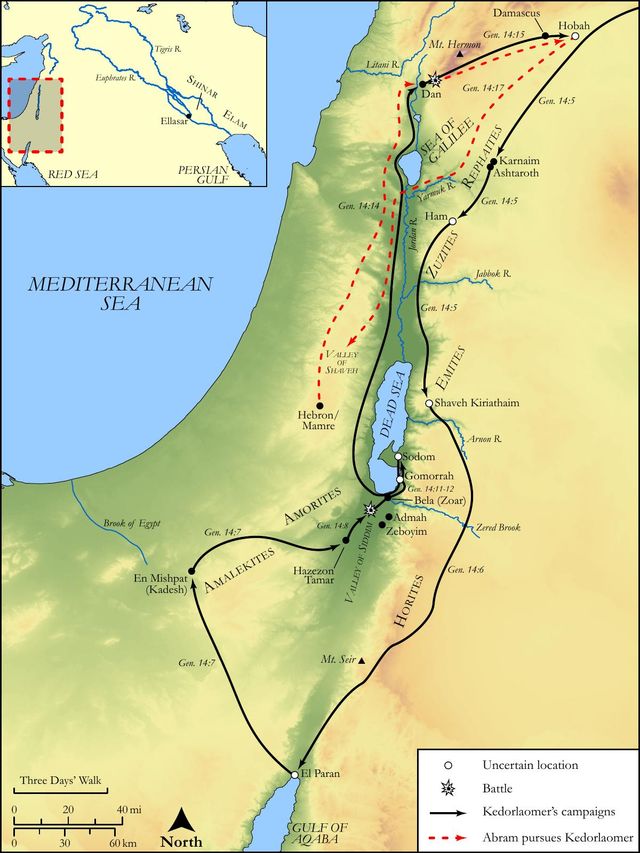
See on the biblical-era map


Study this verse
Public-domain commentary
Matthew Henry
From his Commentary on the Whole Bible. Henry comments on passages, not single verses — this entry covers Genesis 14:1–12. His three-level outline is real structure in the source text, so it is rendered as structure.
We have here an account of the first war that ever we read of in scripture, which (though the wars of the nations make the greatest figure in history) we should not have had the history of if Abram and Lot had not been concerned in it. Now, concerning this war, we may observe,
I.The parties engaged in it.
The invaders were four kings, two of them no less than kings of Shinar and Elam (that is, Chaldea and Persia), yet probably not the sovereign princes of those great kingdoms in their own persons, but either officers under them, or rather the heads and leaders of some colonies which came out of those great nations, and settled themselves near Sodom, but retained the names of the countries from which they had their origin. The invaded were the kings of five cities that lay near together in the plain of Jordan, namely, Sodom, Gomorrah, Admah, Zeboiim, and Zoar. Four of them are named, but not the fifth, the king of Zoar or Bela, either because he was much more mean and inconsiderable or because he was much more wicked and inglorious than the rest, and worthy to be forgotten.
II.The occasion of this war was the revolt of the five kings from under the government of Chedorlaomer.
Twelve years they served him. Small joy they had of their fruitful land, while thus they were tributaries to a foreign power, and could not call what they had their own. Rich countries are a desirable prey, and idle luxurious countries are an easy prey, to growing greatness. The Sodomites were the posterity of Canaan whom Noah had pronounced a servant to Shem, from whom Elam descended; thus soon did that prophecy begin to e fulfilled. In the thirteenth year, beginning to be weary of their subjection, they rebelled, denied their tribute, and attempted to shake off the yoke and retrieve their ancient liberties. In the fourteenth year, after some pause and preparation, Chedorlaomer, in conjunction with his allies, set himself to chastise and reduce the rebels, and, since he could not have it otherwise, to fetch his tribute from them on the point of his sword. Note, Pride, covetousness, and ambition, are the lusts from which wars and fightings come. To these insatiable idols the blood of thousands has been sacrificed.
III.The progress and success of the war.
The four kings laid the neighbouring countries waste and enriched themselves with the spoil of them (Gen 14:5-7), upon the alarm of which it had been the wisdom of the king of Sodom to submit, and desire conditions of peace; for how could he grapple with an enemy thus flushed with victory? But he would rather venture the utmost extremity than yield, and it sped accordingly. Quos Deus destruet eos dementat - Those whom God means to destroy he delivers up to infatuation.
1.The forces of the king of Sodom and his allies were routed; and, it should seem, many of them perished in the slime-pits who had escaped the sword, Gen 14:10. In all places we are surrounded with deaths of various kinds, especially in the field of battle.
2.The cities were plundered, Gen 14:11. All the goods of Sodom, and particularly their stores and provisions of victuals, were carried off by the conquerors. Note, When men abuse the gifts of a bountiful providence to gluttony and excess, it is just with God, and his usual way, by some judgment or other to strip them of that which they have so abused, Hos 2:8, Hos 2:9.
3.Lot was carried captive, Gen 14:12. They took Lot among the rest, and his goods. Now Lot may here be considered,
(1.)As sharing with his neighbours in this common calamity. Though he was himself a righteous man, and (which is here expressly noticed) Abram's brother's son, yet he was involved with the rest in all this trouble. Note, All things come alike to all, Ecc 9:2. The best of men cannot promise themselves an exemption from the greatest troubles in this life; neither from our own piety nor our relation to those that are the favourites of heaven will be our security, when God's judgments are abroad. Note, further, Many an honest man fares the worse for his wicked neighbours. It is therefore our wisdom to separate ourselves, or at least to distinguish ourselves, from them (Co2 6:17), and so deliver ourselves, Rev 18:4.
(2.)As smarting for the foolish choice he made of a settlement here. This is plainly intimated when it is said, They took Abram's brother's son, who dwelt in Sodom. So near a relation of Abram should have been a companion and disciple of Abram, and should have abode by his tents; but, if he choose to dwell in Sodom, he must thank himself if he share in Sodom's calamities. Note, When we go out of the way of our duty we put ourselves from under God's protection, and cannot expect that the choices which are made by our lusts should issue to our comfort. Particular mention is made of their taking Lot's goods, those goods which had occasioned his contest with Abram and his separation from him. Note, It is just with God to deprive us of those enjoyments by which we have suffered ourselves to be deprived of our enjoyment of him.
Historical interpretation
Historical reception
1 surviving comment on this verse from the historical church.
Now it came to pass in those days that Amraphel, king of Shinar, Ariok, king of Pontus, Chodorlahomor, king of the Elamites, and Thadat, king of the nations, made war against Bera, king of Sodom, and against Birsha, king of Gomorrah, and the rest. It is recounted how Chodorlachomor, king of the Elamites, that is, the Persians, waging war against the Pentapolis with allied kings, won a victory, and how many nations were slain by him on his march to that contest. It is not to be supposed that the sacred author of Scripture recorded these only for the sake of historical study but rather to commend to us the grace of heaven. For it teaches us through the victory of Abraham, who overcame so many kings with a few men, what the power of faith is, with which he himself was armed, and how great the grace of divine blessing was, with which he was endowed. Because in the same way, the saints, later to be born, would, through this faith, overcome kingdoms, perform righteousness, and obtain promises. But there is also another very important and by no means negligible reason why the battle of the kings, the initial flight of the Sodomites, and their subsequent capture is written, for it is established that they, too, were subsequently utterly overthrown by heavenly wrath. Seeing their wickedness, God first chastised them with hostile slaughter and captivity. But then, through his faithful servant, he delivered them from that captivity with all the things that were taken, and this was for the sake of the blessed Lot, who served God faithfully among them, so that aided by such a gift of divine protection and delivered from their miseries, they might learn, leaving their errors, to serve God and follow his example in good works, by whom and through whom they were saved by God's grace. But because they neither wished to be corrected by divine chastisements nor by gifts to abandon their iniquity, but rather daily added new crimes to their old wickedness, it remained that they be damned by heavenly wrath permanently. This kind of correction and punishment continues to this day, indeed until the end of the age, against the impious and sinners, for those who care neither for heavenly benefits nor chastisements are subsequently condemned by heavenly vengeance. In this way, the world itself will finally meet its end, when men throughout the whole earth, ungrateful for heavenly gifts and insensitive to chastisements, will suddenly be swept to eternal destruction by the whirlwind of the last judgment. And indeed, it is mentioned that all these came together in the wooded valley which is now the Salt Sea, anticipating where the battle took place. For it is explained later what the cause of the duel was and by what route the hostile army, after causing massive destruction, came there: so that the greater the power of the adversaries is shown, the mightier the faith of Abraham appears, by which he easily broke all their strength. The wooded valley is the region where at that time Pentapolis, that is, the province of Sodom and neighboring cities, was located. Now, however, after being overflowed following the fire with waters from the Jordan, it is called the Salt Sea or the Dead Sea in sacred Scripture, but by Greek historians it is called the Asphaltite Lake, that is, the lake of bitumen, and it is located between Jericho and Zoar.
Continue studying Genesis 14:1 across the web’s major study libraries — every link below opens this exact verse, chapter, or book on the destination site.
Read & Compare
 BibleGatewayThis verse in more than 200 translations and 70 languages.
 Bible.comThe YouVersion reader — hundreds of translations, reading plans, and highlights.
 ESV.orgCrossway's official English Standard Version reader.
 NET BibleThe NET translation with 60,000+ translators' notes on every rendering decision.
 STEP BibleTyndale House's free study tool — original text, vocabulary, and scholarly resources.
 BibliaLogos Bible Software's free web reader.
 USCCBThe New American Bible (Revised Edition) with the U.S. bishops' study notes.
Commentaries
 BibleHub CommentariesDozens of classic commentaries on this verse, gathered on one page.
 StudyLightMore than 100 commentary sets — the largest collection on the web.
 BibleRefPlain-English commentary on what this verse means, verse by verse.
 Enduring WordDavid Guzik's free commentary on this chapter, widely used by Bible teachers.
 Bible Study ToolsVerse commentary alongside Greek and Hebrew study aids.
Original Language & Research
- BibleHub InterlinearThe verse word by word — original language, transliteration, and English.
- BibleHub LexiconEvery word's original-language definition and Strong's entry.
 Blue Letter BibleDeep-study tools — Strong's numbers, concordance, and word studies.
 SefariaThe Hebrew text with Rashi and centuries of Jewish commentary.
Sermons, Hymns & Audio


TrulyRandomVerse is not affiliated with these sites and doesn’t control their content. They’re linked because they’re genuinely useful.
Summary
Genesis 14:1 introduces a powerful coalition of four eastern kings—Amraphel of Shinar, Arioch of Ellasar, Chedorlaomer of Elam, and Tidal of nations—setting the stage for the first major military conflict recorded in the Bible involving Abraham. This verse establishes the turbulent geopolitical landscape of the ancient Near East, laying the groundwork for the dramatic rescue of Lot and highlighting God's sovereign hand amidst human affairs.
Context
ShowHideLiterary Context
Genesis 13 concludes with Abraham and Lot separating due to their growing possessions, with Lot choosing the fertile but morally compromised Jordan Valley, settling near Sodom. Genesis 14:1 immediately pivots from this familial narrative to a grander, geopolitical stage, introducing a formidable coalition of eastern kings. This abrupt transition serves to draw Abraham, the patriarch of God's covenant, into a wider regional conflict, demonstrating that even personal choices (like Lot's) can have far-reaching consequences and that God's plan unfolds within the turbulent realities of human history. The verse sets the stage for Abraham's first military engagement, a pivotal moment that will highlight his faith, his role as a protector, and ultimately lead to his encounter with Melchizedek.
Historical & Cultural Context
The ancient Near East of Abraham's time (roughly 2000-1800 BC) was characterized by a mosaic of city-states and regional kingdoms, often engaged in shifting alliances, tribute systems, and military campaigns. The mention of "Shinar" (Babylonia/Mesopotamia) and "Elam" (modern-day southwestern Iran) signifies powerful, established empires to the east, known for their military might and imperial ambitions. The narrative implies a long-standing suzerainty, with the kings of the Jordan Valley having served Chedorlaomer for twelve years before their rebellion. This historical detail reflects the common practice of vassalage, where weaker states paid tribute to stronger overlords, and rebellion often led to punitive expeditions, as described in the subsequent verses of Genesis 14.
Key Themes
ShowHideGenesis 14:1 introduces several crucial themes that resonate throughout the chapter and the broader patriarchal narrative. First, it underscores the pervasive reality of human conflict and sin in the world, even as God is establishing His covenant people. Second, it highlights God's sovereign oversight even amidst the chaos of international politics, as these events ultimately serve to advance His purposes for Abraham. Third, the verse sets up the theme of Abraham's role as a protector and intercessor, demonstrating his willingness to act decisively to rescue his kin, a foreshadowing of his later intercession for Sodom in Genesis 18. Finally, the detailed enumeration of kings and regions reinforces the historical grounding of the biblical narrative, presenting these events not as myth but as real occurrences within a recognizable ancient world, a characteristic found throughout the book of Genesis.
Exposition and Analysis
ShowHideKey Word Analysis
ShowHideFrom an unused root meaning to be hot; a day (as the warm hours), whether literal (from sunrise to sunset, or from one sunset to the next), or figurative (a space of time defined by an associated term). Here, it denotes a specific period, "in the days of," anchoring the narrative in a particular historical epoch.
From the root mālakh, meaning to rule or reign; a king or ruler. This term highlights the political structure of the ancient Near East, where monarchs held supreme authority over their respective territories, often engaging in warfare and establishing spheres of influence. The repetition of "king" emphasizes the royal status of each named figure.
Rarely (shortened) gôy; apparently from the same root as gēwāh (in the sense of massing); a foreign nation; hence, a Gentile; also (figuratively) a troop of animals, or a flight of locusts. In this context, "king of nations" suggests a ruler over a confederation of various tribes or peoples, rather than a single, clearly defined kingdom, reflecting the diverse and sometimes fluid geopolitical landscape of the region.
Verse Breakdown
ShowHide"And it came to pass in the days of Amraphel king of Shinar"
This introductory phrase, common in biblical narrative, signals a new development in the story, anchoring the events in a specific historical timeframe. Amraphel, identified as the king of Shinar (Mesopotamia/Babylonia), is presented as the first of a powerful eastern coalition, immediately establishing the broad geographical and political scope of the impending conflict.
"Arioch king of Ellasar"
Arioch, king of Ellasar, is introduced as the second member of this formidable alliance. While the exact location of Ellasar remains a subject of scholarly debate, its inclusion underscores the widespread nature of this eastern confederacy, suggesting a network of rulers pooling their military might.
"Chedorlaomer king of Elam"
Chedorlaomer, king of Elam (a powerful kingdom east of Mesopotamia), is often regarded as the dominant figure among these four kings, as subsequent verses describe the kings of the plain serving him. His inclusion signals the involvement of a major regional power, known for its military strength and historical influence over parts of Mesopotamia.
"and Tidal king of nations"
Tidal, the fourth king, is uniquely identified as "king of nations." This title likely indicates a ruler over a diverse collection of nomadic tribes or a confederation of smaller peoples, rather than a single, established kingdom. This detail further highlights the varied composition of the eastern coalition and the complex, often fluid, geopolitical landscape of the ancient Near East.
Literary Devices
ShowHideThe meticulous listing of names and places in Genesis 14:1 employs several literary devices. The most prominent is enumeration or listing, which provides a sense of historical precision and weight, signaling the importance of the impending events by explicitly naming the key actors and their domains. The sudden shift from the familial separation of Abraham and Lot in Genesis 13 to the grand scale of international conflict in Genesis 14 serves as a dramatic juxtaposition, highlighting how personal narratives are interwoven with broader historical currents. Furthermore, by introducing these powerful eastern kings, the verse subtly employs foreshadowing, hinting at the significant conflict that will directly impact Abraham's family (through Lot's capture) and necessitate Abraham's intervention, setting the stage for his first military victory and encounter with Melchizedek. Finally, the repetition of the phrase "king of" (מֶלֶךְ, melek) preceding each ruler's domain functions as a form of anaphora, emphasizing their royal authority and the collective power of this formidable alliance, reinforcing the gravity of the coalition.
Theological and Thematic Connections
ShowHideGenesis 14:1, while seemingly a mere historical record of ancient kings, profoundly underscores the theological truth of God's absolute sovereignty over all earthly powers and geopolitical events. Even in the midst of human ambition, conflict, and the rise and fall of empires, God's overarching plan for His covenant people remains steadfastly on course. The introduction of these formidable eastern kings sets the stage for a conflict that, though initiated by human rebellion and power struggles, will ultimately serve to advance God's purposes, drawing Abraham into action and demonstrating divine protection over the lineage of promise. This verse reminds us that no earthly coalition, however mighty, can thwart the divine will; rather, all nations and their rulers are ultimately instruments, wittingly or unwittingly, in the hands of the Almighty.
Reflection and Application
ShowHideGenesis 14:1, though a seemingly simple list of names and places, serves as a profound reminder that God's redemptive plan unfolds not in a vacuum, but within the messy, complex, and often turbulent realities of human history and global politics. Just as Abraham lived amidst real geopolitical turmoil, facing powerful empires and their conflicts, so too are our lives situated within a world of shifting powers, international relations, and societal challenges. This verse encourages us to recognize that even seemingly distant or abstract geopolitical events can have very personal implications, as vividly demonstrated by the subsequent capture of Lot. It challenges believers to remain engaged with the world, not with fear or despair, but with a deep-seated trust in God's ultimate sovereignty over all nations and circumstances. We are called to discern God's hand at work even in the midst of chaos, knowing that He can use human conflicts and political machinations to advance His purposes and reveal His protective care over His people, as powerfully demonstrated by Abraham's valiant rescue and the subsequent divine blessing.
Questions for Reflection
ShowHideFAQ
ShowHideWho were these kings, and why are they important?
ShowHideThese kings—Amraphel of Shinar, Arioch of Ellasar, Chedorlaomer of Elam, and Tidal of nations—were powerful rulers from eastern kingdoms (Mesopotamia and Elam) who had established dominion over the cities of the plain for twelve years. They are crucial to the narrative because their punitive expedition against the rebellious cities of the plain, particularly Sodom, directly leads to the capture of Lot, Abraham's nephew. This event, in turn, draws Abraham into the conflict, setting the stage for his first military intervention and his significant encounter with Melchizedek, king of Salem.
What is the significance of "Shinar" and "Elam" in this verse?
ShowHide"Shinar" is the biblical name for Babylonia or Mesopotamia, a region of immense historical and biblical significance as the cradle of civilization, the site of the Tower of Babel, and Abraham's ancestral homeland. "Elam" was a powerful ancient kingdom located east of Mesopotamia (modern-day southwestern Iran), renowned for its military prowess and historical influence. Their inclusion highlights the vast geographical scope and the formidable nature of the eastern coalition, grounding the narrative in identifiable ancient Near Eastern geopolitics and demonstrating the historical reality of the events described in Genesis 14.
Does this detailed historical information make the Bible more credible?
ShowHideYes, the inclusion of specific names of kings and kingdoms, many of which have parallels or are consistent with extra-biblical historical and archaeological records, significantly enhances the credibility of the biblical narrative. It demonstrates that the events described are not mythical tales but are rooted in real historical and geographical contexts of the ancient Near East. This historical grounding reinforces the Bible's claim as a reliable historical document, providing a tangible backdrop for the unfolding of God's redemptive plan, as seen throughout the book of Genesis.
Christ-Centered Fulfillment
ShowHideWhile Genesis 14:1 primarily details the geopolitical forces at play in Abraham's time, it implicitly points to the ultimate reign of Christ by showcasing God's sovereign control over all earthly powers and their conflicts. The chaos and ambition of human kingdoms, as exemplified by this eastern coalition, ultimately serve God's overarching plan to establish His eternal kingdom. Abraham's subsequent victory over these kings, though a temporal rescue, powerfully foreshadows Christ's decisive triumph over all spiritual and earthly adversaries, including sin, death, and the forces of evil, as described in Colossians 2:15. Jesus, the true King of kings and Lord of lords, delivers His people not from physical bondage to earthly rulers, but from the spiritual bondage of sin, establishing a kingdom of peace, righteousness, and eternal life that transcends all human empires, as promised in Revelation 19:16. The preservation of the lineage of promise, through which Christ would eventually come, even amidst the turmoil of nations and the clash of empires, stands as a testament to God's unwavering commitment to His redemptive plan, culminating in the person and work of our Lord Jesus Christ.