


Genesis 10:10
- וַתְּהִיva·te·Hiand it wasH1961Conj-w ¦ V-Qal-ConsecImperf-3fsVerb Qal Consecutive Imperfect 3rd Singular Feminineוַandתְּהִיit was
- רֵאשִׁיתre·Shit[the] beginning ofH7225N-fscNoun Singular Feminine Construct
- מַמְלַכְתּוֹmam·lakh·Tohis kingdomH4467N-fsc ¦ 3msNoun Singular Feminine Constructמַמְלַכְתּkingdomוֹhis
- בָּבֶלba·VelBabelH894N-properNoun Proper Location
- וְאֶרֶךְve·'E·rekhand ErechH751Conj-w ¦ N-properNoun Proper LocationוְandאֶרֶךְErech
- וְאַכַּדve·'a·Kadand AkkadH390Conj-w ¦ N-properNoun Proper LocationוְandאַכַּדAkkad
- וְכַלְנֵהve·khal·Nehand CalnehH3641Conj-w ¦ N-properNoun Proper LocationוְandכַלְנֵהCalneh
- בְּאֶרֶץbe·'E·retzin [the] land ofH776Prep-b ¦ N-fscNoun Singular Feminine Constructבְּinאֶרֶץ[the] land of
- שִׁנְעָרshin·'ArShinarH8152N-properNoun Proper Location
English is a literal word-by-word gloss of the Hebrew, not the KJV's wording. Why?
This is the original text the KJV's translators worked from — each Hebrew word with its own literal English meaning in this verse, prepared by scholars at Tyndale House, Cambridge. The KJV translates whole sentences, not word by word, so its wording differs: one Hebrew word can become several English words, and the KJV may choose “the LORD” where the gloss reads “Yahweh”. Both are faithful — they answer different questions. For the KJV's own rendering, switch to the KJV text.
Details
See on the biblical-era maps


Study this verse
Public-domain commentary
Matthew Henry
From his Commentary on the Whole Bible. Henry comments on passages, not single verses — this entry covers Genesis 10:6–14. His three-level outline is real structure in the source text, so it is rendered as structure.
That which is observable and improvable in these verses is the account here given of Nimrod, Gen 10:8-10. He is here represented as a great man in his day: He began to be a mighty one in the earth, that is, whereas those that went before him were content to stand upon the same level with their neighbours, and though every man bore rule in his own house yet no man pretended any further, Nimrod's aspiring mind could not rest here; he was resolved to tower above his neighbours, not only to be eminent among them, but to lord it over them. The same spirit that actuated the giants before the flood (who became mighty men, and men of renown, Gen 6:4), now revived in him, so soon was that tremendous judgment which the pride and tyranny of those mighty men brought upon the world forgotten. Note, There are some in whom ambition and affectation of dominion seem to be bred in the bone; such there have been and will be, notwithstanding the wrath of God often revealed from heaven against them. Nothing on this side hell will humble and break the proud spirits of some men, in this like Lucifer, Isa 14:14, Isa 14:15. Now,
I.Nimrod was a great hunter; with this he began, and for this became famous to a proverb. Every great hunter is, in remembrance of him, called a Nimrod.
1.Some think he did good with his hunting, served his country by ridding it of the wild beasts which infested it, and so insinuated himself into the affections of his neighbours, and got to be their prince. Those that exercise authority either are, or at least would be called, benefactors, Luk 22:25.
2.Others think that under pretence of hunting he gathered men under his command, in pursuit of another game he had to play, which was to make himself master of the country and to bring them into subjection. He was a mighty hunter, that is, he was a violent invader of his neighbours' rights and properties, and a persecutor of innocent men, carrying all before him, and endeavouring to make all his own by force and violence. He thought himself a mighty prince, but before the Lord (that is, in God's account) he was but a mighty hunter. Note, Great conquerors are but great hunters. Alexander and Caesar would not make such a figure in scripture-history as they do in common history; the former is represented in prophecy but as a he-goat pushing, Dan 8:5. Nimrod was a mighty hunter against the Lord, so the Septuagint; that is,
(1.)He set up idolatry, as Jeroboam did, for the confirming of his usurped dominion. That he might set up a new government, he set up a new religion upon the ruin of the primitive constitution of both. Babel was the mother of harlots. Or,
(2.)He carried on his oppression and violence in defiance of God himself, daring Heaven with his impieties, as if he and his huntsmen could out-brave the Almighty, and were a match for the Lord of hosts and all his armies. As if it were a small thing to weary men, he thinks to weary my God also, Isa 7:13.
II.Nimrod was a great ruler:
The beginning of his kingdom was Babel, Gen 10:10. Some way or other, by arts or arms, he got into power, either being chosen to it or forcing his way to it; and so laid the foundations of a monarchy, which was afterwards a head of gold, and the terror of the mighty, and bade fair to be universal. It does not appear that he had any right to rule by birth; but either his fitness for government recommended him, as some think, to an election, or by power and policy he advanced gradually, and perhaps insensibly, into the throne. See the antiquity of civil government, and particularly that form of it which lodges the sovereignty in a single person. If Nimrod and his neighbours began, other nations soon learned to incorporate under one head for their common safety and welfare, which, however it began, proved so great a blessing to the world that things were reckoned to go ill indeed when there was no king in Israel.
III.Nimrod was a great builder.
Probably he was architect in the building of Babel, and there he began his kingdom; but, when his project to rule all the sons of Noah was baffled by the confusion of tongues, out of that land he went forth into Assyria (so the margin reads it, Gen 10:11) and built Nineveh, etc., that, having built these cities, he might command them and rule over them. Observe, in Nimrod, the nature of ambition.
1.It is boundless. Much would have more, and still cries, Give, give.
2.It is restless. Nimrod, when he had four cities under his command, could not be content till he had four more.
3.It is expensive. Nimrod will rather be at the charge of rearing cities than not have the honour of ruling them. The spirit of building is the common effect of a spirit of pride.
4.It is daring, and will stick at nothing. Nimrod's name signifies rebellion, which (if indeed he did abuse his power to the oppression of his neighbours) teaches us that tyrants to men are rebels to God, and their rebellion is as the sin of witchcraft.
Historical interpretation
Four Centuries of Reception
5 surviving comments on this verse. Each one is dated, so this reads as a timeline rather than a list.
Select a marker to jump to its quote. Markers stagger vertically where authors wrote within a few decades of each other.
Concerning Nimrod, Moses said, “He was a mighty hunter before the Lord,” because, according to the will of the Lord, it was he who fought with each of these nations and chased them out from there, so that they would go out and settle in the regions that had been set apart for them by God. “Therefore it is said, like Nimrod a mighty hunter before the Lord.” One used to bless a chief or a ruler by saying, “May you be like Nimrod, a mighty hunter who was victorious in the battles of the Lord.”
Then sacred Scripture goes on from this point to tell of the children born to the sons in these words: “Now, Ham became the father of Cush”; and further, “Now, Cush became the father of Nebrod (Nimrod), who began to be a giant on earth. He was a giant hunter before the Lord.” While some people say the phrase “before the Lord” means being in opposition to God, I on the contrary do not think sacred Scripture is implying this. Rather, it implies that [Nimrod] was strong and brave. But the phrase “before the Lord” means created by him, receiving from him God’s blessing. Or it may mean that God was on the point of arousing our wonder through him by creating such a remarkable creature and displaying him before us on the earth. Nimrod too, however, in his turn in imitation of his forebear did not take due advantage of his natural preeminence but hit upon another form of servitude in endeavoring to become ruler and king. You see, there would not ever be a king unless there were people being ruled. But in that case freedom is seen for what it really is, whereas slavery is the most galling obstacle to conditions of freedom, when all the more power is exercised over free people. See what ambition is guilty of. Observe bodily strength not keeping to its limits but constantly lusting after more and clutching for glory. You see, the orders [Nimrod] gave were not those of a leader. Rather, he even builds cities with a view to ruling over the enemy.
A Nimrod, who goes round the world, made rough
With deep ravines and wooden crags, and strives
To waylay some by fraud and secret wiles,
To vanquish others by his giant arms
And spread his deadly triumphs far and wide.
“And Chus [Cush] begat Nimrod. This man began to be powerful in the earth.” And after a little while, it says, “And the beginning of his kingdom was Babel and Arach and Achad and Chalanne in the land of Senaar [Shinar].” Nimrod, son of Chus, was the first to seize despotic rule over the people, which men were not yet accustomed to; and he reigned in Babylon, which was called Babel, because the languages of those building the tower were thrown into confusion there. For Babel signifies confusion. Then he also reigned in Arach, that is, in Edissa; and in Achad, which is now called Nisibis; and in Chalanne, which was later called Seleucia after king Seleucus when its name had been changed and which is now in actual fact called Ctesiphon.
Now the beginning of his kingdom was Babylon and Erech, and Accad, and Calneh, in the land of Shinar. In the following passages, it is more fully explained how Babylon was made; but here it is first stated that it is left unmentioned that Nimrod was the builder of that city and its most proud tower. The beginning of his kingdom was Babylon, either because it was the first of his cities, founded, or because it was considered the metropolis of his kingdom due to its size and splendor. "Erech is what is now Edessa, Accad is what is now Nisibis, a city of Mesopotamia. Calneh is what is now Seleucia, named after King Seleucus, or certainly what is now also called Ctesiphon." But what is added in the land of Shinar seems to pertain to all the same four cities. Shinar, indeed, is said to be a plain of such width that it could easily contain Babylon itself and many other cities. Because Babylon, with the cities of which it is the capital, designates the proud glory of this world, which is subject to confusion; for Babel means confusion, aptly the builder of it figuratively indicates the devil, who is the head of all evils; to whom also the name Nimrod, which sounds like tyrant, or fugitive, or transgressor, suits well. For he is a tyrant because, rebelling against the Creator, he strives to obtain the height of divinity and the kingdom of the world. He is a fugitive, because, having fallen from heaven and cast out from the society of the angels who remained in their state, he wretchedly exults too much. He is a transgressor, because he disdained to obey the will of the Creator, to whom the role of a hunter is not undeservedly attributed; for he sets traps of his ambushes in the forest of this world, and hunts men who are clean in nature and wit, like deer and goats, deceiving them for death: surely opposed to those hunters who seek to catch the souls of men by their teaching so that they may lead them to eternal life; to whom the Lord speaks, saying, "Come after me, and I will make you become fishers of men" (Matthew 4:19); whose homeland for that reason was called Bethsaida, that is, the House of Hunters, because they were to hunt men for life. Now Nimrod is the son of Cush, which is interpreted as Ethiopian, because indeed the ancient enemy always arises anew from the dark people of the unfaithful through the execution of nefarious teaching or operation.
Continue studying Genesis 10:10 across the web’s major study libraries — every link below opens this exact verse, chapter, or book on the destination site.
Read & Compare
 BibleGatewayThis verse in more than 200 translations and 70 languages.
 Bible.comThe YouVersion reader — hundreds of translations, reading plans, and highlights.
 ESV.orgCrossway's official English Standard Version reader.
 NET BibleThe NET translation with 60,000+ translators' notes on every rendering decision.
 STEP BibleTyndale House's free study tool — original text, vocabulary, and scholarly resources.
 BibliaLogos Bible Software's free web reader.
 USCCBThe New American Bible (Revised Edition) with the U.S. bishops' study notes.
Commentaries
 BibleHub CommentariesDozens of classic commentaries on this verse, gathered on one page.
 StudyLightMore than 100 commentary sets — the largest collection on the web.
 BibleRefPlain-English commentary on what this verse means, verse by verse.
 Enduring WordDavid Guzik's free commentary on this chapter, widely used by Bible teachers.
 Bible Study ToolsVerse commentary alongside Greek and Hebrew study aids.
Original Language & Research
- BibleHub InterlinearThe verse word by word — original language, transliteration, and English.
- BibleHub LexiconEvery word's original-language definition and Strong's entry.
 Blue Letter BibleDeep-study tools — Strong's numbers, concordance, and word studies.
 SefariaThe Hebrew text with Rashi and centuries of Jewish commentary.
Sermons, Hymns & Audio


TrulyRandomVerse is not affiliated with these sites and doesn’t control their content. They’re linked because they’re genuinely useful.
Summary
Genesis 10:10 meticulously records the foundational cities of Nimrod's burgeoning kingdom, identifying Babel, Erech, Accad, and Calneh within the fertile plain of Shinar. This verse marks a pivotal moment in post-Flood human history, detailing the emergence of the first organized, centralized human empire and setting the stage for future developments in governance, urbanism, and the recurring theme of human ambition in defiance of divine design.
Context
ShowHideLiterary Context
Genesis 10, often termed the "Table of Nations," serves as a crucial genealogical and geographical bridge between the global flood and the subsequent narratives of human dispersion and covenant. Following the account of Noah's descendants repopulating the earth, the chapter systematically traces the lineages of Japheth, Ham, and Shem. Within this broader framework, Genesis 10:8-9 introduces Nimrod, a grandson of Ham through Cush, as a figure of exceptional strength and influence, renowned as a "mighty hunter before the LORD." Verse 10 specifically hones in on Nimrod's political achievements, transitioning from his prowess as a hunter to his role as a kingdom-builder, thereby setting the immediate stage for the subsequent narrative of the Tower of Babel in Genesis 11, where the city of Babel, prominently mentioned here, becomes the epicenter of human rebellion and divine judgment.
Historical & Cultural Context
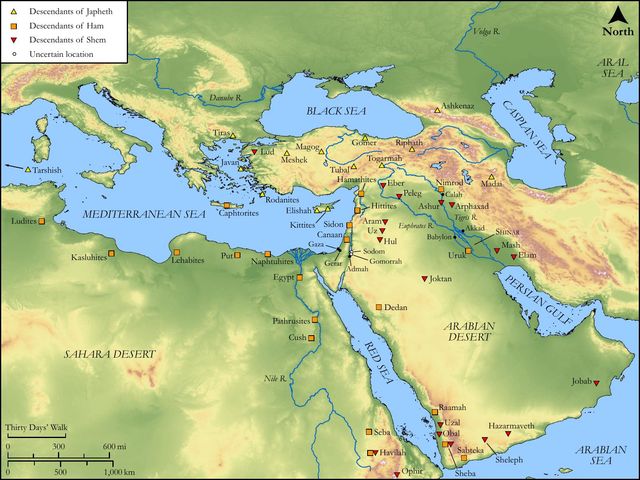
The setting for Genesis 10:10 is the ancient Near East, specifically Mesopotamia, often hailed as the "cradle of civilization." This region, particularly the alluvial plain of Shinar (Sumer/Babylonia), was characterized by its fertile lands, conducive to early agriculture, and the subsequent development of urban centers. Historically, this period saw the rise of city-states and the earliest forms of centralized governance, predating the great empires of later antiquity. The mention of cities like Erech (Uruk) and Accad (Akkad) resonates with archaeological discoveries that confirm their antiquity and significance as major urban and political hubs in Sumerian and Akkadian history. Nimrod's establishment of a "kingdom" (מַמְלָכָה, mamlakah) reflects a shift from nomadic or tribal societies to more complex, organized political structures, a development that would profoundly shape human civilization.
Key Themes
ShowHideGenesis 10:10 contributes significantly to several overarching themes within the book of Genesis and the broader biblical narrative. Firstly, it highlights the theme of human expansion and organization in the post-Flood world, demonstrating humanity's capacity for building complex societies and consolidating power. Secondly, the introduction of Nimrod and his kingdom, particularly Babel, foreshadows the recurring biblical theme of human ambition and rebellion against divine authority. Nimrod's kingdom-building, while a testament to human ingenuity, subtly contrasts with God's command to fill the earth, suggesting a desire for human unity and glory rather than divinely ordained dispersion. Finally, this verse lays the groundwork for the geographical and theological significance of Mesopotamia, a region that would repeatedly play a crucial role in the history of Israel, from Abraham's call out of Ur of the Chaldees (Genesis 11:31) to the Babylonian Exile centuries later.
Exposition and Analysis
ShowHideKey Word Analysis
ShowHideThis word signifies not merely a chronological start but often implies preeminence, chief, or first in importance or rank. Here, it denotes the foundational, inaugural phase of Nimrod's dominion, marking it as the first significant kingdom established in the post-Flood era. It underscores the pioneering nature of Nimrod's political enterprise.
Derived from the verb "to rule as king," this term denotes dominion, a realm, or the abstract concept of royal power. Its use here signifies a departure from earlier patriarchal or tribal structures, indicating a centralized, organized political entity with a defined territory and ruler. This is the first explicit mention of a "kingdom" in the biblical narrative, highlighting a new stage in human societal development.
This name, later known as Babylon, is derived from a root meaning "confusion." While its original Akkadian meaning might have been "gate of God," the biblical text intentionally reinterprets it in Genesis 11:9 to link it to the Hebrew verb balal (to confuse), foreshadowing the divine judgment on human pride and unified rebellion at the Tower of Babel. Its inclusion as the "beginning" city is therefore highly symbolic.
Verse Breakdown
ShowHide"And the beginning of his kingdom was Babel,"
This clause introduces the inaugural phase of Nimrod's dominion, establishing Babel as its primary, foundational city. The use of "beginning" (rêʼshîyth) suggests not just a chronological start but also a preeminent or chief status for Babel within his emerging realm. This marks a significant shift in human societal structure, moving from dispersed family units to centralized, organized political power under a single ruler.
"and Erech, and Accad, and Calneh,"
These three cities are listed as integral components of Nimrod's initial kingdom, alongside Babel. Erech (modern Uruk) was one of the oldest and most influential Sumerian cities, renowned for its monumental architecture and early writing. Accad (Akkad) would later become the capital of the first great Mesopotamian empire under Sargon, suggesting Nimrod's role as a precursor to such imperial unification. Calneh, though its exact location remains debated, is generally placed within the Mesopotamian plain, reinforcing the urban and consolidated nature of Nimrod's rule. The enumeration of these cities emphasizes the geographical scope and urban foundation of his power.
"in the land of Shinar."
This phrase specifies the geographical setting of Nimrod's kingdom. Shinar (Sumer/Babylonia) refers to the fertile alluvial plain between the Tigris and Euphrates rivers in southern Mesopotamia. This region was the historical "cradle of civilization," where urbanism, advanced agriculture, and complex political systems first emerged. Its identification as the heart of Nimrod's kingdom underscores the strategic importance and historical significance of this area as a center of human innovation and power in the ancient world.
Literary Devices
ShowHideThe verse employs Enumeration to list the foundational cities of Nimrod's kingdom, providing a concrete geographical scope for his nascent empire. This technique not only informs the reader of the specific locations but also emphasizes the urban and organized nature of his rule, contrasting with the more dispersed settlements implied earlier in Genesis. Furthermore, there is significant Foreshadowing, particularly with the mention of "Babel." This city's prominence here directly anticipates the narrative of the Tower of Babel in the subsequent chapter, where it becomes a symbol of human hubris and divine judgment. The very name "Babel" carries Symbolism, implicitly linked to confusion and rebellion, setting a thematic tone for the unfolding human story. The description of Nimrod's "kingdom" also introduces the Archetype of the powerful earthly ruler, a figure who will recur throughout biblical history, often in opposition to God's ultimate sovereignty.
Theological and Thematic Connections
ShowHideGenesis 10:10 introduces the pivotal concept of a human "kingdom" in the post-Flood world, marking a significant shift from familial or tribal structures to centralized, organized governance. This development, spearheaded by Nimrod, highlights humanity's inherent drive for consolidation, power, and the establishment of grand enterprises. The choice of Babel as the "beginning" of this kingdom is laden with theological significance, foreshadowing the narrative of human pride and rebellion against God's design that culminates in the confusion of languages at the Tower of Babel. While human organization and civilization are not inherently evil, Nimrod's kingdom-building, particularly his focus on urban centers and consolidated power, subtly contrasts with God's earlier command for humanity to be fruitful, multiply, and fill the earth, hinting at a human desire for self-sufficiency and glory apart from divine guidance.
Reflection and Application
ShowHideGenesis 10:10 offers a profound lens through which to examine the enduring themes of human ambition, power, and the establishment of earthly kingdoms. Nimrod's pioneering role in founding the first post-Flood empire, centered in cities like Babel, serves as a foundational narrative for understanding humanity's innate drive to organize, build, and consolidate power. While the capacity for civilization and collective endeavor is a gift, this verse, particularly in light of the subsequent Babel narrative, cautions us against the dangers of pursuing power and glory independently of, or in defiance of, God's will. It compels us to reflect on the motivations behind our own aspirations, whether personal, communal, or national. Are our efforts directed towards building a kingdom for ourselves, or are we seeking to align our endeavors with God's overarching purposes for humanity and creation? The story of Babel reminds us that unchecked human ambition, seeking to reach "the heavens" through its own strength, ultimately leads to confusion, division, and a scattering that thwarts God's design for unity and blessing. Therefore, we are called to humble ourselves, recognizing God's ultimate sovereignty over all earthly realms, and to direct our energies toward building His kingdom, characterized by righteousness, peace, and joy in the Holy Spirit.
Questions for Reflection
ShowHideFAQ
ShowHideHow does Genesis 10:10 connect to the Tower of Babel narrative?
ShowHideGenesis 10:10 serves as a crucial geographical and political prelude to the Tower of Babel story in Genesis 11:1-9. It establishes Babel as the initial capital and a prominent city of Nimrod's kingdom, highlighting its early significance as a center of human power and consolidation. The subsequent narrative then reveals that this very city became the focal point of humanity's unified rebellion against God, where they sought to build a tower to heaven for their own glory and to "make a name for themselves," leading to the divine confusion of languages and the scattering of peoples across the earth. Thus, Genesis 10:10 sets the stage for understanding the theological implications of human ambition centered in Babel.
What is the significance of "Shinar" in biblical history?
ShowHide"Shinar" (Sumer/Babylonia) is highly significant as the historical cradle of early civilization in Mesopotamia, where urban centers, writing, and complex political systems first developed. In the Bible, Shinar is consistently portrayed as a place of human innovation, power, and often, rebellion against God. Beyond Nimrod's kingdom and the Tower of Babel, it is the land from which Abraham was called (Genesis 11:31), and it later became the seat of the mighty Babylonian Empire, which played a crucial role in Israel's history, including the exile and the destruction of the Temple (2 Kings 25). Its recurring presence in scripture underscores its importance as a symbol of human-centered power and often, opposition to God's divine plan, ultimately representing the worldly system that stands in contrast to God's kingdom.
Christ-Centered Fulfillment
ShowHideThe rise of Nimrod's kingdom in Genesis 10:10, centered in Babel, presents a profound theological contrast to the kingdom of God inaugurated and ultimately fulfilled by Jesus Christ. Nimrod's empire embodies humanity's fallen ambition to establish a kingdom based on human strength, consolidation, and self-glory, a pursuit that inevitably leads to confusion, division, and scattering, as vividly portrayed in the subsequent narrative of Babel. In stark contrast, Jesus Christ establishes a kingdom "not of this world" (John 18:36), founded on divine power, righteousness, and humble service, rather than human might or earthly conquest. While Nimrod sought to unite humanity under a singular, human-devised rule, leading to linguistic and cultural fragmentation, Christ's atoning work on the cross (Colossians 1:19-20) and the outpouring of the Holy Spirit at Pentecost (Acts 2:1-11) begin to reverse the curse of Babel, uniting people from every tribe, tongue, and nation into one body under His headship. Christ is the true King, whose reign is eternal, just, and brings true peace and unity, ultimately subduing all earthly kingdoms and establishing a perfect, everlasting kingdom where God's will is perfectly done (Revelation 11:15).