


Jeremiah 50:21
Bible text: King James Version (1769 Blayney text) · Public domain
Bible text: King James Version with Strong's numbers · Public domain
Bible text: Berean Standard Bible · Public domain
Bible text: American Standard Version (1901) · Public domain
Bible text: World English Bible, Messianic edition · Public domain
Bible text: Geneva Bible (1599) · Public domain
Bible text: Young's Literal Translation · Public domain
- עַל'alonH5921PrepPreposition
- הָאָרֶץha·'A·retzthe land ofH776Art ¦ N-fscNoun Singular Feminine Constructהָtheאָרֶץland of
- מְרָתַיִםme·ra·Ta·yimMerathaimH4850N-properNoun Proper Location
- עֲלֵה'a·Lehgo upH5927V-Qal-Imp-2msVerb Qal Imperative 2nd Singular Masculine
- עָלֶיהָ'a·Lei·haon itH5921Prep ¦ 3fsPrepositionעָלֶיonהָit
- וְאֶלve·'eland againstH413Conj-w ¦ PrepPrepositionוְandאֶלagainst
- יוֹשְׁבֵיyo·she·Vei[the] inhabitants ofH3427V-Qal-Prtcpl-mpVerb Qal Participle Plural Masculine Construct
- פְּקוֹדpe·KodPekodH6489N-properNoun Proper Location
- חֲרֹבcha·RokillH2717V-Qal-InfVerb Qal Infinitive Construct
- וְהַחֲרֵםve·ha·cha·Remand totally destroyH2763Conj-w ¦ V-Hiphil-InfAbsVerb Hiphil Infinitive Absoluteוְandהַחֲרֵםtotally destroy
- אַחֲרֵיהֶם'a·cha·rei·Hemafter themH310Adj-mpc ¦ 3mpAdjective Numerical Plural Masculine Constructאַחֲרֵיafterהֶםthem
- נְאֻםne·'um[the] utterance ofH5002N-mscNoun Singular Masculine Construct
- יְהוָהYah·wehYahwehH3068N-properNoun Proper Title
- וַעֲשֵׂהva·'a·Sehand doH6213Conj-w ¦ V-Qal-Imp-2msVerb Qal Imperative 2nd Singular Masculineוַandעֲשֵׂהdo
- כְּכֹלke·Kholaccording to allH3605Prep-k ¦ N-msNoun Singular Masculine Absoluteכְּaccording toכֹלall
- אֲשֶׁר'a·SherthatH834RelParticle Relative
- צִוִּיתִיךָtzi·vi·Ti·khaI have commanded youH6680V-Piel-Perf-1cs ¦ 2msVerb Piel Perfect 1st Singular common genderצִוִּיתִיI have commandedךָyou
English is a literal word-by-word gloss of the Hebrew, not the KJV's wording. Why?
This is the original text the KJV's translators worked from — each Hebrew word with its own literal English meaning in this verse, prepared by scholars at Tyndale House, Cambridge. The KJV translates whole sentences, not word by word, so its wording differs: one Hebrew word can become several English words, and the KJV may choose “the LORD” where the gloss reads “Yahweh”. Both are faithful — they answer different questions. For the KJV's own rendering, switch to the KJV text.
Details
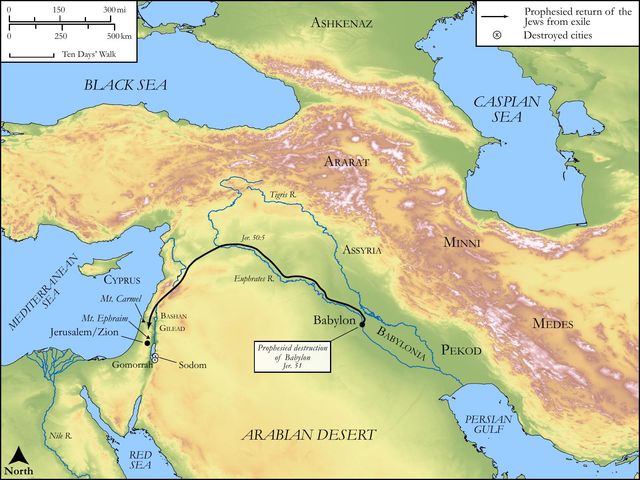
See on the biblical-era map
Study this verse
Public-domain commentary
Matthew Henry
From his Commentary on the Whole Bible. Henry comments on passages, not single verses — this entry covers Jeremiah 50:21–32.
Here, 1. The forces are mustered and commissioned to destroy Babylon, and every thing is got ready for a descent upon that potent kingdom: Go up against that land by Merathaim, the country of the Mardi, that lay part in Assyria and part in Armenia; and go among the inhabitants of Pekod, another country (mentioned Eze 23:23) which Cyrus took in his way to Babylon. The forces of Cyrus are called to go up against Babylon (Jer 50:21), to come against her from the utmost border. Let all come together, for there will be both work and pay enough for them all, Jer 50:26. Distance of place must not be their hindrance from engaging in this work. The archers particularly must be called together against Babylon, Jer 50:29. Thus the Lord hath opened his armoury (Jer 50:25), his treasury (so the word is), and hath brought forth the weapons of his indignation, as great princes fetch out of their magazines and stores all necessary provisions for their armies when they undertake any great expedition. Media and Persia are now God's armoury; thence he fetches the weapons of his wrath, Cyrus and his great officers and armies, whom he will make use of for the destruction of Babylon. Note, Great men are but instruments which the great God makes use of to serve his own purposes. He has variety of instruments, has them at command, has armouries ready to be opened according as the occasion is. This is the work of the Lord God of hosts. Note, When God has work to do he will make it appear that he is God of hosts, and will not want instruments to do it with. 2. Instructions are given them what to do. In general, Do according to all that I have commanded thee, Jer 50:21. It was said of Cyrus (Isa 44:28), He shall perform all my pleasure, in his expedition against Babylon. They must waste and utterly destroy after them; when they have destroyed once they must go over them again, or destroy their posterity that should come after them. They must open her store-houses (Jer 50:26), rifle her treasures, and turn her artillery against herself. They must cast her up as heaps; let all the wealth and pomp of Babylon be shovelled up in a heap of ruins and rubbish. Tread her down as heaps (so the margin reads it) and destroy her utterly. See how little account the great God makes of those things which men so much value and value themselves so much upon. Their princes and great men, who are fat and bulky, shall fall by the sword, not as men of war in the field of battle, which we call a bed of honour, but as beasts by the butcher's hand (Jer 50:27): Slay all her bullocks, all her mighty men; let them go down sottishly and insensibly, as an ox to the slaughter. Woe unto them! their case is the more sad for the little sense they have of it. Their day has come to fall, the time when they must be reckoned with, and they are not aware of it. 3. Assurances are given them of success. Let them do what God commands, and they shall accomplish what he threatens. A great destruction shall be made, Jer 50:22. Babylon shall become a desolation (Jer 50:23); her young men and all her men of war shall be cut off in that day which should have been her defence, Jer 50:30. God is against her (Jer 50:31); he has laid a snare for her (Jer 50:24); he has formed this enterprise against her, that she should be surprised as a bird taken in a snare. Cyrus shall no doubt prevail, for he fights under God. God will kindle a fire in the cities of Babylon (Jer 50:32); and who can stand before him when he is angry, or quench the fire that he has kindled? 4. Reasons are given for these severe dealings with Babylon. Those that are employed in this war may, if they please, know the grounds of it, and be satisfied in the justice of it, which it is fit all should be that are called to such work. (1.) Babylon has been very troublesome, vexatious, and injurious, to all its neighbours; it has been the hammer of the whole earth (Jer 50:23), beating, beating down, and beating to pieces, all the nations far and near. It has done so long enough; it is time now that it be cut asunder and broken. Note, He that is the god of nations will sooner or later assert the injured rights of nations against those that unjustly and violently invade them. The God of the whole earth will break the hammer of the whole earth. (2.) Babylon has bidden defiance to God himself: Thou has striven against the Lord (Jer 50:24), hast joined issue with him (so the word signifies) as in law or battle, hast openly opposed him, set up rivals with him, raised rebellion against him; therefore thou art now found, and caught, as in a snare. Note, Those that strive against the Lord will soon find themselves over-matched. (3.) Babylon ruined Jerusalem, the holy city, and the holy house there, and must now be called to an account for that. This is the manifesto published in Zion, in the day of Babylon's visitation; it is the vengeance of the Lord our God, the vengeance of his temple, Jer 50:28. The burning of the temple, and the carrying away of its vessels, were articles in the charge against Babylon on which greater stress was laid than upon its being the hammer of the whole earth; for Zion was the joy and glory of the whole earth. Note, Whatever wrong is done to God's church (his temple in the world) it will certainly be reckoned for; and no vengeance will be sorer nor heavier than the vengeance of the temple. (4.) Babylon has been very haughty and insolent, and therefore must have a fall; for it is the glory of God to look upon those that are proud and to abase them, Job 40:12. I am against thee, O thou most proud! Jer 50:31 and again Jer 50:32. Thou pride (so the word is), as proud as pride itself. Note, the pride of men's hearts sets God against them and ripens them apace for ruin; for God resists the proud and will bring them down. The most proud shall stumble and fall; they shall fall not so much by others' thrusting them down as by their own stumbling; for they hold their heads so high that they never look under their feet, to choose their way and avoid stumbling-blocks, but walk at all adventures. Babylon's pride must unavoidably be her ruin; for she has been proud against the Lord, against the Holy One of Israel (Jer 50:29), has insulted him in insulting over his people; she has made him her enemy, and therefore, when she has fallen, none shall raise her up, Jer 50:32. Who can help those up whom God will throw down?
Continue studying Jeremiah 50:21 across the web’s major study libraries — every link below opens this exact verse, chapter, or book on the destination site.
Read & Compare
 BibleGatewayThis verse in more than 200 translations and 70 languages.
 Bible.comThe YouVersion reader — hundreds of translations, reading plans, and highlights.
 ESV.orgCrossway's official English Standard Version reader.
 NET BibleThe NET translation with 60,000+ translators' notes on every rendering decision.
 STEP BibleTyndale House's free study tool — original text, vocabulary, and scholarly resources.
 BibliaLogos Bible Software's free web reader.
 USCCBThe New American Bible (Revised Edition) with the U.S. bishops' study notes.
Commentaries
 BibleHub CommentariesDozens of classic commentaries on this verse, gathered on one page.
 StudyLightMore than 100 commentary sets — the largest collection on the web.
 BibleRefPlain-English commentary on what this verse means, verse by verse.
 Enduring WordDavid Guzik's free commentary on this chapter, widely used by Bible teachers.
 Bible Study ToolsVerse commentary alongside Greek and Hebrew study aids.
Original Language & Research
- BibleHub InterlinearThe verse word by word — original language, transliteration, and English.
- BibleHub LexiconEvery word's original-language definition and Strong's entry.
 Blue Letter BibleDeep-study tools — Strong's numbers, concordance, and word studies.
 SefariaThe Hebrew text with Rashi and centuries of Jewish commentary.
Sermons, Hymns & Audio


TrulyRandomVerse is not affiliated with these sites and doesn’t control their content. They’re linked because they’re genuinely useful.
Summary
Jeremiah 50:21 delivers a powerful divine mandate for the comprehensive and absolute destruction of Merathaim and Pekod, regions associated with Babylon. This prophetic decree is a stark declaration of Yahweh's sovereign judgment against the formidable empire that had relentlessly oppressed His chosen people. It underscores God's ultimate authority over all nations and His unwavering commitment to executing His righteous will, demanding precise and unreserved obedience from those He commissions to carry out His punitive purposes against the proud and wicked.
Context
ShowHideLiterary Context
This verse is intricately woven into the expansive "Burden Against Babylon" found in Jeremiah chapters 50-51. These chapters comprise a significant prophetic oracle detailing the complete and irreversible downfall of the Babylonian Empire. Babylon had served as God's instrument for Judah's chastisement, but through its excessive cruelty, arrogance, and idolatry, it had overstepped its divine commission. Specifically, Jeremiah 50:21 issues a direct, imperative command to the agents of God's judgment—implicitly the Medes and Persians, though not named—to march against and utterly destroy specific regions associated with Babylon. This immediate context follows broader declarations of Babylon's impending desolation and precedes further detailed descriptions of its destruction and the subsequent restoration of Israel. The specificity of "Merathaim" and "Pekod" within this larger judgment narrative emphasizes the comprehensive nature of God's wrath, indicating that no part of the oppressive empire would escape His righteous hand.
Historical & Cultural Context
Historically, Jeremiah 50:21 is situated against the backdrop of the Babylonian Empire's apparent invincibility, following its conquest of Judah, the destruction of Jerusalem and its Temple in 586 BC, and the subsequent exile of the Jewish people. Under Nebuchadnezzar, Babylon was the dominant superpower of its era. Yet, Jeremiah's prophecy boldly declares its inevitable collapse, which historically materialized with the fall of Babylon to Cyrus the Great and the Persian Empire in 539 BC. Culturally, the naming of "Merathaim" and "Pekod" carries profound symbolic weight. "Merathaim" (מְרָתַיִם), often interpreted as "double bitterness" or "double rebellion," serves as a symbolic name for Babylon, highlighting its egregious sins and the severe retribution it would face. "Pekod" (פְּקוֹד), meaning "visitation" or "punishment," directly alludes to the divine reckoning that would befall these regions. These names, whether actual geographical locations or symbolic epithets, underscore the theological conviction that no nation, however mighty, operates outside the purview of God's justice. The command to "waste and utterly destroy" reflects the common, brutal practice of warfare among the nations, where conquered cities and lands were often laid desolate as a display of dominance and a stark warning.
Key Themes
ShowHideSeveral profound themes resonate within Jeremiah 50:21. Primarily, it powerfully articulates the theme of Divine Judgment, demonstrating God's unwavering commitment to justice and His readiness to punish nations that defy His moral order and oppress His chosen people. The severity of the command—"waste and utterly destroy"—underscores the totality of this impending judgment, a just recompense for Babylon's arrogance and cruelty, especially against Judah, as seen in Jeremiah 25:12. Secondly, the verse highlights God's Sovereignty over Nations. The repeated declaration "saith the LORD" and the imperative "do according to all that I have commanded thee" emphasize Yahweh's supreme authority and control over human history, demonstrating that even powerful empires like Babylon are mere instruments in His hands, subject to His ultimate will and judgment. This aligns with themes found in Daniel 2:21. Finally, the passage speaks to the Fulfillment of Prophecy, serving as a testament to God's faithfulness in executing His declared word. The detailed nature of Jeremiah's oracle concerning Babylon's fall assures that God's plans for nations, whether for judgment or restoration, will inevitably come to pass, reinforcing the truth that God declares "the end from the beginning" (Isaiah 46:10).
Exposition and Analysis
ShowHideKey Word Analysis
ShowHideThis primitive root signifies "to parch (through drought) i.e. (by analogy,) to desolate, destroy, kill." It implies a thorough and devastating destruction, rendering the land uninhabitable and barren, reflecting the complete undoing of Babylon's prosperity and power as commanded in Jeremiah 50:21.
This powerful verb means "to seclude; specifically (by a ban) to devote to religious uses (especially destruction)." It carries the connotation of a complete and irreversible annihilation, often associated with the concept of herem, where something is devoted to God by being utterly destroyed, as seen in contexts like Joshua 6:17. Here, it underscores the divinely ordained and total eradication of Babylon's influence and presence in the targeted regions.
This term is derived from a root meaning "to visit" or "to punish," and it serves as a symbolic name for a region within or associated with Babylon, signifying "punishment." Its inclusion in Jeremiah 50:21 directly foreshadows the divine reckoning that would befall Babylon, indicating that God's "visitation" would bring about its deserved judgment and destruction for its sins, particularly its oppression of Judah.
Verse Breakdown
ShowHide"Go up against the land of Merathaim, [even] against it, and against the inhabitants of Pekod"
This opening imperative issues a direct military command to an unnamed force, likely referring to the Medes and Persians, to launch an assault. "Merathaim" (meaning "double bitterness" or "double rebellion") and "Pekod" (meaning "visitation" or "punishment") are symbolic or regional names for parts of Babylonia, emphasizing the specific targets of divine wrath. The repetition ("against it, and against") intensifies the focus on the comprehensive nature of the impending attack, leaving no part untouched.
"waste and utterly destroy after them, saith the LORD"
This clause reveals the devastating extent of the commanded action. "Waste" (Hebrew: chârab) implies desolation and ruin, while "utterly destroy" (Hebrew: châram) signifies a complete and irreversible annihilation, often with the connotation of being devoted to destruction as an act of divine judgment. The phrase "after them" suggests a thorough pursuit and eradication of all remnants. The emphatic declaration "saith the LORD" (Hebrew: nᵉʼum Yᵉhôvâh) underscores the divine origin and absolute authority behind this decree, making it a non-negotiable command from the sovereign God.
"and do according to all that I have commanded thee"
This concluding imperative reinforces the absolute nature of God's command. It demands total obedience from the agents of judgment, ensuring that the destruction is executed precisely as Yahweh has decreed, without deviation or mercy. This highlights God's meticulous control over the unfolding of historical events and His unwavering commitment to fulfilling His prophetic word.
Literary Devices
ShowHideJeremiah 50:21 employs several powerful literary devices to convey its message of impending judgment. The verse opens with a direct Apostrophe or Personification, addressing an unnamed force ("Go up against the land...") as if it were a conscious agent receiving a divine command, thereby emphasizing the directness and urgency of God's decree. Symbolism is evident in the names "Merathaim" and "Pekod." "Merathaim," meaning "double bitterness" or "double rebellion," serves as a symbolic epithet for Babylon, highlighting its profound sinfulness and the severity of the retribution it deserves. "Pekod," meaning "visitation" or "punishment," directly foreshadows the divine reckoning, transforming geographical names into theological statements. The repeated and strong verbs "waste" (chârab) and "utterly destroy" (châram) constitute Intensification and a form of Hyperbole, emphasizing the totality and severity of the judgment, leaving no room for partial destruction. Finally, the recurring phrase "saith the LORD" functions as a Divine Fiat or Authoritative Declaration, lending an undeniable weight of divine authority to the entire command and underscoring God's absolute sovereignty over nations and history.
Theological and Thematic Connections
ShowHideJeremiah 50:21 serves as a profound theological statement on God's active involvement in human history and His unwavering commitment to justice. It underscores that divine judgment is not arbitrary but a righteous response to national sin, particularly the oppression of God's people and defiance of His moral order. The specific targeting of "Merathaim" and "Pekod" illustrates that God's judgment is precise and comprehensive, reaching every corner of a rebellious empire. This verse affirms God's absolute sovereignty over all nations, demonstrating that He raises up and casts down empires according to His divine purpose, using even pagan nations as instruments of His will before holding them accountable for their own transgressions. It offers both a warning to those who defy God and an assurance to the oppressed that their suffering is seen and will ultimately be avenged by a just God.
Reflection and Application
ShowHideJeremiah 50:21 calls us to profound reflection on the nature of God and our place in His sovereign plan. While the immediate context is ancient Babylon, the underlying principles are timeless and universally applicable. This verse reminds us that no nation, institution, or individual can ultimately escape divine accountability. God's justice, though sometimes delayed from a human perspective, is certain and comprehensive. For believers, this truth offers immense comfort: God sees injustice, hears the cries of the oppressed, and will ultimately right all wrongs. It encourages us to trust in His perfect timing and His righteous judgment, even when the world seems chaotic or unjust. Furthermore, it challenges us to examine our own lives and societies, asking if we are aligning with God's righteous standards or if we are, in any way, participating in systems or attitudes that oppress, exploit, or defy Him. Our response should be one of humility, repentance where necessary, and a renewed commitment to living justly and compassionately, reflecting the character of the God who judges righteously.
Questions for Reflection
ShowHideFAQ
ShowHideWho are Merathaim and Pekod?
ShowHideMerathaim and Pekod are likely symbolic or regional names for parts of Babylonia. "Merathaim" (מְרָתַיִם) can be translated as "double bitterness" or "double rebellion," serving as a symbolic epithet for Babylon itself, highlighting its profound sinfulness and the severe retribution it would face. "Pekod" (פְּקוֹד), meaning "visitation" or "punishment," directly alludes to the divine reckoning that would befall these regions. While some scholars have attempted to identify them with specific geographical locations, their primary significance in Jeremiah 50:21 lies in their symbolic representation of Babylon's guilt and its destined judgment, emphasizing the comprehensive nature of God's wrath against the entire empire.
Why is God commanding such extreme destruction?
ShowHideGod's command for "waste and utterly destroy" reflects the severe nature of Babylon's sins and the custom of warfare among the nations of that day. Babylon had not only conquered Judah but had done so with excessive cruelty, destroying Jerusalem, its Temple, and exiling its people. While God used Babylon as an instrument of His judgment against Judah (Jeremiah 25:9), Babylon's arrogance and actions against God's people went beyond its divine commission. The extreme destruction serves as a just recompense for its pride, idolatry, and oppression, demonstrating God's unwavering justice and His commitment to avenging His people, as prophesied in Jeremiah 50:11. It also serves as a powerful warning to all nations that defy the Lord and oppress the innocent.
Does this prophecy have a future fulfillment beyond ancient Babylon?
ShowHideWhile Jeremiah 50:21 and the surrounding chapters primarily refer to the historical fall of ancient Babylon to the Medo-Persian Empire in 539 BC, the themes of divine judgment against oppressive empires resonate throughout biblical prophecy and theology. The concept of "Babylon" later becomes a powerful symbol in the New Testament, particularly in the Book of Revelation, representing all systems and powers that oppose God and persecute His people. The prophetic declarations of its ultimate downfall in Revelation 18 echo the language and themes found in Jeremiah, suggesting a spiritual and eschatological fulfillment where God's final judgment will be executed against all forms of spiritual "Babylon" that stand in rebellion against Him. Thus, while historically fulfilled, its principles extend to future divine reckonings.
Christ-Centered Fulfillment
ShowHideWhile Jeremiah 50:21 speaks of God's judgment against a specific earthly empire, its ultimate Christ-centered fulfillment lies in the triumph of God's kingdom over all opposing powers, culminating in the reign of Jesus Christ. The "waste and utterly destroy" command, though physically executed against Babylon, foreshadows the spiritual destruction of all forces of sin, death, and evil that hold humanity captive. Christ, as the King of kings and Lord of lords, is the ultimate executor of divine justice, not through earthly armies but through His redemptive work on the cross and His glorious return. He has already triumphed over the principalities and powers through His death and resurrection, disarming them. The final "Pekod" or "visitation" of judgment will be at Christ's second coming, where He will judge the living and the dead and establish His eternal kingdom, utterly destroying all forms of spiritual "Babylon" that rebel against God, as depicted in Revelation 19. Thus, the judgment declared in Jeremiah finds its ultimate and perfect realization in the person and work of Christ, who brings both judgment upon sin and salvation to those who believe, ensuring that all that opposes God will ultimately be brought to nothing, and His righteous reign will prevail forever.