


1 Samuel 15:24
Bible text: King James Version (1769 Blayney text) · Public domain
Bible text: King James Version with Strong's numbers · Public domain
Bible text: Berean Standard Bible · Public domain
Bible text: American Standard Version (1901) · Public domain
Bible text: World English Bible, Messianic edition · Public domain
Bible text: Geneva Bible (1599) · Public domain
Bible text: Young's Literal Translation · Public domain
- וַיֹּאמֶרvai·Yo·merand he saidH559Conj-w ¦ V-Qal-ConsecImperf-3msVerb Qal Consecutive Imperfect 3rd Singular Masculineוַandיֹּאמֶרhe said
- שָׁאוּלsha·'UlSaulH7586N-proper-mNoun Proper Masculine
- אֶל'eltoH413PrepPreposition
- שְׁמוּאֵלshe·mu·'ElSamuelH8050N-proper-mNoun Proper Masculine
- חָטָאתִיcha·Ta·tiI have sinnedH2398V-Qal-Perf-1csVerb Qal Perfect 1st Singular common gender
- כִּיkiforH3588PrtParticle Conditional
- עָבַרְתִּי'a·Var·tiI have transgressedH5674V-Qal-Perf-1csVerb Qal Perfect 1st Singular common gender
- אֶת'et<obj.>H853DirObjMParticle Object Indicator
- פִּיpi[the] mouth ofH6310N-mscNoun Singular Masculine Construct
- יְהוָהYah·wehYahwehH3068N-properNoun Proper Title
- וְאֶתve·'Etand <obj.>H853Conj-w ¦ DirObjMParticle Object Indicatorוְandאֶת<obj.>
- דְּבָרֶיךָde·va·Rei·khayour wordsH1697N-mpc ¦ 2msNoun Plural Masculine Constructדְּבָרֶיwordsךָyour
- כִּיkiforH3588PrtParticle Conditional
- יָרֵאתִיya·Re·tiI fearedH3372V-Qal-Perf-1csVerb Qal Perfect 1st Singular common gender
- אֶת'et<obj.>H853DirObjMParticle Object Indicator
- הָעָםha·'Amthe peopleH5971Art ¦ N-msNoun Singular Masculine Absoluteהָtheעָםpeople
- וָאֶשְׁמַעva·'esh·Ma'and I listenedH8085Conj-w ¦ V-Qal-ConsecImperf-1csVerb Qal Consecutive Imperfect 1st Singular common genderוָandאֶשְׁמַעI listened
- בְּקוֹלָםbe·ko·Lamto their voiceH6963Prep-b ¦ N-msc ¦ 3mpNoun Singular Masculine Constructבְּtoקוֹלָvoiceםtheir
English is a literal word-by-word gloss of the Hebrew, not the KJV's wording. Why?
This is the original text the KJV's translators worked from — each Hebrew word with its own literal English meaning in this verse, prepared by scholars at Tyndale House, Cambridge. The KJV translates whole sentences, not word by word, so its wording differs: one Hebrew word can become several English words, and the KJV may choose “the LORD” where the gloss reads “Yahweh”. Both are faithful — they answer different questions. For the KJV's own rendering, switch to the KJV text.
Details
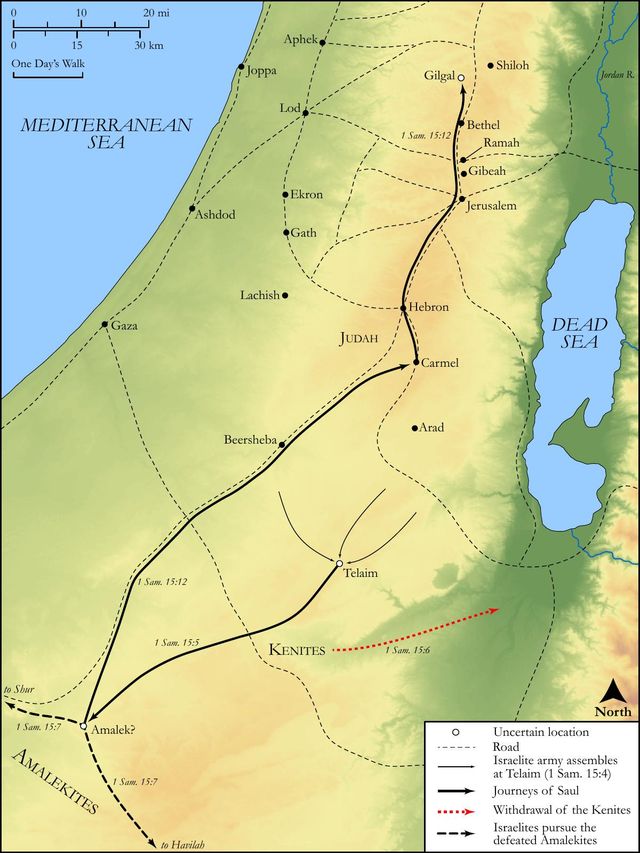
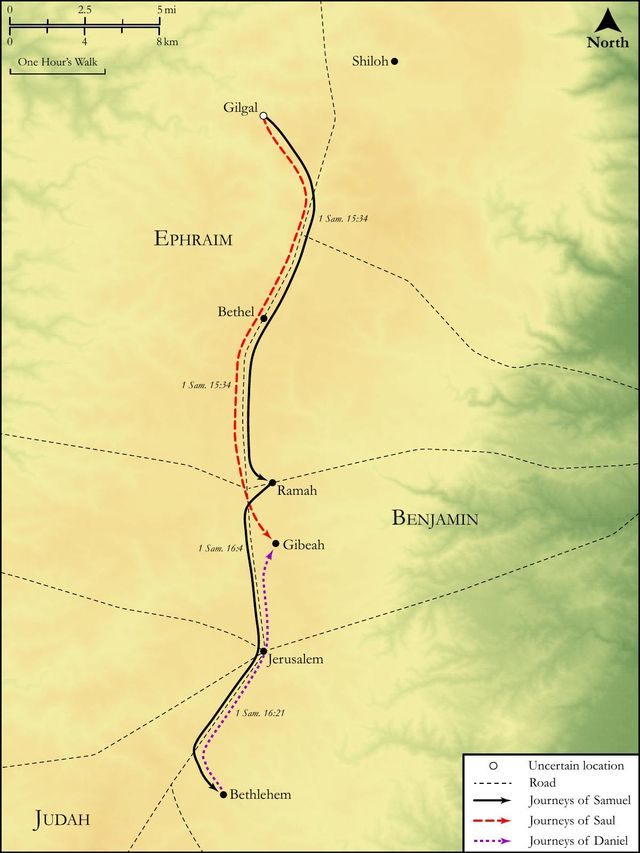
See on the biblical-era maps
Study this verse
Public-domain commentary
Matthew Henry
From his Commentary on the Whole Bible. Henry comments on passages, not single verses — this entry covers 1 Samuel 15:24–31. His two-level outline is real structure in the source text, so it is rendered as structure.
Saul is at length brought to put himself into the dress of the penitent; but it is too evident that he only acts the part of a penitent, and is not one indeed. Observe,
I.How poorly he expressed his repentance.
It was with much ado that he was made sensible of his fault, and not till he was threatened with being deposed. This touched him in a tender part. Then he began to relent, and not till then. When Samuel told him he was rejected from being king, then he said, I have sinned, Sa1 15:24. His confession was not free nor ingenuous, but extorted by the rack, and forced from him. We observe here several bad signs of the hypocrisy of his repentance, and that it came short even of Ahab's.
1.He made his application to Samuel only, and seemed most solicitous to stand right in his opinion and to gain his favour. He makes a little god of him, only to preserve his reputation with the people, because they all knew Samuel to be a prophet, and the man that had been the instrument of his preferment. Thinking it would please Samuel, and be a sort of bribe to him, he puts it into his confession: I have transgressed the commandment of the Lord and thy word; as if he had been in God's stead, Sa1 15:24. David, though convinced by the ministry of Nathan, yet, in his confession, has his eye to God alone, not to Nathan. Psa 51:4 Against thee only have I sinned. But Saul, ignorantly enough, confesses his sin as a transgression of Samuel's word; whereas his word was no other than a declaration of the commandment of the Lord. He also applies to Samuel for forgiveness (Sa1 15:25): I pray thee, pardon my sin; as if any could forgive sin but God only. Those wretchedly deceive themselves who, when they have fallen into scandalous sin, think it enough to make their peace with the church and their ministers, by the show and plausible profession of repentance, without taking care to make their peace with God by the sincerity of it. The most charitable construction we can put upon this of Saul is to suppose that he looked upon Samuel as a sort of mediator between him and God, and intended an address to God in his application to him. However, it was very weak.
2.He excused his fault even in the confession of it, and that is never the fashion of a true penitent (Sa1 15:24): I did it because I feared the people, and obeyed their voice. We have reason enough to think that it was purely his own doing and not the people's; however, if they were forward to do it, it is plain, by what we have read before, that he knew how to keep up his authority among them and did not stand in any awe of them. So that the excuse was false and frivolous; whatever he pretended, he did not really fear the people. But it is common for sinners, in excusing their faults, to plead the thoughts and workings of their own minds, because those are things which, how groundless soever, no man can disprove; but they forget that God searchest the heart.
3.All his care was to save his credit, and preserve his interest in the people, lest they should revolt from him, or at least despise him. Therefore he courts Samuel with so much earnestness (Sa1 15:25) to turn again with him, and assist in a public thanksgiving for the victory. Very importunate he was in this matter when he laid hold on the skirt of his mantle to detain him (Sa1 15:27), not that he cared for Samuel, but he feared that if Samuel forsook him the people would do so too. Many seem zealously affected to good ministers and good people only for the sake of their own interest and reputation, while in heart they hate them. But his expression was very gross when he said (Sa1 15:30), I have sinned, yet honour me, I pray thee, before my people. Is this the language of a penitent? No, but the contrary: "I have sinned, shame me now, for to me belongs shame, and no man can loathe me so much as I loathe myself." Yet how often do we meet with the copies of this hypocrisy of Saul! It is very common for those who are convicted of sin to show themselves very solicitous to be honoured before the people. Whereas he that has lost the honour of an innocent can pretend to no other than that of a penitent, and it is the honour of a penitent to take shame to himself.
II.How little he got by these thin shows of repentance. What point did he gain by them?
1.Samuel repeated the sentence passed upon him, so far was he from giving any hopes of the repeal of it, Sa1 15:26, the same with Sa1 15:23. He that covers his sins shall never prosper, Pro 28:13. Samuel refused to turn back with him, but turned about to go away, Sa1 15:27. As the thing appeared to him upon the first view, he thought it altogether unfit for him so far to countenance one whom God had rejected as to join with him in giving thanks to God for a victory which was made to serve rather Saul's covetousness than God's glory. Yet afterwards he did turn again with him (Sa1 15:31), upon further thoughts, and probably by divine direction, either to prevent a mutiny among the people or perhaps not to do honour to Saul (for, though Saul worshipped the Lord, Sa1 15:31, it is not said Samuel presided in that worship), but to do justice on Agag, Sa1 15:32.
2.He illustrated the sentence by a sign, which Saul himself, by his rudeness, gave occasion for. When Samuel was turning from him he tore his clothes to detain him (Sa1 15:27), so loth was he to part with the prophet; but Samuel put a construction upon this accident which none but a prophet could do. He made it to signify the rending of the kingdom from him (Sa1 15:28), and that, like this, was his own doing. "He hath rent it from thee, and given it to a neighbour better than thou," namely, to David, who afterwards, upon occasion, cut off the skirt of Saul's robe (Sa1 24:4), upon which Saul said (Sa1 24:20), I know that thou shalt surely be king, perhaps remembering this sign, the tearing of the skirt of Samuel's mantle.
3.He ratified it by a solemn declaration of its being irreversible (Sa1 15:29): The Strength of Israel will not lie. The Eternity or Victory of Israel, so some read it; the holy One, so the Arabic; the most noble One, so the Syriac; the triumphant King of Israel, so bishop Patrick. "He is determined to depose thee, and he will not change his purpose. He is not a man that should repent." Men are fickle and alter their minds, feeble and cannot effect their purposes; something happens which they could not foresee, by which their measures are broken. But with God it is not so. God has sometimes repented of the evil which he thought to have done, repentance was hidden from Saul, and therefore hidden from God's eyes.
Historical interpretation
Historical reception
1 surviving comment on this verse from the historical church.
Saul, too, when he was reproved by Samuel, said, “I have sinned.” Why, then, was he not considered fit to be told, as David was, that the Lord had pardoned his sin? Is there favoritism with God? Far from it. While to the human ear the words were the same, the divine eye saw a difference in the heart. The lesson for us to learn from these things is that the kingdom of heaven is within us and that we must worship God from our inmost feelings, that out of the abundance of the heart the mouth may speak, instead of honoring him with our lips, like the people of old, while our hearts are far from him. We may learn also to judge people, whose hearts we cannot see, only as God judges, who sees what we cannot, and who cannot be biased or misled.
Continue studying 1 Samuel 15:24 across the web’s major study libraries — every link below opens this exact verse, chapter, or book on the destination site.
Read & Compare
 BibleGatewayThis verse in more than 200 translations and 70 languages.
 Bible.comThe YouVersion reader — hundreds of translations, reading plans, and highlights.
 ESV.orgCrossway's official English Standard Version reader.
 NET BibleThe NET translation with 60,000+ translators' notes on every rendering decision.
 STEP BibleTyndale House's free study tool — original text, vocabulary, and scholarly resources.
 BibliaLogos Bible Software's free web reader.
 USCCBThe New American Bible (Revised Edition) with the U.S. bishops' study notes.
Commentaries
 BibleHub CommentariesDozens of classic commentaries on this verse, gathered on one page.
 StudyLightMore than 100 commentary sets — the largest collection on the web.
 BibleRefPlain-English commentary on what this verse means, verse by verse.
 Enduring WordDavid Guzik's free commentary on this chapter, widely used by Bible teachers.
 Bible Study ToolsVerse commentary alongside Greek and Hebrew study aids.
Original Language & Research
- BibleHub InterlinearThe verse word by word — original language, transliteration, and English.
- BibleHub LexiconEvery word's original-language definition and Strong's entry.
 Blue Letter BibleDeep-study tools — Strong's numbers, concordance, and word studies.
 SefariaThe Hebrew text with Rashi and centuries of Jewish commentary.
Sermons, Hymns & Audio


TrulyRandomVerse is not affiliated with these sites and doesn’t control their content. They’re linked because they’re genuinely useful.
Summary
1 Samuel 15:24 captures King Saul's pivotal and problematic confession to the prophet Samuel, where he acknowledges transgressing the Lord's command and Samuel's words. This admission, however, is immediately qualified by his explanation that he acted out of fear of the people and a desire to obey their voice. This moment serves as a stark revelation of Saul's spiritual priorities, highlighting a profound character flaw—a greater concern for human approval than for divine obedience—which ultimately sealed his rejection as king and stands as a poignant warning against compromised faith and superficial repentance.
Context
ShowHideLiterary Context
This verse is the dramatic climax of a direct confrontation between Samuel and Saul, following Saul's egregious failure to fully execute God's explicit command regarding the Amalekites. In 1 Samuel 15:3, the Lord, through Samuel, had commanded a complete "devotion to destruction" (herem) of all Amalek, including their king and livestock. Saul, however, spared King Agag and the finest of the sheep and oxen, ostensibly for sacrifice to the Lord. Samuel's subsequent, scathing rebuke, culminating in the powerful declaration in 1 Samuel 15:22-23, emphasized that "to obey is better than sacrifice" and unequivocally announced God's rejection of Saul's kingship due to his rebellion. Saul's words in 1 Samuel 15:24 are his immediate, desperate, and ultimately insufficient response to this divine judgment, revealing a self-preservation instinct rather than true contrition. This episode marks a definitive turning point in the narrative, solidifying Saul's spiritual decline and setting the stage for David's anointing as the next king of Israel.
Historical & Cultural Context
The concept of "herem" (devotion to destruction) was a unique and severe command in ancient Israelite warfare, signifying that certain enemies and their possessions were to be utterly destroyed as an offering to God. This practice served to prevent contamination from pagan practices and demonstrated Israel's absolute reliance on Yahweh for victory and sustenance. For a king, obedience to such a command was paramount, as he was God's chosen representative and the custodian of divine law. Furthermore, the relationship between prophet and king was crucial; the prophet served as God's direct messenger, holding the king accountable to divine mandates. Saul, as Israel's first king, was under immense pressure to establish his authority and secure popular support. In a culture where a king's perceived strength and wealth (including captured spoils) often bolstered his image and prestige, Saul's decision to spare the best livestock and the enemy king (perhaps as a trophy or for tribute) could be seen as an attempt to enhance his standing with the people. This cultural pressure, however, directly conflicted with the divine mandate, exposing Saul's misplaced priorities and his failure to grasp the unique nature of Israel's covenant relationship with God.
Key Themes
ShowHideThe central themes illuminated by 1 Samuel 15:24 are profound and enduring. Firstly, it underscores the critical importance of unconditional obedience to God's commands, demonstrating that partial obedience is tantamount to complete disobedience. Saul's attempt to rationalize his actions by claiming a desire to offer sacrifices reveals a misunderstanding of God's priorities, as Samuel explicitly states that obedience is more valuable than sacrifice. Secondly, the verse powerfully illustrates the destructive nature of the fear of man versus the fear of God. Saul's explicit confession, "I feared the people, and obeyed their voice," highlights a profound spiritual struggle where the desire for human approval and avoidance of popular disapproval superseded reverence and obedience to the Lord. This fear of man is consistently portrayed in scripture as a snare, as seen in Proverbs 29:25. Finally, Saul's confession raises critical questions about the nature of true repentance. While he admits to sin, his immediate self-justification suggests a conditional confession, lacking the deep contrition and unreserved responsibility that characterize genuine repentance, a pattern that would tragically continue throughout his reign.
Exposition and Analysis
ShowHideKey Word Analysis
ShowHideThis primitive root literally means "to miss the mark" or "to go astray." In a moral and theological sense, it signifies a deviation from God's standard, a failure to meet His righteous requirements, or an act of disobedience against His revealed will. Saul's use of this word acknowledges his failure to hit the target of God's command but, as the rest of the verse reveals, does not necessarily imply deep contrition or a genuine desire for transformative change.
Meaning "to pass over," "to cross a boundary," or "to violate." This term emphasizes a deliberate and active crossing of a line or breaking of a covenant. It highlights that Saul's disobedience was not an accidental oversight but a conscious act of stepping beyond the clear boundaries set by God's explicit commandment, indicating a willful disregard for divine authority.
While yârêʾ can denote reverential awe or worshipful fear of God, in this context, it clearly signifies dread, apprehension, or a servile fear of human reaction. Saul's fear was not a healthy respect for authority but a debilitating anxiety about popular opinion and potential rebellion, which led him to compromise his divine mandate and prioritize human favor over divine approval.
Verse Breakdown
ShowHide"And Saul said unto Samuel, I have sinned"
Saul's initial declaration is an admission of guilt, an acknowledgment of wrongdoing. On the surface, it appears to be a confession. However, given the immediate context of Samuel's severe rebuke and the subsequent qualification in the latter part of the verse, this admission is more a reluctant acknowledgment of being caught rather than a heartfelt expression of genuine sorrow for offending God. It is a statement of fact, a concession to the undeniable evidence, rather than a cry for forgiveness rooted in true contrition.
"for I have transgressed the commandment of the LORD, and thy words"
Here, Saul specifies the nature of his sin: a direct transgression against God's explicit command, delivered authoritatively through Samuel. This indicates Saul understood the divine origin and authority of the instruction he violated. His inclusion of "thy words" acknowledges Samuel's role as God's prophet, but also subtly attempts to diffuse the absolute divine weight of the command by implying a human element, perhaps making it seem less solely God's.
"because I feared the people, and obeyed their voice"
This is the pivotal clause, revealing the true motivation behind Saul's disobedience and the core of his spiritual failing. He explicitly states that his primary allegiance was to the people, not to God. His fear of human disapproval or potential rebellion, and his desire to retain popular favor and avoid social or political consequences, led him to compromise God's clear directive. This statement transforms his "confession" into an excuse, demonstrating a profound lack of genuine repentance and a heart still enslaved by the opinions and expectations of men.
Literary Devices
ShowHideThe passage employs several potent literary devices to convey its profound theological message. Confession is present in Saul's initial admission of sin, yet it is immediately undermined by Justification, as he provides an excuse for his actions rather than taking full responsibility. This creates a powerful Contrast between genuine repentance (which involves unreserved responsibility and sorrow for sin itself) and superficial acknowledgment (which seeks to shift blame or mitigate consequences). There is also significant Irony in Saul's statement: the king, chosen by God to lead His people and represent His authority, fears those very people more than he fears the Almighty God who appointed him. This highlights a fundamental inversion of proper spiritual order and allegiance. Furthermore, the scene serves as powerful Foreshadowing, as Saul's pattern of partial obedience and fear of man will continue to define his reign, ultimately leading to his complete rejection and tragic downfall. The narrative effectively uses Direct Speech to allow Saul's own words to expose the depth of his spiritual compromise and the true condition of his heart.
Theological and Thematic Connections
ShowHideSaul's qualified confession in 1 Samuel 15:24 serves as a timeless theological lesson on the nature of obedience, the danger of misplaced fear, and the characteristics of true repentance. His failure to obey God fully, stemming from a desire to please people, illustrates that God demands wholehearted submission, not partial compliance or external religiosity. This incident underscores that the heart's motivation is paramount to God; He desires a relationship of trust and obedience that prioritizes His will above all human considerations. Saul's example warns against the spiritual idolatry of human approval, which inevitably leads to compromise with divine truth and a forfeiture of God's blessing. True repentance, in contrast to Saul's conditional admission, involves a contrite heart, a full acknowledgment of wrongdoing without excuse, and a turning away from the sin to embrace God's will, trusting in His mercy.
Reflection and Application
ShowHideSaul's tragic example in 1 Samuel 15:24 holds profound implications for contemporary believers. It compels us to rigorously examine the true motivations behind our actions and decisions. Are we driven by a genuine desire to please God above all else, or do we subtly, perhaps even unconsciously, allow the opinions, expectations, or potential disapproval of others to dictate our choices? The fear of man can manifest in many forms—from compromising our convictions to avoid social ostracism, to seeking validation through performance, to prioritizing worldly success over spiritual integrity. This passage challenges us to cultivate a deeper, reverential fear of God that eclipses all other fears, enabling us to stand firm in obedience regardless of external pressures. Furthermore, it calls us to practice authentic repentance, which is characterized by unreserved admission of sin, a rejection of all excuses, and a sincere turning towards God's righteous path, trusting in His mercy rather than attempting to manage our image or protect our reputation.
Questions for Reflection
ShowHideFAQ
ShowHideWas Saul's confession in 1 Samuel 15:24 genuine repentance?
ShowHideWhile Saul uses the words "I have sinned," his confession is widely considered by scholars to be superficial and lacking genuine repentance. The immediate qualification, "because I feared the people, and obeyed their voice," reveals that his primary concern was not offending God but rather the consequences of his disobedience, particularly Samuel's pronouncement of God's rejection and the potential loss of his kingdom. True repentance involves a change of heart and mind, a sorrow for sin itself, and a turning away from the wrong path, as exemplified by David in Psalm 51. Saul's subsequent actions throughout his reign confirm this lack of genuine contrition, as he continued to demonstrate a pattern of self-interest and disobedience rather than humble submission to God.
What does it mean to "fear the people" in this context, and why is it so detrimental?
ShowHideTo "fear the people" in this context means to be more concerned with human approval, public opinion, or the avoidance of popular disapproval than with obeying God. For Saul, it meant prioritizing the people's desire for spoils and a victorious king's image over God's explicit command for complete destruction. This fear is detrimental because it shifts one's ultimate allegiance from God to humanity. As Proverbs 29:25 states, "The fear of man lays a snare, but whoever trusts in the Lord is safe." It leads to compromise, disobedience, and ultimately, spiritual bondage, as one becomes enslaved to the ever-changing whims and expectations of others rather than the unchanging will of God. It prevents one from living authentically for God.
Why was partial obedience considered complete disobedience by God?
ShowHideGod's commands are not suggestions or options from which we can pick and choose. They are expressions of His perfect will and character, demanding complete and unqualified submission. In the case of the Amalekites, God's command for "herem" (utter destruction) was a test of Saul's obedience and a demonstration of Israel's complete reliance on Him. Saul's partial obedience—sparing the best of the livestock and King Agag—was a direct violation of the spirit and letter of the command. It implied that Saul knew better than God, or that he could improve upon God's plan. As Samuel famously declared in 1 Samuel 15:22, "Has the Lord as great delight in burnt offerings and sacrifices, as in obeying the voice of the Lord? Behold, to obey is better than sacrifice, and to listen than the fat of rams." For God, who sees the heart, partial obedience reveals a rebellious spirit and a lack of trust, which is tantamount to full disobedience in His eyes.
Christ-Centered Fulfillment
ShowHideSaul's profound failure to obey God fully due to his fear of man starkly contrasts with the perfect obedience of Jesus Christ. Where Saul prioritized human approval and his own perceived advantage, Christ perfectly embodied the fear of God, demonstrating unwavering submission to the Father's will, even unto death. The Old Testament consistently reveals humanity's inability to perfectly obey God's commands, highlighting the desperate need for a perfect deliverer. Jesus, as the ultimate King, did not succumb to the fear of man, but rather, as prophesied in Psalm 40:8, delighted to do His Father's will. His entire life, from His incarnation to His crucifixion, was an act of perfect obedience, as seen in Philippians 2:8. He perfectly fulfilled the Law and all righteousness, not for His own gain, but for the redemption of humanity. Through His sinless life and atoning death, Christ provides the perfect righteousness that covers our disobedience and offers true repentance, freeing us from the snare of the fear of man and empowering us to obey God from a heart transformed by His Spirit. In Christ, we find the ultimate King who truly feared God, not man, and whose perfect obedience secures our salvation, allowing us to live lives of genuine submission to God, no longer bound by the opinions of others, but by the liberating truth of the Gospel, as declared in John 8:36.