


1 Samuel 15:3
Bible text: King James Version (1769 Blayney text) · Public domain
Bible text: King James Version with Strong's numbers · Public domain
Bible text: Berean Standard Bible · Public domain
Bible text: American Standard Version (1901) · Public domain
Bible text: World English Bible, Messianic edition · Public domain
Bible text: Geneva Bible (1599) · Public domain
Bible text: Young's Literal Translation · Public domain
- עַתָּה'a·TahnowH6258AdvAdverb
- לֵךְlekhgoH1980V-Qal-Imp-2msVerb Qal Imperative 2nd Singular Masculine
- וְהִכִּיתָהve·hi·ki·Tahand you will attackH5221Conj-w ¦ V-Hiphil-ConsecPerf-2msVerb Hiphil Consecutive Perfect 2nd Singular Masculineוְandהִכִּיתָהyou will attack
- אֶת'et<obj.>H853DirObjMParticle Object Indicator
- עֲמָלֵק'a·ma·LekAmalekH6002N-properNoun Proper Location
- וְהַחֲרַמְתֶּםve·ha·cha·ram·Temand you will totally destroyH2763Conj-w ¦ V-Hiphil-ConsecPerf-2mpVerb Hiphil Consecutive Perfect 2nd Plural Masculineוְandהַחֲרַמְתֶּםyou will totally destroy
- אֶת'et<obj.>H853DirObjMParticle Object Indicator
- כָּלkolallH3605N-msNoun Singular Masculine Absolute
- אֲשֶׁר'a·SherthatH834RelParticle Relative
- לוֹlo[belongs] to <the> itPrep-l ¦ 3msSuffix Personal 3rd Singular Masculineל[belongs] to <the>וֹit
- וְלֹאve·Lo'and notH3808Conj-w ¦ NegParticle Negativeוְandלֹאnot
- תַחְמֹלtach·Molyou must have compassionH2550V-Qal-Imperf-2msVerb Qal Imperfect 2nd Singular Masculine
- עָלָיו'a·Lavon itH5921Prep ¦ 3msPreposition Definiteעָלָיonוit
- וְהֵמַתָּהve·he·ma·Tahand you will put to deathH4191Conj-w ¦ V-Hiphil-ConsecPerf-2msVerb Hiphil Consecutive Perfect 2nd Singular Masculineוְandהֵמַתָּהyou will put to death
- מֵאִישׁme·'Ishfrom a manH376Prep-m ¦ N-msNoun Singular Masculine Absoluteמֵfromאִישׁa man
- עַד'aduntoH5704PrepPreposition
- אִשָּׁה'i·Shaha womanH802N-fsNoun Singular Feminine Absolute
- מֵעֹלֵלme·'o·Lelfrom a childH5768Prep-m ¦ N-msNoun Singular Masculine Absoluteמֵfromעֹלֵלa child
- וְעַדve·'adand untoH5704Conj-w ¦ PrepPrepositionוְandעַדunto
- יוֹנֵקyo·Neka suckling-childH3243N-msNoun Singular Masculine Absolute
- מִשּׁוֹרmi·Shorfrom an oxH7794Prep-m ¦ N-msNoun Singular Masculine Absoluteמִfromשּׁוֹרan ox
- וְעַדve·'adand untoH5704Conj-w ¦ PrepPrepositionוְandעַדunto
- שֶׂהSeha sheepH7716N-csNoun Singular common gender Absolute
- מִגָּמָלmi·ga·Malfrom a camelH1581Prep-m ¦ N-csNoun Singular common gender Absoluteמִfromגָּמָלa camel
- וְעַדve·'adand untoH5704Conj-w ¦ PrepPrepositionוְandעַדunto
- חֲמוֹרcha·Mora donkeyH2543N-csNoun Singular common gender Absolute
English is a literal word-by-word gloss of the Hebrew, not the KJV's wording. Why?
This is the original text the KJV's translators worked from — each Hebrew word with its own literal English meaning in this verse, prepared by scholars at Tyndale House, Cambridge. The KJV translates whole sentences, not word by word, so its wording differs: one Hebrew word can become several English words, and the KJV may choose “the LORD” where the gloss reads “Yahweh”. Both are faithful — they answer different questions. For the KJV's own rendering, switch to the KJV text.
Details
See on the biblical-era maps
Study this verse
Public-domain commentary
Matthew Henry
From his Commentary on the Whole Bible. Henry comments on passages, not single verses — this entry covers 1 Samuel 15:1–9. His two-level outline is real structure in the source text, so it is rendered as structure.
Here, I. Samuel, in God's name, solemnly requires Saul to be obedient to the command of God, and plainly intimates that he was now about to put him upon a trial, in one particular instance, whether he would be obedient or no, Sa1 15:1. And the making of this so expressly the trial of his obedience did very much aggravate his disobedience. 1. He reminds him of what God had done for him: "The Lord sent me to anoint thee to be a king. God gave thee thy power, and therefore he expects thou shouldst use thy power for him. He put honour upon thee, and now thou must study how to do him honour. He made thee king over Israel, and now thou must plead Israel's cause and avenge their quarrels. Thou art advanced to command Israel, but know that thou art a subject to the God of Israel and must be commanded by him." Men's preferment, instead of releasing them from their obedience to God, obliges them so much the more to it. Samuel had himself been employed to anoint Saul, and therefore was the fitter to be send with these orders to him. 2. He tells him, in general, that, in consideration of this, whatever God commanded him to do he was bound to do it: Now therefore hearken to the voice of the Lord. Note, God's favours to us lay strong obligations upon us to be obedient to him. This we must render, Psa 116:12.
II.He appoints him a particular piece of service, in which he must now show his obedience to God more than in any thing he had done yet.
Samuel premises God's authority to the command: Thus says the Lord of hosts, the Lord of all hosts, of Israel's hosts. He also gives him a reason for the command, that the severity he must use might not seem hard: I remember that which Amalek did to Israel, Sa1 15:2. God had an ancient quarrel with the Amalekites, for the injuries they did to his people Israel when he brought them out of Egypt. We have the story, Exo 17:8, etc., and the crime is aggravated, Deu 25:18. He basely smote the hindmost of them, and feared not God. God then swore that he would have war with Amalek from generation to generation, and that in process of time he would utterly put out the remembrance of Amalek; this is the work that Saul is now appointed to do (Sa1 15:3): "Go and smite Amalek. Israel is now strong, and the measure of the iniquity of Amalek is now full; now go and make a full riddance of that devoted nation." He is expressly commanded to kill and slay all before him, man and woman, infant and suckling, and not spare them out of pity; also ox and sheep, camel and ass, and not spare them out of covetousness. Note,
1.Injuries done to God's Israel will certainly be reckoned for sooner or later, especially the opposition given them when they are coming out of Egypt.
2.God often bears long with those that are marked for ruin. The sentence passed is not executed speedily.
3.Though he bear long, he will not bear always. The year of recompence for the controversy of Israel will come at last. Though divine justice strikes slowly it strikes surely.
4.The longer judgment is delayed many times the more severe it is when it comes.
5.God chooses out instruments to do his work that are fittest for it. This was bloody work, and therefore Saul who was a rough and severe man must do it.
III.Saul hereupon musters his forces, and makes a descent upon the country of Amalek.
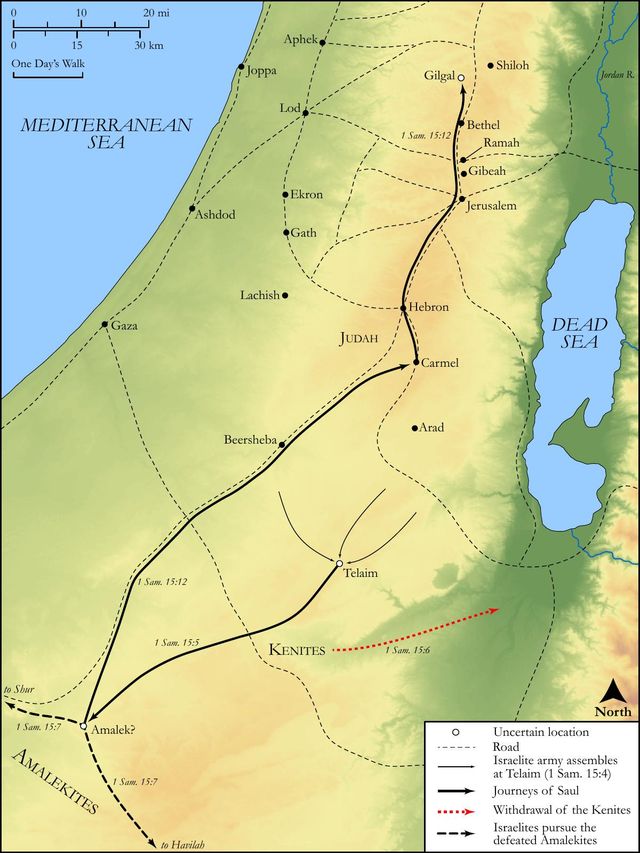
It was an immense army that he brought into the field (Sa1 15:4): 200,000 footmen. When he came to engage the Philistines, and the success was hazardous, he had but 600 attending him, Sa1 13:15. But now that he was to attack the Amalekites by express order from heaven, in which he was sure of victory, he had thousands at his call. But, whatever it was at other times, it was not now for the honour of Judah that their forces were numbered by themselves, for their quota was scandalously short (whatever was the reason), but a twentieth part of the whole, for they were by 10,000, when the other ten tribes (for I except Levi) brought into the field 200,000. The day of Judah's honour drew near, but had not yet come. Saul numbered them in Telaim, which signifies lambs. He numbered then like lambs (so the vulgar Latin), numbered them by the paschal lambs (so the Chaldee), allowing ten to a lamb, a way of numbering used by the Jews in the later times of their nation. Saul drew all his forces to the city of Amalek, that city that was their metropolis (Sa1 15:5), that he might provoke them to give him battle.
IV.He gave friendly advice to the Kenites to separate themselves from the Amalekites among whom they dwelt, while this execution was in doing, Sa1 15:6. Herein he did prudently and piously, and, it is probable, according to the direction Samuel gave him. The Kenites were of the family and kindred of Jethro, Moses's father-in-law, a people that dwelt in tents, which made it easy for them, upon every occasion, to remove to other lands not appropriated. Many of them, at this time, dwelt among the Amalekites, where, though they dwelt in tents, they were fortified by nature, for they put their nest in a rock, being hardy people that could live any where, and affected fastnesses, Num 24:21. Balaam had foretold that they should be wasted, Num 24:22. However, Saul must not waste them. But,
1.He acknowledges the kindness of their ancestors to Israel, when they came out of Egypt. Jethro and his family had been very helpful and serviceable to them in their passage through the wilderness, had been to them instead of eyes, and this is remembered to their posterity many ages after. Thus a good man leaves the divine blessing for an inheritance to his children's children; those that come after us may be reaping the benefit of our good works when we are in our graves. God is not unrighteous to forget the kindnesses shown to his people; but they shall be remembered another day, at furthest in the great day, and recompensed in the resurrection of the just. I was hungry, and you gave me meat. God's remembering the kindness of the Kenites' ancestors in favour to them, at the same time when he was punishing the injuries done by the ancestors of the Amalekites, helped to clear the righteousness of God in that dispensation. If he entail favours, why may he not entail frowns? He espouses his people's cause, so as to bless those that bless them; and therefore so as to curse those that curse them, Num 24:9; Gen 12:3. They cannot themselves requite the kindnesses nor avenge the injuries done them, but God will do both.
2.He desires them to remove their tents from among the Amalekites: Go, depart, get you down from among them. When destroying judgments are abroad God will take care to separate between the precious and the vile, and to hide the meek of the earth in the day of his anger. It is dangerous being found in the company of God's enemies, and it is our duty and interest to come out from among them, lest we share in their sins and plagues, Rev 18:4. The Jews have a saying, Woe to the wicked man and woe to his neighbour.
V.Saul prevailed against the Amalekites, for it was rather an execution of condemned malefactors than a war with contending enemies.
The issue could not be dubious when the cause was just and the call so clear: He smote them (Sa1 15:7), utterly destroyed them, Sa1 15:8. Now they paid dearly for the sin of their ancestors. God sometimes lays up iniquity for the children. They were idolaters, and were guilty of many other sins, for which they deserved to fall under the wrath of God; yet, when God would reckon with them, he fastened upon the sin of their ancestors in abusing his Israel as the ground of his quarrel. Lord, How unsearchable are thy judgments, yet how incontestable is thy righteousness!
VI.Yet he did his work by halves, Sa1 15:9.
1.He spared Agag, because he was a king like himself, and perhaps in hope to get a great ransom for him.
2.He spared the best of the cattle, and destroyed only the refuse, that was good for little. Many of the people, we may suppose, made their escape, and took their effects with them into other countries, and therefore we read of Amalekites after this; but that could not be helped. It was Saul's fault that he did not destroy such as came to his hands and were in his power. That which was now destroyed was in effect sacrificed to the justice of God, as the God to whom vengeance belongeth; and for Saul to think the torn and the sick, the lame and the lean, good enough for that, while he reserved for his own fields and his own table the firstlings and the fat, was really to honour himself more than God.
Historical interpretation
Ten Centuries of Reception
2 surviving comments on this verse. Each one is dated, so this reads as a timeline rather than a list.
Select a marker to jump to its quote. Markers stagger vertically where authors wrote within a few decades of each other.
Do not spare them, but kill, etc. From man to woman, from the perfected work of sin to carnal thought, namely the filthy mother and nurse of wicked offspring. The infant and the suckling, the very beginnings and purpose of nefarious action, which a recent evil thought desires to nourish even worse; understand, the ox, the sheep, the camel, and the donkey, symbolize dullness of folly, laziness of sloth, the baseness of pride, and the wantonness of luxury.
Child: The great Master of life and death (who cuts off one half of all mankind whilst they are children) has been pleased sometimes to ordain that children should be put to the sword, in detestation of the crimes of their parents, and that they might not live to follow the same wicked ways. But without such ordinance of God it is not allowable, in any wars, how just soever, to kill children.
Continue studying 1 Samuel 15:3 across the web’s major study libraries — every link below opens this exact verse, chapter, or book on the destination site.
Read & Compare
 BibleGatewayThis verse in more than 200 translations and 70 languages.
 Bible.comThe YouVersion reader — hundreds of translations, reading plans, and highlights.
 ESV.orgCrossway's official English Standard Version reader.
 NET BibleThe NET translation with 60,000+ translators' notes on every rendering decision.
 STEP BibleTyndale House's free study tool — original text, vocabulary, and scholarly resources.
 BibliaLogos Bible Software's free web reader.
 USCCBThe New American Bible (Revised Edition) with the U.S. bishops' study notes.
Commentaries
 BibleHub CommentariesDozens of classic commentaries on this verse, gathered on one page.
 StudyLightMore than 100 commentary sets — the largest collection on the web.
 BibleRefPlain-English commentary on what this verse means, verse by verse.
 Enduring WordDavid Guzik's free commentary on this chapter, widely used by Bible teachers.
 Bible Study ToolsVerse commentary alongside Greek and Hebrew study aids.
Original Language & Research
- BibleHub InterlinearThe verse word by word — original language, transliteration, and English.
- BibleHub LexiconEvery word's original-language definition and Strong's entry.
 Blue Letter BibleDeep-study tools — Strong's numbers, concordance, and word studies.
 SefariaThe Hebrew text with Rashi and centuries of Jewish commentary.
Sermons, Hymns & Audio


TrulyRandomVerse is not affiliated with these sites and doesn’t control their content. They’re linked because they’re genuinely useful.
Summary
First Samuel 15:3 delivers a critical divine mandate from God, conveyed through the prophet Samuel to King Saul. This command instructs Saul to execute God's long-decreed judgment against the Amalekites, demanding their complete and utter destruction, including all their possessions and living creatures. This comprehensive directive represents an act of herem warfare, signifying their absolute devotion to God for destruction due to their persistent wickedness and historical enmity toward Israel. The command serves as a pivotal test of Saul's obedience and fitness for kingship, highlighting the absolute nature of God's sovereign will and righteous judgment.
Context
ShowHideLiterary Context
This verse is strategically placed early in King Saul's reign, following his anointing and initial military successes, but preceding his definitive rejection by God as king. 1 Samuel 15 opens with Samuel reiterating God's commission to Saul as king and immediately delivering this specific, non-negotiable command concerning the Amalekites. The narrative tension in the chapter hinges entirely on Saul's response to this direct divine instruction. His subsequent partial obedience, detailed in 1 Samuel 15:9, where he spares King Agag and the best of the livestock, and the inadequate excuses he offers, directly lead to Samuel's solemn pronouncement of God's rejection of Saul's kingship. This culminates in the profound declaration that "to obey is better than sacrifice" in 1 Samuel 15:22. Thus, 1 Samuel 15:3 establishes the critical test that ultimately precipitates the dramatic downfall of Israel's first monarch.
Historical & Cultural Context
The Amalekites were a nomadic, predatory people, descendants of Esau through Eliphaz and Timna (Genesis 36:12). They harbored a deep-seated and enduring animosity towards Israel. Their most infamous act was their unprovoked ambush of the Israelites from the rear during their vulnerable exodus from Egypt, specifically targeting the weak and stragglers (Exodus 17:8-16). This cowardly act, committed against a people under divine protection, led to a solemn divine oath that God would "utterly blot out the remembrance of Amalek from under heaven" (Exodus 17:14; Deuteronomy 25:17-19). The command given to Saul centuries later in 1 Samuel 15:3 represents the divinely appointed time for the fulfillment of this ancient decree. The practice of herem (Hebrew: חֵרֶם, ḥērem), often translated as "devotion to destruction" or "the ban," was a specific form of holy war in Israel, as at Jericho. In this context, all spoils and life were dedicated to God, typically by complete destruction, to prevent defilement, appropriation, or the perpetuation of evil. It was not a general license for warfare but a unique, divinely ordained act against particularly wicked nations whose sin had reached its full measure, posing an existential and moral threat to God's covenant people.
Key Themes
ShowHideThis verse powerfully underscores several foundational themes within the book of 1 Samuel and the broader Old Testament narrative. Firstly, it highlights Divine Judgment against persistent and pervasive evil. The Amalekites' consistent enmity towards God's people and their inherent wickedness, spanning generations, brought about this comprehensive and long-foretold judgment. Secondly, it emphasizes the absolute necessity of Total Obedience to God's explicit commands. The instruction to "utterly destroy all that they have, and spare them not" leaves no room for human discretion, partial fulfillment, or self-serving interpretations, serving as a direct and uncompromising test of Saul's submission to divine authority. Thirdly, the Severity and Totality of the Command—explicitly including "man and woman, infant and suckling, ox and sheep, camel and ass"—illustrates the comprehensive nature of the herem judgment. This complete eradication of the Amalekite entity and their resources was designed to prevent any future resurgence, moral corruption, or defilement of Israel. Finally, this command serves as a crucial Test of Kingship, evaluating Saul's fitness to lead God's people by demonstrating his willingness to prioritize God's will above all else, even when it was difficult, counter-intuitive, or seemingly harsh from a human perspective, revealing his true heart and loyalty.
Exposition and Analysis
ShowHideKey Word Analysis
ShowHideThis verb (H5221) means "to strike (lightly or severely, literally or figuratively); beat, kill, slay." In the context of warfare, it denotes a decisive blow or a fatal strike. Here, it initiates the action of combat, leading to the complete destruction commanded. It implies a direct, forceful engagement with the enemy, signifying the commencement of hostilities.
This is a crucial term (H2763), meaning "to seclude; specifically (by a ban) to devote to religious uses (especially destruction); make accursed, consecrate, (utterly) destroy." It signifies setting something apart as sacred to God, often for complete destruction, particularly in the context of warfare against those deemed irredeemably wicked. It's not merely physical annihilation but an act of consecration to God's judgment, removing the entity entirely from common use or existence. It implies a total, uncompromising elimination as an act of divine justice.
This verb (H2550) means "to commiserate; by implication, to spare; have compassion, (have) pity." The negative command "spare them not" emphatically reinforces the absolute nature of the herem command. It leaves no room for mercy, sentimentality, or selective destruction, underscoring the severity and totality of God's judgment against the Amalekites.
Verse Breakdown
ShowHide"Now go and smite Amalek"
This opening phrase is a direct, imperative command from God through Samuel, initiating the military action. "Go" (Hebrew: יָלַךְ, yâlak) implies immediate deployment and decisive action, while "smite" (Hebrew: נָכָה, nâkâh) signifies the commencement of hostilities against a specific, long-standing enemy. The target, "Amalek" (Hebrew: עֲמָלֵק, ʻĂmâlêq), is clearly identified, recalling centuries of historical animosity and divine decree against this particular nation.
"and utterly destroy all that they have, and spare them not"
This clause defines the nature and comprehensive scope of the military action. "Utterly destroy" (Hebrew: חָרַם, ḥāram) indicates a complete devotion to destruction, meaning nothing is to be taken as spoil or left alive. "All that they have" extends the command beyond just people to their possessions and livestock, ensuring no remnant or resource remains that could perpetuate their influence or be misappropriated by Israel. "Spare them not" (Hebrew: חָמַל, ḥāmal, in the negative) reinforces the absolute, uncompromising nature of the command, eliminating any possibility of partial obedience or human compassion overriding divine instruction.
"but slay both man and woman, infant and suckling, ox and sheep, camel and ass"
This final, highly specific enumeration details the comprehensive nature of the herem judgment. It explicitly includes every category of life within the Amalekite society—from the most vulnerable ("infant" (Hebrew: עוּלֵל, ʻôwlêl) and "suckling" (Hebrew: יָנַק, yânaq)) to the able-bodied ("man" (Hebrew: אִישׁ, ʼîysh) and "woman" (Hebrew: אִשָּׁה, ʼishshâh)), and all their valuable livestock ("ox" (Hebrew: שׁוֹר, shôwr), "sheep" (Hebrew: שֶׂה, seh), "camel" (Hebrew: גָּמָל, gâmâl), and "ass" (Hebrew: חֲמוֹר, chămôwr)). This meticulous level of detail emphasizes the totality of the judgment, leaving no ambiguity about the extent of the required destruction and ensuring the complete eradication of the Amalekite presence as a distinct entity.
Literary Devices
ShowHideThe verse employs several powerful Literary Devices to convey the gravity and absolute totality of the divine command. Enumeration is prominently used in the latter part of the verse ("man and woman, infant and suckling, ox and sheep, camel and ass"). This meticulous listing of every category of life to be destroyed serves to emphasize the comprehensive and absolute nature of the herem judgment, leaving no room for misinterpretation or partial compliance. The strong, direct Command Form ("Now go and smite," "utterly destroy," "spare them not," "slay") conveys the divine authority and the non-negotiable nature of the instruction, highlighting the imperative of immediate and complete obedience. The repetition of the idea of "total destruction" through phrases like "utterly destroy" and "spare them not" creates a powerful sense of Emphasis, underscoring the severity, finality, and uncompromising nature of God's judgment against the Amalekites.
Theological and Thematic Connections
ShowHideThis challenging passage reveals profound truths about God's holiness, justice, and sovereignty. While undeniably difficult for modern readers, it must be understood within the Old Testament context of God's specific judgments against nations whose wickedness had reached a full measure, posing a direct and persistent threat to the purity and survival of His covenant people, Israel, through whom the Messiah would ultimately come. This was not a general command for indiscriminate violence but a unique, divinely ordained act of herem warfare, fulfilling a long-standing oath against a people characterized by relentless evil and a foundational attack on God's chosen nation. It demonstrates God's righteous wrath against sin and His unwavering commitment to protect His redemptive plan, even through severe means, ensuring that evil does not utterly corrupt the world or derail His purposes.
Reflection and Application
ShowHideFirst Samuel 15:3 is undeniably one of the most difficult passages in the Bible, confronting readers with the stark reality of divine judgment and the severity of God's holiness. For contemporary believers, it compels us to grapple with the multifaceted nature of God, who is both boundless love and consuming fire. It reminds us that sin, particularly persistent, generational wickedness that actively opposes God's purposes, carries severe and comprehensive consequences. While we live under the New Covenant, where God's ultimate judgment is revealed in Christ's atoning work and His future return, this passage profoundly teaches us about the absolute necessity of total obedience to God's revealed will, even when it is challenging, counter-cultural, or beyond our full human comprehension. Saul's failure to fully obey serves as a timeless warning against partial obedience, self-serving compromises, and prioritizing human reasoning or perceived piety over God's clear commands. It calls us to examine our own lives: where are we tempted to compromise God's word for convenience, comfort, or a desire for human approval? True faith trusts God's wisdom and justice, even when His ways are difficult to reconcile with our immediate sensibilities.
Questions for Reflection
ShowHideFAQ
ShowHideWhy did God command the killing of infants and animals?
ShowHideThis is perhaps the most challenging aspect of the command for modern readers. The inclusion of infants, women, and animals in the herem (devotion to destruction) command signifies the totality and finality of the divine judgment against the Amalekites. From a theological perspective, it ensured the complete eradication of a people group whose wickedness had reached an irredeemable level and who posed a persistent, existential threat to God's covenant people, Israel. The Amalekites were not just individuals but a collective entity defined by their deep-seated enmity towards God and His purposes, as evidenced by their unprovoked attack on the vulnerable Israelites during the Exodus (Exodus 17:8-16) and their continued opposition. The complete destruction of a defeated enemy, including their offspring and resources, had been commanded against the cities of the Canaanites, where Israel was to save alive nothing that breathed, lest the survivors teach Israel their abominations, and it signified a definitive end to their lineage and threat. While morally abhorrent by modern standards, it was understood within that cultural context as a total act of divine justice, ensuring that the root of evil was completely removed and that no remnant could perpetuate their destructive influence or defile God's people. This was a unique, specific judgment, not a universal principle for warfare, and it served to protect the purity of the lineage through which the Messiah would ultimately come.
Christ-Centered Fulfillment
ShowHideWhile 1 Samuel 15:3 describes a severe act of divine judgment in the Old Testament, its Christ-centered fulfillment is found not in replicating such physical violence, but in understanding God's unwavering commitment to justice and the ultimate, definitive eradication of sin and evil through the redemptive work of Jesus Christ. The herem judgment against Amalek foreshadows the ultimate and decisive judgment against all sin and evil that is accomplished and will be fully realized in Christ. Jesus, the true King, perfectly fulfilled God's will, demonstrating ultimate obedience where Saul failed, even to the point of death on a cross (Philippians 2:8). Furthermore, Christ's work on the cross is the ultimate act of "utter destruction" of sin's power and the devil's works (Hebrews 2:14; 1 John 3:8). While the Old Testament judgment involved physical destruction, the New Testament emphasizes spiritual warfare and the ultimate triumph over spiritual enemies through Christ's victory. Believers are now called to "put to death" the deeds of the flesh by the Spirit (Romans 8:13) and to "destroy arguments and every lofty opinion raised against the knowledge of God" (2 Corinthians 10:5), reflecting a spiritual application of the principle of utterly destroying that which opposes God's holy character within their own lives. Ultimately, the future return of Christ will bring the final and complete judgment against all evil, ushering in a new heaven and new earth where righteousness dwells (Revelation 20:11-15; Revelation 21:1-4), fulfilling the ultimate divine intention to utterly remove all that is contrary to His holy and righteous character.