


Joshua 6:21
Bible text: King James Version (1769 Blayney text) · Public domain
Bible text: Berean Standard Bible · Public domain
Bible text: American Standard Version (1901) · Public domain
Bible text: World English Bible, Messianic edition · Public domain
Bible text: Geneva Bible (1599) · Public domain
Bible text: Young's Literal Translation · Public domain
- וַיַּחֲרִימוּvai·ya·cha·Ri·muand they totally destroyedH2763Conj-w ¦ V-Hiphil-ConsecImperf-3mpVerb Hiphil Consecutive Imperfect 3rd Plural Masculineוַandיַּחֲרִימוּthey totally destroyed
- אֶת'et<obj.>H853DirObjMParticle Object Indicator
- כָּלkolallH3605N-msNoun Singular Masculine Absolute
- אֲשֶׁר'a·SherthatH834RelParticle Relative
- בָּעִירba·'Ir[was] in the cityH5892Prep-b ¦ N-fsNoun Singular Feminine Absoluteבָּ[was] in theעִירcity
- מֵאִישׁme·'Ishfrom manH376Prep-m ¦ N-msNoun Singular Masculine Absoluteמֵfromאִישׁman
- וְעַדve·'adand untoH5704Conj-w ¦ PrepPrepositionוְandעַדunto
- אִשָּׁה'i·ShahwomanH802N-fsNoun Singular Feminine Absolute
- מִנַּעַרmi·Na·'arfrom young manH5288Prep-m ¦ N-msNoun Singular Masculine Absoluteמִfromנַּעַרyoung man
- וְעַדve·'adand untoH5704Conj-w ¦ PrepPrepositionוְandעַדunto
- זָקֵןza·Kenold [man]H2205Adj-msAdjective Singular Masculine Absolute
- וְעַדve·'Adand untoH5704Conj-w ¦ PrepPrepositionוְandעַדunto
- שׁוֹרShorox[en]H7794N-msNoun Singular Masculine Absolute
- וָשֶׂהva·Sehand sheepH7716Conj-w ¦ N-csNoun Singular common gender Absoluteוָandשֶׂהsheep
- וַחֲמוֹרva·cha·Morand donkey[s]H2543Conj-w ¦ N-csNoun Singular common gender Absoluteוַandחֲמוֹרdonkey[s]
- לְפִיle·fito [the] mouth ofH6310Prep-l ¦ N-mscNoun Singular Masculine Constructלְtoפִי[the] mouth of
- חָרֶבCha·rev[the] swordH2719N-fsNoun Singular Feminine Absolute
English is a literal word-by-word gloss of the Hebrew, not the KJV's wording. Why?
This is the original text the KJV's translators worked from — each Hebrew word with its own literal English meaning in this verse, prepared by scholars at Tyndale House, Cambridge. The KJV translates whole sentences, not word by word, so its wording differs: one Hebrew word can become several English words, and the KJV may choose “the LORD” where the gloss reads “Yahweh”. Both are faithful — they answer different questions. For the KJV's own rendering, switch to the KJV text.
Details
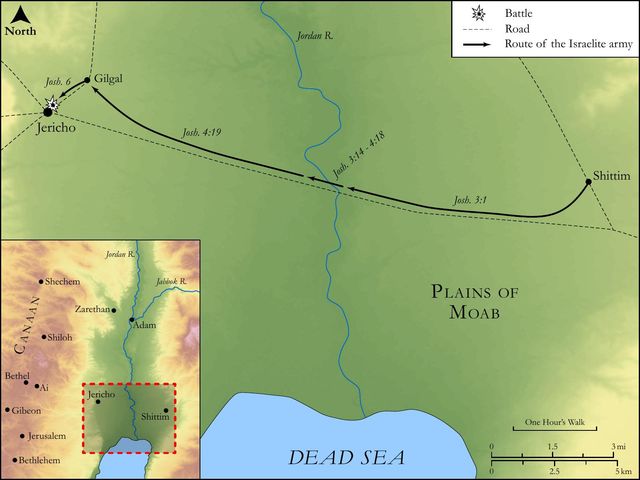
See on the biblical-era map
Study this verse
Public-domain commentary
Matthew Henry
From his Commentary on the Whole Bible. Henry comments on passages, not single verses — this entry covers Joshua 6:17–27. His two-level outline is real structure in the source text, so it is rendered as structure.
The people had religiously observed the orders given them concerning the besieging of Jericho, and now at length Joshua had told them (Jos 6:16), "The Lord hath given you the city, enter and take possession." Accordingly in these verses we have,
I.The rules they were to observe in taking possession.
God gives it to them, and therefore may direct it to what uses and intents, and clog it with what provisos and limitations he thinks fit. It is given to them to be devoted to God, as the first and perhaps the worst of all the cities of Canaan.
1.The city must be burnt, and all the lives in it sacrificed without mercy to the justice of God. All this they knew was included in those words, Jos 6:17. The city shall be a cherem, a devoted thing, at and all therein, to the Lord. No life in it might be ransomed upon any terms; they must all be surely put to death, Lev 27:29. So he appoints from whom as creatures they had received their lives, and to whom as sinners they had forfeited them; and who may dispute his sentence? Is God unrighteous, who thus taketh vengeance? God forbid we should entertain such a thought! There was more of God seen in the taking of Jericho than of any other of the cities of Canaan, and therefore that must be more than any other devoted to him. And the severe usage of this city would strike a terror upon all the rest and melt their hearts yet more before Israel. Only, when this severity is ordered, Rahab and her family are excepted: She shall live and all that are with her. She had distinguished herself from her neighbours by the kindness she showed to Israel, and therefore shall be distinguished from them by the speedy return of that kindness.
2.All the treasure of it, the money and plate and valuable goods, must be consecrated to the service of the tabernacle, and brought into the stock of dedicated things, the Jews say because the city was taken on the sabbath day. Thus God would be honoured by the beautifying and enriching of his tabernacle; thus preparation was made for the extraordinary expenses of his service; and thus the Israelites were taught not to set their hearts upon worldly wealth nor to aim at heaping up abundance of it for themselves. God had promised them a land flowing with milk and honey, not a land abounding with silver and gold; for he would have them live comfortably in it, that they might serve him cheerfully, but not covet either to trade with distant countries or to hoard for after times. He would likewise have them to reckon themselves enriched in the enriching of the tabernacle, and to think that which was laid up in God's house as truly their honour and wealth as if it had been laid up in their own.
3.A particular caution is given them to take heed of meddling with the forbidden spoil; for what was devoted to God, if they offered to appropriate it to their own use, would prove accursed to them; therefore (Jos 6:18) "In any wise keep yourselves from the accursed thing; you will find yourselves inclined to reach towards it, but check yourselves, and frighten yourselves from having any thing to do with it." He speaks as if he foresaw the sin of Achan, which we have an account of in the next chapter, when he gives this reason for the caution, lest you make the camp of Israel a curse and trouble it, as it proved that Achan did.
II.The entrance that was opened to them into the city by the sudden fall of the walls, or at least that part of the wall over against which they then were when they gave the shout (Jos 6:20): The wall fell down flat, and probably killed abundance of people, the guards that stood sentinel upon it, or others that crowded about it, to look at the Israelites that were walking round. We read of thousands killed by the fall of a wall, Kg1 20:30. that which they trusted to for defence proved their destruction. The sudden fall of the wall, no doubt, put the inhabitants into such a consternation that they had no strength nor spirit to make any resistance, but they became an easy prey to the sword of Israel, and saw to how little purpose it was to shut their gates against a people that had the Lord on the head of them, Mic 2:13. Note, The God of heaven easily can, and certainly will, break down all the opposing power of his and his church's enemies. Gates of brass and bars of iron are, before him, but as straw and rotten wood, Isa 45:1, Isa 45:2. Who will bring me into the strong city? Wilt not thou, O God? Psa 60:9, Psa 60:10. Thus shall Satan's kingdom fall, nor shall any prosper that harden themselves against God.
III.The execution of the orders given concerning this devoted city.
All that breathed were put to the sword; not only the men that were found in arms, but the women, and children, and old people. Though they cried for quarter, and begged ever so earnestly for their lives, there was no room for compassion, pity must be forgotten: they utterly destroyed all, Jos 6:21. If they had not had a divine warrant under the seal of miracles for this execution, it could not have been justified, nor can it justify the like now, when we are sure no such warrant can be produced. But, being appointed by the righteous Judge of heaven and earth to do it, who is not unrighteous in taking vengeance, they are to be applauded in doing it as the faithful ministers of his justice. Work for God was then bloody work; and cursed was he that did it deceitfully, keeping back his sword from blood, Jer 48:10. But the spirit of the gospel is very different, for Christ came not to destroy men's lives but to save them, Luk 9:56. Christ's victories were of another nature. The cattle were put to death with the owners, as additional sacrifices to the divine justice. The cattle of the Israelites, when slain at the altar, were accepted as sacrifices for them, but the cattle of these Canaanites were required to be slain as sacrifices with them, for their iniquity was not to be purged with sacrifice and offering: both were for the glory of God. 2. The city was burnt with fire, and all that was in it, Jos 6:24. The Israelites, perhaps, when they had taken Jericho, a large and well-built city, hoped they should have that for their head-quarters; but God will have them yet to dwell in tents, and therefore fires this nest, lest they should nestle in it. 3. All the silver and gold, and all those vessels which were capable of being purified by fire, were brought into the treasury of the house of the Lord; not that he needed it but that he would be honoured by it, as the Lord of hosts, of their hosts in particular, the God that gave the victory and therefore might demand the spoil, either the whole, as here, or, as sometimes, a tenth, Heb 7:4.
IV.The preservation of Rahab the harlot, or inn-keeper, who perished not with those that believed not, Heb 11:31.
The public faith was engaged for her safety by the two spies, who acted therein as public persons; and therefore, though the hurry they were in at the taking of the town was no doubt very great, yet Joshua took effectual care for her preservation. The same persons that she had secured were employed to secure her, Jos 6:22, Jos 6:23. They were best able to do it who knew her and her house, and they were fittest to do it, that it might appear it was for the sake of her kindness to them that she was thus distinguished and had her life given her for a prey. All her kindred were saved with her; like Noah she believed to the saving of her house; and thus faith in Christ brings salvation to the house, Act 16:31. Some ask how her house, which is said to have been upon the wall (Jos 2:15), escaped falling with the wall; we are sure it did escape, for she and her relations were safe in it, either though it joined so near to the wall as to be said to be upon it, yet it was so far off as not to fall either with the wall or under it; or, rather, that part of the wall on which her house stood fell not. Now being preserved alive,
1.She was left for some time without the camp to be purified from the Gentile superstition, which she was to renounce, and to be prepared for her admission as a proselyte.
2.She was in due time incorporated with the church of Israel, and she and her posterity dwelt in Israel, and her family was remarkable long after. We find her the wife of Salmon, prince of Judah, mother of Boaz, and named among the ancestors of our Saviour, Mat 1:5. Having received Israelites in the name of Israelites, she had an Israelite's reward. Bishop Pierson observes that Joshua's saving Rahab the harlot, and admitting her into Israel, were a figure of Christ's receiving into his kingdom, and entertaining there, the publicans and the harlots, Mat 21:31. Or it may be applied to the conversion of the Gentiles.
V.Jericho is condemned to a perpetual desolation, and a curse pronounced upon the man that at any time hereafter should offer to rebuild it (Jos 6:26): Joshua adjured them, that is, the elders and people of Israel, not only by their own consent, obliging themselves and their posterity never to rebuild this city, but by the divine appointment, God himself having forbidden it under the sever penalty here annexed.
1.God would hereby show the weight of a divine curse; where it rests there is no contending with it nor getting from under it; it brings ruin without remedy or repair.
2.He would have it to remain in its ruins a standing monument of his wrath against the Canaanites when the measure of their iniquity was full, and of his mercy to his people when the time had come for their settlement in Canaan. The desolations of their enemies were witnesses of his favour to them, and would upbraid them with their ingratitude to that God who had done so much for them. The situation of the city was very pleasant, and probably its nearness to Jordan was an advantage to it, which would tempt men to build upon the same spot; but they are here told it is at their peril if they do it. Men build for their posterity, but he that builds Jericho shall have no posterity to enjoy what he builds; his eldest son shall die when he begins the work, and if he take not warning by that stroke to desist, but will go on presumptuously, the finishing of his work shall be attended with the funeral of his youngest, and we must suppose all the rest cut off between. This curse, not being a curse causeless, did come upon that man who long after rebuilded Jericho (Kg1 16:34), but we are not to think it made the place ever the worse when it was built, or brought any hurt to those that inhabited it. We find Jericho afterwards graced with the presence, not only of those two great prophets Elijah and Elisha, but of our blessed Saviour himself, Luk 18:35; Luk 19:1; Mat 20:29. Note, It is a dangerous thing to attempt the building up of that which God will have to be destroyed. See Mal 1:4.
Lastly, All this magnified Joshua and raised his reputation (Jos 6:27); it made him not only acceptable to Israel, but formidable to the Canaanites, because it appeared that God was with him of a truth: the Word of the Lord was with him, so the Chaldee, even Christ himself, the same that was with Moses. Nothing can more raise a man's reputation, nor make him appear more truly great, than to have the evidences of God's presence with him.
Continue studying Joshua 6:21 across the web’s major study libraries — every link below opens this exact verse, chapter, or book on the destination site.
Read & Compare
 BibleGatewayThis verse in more than 200 translations and 70 languages.
 Bible.comThe YouVersion reader — hundreds of translations, reading plans, and highlights.
 ESV.orgCrossway's official English Standard Version reader.
 NET BibleThe NET translation with 60,000+ translators' notes on every rendering decision.
 STEP BibleTyndale House's free study tool — original text, vocabulary, and scholarly resources.
 BibliaLogos Bible Software's free web reader.
 USCCBThe New American Bible (Revised Edition) with the U.S. bishops' study notes.
Commentaries
 BibleHub CommentariesDozens of classic commentaries on this verse, gathered on one page.
 StudyLightMore than 100 commentary sets — the largest collection on the web.
 BibleRefPlain-English commentary on what this verse means, verse by verse.
 Enduring WordDavid Guzik's free commentary on this chapter, widely used by Bible teachers.
 Bible Study ToolsVerse commentary alongside Greek and Hebrew study aids.
Original Language & Research
- BibleHub InterlinearThe verse word by word — original language, transliteration, and English.
- BibleHub LexiconEvery word's original-language definition and Strong's entry.
 Blue Letter BibleDeep-study tools — Strong's numbers, concordance, and word studies.
 SefariaThe Hebrew text with Rashi and centuries of Jewish commentary.
Sermons, Hymns & Audio


TrulyRandomVerse is not affiliated with these sites and doesn’t control their content. They’re linked because they’re genuinely useful.
Summary
Joshua 6:21 vividly recounts the comprehensive execution of the herem—the divine ban or devotion to destruction—upon the city of Jericho. Following the miraculous collapse of its formidable walls, the Israelites, acting as direct instruments of God's righteous judgment, meticulously annihilated every living being within the city, from humans of all ages to livestock, by the sword. This was not an act of human brutality for conquest or plunder, but a unique, theologically profound act of consecration, setting the entire city and its inhabitants apart for God's exclusive claim. It served as both a "firstfruits" offering of the conquered land and a severe, decisive judgment against the deep-seated wickedness and pervasive idolatry of the Canaanites, thereby safeguarding the spiritual purity of the nascent nation of Israel.
Context
ShowHideLiterary Context
Joshua 6:21 marks the culmination of the dramatic narrative surrounding the fall of Jericho. It immediately follows the miraculous collapse of the city's walls in Joshua 6:20, which occurred after seven days of ritualistic marching and trumpet blasts as commanded by God. This verse details the comprehensive and decisive action taken by the Israelite army upon entering the city. As the first city encountered and conquered in the Promised Land, Jericho's destruction established a foundational precedent, demonstrating God's power, validating Israel's obedience, and setting the pattern for future encounters with the Canaanites. Crucially, the narrative emphasizes that this destruction was not for personal gain or plunder, but a direct and meticulous fulfillment of God's specific command for Jericho to be "devoted" to Him. This unique application of the herem also serves as a stark warning about the strict consequences of disobedience, a lesson tragically underscored by Achan's sin in the subsequent chapter.
Historical & Cultural Context
The divine command to "utterly destroy" the inhabitants of Canaanite cities, including Jericho, must be understood within the unique historical and theological framework of the Old Testament. Canaanite cultures were notoriously characterized by pervasive idolatry, including the horrific practice of child sacrifice (e.g., to Molech), widespread temple prostitution, and other morally abhorrent practices that profoundly defiled the land and its people (Leviticus 18:24-28). God, in His long-suffering patience, had endured their wickedness for centuries, waiting for "the iniquity of the Amorites" to reach its "full measure" (Genesis 15:16) before initiating this judgment. The herem was a unique divine judgment, often termed "holy war," where God Himself was the primary warrior, and Israel served as His instrument of justice. This was distinct from the typical warfare of that day, as it was a consecrated act designed to cleanse the land of its spiritual pollution and prevent Israel from being corrupted by the surrounding pagan practices and their associated moral depravity.
Key Themes
ShowHideThe meticulous execution of the herem in Joshua 6:21 powerfully underscores several profound theological themes. Firstly, Divine Judgment and Holiness are paramount; the complete destruction signifies God's righteous wrath against pervasive and unrepentant sin, and His absolute holiness, which cannot tolerate such wickedness in His presence or in the land He is giving to His people. This act served as a severe warning to other nations and a profound lesson for Israel about the dire consequences of sin and the imperative of separation from evil. Secondly, Radical Obedience to God's Commands is highlighted; the Israelites' unwavering adherence to God's severe instructions, even to the point of destroying every living thing, demonstrates their faith and commitment to the covenant, even when the commands were difficult, counter-intuitive, or seemingly harsh. This obedience was crucial for their success and for maintaining their covenant relationship with God. Finally, the concept of The Herem (Ban/Devotion) is central. This term (from the Hebrew root charam) denotes something irrevocably set apart for God, often for destruction, as an act of judgment or consecration. In this specific instance, Jericho and its entire contents were "devoted" to God as the "firstfruits" of the conquest and as an act of divine justice against its inhabitants, explicitly not for Israel's personal gain (Deuteronomy 7:2-6 and Deuteronomy 20:16-18).
Exposition and Analysis
ShowHideKey Word Analysis
ShowHideThis verb is the root of the noun herem, signifying something "devoted," "consecrated," or "put under the ban." In this context, it means to irrevocably set apart for God, specifically for complete annihilation. It is far more than mere killing; it represents a theological act of dedicating something to God through destruction, often as an expression of divine wrath and holiness against evil. This distinguishes the conquest of Jericho from typical warfare, emphasizing its unique, ritualistic, and divinely ordained nature as an act of purification and judgment.
This word refers to a fortified settlement, a place guarded by a watch. In the context of Jericho, it signifies not just a collection of buildings but a complete socio-political entity, a stronghold of Canaanite idolatry and wickedness. The command to destroy "all that was in the city" underscores that the judgment was against the entire stronghold of evil, encompassing every aspect of its existence, leaving no part of the defiled entity to corrupt the land or Israel.
This term denotes a cutting instrument, specifically a sword, dagger, or other sharp implement, often emphasizing its destructive effect. In Joshua 6:21, "the edge of the sword" specifies the instrument of execution. The sword here is not merely a weapon of war but an instrument of divine justice, carrying out the sentence decreed by God. It highlights the severity, finality, and physical immediacy of the judgment, signifying a swift and decisive action that completely fulfills the divine mandate.
Verse Breakdown
ShowHide"And they utterly destroyed"
This opening clause identifies the agents of destruction ("they," the Israelites) and the nature of their action. The verb "utterly destroyed" (from charam) signifies that Israel was acting as God's instrument, carrying out a sacred and complete act of devotion through annihilation, rather than merely engaging in conventional warfare for territorial gain. Their meticulous obedience to this severe command underscores their submission to divine authority and their role in God's redemptive plan.
"all that [was] in the city, both man and woman, young and old"
This phrase specifies the comprehensive scope of the destruction, encompassing every human inhabitant regardless of age or gender. This absolute totality emphasizes the severity of God's judgment against the city's entrenched wickedness and the imperative for a complete cleansing of the land from its pervasive defilement. It underscores that the herem was a judgment on the city as a whole, a complete eradication of its corrupting influence, not merely a military victory over its fighting men.
"and ox, and sheep, and ass"
The explicit inclusion of animals further illustrates the complete devotion of Jericho to God. This was not about taking spoils for Israel; rather, the entire city, including its living creatures and material possessions (except for specific items like silver and gold for the Lord's treasury), was "set apart" for God through destruction. This act signified that the city and everything in it was irrevocably God's, consecrated to Him as a firstfruit of the conquest and as an act of purification, removing any potential source of defilement or temptation for Israel.
"with the edge of the sword"
This final phrase describes the precise means by which the destruction was carried out. The "edge of the sword" serves as the instrument of divine execution, signifying a swift, decisive, and divinely sanctioned act of judgment. It highlights the physical and immediate nature of the herem's implementation, emphasizing that the command was fulfilled thoroughly and without hesitation.
Literary Devices
ShowHideJoshua 6:21 employs several potent literary devices to underscore the totality and profound significance of the event. Enumeration is prominently featured through the exhaustive listing of categories of inhabitants and animals ("man and woman, young and old, and ox, and sheep, and ass"). This comprehensive catalog emphasizes the absolute and uncompromising nature of the herem, leaving no ambiguity about the scope of the divine judgment. The repeated use of the concept of "all" (implied by the Hebrew kol in "all that was in the city") functions as Totalizing Language, reinforcing the idea that nothing was spared, thereby highlighting the completeness and finality of God's judgment. Furthermore, the passage functions as a classic Divine Command-Execution Narrative, where a specific, severe divine instruction (the herem) is followed by its immediate and meticulous fulfillment by the human agents. This narrative structure emphasizes God's absolute sovereignty and Israel's radical obedience. The very concept of "utterly destroying" something by "devoting" it to God through annihilation can be seen as a form of Thematic Irony, where life is consecrated to God through its cessation, underscoring the unique and severe nature of this divine judgment and its purpose of spiritual cleansing.
Theological and Thematic Connections
ShowHideJoshua 6:21 stands as a stark and challenging testament to God's absolute holiness and His righteous judgment against sin. While difficult for modern readers to reconcile with contemporary sensibilities, it reveals a God who takes sin profoundly seriously, particularly the entrenched idolatry, moral depravity, and violence of the Canaanites, which had reached a point of no return. The herem was not an act of arbitrary cruelty or genocide in the modern sense, but a unique, divinely ordained judgment, a "holy war" where God Himself fought to cleanse the land He was giving to His covenant people. This act served a dual purpose: to justly recompense the Canaanites for their profound wickedness and to protect Israel from spiritual contamination, ensuring their separation and purity as a nation set apart for God. It underscores that God's justice is not merely punitive but also redemptive, clearing the way for a holy people to inhabit a holy land, foreshadowing a future where all evil will ultimately be eradicated and a new, pure creation established.
Reflection and Application
ShowHideThe command and execution of the herem in Joshua 6:21 present a profoundly challenging passage, demanding careful theological reflection and a nuanced understanding. While the physical extermination of a people group is specific to Old Testament divine judgment and is emphatically not a model for Christian conduct today, the verse offers profound spiritual lessons for believers. It serves as a stark reminder of the gravity of sin in God's eyes and His unwavering commitment to justice. Just as the Canaanites faced judgment for their profound and unrepentant wickedness, so too does all unrepentant sin ultimately lead to separation from God. For believers, this passage challenges us to consider our own obedience to God's commands, even when they are difficult, counter-cultural, or seem to defy human logic. True faith involves trusting God's wisdom and righteousness above our own understanding, acknowledging His sovereign right to judge. In a New Testament context, believers are called to engage in spiritual warfare, not against flesh and blood (as powerfully described in Ephesians 6:12), but against spiritual forces of evil and the strongholds of sin within our own lives and in the world. This involves a radical "utter destruction" or eradication of idolatry, worldly influences, and sinful habits, dedicating ourselves entirely to God's holiness and purity. It calls us to a complete and uncompromising devotion to Christ, allowing no rival allegiances in our hearts, echoing the totality of the herem in a spiritual sense.
Questions for Reflection
ShowHideFAQ
ShowHideHow can a loving God command such widespread destruction, including women and children?
ShowHideThis is undeniably one of the most challenging passages in the Old Testament, and it requires careful theological discernment. It's crucial to understand that the herem (ban) at Jericho was a unique, divinely ordained act of judgment, not a general command for all warfare or a model for human behavior. The Canaanites had practiced extreme wickedness for centuries, including horrific child sacrifice, pervasive temple prostitution, and widespread idolatry, which had profoundly "defiled the land" (Leviticus 18:24-28). God, in His long-suffering patience, had waited for "the iniquity of the Amorites" to reach its "full measure" (Genesis 15:16) before executing this judgment. The destruction served multiple, interconnected purposes: it was a just recompense for profound evil, a cleansing of the land from its spiritual pollution, and a protective measure to prevent Israel from being corrupted by these abhorrent practices. It underscores God's absolute holiness and His intolerance of unrepentant, pervasive sin, demonstrating that He is both perfectly loving and perfectly just. This event is not presented as a model for human behavior or warfare, but as a unique act of divine judgment within salvation history, highlighting God's sovereign authority over life and death.
Is the destruction of Jericho a model for how believers should engage in warfare or deal with enemies today?
ShowHideAbsolutely not. The herem at Jericho was a specific, unrepeatable divine command given to Israel for a particular time and purpose in their unique role in salvation history. It was a theological act of judgment and consecration, not a blueprint for all future warfare or interpersonal conflict. The New Testament clearly teaches a radically different ethic for believers, emphasizing love for enemies (Matthew 5:44), reconciliation (2 Corinthians 5:18-20), and spiritual warfare against spiritual forces, not flesh and blood (Ephesians 6:12). While the passage powerfully reminds us of God's holiness and the seriousness of sin, its application for believers today is primarily spiritual: to "destroy" (eradicate) sin and idolatry in our own lives and to devote ourselves wholly and uncompromisingly to God, allowing no rival allegiances to diminish our loyalty to Christ.
Christ-Centered Fulfillment
ShowHideWhile Joshua 6:21 describes a physical act of judgment and destruction, its deepest theological and redemptive fulfillment is profoundly found in Christ. The "utter destruction" of Jericho, a city utterly devoted to God as a firstfruit of judgment against pervasive evil, powerfully foreshadows Christ's decisive and complete victory over sin, death, and the spiritual forces of evil. Just as Jericho's formidable walls crumbled at God's command, so too did the strongholds of sin and death collapse through Christ's sacrificial work on the cross. He is the ultimate One "devoted" to God, the Lamb of God who takes away the sin of the world, set apart for sacrifice to cleanse humanity from its spiritual defilement. Through His death and resurrection, Christ "disarmed the powers and authorities, he made a public spectacle of them, triumphing over them by the cross" (Colossians 2:13-15). His work allows believers to be "set apart" for God, not through physical annihilation, but through spiritual transformation and sanctification by the Holy Spirit, becoming a "new creation" (2 Corinthians 5:17). Ultimately, the complete eradication of evil and the establishment of a new heavens and new earth, where "death shall be no more, neither shall there be mourning, nor crying, nor pain anymore" (Revelation 21:4), finds its promise and final fulfillment in the ultimate judgment and glorious triumph of Christ, who will utterly destroy all that opposes God, bringing about a perfect and holy kingdom for all eternity.