


Joshua 6:20
Bible text: King James Version (1769 Blayney text) · Public domain
Bible text: King James Version with Strong's numbers · Public domain
Bible text: Berean Standard Bible · Public domain
Bible text: American Standard Version (1901) · Public domain
Bible text: World English Bible, Messianic edition · Public domain
Bible text: Geneva Bible (1599) · Public domain
Bible text: Young's Literal Translation · Public domain
- וַיָּרַעvai·Ya·ra'and it shoutedH7321Conj-w ¦ V-Hiphil-ConsecImperf-3msVerb Hiphil Consecutive Imperfect 3rd Singular Masculineוַandיָּרַעit shouted
- הָעָםha·'Amthe peopleH5971Art ¦ N-msNoun Singular Masculine Absoluteהָtheעָםpeople
- וַיִּתְקְעוּvai·yit·ke·'Uand they gave a blastH8628Conj-w ¦ V-Qal-ConsecImperf-3mpVerb Qal Consecutive Imperfect 3rd Plural Masculineוַandיִּתְקְעוּthey gave a blast
- בַּשֹּׁפָרוֹתba·sho·fa·Roton the trumpetsH7782Prep-b ¦ N-fpNoun Plural Feminine Absoluteבַּon theשֹּׁפָרוֹתtrumpets
- וַיְהִיvay·Hiand it wasH1961Conj-w ¦ V-Qal-ConsecImperf-3msVerb Qal Consecutive Imperfect 3rd Singular Masculineוַandיְהִיit was
- כִשְׁמֹעַkhish·Mo·a'when heardH8085Prep-k ¦ V-Qal-InfVerb Qal Infinitive Constructכִwhenשְׁמֹעַheard
- הָעָםha·'Amthe peopleH5971Art ¦ N-msNoun Singular Masculine Absoluteהָtheעָםpeople
- אֶת'et<obj.>H853DirObjMParticle Object Indicator
- קוֹלKol[the] sound ofH6963N-mscNoun Singular Masculine Construct
- הַשּׁוֹפָרha·sho·Farthe trumpetH7782Art ¦ N-msNoun Singular Masculine Absoluteהַtheשּׁוֹפָרtrumpet
- וַיָּרִיעוּvai·ya·Ri·'uand they shoutedH7321Conj-w ¦ V-Hiphil-ConsecImperf-3mpVerb Hiphil Consecutive Imperfect 3rd Plural Masculineוַandיָּרִיעוּthey shouted
- הָעָםha·'Amthe peopleH5971Art ¦ N-msNoun Singular Masculine Absoluteהָtheעָםpeople
- תְּרוּעָהte·ru·'Aha shoutH8643N-fsNoun Singular Feminine Absolute
- גְדוֹלָהge·do·LahloudH1419Adj-fsAdjective Singular Feminine Absolute
- וַתִּפֹּלva·ti·Poland it fellH5307Conj-w ¦ V-Qal-ConsecImperf-3fsVerb Qal Consecutive Imperfect 3rd Singular Feminineוַandתִּפֹּלit fell
- הַחוֹמָהha·cho·Mahthe city wallH2346Art ¦ N-fsNoun Singular Feminine Absoluteהַtheחוֹמָהcity wall
- תַּחְתֶּיהָtach·Tei·haits in placeH8478N-mpc ¦ 3fsNoun Plural Masculine Constructתַּחְתֶּיin placeהָits
- וַיַּעַלvai·Ya·'aland it went upH5927Conj-w ¦ V-Qal-ConsecImperf-3msVerb Qal Consecutive Imperfect 3rd Singular Masculineוַandיַּעַלit went up
- הָעָםha·'Amthe peopleH5971Art ¦ N-msNoun Singular Masculine Absoluteהָtheעָםpeople
- הָעִירָהha·'I·rahthe city towardsH5892Art ¦ N-fs ¦ SfxNoun Singular Feminine Absoluteהָtheעִירָcityהtowards
- אִישׁ'isheveryoneH376N-msNoun Singular Masculine Absolute
- נֶגְדּוֹneg·Dobefore himselfH5048Adj-msc ¦ 3msAdjective Numerical Singular Masculine Constructנֶגְדּbeforeוֹhimself
- וַיִּלְכְּדוּvai·yil·ke·Duand they capturedH3920Conj-w ¦ V-Qal-ConsecImperf-3mpVerb Qal Consecutive Imperfect 3rd Plural Masculineוַandיִּלְכְּדוּthey captured
- אֶת'et<obj.>H853DirObjMParticle Object Indicator
- הָעִירha·'Irthe cityH5892Art ¦ N-fsNoun Singular Feminine Absoluteהָtheעִירcity
English is a literal word-by-word gloss of the Hebrew, not the KJV's wording. Why?
This is the original text the KJV's translators worked from — each Hebrew word with its own literal English meaning in this verse, prepared by scholars at Tyndale House, Cambridge. The KJV translates whole sentences, not word by word, so its wording differs: one Hebrew word can become several English words, and the KJV may choose “the LORD” where the gloss reads “Yahweh”. Both are faithful — they answer different questions. For the KJV's own rendering, switch to the KJV text.
Details
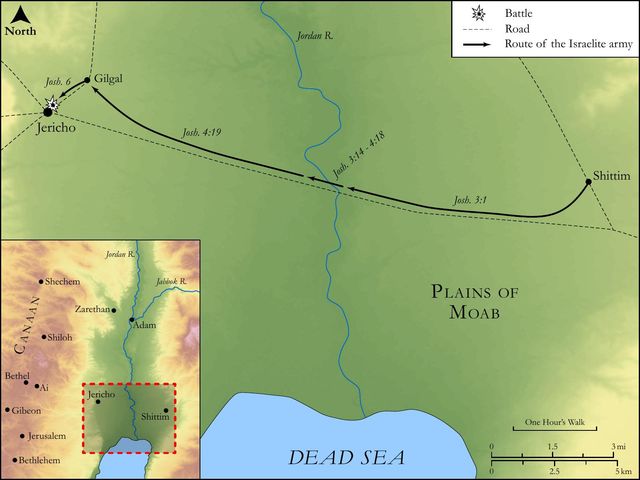
See on the biblical-era map
Study this verse
Public-domain commentary
Matthew Henry
From his Commentary on the Whole Bible. Henry comments on passages, not single verses — this entry covers Joshua 6:17–27. His two-level outline is real structure in the source text, so it is rendered as structure.
The people had religiously observed the orders given them concerning the besieging of Jericho, and now at length Joshua had told them (Jos 6:16), "The Lord hath given you the city, enter and take possession." Accordingly in these verses we have,
I.The rules they were to observe in taking possession.
God gives it to them, and therefore may direct it to what uses and intents, and clog it with what provisos and limitations he thinks fit. It is given to them to be devoted to God, as the first and perhaps the worst of all the cities of Canaan.
1.The city must be burnt, and all the lives in it sacrificed without mercy to the justice of God. All this they knew was included in those words, Jos 6:17. The city shall be a cherem, a devoted thing, at and all therein, to the Lord. No life in it might be ransomed upon any terms; they must all be surely put to death, Lev 27:29. So he appoints from whom as creatures they had received their lives, and to whom as sinners they had forfeited them; and who may dispute his sentence? Is God unrighteous, who thus taketh vengeance? God forbid we should entertain such a thought! There was more of God seen in the taking of Jericho than of any other of the cities of Canaan, and therefore that must be more than any other devoted to him. And the severe usage of this city would strike a terror upon all the rest and melt their hearts yet more before Israel. Only, when this severity is ordered, Rahab and her family are excepted: She shall live and all that are with her. She had distinguished herself from her neighbours by the kindness she showed to Israel, and therefore shall be distinguished from them by the speedy return of that kindness.
2.All the treasure of it, the money and plate and valuable goods, must be consecrated to the service of the tabernacle, and brought into the stock of dedicated things, the Jews say because the city was taken on the sabbath day. Thus God would be honoured by the beautifying and enriching of his tabernacle; thus preparation was made for the extraordinary expenses of his service; and thus the Israelites were taught not to set their hearts upon worldly wealth nor to aim at heaping up abundance of it for themselves. God had promised them a land flowing with milk and honey, not a land abounding with silver and gold; for he would have them live comfortably in it, that they might serve him cheerfully, but not covet either to trade with distant countries or to hoard for after times. He would likewise have them to reckon themselves enriched in the enriching of the tabernacle, and to think that which was laid up in God's house as truly their honour and wealth as if it had been laid up in their own.
3.A particular caution is given them to take heed of meddling with the forbidden spoil; for what was devoted to God, if they offered to appropriate it to their own use, would prove accursed to them; therefore (Jos 6:18) "In any wise keep yourselves from the accursed thing; you will find yourselves inclined to reach towards it, but check yourselves, and frighten yourselves from having any thing to do with it." He speaks as if he foresaw the sin of Achan, which we have an account of in the next chapter, when he gives this reason for the caution, lest you make the camp of Israel a curse and trouble it, as it proved that Achan did.
II.The entrance that was opened to them into the city by the sudden fall of the walls, or at least that part of the wall over against which they then were when they gave the shout (Jos 6:20): The wall fell down flat, and probably killed abundance of people, the guards that stood sentinel upon it, or others that crowded about it, to look at the Israelites that were walking round. We read of thousands killed by the fall of a wall, Kg1 20:30. that which they trusted to for defence proved their destruction. The sudden fall of the wall, no doubt, put the inhabitants into such a consternation that they had no strength nor spirit to make any resistance, but they became an easy prey to the sword of Israel, and saw to how little purpose it was to shut their gates against a people that had the Lord on the head of them, Mic 2:13. Note, The God of heaven easily can, and certainly will, break down all the opposing power of his and his church's enemies. Gates of brass and bars of iron are, before him, but as straw and rotten wood, Isa 45:1, Isa 45:2. Who will bring me into the strong city? Wilt not thou, O God? Psa 60:9, Psa 60:10. Thus shall Satan's kingdom fall, nor shall any prosper that harden themselves against God.
III.The execution of the orders given concerning this devoted city.
All that breathed were put to the sword; not only the men that were found in arms, but the women, and children, and old people. Though they cried for quarter, and begged ever so earnestly for their lives, there was no room for compassion, pity must be forgotten: they utterly destroyed all, Jos 6:21. If they had not had a divine warrant under the seal of miracles for this execution, it could not have been justified, nor can it justify the like now, when we are sure no such warrant can be produced. But, being appointed by the righteous Judge of heaven and earth to do it, who is not unrighteous in taking vengeance, they are to be applauded in doing it as the faithful ministers of his justice. Work for God was then bloody work; and cursed was he that did it deceitfully, keeping back his sword from blood, Jer 48:10. But the spirit of the gospel is very different, for Christ came not to destroy men's lives but to save them, Luk 9:56. Christ's victories were of another nature. The cattle were put to death with the owners, as additional sacrifices to the divine justice. The cattle of the Israelites, when slain at the altar, were accepted as sacrifices for them, but the cattle of these Canaanites were required to be slain as sacrifices with them, for their iniquity was not to be purged with sacrifice and offering: both were for the glory of God. 2. The city was burnt with fire, and all that was in it, Jos 6:24. The Israelites, perhaps, when they had taken Jericho, a large and well-built city, hoped they should have that for their head-quarters; but God will have them yet to dwell in tents, and therefore fires this nest, lest they should nestle in it. 3. All the silver and gold, and all those vessels which were capable of being purified by fire, were brought into the treasury of the house of the Lord; not that he needed it but that he would be honoured by it, as the Lord of hosts, of their hosts in particular, the God that gave the victory and therefore might demand the spoil, either the whole, as here, or, as sometimes, a tenth, Heb 7:4.
IV.The preservation of Rahab the harlot, or inn-keeper, who perished not with those that believed not, Heb 11:31.
The public faith was engaged for her safety by the two spies, who acted therein as public persons; and therefore, though the hurry they were in at the taking of the town was no doubt very great, yet Joshua took effectual care for her preservation. The same persons that she had secured were employed to secure her, Jos 6:22, Jos 6:23. They were best able to do it who knew her and her house, and they were fittest to do it, that it might appear it was for the sake of her kindness to them that she was thus distinguished and had her life given her for a prey. All her kindred were saved with her; like Noah she believed to the saving of her house; and thus faith in Christ brings salvation to the house, Act 16:31. Some ask how her house, which is said to have been upon the wall (Jos 2:15), escaped falling with the wall; we are sure it did escape, for she and her relations were safe in it, either though it joined so near to the wall as to be said to be upon it, yet it was so far off as not to fall either with the wall or under it; or, rather, that part of the wall on which her house stood fell not. Now being preserved alive,
1.She was left for some time without the camp to be purified from the Gentile superstition, which she was to renounce, and to be prepared for her admission as a proselyte.
2.She was in due time incorporated with the church of Israel, and she and her posterity dwelt in Israel, and her family was remarkable long after. We find her the wife of Salmon, prince of Judah, mother of Boaz, and named among the ancestors of our Saviour, Mat 1:5. Having received Israelites in the name of Israelites, she had an Israelite's reward. Bishop Pierson observes that Joshua's saving Rahab the harlot, and admitting her into Israel, were a figure of Christ's receiving into his kingdom, and entertaining there, the publicans and the harlots, Mat 21:31. Or it may be applied to the conversion of the Gentiles.
V.Jericho is condemned to a perpetual desolation, and a curse pronounced upon the man that at any time hereafter should offer to rebuild it (Jos 6:26): Joshua adjured them, that is, the elders and people of Israel, not only by their own consent, obliging themselves and their posterity never to rebuild this city, but by the divine appointment, God himself having forbidden it under the sever penalty here annexed.
1.God would hereby show the weight of a divine curse; where it rests there is no contending with it nor getting from under it; it brings ruin without remedy or repair.
2.He would have it to remain in its ruins a standing monument of his wrath against the Canaanites when the measure of their iniquity was full, and of his mercy to his people when the time had come for their settlement in Canaan. The desolations of their enemies were witnesses of his favour to them, and would upbraid them with their ingratitude to that God who had done so much for them. The situation of the city was very pleasant, and probably its nearness to Jordan was an advantage to it, which would tempt men to build upon the same spot; but they are here told it is at their peril if they do it. Men build for their posterity, but he that builds Jericho shall have no posterity to enjoy what he builds; his eldest son shall die when he begins the work, and if he take not warning by that stroke to desist, but will go on presumptuously, the finishing of his work shall be attended with the funeral of his youngest, and we must suppose all the rest cut off between. This curse, not being a curse causeless, did come upon that man who long after rebuilded Jericho (Kg1 16:34), but we are not to think it made the place ever the worse when it was built, or brought any hurt to those that inhabited it. We find Jericho afterwards graced with the presence, not only of those two great prophets Elijah and Elisha, but of our blessed Saviour himself, Luk 18:35; Luk 19:1; Mat 20:29. Note, It is a dangerous thing to attempt the building up of that which God will have to be destroyed. See Mal 1:4.
Lastly, All this magnified Joshua and raised his reputation (Jos 6:27); it made him not only acceptable to Israel, but formidable to the Canaanites, because it appeared that God was with him of a truth: the Word of the Lord was with him, so the Chaldee, even Christ himself, the same that was with Moses. Nothing can more raise a man's reputation, nor make him appear more truly great, than to have the evidences of God's presence with him.
Historical interpretation
Three Centuries of Reception
9 surviving comments on this verse. Each one is dated, so this reads as a timeline rather than a list.
Select a marker to jump to its quote. Markers stagger vertically where authors wrote within a few decades of each other.
The consummation of the world will not happen in stages, but suddenly. With this ought to be compared, I think, what was written in Joshua, when by a single sound of a trumpet the crumbling city of Jericho suddenly perished; and like this example Babylon also in the consummation of the age will fall and suddenly be obliterated.
How, therefore, is Jericho captured? The sword is not drawn against it; the battering ram is not arranged, nor is the spear hurled. The priestly trumpets alone are employed, and by these the walls of Jericho are overthrown.We frequently find Jericho to be placed in Scripture as a figure of this world.…
Consequently, this Jericho (that is, the world) is about to fall; for indeed the consummation of the age has already been made known a little while ago by the sacred books. In what way, therefore, will the consummation be given to it? By what instruments? By the sound, it says, of trumpets. Of what trumpets? Let Paul make known the mystery of this secret to you. Hear what he himself says: “The trumpet will sound,” he says, “and the dead who are in Christ will rise incorruptible,” and, “The Lord himself with a command, with the voice of the archangel and with the trumpet of God, will descend from heaven.” At that time, therefore, Jesus our Lord conquers Jericho with trumpets and overthrows it, so that out of it, only the prostitute is saved and all her house.
At the coming of Jesus [Joshua], the walls of Jericho were overthrown; at the coming of my Lord Jesus, the world is overcome. Yet I want to know more plainly how the world is overcome and to understand more clearly those things that are said. I myself, I who teach you, want to learn equally with you. Let us summon Paul as a teacher for all of us, for he is a fellow priest of Christ, so that he can disclose to us how Christ overcame the world. Therefore, hear him saying, “That which was opposed to us he took away from our midst and fixed to his own cross; and stripping principalities and authorities he exposed them openly, triumphing over them on the wood of the cross.” From these words, therefore, I understand that when the heavenly powers saw the fight of Jesus—the principalities and hostile authorities stripped of their authorities, “the strong one bound and his goods plundered”22—they thundered with their heavenly trumpets, because with the prince of this world bound, the world was overcome and the heavenly army gave the joyful shout at the triumph of Christ. Truly, therefore, blessed are the people of the nations, those who know this joyful shout of the heavenly army and who begin to recognize the mysteries and believe.
But when our Lord Jesus Christ comes, whose arrival that prior son of Nun designated, he sends priests, his apostles, bearing “trumpets hammered thin,” the magnificent and heavenly instruction of proclamation. Matthew first sounded the priestly trumpet in his Gospel; Mark also; Luke and John each played their own priestly trumpets. Even Peter cries out with trumpets in two of his epistles; also James and Jude. In addition, John also sounds the trumpet through his epistles, and Luke, as he describes the Acts of the Apostles. And now that last one comes, the one who said, “I think God displays us apostles last,” and in fourteen of his epistles, thundering with trumpets, he casts down the walls of Jericho and all the devices of idolatry and dogmas of philosophers, all the way to the foundations.
And did Joshua, the son of Nun, err in recognizing the leader of the heavenly host? But after he believed, he forthwith conquered, being found worthy to triumph in the battle of faith. Again, he did not lead forth his armed ranks into the fight, nor did he overthrow the ramparts of the enemy’s walls, with battering rams or other engines of war, but with the sound of the seven trumpets of the priests. Thus the blare of the trumpet and the badge of the priest brought a cruel war to an end.
So the walls of that city, called Jericho, which in the Hebrew tongue is said to mean moon, fell when they had been encircled seven times by the ark of the covenant. What, then, does the announcement of the kingdom of heaven portend—signified by the encircling of the ark—except that all the battlements of mortal life, that is, all the hope of this world, which is opposed to the hope of the world to come, will be destroyed by the sevenfold gift of the Holy Spirit, working through the free will? For, those walls fell of their own accord, not by any violent push of the ark in its circuit. There are other references in Scripture which suggest the church to us under the symbolism of the moon, as it makes its pilgrimage in this mortal life, amid toils and labors, far from that Jerusalem whose citizens are the holy angels.
Besides the signs just mentioned and the voices which could be heard in the neighborhood of the ark, other miraculous testimonies to the law were witnessed. For example, when the people were entering the promised land and the ark was crossing the Jordan, the river stood still above them and flowed on below them so that the ark and the people had a dry place for crossing. Again, when they came upon the first hostile city where the religion was pagan and polytheistic, the ark was carried around it seven times and then, suddenly, the walls collapsed before a hand was raised or a battering ram was used.
Human salvation is useless, and my strength lends me no strength if I lack the strength of God. What good was the boundless vigor of giants? Or the kings of Egypt? Or mighty Jericho? Their own inflated glory was the cause of death for all of them, and God’s power broke them not by the strength of heroes but by that of the weak. The famed giant died like a dog, felled by a shepherd boy’s sling. The din of trumpets shook down the famous city. The renowned and haughty king lay dead on the sand of the shore, and the riches of the kingdom were equated with his naked corpse. So wherever Christ is with us, a web is a wall; for the person without Christ, a wall will become a web.
The divine reading attests that the walls of Jericho at once collapsed at the din of trumpets. So there is no doubt that the sounds of music, at the Lord’s command or with his permission, have unleashed great forces.
Continue studying Joshua 6:20 across the web’s major study libraries — every link below opens this exact verse, chapter, or book on the destination site.
Read & Compare
 BibleGatewayThis verse in more than 200 translations and 70 languages.
 Bible.comThe YouVersion reader — hundreds of translations, reading plans, and highlights.
 ESV.orgCrossway's official English Standard Version reader.
 NET BibleThe NET translation with 60,000+ translators' notes on every rendering decision.
 STEP BibleTyndale House's free study tool — original text, vocabulary, and scholarly resources.
 BibliaLogos Bible Software's free web reader.
 USCCBThe New American Bible (Revised Edition) with the U.S. bishops' study notes.
Commentaries
 BibleHub CommentariesDozens of classic commentaries on this verse, gathered on one page.
 StudyLightMore than 100 commentary sets — the largest collection on the web.
 BibleRefPlain-English commentary on what this verse means, verse by verse.
 Enduring WordDavid Guzik's free commentary on this chapter, widely used by Bible teachers.
 Bible Study ToolsVerse commentary alongside Greek and Hebrew study aids.
Original Language & Research
- BibleHub InterlinearThe verse word by word — original language, transliteration, and English.
- BibleHub LexiconEvery word's original-language definition and Strong's entry.
 Blue Letter BibleDeep-study tools — Strong's numbers, concordance, and word studies.
 SefariaThe Hebrew text with Rashi and centuries of Jewish commentary.
Sermons, Hymns & Audio


TrulyRandomVerse is not affiliated with these sites and doesn’t control their content. They’re linked because they’re genuinely useful.
Summary
Joshua 6:20 presents the dramatic and miraculous climax of the Battle of Jericho, where the formidable walls of the city collapsed instantaneously. This pivotal moment occurred as the Israelite people, in an act of unified and obedient faith, shouted in response to the priests' trumpet blasts. This divinely orchestrated event allowed the Israelite army to enter and conquer the city without conventional siege warfare, powerfully demonstrating God's sovereign power, His unwavering faithfulness to His covenant promises, and the transformative power of corporate faith and obedience.
Context
ShowHideLiterary Context
Joshua 6:20 serves as the powerful culmination of a meticulously detailed divine strategy for the conquest of Jericho, as revealed in Joshua 6:1-5. The narrative arc of Joshua's early chapters establishes Israel's readiness for conquest following their miraculous crossing of the Jordan River (Joshua 3), the renewal of their covenant identity through circumcision and Passover at Gilgal (Joshua 5:1-12), and Joshua's profound encounter with the Commander of the Lord's Army (Joshua 5:13-15). Jericho, a strategically vital and heavily fortified city, presented the first seemingly insurmountable obstacle to Israel's entry into Canaan. The preceding verses in Joshua 6 meticulously detail the unconventional instructions for the seven-day march around the city, building intense suspense and anticipation for this climactic moment. Verse 20 directly follows the final, decisive command for the people to shout and the priests to blow the trumpets (Joshua 6:16). The immediate aftermath of the wall's collapse sees the Israelites' swift entry and the city's complete destruction, with the notable exception of Rahab and her family, who were spared due to her faith (Joshua 6:21-25).
Historical & Cultural Context
Jericho, often referred to as one of the oldest continually inhabited cities in the world, was a formidable fortress, strategically positioned at a key gateway into Canaan from the eastern side of the Jordan Valley. The city was "straitly shut up because of the children of Israel," making it appear impregnable to siege warfare. The Israelite conquest of Canaan, as depicted in the book of Joshua, was understood within the framework of a "holy war" or herem, a concept where God commanded the complete destruction of certain cities and their inhabitants. This was not arbitrary violence but a divine judgment against the pervasive wickedness, idolatry, and moral corruption of the Canaanite peoples, intended to prevent the spiritual contamination of Israel. The use of trumpets, specifically shofars (ram's horns), was deeply ingrained in Israelite culture, serving multifaceted roles. They were used for military signals, calling assemblies, announcing new moons and festivals, and proclaiming God's presence, judgment, or victory (e.g., Leviticus 23:24). The "shout" was also a common practice in Israel, often functioning as a war cry, a declaration of triumph, or a communal expression of religious fervor, as when all Israel shouted with a great shout at the coming of the ark of the covenant into the camp. In this context, the shout was uniquely tied to a divine command, transforming a human act into a conduit for supernatural power.
Key Themes
ShowHideJoshua 6:20 powerfully encapsulates several core theological and narrative themes central to the book of Joshua and the broader biblical narrative. Firstly, it is a profound demonstration of Divine Sovereignty and Intervention. The miraculous collapse of the walls unequivocally underscores that the conquest of Canaan was not achieved by Israel's military might, strategic brilliance, or superior weaponry, but solely by God's direct, supernatural power. This event fulfills God's promise to give them the land and to fight for them (Deuteronomy 9:3). Secondly, the passage highlights the critical importance of Faith and Obedience. The Israelites' willingness to follow God's unconventional, seemingly illogical, and repetitive instructions for seven days, culminating in a collective shout, was an act of profound and sustained faith. This is explicitly affirmed in the New Testament, stating that "By faith the walls of Jericho fell, after the people had marched around them for seven days" (Hebrews 11:30). Thirdly, the fall of Jericho emphasizes God's Covenant Faithfulness. This initial, decisive victory marked the first major fulfillment of God's ancient promise to Abraham to give his descendants the land of Canaan as an everlasting possession (Genesis 12:7). Finally, the narrative showcases the Power of Unified Action and Corporate Worship in the face of insurmountable odds, as the entire community participated in the final, decisive act of obedience, demonstrating the strength found in collective trust in God.
Exposition and Analysis
ShowHideKey Word Analysis
ShowHideThis verb signifies a loud noise, often associated with a battle cry, a shout of triumph, or a trumpet blast. Its root meaning can also imply "to mar" or "to break," suggesting a sound so powerful it could shatter. In Joshua 6:20, it describes a divinely commanded, unified, and expectant cry from the people. It is not merely an auditory phenomenon but a spiritual act of faith and a declaration of God's impending victory, serving as the human response that triggers the divine action.
These refer to ram's horns, instruments with a clear, penetrating sound, used extensively in Israelite life. Their functions ranged from signaling (war, assembly) to religious ceremonies (e.g., announcing the New Moon, the Day of Atonement, or the Year of Jubilee). Their deployment at Jericho was not for a conventional military charge but as a crucial component of a ritualistic act of obedience, signifying the presence, power, and authority of God in the battle, and serving as a divine signal for the people's shout.
This primitive root means "to fall" in a wide variety of applications, both literal and figurative. It can imply a complete collapse, an overthrow, or something coming down. In this context, it describes the sudden, complete, and miraculous collapse of the city wall. The accompanying phrase "flat" (often understood as "under itself" or "in its place") emphasizes the thoroughness of the collapse, indicating that the wall did not merely crumble but was utterly leveled, creating an unobstructed path for the Israelites to ascend directly into the city. This highlights the supernatural precision and purpose of God's intervention.
Verse Breakdown
ShowHide"So the people shouted when [the priests] blew with the trumpets"
This opening clause immediately establishes the synchronized and coordinated action that initiated the miracle. It highlights the precise timing of the priests' trumpet blast and the people's collective shout, indicating their immediate and unified obedience to God's specific instructions given through Joshua. This collective act was not arbitrary but the divinely appointed trigger for the unleashing of God's power.
"and it came to pass, when the people heard the sound of the trumpet, and the people shouted with a great shout"
This repetition serves to emphasize both the precise sequence of events and the intensity of the Israelites' response. The double mention of "the people shouted" and the addition of "with a great shout" underscores the magnitude, unity, and fervor of their collective cry of faith and anticipation. It was not a hesitant or scattered sound, but a powerful, resounding declaration, signifying their full commitment and trust in God's plan.
"that the wall fell down flat"
This is the miraculous core of the verse, describing the immediate and supernatural consequence of the people's obedience. Instantly following the human act of faith, God's omnipotent power is unleashed, causing the seemingly impregnable walls of Jericho to collapse completely. The phrase "fell down flat" implies a perfect, inward collapse that created direct, ramp-like access into the city, rather than leaving a pile of rubble that would have hindered entry. This showcases the precision and divine purpose of God's intervention.
"so that the people went up into the city, every man straight before him, and they took the city"
This final clause vividly describes the immediate and successful outcome of the miracle. The miraculous collapse created unobstructed paths for the Israelites, allowing each soldier to advance directly into the city without needing siege equipment, ladders, or facing further resistance from the fortifications. This confirms the ultimate divine purpose of the wall's collapse: to enable the swift, decisive, and effortless conquest of Jericho, marking the first major victory in the Promised Land and a powerful validation of God's presence and power among His people.
Literary Devices
ShowHideJoshua 6:20 is rich in literary devices that amplify its dramatic and theological impact. Repetition is prominently employed, particularly with the phrases "the people shouted" and "the sound of the trumpet," which serves to emphasize the coordinated, climactic, and highly significant nature of the event, building narrative tension and highlighting the importance of the synchronized human action. The description of the shout as a "great shout" utilizes hyperbole to convey the immense volume and collective fervor of the Israelites' cry, underscoring their unified faith and the dramatic culmination of the seven-day ritual. The entire narrative of the walls falling is the central Miracle or Divine Intervention of the chapter, where God directly acts in the natural world to achieve His purposes, serving as the ultimate plot device that resolves the seemingly impossible challenge of conquering Jericho. Furthermore, the verse clearly establishes a powerful Cause and Effect relationship: the obedient shout and trumpet blast are the direct cause, and the immediate, complete collapse of the wall is the miraculous effect, demonstrating God's responsiveness to His people's faith. As the peak of the action in the Jericho narrative, this verse functions as the Narrative Climax, providing the turning point in the conquest of Canaan and a powerful demonstration of God's faithfulness.
Theological and Thematic Connections
ShowHideJoshua 6:20 stands as a foundational text affirming God's absolute sovereignty over creation, history, and the affairs of humanity. It profoundly teaches that divine power is not limited by human obstacles, conventional warfare, or the laws of nature, but rather operates in ways that defy human logic and expectations. This miracle often requires simple, yet profound, acts of faith and obedience from His people as a catalyst. The fall of Jericho demonstrates that God actively fights for His people, fulfilling His covenant promises through supernatural means when necessary, thereby building Israel's confidence in His faithfulness for the battles yet to come. This event underscores that ultimate victory belongs to the Lord, and human effort, while required in obedience, is merely a channel through which God's mighty and miraculous work is accomplished.
Reflection and Application
ShowHideThe miraculous fall of Jericho's walls in Joshua 6:20 offers enduring and profound lessons for believers navigating the "walls" in their own lives—whether they be personal struggles, seemingly insurmountable obstacles, or societal challenges. This passage challenges us to consider that God's solutions to our most daunting problems may not always align with human reason, conventional wisdom, or our preferred methods. Just as the Israelites were called to a seemingly illogical, repetitive act of faith—marching and shouting—we too are often called to trust God's unconventional methods, even when they appear foolish or ineffective to the world. Our active, consistent obedience, even in small or repetitive acts, can be the very catalyst for God's mighty intervention. The power was not inherent in the shout itself, nor in the trumpets, but in the obedient faith behind them, demonstrating that God honors a heart fully yielded to His will. This passage reminds us that God is actively engaged in our battles, and our primary role is to step out in faith, allowing Him to accomplish the impossible. Our "shout" today might manifest as our bold declaration of God's truth, our unwavering praise in the face of adversity, our persistent prayer, or our steadfast confidence in His promises, even before we see their full manifestation.
Questions for Reflection
ShowHideFAQ
ShowHideWhy did God use such an unusual method for conquering Jericho?
ShowHideGod chose this unconventional method primarily to demonstrate unequivocally that the victory was entirely His, not a result of Israel's military prowess, strategic genius, or superior weaponry. If the walls had fallen by conventional siege, the Israelites might have been tempted to attribute the success to their own strength or tactics. By commanding a ritualistic march, trumpet blasts, and a unified shout, God ensured that the miracle would be undeniable, reinforcing His absolute sovereignty and omnipotent power. This method also served as a profound test of Israel's faith and obedience, teaching them a crucial lesson for their ongoing conquest of Canaan: they were to rely completely on Him for their battles, knowing that God Himself would fight for them when they walked in obedience (Deuteronomy 20:4).
Was the shout itself magical or inherently powerful?
ShowHideNo, the shout itself was not magical or inherently powerful. Its efficacy derived entirely from being an act of faith and obedience to a direct divine command. The miracle—the collapse of the walls—was God's doing, not a result of human incantations, mystical power inherent in the sound, or any form of human manipulation. The shout was the divinely appointed human trigger, the signal that unlocked God's supernatural intervention. It was a corporate declaration of faith, dependence, and expectation, a spiritual act that God honored with His mighty power, much like how faith in Christ's name brings about healing and transformation in the New Testament (Acts 3:16).
What does "fell down flat" specifically imply about the wall's collapse?
ShowHideThe Hebrew phrase translated "fell down flat" (wattippōl haḥômâ taḥteyhā) literally means "and the wall fell under itself" or "in its place." This precise phrasing suggests a complete and thorough collapse, likely inward, creating a ramp-like path directly into the city. Instead of leaving a chaotic pile of rubble that would have been difficult to climb over, the walls collapsed in such a way that the Israelites could "go up into the city, every man straight before him." This highlights the precise, purposeful, and perfectly executed nature of God's miracle, designed not just to destroy the obstacle but to facilitate immediate and easy access for the conquering army, demonstrating His perfect planning and execution for His people's victory.
Christ-Centered Fulfillment
ShowHideThe dramatic fall of Jericho, orchestrated by the mysterious Commander of the Lord's Army, whom many scholars identify as a pre-incarnate appearance of Christ (Joshua 5:13-15), serves as a powerful type and shadow pointing to Christ's ultimate and decisive victory over the spiritual "walls" that separate humanity from God. Just as Jericho's formidable walls represented an insurmountable barrier to Israel's inheritance of the Promised Land, so too do sin, death, and the powers of darkness stand as seemingly impregnable fortresses against humanity's reconciliation with God. Yet, in Jesus Christ, the true Joshua (whose name means "Yahweh saves"), these spiritual walls have been decisively conquered. His sacrificial death on the cross and triumphant resurrection represent the ultimate "shout" of victory, dismantling the spiritual strongholds that held humanity captive (Colossians 2:15). We, the New Testament Israel, are called not to conquer physical cities, but to engage in spiritual warfare, not by human might, wisdom, or conventional weapons, but by the power of God through the gospel (2 Corinthians 10:4-5). The "trumpet" of the gospel message proclaims Christ's finished work and His triumph over sin and death, and our "shout" is the declaration of His Lordship, our praise, and the victory we have in Him. Ultimately, the future "shout" of the Lord Himself, accompanied by the trumpet call of God, will usher in His glorious return, the final, complete conquest of all evil, and the establishment of His eternal kingdom, where every spiritual wall will fall flat before Him (1 Thessalonians 4:16).