


Genesis 10:9
Bible text: King James Version (1769 Blayney text) · Public domain
Bible text: Berean Standard Bible · Public domain
Bible text: American Standard Version (1901) · Public domain
Bible text: World English Bible, Messianic edition · Public domain
Bible text: Geneva Bible (1599) · Public domain
Bible text: Young's Literal Translation · Public domain
- הוּאhu'heH1931Pro-3msPronoun Personal 3rd Singular Masculine
- הָיָהha·Yahhe wasH1961V-Qal-Perf-3msVerb Qal Perfect 3rd Singular Masculine
- גִבֹּרgi·bora mighty [man] ofH1368N-mscNoun Singular Masculine Construct
- צַיִדTza·yidhuntingH6718N-msNoun Singular Masculine Absolute
- לִפְנֵיlif·Nei<to> beforeH6440Prep-l ¦ N-mpcNoun Plural Masculine Constructלִ<to>פְנֵיbefore
- יְהוָהYah·wehYahwehH3068N-properNoun Proper Title
- עַל'althere-H5921PrepPreposition
- כֵּןken-foreH3651AdvAdverb
- יֵאָמַרye·'a·Marit is saidH559V-Niphal-Imperf-3msVerb Niphal Imperfect 3rd Singular Masculine
- כְּנִמְרֹדke·nim·Rodlike NimrodH5248Prep-k ¦ N-proper-mNoun Proper MasculineכְּlikeנִמְרֹדNimrod
- גִּבּוֹרgi·Bora mighty [man] ofH1368N-mscNoun Singular Masculine Construct
- צַיִדTza·yidhuntingH6718N-msNoun Singular Masculine Absolute
- לִפְנֵיlif·Nei<to> beforeH6440Prep-l ¦ N-mpcNoun Plural Masculine Constructלִ<to>פְנֵיbefore
- יְהוָהYah·wehYahwehH3068N-properNoun Proper Title
English is a literal word-by-word gloss of the Hebrew, not the KJV's wording. Why?
This is the original text the KJV's translators worked from — each Hebrew word with its own literal English meaning in this verse, prepared by scholars at Tyndale House, Cambridge. The KJV translates whole sentences, not word by word, so its wording differs: one Hebrew word can become several English words, and the KJV may choose “the LORD” where the gloss reads “Yahweh”. Both are faithful — they answer different questions. For the KJV's own rendering, switch to the KJV text.
Details
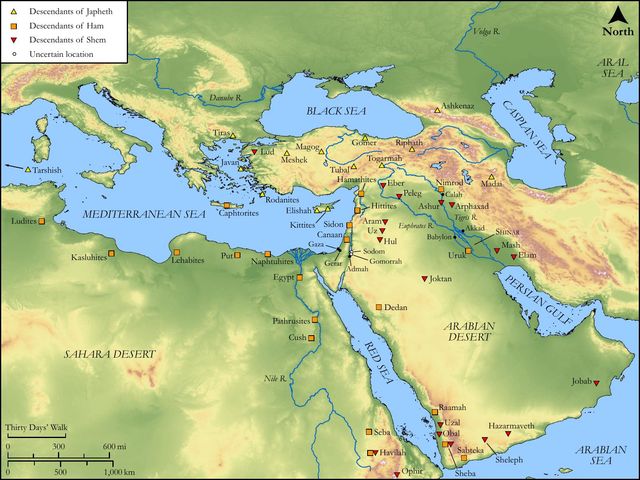
See on the biblical-era maps


Study this verse
Public-domain commentary
Matthew Henry
From his Commentary on the Whole Bible. Henry comments on passages, not single verses — this entry covers Genesis 10:6–14. His three-level outline is real structure in the source text, so it is rendered as structure.
That which is observable and improvable in these verses is the account here given of Nimrod, Gen 10:8-10. He is here represented as a great man in his day: He began to be a mighty one in the earth, that is, whereas those that went before him were content to stand upon the same level with their neighbours, and though every man bore rule in his own house yet no man pretended any further, Nimrod's aspiring mind could not rest here; he was resolved to tower above his neighbours, not only to be eminent among them, but to lord it over them. The same spirit that actuated the giants before the flood (who became mighty men, and men of renown, Gen 6:4), now revived in him, so soon was that tremendous judgment which the pride and tyranny of those mighty men brought upon the world forgotten. Note, There are some in whom ambition and affectation of dominion seem to be bred in the bone; such there have been and will be, notwithstanding the wrath of God often revealed from heaven against them. Nothing on this side hell will humble and break the proud spirits of some men, in this like Lucifer, Isa 14:14, Isa 14:15. Now,
I.Nimrod was a great hunter; with this he began, and for this became famous to a proverb. Every great hunter is, in remembrance of him, called a Nimrod.
1.Some think he did good with his hunting, served his country by ridding it of the wild beasts which infested it, and so insinuated himself into the affections of his neighbours, and got to be their prince. Those that exercise authority either are, or at least would be called, benefactors, Luk 22:25.
2.Others think that under pretence of hunting he gathered men under his command, in pursuit of another game he had to play, which was to make himself master of the country and to bring them into subjection. He was a mighty hunter, that is, he was a violent invader of his neighbours' rights and properties, and a persecutor of innocent men, carrying all before him, and endeavouring to make all his own by force and violence. He thought himself a mighty prince, but before the Lord (that is, in God's account) he was but a mighty hunter. Note, Great conquerors are but great hunters. Alexander and Caesar would not make such a figure in scripture-history as they do in common history; the former is represented in prophecy but as a he-goat pushing, Dan 8:5. Nimrod was a mighty hunter against the Lord, so the Septuagint; that is,
(1.)He set up idolatry, as Jeroboam did, for the confirming of his usurped dominion. That he might set up a new government, he set up a new religion upon the ruin of the primitive constitution of both. Babel was the mother of harlots. Or,
(2.)He carried on his oppression and violence in defiance of God himself, daring Heaven with his impieties, as if he and his huntsmen could out-brave the Almighty, and were a match for the Lord of hosts and all his armies. As if it were a small thing to weary men, he thinks to weary my God also, Isa 7:13.
II.Nimrod was a great ruler:
The beginning of his kingdom was Babel, Gen 10:10. Some way or other, by arts or arms, he got into power, either being chosen to it or forcing his way to it; and so laid the foundations of a monarchy, which was afterwards a head of gold, and the terror of the mighty, and bade fair to be universal. It does not appear that he had any right to rule by birth; but either his fitness for government recommended him, as some think, to an election, or by power and policy he advanced gradually, and perhaps insensibly, into the throne. See the antiquity of civil government, and particularly that form of it which lodges the sovereignty in a single person. If Nimrod and his neighbours began, other nations soon learned to incorporate under one head for their common safety and welfare, which, however it began, proved so great a blessing to the world that things were reckoned to go ill indeed when there was no king in Israel.
III.Nimrod was a great builder.
Probably he was architect in the building of Babel, and there he began his kingdom; but, when his project to rule all the sons of Noah was baffled by the confusion of tongues, out of that land he went forth into Assyria (so the margin reads it, Gen 10:11) and built Nineveh, etc., that, having built these cities, he might command them and rule over them. Observe, in Nimrod, the nature of ambition.
1.It is boundless. Much would have more, and still cries, Give, give.
2.It is restless. Nimrod, when he had four cities under his command, could not be content till he had four more.
3.It is expensive. Nimrod will rather be at the charge of rearing cities than not have the honour of ruling them. The spirit of building is the common effect of a spirit of pride.
4.It is daring, and will stick at nothing. Nimrod's name signifies rebellion, which (if indeed he did abuse his power to the oppression of his neighbours) teaches us that tyrants to men are rebels to God, and their rebellion is as the sin of witchcraft.
Historical interpretation
Four Centuries of Reception
6 surviving comments on this verse. Each one is dated, so this reads as a timeline rather than a list.
Select a marker to jump to its quote. Markers stagger vertically where authors wrote within a few decades of each other.
Concerning Nimrod, Moses said, “He was a mighty hunter before the Lord,” because, according to the will of the Lord, it was he who fought with each of these nations and chased them out from there, so that they would go out and settle in the regions that had been set apart for them by God. “Therefore it is said, like Nimrod a mighty hunter before the Lord.” One used to bless a chief or a ruler by saying, “May you be like Nimrod, a mighty hunter who was victorious in the battles of the Lord.”
Then sacred Scripture goes on from this point to tell of the children born to the sons in these words: “Now, Ham became the father of Cush”; and further, “Now, Cush became the father of Nebrod (Nimrod), who began to be a giant on earth. He was a giant hunter before the Lord.” While some people say the phrase “before the Lord” means being in opposition to God, I on the contrary do not think sacred Scripture is implying this. Rather, it implies that [Nimrod] was strong and brave. But the phrase “before the Lord” means created by him, receiving from him God’s blessing. Or it may mean that God was on the point of arousing our wonder through him by creating such a remarkable creature and displaying him before us on the earth. Nimrod too, however, in his turn in imitation of his forebear did not take due advantage of his natural preeminence but hit upon another form of servitude in endeavoring to become ruler and king. You see, there would not ever be a king unless there were people being ruled. But in that case freedom is seen for what it really is, whereas slavery is the most galling obstacle to conditions of freedom, when all the more power is exercised over free people. See what ambition is guilty of. Observe bodily strength not keeping to its limits but constantly lusting after more and clutching for glory. You see, the orders [Nimrod] gave were not those of a leader. Rather, he even builds cities with a view to ruling over the enemy.
A Nimrod, who goes round the world, made rough
With deep ravines and wooden crags, and strives
To waylay some by fraud and secret wiles,
To vanquish others by his giant arms
And spread his deadly triumphs far and wide.
“And Chus [Cush] begat Nimrod. This man began to be powerful in the earth.” And after a little while, it says, “And the beginning of his kingdom was Babel and Arach and Achad and Chalanne in the land of Senaar [Shinar].” Nimrod, son of Chus, was the first to seize despotic rule over the people, which men were not yet accustomed to; and he reigned in Babylon, which was called Babel, because the languages of those building the tower were thrown into confusion there. For Babel signifies confusion. Then he also reigned in Arach, that is, in Edissa; and in Achad, which is now called Nisibis; and in Chalanne, which was later called Seleucia after king Seleucus when its name had been changed and which is now in actual fact called Ctesiphon.
From whom even today remains the proverb, so that it is said: Like Nimrod, a mighty hunter before the Lord. With those imitating the devil who are on his side, it can very truly be said, because such people, when they hunt the souls of men either by their word or example to destruction, follow the deeds of the ancient transgressor and deceiver.
From him came the proverb: Like Nimrod, a mighty hunter before the Lord. It turned into a proverb because his deeds were unprecedented in his time; and the phrase before the Lord was added to magnify the crime, since it was evidently quite reckless and arrogant for a man on earth to dare live in such a way before the Lord, who looks down from heaven upon the children of men; whence it is clear that many at that time avoided doing such things due to fear of divine oversight, although another version has it that Nimrod was a giant hunter against the Lord. From the ambiguous Greek term, enantion, both can be interpreted. In fact, in the psalm where we sing let us weep before the Lord who made us (Psalm 95:6), the word is enantion Kyrion. This also appears in the book of Job, where it is written, You burst forth into rage against the Lord. The understanding about the giant is thus evident, that he was a mighty hunter of brute animals, as a powerful man; but because he was an impious man, he led a proud life against the will of the Creator.
Continue studying Genesis 10:9 across the web’s major study libraries — every link below opens this exact verse, chapter, or book on the destination site.
Read & Compare
 BibleGatewayThis verse in more than 200 translations and 70 languages.
 Bible.comThe YouVersion reader — hundreds of translations, reading plans, and highlights.
 ESV.orgCrossway's official English Standard Version reader.
 NET BibleThe NET translation with 60,000+ translators' notes on every rendering decision.
 STEP BibleTyndale House's free study tool — original text, vocabulary, and scholarly resources.
 BibliaLogos Bible Software's free web reader.
 USCCBThe New American Bible (Revised Edition) with the U.S. bishops' study notes.
Commentaries
 BibleHub CommentariesDozens of classic commentaries on this verse, gathered on one page.
 StudyLightMore than 100 commentary sets — the largest collection on the web.
 BibleRefPlain-English commentary on what this verse means, verse by verse.
 Enduring WordDavid Guzik's free commentary on this chapter, widely used by Bible teachers.
 Bible Study ToolsVerse commentary alongside Greek and Hebrew study aids.
Original Language & Research
- BibleHub InterlinearThe verse word by word — original language, transliteration, and English.
- BibleHub LexiconEvery word's original-language definition and Strong's entry.
 Blue Letter BibleDeep-study tools — Strong's numbers, concordance, and word studies.
 SefariaThe Hebrew text with Rashi and centuries of Jewish commentary.
Sermons, Hymns & Audio


TrulyRandomVerse is not affiliated with these sites and doesn’t control their content. They’re linked because they’re genuinely useful.
Summary
Genesis 10:9 introduces Nimrod as a figure of immense strength and influence in the early post-Flood world, describing him as "a mighty hunter before the LORD." This verse highlights his exceptional prowess and reputation, which became a widely recognized proverb, marking him as a powerful individual pivotal in the nascent formation of human societies and kingdoms, particularly in Mesopotamia.
Context
ShowHideLiterary Context
This verse is situated within the "Table of Nations" in Genesis 10, a genealogical and geographical record detailing the descendants of Noah's sons—Shem, Ham, and Japheth—and the subsequent dispersal of peoples across the earth after the Great Flood. Nimrod, a descendant of Ham through Cush, stands out in this otherwise purely genealogical list, receiving a distinct narrative description. This unique emphasis signals his exceptional importance and influence, setting the stage for his role in the establishment of early cities and kingdoms, as elaborated in Genesis 10:10-12. His prominence here also foreshadows the narrative shift in Genesis 11, where the focus moves from the orderly dispersion of nations to the unified rebellion at Babel, a project often associated with Nimrod's leadership.
Historical & Cultural Context
In the post-Flood era, hunting was far more than a means of sustenance; it was a profound demonstration of strength, courage, and leadership. Communities faced constant threats from wild animals, and a "mighty hunter" was a vital protector, commanding immense respect and authority. Such a figure often transitioned naturally into a political leader, establishing settlements and cities, and organizing people for defense and dominion. Nimrod's activities, including the founding of cities like Babel, Erech, Accad, and Calneh in the land of Shinar, as well as Nineveh and other cities in Assyria, reflect the historical reality of early urban development and the rise of powerful city-states in Mesopotamia. His role as a "mighty hunter" thus encompasses both the physical subjugation of nature and the political subjugation of people, laying the groundwork for the first empires.
Key Themes
ShowHideGenesis 10:9 contributes to several key themes within the broader biblical narrative. It introduces the theme of human power and ambition, particularly as it relates to the establishment of earthly kingdoms and dominion. Nimrod's exceptional might raises questions about the exercise of power and whether it is wielded in alignment with or in opposition to divine will. The phrase "before the LORD" also introduces the theme of divine observation and accountability, reminding readers that all human actions, regardless of their scale or intent, are performed under the direct gaze of God. Furthermore, Nimrod's story subtly prefigures the ongoing biblical tension between human attempts to build autonomous empires (culminating in the Tower of Babel) and God's ultimate sovereignty over all creation and human affairs, a tension that echoes throughout the Old Testament and finds its ultimate resolution in the person of Christ.
Exposition and Analysis
ShowHideGenesis 10:9 provides a unique and emphatic description of Nimrod, a grandson of Ham, highlighting his exceptional power and renown. The verse's structure, particularly its repetition, underscores his legendary status and the lasting impact of his reputation among the nations.
Key Word Analysis
ShowHideThis term signifies more than mere physical strength; it denotes someone powerful, a warrior, a champion, or even a tyrant. In this context, it implies a figure of exceptional prowess, capable of dominating both nature and, by extension, people. The word suggests leadership and the ability to establish authority and control.
While literally referring to the chase or game, in the context of a "mighty hunter," it extends beyond simply tracking and killing animals. It speaks to the skill, cunning, and aggressive nature required to subdue wild beasts, which in that age was a highly respected and often politically significant activity. For Nimrod, it foreshadows his role in establishing dominion over human populations.
Literally "face," this word is used prepositionally to mean "in the presence of," "in the sight of," or "in front of." However, in certain contexts, particularly when combined with an individual's actions, it can also carry the connotation of "in defiance of" or "against." This ambiguity is crucial for interpreting Nimrod's relationship with the LORD, suggesting either divine acknowledgment of his power or a challenge to divine authority.
Verse Breakdown
ShowHide"He was a mighty hunter before the LORD"
This initial declaration introduces Nimrod's defining characteristic. The phrase "mighty hunter" (Hebrew: gibbôwr tsayid) immediately establishes him as a figure of extraordinary strength, skill, and perhaps even ruthlessness. It speaks to his ability to subdue, whether animals or people. The phrase "before the LORD" (Hebrew: lipney YHWH) is central to the verse's meaning and has been subject to dual interpretations. It can mean "in the sight of the LORD," implying that God observed and perhaps even acknowledged Nimrod's exceptional power. Alternatively, and often favored by commentators given Nimrod's traditional association with the Tower of Babel and the potential etymology of his name (from marad, "to rebel"), it can signify "in defiance of the LORD" or "against the LORD," suggesting that his might was wielded in opposition to God's will or in a manner that challenged divine authority.
"wherefore it is said"
This parenthetical clause indicates that Nimrod's reputation was so profound and widely recognized that it became a common proverb or saying among the people of that era. It highlights his legendary status and the enduring impact of his actions, solidifying his place in popular memory as an archetype of power.
"Even as Nimrod the mighty hunter before the LORD"
The repetition of the initial descriptive phrase serves to emphatically reinforce Nimrod's iconic status. This reiteration underscores that his name became synonymous with exceptional might and, depending on the chosen interpretation of "before the LORD," either divinely observed power or defiant human ambition. This literary device ensures that his character is firmly etched into the historical and cultural consciousness of the post-Flood world, serving as a benchmark for extraordinary power.
Literary Devices
ShowHideThe verse employs several literary devices to convey its message about Nimrod. The most prominent is Repetition, with the phrase "a mighty hunter before the LORD" appearing twice. This repetition serves to emphasize Nimrod's extraordinary nature and the lasting impact of his reputation, ensuring his legendary status is firmly established in the reader's mind. The phrase "wherefore it is said" indicates the use of Proverbial Language, suggesting that Nimrod's prowess and perhaps his controversial nature had become a common saying or byword among the nations, elevating his story beyond a mere historical account to a cultural archetype. Finally, the phrase "before the LORD" introduces a significant Ambiguity or double entendre. While literally meaning "in the presence of God," its context and traditional interpretations allow for readings of both "in the sight of God" (as observed or permitted) and "in defiance of God" (as an act of rebellion). This literary choice invites deeper theological reflection on the nature of human power and its relationship to divine authority.
Theological and Thematic Connections
ShowHideNimrod's narrative in Genesis 10:9 serves as a foundational theological statement on the nature of human power, ambition, and its relationship to divine sovereignty. He represents the archetype of a powerful human leader who establishes dominion and builds kingdoms, potentially apart from or even in defiance of God's will. This story sets the stage for the recurring biblical theme of human attempts to create self-sufficient empires, culminating in the Tower of Babel, and contrasting sharply with God's ultimate plan for humanity to fill the earth and live in humble dependence upon Him. The ambiguity of "before the LORD" highlights the tension between God's omnipresent gaze and humanity's freedom to choose obedience or rebellion, underscoring that all actions are ultimately performed in the divine presence.
Reflection and Application
ShowHideNimrod's narrative serves as a timeless reminder about the nature of power and ambition. While strength, skill, and leadership are gifts that can be used for good, the crucial question for every individual is how these capabilities are utilized. Are one's might and influence employed to serve God's purposes, to protect and build up in accordance with His will, or do they lead to self-exaltation, the building of personal kingdoms, and rebellion against divine authority? The phrase "before the LORD" challenges us to consider that all our actions, whether great or small, public or private, are performed under the direct, discerning gaze of God. Our ultimate posture should be one of humility and obedience, seeking to honor Him in all we do, rather than merely building our own names or empires, a theme powerfully explored in the narrative of the scattering from Babel.
Questions for Reflection
ShowHideFAQ
ShowHideWhat does "mighty hunter" signify beyond literal hunting?
ShowHideThe term "mighty hunter" (Hebrew: gibbôwr tsayid) implies much more than just skill in pursuing animals. It suggests a powerful, heroic, or even tyrannical figure who establishes dominion. In that age, a successful hunter often became a leader, protecting communities from wild beasts but also potentially dominating and organizing them. For Nimrod, this prowess extended to building cities and kingdoms, as seen in Genesis 10:10-12, indicating his ability to subdue both nature and people, laying the groundwork for early empires.
What are the two main interpretations of "before the LORD" in this verse?
ShowHideThe Hebrew phrase lipney YHWH can be interpreted in two primary ways: first, "In the sight of the LORD," meaning God observed and acknowledged Nimrod's exceptional greatness and power, perhaps even with a degree of divine permission or recognition. Second, and often favored by commentators, is "In defiance of the LORD" or "against the LORD." This latter interpretation is supported by the potential etymology of Nimrod's name (from marad, "to rebel") and his traditional association with the Tower of Babel, suggesting his might was wielded in opposition to God's will or in a manner that challenged divine authority and sought human self-exaltation.
Is Nimrod presented as a positive or negative figure in the Bible?
ShowHideThe biblical text itself offers a somewhat ambiguous portrayal. While it acknowledges his might and kingdom-building, the strong association with the Tower of Babel (often seen as a project of human rebellion against God's command to fill the earth) and the potential etymology of his name suggesting rebellion often lead traditional interpretations to view him as a negative figure. He embodies the human desire for self-exaltation and the building of earthly kingdoms apart from divine guidance, standing as a contrast to God's intended order and sovereignty.
Christ-Centered Fulfillment
ShowHideNimrod, as the archetypal "mighty hunter" who builds earthly kingdoms through human might and potential defiance of God, stands in profound contrast to the true King and Shepherd, Jesus Christ. Nimrod sought to establish an earthly empire through self-exaltation and centralized power, culminating in the rebellion at Babel where humanity sought to make a name for itself. Christ, however, came not to build an earthly kingdom by force or self-aggrandizement, but to establish a spiritual kingdom through humility, self-sacrifice, and perfect obedience to the Father's will, as described in Philippians 2:5-8. He is the ultimate "hunter" not of animals or people for dominion, but of lost souls, seeking and saving the lost (Luke 19:10), gathering them into God's fold as the Good Shepherd (John 10:11-16). Where Nimrod's power led to division and scattering at Babel, Christ's power, demonstrated on the cross and through the resurrection, brings reconciliation and unity, fulfilling God's true design for humanity in a kingdom that is "not of this world" (John 18:36) yet transforms it from within, ultimately bringing all things under His gracious and righteous reign (Ephesians 1:9-10).