


Genesis 14:14
- וַיִּשְׁמַעvai·yish·Ma'and he heardH8085Conj-w ¦ V-Qal-ConsecImperf-3msVerb Qal Consecutive Imperfect 3rd Singular Masculineוַandיִּשְׁמַעhe heard
- אַבְרָם'av·RamAbramH87N-proper-mNoun Proper Masculine
- כִּיkithatH3588PrtParticle Conditional
- נִשְׁבָּהnish·Bahhe had been taken captiveH7617V-Niphal-Perf-3msVerb Niphal Perfect 3rd Singular Masculine
- אָחִיו'a·Chivhis relativeH251N-msc ¦ 3msNoun Singular Masculine Constructאָחִיrelativeוhis
- וַיָּרֶקvai·Ya·rekand he drew outH7324Conj-w ¦ V-Hiphil-ConsecImperf-3msVerb Hiphil Consecutive Imperfect 3rd Singular Masculineוַandיָּרֶקhe drew out
- אֶת'et<obj.>H853DirObjMParticle Object Indicator
- חֲנִיכָיוcha·ni·Khavhis trained menH2593N-mpc ¦ 3msNoun Plural Masculine Constructחֲנִיכָיtrained menוhis
- יְלִידֵיye·li·Deithose born ofH3211N-mpcNoun Plural Masculine Construct
- בֵיתוֹvei·Tohis householdH1004N-msc ¦ 3msNoun Singular Masculine Constructבֵיתhouseholdוֹhis
- שְׁמֹנָהshe·mo·Naheight-H8083Adj-csAdjective Numerical Singular common gender Absolute
- עָשָׂר'a·SarteenH6240Adj-csAdjective Numerical Singular common gender Absolute
- וּשְׁלֹשׁu·she·Loshand threeH7969Conj-w ¦ Adj-cscAdjective Numerical Singular common gender Constructוּandשְׁלֹשׁthree
- מֵאוֹתme·'othundred<s>H3967Adj-fpAdjective Numerical Plural Feminine Absolute
- וַיִּרְדֹּףvai·yir·Dofand he pursuedH7291Conj-w ¦ V-Qal-ConsecImperf-3msVerb Qal Consecutive Imperfect 3rd Singular Masculineוַandיִּרְדֹּףhe pursued
- עַד'adtoH5704PrepPreposition
- דָּןDanDanH1835N-properNoun Proper Location
English is a literal word-by-word gloss of the Hebrew, not the KJV's wording. Why?
This is the original text the KJV's translators worked from — each Hebrew word with its own literal English meaning in this verse, prepared by scholars at Tyndale House, Cambridge. The KJV translates whole sentences, not word by word, so its wording differs: one Hebrew word can become several English words, and the KJV may choose “the LORD” where the gloss reads “Yahweh”. Both are faithful — they answer different questions. For the KJV's own rendering, switch to the KJV text.
Details
See on the biblical-era map


Study this verse
Public-domain commentary
Matthew Henry
From his Commentary on the Whole Bible. Henry comments on passages, not single verses — this entry covers Genesis 14:13–16. His three-level outline is real structure in the source text, so it is rendered as structure.
We have here an account of the only military action we ever find Abram engaged in, and this he was prompted to, not by his avarice or ambition, but purely by a principle of charity; it was not to enrich himself, but to help his friend. Never was any military expedition undertaken, prosecuted, and finished, more honourably than this of Abram's. Here we have,
I.The tidings brought him of his kinsman's distress.
Providence so ordered it that he now sojourned not far off, that he might be a very present help.
1.He is here called Abram the Hebrew, that is, the son and follower of Heber, in whose family the profession of the true religion was kept up in that degenerate age. Abram herein acted like a Hebrew - in a manner not unworthy of the name and character of a religious professor.
2.The tidings were brought by one that had escaped with his life for a prey. Probably he was a Sodomite, and as bad as the worst of them; yet knowing Abram's relation to Lot, and concern for him, he implores his help, and hopes to speed for Lot's sake. Note, The worst of men, in the day of their trouble, will be glad to claim acquaintance with those that are wise and good, and so get an interest in them. The rich man in hell called Abram Father; and the foolish virgins made court to the wise for a share of their oil.
II.The preparations he made for this expedition.
The cause was plainly good, his call to engage in it was clear, and therefore, with all speed, he armed his trained servants, born in his house, to the number of three hundred and eighteen - a great family, but a small army, about as many as Gideon's that routed the Midianites, Jdg 7:7. He drew out his trained servants, or his catechised servants, not only instructed in the art of war, which was then far short of the perfection which later and worse ages have improved it to, but instructed in the principles of religion; for Abram commanded his household to keep the way of the Lord. This shows that Abram was,
1.A great man, who had so many servants depending upon him, and employed by him, which was not only his strength and honour, but gave him a great opportunity of doing good, which is all that is truly valuable and desirable in great places and great estates.
2.A good man, who not only served God himself, but instructed all about him in the service of God. Note, Those that have great families have not only many bodies, but many souls besides their own, to take care of and provide for. Those that would be found the followers of Abram must see that their servants be catechised servants.
3.A wise man for, though he was a man of peace, yet he disciplined his servants for war, not knowing what occasion he might have, some time or other, so to employ them. Note, Though our holy religion teaches us to be for peace, yet it does not forbid us to provide for war.
III.His allies and confederates in this expedition.
He prevailed with his neighbours, Aner, Eshcol, and Mamre (with whom he kept up a fair correspondence) to go along with him. It was his prudence thus to strengthen his own troops with their auxiliary forces; and probably they saw themselves concerned, in interest, to act, as they could, against this formidable power, lest their own turn should be next. Note,
1.It is our wisdom and duty to behave ourselves so respectfully and obligingly towards all men as that, whenever there is occasion, they may be willing and ready to do us a kindness.
2.Those who depend on God's help, yet, in times of distress, ought to make use of men's help, as Providence offers it; else they tempt God.
IV.His courage and conduct were very remarkable.
1.There was a great deal of bravery in the enterprise itself, considering the disadvantages he lay under. What could one family of husbandmen and shepherds do against the armies of four princes, who now came fresh from blood and victory? It was not a vanquished, but a victorious army, that he was to pursue; nor was he constrained by necessity to this daring attempt, but moved to it by generosity; so that, all things considered, it was, for aught I know, as great an instance of true courage as ever Alexander or Caesar was celebrated for. Note, Religion tends to make men, not cowardly, but truly valiant. The righteous is bold as a lion. The true Christian is the true hero.
2.There was a great deal of policy in the management of it. Abram was no stranger to the stratagems of war: He divided himself, as Gideon did his little army (Jdg 7:16), that he might come upon the enemy from several quarters at once, and so make his few seem a great many; he made his attack by night, that he might surprise them. Note, Honest policy is a good friend both to our safety and to our usefulness. The serpent's head (provided it be nothing akin to the old serpent) may well become a good Christian's body, especially if it have a dove's eye in it, Mat 10:16.
V.His success was very considerable, Gen 14:15, Gen 14:16.
He defeated his enemies, and rescued his friends; and we do not find that he sustained any loss. Note, Those that venture in a good cause, with a good heart, are under the special protection of a good God, and have reason to hope for a good issue. Again, It is all one with the Lord to save by many or by few, Sa1 14:6. Observe,
1.He rescued his kinsman; twice here he is called his brother Lot. The remembrance of the relation that was between them, both by nature and grace, made him forget the little quarrel that had been between them, in which Lot had by no means acted well towards Abram. Justly might Abram have upbraided Lot with his folly in quarrelling with him and removing from him, and have told him that he was well enough served, he might have known when he was well off; but, in the charitable breast of pious Abram, it is all forgiven and forgotten, and he takes this opportunity to give a real proof of the sincerity of his reconciliation. Note,
(1.)We ought to be ready, whenever it is in the power of our hands, to succour and relieve those that are in distress, especially our relations and friends. A brother is born for adversity, Pro 17:17. A friend in need is a friend indeed.
(2.)Though others have been wanting in their duty to us, yet we must not therefore deny our duty to them. Some have said that they can more easily forgive their enemies than their friends; but we shall see ourselves obliged to forgive both if we consider, not only that our God, when we were enemies, reconciled us, but also that he passeth by the transgression of the remnant of his heritage, Mic 7:18.
2.He rescued the rest of the captives, for Lot's sake, though they were strangers to him and such as he was under no obligation to at all; nay, though they were Sodomites, sinners before the Lord exceedingly, and though, probably, he might have recovered Lot alone by ransom, yet he brought back all the women, and the people, and their goods, Gen 14:16. Note, As we have opportunity we must do good to all men. Our charity must be extensive, as opportunity offers itself. Wherever God gives life, we must not grudge the help we can give to support it. God does good to the just and unjust, and so must we, Mat 5:45. This victory which Abram obtained over the kings the prophet seems to refer to, Isa 41:2, Who raised up the righteous man from the east, and made him rule over kings? And some suggest that, as before he had a title to this land by grant, so now by conquest.
Historical interpretation
Three Centuries of Reception
4 surviving comments on this verse. Each one is dated, so this reads as a timeline rather than a list.
Select a marker to jump to its quote. Markers stagger vertically where authors wrote within a few decades of each other.
“When Abraham learned of this, he counted his servants born in the house” and with 318 men won a victory and liberated his nephew. This shows that the separation had taken place in friendship, since Abraham’s love for his nephew was so great that he was willing to confront even the dangers of war on his behalf. What does it mean “he counted”? It means he “chose.” So too what Jesus said in the Gospel refers not only to the knowledge of God but also to the grace of the just: “Even the hairs on your head are all counted.” Indeed, “the Lord knows those who are his,” but those who are not his he does not deign to know. Abraham, then, counted 318 men. You should understand that it is not numerical quantity that is here expressed but the value of their election. He chose, in fact, those whom he judged worthy to belong to the number of the faithful who were to believe in the passion of our Lord Jesus Christ. Indeed, the letter T in Greek means “three hundred,” and the sum IH—ten plus eight—expresses the name of Jesus. So Abraham conquered in virtue of faith, not through the strength of a numerous army. And so it was that with no more than a few house servants he triumphed over those who had defeated the armies of five kings.
Consider in this case, I ask you, dearly beloved, the greatness of heart exemplified in the just man’s virtue. Trusting in the power of God, he was not cowed by the force of the enemy when he learned of the rout they had caused, first by falling upon all the tribes and prevailing against the Amalekites and all the others, and then by engaging the Sodomites, putting them to flight and seizing all their property. The reason, you see, why sacred Scripture described all this to us ahead of time, as well as all they achieved through their bravery, was that you might learn that the patriarch prevailed against them not by physical strength but through faith in God. [He] achieved all this under the protection of help from on high, not by wielding weapons and arrows and spears or by drawing bows or raising shields but with a few retainers of his own household.
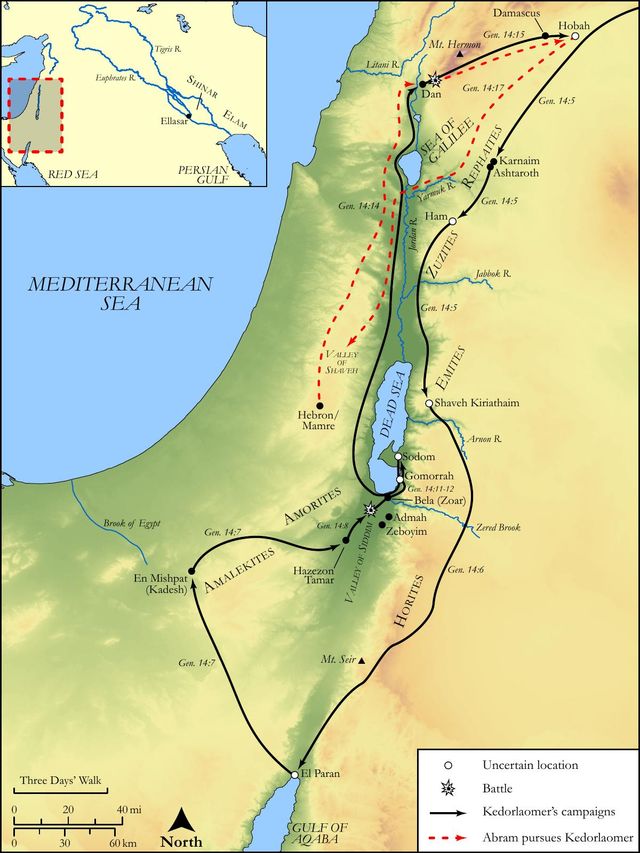
(Verse 14) And he pursued them as far as Dan, to the city of the Phoenicians, which is now called Paneas. But Dan is one of the sources of the Jordan. For the other is also called Jor, which means 'stream'. Therefore, the Jordan is the name given to the two springs that, not far from each other, join to form a single stream.
When Abram heard that his brother Lot had been captured, he numbered his trained servants, three hundred and eighteen, and so on. Indeed, it is a very great miracle of divine power that Abraham, with such a small troop, inflicted such a great slaughter on the enemies, but it contains the deeper sacrament of faith in which we must overcome the spiritual battle. There were three hundred and eighteen, a number that clearly designates the victorious sign of the cross and the name of our Savior Jesus Christ, through whom this has been consecrated for the fortification of our salvation. For among the Greeks, three hundred is marked by the letter T, which is shaped like a cross. For if it had received an apex in the middle, not the figure of the cross but the very sign of the cross would be clearly seen. However, ten and eight are marked among them by Ι and Η, which are the first letters in the name of Jesus: and therefore when three hundred and eighteen are noted in Greek, it is not far from being read as the cross of Jesus. So, fittingly, Abraham overcame the enemies and freed his brother with three hundred and eighteen comrades, to mystically prefigure that the one who would recall the world from death through the passion of the cross would be born from his seed; and he himself would also, by the name of the Savior, that is, Jesus, stand out and be honored throughout the whole world: but also, that all who would pertain to salvation would achieve salvation only through this venerable sign and through his terrible name.
Continue studying Genesis 14:14 across the web’s major study libraries — every link below opens this exact verse, chapter, or book on the destination site.
Read & Compare
 BibleGatewayThis verse in more than 200 translations and 70 languages.
 Bible.comThe YouVersion reader — hundreds of translations, reading plans, and highlights.
 ESV.orgCrossway's official English Standard Version reader.
 NET BibleThe NET translation with 60,000+ translators' notes on every rendering decision.
 STEP BibleTyndale House's free study tool — original text, vocabulary, and scholarly resources.
 BibliaLogos Bible Software's free web reader.
 USCCBThe New American Bible (Revised Edition) with the U.S. bishops' study notes.
Commentaries
 BibleHub CommentariesDozens of classic commentaries on this verse, gathered on one page.
 StudyLightMore than 100 commentary sets — the largest collection on the web.
 BibleRefPlain-English commentary on what this verse means, verse by verse.
 Enduring WordDavid Guzik's free commentary on this chapter, widely used by Bible teachers.
 Bible Study ToolsVerse commentary alongside Greek and Hebrew study aids.
Original Language & Research
- BibleHub InterlinearThe verse word by word — original language, transliteration, and English.
- BibleHub LexiconEvery word's original-language definition and Strong's entry.
 Blue Letter BibleDeep-study tools — Strong's numbers, concordance, and word studies.
 SefariaThe Hebrew text with Rashi and centuries of Jewish commentary.
Sermons, Hymns & Audio


TrulyRandomVerse is not affiliated with these sites and doesn’t control their content. They’re linked because they’re genuinely useful.
Summary
Genesis 14:14 records Abram's swift and decisive response to the news of his nephew Lot's capture, detailing his mobilization of a formidable private force of three hundred and eighteen trained, home-born servants to pursue the victorious kings and rescue Lot, thereby showcasing Abram's profound familial loyalty, military prowess, and leadership in the tumultuous ancient Near East.
Context
ShowHideLiterary Context
This verse immediately follows the "Battle of the Kings" described in Genesis 14:1-11, a pivotal conflict where a coalition of eastern kings, led by Kedorlaomer, decisively defeated the kings of the Jordan Valley, including Sodom and Gomorrah. As a consequence of this victory, the invading forces plundered the cities and took captives, among whom was Abram's nephew, Lot, who had chosen to dwell in Sodom (Genesis 14:12). The news of Lot's captivity, brought by a survivor (Genesis 14:13), serves as the direct catalyst for Abram's extraordinary military intervention, shifting the narrative focus from regional conflict to Abram's personal and familial responsibility.
Historical & Cultural Context
In the ancient Near East, powerful patriarchal figures like Abram often maintained substantial households that included not only family members but also numerous servants, dependents, and even a private militia for protection and influence. This was a common practice in a period lacking centralized governmental protection, where self-reliance and the ability to defend one's assets and kin were paramount. The presence of "trained servants" highlights Abram's significant wealth and status, placing him among the elite of his time. The pursuit "unto Dan" also points to the vast distances covered in ancient military campaigns and the determination required for such an undertaking in a largely undeveloped and often dangerous landscape.
Key Themes
ShowHideGenesis 14:14 contributes significantly to several overarching themes within the book of Genesis and the broader biblical narrative. It powerfully illustrates the theme of Familial Loyalty and Responsibility, as Abram, despite Lot's questionable choices, acts decisively to rescue his kinsman. It also highlights Abram's Growing Stature and Resources, demonstrating that he is not merely a recipient of divine promises but a capable leader with tangible means. Furthermore, Abram's victory, though seemingly a military feat, implicitly underscores the theme of Divine Providence and Blessing, foreshadowing how God would use Abram's strength and resources to fulfill His covenant promises, including the promise of a great nation and protection from enemies, echoing the broader narrative of God's faithfulness to His chosen ones throughout Genesis.
Exposition and Analysis
ShowHideKey Word Analysis
ShowHideMeaning 'initiated' or 'practiced.' This term signifies that Abram's servants were not merely household staff but individuals who had undergone specific instruction and discipline, likely in military tactics or self-defense. This detail elevates the status of Abram's force, indicating a level of professionalism and readiness that would be crucial for a successful military engagement, distinguishing them from a mere collection of laborers.
Referring to those 'born' in his own house. This emphasizes the deep loyalty and familial bond of these servants. They were not hired mercenaries but integral, lifelong members of Abram's extended household, raised within his patriarchal structure. Their status as 'home-born' suggests a profound personal allegiance to Abram, making their participation in the dangerous rescue mission a matter of shared identity and commitment rather than mere obligation.
Meaning 'to run after,' often with hostile intent. This verb powerfully conveys Abram's determined and aggressive action. It was not a casual follow-up but an active, relentless chase of the captors, demonstrating his unwavering resolve to reclaim Lot and the plundered goods. The intensity of the word highlights the urgency and the strategic nature of Abram's pursuit.
Verse Breakdown
ShowHide"And when Abram heard that his brother was taken captive"
This clause establishes the immediate catalyst for Abram's action: the news of Lot's capture. The use of "his brother" (referring to his nephew, Lot, a common ancient Near Eastern idiom for close kin) underscores the deep familial bond and personal stake Abram felt, motivating his swift and courageous response despite Lot's earlier choice to separate from him.
"he armed his trained [servants], born in his own house, three hundred and eighteen"
This phrase details the composition and size of Abram's fighting force. The description "trained servants, born in his own house" highlights their loyalty, discipline, and integral connection to Abram's household. The specific number, "three hundred and eighteen," emphasizes the formidable and organized nature of this private army, indicating Abram's considerable wealth, influence, and capacity for self-defense and offensive action in a volatile region.
"and pursued [them] unto Dan"
This final clause describes the extent and determination of Abram's pursuit. His chase extended a significant distance northward, demonstrating his unwavering commitment to recovering Lot and the plundered goods. The mention of "Dan" (an anachronistic name for Laish at this time) indicates the full geographical scope of his relentless pursuit into the northern reaches of Canaan.
Literary Devices
ShowHideThe verse employs several significant literary devices. Anachronism is evident in the mention of "Dan," a name that the city of Laish would not bear until centuries later, as recorded in Judges 18:29. This is a common editorial technique in biblical narratives, where later redactors update place names to be familiar to their contemporary audience, ensuring geographical clarity. The specific number "three hundred and eighteen" might be seen as Hyperbole if interpreted as a symbolic representation of a vast and formidable force, though it could also be a literal count emphasizing the precise and organized nature of Abram's retinue. Regardless, it serves to underscore the impressive scale of Abram's household and his military capability. Furthermore, Abram's decisive and successful military action in this verse serves as Foreshadowing of the future strength and military prowess of the nation of Israel, descended from him, and their eventual conquest of the land of Canaan under God's guidance.
Theological and Thematic Connections
ShowHideAbram's courageous and decisive action in Genesis 14:14 transcends a mere historical account of a military triumph; it is imbued with profound theological significance. His unwavering commitment to rescue Lot, despite Lot's earlier separation and choice of dwelling, exemplifies a deep, covenantal loyalty that mirrors God's own faithfulness to His people, even when they stray. This act of liberation, undertaken with his household, underscores the principle that God often uses the prepared resources and capabilities of His servants to accomplish His redemptive purposes, demonstrating that faith is not passive but often calls for active, courageous engagement.
Reflection and Application
ShowHideAbram's actions in Genesis 14:14 offer profound lessons for believers today, demonstrating a powerful blend of familial responsibility, strategic resourcefulness, and courageous faith. His immediate and costly intervention to rescue Lot, even after Lot's questionable choices, challenges us to cultivate a deep and unwavering commitment to our family and community, especially when loved ones are in distress or have made poor decisions. This passage calls us to leverage our God-given resources—whether they be our time, talents, wealth, or influence—not for personal gain, but for the welfare and liberation of others, particularly those held captive by circumstances, sin, or injustice. Abram's willingness to confront a superior force with a well-trained, loyal, and disciplined household also inspires us to prepare ourselves and our "households" (our families, churches, and communities) to face challenges with courage and strategic wisdom, trusting that God can empower even seemingly small forces to achieve great victories when acting in faith and obedience.
Questions for Reflection
ShowHideFAQ
ShowHideWhy is "Dan" mentioned in Genesis 14:14 if the city was not named until centuries later?
ShowHideThe mention of "Dan" in Genesis 14:14 is widely understood by biblical scholars as an anachronism, which means a reference to a place name that came into common use much later than the historical events being described. The city was originally known as Laish (or Leshem) and was only renamed Dan after its conquest by the tribe of Dan, as explicitly recorded in Judges 18:29. This editorial practice is common in ancient literature, including the Bible. It serves to provide a familiar geographical reference for later readers, ensuring they could easily understand the extent of Abram's pursuit into the northernmost regions of Canaan, rather than using an archaic name that would have been obscure to them.
Christ-Centered Fulfillment
ShowHideAbram's heroic rescue of Lot, mobilizing his entire household to redeem a kinsman from the clutches of powerful, oppressive enemies, serves as a profound type or foreshadowing of the ultimate redemptive work of Jesus Christ. Just as Abram, a patriarch and a man of strength, actively pursued and delivered Lot from physical bondage, so too does Christ, the greater Son of Abraham and the true King, actively pursue and deliver humanity from the dominion of sin, death, and spiritual captivity. His "trained servants" are His disciples, whom He equips and sends forth to participate in His ongoing mission of liberation and reconciliation, echoing the call to be fishers of men. Christ's victory on the cross, where He disarmed principalities and powers, is the ultimate act of rescue, freeing His people from spiritual bondage and bringing them into His eternal kingdom, fulfilling the pattern of courageous, self-sacrificial deliverance seen in Abram's actions. Through Christ, we are not merely rescued but also adopted into God's family, becoming part of His household, just as Abram's home-born servants were integral to his rescue mission.