


Genesis 17:27
- וְכָלve·kholand allH3605Conj-w ¦ N-mscNoun Singular Masculine Constructוְandכָלall
- אַנְשֵׁי'an·Shei[the] men ofH582N-mpcNoun Plural Masculine Construct
- בֵיתוֹvei·Tohis householdH1004N-msc ¦ 3msNoun Singular Masculine Constructבֵיתhouseholdוֹhis
- יְלִידye·Lidone born ofH3211N-mscNoun Singular Masculine Construct
- בָּיִתBa·yit[the] householdH1004N-msNoun Singular Masculine Absolute
- וּמִקְנַתu·mik·natand a purchase ofH4736Conj-w ¦ N-fscNoun Singular Feminine Constructוּandמִקְנַתa purchase of
- כֶּסֶףKe·sefsilverH3701N-msNoun Singular Masculine Absolute
- מֵאֵתme·'Etfrom withH854Prep-m ¦ DirObjMParticle Object Indicatorמֵfromאֵתwith
- בֶּןbena son ofH1121N-mscNoun Singular Masculine Construct
- נֵכָרne·KharforeignnessH5236N-msNoun Singular Masculine Absolute
- נִמֹּלוּni·Mo·luthey were circumcisedH4135V-Niphal-Perf-3cpVerb Niphal Perfect 3rd Plural common gender
- אִתּוֹ'i·Towith himH854Prep ¦ 3msPreposition Definiteאִתּwithוֹhim
English is a literal word-by-word gloss of the Hebrew, not the KJV's wording. Why?
This is the original text the KJV's translators worked from — each Hebrew word with its own literal English meaning in this verse, prepared by scholars at Tyndale House, Cambridge. The KJV translates whole sentences, not word by word, so its wording differs: one Hebrew word can become several English words, and the KJV may choose “the LORD” where the gloss reads “Yahweh”. Both are faithful — they answer different questions. For the KJV's own rendering, switch to the KJV text.
Details
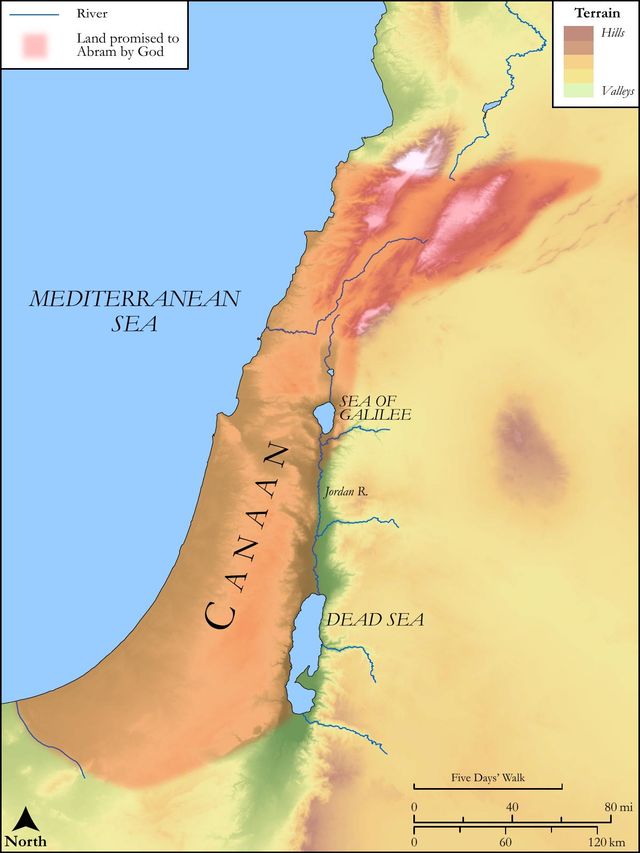
See on the biblical-era maps


Study this verse
Public-domain commentary
Matthew Henry
From his Commentary on the Whole Bible. Henry comments on passages, not single verses — this entry covers Genesis 17:23–27.
We have here Abraham's obedience to the law of circumcision. He himself and all his family were circumcised, so receiving the token of the covenant and distinguishing themselves from other families, that had no part nor lot in the matter. 1. It was an implicit obedience: He did as God had said to him, and did not ask why or wherefore. God's will was not only a law to him, but a reason; he did it because God told him. 2. It was a speedy obedience: In the self-same day, Gen 17:23, Gen 17:26. Sincere obedience is not dilatory, Psa 119:60. While the command is yet sounding in our ears, and the sense of duty is fresh, it is good to apply ourselves to it immediately, lest we deceive ourselves by putting it off to a more convenient season. 3. It was a universal obedience: He did not circumcise his family and excuse himself, but set them an example; nor did he take the comfort of the seal of the covenant to himself only, but desired that all his might share with him in it. This is a good example to masters of families; they and their houses must serve the Lord. Though God's covenant was not established with Ishmael, yet he was circumcised; for children of believing parents, as such, have a right to the privileges of the visible church, and the seals of the covenant, whatever they may prove afterwards. Ishmael is blessed, and therefore circumcised. 4. Abraham did this though much might be objected against it. Though circumcision was painful, - though to grown men it was shameful, - though, while they were sore and unfit for action, their enemies might take advantage against them, as Simeon and Levi did against the Shechemites, - though Abraham was ninety-nine years old, and had been justified and accepted of God long since, - though so strange a thing done religiously might be turned to his reproach by the Canaanite and the Perizzite that dwelt then in the land, - yet God's command was sufficient to answer these and a thousand such objection: what God requires we must do, not conferring with flesh and blood.
Historical interpretation
Three Centuries of Reception
2 surviving comments on this verse. Each one is dated, so this reads as a timeline rather than a list.
Select a marker to jump to its quote. Markers stagger vertically where authors wrote within a few decades of each other.
Learn fully then, children of love, concerning all things, for Abraham, who first circumcised, did so looking forward in the spirit to Jesus and had received the doctrines of the three letters. For it says, “Abraham circumcised from his household eighteen men and three hundred.” What then was the knowledge that was given to him? Notice that he first mentions the eighteen, and after a pause the three hundred. The eighteen is I (= 10) and H (= 8)—you have Jesus—and because the cross was destined to have grace in the T he says “and three hundred.” So he indicates Jesus in the two letters and the cross in the other. He knows this who placed the gift of his teaching in our hearts.
Consider, on the other hand, I ask you, dearly beloved, God’s loving kindness and his unspeakable kindness to us. In that case pain and distress resulted from the action and no benefit came from circumcision, except simply making people recognizable through this sign and separating them from the other peoples. Our circumcision, on the contrary—I mean the grace of baptism—involves a painless medicine and is the means of countless good things for us, filling us with the grace of the Spirit. It has no limited span as in that other case, but rather in early years, in middle age and in the very height of old age can a person receive this circumcision—not the work of human hands—which involves not simply endurance but laying aside sin’s burden and finding pardon for the faults of all time.… The loving God saw the extraordinary degree of our limitations and the fact that we are suffering from incurable diseases and need a lot of care as well as his ineffable love. [Thus] he is in his provision for our salvation granted us the renewal that comes from the bath of rebirth, so that by setting aside the former person—that is, evil deeds—and putting on the new we may advance along the way of virtue.
Continue studying Genesis 17:27 across the web’s major study libraries — every link below opens this exact verse, chapter, or book on the destination site.
Read & Compare
 BibleGatewayThis verse in more than 200 translations and 70 languages.
 Bible.comThe YouVersion reader — hundreds of translations, reading plans, and highlights.
 ESV.orgCrossway's official English Standard Version reader.
 NET BibleThe NET translation with 60,000+ translators' notes on every rendering decision.
 STEP BibleTyndale House's free study tool — original text, vocabulary, and scholarly resources.
 BibliaLogos Bible Software's free web reader.
 USCCBThe New American Bible (Revised Edition) with the U.S. bishops' study notes.
Commentaries
 BibleHub CommentariesDozens of classic commentaries on this verse, gathered on one page.
 StudyLightMore than 100 commentary sets — the largest collection on the web.
 BibleRefPlain-English commentary on what this verse means, verse by verse.
 Enduring WordDavid Guzik's free commentary on this chapter, widely used by Bible teachers.
 Bible Study ToolsVerse commentary alongside Greek and Hebrew study aids.
Original Language & Research
- BibleHub InterlinearThe verse word by word — original language, transliteration, and English.
- BibleHub LexiconEvery word's original-language definition and Strong's entry.
 Blue Letter BibleDeep-study tools — Strong's numbers, concordance, and word studies.
 SefariaThe Hebrew text with Rashi and centuries of Jewish commentary.
Sermons, Hymns & Audio


TrulyRandomVerse is not affiliated with these sites and doesn’t control their content. They’re linked because they’re genuinely useful.
Summary
Genesis 17:27 powerfully concludes the account of God's covenant with Abraham, detailing Abraham's immediate and comprehensive obedience to the command of circumcision. On the very day the divine instruction was given, Abraham ensured that every male under his authority—whether born within his household or acquired through purchase—received the physical sign of the covenant, thereby demonstrating profound faith, unwavering leadership, and setting apart his entire household unto the Lord as the nascent community of God's chosen people.
Context
ShowHideLiterary Context
Genesis 17:27 serves as the culminating act of obedience in the pivotal covenant chapter of Genesis 17. Immediately preceding this verse, God renews His promises to Abraham, establishing him as the father of many nations and reaffirming the grant of the land of Canaan. Crucially, God institutes circumcision as the perpetual sign of this covenant, detailing its requirements and consequences in Genesis 17:9-14. Verses 23-26 specifically recount Abraham's personal circumcision and that of Ishmael, setting the stage for the broader household's compliance in verse 27. This swift and complete action underscores Abraham's unwavering faith and commitment, providing a powerful narrative resolution to God's command.
Historical & Cultural Context
In the ancient Near East, household structures were expansive, encompassing not only nuclear families but also extended relatives, servants, and slaves. The head of the household, like Abraham, held significant authority and responsibility for all within his domain. Slavery was a common institution, with individuals acquired through birth or purchase forming an integral part of the household economy and social fabric. The practice of marking or branding servants was known, but circumcision, as commanded by God, was unique in its theological significance. This act, performed on the eighth day for infants (though here, on adults), was a profound cultural statement, setting Abraham's household apart from surrounding peoples and signifying their distinct identity and allegiance to Yahweh.
Key Themes
ShowHideGenesis 17:27 significantly contributes to several overarching themes in Genesis and the broader biblical narrative. It highlights the theme of Covenant Faithfulness, demonstrating Abraham's immediate response to God's specific command, which is a hallmark of his walk with God (Genesis 12:4). The verse also emphasizes Household Theology, showing that God's covenant extended beyond Abraham himself to encompass the entire community under his authority, establishing a pattern for the inclusion of others into God's people. Furthermore, it underscores the theme of Divine Initiative and Human Response, where God graciously establishes the covenant, and humanity is called to respond in obedience. This act of circumcision physically manifests the theme of Separation and Holiness, marking Abraham's lineage as distinct and set apart for God's redemptive purposes, laying the groundwork for the formation of a holy nation, as promised in Genesis 12:2.
Exposition and Analysis
ShowHideGenesis 17:27 reads: "And all the men of his house, born in the house, and bought with money of the stranger, were circumcised with him." This verse details the scope and immediacy of Abraham's obedience to God's covenant command.
Key Word Analysis
ShowHideThis term (H582) refers to a mortal man in general, often used collectively. Its use here emphasizes that the command for circumcision applied to every male individual within Abraham's sphere of influence, regardless of their status or origin, underscoring the universal application of the covenant sign within his household.
This word (H1004) is rich in meaning, extending beyond a physical dwelling to encompass the entire household, family, or even a lineage. In this context, "his house" signifies Abraham's extended family unit, including all dependents and servants, highlighting that the covenant was not merely individual but communal, embracing the entire social and familial structure under Abraham's headship.
This primitive root (H4135) means "to cut short" or "to curtail," specifically referring to the removal of the foreskin. This act was the physical sign of the covenant, symbolizing dedication, purification, and the setting apart of God's people. The passive voice "were circumcised" indicates that the action was performed upon them, emphasizing their submission to the divine command through Abraham's leadership.
Verse Breakdown
ShowHide"And all the men of his house"
This phrase emphasizes the comprehensive nature of Abraham's compliance. The covenant sign was not limited to Abraham or his direct biological descendants but extended to every male under his authority and within his household. This highlights the communal aspect of the Abrahamic covenant, where the head of the household represented and acted on behalf of all under his care, bringing them into the visible sign of God's promise.
"born in the house"
This refers to male servants or their children who were born within Abraham's household. They were part of his extended family structure, indicating that even those not related by blood were brought into the covenant community through this sign, signifying their integration and shared identity within Abraham's people.
"and bought with money of the stranger"
This refers to male slaves acquired through purchase, likely from non-Israelite peoples. Their inclusion underscores the principle that anyone who became part of Abraham's household, regardless of their origin, was to be brought under the covenant sign. This demonstrates God's desire for a distinct, set-apart people, even in its nascent stages, transcending immediate familial ties.
"were circumcised with him"
The immediate execution, "the selfsame day" (mentioned in Genesis 17:26), further underscores Abraham's absolute trust and prompt obedience to divine instruction, leaving no room for delay or hesitation. The phrase "with him" signifies that Abraham himself underwent the procedure alongside his entire household, demonstrating leadership by example and shared commitment to the covenant, solidifying the unity of the household in this foundational act of faith.
Literary Devices
ShowHideThe verse employs several literary devices to convey its profound message. Emphasis is achieved through the repeated use of "all" and the specific enumeration of those circumcised ("born in the house, and bought with money of the stranger"), highlighting the comprehensive nature of Abraham's obedience. This serves to underscore the thoroughness of his response to God's command. Symbolism is central, as the physical act of circumcision itself is a powerful symbol of the covenant, representing dedication, cleansing, and the setting apart of a people for God. The inclusion of diverse members of the household also functions as Foreshadowing, subtly hinting at the future universal reach of God's people, which would eventually extend beyond biological lineage to encompass gentiles. The concise, declarative sentence structure also lends itself to a sense of Finality and Authority, affirming the completion of the divine directive.
Theological and Thematic Connections
ShowHideGenesis 17:27 powerfully illustrates the nature of covenant and obedience, serving as a foundational moment in the establishment of God's chosen people. Abraham's immediate and comprehensive response to God's command for circumcision underscores that true faith is not merely intellectual assent but is demonstrated through action and submission to divine will. This physical mark, applied to every male in his household, established a visible and indelible sign of their unique identity and relationship with the Almighty, setting them apart as a distinct people. It reveals God's desire for a community, not just an individual, to bear the marks of His covenant, laying the groundwork for the nation of Israel and foreshadowing the broader, spiritual community of believers in Christ.
Reflection and Application
ShowHideGenesis 17:27 offers timeless lessons for believers today, primarily centered on the nature of obedience and the scope of God's covenant. Abraham's prompt and thorough obedience to God's command serves as a compelling example; our faith is often demonstrated by how quickly and completely we respond to God's revealed will, rather than delaying or questioning. This verse reminds us that true faith is active and encompasses every sphere of our lives and influence. While physical circumcision is no longer a requirement for believers under the New Covenant, the underlying principle of being set apart for God remains paramount. The New Testament emphasizes a spiritual transformation, often called the "circumcision of the heart", which signifies true belonging to God's people through faith in Christ and the work of the Holy Spirit. This spiritual reality, which Romans 4:11 describes as circumcision being a seal of righteousness by faith, is what truly matters. Furthermore, just as Abraham's entire household was included in the covenant sign, the New Covenant embraces all who believe, regardless of background or ethnicity, fulfilling the truth that those who are of faith are Abraham's children, called to live lives of distinct holiness and devotion to God.
Questions for Reflection
ShowHideFAQ
ShowHideWhy was circumcision chosen as the sign of the covenant?
ShowHideCircumcision, the cutting away of flesh, symbolized a cutting off from the old life and a dedication to God. It was a physical, permanent mark that identified the covenant people and served as a constant reminder of their unique relationship with God and their obligation to be holy. It also pointed forward to the spiritual cleansing and new life offered through Christ, as later explained in Deuteronomy 30:6 and Colossians 2:11.
Does "all the men of his house" imply that women were excluded from the covenant?
ShowHideWhile the physical sign of circumcision was for males, women were implicitly included in the covenant through their relationship with the circumcised men of their household (fathers, husbands, sons). The covenant was for the entire community, and women were integral members of that community, sharing in its blessings and responsibilities, even without the physical mark. This is consistent with the understanding of household covenants throughout the Old Testament, where the head of the household represented the entire family unit before God, as seen in passages like Exodus 12:3-4.
How does Abraham's obedience in Genesis 17:27 relate to faith?
ShowHideAbraham's immediate and comprehensive obedience in Genesis 17:27 is a direct demonstration of his faith. True faith is not merely intellectual assent but results in action and submission to God's will. His prompt response shows his trust in God's command, even when it involved a painful and culturally significant act. This active obedience is a hallmark of Abraham's faith, which is commended throughout Scripture, particularly in Romans 4:3 and James 2:21-23.
Christ-Centered Fulfillment
ShowHideGenesis 17:27 and the covenant of circumcision find their ultimate fulfillment in Jesus Christ and the New Covenant. The physical cutting of the flesh, which marked Abraham's household as God's people, foreshadowed the spiritual "circumcision of the heart" that occurs through faith in Christ, where the old sinful nature is "cut away" by the Holy Spirit. As Colossians 2:11-12 explains, believers are "circumcised with a circumcision made without hands, by putting off the body of the flesh, by the circumcision of Christ, having been buried with him in baptism, in which you were also raised with him through faith in the working of God." In Christ, the covenant is no longer bound by ethnicity or physical rite but is open to all who believe, forming a new spiritual household—the Church—where belonging is based on faith in Jesus, making all believers true spiritual descendants of Abraham, regardless of their physical lineage or past, as Galatians 3:28-29 declares, "there is neither Jew nor Greek... And if ye be Christ's, then are ye Abraham's seed, and heirs according to the promise." Thus, the comprehensive inclusion of Abraham's household points to the expansive, global reach of God's redemptive plan in Christ, bringing people from every nation into His family.