


Genesis 14:15
Bible text: King James Version (1769 Blayney text) · Public domain
Bible text: Berean Standard Bible · Public domain
Bible text: American Standard Version (1901) · Public domain
Bible text: World English Bible, Messianic edition · Public domain
Bible text: Geneva Bible (1599) · Public domain
Bible text: Young's Literal Translation · Public domain
- וַיֵּחָלֵקvai·ye·cha·Lekand divided himselfH2505Conj-w ¦ V-Niphal-ConsecImperf-3msVerb Niphal Consecutive Imperfect 3rd Singular Masculineוַandיֵּחָלֵקdivided himself
- עֲלֵיהֶם'a·lei·Hemon themH5921Prep ¦ 3mpPreposition Definiteעֲלֵיonהֶםthem
- לַיְלָהLay·lahnightH3915N-msNoun Singular Masculine Absolute
- הוּאhu'heH1931Pro-3msPronoun Personal 3rd Singular Masculine
- וַעֲבָדָיוva·'a·va·Davand his servantsH5650Conj-w ¦ N-mpc ¦ 3msNoun Plural Masculine Constructוַandעֲבָדָיservantsוhis
- וַיַּכֵּםvai·ya·Kemand he attacked themH5221Conj-w ¦ V-Hiphil-ConsecImperf-3ms ¦ 3mpVerb Hiphil Consecutive Imperfect 3rd Singular Masculineוַandיַּכֵּhe attackedםthem
- וַיִּרְדְּפֵםvai·yir·de·Femand he pursued themH7291Conj-w ¦ V-Qal-ConsecImperf-3ms ¦ 3mpVerb Qal Consecutive Imperfect 3rd Singular Masculineוַandיִּרְדְּפֵhe pursuedםthem
- עַד'adtoH5704PrepPreposition
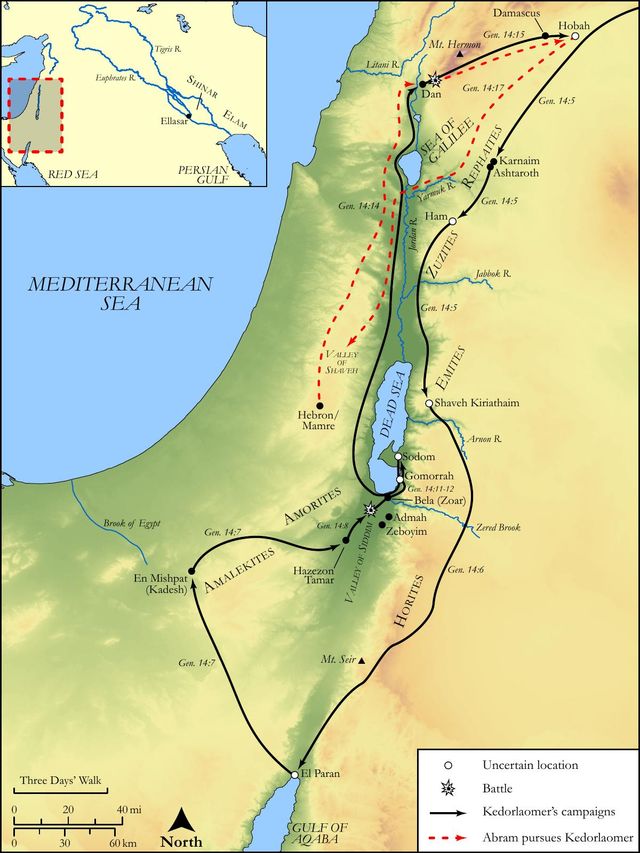
- חוֹבָהcho·VahHobahH2327N-properNoun Proper Location
- אֲשֶׁר'a·SherwhichH834RelParticle Relative
- מִשְּׂמֹאלmi·se·Mol[is] from [the] northH8040Prep-m ¦ N-msNoun Singular Masculine Absoluteמִ[is] fromשְּׂמֹאל[the] north
- לְדַמָּשֶׂקle·da·Ma·sekof DamascusH1834Prep-l ¦ N-properNoun Proper LocationלְofדַמָּשֶׂקDamascus
English is a literal word-by-word gloss of the Hebrew, not the KJV's wording. Why?
This is the original text the KJV's translators worked from — each Hebrew word with its own literal English meaning in this verse, prepared by scholars at Tyndale House, Cambridge. The KJV translates whole sentences, not word by word, so its wording differs: one Hebrew word can become several English words, and the KJV may choose “the LORD” where the gloss reads “Yahweh”. Both are faithful — they answer different questions. For the KJV's own rendering, switch to the KJV text.
Details
See on the biblical-era maps


Study this verse
Public-domain commentary
Matthew Henry
From his Commentary on the Whole Bible. Henry comments on passages, not single verses — this entry covers Genesis 14:13–16. His three-level outline is real structure in the source text, so it is rendered as structure.
We have here an account of the only military action we ever find Abram engaged in, and this he was prompted to, not by his avarice or ambition, but purely by a principle of charity; it was not to enrich himself, but to help his friend. Never was any military expedition undertaken, prosecuted, and finished, more honourably than this of Abram's. Here we have,
I.The tidings brought him of his kinsman's distress.
Providence so ordered it that he now sojourned not far off, that he might be a very present help.
1.He is here called Abram the Hebrew, that is, the son and follower of Heber, in whose family the profession of the true religion was kept up in that degenerate age. Abram herein acted like a Hebrew - in a manner not unworthy of the name and character of a religious professor.
2.The tidings were brought by one that had escaped with his life for a prey. Probably he was a Sodomite, and as bad as the worst of them; yet knowing Abram's relation to Lot, and concern for him, he implores his help, and hopes to speed for Lot's sake. Note, The worst of men, in the day of their trouble, will be glad to claim acquaintance with those that are wise and good, and so get an interest in them. The rich man in hell called Abram Father; and the foolish virgins made court to the wise for a share of their oil.
II.The preparations he made for this expedition.
The cause was plainly good, his call to engage in it was clear, and therefore, with all speed, he armed his trained servants, born in his house, to the number of three hundred and eighteen - a great family, but a small army, about as many as Gideon's that routed the Midianites, Jdg 7:7. He drew out his trained servants, or his catechised servants, not only instructed in the art of war, which was then far short of the perfection which later and worse ages have improved it to, but instructed in the principles of religion; for Abram commanded his household to keep the way of the Lord. This shows that Abram was,
1.A great man, who had so many servants depending upon him, and employed by him, which was not only his strength and honour, but gave him a great opportunity of doing good, which is all that is truly valuable and desirable in great places and great estates.
2.A good man, who not only served God himself, but instructed all about him in the service of God. Note, Those that have great families have not only many bodies, but many souls besides their own, to take care of and provide for. Those that would be found the followers of Abram must see that their servants be catechised servants.
3.A wise man for, though he was a man of peace, yet he disciplined his servants for war, not knowing what occasion he might have, some time or other, so to employ them. Note, Though our holy religion teaches us to be for peace, yet it does not forbid us to provide for war.
III.His allies and confederates in this expedition.
He prevailed with his neighbours, Aner, Eshcol, and Mamre (with whom he kept up a fair correspondence) to go along with him. It was his prudence thus to strengthen his own troops with their auxiliary forces; and probably they saw themselves concerned, in interest, to act, as they could, against this formidable power, lest their own turn should be next. Note,
1.It is our wisdom and duty to behave ourselves so respectfully and obligingly towards all men as that, whenever there is occasion, they may be willing and ready to do us a kindness.
2.Those who depend on God's help, yet, in times of distress, ought to make use of men's help, as Providence offers it; else they tempt God.
IV.His courage and conduct were very remarkable.
1.There was a great deal of bravery in the enterprise itself, considering the disadvantages he lay under. What could one family of husbandmen and shepherds do against the armies of four princes, who now came fresh from blood and victory? It was not a vanquished, but a victorious army, that he was to pursue; nor was he constrained by necessity to this daring attempt, but moved to it by generosity; so that, all things considered, it was, for aught I know, as great an instance of true courage as ever Alexander or Caesar was celebrated for. Note, Religion tends to make men, not cowardly, but truly valiant. The righteous is bold as a lion. The true Christian is the true hero.
2.There was a great deal of policy in the management of it. Abram was no stranger to the stratagems of war: He divided himself, as Gideon did his little army (Jdg 7:16), that he might come upon the enemy from several quarters at once, and so make his few seem a great many; he made his attack by night, that he might surprise them. Note, Honest policy is a good friend both to our safety and to our usefulness. The serpent's head (provided it be nothing akin to the old serpent) may well become a good Christian's body, especially if it have a dove's eye in it, Mat 10:16.
V.His success was very considerable, Gen 14:15, Gen 14:16.
He defeated his enemies, and rescued his friends; and we do not find that he sustained any loss. Note, Those that venture in a good cause, with a good heart, are under the special protection of a good God, and have reason to hope for a good issue. Again, It is all one with the Lord to save by many or by few, Sa1 14:6. Observe,
1.He rescued his kinsman; twice here he is called his brother Lot. The remembrance of the relation that was between them, both by nature and grace, made him forget the little quarrel that had been between them, in which Lot had by no means acted well towards Abram. Justly might Abram have upbraided Lot with his folly in quarrelling with him and removing from him, and have told him that he was well enough served, he might have known when he was well off; but, in the charitable breast of pious Abram, it is all forgiven and forgotten, and he takes this opportunity to give a real proof of the sincerity of his reconciliation. Note,
(1.)We ought to be ready, whenever it is in the power of our hands, to succour and relieve those that are in distress, especially our relations and friends. A brother is born for adversity, Pro 17:17. A friend in need is a friend indeed.
(2.)Though others have been wanting in their duty to us, yet we must not therefore deny our duty to them. Some have said that they can more easily forgive their enemies than their friends; but we shall see ourselves obliged to forgive both if we consider, not only that our God, when we were enemies, reconciled us, but also that he passeth by the transgression of the remnant of his heritage, Mic 7:18.
2.He rescued the rest of the captives, for Lot's sake, though they were strangers to him and such as he was under no obligation to at all; nay, though they were Sodomites, sinners before the Lord exceedingly, and though, probably, he might have recovered Lot alone by ransom, yet he brought back all the women, and the people, and their goods, Gen 14:16. Note, As we have opportunity we must do good to all men. Our charity must be extensive, as opportunity offers itself. Wherever God gives life, we must not grudge the help we can give to support it. God does good to the just and unjust, and so must we, Mat 5:45. This victory which Abram obtained over the kings the prophet seems to refer to, Isa 41:2, Who raised up the righteous man from the east, and made him rule over kings? And some suggest that, as before he had a title to this land by grant, so now by conquest.
Historical interpretation
Three Centuries of Reception
2 surviving comments on this verse. Each one is dated, so this reads as a timeline rather than a list.
Select a marker to jump to its quote. Markers stagger vertically where authors wrote within a few decades of each other.
“Abraham counted 318 servants, born in his house … as far as Hobah, which is to the right of Damascus.” Even the number is of vital importance. For in that number there is life, if we believe in the passion in the name of the Lord Jesus. In fact, this is the interpretation of the above-mentioned name, Hobah, that is, “life.” Appropriately too it is said that Hobah is located to the right of Damascus. For the sheep stand on the right, while the goats are on the left. The trained mind knows how many soldiers to choose to finish the battle, with what arms to supply them, with what banners to lead them. It does not lead its forces with images of eagles or dragons, but it marches into battle with the cross of Christ and in the name of Jesus, deriving courage from this sign, loyal to this banner. Rightly then is that mind called trained which has received the true wisdom of the just man. And justice is quick to correct, and by admonishing it calls back sinners, it stems the assaults of the passions.
And he pursued them as far as Dan, and having divided his companions, he fell upon them at night and struck them, and pursued them as far as Hobah, which is to the left of Damascus. The entire series of sacred scripture is full of mystic figures, and not only in what is said and done, but even in the very places and times where these things take place, it agrees with that apostolic saying, "For all these things happened to them as examples, and they were written for our admonition" (1 Cor. 10:11). Dan is interpreted as Judgment, Hobah as Condemnation, Damascus as the Cup of Blood. Therefore, Abraham, pursuing his enemies, found them in Dan and struck them by night when they were unsuspecting and secure, those who were rejoicing as if with captured prey, boasting that they had raged up to that point; for all sinners and those exalting themselves in the riches of this life and in the oppression of the innocent are permitted to boast up to the brink of divine judgment about their works; but with imprudent blindness, as if set in the midst of the night, when they say peace and safety, then sudden destruction will come upon them: hence it is well said that he struck them and pursued them to Hobah, that is, Condemnation, which is understood to mean no other condemnation than sudden and eternal destruction. It is said, he says, 'to the left of Damascus.' Damascus, as we have said, is interpreted as the Cup of Blood; by which name the delight of vices is rightly signified. For what is the delight of sin but a cup of blood, when one strives to fulfill the desires of the flesh and blood without any hesitation? And Hobah is where Abraham struck his adversaries, to the left of Damascus, because the condemnation that is going to punish the impious will thrust them into eternal punishment with the devil and his angels, which is usually designated by the left. However, Damascus is a noble city of Phoenicia and formerly the metropolis of all Syria. Dan was also a town of Phoenicia, the boundary of the province of Judea towards the north where today is Paneas, which was formerly called Caesarea Philippi; from where also the Jordan derived its name, which flows from Lebanon. For Dan is one of its sources; the other is called Jor, which is interpreted as Stream. Therefore, with the two sources not far from each other united into one stream, it is thenceforth called the Jordan.
Continue studying Genesis 14:15 across the web’s major study libraries — every link below opens this exact verse, chapter, or book on the destination site.
Read & Compare
 BibleGatewayThis verse in more than 200 translations and 70 languages.
 Bible.comThe YouVersion reader — hundreds of translations, reading plans, and highlights.
 ESV.orgCrossway's official English Standard Version reader.
 NET BibleThe NET translation with 60,000+ translators' notes on every rendering decision.
 STEP BibleTyndale House's free study tool — original text, vocabulary, and scholarly resources.
 BibliaLogos Bible Software's free web reader.
 USCCBThe New American Bible (Revised Edition) with the U.S. bishops' study notes.
Commentaries
 BibleHub CommentariesDozens of classic commentaries on this verse, gathered on one page.
 StudyLightMore than 100 commentary sets — the largest collection on the web.
 BibleRefPlain-English commentary on what this verse means, verse by verse.
 Enduring WordDavid Guzik's free commentary on this chapter, widely used by Bible teachers.
 Bible Study ToolsVerse commentary alongside Greek and Hebrew study aids.
Original Language & Research
- BibleHub InterlinearThe verse word by word — original language, transliteration, and English.
- BibleHub LexiconEvery word's original-language definition and Strong's entry.
 Blue Letter BibleDeep-study tools — Strong's numbers, concordance, and word studies.
 SefariaThe Hebrew text with Rashi and centuries of Jewish commentary.
Sermons, Hymns & Audio


TrulyRandomVerse is not affiliated with these sites and doesn’t control their content. They’re linked because they’re genuinely useful.
Summary
Genesis 14:15 vividly recounts Abram's audacious and strategically brilliant night assault against the coalition of eastern kings who had abducted his nephew Lot. By dividing his forces and striking under the cover of darkness, Abram and his trained household servants achieved a decisive victory, routing the enemy and pursuing them relentlessly northward to Hobah, near Damascus. This pivotal event underscores Abram's military prowess, his unwavering loyalty, and the providential success that attended his mission to rescue Lot and recover the plundered goods.
Context
ShowHideLiterary Context
Genesis 14 stands as a unique narrative within the patriarchal history, detailing Abram's singular involvement in military conflict. The preceding verses establish the backdrop: a major regional war between the eastern kings (led by Chedorlaomer) and the rebellious city-states of the Jordan Valley, including Sodom and Gomorrah. Following the defeat of the Jordan Valley kings, Lot, Abram's nephew, who had settled in Sodom, was captured along with his possessions (Genesis 14:11-12). Upon learning of Lot's plight from an escapee (Genesis 14:13), Abram immediately mobilized his 318 trained servants, born in his household, to pursue the victorious kings. Verse 15 describes the climax of this pursuit, showcasing Abram's tactical genius and the swift, overwhelming defeat of a seemingly superior enemy, setting the stage for his encounter with Melchizedek in the subsequent verses (Genesis 14:18-20).
Historical & Cultural Context
In the days of the patriarchs, tribal leaders like Abram often maintained a retinue of armed servants capable of defending their households and interests. While Abram is primarily depicted as a nomadic shepherd, this passage reveals a lesser-known aspect of his leadership: his capacity as a military commander. The "kings" mentioned were likely rulers of city-states or tribal confederations, and their conflicts were common for control over trade routes, resources, and tribute. Night attacks, though risky, were a recognized military tactic, often employed to achieve surprise against a complacent or weary foe. The pursuit "unto Hobah, which is on the left hand of Damascus" highlights the vast distances covered in such campaigns and the thoroughness required to recover captives and spoils. Damascus itself was an ancient and significant city, serving as a major hub in the Levant, indicating the far northern reach of this engagement.
Key Themes
ShowHideThis verse contributes significantly to several overarching themes in Genesis and the broader biblical narrative. It highlights Abram's character as a man of courageous action and unwavering loyalty to his family, even when it means personal risk. It subtly introduces the theme of divine enablement and blessing, as Abram's victory against a formidable force hints at God's protective hand, even before explicit divine intervention is mentioned in this specific verse. The rescue of Lot also foreshadows God's broader work of redemption and liberation for His people. Furthermore, Abram's refusal of the spoils from the King of Sodom later in the chapter (Genesis 14:22-23) underscores the theme of trust in God's provision over worldly gain, reinforcing his unique faith.
Exposition and Analysis
ShowHideKey Word Analysis
ShowHideA primitive root meaning "to be smooth," but by implication "to apportion or separate." In this military context, it signifies a strategic splitting of forces, likely into multiple companies or attack groups, to launch a multi-pronged or surprise assault. This tactical maneuver was crucial for Abram's success against a presumably larger and victorious enemy.
A primitive root meaning "to strike (lightly or severely, literally or figuratively)." Here, it conveys a decisive and powerful blow, indicating a thorough defeat and rout of the enemy rather than a mere skirmish. The completeness of the victory is emphasized by this strong verb.
A primitive word referring to the "left hand" or "left side." In Hebrew geographical orientation, one typically faced east (towards the rising sun). Therefore, "on the left hand of Damascus" indicates a location to the north or northwest of the city of Damascus, emphasizing the extensive distance Abram pursued the fleeing kings.
Verse Breakdown
ShowHide"And he divided himself against them, he and his servants, by night"
This phrase reveals Abram's brilliant military strategy. Instead of a frontal assault, he split his forces, likely surrounding the enemy camp under the cover of darkness. This unexpected night attack, executed by Abram himself alongside his trained household servants, would have created confusion and panic among the complacent, victorious kings, who were likely resting after their earlier conquests. The element of surprise was paramount to his success.
"and smote them, and pursued them unto Hobah"
The immediate result of the night assault was a decisive defeat. "Smote them" indicates a complete rout, not just a minor skirmish. Abram and his men then engaged in a relentless pursuit, driving the fleeing kings far from the battleground. Hobah, a place in Syria, signifies the great distance and thoroughness of Abram's victory, ensuring the enemy was completely dispersed and no counter-attack was possible.
"which [is] on the left hand of Damascus"
This geographical marker provides a clear indication of Hobah's location relative to the prominent city of Damascus. From an observer facing east, "on the left hand" points northward. This detail underscores the extraordinary reach of Abram's pursuit, extending deep into what is now modern Syria, confirming the absolute nature of his triumph and the recovery of all that was taken.
Literary Devices
ShowHideGenesis 14:15 employs several literary devices to enhance its narrative impact. The use of Conciseness allows the verse to convey a complex military operation with remarkable brevity, focusing on the decisive actions and their outcome. Action Verbs like "divided," "smote," and "pursued" create a sense of rapid, relentless movement and highlight Abram's proactive and effective leadership. The phrase "by night" functions as a crucial element of Setting and Tactical Detail, emphasizing the element of surprise and the strategic acumen of Abram. Finally, the precise Geographical Detail "unto Hobah, which is on the left hand of Damascus" grounds the narrative in a tangible reality, attesting to the historical veracity of the account and the extraordinary extent of Abram's pursuit.
Theological and Thematic Connections
ShowHideAbram's decisive victory in Genesis 14:15, while seemingly a purely military achievement, carries profound theological implications. It serves as an early demonstration of God's implicit favor and protective hand upon Abram, even before an explicit divine command or intervention is recorded in this specific battle. Abram, a man of faith, acts with courage and strategic wisdom, and his success against a formidable coalition strongly implies divine enablement. This episode reinforces the theme that God often works through His faithful servants, empowering them to overcome seemingly insurmountable odds, not through passive waiting, but through courageous, Spirit-led action. It also highlights Abram's role as a rescuer, foreshadowing a greater rescue to come.
Reflection and Application
ShowHideGenesis 14:15 offers powerful lessons for believers navigating the challenges of life. Abram's swift and decisive action, driven by loyalty to his family, reminds us that faith is not passive but often calls for courageous engagement with the difficulties we face. His strategic use of the night and division of forces illustrate the importance of combining spiritual reliance with practical wisdom and intelligent planning. We are called to be proactive in addressing injustice and protecting the vulnerable, rather than succumbing to despair or inaction. Furthermore, the extraordinary outcome of Abram's mission, against seemingly overwhelming odds, serves as a powerful reminder that when we act in faith and obedience, God can empower us to achieve victories that far surpass our natural abilities. This account encourages us to trust in God's enabling power, even when the "enemy" seems stronger, and to act with both spiritual conviction and practical discernment.
Questions for Reflection
ShowHideFAQ
ShowHideWhat does "on the left hand of Damascus" mean geographically?
ShowHideFrom the Hebrew perspective, geographical orientation typically involved facing east, towards the rising sun. In this orientation, one's left hand would point northward. Therefore, "Hobah, which is on the left hand of Damascus" precisely indicates a location to the north or northwest of the prominent city of Damascus. This detail emphasizes the great distance Abram pursued the kings, demonstrating the thoroughness and completeness of his victory and the extent of the enemy's rout.
Does Abram's military action contradict his identity as a man of peace and faith?
ShowHideNo, Abram's military action in Genesis 14 does not contradict his identity as a man of peace and faith; rather, it reveals another dimension of his character and calling. His action was not a conquest for personal gain, territory, or expansion of power, but a righteous rescue mission driven by loyalty to his family (his nephew Lot) and a response to an act of aggression and injustice. Abram's subsequent refusal of the spoils from the King of Sodom (Genesis 14:22-23) further underscores that his motivation was not greed but the liberation of the captives and the vindication of the innocent. This aligns perfectly with his character as a man who trusts God for his provision and acts with integrity, even when engaging in necessary conflict.
Christ-Centered Fulfillment
ShowHideAbram's courageous and strategic rescue of Lot in Genesis 14:15 serves as a profound type, or foreshadowing, of Christ's ultimate redemptive work. Just as Abram, leading his trained household, pursued and decisively defeated a powerful enemy to liberate his captive nephew, so too does Christ, the greater Son of Abraham, enter the domain of sin and death to decisively defeat the spiritual enemies that hold humanity captive. His victory on the cross and resurrection is the ultimate "night attack" against the forces of darkness, securing the liberation of all who are His. Abram's act of rescue, driven by loyalty and love, prefigures Christ's perfect love and self-sacrifice (John 15:13) that redeems us from the dominion of sin and death (Colossians 1:13-14), bringing us into the freedom and light of God's kingdom (Ephesians 2:4-6). Like Abram's pursuit to Hobah, Christ's victory is complete and far-reaching, ensuring the total defeat of our spiritual adversaries and the full recovery of those held captive by sin.