


Genesis 14:16
- וַיָּשֶׁבvai·Ya·shevand he brought backH7725Conj-w ¦ V-Hiphil-ConsecImperf-3msVerb Hiphil Consecutive Imperfect 3rd Singular Masculineוַandיָּשֶׁבhe brought back
- אֵת'et<obj.>H853DirObjMParticle Object Indicator
- כָּלkolallH3605N-mscNoun Singular Masculine Construct
- הָרְכֻשׁha·re·Khushthe possession[s]H7399Art ¦ N-msNoun Singular Masculine Absoluteהָtheרְכֻשׁpossession[s]
- וְגַםve·Gamand alsoH1571Conj-w ¦ AdvAdverbוְandגַםalso
- אֶת'et<obj.>H853DirObjMParticle Object Indicator
- לוֹטLotLotH3876N-proper-mNoun Proper Masculine
- אָחִיו'a·Chivhis relativeH251N-msc ¦ 3msNoun Singular Masculine Constructאָחִיrelativeוhis
- וּרְכֻשׁוֹu·re·khu·Shoand his possession[s]H7399Conj-w ¦ N-msc ¦ 3msNoun Singular Masculine Constructוּandרְכֻשׁpossession[s]וֹhis
- הֵשִׁיבhe·Shivhe brought backH7725V-Hiphil-Perf-3msVerb Hiphil Perfect 3rd Singular Masculine
- וְגַםve·Gamand alsoH1571Conj-w ¦ AdvAdverbוְandגַםalso
- אֶת'et<obj.>H853DirObjMParticle Object Indicator
- הַנָּשִׁיםha·na·Shimthe womenH802Art ¦ N-mpNoun Plural Masculine Absoluteהַtheנָּשִׁיםwomen
- וְאֶתve·'Etand <obj.>H853Conj-w ¦ DirObjMParticle Object Indicatorוְandאֶת<obj.>
- הָעָםha·'Amthe peopleH5971Art ¦ N-msNoun Singular Masculine Absoluteהָtheעָםpeople
English is a literal word-by-word gloss of the Hebrew, not the KJV's wording. Why?
This is the original text the KJV's translators worked from — each Hebrew word with its own literal English meaning in this verse, prepared by scholars at Tyndale House, Cambridge. The KJV translates whole sentences, not word by word, so its wording differs: one Hebrew word can become several English words, and the KJV may choose “the LORD” where the gloss reads “Yahweh”. Both are faithful — they answer different questions. For the KJV's own rendering, switch to the KJV text.
Details
See on the biblical-era map


Study this verse
Public-domain commentary
Matthew Henry
From his Commentary on the Whole Bible. Henry comments on passages, not single verses — this entry covers Genesis 14:13–16. His three-level outline is real structure in the source text, so it is rendered as structure.
We have here an account of the only military action we ever find Abram engaged in, and this he was prompted to, not by his avarice or ambition, but purely by a principle of charity; it was not to enrich himself, but to help his friend. Never was any military expedition undertaken, prosecuted, and finished, more honourably than this of Abram's. Here we have,
I.The tidings brought him of his kinsman's distress.
Providence so ordered it that he now sojourned not far off, that he might be a very present help.
1.He is here called Abram the Hebrew, that is, the son and follower of Heber, in whose family the profession of the true religion was kept up in that degenerate age. Abram herein acted like a Hebrew - in a manner not unworthy of the name and character of a religious professor.
2.The tidings were brought by one that had escaped with his life for a prey. Probably he was a Sodomite, and as bad as the worst of them; yet knowing Abram's relation to Lot, and concern for him, he implores his help, and hopes to speed for Lot's sake. Note, The worst of men, in the day of their trouble, will be glad to claim acquaintance with those that are wise and good, and so get an interest in them. The rich man in hell called Abram Father; and the foolish virgins made court to the wise for a share of their oil.
II.The preparations he made for this expedition.
The cause was plainly good, his call to engage in it was clear, and therefore, with all speed, he armed his trained servants, born in his house, to the number of three hundred and eighteen - a great family, but a small army, about as many as Gideon's that routed the Midianites, Jdg 7:7. He drew out his trained servants, or his catechised servants, not only instructed in the art of war, which was then far short of the perfection which later and worse ages have improved it to, but instructed in the principles of religion; for Abram commanded his household to keep the way of the Lord. This shows that Abram was,
1.A great man, who had so many servants depending upon him, and employed by him, which was not only his strength and honour, but gave him a great opportunity of doing good, which is all that is truly valuable and desirable in great places and great estates.
2.A good man, who not only served God himself, but instructed all about him in the service of God. Note, Those that have great families have not only many bodies, but many souls besides their own, to take care of and provide for. Those that would be found the followers of Abram must see that their servants be catechised servants.
3.A wise man for, though he was a man of peace, yet he disciplined his servants for war, not knowing what occasion he might have, some time or other, so to employ them. Note, Though our holy religion teaches us to be for peace, yet it does not forbid us to provide for war.
III.His allies and confederates in this expedition.
He prevailed with his neighbours, Aner, Eshcol, and Mamre (with whom he kept up a fair correspondence) to go along with him. It was his prudence thus to strengthen his own troops with their auxiliary forces; and probably they saw themselves concerned, in interest, to act, as they could, against this formidable power, lest their own turn should be next. Note,
1.It is our wisdom and duty to behave ourselves so respectfully and obligingly towards all men as that, whenever there is occasion, they may be willing and ready to do us a kindness.
2.Those who depend on God's help, yet, in times of distress, ought to make use of men's help, as Providence offers it; else they tempt God.
IV.His courage and conduct were very remarkable.
1.There was a great deal of bravery in the enterprise itself, considering the disadvantages he lay under. What could one family of husbandmen and shepherds do against the armies of four princes, who now came fresh from blood and victory? It was not a vanquished, but a victorious army, that he was to pursue; nor was he constrained by necessity to this daring attempt, but moved to it by generosity; so that, all things considered, it was, for aught I know, as great an instance of true courage as ever Alexander or Caesar was celebrated for. Note, Religion tends to make men, not cowardly, but truly valiant. The righteous is bold as a lion. The true Christian is the true hero.
2.There was a great deal of policy in the management of it. Abram was no stranger to the stratagems of war: He divided himself, as Gideon did his little army (Jdg 7:16), that he might come upon the enemy from several quarters at once, and so make his few seem a great many; he made his attack by night, that he might surprise them. Note, Honest policy is a good friend both to our safety and to our usefulness. The serpent's head (provided it be nothing akin to the old serpent) may well become a good Christian's body, especially if it have a dove's eye in it, Mat 10:16.
V.His success was very considerable, Gen 14:15, Gen 14:16.
He defeated his enemies, and rescued his friends; and we do not find that he sustained any loss. Note, Those that venture in a good cause, with a good heart, are under the special protection of a good God, and have reason to hope for a good issue. Again, It is all one with the Lord to save by many or by few, Sa1 14:6. Observe,
1.He rescued his kinsman; twice here he is called his brother Lot. The remembrance of the relation that was between them, both by nature and grace, made him forget the little quarrel that had been between them, in which Lot had by no means acted well towards Abram. Justly might Abram have upbraided Lot with his folly in quarrelling with him and removing from him, and have told him that he was well enough served, he might have known when he was well off; but, in the charitable breast of pious Abram, it is all forgiven and forgotten, and he takes this opportunity to give a real proof of the sincerity of his reconciliation. Note,
(1.)We ought to be ready, whenever it is in the power of our hands, to succour and relieve those that are in distress, especially our relations and friends. A brother is born for adversity, Pro 17:17. A friend in need is a friend indeed.
(2.)Though others have been wanting in their duty to us, yet we must not therefore deny our duty to them. Some have said that they can more easily forgive their enemies than their friends; but we shall see ourselves obliged to forgive both if we consider, not only that our God, when we were enemies, reconciled us, but also that he passeth by the transgression of the remnant of his heritage, Mic 7:18.
2.He rescued the rest of the captives, for Lot's sake, though they were strangers to him and such as he was under no obligation to at all; nay, though they were Sodomites, sinners before the Lord exceedingly, and though, probably, he might have recovered Lot alone by ransom, yet he brought back all the women, and the people, and their goods, Gen 14:16. Note, As we have opportunity we must do good to all men. Our charity must be extensive, as opportunity offers itself. Wherever God gives life, we must not grudge the help we can give to support it. God does good to the just and unjust, and so must we, Mat 5:45. This victory which Abram obtained over the kings the prophet seems to refer to, Isa 41:2, Who raised up the righteous man from the east, and made him rule over kings? And some suggest that, as before he had a title to this land by grant, so now by conquest.
Historical interpretation
Historical reception
2 surviving comments on this verse. Each one is dated, so this reads as a timeline rather than a list.
Select a marker to jump to its quote. Markers stagger vertically where authors wrote within a few decades of each other.
“Abraham also recovered the goods.” … This certainly does not refer to patrimony but to the vital goods of the soul, where the truly valuable riches—not straw, not hay—are to be found, where there is a reliable splendor of eloquence that contains the substance of our hope. These are indeed our true goods, that is, wisdom that abounds in riches; these are the goods that do not perish. Bodily enjoyment and the use of external goods, on the other hand, are of short, not of long, duration. This is why some people rightly regard it as improper to speak of inherited substance. In fact, inheritance is not the basis of our subsistence, since even people who lack money do not, however, lack the substance of life.
Why was it, someone may ask, that he called up retainers of his own household to the number of 318? For you to learn that he did not simply take everyone but only retainers of his own household, men raised by Lot, so that they might wreak their vengeance with much relish, like men entering this conflict for their own lord. “He fell upon them by night,” the text says, “himself and his retainers, and continued to strike and pursue them.” It was, you see, a hand from on high that joined in the attack and assisted in directing the battle. Hence they had no need of weapons or fighting machines. Instead, he had only to heave into sight with his retainers to smite some and cause others to take to flight, doing both in complete security without harassment from anyone. And he recovered the cavalry of the king of Sodom, his nephew Lot, all his accoutrements and the women. Do you see why it was permitted that while the others fled Lot alone should be taken captive? For two reasons: so that the patriarch’s virtue should become manifest and that on his account many others also might find deliverance. Then he returns bearing a great prize of distinction, Lot, and parading as well as him the cavalry, women and accoutrements. [He] announces in a clear voice and proclaims more loudly than any trumpet that it was not by human power nor by force of numbers that he had won the prize and achieved victory but had done everything with aid from on high.
Continue studying Genesis 14:16 across the web’s major study libraries — every link below opens this exact verse, chapter, or book on the destination site.
Read & Compare
 BibleGatewayThis verse in more than 200 translations and 70 languages.
 Bible.comThe YouVersion reader — hundreds of translations, reading plans, and highlights.
 ESV.orgCrossway's official English Standard Version reader.
 NET BibleThe NET translation with 60,000+ translators' notes on every rendering decision.
 STEP BibleTyndale House's free study tool — original text, vocabulary, and scholarly resources.
 BibliaLogos Bible Software's free web reader.
 USCCBThe New American Bible (Revised Edition) with the U.S. bishops' study notes.
Commentaries
 BibleHub CommentariesDozens of classic commentaries on this verse, gathered on one page.
 StudyLightMore than 100 commentary sets — the largest collection on the web.
 BibleRefPlain-English commentary on what this verse means, verse by verse.
 Enduring WordDavid Guzik's free commentary on this chapter, widely used by Bible teachers.
 Bible Study ToolsVerse commentary alongside Greek and Hebrew study aids.
Original Language & Research
- BibleHub InterlinearThe verse word by word — original language, transliteration, and English.
- BibleHub LexiconEvery word's original-language definition and Strong's entry.
 Blue Letter BibleDeep-study tools — Strong's numbers, concordance, and word studies.
 SefariaThe Hebrew text with Rashi and centuries of Jewish commentary.
Sermons, Hymns & Audio


TrulyRandomVerse is not affiliated with these sites and doesn’t control their content. They’re linked because they’re genuinely useful.
Summary
Genesis 14:16 marks the triumphant climax of Abram's audacious pursuit, meticulously detailing his complete and successful recovery of all that was plundered during the War of the Kings. This verse specifically highlights the comprehensive restoration of his nephew Lot, along with all Lot's possessions, the women, and the people who had been captured from Sodom and Gomorrah, unequivocally underscoring the totality and divine enablement of Abram's victory.
Context
ShowHideLiterary Context
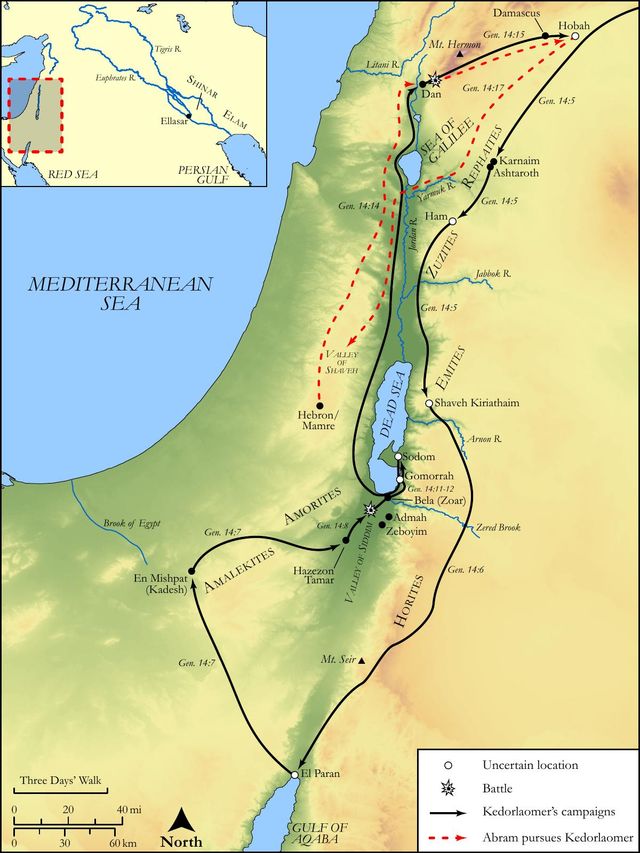
This verse serves as the decisive resolution to the preceding narrative of the War of the Kings in Genesis 14. Following the defeat of the kings of Sodom and Gomorrah by Chedorlaomer and his allies, Lot, who had chosen to settle near Sodom (Genesis 13-10-11), was captured. Upon hearing this dire news, Abram, demonstrating remarkable courage and strategic acumen, immediately mobilized his 318 trained household servants. He pursued the formidable coalition of kings all the way to Dan, orchestrating a surprise night attack that routed them. Genesis 14:16 then succinctly, yet powerfully, summarizes the comprehensive outcome of this daring rescue mission, confirming that nothing was left behind, thus paving the way for his significant encounter with Melchizedek in the subsequent verses (Genesis 14-18-20).
Historical & Cultural Context
In the ancient Near East, warfare was a brutal reality, often resulting in the complete subjugation, plunder, and enslavement of the defeated. The practice of taking "goods," "women," and "people" as spoils of war was common and devastating. Abram's ability to muster 318 trained men reflects the significant size and strength of his household, indicating his considerable wealth and influence as a tribal leader. His pursuit of a victorious coalition of kings was an extraordinary act, defying conventional military wisdom. Furthermore, the strong bonds of kinship were paramount in this culture; Abram's willingness to risk everything for his nephew Lot, despite their earlier separation (Genesis 13-7-9), underscores the deep responsibility felt within family units and the expectation of a kinsman-redeemer.
Key Themes
ShowHideGenesis 14:16 contributes significantly to several overarching themes within the book of Genesis and the broader biblical narrative. It highlights the theme of Divine Protection and Provision for Abram, demonstrating God's continued faithfulness to His covenant promises even in the face of military conflict. Abram's victory, against overwhelming odds, implicitly points to God's hand enabling his servant. The verse also underscores the theme of Redemption and Restoration, as Abram acts as a human agent of recovery, bringing back what was lost and enslaved. This foreshadows God's ultimate plan for the redemption of humanity and creation. Finally, Abram's decisive action and unwavering loyalty to Lot, despite Lot's questionable choices, exemplifies themes of Righteousness and Intercession, showcasing a righteous leader who acts justly and selflessly on behalf of the vulnerable.
Exposition and Analysis
ShowHideKey Word Analysis
ShowHideA primitive root meaning "to turn back (hence, away) transitively or intransitively, literally or figuratively (not necessarily with the idea of return to the starting point); generally to retreat; often adverbial, again." In this context, shûwb signifies a complete and successful restoration, emphasizing that Abram not only defeated the enemy but meticulously ensured the return of all stolen property and captured individuals to their rightful place. The repetition of this verb ("brought back," "brought again") underscores the thoroughness of the recovery.
Meaning "property (as gathered); good, riches, substance." This term refers to the material possessions, livestock, and wealth that were plundered. Its inclusion highlights the economic devastation inflicted by the invading kings and the comprehensive material recovery achieved by Abram, demonstrating that the rescue was not just personal but also economic.
Meaning "a people (as a congregated unit); specifically, a tribe (as those of Israel); hence (collectively) troops or attendants; figuratively, a flock; folk, men, nation, people." This word denotes the general populace, the inhabitants of Sodom and Gomorrah who were taken captive. Its inclusion alongside "women" emphasizes the rescue of the entire community, not just the prominent figures or their immediate families, showcasing the broad scope of Abram's humanitarian intervention.
Verse Breakdown
ShowHide"And he brought back all the goods"
This opening clause immediately establishes the comprehensive nature of Abram's victory. The phrase "all the goods" (כָּל־הָרְכֻשׁ, kol-hārekûsh) signifies that every item of value, every piece of property plundered by the Eastern kings, was recovered. This was not a partial success but a total reversal of the enemy's gains, underscoring the effectiveness and divine favor upon Abram's military action.
"and also brought again his brother Lot, and his goods"
This part of the verse shifts focus from the general plunder to the specific and personal recovery of Abram's kinsman, Lot. The repetition of the verb "brought again" (וַיָּשֶׁב, vayyashēv) emphasizes the deliberate act of restoration. The inclusion of "his goods" alongside Lot himself highlights that Lot's personal wealth, which was part of the initial plunder, was also fully restored, ensuring his livelihood and status were re-established. This demonstrates Abram's deep familial loyalty and commitment to Lot's well-being.
"and the women also, and the people"
This final phrase broadens the scope of the rescue to include the wider community of captives from Sodom and Gomorrah. "The women" (וְאֶת־הַנָּשִׁים, wə'et-hannāšîm) are specifically mentioned, highlighting their particular vulnerability in ancient warfare. "And the people" (וְאֶת־הָעָם, wə'et-hā‘ām) refers to the general populace, emphasizing that Abram's intervention extended beyond his immediate family to liberate a multitude of individuals who had been enslaved. This comprehensive list underscores the immense scale of the rescue and the totality of the restoration achieved, leaving no one behind.
Literary Devices
ShowHideThe verse employs several effective literary devices. Repetition is evident in the double use of the verb "brought back" (or "brought again"), which powerfully emphasizes the thoroughness and completeness of Abram's recovery mission. This repetition reinforces the idea that nothing was left behind and that the victory was absolute. Furthermore, the verse utilizes Enumeration through its detailed listing of the recovered items and individuals: "all the goods," "his brother Lot," "his goods," "the women," and "the people." This precise and comprehensive listing serves to highlight the immense scope of the rescue operation and the totality of the restoration achieved. The concise and direct phrasing of the verse also contributes to its impact, conveying the decisive and successful outcome of Abram's actions with powerful Brevity.
Theological and Thematic Connections
ShowHideAbram's decisive victory and comprehensive restoration in Genesis 14:16 are not merely a record of military prowess but a profound theological statement about God's active involvement in the life of His chosen servant. While the text attributes the action to Abram, the miraculous success against a superior force implicitly points to divine enablement and protection, underscoring God's faithfulness to the Abrahamic covenant. This event serves as an early biblical demonstration of God's character as a deliverer and restorer, using human agents to bring about justice and liberation. Abram's willingness to risk everything for Lot also prefigures the concept of a kinsman-redeemer, one who acts to restore what is lost or enslaved, a theme that resonates throughout the Old Testament and finds its ultimate fulfillment in Christ.
Reflection and Application
ShowHideGenesis 14:16 offers profound lessons for believers today, encouraging us to act decisively for righteousness and to embody unwavering loyalty. Abram's immediate and courageous response to injustice and the suffering of his family teaches us to be proactive in defending the innocent and standing for what is right, even when it requires personal risk and effort. His willingness to engage in conflict for the sake of others, not for personal gain, challenges us to consider our own spheres of influence and how we might intervene for justice and liberation. Furthermore, his unwavering loyalty to Lot, despite Lot's prior questionable choices and the potential for strained relations, serves as a powerful reminder of the enduring importance of family relationships and our responsibility to support loved ones in times of need. Ultimately, Abram's improbable victory against a coalition of powerful kings suggests that when we step out in faith and obedience, trusting in God's empowerment, He can enable us to accomplish what seems impossible, as further evidenced by his subsequent encounter with Melchizedek, where he acknowledges God as the "Possessor of heaven and earth" (Genesis 14-19-20).
Questions for Reflection
ShowHideFAQ
ShowHideWhat is the significance of the detailed list of what was recovered in Genesis 14:16?
ShowHideThe detailed listing of "all the goods," "his brother Lot, and his goods, and the women also, and the people" is highly significant because it emphasizes the comprehensive and thorough nature of Abram's victory and rescue mission. It highlights that his intervention was not a partial success but a complete restoration of everything that had been plundered, leaving nothing behind. This underscores Abram's effectiveness as a deliverer and the divine blessing on his efforts, ensuring that no aspect of the loss remained unrecovered. It also demonstrates the immense scale of the plunder and, consequently, the magnitude of Abram's triumph.
Why did Abram risk so much to rescue Lot, given their previous separation?
ShowHideDespite their previous separation due to strife between their herdsmen (Genesis 13-7-9), Abram's actions demonstrate profound family loyalty, a deep sense of responsibility, and a commitment to justice. As Lot's uncle and the patriarch of their extended family, Abram felt a strong familial obligation to act as a kinsman-redeemer. His willingness to risk his life and resources for Lot exemplifies the enduring importance of kinship bonds in ancient Near Eastern culture and, more significantly, reveals Abram's righteous character and his role as a deliverer, reflecting God's own nature as a rescuer of the oppressed. This act of selfless intervention also sets a precedent for righteous conduct within the covenant community.
Christ-Centered Fulfillment
ShowHideAbram's decisive and comprehensive act of rescue in Genesis 14:16 serves as a powerful prefigurement of Christ's ultimate redemptive work. Just as Abram pursued and brought back Lot and all that was lost to physical captivity and plunder, Christ, the greater Deliverer, actively pursued humanity, which was lost and enslaved by sin and death (Colossians 1-13-14). His victory on the cross represents the ultimate triumph over spiritual enemies—sin, death, and the devil (Hebrews 2-14-15), bringing about a complete and total restoration. This restoration is not merely of goods and physical freedom, but of humanity's broken relationship with God, eternal life, and freedom from the bondage of sin (Romans 5-8). Through Christ, all that was lost in the Fall is redeemed and brought back into fellowship with the Father, fulfilling the archetype of rescue and restoration so powerfully exemplified by Abram, but on an infinitely grander, spiritual, and eternal scale, offering abundant life to all who believe (John 10-10).