


Genesis 14:17
Bible text: King James Version (1769 Blayney text) · Public domain
Bible text: King James Version with Strong's numbers · Public domain
Bible text: Berean Standard Bible · Public domain
Bible text: American Standard Version (1901) · Public domain
Bible text: World English Bible, Messianic edition · Public domain
Bible text: Geneva Bible (1599) · Public domain
Bible text: Young's Literal Translation · Public domain
- וַיֵּצֵאvai·ye·Tze'and he went outH3318Conj-w ¦ V-Qal-ConsecImperf-3msVerb Qal Consecutive Imperfect 3rd Singular Masculineוַandיֵּצֵאhe went out
- מֶלֶךְMe·lekh[the] king ofH4428N-mscNoun Singular Masculine Construct
- סְדֹםse·DomSodomH5467N-properNoun Proper Location
- לִקְרָאתוֹlik·ra·Toto meet himH7122Prep-l ¦ V-Qal-Inf ¦ 3msVerb Qal Infinitive Constructלִtoקְרָאתmeetוֹhim
- אַחֲרֵי'a·cha·ReiafterH310Adj-mpcAdjective Numerical Plural Masculine Construct
- שׁוּבוֹshu·Vohe returnedH7725V-Qal-Inf ¦ 3msVerb Qal Infinitive Constructשׁוּבreturnedוֹhe
- מֵהַכּוֹתme·ha·kOtfrom defeatingH5221Prep-m ¦ V-Hiphil-InfVerb Hiphil Infinitive Constructמֵfromהַכּוֹתdefeating
- אֶת'et<obj.>H853DirObjMParticle Object Indicator
- כְּדָרְKedor-la·'ֹo·merKedor-laomerH3540N-proper-mNoun Proper Masculine
- וְאֶתve·'Etand <obj.>H853Conj-w ¦ DirObjMParticle Object Indicatorוְandאֶת<obj.>
- הַמְּלָכִיםha·me·la·Khimthe kingsH4428Art ¦ N-mpNoun Plural Masculine Absoluteהַtheמְּלָכִיםkings
- אֲשֶׁר'a·SherwhoH834RelParticle Relative
- אִתּוֹ'i·To[were] with himH854Prep ¦ 3msPreposition Definiteאִתּ[were] withוֹhim
- אֶל'eltoH413PrepPreposition
- עֵמֶק'E·mek[the] valley ofH6010N-mscNoun Singular Masculine Construct
- שָׁוֵהsha·VehShavehH7740N-properNoun Proper Location
- הוּאhu'thatH1931Pro-3msPronoun Personal 3rd Singular Masculine
- עֵמֶק'E·mek[is] [the] valley ofH6010N-mscNoun Singular Masculine Construct
- הַמֶּלֶךְha·Me·lekhthe kingH4428Art ¦ N-msNoun Singular Masculine Absoluteהַtheמֶּלֶךְking
English is a literal word-by-word gloss of the Hebrew, not the KJV's wording. Why?
This is the original text the KJV's translators worked from — each Hebrew word with its own literal English meaning in this verse, prepared by scholars at Tyndale House, Cambridge. The KJV translates whole sentences, not word by word, so its wording differs: one Hebrew word can become several English words, and the KJV may choose “the LORD” where the gloss reads “Yahweh”. Both are faithful — they answer different questions. For the KJV's own rendering, switch to the KJV text.
Details
See on the biblical-era maps


Study this verse
Public-domain commentary
Matthew Henry
From his Commentary on the Whole Bible. Henry comments on passages, not single verses — this entry covers Genesis 14:17–20. His three-level outline is real structure in the source text, so it is rendered as structure.
This paragraph begins with the mention of the respect which the king of Sodom paid to Abram at his return from the slaughter of the kings; but, before a particular account is given of this, the story of Melchizedek is briefly related, concerning whom observe,
I.Who he was.
He was king of Salem and priest of the most high God; and other glorious things are said of him, Heb 7:1, etc.
1.The rabbin, and most of our rabbinical writers, conclude that Melchizedek was Shem the son of Noah, who was king and priest to those that descended from him, according to the patriarchal model. But this is not at all probable; for why should his name be changed? And how came he to settle in Canaan?
2.Many Christian writers have thought that this was an appearance of the Son of God himself, our Lord Jesus, known to Abram, at this time, by this name, as afterwards, Hagar called him by another name, Gen 16:13. He appeared to him as a righteous king, owning a righteous cause, and giving peace. It is difficult to imagine that any mere man should be said to be without father, without mother, and without descent, having neither beginning of days nor end of life, Heb 7:3. It is witnessed of Melchizedek that he liveth, and that he abideth a priest continually (Gen 14:3, Gen 14:8); nay (Gen 14:13, Gen 14:14), the apostle makes him of whom these things are spoken to be our Lord who sprang out of Judah. It is likewise difficult to think that any mere man should, at this time, be greater than Abram in the things of God, that Christ should be a priest after the order of any mere man, and that any human priesthood should so far excel that of Aaron as it is certain that Melchizedek's did.
3.The most commonly received opinion is that Melchizedek was a Canaanitish prince, that reigned in Salem, and kept up the true religion there; but, if so, why his name should occur here only in all the story of Abram, and why Abram should have altars of his own and not attend the altars of his neighbour Melchizedek who was greater than he, seem unaccountable. Mr. Gregory of Oxford tells us that the Arabic Catena, which he builds much upon the authority of, gives this account of Melchizedek, That he was the son of Heraclim, the son of Peleg, the son of Eber, and that his mother's name was Salathiel, the daughter of Gomer, the son of Japheth, the son of Noah.
II.What he did.
1.He brought forth bread and wine, for the refreshment of Abram and his soldiers, and in congratulation of their victory. This he did as a king, teaching us to do good and to communicate, and to be given to hospitality, according to our ability; and representing the spiritual provisions of strength and comfort which Christ has laid up for us in the covenant of grace for our refreshment, when we are wearied with our spiritual conflicts.
2.As priest of the most high God, he blessed Abram, which we may suppose a greater refreshment to Abram than his bread and wine were. Thus God, having raised up his Son Jesus, has sent him to bless us, as one having authority; and those whom he blesses are blessed indeed. Christ went to heaven when he was blessing his disciples (Luk 24:51); for this is what he ever lives to do.
III.What he said, Gen 14:19, Gen 14:20.
Two things were said by him: - 1. He blessed Abram from God: Blessed be Abram, blessed of the most high God, Gen 14:19. Observe the titles he here gives to God, which are very glorious. (1.) The most high God, which bespeaks his absolute perfections in himself and his sovereign dominion over all the creatures; he is King of kings. Note, It will greatly help both our faith and our reverence in prayer to eye God as the most high God, and to call him so. (2.) Possessor of heaven and earth, that is, rightful owner, and sovereign Lord, of all the creatures, because he made them. This bespeaks him a great God, and greatly to be praised (Psa 24:1), and those a happy people who have an interest in his favour and love. 2. He blessed God for Abram (Gen 14:20): and blessed be the most high God. Note, (1.) In all our prayers, we must praise God, and join hallelujahs with all our hosannahs. These are the spiritual sacrifices we must offer up daily, and upon particular occasions. (2.) God, as the most high God, must have the glory of all our victories, Exo 17:15; Sa1 7:10, Sa1 7:12; Jdg 5:1, Jdg 5:2; Ch2 20:21. In them he shows himself higher than our enemies (Exo 18:11), and higher than we; for without him we could do nothing. (3.) We ought to give thanks for others' mercies as for our own, triumphing with those that triumph. (4.) Jesus Christ, our great high priest, is the Mediator both of our prayers and praises, and not only offers up ours, but his own for us. See Luk 10:21.
IV.What was done to him:
Abram gave him tithes of all, that is, of the spoils, Heb 7:4. This may be looked upon,
1.As a gratuity presented to Melchizedek, by way of return for his tokens of respect. Note, Those that receive kindness should show kindness. Gratitude is one of nature's laws.
2.As an offering vowed and dedicated to the most high God, and therefore put into the hands of Melchizedek his priest. Note,
(1.)When we have received some signal mercy from God, it is very fit that we should express our thankfulness by some special act of pious charity. God must always have his dues out of our substance, especially when, by any particular providence, he has either preserved or increased it to us.
(2.)That the tenth of our increase is a very fit proportion to be set apart for the honour of God and the service of his sanctuary.
(3.)That Jesus Christ, our great Melchizedek, is to have homage done him, and to be humbly acknowledged by every one of us as our king and priest; and not only the tithe of all, but all we have, must be surrendered and given up to him.
Historical interpretation
Historical reception
1 surviving comment on this verse from the historical church.
Do you see here in every event the just man being conspicuous and demonstrating to everyone on every occasion God’s providence in his regard? Now you see him also zealous to prove a teacher of reverence for God to the Sodomites. “The king of Sodom,” Scripture says, remember, “came out to meet him on his return from the defeat of Chedorlaomer and the kings with him.” Notice the extent of his virtue and his enjoyment of assistance from God. The king comes out to meet this stranger, advanced in years, and shows high regard for him. He had learned, you see, that the advantage of kingship is as nothing to the person who lacks assistance from on high and that nothing could be more efficacious than God’s hand raised to assist.
Continue studying Genesis 14:17 across the web’s major study libraries — every link below opens this exact verse, chapter, or book on the destination site.
Read & Compare
 BibleGatewayThis verse in more than 200 translations and 70 languages.
 Bible.comThe YouVersion reader — hundreds of translations, reading plans, and highlights.
 ESV.orgCrossway's official English Standard Version reader.
 NET BibleThe NET translation with 60,000+ translators' notes on every rendering decision.
 STEP BibleTyndale House's free study tool — original text, vocabulary, and scholarly resources.
 BibliaLogos Bible Software's free web reader.
 USCCBThe New American Bible (Revised Edition) with the U.S. bishops' study notes.
Commentaries
 BibleHub CommentariesDozens of classic commentaries on this verse, gathered on one page.
 StudyLightMore than 100 commentary sets — the largest collection on the web.
 BibleRefPlain-English commentary on what this verse means, verse by verse.
 Enduring WordDavid Guzik's free commentary on this chapter, widely used by Bible teachers.
 Bible Study ToolsVerse commentary alongside Greek and Hebrew study aids.
Original Language & Research
- BibleHub InterlinearThe verse word by word — original language, transliteration, and English.
- BibleHub LexiconEvery word's original-language definition and Strong's entry.
 Blue Letter BibleDeep-study tools — Strong's numbers, concordance, and word studies.
 SefariaThe Hebrew text with Rashi and centuries of Jewish commentary.
Sermons, Hymns & Audio


TrulyRandomVerse is not affiliated with these sites and doesn’t control their content. They’re linked because they’re genuinely useful.
Summary
Genesis 14:17 marks the crucial juncture following Abram's triumphant military campaign, where he returns from decisively defeating Chedorlaomer and his allied kings. This verse sets the stage for a series of highly significant encounters, beginning with the king of Sodom, and immediately preceding the pivotal meeting with Melchizedek. It highlights the public recognition of Abram's extraordinary victory and introduces the contrasting forces of worldly power and divine authority that will vie for his allegiance in the immediate aftermath of his triumph.
Context
ShowHideLiterary Context
Genesis 14 details a unique episode in the patriarchal narratives, presenting Abram not as a nomadic shepherd but as a formidable military leader. The chapter begins with a coalition of four kings, led by Chedorlaomer king of Elam, conquering the cities of the Jordan Valley, including Sodom and Gomorrah, and taking Lot, Abram's nephew, captive. Upon hearing this, Abram mobilizes his 318 trained household servants and, with divine assistance, pursues and defeats the much larger allied forces, recovering all the spoils and captives, including Lot (Genesis 14:14-16). Verse 17 thus serves as the narrative bridge, transitioning from the account of Abram's military prowess and God-given victory to the profound theological encounters that follow, setting up the dramatic juxtaposition between the king of Sodom and Melchizedek.
Historical & Cultural Context
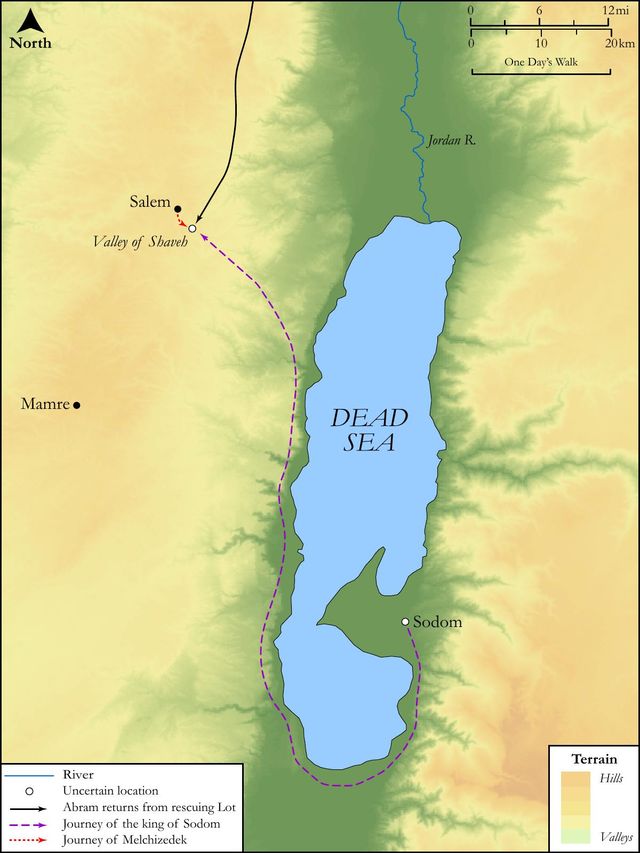
The period of the patriarchs (roughly 2000-1500 BC) was characterized by city-states and regional conflicts, often involving alliances and raids for plunder and control. The "kings" mentioned were likely rulers of relatively small city-states, not vast empires in the later sense. The "valley of Shaveh" or "king's dale" was a known geographical landmark, likely situated near what would become Jerusalem, a strategic location for important meetings. The custom of a victorious leader being met upon return was common, often involving negotiations over spoils and recognition of authority. Abram's refusal of the king of Sodom's offer later in the chapter (Genesis 14:21-24) would have been a profoundly counter-cultural act, demonstrating a reliance on divine provision over worldly gain.
Key Themes
ShowHideThis verse contributes to several overarching themes in Genesis and the broader biblical narrative. It underscores the theme of Divine Providence and Protection, as Abram's victory is clearly attributed to God's hand, despite his limited forces. It also introduces the theme of Spiritual Discernment, as Abram is immediately confronted with a choice between worldly recognition and divine blessing. The subsequent encounters in the "king's dale" highlight the Contrast of Kingdoms—the corrupt, earthly kingdom of Sodom versus the righteous, divine kingdom represented by Melchizedek. Furthermore, this chapter, including this verse, lays foundational groundwork for the theme of Covenant Faithfulness, demonstrating Abram's unwavering trust in God's promises even in the face of temptation. The unique figure of Melchizedek, introduced immediately after this verse, also foreshadows the Messianic Priesthood and Kingship that finds its ultimate fulfillment in Christ, a theme subtly prepared for by the setting of this significant meeting.
Exposition and Analysis
ShowHideKey Word Analysis
ShowHideMeaning "a king" or "royal." In this context, it refers to Bera, the king of Sodom. His title underscores his worldly authority and the nature of the encounter as one between a victorious military leader (Abram) and a sovereign whose people and possessions have been rescued. The repetition of "king" (referring to Sodom's king and the kings with Chedorlaomer) emphasizes the political and hierarchical nature of the conflict and its aftermath.
A primitive root meaning "to go (causatively, bring) out, in a great variety of applications." Here, it signifies the king of Sodom's deliberate action of moving from his city to meet Abram. This "going out" is not accidental but a purposeful act of engagement, demonstrating his eagerness to reclaim his citizens and property, and to acknowledge (or perhaps, to control) the one who rescued them.
A primitive root meaning "to turn back (hence, away) transitively or intransitively, literally or figuratively." This word emphasizes Abram's successful completion of his mission and his journey back to his encampment. His "return" is not merely a physical movement but signifies the conclusion of a major military engagement, setting the stage for the subsequent interactions and theological developments.
Verse Breakdown
ShowHide"And the king of Sodom went out to meet him"
This clause immediately establishes the identity of the first person to confront Abram after his victory. The king of Sodom, Bera, takes the initiative to approach Abram, indicating his vested interest in the outcome of the battle and his desire to engage with the victor. His "going out" underscores the public and official nature of this post-war encounter.
"after his return from the slaughter of Chedorlaomer, and of the kings that [were] with him"
This phrase provides the temporal context for the meeting. It occurs immediately following Abram's decisive and violent victory ("slaughter") over the powerful coalition of kings. The mention of "Chedorlaomer, and of the kings that were with him" highlights the formidable nature of the enemy Abram defeated, amplifying the significance of his triumph and the subsequent attention he receives.
"at the valley of Shaveh, which [is] the king's dale."
This final clause specifies the precise location of the meeting. The "valley of Shaveh" (Hebrew: emek Shaveh, meaning "valley of the plain" or "level valley") is explicitly identified as "the king's dale." This dual naming suggests a well-known and significant geographical landmark, possibly a place traditionally used for royal or important gatherings, thus lending an air of official gravitas to the encounter. Its later mention in 2 Samuel 18:18 as the place where Absalom erected a pillar further attests to its prominence.
Literary Devices
ShowHideThe verse employs several effective literary devices. Juxtaposition is subtly introduced, as the king of Sodom's appearance immediately precedes Melchizedek's, setting up a profound contrast between worldly and divine authority. The naming of the location as "the valley of Shaveh, which is the king's dale" utilizes Apposition to provide clarity and emphasize the significance of the meeting place, suggesting a site of historical or royal importance. The term "slaughter" functions as Hyperbole or intense Imagery, vividly conveying the decisive and violent nature of Abram's victory over the allied kings, underscoring the magnitude of his achievement and the power of God working through him.
Theological and Thematic Connections
ShowHideGenesis 14:17 serves as a critical transition point, moving from Abram's military triumph to his theological encounters. The immediate appearance of the king of Sodom highlights the reality that even after a divinely empowered victory, the world and its temptations are quick to present themselves. This encounter sets up a profound theological contrast, forcing Abram (and the reader) to consider the source of true blessing and authority. It underscores the theme of divine sovereignty, as God's hand is evident in Abram's victory, and prepares the way for the introduction of Melchizedek, a figure who transcends the mundane and points to a higher, spiritual reality. The verse thus emphasizes the ongoing need for discernment and allegiance to God, even amidst worldly recognition and potential gain.
Reflection and Application
ShowHideGenesis 14:17 offers profound insights for contemporary believers. It reminds us that spiritual victories, whether personal breakthroughs or significant achievements, often lead to immediate encounters with worldly pressures or temptations. Just as the king of Sodom emerged to meet Abram, so too can the allure of worldly recognition, material gain, or compromised ethics present itself in the aftermath of God's blessing. This verse challenges us to remain vigilant, to recognize that true integrity lies not in accepting worldly accolades or spoils that might compromise our faith, but in maintaining our allegiance to God as the ultimate source of our provision and blessing. It prompts us to ask ourselves: In moments of triumph, do we seek the applause of the world or the approval of God? Are we prepared to discern between opportunities that seem beneficial but could subtly undermine our spiritual walk, and those that truly honor God? This discernment is crucial for living a life that consistently reflects God's glory.
Questions for Reflection
ShowHideFAQ
ShowHideWho was the king of Sodom mentioned in this verse?
ShowHideThe king of Sodom mentioned here is Bera, as explicitly identified in Genesis 14:2. He was one of the kings of the Jordan Valley cities who rebelled against Chedorlaomer and was subsequently defeated and captured, only to be rescued by Abram's military intervention.
What is the significance of the "valley of Shaveh" or "king's dale" as the meeting place?
ShowHideThe "valley of Shaveh" (Hebrew: emek Shaveh), also known as "the king's dale," was a prominent and likely well-known geographical location, probably situated near ancient Jerusalem. Its designation as "the king's dale" suggests it was a place of historical or royal importance, perhaps a traditional site for significant gatherings or treaties. This choice of location underscores the gravity and public nature of the encounters that unfolded there, specifically Abram's meeting with the king of Sodom and, immediately thereafter, with Melchizedek. The same location is later referenced in 2 Samuel 18:18, where Absalom erected a monument to himself, further solidifying its status as a notable landmark.
Christ-Centered Fulfillment
ShowHideWhile Genesis 14:17 itself describes a historical encounter, its profound Christ-centered fulfillment is found in the immediate narrative progression, particularly the appearance of Melchizedek in the very next verse. The king of Sodom represents the fallen world system, offering its tainted rewards and seeking to claim allegiance. In stark contrast, Melchizedek, king of Salem and priest of the Most High God, emerges as a prefigurement of Christ. Abram's subsequent choice to accept blessing from Melchizedek and to give him a tithe, while resolutely refusing the king of Sodom's offer, powerfully foreshadows the believer's ultimate allegiance to Jesus Christ. Christ is our true King and High Priest, whose victory over sin and death far surpasses Abram's military triumph (Hebrews 7:1-3). His priesthood is eternal and superior to the Levitical priesthood (Hebrews 7:11-17), and His kingdom is not of this world (John 18:36). Thus, Abram's encounter in the "king's dale" sets the stage for a dramatic revelation of the true source of blessing and authority, ultimately pointing to Jesus as the one in whom all divine provision and eternal redemption are found.