


Luke 24:51
Bible text: King James Version (1769 Blayney text) · Public domain
Bible text: Berean Standard Bible · Public domain
Bible text: American Standard Version (1901) · Public domain
Bible text: World English Bible, Messianic edition · Public domain
Bible text: Geneva Bible (1599) · Public domain
Bible text: Young's Literal Translation · Public domain
- καὶkaiAndG2532CONJConjunction
- ἐγένετοegenetoit came to passG1096V-2ADI-3SVerb 2nd Aorist Middle Deponent Indicative 3rd Singular
- ἐνenduringG1722PREPPreposition
- τῷtōtheG3588T-DSNDefinite article Dative Singular Neuter
- εὐλογεῖνeulogeinblessingG2127V-PANVerb Present Active Infinitive
- αὐτὸνautonby HimG846P-ASMPersonal pronoun Accusative Singular Masculine
- αὐτοὺςautousthemG846P-APMPersonal pronoun Accusative Plural Masculine
- διέστηdiestēHe was separatedG1339V-2AAI-3SVerb 2nd Aorist Active Indicative 3rd Singular
- ἀπ᾽ap᾽fromG575PREPPreposition
- αὐτῶνautōnthemG846P-GPMPersonal pronoun Genitive Plural Masculine
- καὶkaiandG2532CONJConjunction
- ἀνεφέρετοanepheretowas carried upG399V-IPI-3SVerb Imperfect Passive Indicative 3rd Singular
- εἰςeisintoG1519PREPPreposition
- τὸνton<the>G3588T-ASMDefinite article Accusative Singular Masculine
- οὐρανόνouranonheavenG3772N-ASMNoun Accusative Singular Masculine
English is a literal word-by-word gloss of the Greek, not the KJV's wording. Why?
This is the original text the KJV's translators worked from — each Greek word with its own literal English meaning in this verse, prepared by scholars at Tyndale House, Cambridge. The KJV translates whole sentences, not word by word, so its wording differs: one Greek word can become several English words, and the KJV may choose “charity” where the gloss reads “love”. Both are faithful — they answer different questions. For the KJV's own rendering, switch to the KJV text.
Details
See on the biblical-era maps

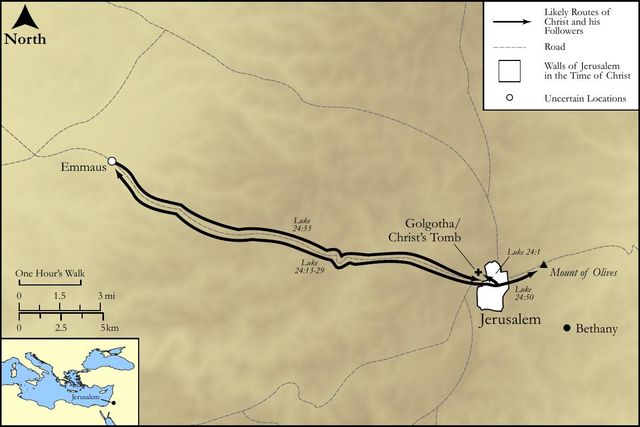
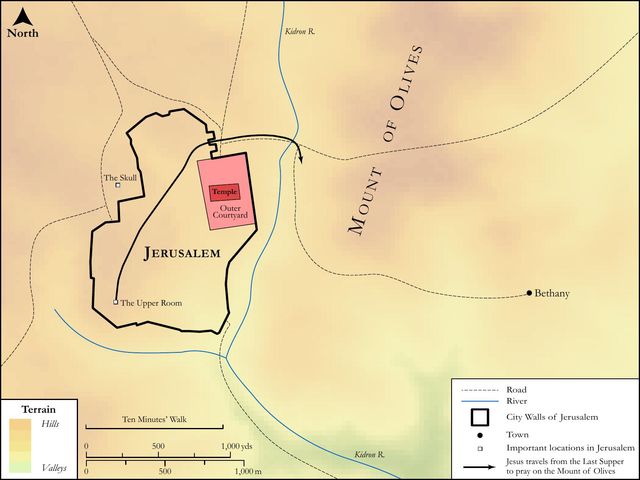
Study this verse
Public-domain commentary
Matthew Henry
From his Commentary on the Whole Bible. Henry comments on passages, not single verses — this entry covers Luke 24:50–53. His three-level outline is real structure in the source text, so it is rendered as structure.
This evangelist omits the solemn meeting between Christ and his disciples in Galilee; but what he said to them there, and at other interviews, he subjoins to what he said to them at the first visit he made them on the evening of the day he rose; and has now nothing more to account for but his ascension into heaven, of which we have a very brief narrative in these verses, in which we are told,
I.How solemnly Christ took leave of his disciples.
Christ's design being to reconcile heaven and earth, and to continue a days-man between them, it was necessary that he should lay his hands on them both, and, in order thereunto, that he should pass and repass. He had business to do in both worlds, and accordingly came from heaven to earth in his incarnation, to despatch his business here, and, having finished this, he returned to heaven, to reside there, and negotiate our affairs with the Father. Observe,
1.Whence he ascended: from Bethany, near Jerusalem, adjoining to the mount of Olives. There he had done eminent services for his Father's glory, and there he entered upon his glory. There was the garden in which his sufferings began, there he was in his agony; and Bethany signifies the house of sorrow. Those that would go to heaven must ascend thither from the house of sufferings and sorrow, must go by agonies to their joys. The mount of Olives was pitched upon long since to be the place of Christ's ascension: His feet shall stand in that day upon the mount of Olives, Zac 14:4. And here it was that awhile ago he began his triumphant entry into Jerusalem, Luk 19:29.
2.Who were the witnesses of his ascension: He led out his disciples to see him. Probably, it was very early in the morning that he ascended, before people were stirring; for he never showed himself openly to all the people after his resurrection, but only to chosen witnesses. The disciples did not see him rise out of the grace, because his resurrection was capable of being proved by their seeing him alive afterwards; but they saw him ascend into heaven, because they could not otherwise have an ocular demonstration of his ascension. They were led out on purpose to see him ascend, had their eye upon him when he ascended, and were not looking another way.
3.What was the farewell he gave them: He lifted up his hands, and blessed them. He did not go away in displeasure, but in love; he left a blessing behind him; he lifted up his hands, as the high priest did when he blessed the people; see Lev 9:22. He blessed as one having authority, commanded the blessing which he had purchased; he blessed them as Jacob blessed his sons. The apostles were now as the representatives of the twelve tribes, so that in blessing them he blessed all his spiritual Israel, and put his Father's name upon them. He blessed them as Jacob blessed his sons, and Moses the tribes, at parting, to show that, having loved his own which were in the world, he loved them unto the end.
4.How he left them: While he was blessing them, he was parted from them; not as if he were taken away before he had said all he had to say, but to intimate that his being parted from them did not put an end to his blessing them, for the intercession which he went to heaven to make for all his is a continuation of the blessing. He began to bless them on earth, but he went to heaven to go on with it. Christ was now sending his apostles to preach his gospel to the world, and he gives them his blessing, not for themselves only, but to be conferred in his name upon all that should believe on him through their word; for in him all the families of the earth were to be blessed.
5.How his ascension is described.
(1.)He was parted from them, was taken from their head, as Elijah from Elisha's. Note, The dearest friends must part. Those that love us, and pray for us, and instruct us, must be parted form us. The bodily presence of Christ himself was not to be expected always in this world; those that knew him after the flesh must now henceforth know him so no more.
(2.)He was carried up into heaven; not by force, but by his own act and deed. As he arose, so he ascended, by his own power, yet attended by angels. There needed no chariot of fire, nor horses of fire; he knew the way, and, being the Lord from heaven, could go back himself. He ascended in a cloud, as the angel in the smoke of Manoah's sacrifice, Jdg 13:20.
II.How cheerfully his disciples continued their attendance on him, and on God through him, even now that he was parted from them.
1.They paid their homage to him at his going away, to signify that though he was going into a far country, yet they would continue his loyal subjects, that they were willing to have him reign over them: They worshipped him. Luk 24:52. Note, Christ expects adoration from those that receive blessings from him. He blessed them, in token of gratitude for which they worshipped him. This fresh display of Christ's glory drew from them fresh acknowledgments and adorations of it. They knew that though he was parted form them, yet he could, and did, take notice of their adorations of him; the cloud that received him out of their sight did not put them or their services out of his sight.
2.They returned to Jerusalem with great joy. There they were ordered to continue till the Spirit should be poured out upon them, and thither they went accordingly, though it was into the mouth of danger. Thither they went, and there they staid with great joy. This was a wonderful change, and an effect of the opening of their understandings. When Christ told them that he must leave them sorrow filled their hearts; yet now that they see him go they are filled with joy, being convinced at length that it was expedient for them and for the church that he should go away, to send the Comforter. Note, The glory of Christ is the joy, the exceeding joy, of all true believers, even while they are here in this world; much more will it be so when they go to the new Jerusalem, and find him there in his glory.
3.They abounded in acts of devotion while they were in expectation of the promise of the Father, Luk 24:53.
(1.)They attended the temple-service at the hours of prayer. God had not as yet quite forsaken it, and therefore they did not. They were continually in the temple, as their Master was when he was at Jerusalem. The Lord loves the gates of Zion, and so should we. Some think that they had their place of meeting, as disciples, in some of the chambers of the temple which belonged to some Levite that was well affected to them; but others think it is not likely that this either could be concealed fRom. or would be connived at by, the chief priests and rulers of the temple.
(2.)Temple-sacrifices, they knew, were superseded by Christ's sacrifice, but the temple-songs they joined in. Note, While we are waiting for God's promises we must go forth to meet them with our praises. Praising and blessing God is work that is never out of season: and nothing better prepares the mind for the receiving of the Holy Ghost than holy joy and praise. Fears are silenced, sorrows sweetened and allayed, and hopes kept up.
The amen that concludes seems to be added by the church and every believer to the reading of the gospel, signifying an assent to the truths of the gospel, and a hearty concurrence with all the disciples of Christ in praising and blessing God. Amen. Let him be continually praised and blessed.
Historical interpretation
Nine Centuries of Reception
12 surviving comments on this verse. Each one is dated, so this reads as a timeline rather than a list.
Select a marker to jump to its quote. Markers stagger vertically where authors wrote within a few decades of each other.
But observe, that the Lord submits to our sight the promised rewards. He had promised the resurrection of the body; He rose from the dead, and conferred with His disciples for forty days. It is also promised that we shall be caught up in the clouds through the air; this also He made manifest by His works. For it follows, And it came to pass, while he blessed them, he was parted, &c.
But you will say, How does this concern me? Because thou also shalt be taken up in like manner into the clouds. For thy body is of like nature to His body, therefore shall thy body be so light, that it can pass through the air. For as is the head, so also is the body; as the beginning, so also the end. See then how thou art honoured by this beginning. Man was the lowest part of the rational creation, but the feet have been made the head, being lifted up aloft into the royal throne in their head.
You heard what came to our ears just now from the Gospel: "Lifting up his hands, he blessed them. And it happened, while he was blessing them he withdrew from them, and was carried up to heaven." Who was carried up to heaven? The Lord Christ was. Who is the Lord Christ? He is the Lord Jesus. What is this? Are you going to separate the human from the divine and make one person of God, another of the man, so that there is no longer a trinity of three but a quaternary of four? Just as you, a human being, are soul and body, so the Lord Christ is Word, soul and body. The Word did not depart from the Father. He both came to us and did not forsake the Father. He both took flesh in the womb and continued to govern the universe. What was lifted up into heaven, if not what had been taken from earth? That is to say, the very flesh, the very body, about which he was speaking when he said to the disciples, "Feel, and see that a spirit does not have bones and flesh, as you can see that I have." Let us believe this, brothers and sisters, and if we have difficulty in meeting the arguments of the philosophers, let us hold on to what was demonstrated in the Lord's case without any difficulty of faith. Let them chatter, but let us believe.
He ascended on the fortieth day. Here we are today when everyone present is filled with the Holy Spirit as he comes upon him or her, and they speak with the tongues of all nations. He commends unity to us through the tongues of all nations. The Lord commends unity as he rises again. Christ commends it as he ascends. The Holy Spirit confirms it when he comes today.
Having blessed them and gone ahead a little, he was carried up into heaven so that he might share the Father’s throne even with the flesh that was united to him. The Word made this new pathway for us when he appeared in human form. After this, and in due time, he will come again in the glory of his Father with the angels and will take us up to be with him. Let us glorify him.Being God the Word, he became man for our sakes. He suffered willingly in the flesh, rose from the dead and abolished corruption. He was taken up, and he will come with great glory to judge the living and the dead, to give to every one according to his deeds.
Dearly beloved, through all this time between the resurrection of the Lord and his ascension, the providence of God thought of this, taught this and penetrated their eyes and heart. He wanted them to recognize the Lord Jesus Christ as truly risen, who was truly born, truly suffered and truly died. The manifest truth strengthened the blessed apostles and all the disciples who were frightened by his death on the cross and were doubtful of his resurrection. The result was they were not only afflicted with sadness but also were filled with “great joy” when the Lord went into the heights of heaven.It was certainly a great and indescribable source of joy when, in the sight of the heavenly multitudes, the nature of our human race ascended over the dignity of all heavenly creatures. It passed the angelic orders and was raised beyond the heights of archangels. In its ascension, our human race did not stop at any other height until this same nature was received at the seat of the eternal Father. Our human nature, united with the divinity of the Son, was on the throne of his glory.
The ascension of Christ is our elevation. Hope for the body is also invited where the glory of the Head preceded us. Let us exult, dearly beloved, with worthy joy and be glad with a holy thanksgiving. Today we not only are established as possessors of paradise, but we have even penetrated the heights of the heavens in Christ. The indescribable grace of Christ, which we lost through the “ill will of the devil,” prepared us more fully for that glory. Incorporated within himself, the Son of God placed those whom the violent enemy threw down from the happiness of our first dwelling at the right hand of the Father. The Son of God lives and reigns with God the Father almighty and with the Holy Spirit forever and ever. Amen.
Having omitted all those things which may have taken place during forty-three days between our Lord and His disciples, St. Luke silently joins to the first day of the resurrection, the last day when He ascended into heaven, saying, And he led them out as far as to Bethany. First, indeed, because of the name of the place, which signifies "the house of obedience." For He who descended because of the disobedience of the wicked, ascended because of the obedience of the converted. Next, because of the situation of the same village, which is said to be placed on the side of the mount of Olives; because He has placed the foundations, as it were, of the house of the obedient Church, of faith, hope, and love, in the side of that highest mountain, namely, Christ. But He blessed them to whom He had delivered the precepts of His teaching; hence it follows, And he lifted up his hands, and blessed them.
When the Lord ascended into heaven, the disciples adoring Him where His feet lately stood, immediately return to Jerusalem, where they were commanded to wait for the promise of the Father; for it follows, And they worshipped him, and returned, &c. Great indeed was their joy, for they rejoice that their God and Lord after the triumph of His resurrection had also passed into the heavens.
And observe that among the four beasts in heaven, (Ezek. 1:10. Rev. 4:7) Luke is said to be represented by the calf, for by the sacrifice of a calf, they were ordered to be initiated who were chosen to the priesthood; (Exod. 29:1.) and Luke has undertaken to explain more fully than the rest the priesthood of Christ; and his Gospel, which he commenced with the ministry of the temple in the priesthood of Zacharias, he has finished with the devotion in the temple. And he has placed the Apostles there, about to be the ministers of a new priesthood, not in the blood of sacrifices, but in the praises of God and in blessing, that in the place of prayer and amidst the praises of their devotion, they might wait with prepared hearts for the promise of the Spirit.
We must not pass over the fact that Bethany is on the slope of the Mount of Olives. Just as Bethany represents a church obedient to the commands of the Lord, so the Mount of Olives quite fittingly represents the very person of our Lord. Appearing in the flesh, he excels all the saints, who are simply human beings, by the loftiness of his dignity and the grace of his spiritual power. We chant to him in the Psalms, “God, your God, has anointed you with the oil of happiness above your companions.” The present Gospel reading bears witness that he promised the favor of the same holy anointing to his companions, the faithful. He sent what he had promised, as we know, not long after that. It is delightful to hear how the house of obedience, the holy church, is built on the slope of the Mount of Olives. Let us read the Gospel of John where it said that when his suffering on the cross was fulfilled, “one of the soldiers opened his side with a lance, and immediately blood and water came out.” These truly are the sacraments by which the church is born and nourished in Christ. These are the water of baptism that cleanses the church from sins and the blood of the Lord’s chalice that confirms its gifts. It is also signed with the chrism of the Holy Spirit. The mountain on whose slope the holy city is situated, on which the gift of blessing is given, is properly called the Mount of Olives that it may be capable of being perfected on the day of redemption.
“Then he led them out to Bethany, and lifting up his hands, he blessed them.” Our Redeemer appeared in the flesh to take away sins, remove what humans deserved because of the first curse, and grant believers an inheritance of everlasting blessing. He rightly concluded all that he did in the world with words of blessing. He showed that he was the very one of whom it was said, “For indeed he who gave the law will give a blessing.” It is appropriate that he led those whom he blessed out to Bethany, which is interpreted “house of obedience.” Contempt and pride deserved a curse, but obedience deserved a blessing. The Lord himself was made obedient to his Father even unto death, so that he might restore the lost grace of blessing to the world. He gives the blessing of heavenly life only to those who strive in the holy church to comply with the divine commands.
“Worshiping, they returned to Jerusalem with great joy and were continually in the temple praising and blessing God.” Dearly beloved brothers and sisters, we should always remember, especially in this place, our Lord’s words as he was glorifying his disciples: “Blessed are the eyes that see what you see.” Who is truly capable of describing or of worthily imagining how with blessed sorrow they lowered to the earth the eyes with which they had looked at him whom the heavens were worshiping as their king? He was now returning to the throne of his Father’s glory with the conquered mortal nature that he had taken. How sweet were the tears that they poured out when they were burning with lively hope and gladness over the prospect of their own entry into the heavenly fatherland! They knew that their God and Lord was now bringing there part of their own nature! Such a sight rightly restored them! Then they worshiped in the place where his feet stood. With many tears, they wet the place where he had most recently planted his footsteps. Then they immediately returned to Jerusalem, where he ordered them to wait for the coming of the Holy Spirit.
“While he was blessing them, he departed from them and was carried into heaven.” We must note that the Savior ascended into heaven after he gave his blessing to his disciples. At the same time, we must remember that, as we read in the Acts of the Apostles, angels appeared to them as they were watching his ascension. They said to them, “He will come in the same way as you have seen him going into heaven.” We must labor with all eagerness to understand that the Lord will descend to judge us in the same form and substance of flesh with which he ascended. Since he departed blessing his apostles, he will also make us worthy of his blessing when he returns. He will give us the same status as those to whom he is going to say as they stand at his right hand, “Come, you who are blessed by my Father, receive the kingdom.”
Perhaps pouring into them a power of preservation, until the coming of the Spirit; and perhaps instructing them, that as often as we go away, we should commend to God by our blessing those who are placed under us.
And Elias indeed was seen, as it were, to be taken up into heaven, but the Saviour, the forerunner of all, Himself ascended into heaven to appear in the Divine sight in His sacred body; and already is our nature honoured in Christ by a certain Angelic power.
The Spirit had not yet come, and yet their conversation is spiritual. Before they were shut up; now they stand in the midst of the chief priests; distracted by no worldly object, but despising all things, they praise God continually; as it follows, Praising and blessing God.
Whom imitating, may we ever dwell in a holy life, praising and blessing God; to Whom be glory and blessing and power, for ever and ever. Amen.
And they were watching, praying, and fasting, because indeed they were not living in their own homes, but were abiding in the temple, expecting the grace from on high; among other things also learning from the very place piety and honesty. Hence it is said, And were continually in the temple.
Continue studying Luke 24:51 across the web’s major study libraries — every link below opens this exact verse, chapter, or book on the destination site.
Read & Compare
 BibleGatewayThis verse in more than 200 translations and 70 languages.
 Bible.comThe YouVersion reader — hundreds of translations, reading plans, and highlights.
 ESV.orgCrossway's official English Standard Version reader.
 NET BibleThe NET translation with 60,000+ translators' notes on every rendering decision.
 STEP BibleTyndale House's free study tool — original text, vocabulary, and scholarly resources.
 BibliaLogos Bible Software's free web reader.
 USCCBThe New American Bible (Revised Edition) with the U.S. bishops' study notes.
Commentaries
 BibleHub CommentariesDozens of classic commentaries on this verse, gathered on one page.
 StudyLightMore than 100 commentary sets — the largest collection on the web.
 BibleRefPlain-English commentary on what this verse means, verse by verse.
 Enduring WordDavid Guzik's free commentary on this chapter, widely used by Bible teachers.
 Bible Study ToolsVerse commentary alongside Greek and Hebrew study aids.
Original Language & Research
- BibleHub InterlinearThe verse word by word — original language, transliteration, and English.
- BibleHub LexiconEvery word's original-language definition and Strong's entry.
 Blue Letter BibleDeep-study tools — Strong's numbers, concordance, and word studies.
 CNTR CollationThe earliest Greek manuscripts of this verse, collated letter by letter.
Sermons, Hymns & Audio


TrulyRandomVerse is not affiliated with these sites and doesn’t control their content. They’re linked because they’re genuinely useful.
Summary
Luke 24:51 presents the climactic moment of Jesus' post-resurrection appearances in Luke's Gospel, depicting His final blessing of His disciples before He is supernaturally "parted from them, and carried up into heaven." This pivotal event marks the culmination of His earthly ministry, signifying His return to divine glory and authority, and setting the stage for the outpouring of the Holy Spirit and the global mission of the church.
Context
ShowHideLiterary Context
This verse serves as the narrative crescendo of Luke's Gospel, immediately following Jesus' final instructions to His disciples in Jerusalem, including the command to wait for the promise of the Holy Spirit (Luke 24:49). The scene unfolds as Jesus leads them out to Bethany, a location near the Mount of Olives, which is significant for its association with prophetic events. The Ascension here provides a bridge to Luke's second volume, the Book of Acts, where a more detailed account of this event is given in Acts 1:9-11, emphasizing its historical and theological continuity. Luke carefully positions this event not as a mere disappearance, but as a divinely orchestrated exaltation that transitions the focus from Jesus' physical presence to the Spirit's empowering presence.
Historical & Cultural Context
The act of "blessing" (εὐλογέω, eulogéō') carries deep significance in Jewish tradition, often associated with patriarchal figures, priests, or prophets bestowing divine favor, authority, and prosperity. For Jesus to bless His disciples immediately before His departure underscores His enduring priestly and kingly authority, commissioning them with divine favor for their impending mission. The concept of being "carried up into heaven" resonates with Old Testament narratives of divine ascent, such as Elijah's translation (2 Kings 2:11), but Jesus' ascension is unique in its finality and theological implications, establishing His permanent enthronement at God's right hand. The Mount of Olives, from which Jesus ascended, also holds eschatological significance in Jewish prophecy, particularly in relation to the Messiah's return (Zechariah 14:4).
Key Themes
ShowHideLuke 24:51 powerfully encapsulates several key themes central to Luke-Acts. Foremost is The Ascension of Christ, which is not merely a physical departure but a theological statement of Jesus' exaltation, sovereignty, and return to His divine glory. It signifies the completion of His redemptive work on earth and His enthronement as Lord and Christ (Acts 2:33-36). This event also highlights The Continuity of God's Plan, as Jesus' departure paves the way for the promised Holy Spirit, empowering the disciples to continue His mission, transforming them from witnesses of the resurrection to agents of the Kingdom. Furthermore, the final blessing underscores Christ's Enduring Authority and Care for His followers, a powerful affirmation of His divine commission upon them. Finally, the Ascension inherently carries the theme of Anticipation of Christ's Return, as it establishes the pattern for His future second coming, as explicitly stated by the angels in Acts 1:11.
Exposition and Analysis
ShowHideKey Word Analysis
ShowHideMeaning "to speak well of, i.e. (religiously) to bless (thank or invoke a benediction upon, prosper)." In this context, Jesus' blessing is a final act of divine favor and empowerment upon His disciples, commissioning them for their future ministry and assuring them of God's presence and provision. It is an authoritative pronouncement of well-being and divine approval.
Meaning "to stand apart, i.e. (reflexively) to remove, intervene." This word emphasizes a separation or removal, indicating a distinct physical departure. The passive voice ("he was parted") suggests a divine agency at work, not merely Jesus' own initiative, but God the Father's active role in His Son's exaltation.
Meaning "to take up (literally or figuratively)." Here, it is used in the imperfect passive voice (anephereto), which can imply a continuous or ongoing action, or simply the action of being carried up. This again highlights the divine initiative in the Ascension, as Jesus is not just "going up" but "being carried up" by a power beyond Himself, underscoring the supernatural nature of the event.
Referring to "the sky; by extension, heaven (as the abode of God); by implication, happiness, power, eternity." This signifies not merely a physical ascent into the atmosphere, but a translation into the spiritual realm, the dwelling place of God, indicating Jesus' enthronement in divine authority and glory.
Verse Breakdown
ShowHide"And it came to pass, while he blessed them"
This opening clause sets the scene for the momentous event. The phrase "it came to pass" (Greek, kai egéneto) is a common Lukan literary device, signaling a significant development in the narrative. The action of blessing them is Jesus' final pastoral act, a profound gesture of love, authority, and commissioning, imparting divine favor and spiritual authority to His disciples before His departure.
"he was parted from them"
This phrase describes the initial separation, emphasizing a clear physical departure from the disciples' presence. The passive voice indicates that this parting was not merely Jesus' own decision but a divinely ordained separation, part of God's sovereign plan for His Son's exaltation and the subsequent empowerment of the church.
"and carried up into heaven"
This climactic phrase describes the Ascension itself. The use of "carried up" (Greek, anephereto, imperfect passive) further emphasizes the divine agency involved; Jesus was supernaturally lifted by God's power. "Into heaven" signifies His return to the divine realm, to the presence of the Father, where He assumes His rightful place of supreme authority and glory, completing His earthly redemptive work.
Literary Devices
ShowHideLuke employs several literary devices to underscore the theological significance of this verse. The use of the Divine Passive in "he was parted" and "carried up" subtly emphasizes God the Father's active role in Jesus' exaltation, portraying the Ascension not as a mere departure but as a divinely orchestrated event. The verse functions as a Climax to Luke's Gospel, providing a definitive conclusion to Jesus' earthly ministry and a clear transition point before the narrative continues in Acts. The imagery of being "carried up into heaven" is rich with Symbolism, representing Jesus' return to divine glory, His enthronement as Lord, and the ultimate triumph over sin and death. Furthermore, the scene inherently contains Foreshadowing, as the Ascension points forward to the coming of the Holy Spirit (promised in Luke 24:49) and the future return of Christ, establishing a pattern for His glorious reappearance.
Theological and Thematic Connections
ShowHideThe Ascension of Jesus, as depicted in Luke 24:51, is a cornerstone of Christian theology, affirming the completed work of Christ and His ongoing reign over all things. It is not merely a historical event but a profound theological statement: Jesus, the resurrected Lord, has been exalted to the right hand of God, where He exercises all authority in heaven and on earth. This enthronement signifies His triumph over all spiritual powers and His perpetual intercession for His people. The Ascension also validates the disciples' future mission, as they are sent forth with the authority of the ascended Christ and the promise of the Holy Spirit, transforming them from witnesses to empowered agents of the Kingdom. It provides the ultimate assurance of hope, knowing that our High Priest lives and reigns, preparing a place for us and ensuring His future return.
Reflection and Application
ShowHideThe Ascension of Jesus is far more than a historical footnote; it is a living truth that profoundly impacts the believer's life today. It assures us that Jesus is not a distant, historical figure, but a living, reigning Lord who is actively involved in the affairs of His church and the world. His ascension confirms the efficacy of His sacrifice, the reality of His resurrection, and the certainty of His future return. For us, this means we live with a heavenly perspective, knowing that our citizenship is in heaven and that our ultimate hope is fixed on Christ. It empowers us to live courageously, knowing that the same power that raised Jesus and carried Him to glory is available to us through the Holy Spirit. We are called to continue His mission, confident in His authority and His promise to be with us always, even to the end of the age. The Ascension calls us to look up in worship, to live out our faith with purpose, and to look forward with eager expectation to His glorious return.
Questions for Reflection
ShowHideFAQ
ShowHideWhat is the significance of Jesus blessing His disciples before His ascension?
ShowHideJesus' final blessing in Luke 24:51 is deeply significant. It serves as a powerful act of commissioning, imparting divine favor, authority, and spiritual empowerment upon His disciples. In Jewish tradition, a blessing from an authoritative figure often conveyed a transfer of power or a divine mandate. For Jesus, as the resurrected Lord, to bless them before His departure underscores His enduring priestly and kingly authority. It assures the disciples that they are sent forth with God's approval and provision, preparing them for the daunting task of spreading the Gospel to the world, knowing they are under His divine favor and protection.
Why is the Ascension described as Jesus being "carried up" rather than Him simply "going up" by His own power?
ShowHideThe Greek verb used, anaphérō (G399), in the imperfect passive voice (anephereto), translates to "was being carried up" or "was taken up," rather than an active "He went up." This grammatical construction, known as the Divine Passive, is crucial. It indicates that the Ascension was not merely an act of Jesus' own will, but a divinely orchestrated event, with God the Father actively involved in exalting His Son. While Jesus certainly possesses inherent divine power, the passive voice emphasizes the Father's sovereign role in receiving and enthroning Christ in heaven. This highlights the profound theological significance of the Ascension as God's affirmation and glorification of His Son, completing His redemptive work and establishing His reign over all things. It points to the Father's active participation in the Son's return to glory.
Christ-Centered Fulfillment
ShowHideLuke 24:51, detailing Jesus' ascension, is a pivotal moment in the Christ-centered narrative, marking the glorious culmination of His earthly redemptive work and His enthronement as the reigning Lord. The "carrying up into heaven" is not a mere departure but a divine exaltation, fulfilling Old Testament prophecies of a Messiah who would ascend to power and rule from God's right hand (Psalm 110:1). This event establishes Jesus' ongoing role as our great High Priest, who "always lives to intercede" for us before the Father (Hebrews 7:25). His ascension also paves the way for the outpouring of the Holy Spirit, as Jesus promised, "I will send you what my Father has promised" (Luke 24:49), a promise fulfilled at Pentecost (Acts 2:33). Thus, the Ascension is the necessary bridge between Christ's earthly ministry and His heavenly reign, empowering His church to continue His mission until His glorious return, when "this same Jesus, who has been taken from you into heaven, will come back in the same way you have seen him go into heaven" (Acts 1:11).