


1 Samuel 7:12
Bible text: King James Version (1769 Blayney text) · Public domain
Bible text: King James Version with Strong's numbers · Public domain
Bible text: Berean Standard Bible · Public domain
Bible text: American Standard Version (1901) · Public domain
Bible text: World English Bible, Messianic edition · Public domain
Bible text: Geneva Bible (1599) · Public domain
Bible text: Young's Literal Translation · Public domain
- וַיִּקַּחvai·yi·Kachand he tookH3947Conj-w ¦ V-Qal-ConsecImperf-3msVerb Qal Consecutive Imperfect 3rd Singular Masculineוַandיִּקַּחhe took
- שְׁמוּאֵלshe·mu·'ElSamuelH8050N-proper-mNoun Proper Masculine
- אֶבֶן'E·vena stoneH68N-fscNoun Singular Feminine Construct
- אַחַת'a·ChatoneH259N-fsNoun Singular Feminine Absolute
- וַיָּשֶׂםvai·Ya·semand he put [it]H7760Conj-w ¦ V-Qal-ConsecImperf-3msVerb Qal Consecutive Imperfect 3rd Singular Masculineוַandיָּשֶׂםhe put [it]
- בֵּיןbeinbetweenH996Adj-mscAdjective Numerical Singular Masculine Construct
- הַמִּצְפָּהha·mitz·Pah<the> MizpahH4709Art ¦ N-properNoun Proper Locationהַ<the>מִּצְפָּהMizpah
- וּבֵיןu·Veinand betweenH996Conj-w ¦ Adj-mscAdjective Numerical Singular Masculine Constructוּandבֵיןbetween
- הַשֵּׁןha·Shen<the> ShenH8129Art ¦ N-properNoun Proper Locationהַ<the>שֵּׁןShen
- וַיִּקְרָאvai·yik·Ra'and he calledH7121Conj-w ¦ V-Qal-ConsecImperf-3msVerb Qal Consecutive Imperfect 3rd Singular Masculineוַandיִּקְרָאhe called
- אֶת'et<obj.>H853DirObjMParticle Object Indicator
- שְׁמָהּshe·Mahits nameH8034N-msc ¦ 3fsNoun Singular Masculine Constructשְׁמָnameהּits
- אֶבֶן'E·venEben-H72N-properNoun Proper Location
- הָעָזֶרha·'A·zer-ezerH72N-properNoun Proper Location
- וַיֹּאמַרvai·yo·Marand he saidH559Conj-w ¦ V-Qal-ConsecImperf-3msVerb Qal Consecutive Imperfect 3rd Singular Masculineוַandיֹּאמַרhe said
- עַד'aduntilH5704PrepPreposition
- הֵנָּהHe·nahnowH2008AdvAdverb
- עֲזָרָנוּ'a·za·Ra·nuhe has helped usH5826V-Qal-Perf-3ms ¦ 1cpVerb Qal Perfect 3rd Singular Masculineעֲזָרָhe has helpedנוּus
- יְהוָהYah·wehYahwehH3068N-properNoun Proper Title
English is a literal word-by-word gloss of the Hebrew, not the KJV's wording. Why?
This is the original text the KJV's translators worked from — each Hebrew word with its own literal English meaning in this verse, prepared by scholars at Tyndale House, Cambridge. The KJV translates whole sentences, not word by word, so its wording differs: one Hebrew word can become several English words, and the KJV may choose “the LORD” where the gloss reads “Yahweh”. Both are faithful — they answer different questions. For the KJV's own rendering, switch to the KJV text.
Details
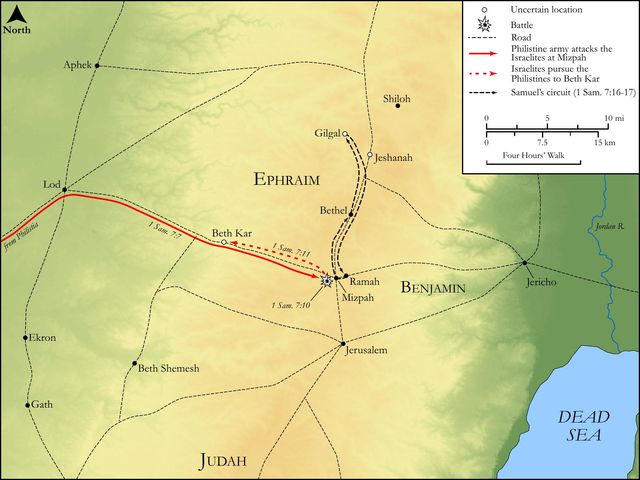
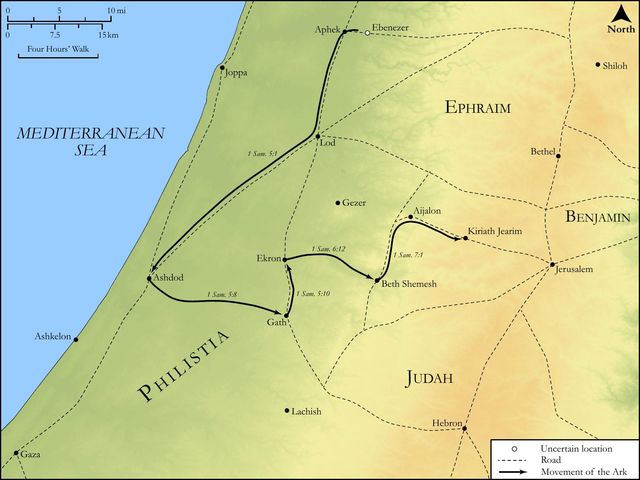
See on the biblical-era maps
Study this verse
Public-domain commentary
Matthew Henry
From his Commentary on the Whole Bible. Henry comments on passages, not single verses — this entry covers 1 Samuel 7:7–12. His two-level outline is real structure in the source text, so it is rendered as structure.
Here, I. The Philistines invade Israel (Sa1 7:7), taking umbrage from that general meeting for repentance and prayer as if it had been a rendezvous for war, and, if so, they thought it prudent to keep the war out of their own country. They had no just cause for this suspicion; but those that seek to do mischief to others will be forward to imagine that others design mischief to them. Now see here, 1. How evil sometimes seems to come out of good. The religious meeting of the Israelites at Mizpeh brought trouble upon them from the Philistines, which perhaps tempted them to wish they had staid at home and to blame Samuel for calling them together. But we may be in God's way and yet meet with distress; nay, when sinners begin to repent and reform, they must expect that Satan will muster all his force against them, and set his instruments on work to the utmost to oppose and discourage them. But, 2. How good is, at length, brought out of that evil. Israel could never be threatened more seasonably than at this time, when they were repenting and praying, nor could they have been better prepared to receive the enemy; nor could the Philistines have acted more impolitely for themselves than to make war upon Israel at this time, when they were making their peace with God. But God permitted them to do it, that he might have an opportunity immediately of crowning his people's reformation with tokens of his favour, and of confirming the words of his messenger, who had assured them that if they repented God would deliver them out of the hand of the Philistines. Thus he makes man's wrath to praise him, and serves the purposes of his grace to his people even by the malicious designs of their enemies against them, Mic 4:11, Mic 4:12.
II.Israel cleaves closely to Samuel, as their best friend, under God, in this distress; though he was no military man, nor ever celebrated as a mighty man of valour, yet, being afraid of the Philistines, for whom they thought themselves an unequal match, they engaged Samuel's prayers for them: Cease not to cry unto the Lord our God for us, Sa1 7:8. They were here unarmed, unprepared for war, come together to fast and pray, not to fight; prayers and tears therefore being all the weapons many of them are now furnished with, to these they have recourse. And, knowing Samuel to have a great interest in heaven, they earnestly beg of him to improve it for them. They had reason to expect it, because he had promised to pray for them (Sa1 7:5), had promised them deliverance from the Philistines (Sa1 7:3), and they had been observant of him in all that which he had spoken to them from the Lord. Thus those who sincerely submit to Christ, as their lawgiver and judge, need not doubt of their interest in his intercession. They were very solicitous that Samuel should not cease to pray for them: what military preparations were to be made they would undertake them, but let him continue instant in prayer, perhaps remembering that when Moses did but let down his hand ever so little Amalek prevailed. O what a comfort is it to all believers that our great intercessor above never ceases, is never silent, for he always appears in the presence of God for us!
III.Samuel intercedes with God for them, and does it by sacrifice, Sa1 7:9.
He took a sucking lamb, and offered it for a burnt-offering, a whole burnt-offering, to the Lord, and, while the sacrifice was in burning, with the smoke of it his prayers ascended up to heaven for Israel. Observe,
1.He made intercession with a sacrifice. Christ intercedes in the virtue of his satisfaction, and in all our prayers we must have an eye to his great oblation, depending upon that for audience and acceptance. Samuel's sacrifice without his prayer would have been an empty shadow, his prayer without the sacrifice would not have been so prevalent, but both together teach us what great things we may expect from God in answer to those prayers which are made with faith in Christ's sacrifice.
2.It was a burnt-offering, which was offered purely for the glory of God, so intimating that the great plea he relied on in his prayer was taken from the honour of God. "Lord, help thy people now for thy name's sake." When we endeavour to give glory to God we may hope he will, in answer to our prayers, work for his own glory.
3.It was but one sucking lamb that he offered; for it is the integrity and intention of the heart that God looks at, more than the bulk or number of the offerings. This one lamb (typifying the Lamb of God) was more acceptable than thousands of rams or bullocks would have been without faith and prayer. Samuel was no priest, but he was a Levite and a prophet; the case was extraordinary, and what he did was by special direction, and therefore was accepted of God. And justly was this reproach put upon the priests because they had corrupted themselves.
IV.God gave a gracious answer to Samuel's prayer (Sa1 7:9):
The Lord heard him. He was himself a Samuel, asked of God, and many a Samuel, many a mercy in answer to prayer, God gave him. Sons of prayer should be famous for praying, as Samuel was among those that call upon his name, Psa 99:6. The answer was a real answer: the Philistines were discomfited (Sa1 7:10, Sa1 7:11), totally routed, and that in such a manner as highly magnified the prayer of Samuel, the power of God, and the valour of Israel.
1.The prayer of Samuel was honoured; for at the very time when he was offering up his sacrifice, and his prayer with it, the battle began, and turned immediately against the Philistines. Thus while he was yet speaking God heard, and answered in thunder, Isa 65:24. God showed that it was Samuel's prayer and sacrifice that he had respect to, and hereby let Israel know that as in a former engagement with the Philistines he had justly chastised their presumptuous confidence in the presence of the ark, on the shoulders of two profane priests, so now he graciously accepted their humble dependence upon the prayer of faith from the mouth and heart of a pious prophet.
2.The power of God was greatly honoured; for he took the work into his own hand, and discomfited them, not with great hail-stones, which would kill them (as Jos 10:11), but with a great thunder, which frightened them and put them into such terror and consternation that they fainted away, and became a very easy prey to the sword of Israel, before whom, being thus confounded, they were smitten. Josephus adds that the earth quaked under them when first they made the onset and in many places opened and swallowed them up, and that, besides the terror of the thunder, their faces and hands were burnt with lightning, which obliged them to shift for themselves by flight. And, being thus driven to their heels by the immediate hand of God (whom they feared not so much as they had feared his ark, Sa1 4:7), then,
3.Honour was put upon the hosts of Israel; they were made use of for the completing of the victory, and had the pleasure of triumphing over their oppressors: They pursued the Philistines, and smote them. How soon did they find the benefit of their repentance, and reformation, and return to God! Now that they have thus engaged him for them none of their enemies can stand before them.
V.Samuel erected a thankful memorial of this victory, to the glory of God and for the encouragement of Israel, Sa1 7:12.
He set up an Eben-ezer, the stone of help. If ever the people's hard hearts should lose the impressions of this providence, this stone would either revive the remembrance of it, and make them thankful, or remain a standing witness against them for their unthankfulness.
1.The place where this memorial was set up was the same where, twenty years before, the Israelites were smitten before the Philistines, for that was beside Eben-ezer, Sa1 4:1. The sin which procured that defeat formerly being pardoned upon their repentance, the pardon was sealed by this glorious victory in the very same place where they then suffered loss; see Hos 1:10.
2.Samuel himself took care to set up this monument. He had been instrumental by prayer to obtain the mercy, and therefore he thought himself in a special manner obliged to make this grateful acknowledgement of it.
3.The reason he gives for the name is, Hitherto the Lord hath helped us, in which he speaks thankfully of what was past, giving the glory of the victory to God only, who had added this to all his former favours; and yet he speaks somewhat doubtfully for the future: "Hitherto things have done well, but what God may yet do with us we know not, that we refer to him; but let us praise him for what he has done." Note, The beginnings of mercy and deliverance are to be acknowledged by us with thankfulness so far as they go, though they be not completely finished, nay, though the issue seem uncertain. Having obtained help from God, I continue hitherto, says blessed Paul, Act 26:22.
Historical interpretation
Three Centuries of Reception
3 surviving comments on this verse. Each one is dated, so this reads as a timeline rather than a list.
Select a marker to jump to its quote. Markers stagger vertically where authors wrote within a few decades of each other.
“That stone which the builders rejected has become the cornerstone.” That is the stone that is called Ebenezer in the book of Kings [Samuel]. That stone is Christ. The name Ebenezer, moreover, means “the stone of help.”
For we may be sure that the very aim of those who pass over [from Israelite to Christian] is transformed from the old to the new, so that the aim of each is no longer the attainment of material felicity but spiritual happiness. That explains the action of the great prophet Samuel himself, before he had anointed King Saul.Samuel cried out to the Lord on behalf of Israel, and God heard him; and when he offered a whole burnt offering, and the foreigners approached to do battle with the people of God, the Lord thundered over them, and they were thrown into confusion and panic as they faced Israel, and so they were overcome. Then Samuel took a stone and set it up between the old and the new Mizpah and gave it the name Ebenezer, which means “the stone of the helper.” And he said, “So far the Lord has helped us.”
Now Mizpah means “aim.” That “stone of the helper” is the mediation of the Savior, through whom we must pass over from the old Mizpah to the new, that is, from the aim which looked for material bliss—a false bliss, in a material kingdom—to the aim which looks for spiritual bliss, the really true bliss, in the kingdom of heaven. And since there is nothing better than this, God helps us “so far.”
And Samuel took a stone, etc. And indeed we read above of the stone of help, which in Hebrew is called Ebenezer; but there the historian anticipated, whereas here he expresses both the time and the cause of the name being given; which, as a clear type of the Mediator, is rightly called one stone, because there is one Lord Jesus Christ, who justifies the circumcision by faith and the uncircumcision through faith; rightly placed between Masphat and Shen, that is, between the place where the altar of the Lord's cross was erected and the singular lamb was offered who takes away the sins of the world, and between it and the place where the victory of the Lord's word could spread throughout the world. That place, most beautifully lying above Bethcar, that is, the house of the lamb or of recognition, because the same Church of Christ shines throughout the entire world. Nor is it by chance that the same place Shen, that is, is said to be named, because the people of the Gentiles, who cry out to the Lord from the ends of the earth, and with Israel they hear: Rejoice, because your names are written in heaven (Luke 10). Of which it is also said elsewhere: And he calls his own sheep by name (John 10). Therefore the Lord took the precious stone, the chosen cornerstone, that is, himself; and set it between the people of the Jews and the Gentiles, who by the powerful help of his Spirit would gather both into one, and miraculously rescued from all adversities, would raise them up to the contemplation of the glory of his divine majesty; to the vision of which, than which nothing is better (for indeed, whatever we who have merited to behold it, seek nothing greater), because we will rejoice in the greatest good, it is said very well: Because the Lord has helped us thus far. Whence also in the Gospel, the Lord, as if promising the highest and incomparable good to the faithful people, says: He who loves me will be loved by my Father, and I will love him and reveal myself to him (John 14).
Continue studying 1 Samuel 7:12 across the web’s major study libraries — every link below opens this exact verse, chapter, or book on the destination site.
Read & Compare
 BibleGatewayThis verse in more than 200 translations and 70 languages.
 Bible.comThe YouVersion reader — hundreds of translations, reading plans, and highlights.
 ESV.orgCrossway's official English Standard Version reader.
 NET BibleThe NET translation with 60,000+ translators' notes on every rendering decision.
 STEP BibleTyndale House's free study tool — original text, vocabulary, and scholarly resources.
 BibliaLogos Bible Software's free web reader.
 USCCBThe New American Bible (Revised Edition) with the U.S. bishops' study notes.
Commentaries
 BibleHub CommentariesDozens of classic commentaries on this verse, gathered on one page.
 StudyLightMore than 100 commentary sets — the largest collection on the web.
 BibleRefPlain-English commentary on what this verse means, verse by verse.
 Enduring WordDavid Guzik's free commentary on this chapter, widely used by Bible teachers.
 Bible Study ToolsVerse commentary alongside Greek and Hebrew study aids.
Original Language & Research
- BibleHub InterlinearThe verse word by word — original language, transliteration, and English.
- BibleHub LexiconEvery word's original-language definition and Strong's entry.
 Blue Letter BibleDeep-study tools — Strong's numbers, concordance, and word studies.
 SefariaThe Hebrew text with Rashi and centuries of Jewish commentary.
Sermons, Hymns & Audio


TrulyRandomVerse is not affiliated with these sites and doesn’t control their content. They’re linked because they’re genuinely useful.
Summary
1 Samuel 7:12 recounts the pivotal moment when the prophet and judge Samuel erected a memorial stone between Mizpeh and Shen, naming it "Ebenezer," meaning "stone of help." This act served as a profound and enduring commemoration of God's miraculous and decisive intervention, which granted Israel a resounding victory over the oppressive Philistines. The monument was established immediately following a period of national repentance and spiritual renewal, solidifying the declaration that "Hitherto hath the LORD helped us," thereby affirming God's unwavering faithfulness and His active, sovereign role as the ultimate source of His people's deliverance and salvation.
Context
ShowHideLiterary Context
This verse provides the climactic resolution to a significant narrative segment within 1 Samuel chapter 7. For two decades, Israel had languished under Philistine subjugation, a direct consequence of their widespread idolatry and spiritual backsliding, a lamentable state described in 1 Samuel 7:2. Samuel, operating in his dual capacity as prophet and judge, initiated a national revival by convening a solemn assembly at Mizpeh. There, he passionately urged the people to renounce their foreign deities and return with undivided hearts to the Lord (1 Samuel 7:3-4). As the Israelites gathered in a posture of repentance, the Philistines, misinterpreting the assembly as a military mobilization, launched a preemptive strike. However, in direct response to Samuel's fervent sacrifice and intercessory prayer, the Lord intervened dramatically, unleashing a powerful thunder that utterly discomfited the Philistines, enabling a decisive Israelite victory (1 Samuel 7:10-11). The erection of the Ebenezer stone immediately after this divine triumph serves as a tangible, permanent witness to God's "hitherto" help, marking the precise location where His omnipotent power was so clearly manifested.
Historical & Cultural Context
The era of the judges, which immediately preceded the establishment of the Israelite monarchy, was characterized by a recurring cycle of spiritual apostasy, subsequent foreign oppression, national repentance, and divine deliverance. The Philistines, a formidable and technologically advanced people (particularly in iron metallurgy, affording them a distinct military advantage), represented a grave existential threat to Israel. They had recently inflicted a humiliating defeat upon Israel, culminating in the capture of the sacred Ark of the Covenant and the establishment of a strong Philistine presence within Israelite territory, as meticulously detailed in 1 Samuel chapters 4-6. Mizpeh itself was a strategically vital high place, frequently utilized for national assemblies, significant religious gatherings, and military musters, thereby amplifying the symbolic weight of Samuel's actions there. The setting up of memorial stones was a custom of long standing in Israel, serving as visible reminders of covenants, momentous historical events, or profound divine interventions. Notable biblical examples include Jacob's pillar at Bethel (Genesis 28:18) and Joshua's twelve stones at Gilgal, commemorating the miraculous crossing of the Jordan River (Joshua 4:7). Thus, the Ebenezer stone conformed to a deeply ingrained cultural practice, ensuring that the memory of God's extraordinary deliverance would be faithfully transmitted across generations.
Key Themes
ShowHideThis verse encapsulates several profound and interconnected themes central to the narrative of 1 Samuel and the broader Old Testament. Foremost among these is the theme of Divine Help and Providence, which powerfully underscores God's active, timely, and often miraculous intervention on behalf of His covenant people. The declaration "Hitherto hath the LORD helped us" highlights God's consistent faithfulness throughout Israel's history and His immediate, powerful assistance in their moment of crisis. Intricately linked is the theme of Remembrance and Memorials, emphasizing the biblical imperative to recall, acknowledge, and celebrate God's past acts of deliverance. The Ebenezer stone functions as a tangible reminder, ensuring that God's mighty works would not fade from the collective memory of future generations, much like the stones erected after the Jordan River crossing (Joshua 4:7). The narrative also vividly illustrates the principle of Repentance and Deliverance, demonstrating that Israel's genuine turning from idolatry and their wholehearted pursuit of God were met with His immediate and saving response. This intrinsic connection between national repentance and divine rescue is a recurring and foundational motif throughout Israel's historical narrative. Finally, the verse prominently features Samuel's Leadership, portraying him as a faithful prophet and judge who not only guided the people spiritually but also diligently ensured the proper commemoration of God's mighty works, thereby solidifying his pivotal role in Israel's transition to monarchy.
Exposition and Analysis
ShowHideKey Word Analysis
ShowHideThis compound Hebrew term, derived from H68 ('eben) meaning "stone" and H72 ('ezer) meaning "help," literally translates to "stone of help." It is far more than a mere geographical marker; it is a profound theological declaration. The stone itself possesses no inherent power, but serves as a tangible witness to the divine assistance provided by God. Its naming is an act of worship and testimony, proclaiming God's character as the Helper and His active involvement in the lives of His people. It embodies the enduring memory of God's intervention and stands as a constant reminder of His faithfulness and omnipotence.
Represented by the sacred Tetragrammaton YHWH (H3068), this is the covenant name of God, signifying "the self-Existent or Eternal." In this context, the use of "LORD" (Jehovah) emphasizes that the help Israel received was not from any human effort or pagan deity, but from the one true, sovereign, and unchanging God who is faithful to His covenant promises. It underscores the divine agency behind the victory, attributing the deliverance solely to the unique power and character of Israel's God.
The verb H5826 (ʻâzar) signifies to surround, protect, or aid. In this context, it denotes God's active, powerful, and effective assistance in a moment of dire national crisis. It implies not merely passive support, but a decisive, overwhelming intervention that dramatically turned the tide of battle and brought about salvation. This word emphatically attributes the victory to the Lord's mighty hand, highlighting His direct and saving involvement.
Verse Breakdown
ShowHide"Then Samuel took a stone, and set [it] between Mizpeh and Shen"
This clause details Samuel's deliberate physical action of establishing the memorial. The precise geographical placement, "between Mizpeh and Shen," is crucial, marking the specific area where God's decisive intervention against the Philistines occurred. This strategic location ensures the stone's visibility and its lasting function as both a landmark and a perpetual reminder of the historical event. Samuel, as the spiritual leader and prophetic voice, takes the initiative to ensure that this profound divine act is appropriately commemorated and not forgotten by the nation.
"and called the name of it Ebenezer"
This is the significant act of naming, which imbues the stone with its profound theological meaning. By bestowing the name "Ebenezer," Samuel transforms an ordinary rock into a "stone of help," thereby embedding within it the powerful narrative of God's miraculous deliverance. This naming is a public and declarative act, intended for all generations to grasp the deep spiritual significance and purpose of the memorial. It serves as an enduring testament to God's character as the unfailing Helper.
"saying, Hitherto hath the LORD helped us"
This is the interpretive declaration that articulates the stone's name and its overarching purpose. Samuel's words encapsulate the profound theological truth: all the help and deliverance Israel has experienced, up to this very moment of their triumphant victory, has originated solely from the Lord. This statement is a humble and grateful acknowledgment of divine sovereignty and a powerful affirmation of God's unwavering faithfulness to His covenant people, even during their periods of unfaithfulness. It functions as both a retrospective expression of praise for God's past works and a forward-looking assurance of His continued provision.
Literary Devices
ShowHideThe verse employs several significant literary devices that amplify its theological impact. Symbolism is paramount, as the stone itself functions as a potent symbol of God's steadfast help, unwavering faithfulness, and enduring presence. It transcends its physical form to become a tangible representation of an invisible, divine reality. The act of setting up the stone is an act of Commemoration, establishing a physical memorial to ensure that a crucial historical and theological event is remembered by future generations. This aligns perfectly with the recurring biblical pattern of using physical markers to recall and transmit divine acts across time. Furthermore, Samuel's declaration, "Hitherto hath the LORD helped us," serves as a powerful Theological Statement or Confession of Faith. It is a concise, yet profound, summary of God's past actions and an affirmation of His unchanging character, transforming a specific historical event into a timeless truth about divine providence and His active involvement in human affairs.
Theological and Thematic Connections
ShowHideThe establishment of the Ebenezer stone in 1 Samuel 7:12 resonates deeply with the broader biblical narrative of God's covenant faithfulness and His people's perpetual need for remembrance. It underscores the profound theological truth that God is an active, intervening deity who consistently responds to the genuine repentance and earnest prayers of His people. The phrase "Hitherto hath the LORD helped us" transcends a mere historical observation; it is a foundational theological principle that instructs us to diligently look back at God's past faithfulness as a firm guarantee for His future provision. This sacred act of memorializing divine help is a recurring motif throughout Scripture, meticulously designed to combat spiritual amnesia and to cultivate an abiding posture of profound gratitude and unwavering trust. It serves as a powerful reminder that our present blessings, deliverances, and victories are inextricably rooted in the unchanging character of God, who remains utterly faithful even when His people falter. The Ebenezer stands as a perpetual sermon in stone, proclaiming God's enduring commitment to His people and His sovereign power to deliver them from every adversary.
Reflection and Application
ShowHideFor believers today, 1 Samuel 7:12 offers profound and enduring encouragement, serving as a powerful call to cultivate a posture of grateful remembrance and confident trust in God's ongoing faithfulness. Just as Samuel meticulously erected a physical "stone of help," we are invited to establish our own "Ebenezer moments" in our lives—intentional and consistent practices of recalling and celebrating God's past interventions, His abundant provisions, and His miraculous deliverances. This might manifest in various forms: diligently journaling specific prayers that have been answered, creating a personal "gratitude list" of God's faithfulness over time, sharing testimonies of His goodness with others, or simply pausing daily to recount His countless blessings. Remembering how God has helped us "hitherto" profoundly strengthens our faith for future challenges, powerfully reminding us that the God who delivered us in the past is the very same God who will faithfully sustain us through present difficulties and guide us through future uncertainties. This practice combats the pervasive human tendency to forget God's goodness in times of struggle and encourages us to humbly acknowledge that every blessing, every victory, and every deliverance ultimately flows from His sovereign hand, thereby fostering a spirit of profound dependence and heartfelt worship.
Questions for Reflection
ShowHideFAQ
ShowHideWhat is an "Ebenezer" and why is it significant?
ShowHideAn "Ebenezer" is a "stone of help," a memorial named by Samuel in 1 Samuel 7:12 to commemorate God's miraculous deliverance of Israel from the oppressive Philistines. Its profound significance lies not in the physical stone itself, but in what it represents: a tangible, enduring memorial to God's active, faithful, and powerful intervention on behalf of His people. It serves as a perpetual reminder that all true help comes solely from the Lord, encouraging future generations to remember and trust implicitly in His divine providence and unwavering care.
Does "hitherto hath the LORD helped us" imply that God's help stops at that point?
ShowHideNo, quite the opposite. The phrase "hitherto hath the LORD helped us" (Hebrew: 'ad-hen Yahweh 'azarānu) literally means "up to this point the LORD has helped us." It is a powerful declaration of God's past and present faithfulness, implying continuity and a proven track record rather than cessation. It acknowledges God's consistent help right up to the very moment of the victory, and by logical extension, suggests that the God who has been faithful "until now" will continue to be faithful into the future. It serves as a firm foundation for future trust, rooted deeply in a demonstrated history of divine assistance. This understanding aligns perfectly with the unchanging nature of God, as affirmed in passages like Hebrews 13:8.
Christ-Centered Fulfillment
ShowHideThe Ebenezer stone, a "stone of help" marking God's powerful deliverance in the Old Testament, finds its ultimate and most profound fulfillment in the person and work of Jesus Christ. While the stone commemorated a physical rescue from an earthly enemy, Christ is our true and eternal Ebenezer, the ultimate "stone of help" who delivers us from the far greater and more formidable enemies of sin, death, and the dominion of darkness. He is the precious Cornerstone upon whom God's spiritual temple is irrevocably built (Isaiah 28:16; 1 Peter 2:4-8), the one through whom all of God's saving help and grace eternally flow. The declaration "Hitherto hath the LORD helped us" powerfully foreshadows the unwavering, consistent, and eternal help found exclusively in Christ, who is profoundly declared to be "the same yesterday and today and forever" (Hebrews 13:8). His finished work on the cross is the definitive and supreme act of divine help, providing complete salvation, perfect reconciliation, and eternal life for all who believe. In Him, we discover not merely temporary relief but everlasting deliverance, unfettered access to God's throne of grace, and abundant help in our every time of need (Hebrews 4:16). Jesus is the ultimate and living memorial of God's faithfulness, embodying the glorious promise that God has indeed helped us, and will continue to help us, through His beloved Son, who came specifically to "save his people from their sins" (Matthew 1:21).