


Joshua 4:9
Bible text: King James Version (1769 Blayney text) · Public domain
Bible text: King James Version with Strong's numbers · Public domain
Bible text: Berean Standard Bible · Public domain
Bible text: American Standard Version (1901) · Public domain
Bible text: World English Bible, Messianic edition · Public domain
Bible text: Geneva Bible (1599) · Public domain
Bible text: Young's Literal Translation · Public domain
- וּשְׁתֵּיםu·she·Teimand two [plus]H8147Conj-w ¦ Adj-fdAdjective Numerical Dual Feminine Absoluteוּandשְׁתֵּיםtwo [plus]
- עֶשְׂרֵה'es·RehtenH6240Adj-cscAdjective Numerical Singular common gender Construct
- אֲבָנִים'a·va·NimstonesH68N-fpNoun Plural Feminine Absolute
- הֵקִיםhe·Kimhe set upH6965V-Hiphil-Perf-3msVerb Hiphil Perfect 3rd Singular Masculine
- יְהוֹשֻׁעַye·ho·shu·a'JoshuaH3091N-proper-mNoun Proper Masculine
- בְּתוֹךְbe·Tokhin [the] middle ofH8432Prep-b ¦ N-mscNoun Singular Masculine Constructבְּinתוֹךְ[the] middle of
- הַיַּרְדֵּןhai·yar·Denthe JordanH3383Art ¦ N-properNoun Proper LocationהַtheיַּרְדֵּןJordan
- תַּחַתTa·chatinH8478N-mscNoun Singular Masculine Construct
- מַצַּבma·Tzav[the] standing-place ofH4673N-mscNoun Singular Masculine Construct
- רַגְלֵיrag·Lei[the] feet ofH7272N-fdcNoun Dual Feminine Construct
- הַכֹּהֲנִיםha·ko·ha·Nimthe priestsH3548Art ¦ N-mpNoun Plural Masculine Absoluteהַtheכֹּהֲנִיםpriests
- נֹשְׂאֵיno·se·'Ei[the] bearers ofH5375V-Qal-Prtcpl-mpVerb Qal Participle Plural Masculine Construct
- אֲרוֹן'a·Ron[the] ark ofH727N-mscNoun Singular Masculine Construct
- הַבְּרִיתha·be·Ritthe covenantH1285Art ¦ N-fsNoun Singular Feminine Absoluteהַtheבְּרִיתcovenant
- וַיִּהְיוּvai·Yih·yuand they have beenH1961Conj-w ¦ V-Qal-ConsecImperf-3mpVerb Qal Consecutive Imperfect 3rd Plural Masculineוַandיִּהְיוּthey have been
- שָׁםShamthereH8033AdvAdverb
- עַד'aduntilH5704PrepPreposition
- הַיּוֹםhai·Yomthe dayH3117Art ¦ N-msNoun Singular Masculine Absoluteהַtheיּוֹםday
- הַזֶּהha·Zeh<the> thisH2088Art ¦ PrtParticle Demonstrativeהַ<the>זֶּהthis
English is a literal word-by-word gloss of the Hebrew, not the KJV's wording. Why?
This is the original text the KJV's translators worked from — each Hebrew word with its own literal English meaning in this verse, prepared by scholars at Tyndale House, Cambridge. The KJV translates whole sentences, not word by word, so its wording differs: one Hebrew word can become several English words, and the KJV may choose “the LORD” where the gloss reads “Yahweh”. Both are faithful — they answer different questions. For the KJV's own rendering, switch to the KJV text.
Details
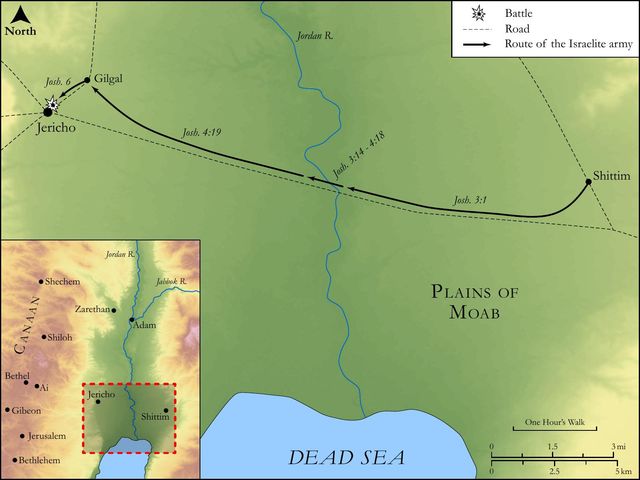
See on the biblical-era map
Study this verse
Public-domain commentary
Matthew Henry
From his Commentary on the Whole Bible. Henry comments on passages, not single verses — this entry covers Joshua 4:1–9. His two-level outline is real structure in the source text, so it is rendered as structure.
We may well imagine how busy Joshua and all the men of war were while they were passing over Jordan, when besides their own marching into an enemy's country, and in the face of the enemy, which could not but occasion them many thoughts of hear, they had their wives, and children, and families, their cattle, and tents, and all their effects, bag and baggage, to convey by this strange and untrodden path, which we must suppose either very muddy or very stony, troublesome to the weak and frightful to the timorous, the descent to the bottom of the river and the ascent out of it steep, so that every man must needs have his head full of care and his hands full of business, and Joshua more than any of them. And yet, in the midst of all his hurry, care must be taken to perpetuate the memorial of this wonderous work of God, and this care might not be adjourned to a time of greater leisure. Note, How much soever we have to do of business for ourselves and our families, we must not neglect nor omit what we have to do for the glory of God and the serving of his honour, for that is our best business. Now,
I.God gave orders for the preparing of this memorial.
Had Joshua done it without divine direction, it might have looked like a design to perpetuate his own name and honour, nor would it have commanded so sacred and venerable a regard from posterity as now, when god himself appointed it. Note, God's works of wonder ought to be kept in everlasting remembrance, and means devise for the preserving of the memorial of them. Some of the Israelites that passed over Jordan perhaps were so stupid, and so little affected with this great favour of God to them, that they felt no concern to have it remembered; while others, it may be, were so much affected with it, and had such deep impressions made upon them by it, that they thought there needed no memorial of it to be erected, the heart and tongue of every Israelite in every age would be a living lasting monument of it. But God, knowing their frame, and how apt they had been soon to forget his works, ordered an expedient for the keeping of this in remembrance to all generations, that those who could not, or would not, read the record of it in the sacred history, might come to the knowledge of it by the monument set up in remembrance of it, of which the common tradition of the country would be an explication; it would likewise serve to corroborate the proof of the matter of fact, and would remain a standing evidence of it to those who in after-ages might question the truth of it. A monument is to be erected, and,
1.Joshua, as chief captain, must five direction about it (v. 1): When all the people had clean passed over Jordan, not even the feeble, that were the hindmost of them, left behind, so that God had done his work completely, and every Israelite got safe into Canaan, then God spoke unto Joshua to provide materials for this monument. It is the pious conjecture of the learned bishop Patrick that Joshua had gone into some place of retirement to return thanks immediately for this wonderful mercy, and then god met him, and spoke thus to him. Or, perhaps, it was by Eleazar the priest that God gave these and other instructions to Joshua; for, though he is not mentioned here, yet, when Joshua was ordained by the imposition of hands to this great trust, god appointed that Eleazar should ask counsel for him after the judgment of Urim, and at his word Joshua and all the children of Israel must go out and come in, Num 27:21.
2.One man out of each tribe, and he a chosen man, must be employed to prepare materials for this monument, that each tribe might have the story told them by one of themselves, and each tribe might contribute something to the glory of God thereby (Jos 4:2, Jos 4:4): Out of ever tribe a man. Not the Levites only, but every Israelite must, in his place, help to make known to the sons of men God's mighty acts, Psa 145:12. The two tribes, though seated already in their possession, yet, sharing in the mercy, must lend a hand to the memorial of it.
3.The stones that must be set up for this memorial are ordered to be taken out of the midst of the cannel (where, probably, there lay abundance of great stones), and as near as might be from the very place where the priests stood with the ark, Jos 4:3, Jos 4:5. This intended monument deserved to be made of stones curiously cut with the finest and most exquisite art, but these stones out of the bottom of the river were more natural and more apt indications of the miracle. let posterity know by this that Jordan was driven back, for these very stones were then fetched out of it. In the institution of signs, God always chose that which was most proper and significant, rather than that which is pompous or curious; for God hath chosen the foolish things of the world. These twelve men, after they got over Jordan, must be sent back to the place where the ark stood, being permitted to come near it (which others might not) for this service: "Pass over before the ark (Jos 4:5), that is, into the presence of the ark, which now stands in the midst of Jordan, and thence fetch these stones." 4. the use of these stones is here appointed for a sign (Jos 4:6), a memorial, Jos 4:7. They would give occasion to the children to ask their parents in time to come, How came these stones hither? (probably the land about not being stony), and then the parents would inform them, as they themselves had been informed, that in this place Jordan was divided by the almighty power of God, to give Israel passage into Canaan, as Joshua enlarges on this head, v. 22, etc.
II.According to these orders the thing was done.
1. Twelve stones were taken up out of the midst of Jordan, and carried in the sight of the people to the place where they had their head-quarters that night, v. 8. It is probable that the stones they took were as big as they could well carry, and as near as might be of a size and shape. But whether they went away with them immediately to the place, of whether they staid to attend the ark, and kept pace with the solemn procession of that, to grace its triumphant entry in to Canaan, is not certain. By these stones which they were ordered to take up God did, as it were, give them livery and seisin of this good land; it is all their own, let them enter and take possession; therefore what these twelve did the children of Israel are said to do (v. 8), because they were the representatives of their respective tribes. In allusion to this, we may observe that when the Lord Jesus, our Joshua, having overcome the sharpness of death and dried up that Jordan, had opened the kingdom of heaven to all believers, he appointed his twelve apostles according to the number of the tribes of Israel, by the memorial of the gospel to transmit the knowledge of this to remote places and future ages. 2. Other twelve stones (probably much larger than the other, for we read not that they were each of them one man's load) were set up in the midst of Jordan (v. 9), piled up so high in a heap or pillar as that the top of it might be seen above the water when the river was low, or seen in the water when it was clear, or at least the noise of commotion of the water passing over it would be observable, and the bargemen would avoid it, as they do a rock. Some way or other, it is likely, it was discernible, so as to notify the very place where the ark stood, and to serve for a duplicate to the other monument, which was to set up on dry land in Gilgal, for the confirming of its testimony and the preserving of its tradition. The sign being doubled, no doubt the thing was certain.
Continue studying Joshua 4:9 across the web’s major study libraries — every link below opens this exact verse, chapter, or book on the destination site.
Read & Compare
 BibleGatewayThis verse in more than 200 translations and 70 languages.
 Bible.comThe YouVersion reader — hundreds of translations, reading plans, and highlights.
 ESV.orgCrossway's official English Standard Version reader.
 NET BibleThe NET translation with 60,000+ translators' notes on every rendering decision.
 STEP BibleTyndale House's free study tool — original text, vocabulary, and scholarly resources.
 BibliaLogos Bible Software's free web reader.
 USCCBThe New American Bible (Revised Edition) with the U.S. bishops' study notes.
Commentaries
 BibleHub CommentariesDozens of classic commentaries on this verse, gathered on one page.
 StudyLightMore than 100 commentary sets — the largest collection on the web.
 BibleRefPlain-English commentary on what this verse means, verse by verse.
 Enduring WordDavid Guzik's free commentary on this chapter, widely used by Bible teachers.
 Bible Study ToolsVerse commentary alongside Greek and Hebrew study aids.
Original Language & Research
- BibleHub InterlinearThe verse word by word — original language, transliteration, and English.
- BibleHub LexiconEvery word's original-language definition and Strong's entry.
 Blue Letter BibleDeep-study tools — Strong's numbers, concordance, and word studies.
 SefariaThe Hebrew text with Rashi and centuries of Jewish commentary.
Sermons, Hymns & Audio


TrulyRandomVerse is not affiliated with these sites and doesn’t control their content. They’re linked because they’re genuinely useful.
Summary
Joshua 4:9 details Joshua's distinct and personal initiative to establish a second, submerged monument of twelve stones within the Jordan River. This unique memorial was erected at the precise location where the priests, bearing the Ark of the Covenant, stood firm during the miraculous crossing. This act served as a profound, enduring, and sacred testament to God's mighty intervention and the Ark's pivotal role, ensuring that the exact point of divine power and priestly obedience was indelibly marked for posterity, even if its presence was known primarily to those who understood its profound origin and purpose.
Context
ShowHideLiterary Context
Joshua 4:9 is strategically placed within the climactic narrative of Israel's entry into the Promised Land, immediately following the miraculous division of the Jordan River. The preceding chapter, Joshua 3, meticulously describes God's command for the priests, carrying the sacred Ark of the Covenant, to step into the swollen Jordan. At this divine signal, the waters upstream were miraculously cut off, allowing the entire nation to cross on dry ground. Joshua 4:1-8 then outlines God's specific instruction for twelve representatives, one from each tribe, to retrieve twelve stones from the riverbed where the priests stood and set them up as a highly visible memorial at Gilgal, their first encampment. Verse 9 then introduces a second, distinct memorial, initiated by Joshua himself, placed within the riverbed. This dual memorial system powerfully underscores the unparalleled significance of this miraculous event, highlighting both its public testimony and its sacred, precise location.
Historical & Cultural Context
The crossing of the Jordan River marked a pivotal transition for the Israelite nation, signifying the end of their forty years of wilderness wandering and their long-awaited entry into the land promised to their patriarchs. This event was deliberately orchestrated by God to echo and reinforce the earlier, foundational miracle of the Red Sea crossing (Exodus 14), thereby demonstrating God's unwavering covenant faithfulness and His omnipotence to a new generation, as well as to the Canaanite inhabitants. Memorial stones were a familiar practice from the days of the patriarchs, serving as tangible markers for significant events, covenants, boundaries, or divine interventions, as when Jacob set up a pillar at Bethel and a heap of witness was raised at Galeed. They functioned as enduring historical records and vital pedagogical tools. The Jordan River, particularly formidable during its harvest flood season (Joshua 3:15), was transformed into a powerful symbol of God's ability to overcome all natural and spiritual obstacles for His chosen people. The Ark of the Covenant, central to this narrative, was far more than a mere religious artifact; it was the tangible symbol of God's holy presence among His people, His divine throne, and the very embodiment of His covenant. Its presence at the precise point of the miracle profoundly underscored divine leadership, authority, and the sanctity of the event.
Key Themes
ShowHideJoshua 4:9 powerfully contributes to several overarching themes woven throughout the book of Joshua and the broader Old Testament narrative. Foremost is the theme of Divine Faithfulness and Power, as God once again unequivocally demonstrates His ability to perform extraordinary miracles to fulfill His promises, mirroring the earlier deliverance at the Red Sea (compare Exodus 14 with Joshua 3). The stones, both those at Gilgal and those in the Jordan, serve as potent symbols of Remembrance and Testimony, ensuring that future generations would inquire about and understand God's mighty acts (as explicitly stated in Joshua 4:6-7). The central role of the Ark of the Covenant emphasizes the theme of God's Presence and Leadership, indicating unequivocally that Israel's success was not attributable to their own strength or military prowess, but solely to the Lord who led the way. Finally, Joshua's personal and distinct act of setting up these additional stones highlights the theme of Obedient Leadership, demonstrating his profound commitment to honoring God's work and meticulously preserving its memory for all time.
Exposition and Analysis
ShowHideKey Word Analysis
ShowHideThis verb (H6965), meaning "to rise," "to stand," or "to establish," is used here in a causative sense, "to cause to stand" or "to erect." It implies a deliberate, intentional, and permanent action of establishing a marker. Unlike merely placing stones, "setting up" suggests an intentional construction designed to endure, reflecting the lasting and foundational significance of the event being commemorated.
This common noun (H68) refers to a stone, but in this sacred context, these are not just ordinary rocks. They are chosen, consecrated objects, imbued with profound symbolic meaning as a memorial. Their number, twelve, is highly significant, representing the twelve tribes of Israel, signifying a corporate, national witness to God's faithfulness and the unity of His people in experiencing His miraculous deliverance.
This word (H3117), meaning "day," is crucial to the idiomatic phrase "unto this day," which signifies an enduring presence or memory. It functions as a historical marker, authenticating the account by affirming that the memorial was still observable or known at the time the book of Joshua was written or compiled. This phrase reinforces the perpetual purpose of the stones as a witness to God's enduring faithfulness and the lasting impact of the Jordan crossing.
Verse Breakdown
ShowHide"And Joshua set up twelve stones in the midst of Jordan"
This clause highlights Joshua's personal and distinct initiative in creating a second, separate memorial. While the first set of twelve stones was taken from the Jordan and set up on the land at Gilgal as a public, visible display for future generations, these stones were uniquely erected in the riverbed itself. This suggests a deeper, perhaps more intimate and reverent, act of remembrance by Joshua, marking the precise, sacred spot of the miracle. The number twelve again emphasizes the representation of all Israel, underscoring the corporate nature of God's deliverance.
"in the place where the feet of the priests which bare the ark of the covenant stood"
This phrase precisely locates the memorial, indicating its profound sacredness. It was not just anywhere in the river, but at the exact, consecrated spot where the Ark of the Covenant, the tangible symbol of God's active presence, throne, and leadership, rested. The priests, acting as mediators and representatives, stood firm, holding the Ark, while the entire nation passed by, underscoring their crucial role in the divine plan and the sanctity and power associated with that specific location.
"and they are there unto this day"
This concluding statement provides a powerful historical affirmation. It asserts that these stones remained in the Jordan, serving as a silent, enduring witness to the miraculous event for generations. This phrase validates the account for the original audience, indicating that the evidence of God's intervention was still observable or at least remembered in their time, reinforcing the truth, historicity, and lasting impact of the Jordan crossing.
Literary Devices
ShowHideJoshua 4:9 masterfully employs several powerful literary devices to convey its profound message. Symbolism is paramount, as the twelve stones themselves symbolize the twelve tribes of Israel and serve as a tangible memorial to God's miraculous intervention. The deliberate act of setting them in the Jordan rather than solely on the bank adds a layer of profound reverence and sacredness for the exact, hallowed spot where the Ark of the Covenant stood, symbolizing God's direct presence and power at the very heart of the miracle. The recurring phrase "unto this day" functions as an affirmation of historical veracity, a common and effective literary device in biblical narratives that authenticates the account and underscores the lasting impact and observable evidence of the divine act. This also contributes significantly to the didactic purpose of the narrative, ensuring that the event serves as a perpetual lesson for future generations about God's unwavering faithfulness, His omnipotent power, and the importance of remembering His mighty deeds.
Theological and Thematic Connections
ShowHideJoshua 4:9 profoundly connects to the broader biblical narrative of God's covenant faithfulness and His strategic use of tangible reminders to transmit divine truth across generations. The act of setting up memorial stones echoes earlier instances where God commanded or inspired the creation of physical markers to commemorate divine encounters or significant events, ensuring that His mighty acts would not be forgotten. These stones in the Jordan serve not only as a historical record but as a profound theological statement about God's active involvement in the life of His people, His absolute sovereignty over creation, and His unwavering commitment to fulfilling His promises. They underscore the timeless principle that remembering God's past faithfulness strengthens faith for present challenges and provides an enduring testimony to His glory for all who inquire.
Reflection and Application
ShowHideJoshua's deeply personal act of setting up these submerged stones in the Jordan offers a powerful and enduring lesson in intentional remembrance. While the stones at Gilgal served as a grand, public display for the nation, these stones in the riverbed represented a deeper, perhaps more intimate, memorial, marking the very spot where God's tangible presence (the Ark) manifested His power in an unprecedented way. This poignant detail reminds us that our faith journey is not solely about grand, public declarations, but also about cherishing and remembering the intimate, sacred moments where God has profoundly intervened in our individual lives. We are called to actively remember our own "Jordan crossings" – those seemingly impossible situations where God miraculously made a way, where His presence was palpable, and where His power broke through formidable obstacles. Creating our own "stones of remembrance," whether through disciplined journaling, specific prayer points, or regular, deliberate reflection, helps us solidify our faith, ground us firmly in God's past faithfulness, and provides a wellspring of hope and courage for navigating future challenges. These personal memorials become a powerful testimony not only to ourselves but also to those we influence, demonstrating the living, active reality of God's transformative work in our lives.
Questions for Reflection
ShowHideFAQ
ShowHideWhy did Joshua set up twelve stones in the Jordan when twelve other stones were taken out of the Jordan and set up at Gilgal?
ShowHideThe biblical text clearly indicates two distinct sets of twelve stones, each serving a slightly different, yet complementary, purpose, though both were memorials to the same miraculous event. The twelve stones taken out of the Jordan and set up at Gilgal (Joshua 4:8 and Joshua 4:20) were explicitly commanded by God and served as a highly visible, public monument for the entire nation. Their primary purpose was explicitly stated: to be a teaching tool for future generations, prompting children to inquire about their meaning, allowing parents to recount God's mighty act (Joshua 4:6-7 and Joshua 4:21-22). In contrast, the twelve stones Joshua set up in the midst of the Jordan (Joshua 4:9) were his own initiative, an additional act of reverence. While less visible, being submerged, they marked the precise, sacred spot where the priests bearing the Ark of the Covenant stood during the miracle. This second set of stones likely served as a deeper, more intimate memorial for Joshua and perhaps for the priests themselves, honoring the exact location of divine power and priestly obedience. It underscored the profound significance of that specific place, ensuring that even the riverbed itself bore a silent, enduring witness to God's intervention.
Christ-Centered Fulfillment
ShowHideThe miraculous crossing of the Jordan and the subsequent memorials in Joshua 4:9 find profound Christ-centered fulfillment in the person and redemptive work of Jesus Christ. Just as the Ark of the Covenant, symbolizing God's holy presence, led Israel through the seemingly impossible barrier of the Jordan River into the Promised Land, so Jesus Christ, the ultimate embodiment of God's presence and the very Word made flesh, leads His people through the impossible barrier of sin and death into the spiritual promised land of eternal life and rest. The stones set up in the Jordan mark the place where the "waters of judgment" were held back, allowing God's people to pass into new life and inheritance. This powerfully foreshadows Christ's ultimate and perfect sacrifice on the cross, where He fully bore the judgment for humanity's sin, allowing all who believe in Him to pass safely from spiritual death to eternal life, from the wilderness of sin into the new creation. He is the true "Ark" who stands in the gap, and through His finished work, we are enabled to enter into the glorious rest that remains for the people of God (Hebrews 4:9-11). The memorials, both visible and submerged, point to the enduring reality of God's saving power, which culminates in the resurrected Christ, who is our living memorial, forever testifying to God's faithfulness and His triumphant victory over sin and death (Romans 6:4). Through Him, we are not merely entering a physical land, but a spiritual reality where God's promises are fully realized in the new covenant life He offers (2 Corinthians 5:17).