


1 Samuel 7:13
- וַיִּכָּנְעוּvai·yi·ka·ne·'Uand they were subduedH3665Conj-w ¦ V-Niphal-ConsecImperf-3mpVerb Niphal Consecutive Imperfect 3rd Plural Masculineוַandיִּכָּנְעוּthey were subdued
- הַפְּלִשְׁתִּיםha·pe·lish·Timthe PhilistinesH6430Art ¦ N-mpNoun Gentilic Plural Masculine AbsoluteהַtheפְּלִשְׁתִּיםPhilistines
- וְלֹאve·lo'and notH3808Conj-w ¦ NegParticle Negativeוְandלֹאnot
- יָסְפוּya·se·Futhey repeatedH3254V-Qal-Perf-3cpVerb Qal Perfect 3rd Plural common gender
- עוֹדodagainH5750Adj-msAdjective Numerical Singular Masculine Absolute
- לָבוֹאla·Vo'to comeH935Prep-l ¦ V-Qal-InfVerb Qal Infinitive Constructלָtoבוֹאcome
- בִּגְבוּלbig·Vulin [the] territory ofH1366Prep-b ¦ N-mscNoun Singular Masculine Constructבִּinגְבוּל[the] territory of
- יִשְׂרָאֵלYis·ra·'ElIsraelH3478N-properNoun Proper Location
- וַתְּהִיva·te·Hiand it wasH1961Conj-w ¦ V-Qal-ConsecImperf-3fsVerb Qal Consecutive Imperfect 3rd Singular Feminineוַandתְּהִיit was
- יַדyad[the] hand ofH3027N-cscNoun Singular common gender Construct
- יְהוָהYah·wehYahwehH3068N-properNoun Proper Title
- בַּפְּלִשְׁתִּיםba·pe·lish·Timon the PhilistinesH6430Prep-b ¦ N-mpNoun Gentilic Plural Masculine Absoluteבַּon theפְּלִשְׁתִּיםPhilistines
- כֹּלkolallH3605N-mscNoun Singular Masculine Construct
- יְמֵיye·Mei[the] days ofH3117N-mpcNoun Plural Masculine Construct
- שְׁמוּאֵלshe·mu·'ElSamuelH8050N-proper-mNoun Proper Masculine
English is a literal word-by-word gloss of the Hebrew, not the KJV's wording. Why?
This is the original text the KJV's translators worked from — each Hebrew word with its own literal English meaning in this verse, prepared by scholars at Tyndale House, Cambridge. The KJV translates whole sentences, not word by word, so its wording differs: one Hebrew word can become several English words, and the KJV may choose “the LORD” where the gloss reads “Yahweh”. Both are faithful — they answer different questions. For the KJV's own rendering, switch to the KJV text.
Details
See on the biblical-era maps
Study this verse
Public-domain commentary
Matthew Henry
From his Commentary on the Whole Bible. Henry comments on passages, not single verses — this entry covers 1 Samuel 7:13–17.
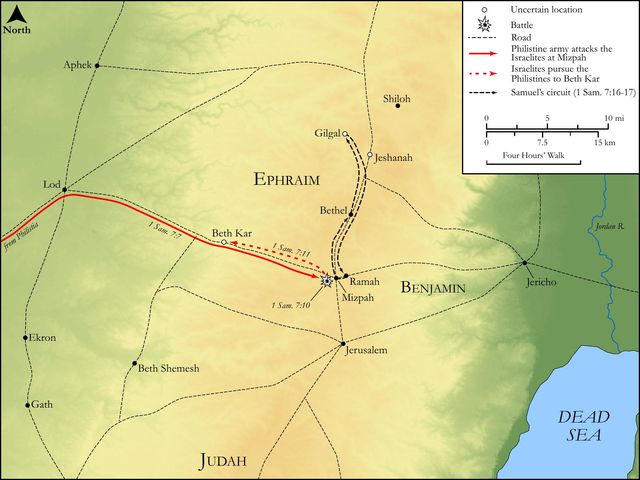
We have here a short account of the further good services that Samuel did to Israel. Having parted them from their idols, and brought them home to their God, he had put them into a capacity of receiving further benefits by his ministry. Having prevailed in that, he becomes, in other instances, a great blessing to them; yet, writing it himself, he is brief in the relation. We are not told here, but it appears (Ch2 35:18) that in the days of Samuel the prophet the people of Israel kept the ordinance of the passover with more than ordinary devotion, notwithstanding the distance of the ark and the desolations of Shiloh. Many good offices, no doubt, he did for Israel, but here we are only told how instrumental he was, 1. In securing the public peace (Sa1 7:13): "In his days the Philistines came no more into the coast of Israel, made no inroads or incursions upon them; they perceived that God now fought for Israel and that his hand was against the Philistines, and this kept them in awe, and restrained the remainder of their wrath." Samuel was a protector and deliverer to Israel, not by dint of sword, as Gideon, nor by strength of arm, as Samson, but by the power of prayer to God and carrying on a work of reformation among the people. Religion and piety are the best securities of a nation. 2. In recovering the public rights, Sa1 7:14. By his influence Israel had the courage to demand the cities which the Philistines had unjustly taken from them and had long detained; and the Philistines, not daring to contend with one that had so great an interest in heaven, tamely yielded to the demand, and restored (some think) even Ekron and Gath, two of the capital cities, though afterwards they retook them; others think some small towns that lay between Ekron and Gath, which were forced out of the Philistines' hands. This they got by their reformation and religion, they got ground of their enemies and got forward in their affairs. It is added, There was peace between Israel and the Amorites, that is, the Canaanites, the remains of the natives. Not that Israel made any league with them, but they were quiet, and not so mischievous to Israel as they had sometimes been. Thus when a man's ways please the Lord he maketh even his enemies to be at peace with him and give him no disturbance, Pro 16:7. 3. In administering public justice (Sa1 7:15, Sa1 7:16): He judged Israel; as a prophet he taught them their duty and reproved them for their sins, which is called judging, Eze 20:4; Eze 22:2. Moses judged Israel when he made them know the statutes of God and his laws (Exo 18:16); and thus Samuel judged them to the last, even after Saul was made king; so he promised them then, when Saul was inaugurated (Sa1 12:23), I will not cease to teach you the good and the right way. As a magistrate, he received appeals from the inferior courts and gave judgment upon them, tried causes and determined them, tried prisoners and acquitted or condemned them, according to the law. This he did all his days, till he grew old and past service, and resigned to Saul; and afterwards he exercised authority when application was made to him; nay, he judged even Agag, and Saul himself. But when he was in his prime he rode the circuit, for the convenience of the country, at least of that part of it which lay most under his influence. He kept courts at Beth-el, Gilgal, and Mizpeh, all in the tribe of Benjamin; but his constant residence was at Ramah, his father's city, and there he judged Israel, thither they resorted to him from all parts with their complaints, Sa1 7:17. 4. In keeping up the public exercises of religion; for there, where he lived, he built an altar to the Lord, not in contempt of the altar that was at Nob, or Gibeon, or wherever the tabernacle was; but divine justice having laid Sholoh waste, and no other place being yet chosen for them to bring their offerings to (Deu 12:11), he looked upon the law which confined them to one place to be for the present suspended, and therefore, being a prophet, and under divine direction, he did as the patriarchs did, he built an altar where he lived, both for the use of his own family and for the good of the country that resorted to it. Great men should use their wealth, power, and interest, for the keeping up of religion in the places where they live.
Historical interpretation
Historical reception
2 surviving comments on this verse. Each one is dated, so this reads as a timeline rather than a list.
And the hand of the Lord was upon the Philistines, etc. The grace of Christ was made to crush the enemies of the primitive Church wherever the light of the Gospel shone in Judea, nor is it repulsed by disbelief and persecution. And the souls deceived by unclean teachers or spirits, are rendered and brought back to the society of the Church, from those who remained sterile of good works, to those who not only remained fruitless for themselves but also tried to oppress those who were fruitful. For Accaron turns into sterility, Geth into a winepress. And indeed, the understanding of sterility is clear, because every tree that does not bear good fruit will be cut down and thrown into the fire (Matthew III). The winepress, however, signifies persecutors of the good, as the Psalms inscribed for the winepresses, and the action of the winepresses themselves demonstrate. For the wood cut from the root, stripped of leaf and bark, and utterly deprived of any hope of bearing fruit, is compacted solely for the pressing of grapes or olives. While pressed by weight, with the husks crushed and skins emptied, the most joyous must and the richest streams of oil flow; the precious liquid indeed is stored in the cellars, but the waste shells are thrown out. Indeed, the winepresses remain empty of fruit, only eagerly awaiting when they begin to press something, until even themselves, worn by long use, are consigned to flames to be burned. Thus, surely, thus the torturers of the Church not only lack the greenery of faith, the leaves of confession, and the good fruits of operation; but also do not cease to weary the fruitful souls engaged in works of mercy and love, and other virtues' pursuits, up to the dissolution of the flesh. For they have nothing more to do after these things, when the dust returns to the earth as it was, and the spirit returns to God who gave it, and they, always being adversaries to the good, are forever consigned to the flames of Gehenna at the appointed time. Yet because some from such individuals, through Christ’s mercy, reclaim the salvation they lost in the first man, it is rightly said that Israel’s cities, from Accaron to Geth, that is, from sterility to the winepress, are restored. Indeed, the Accaronite was Sergius Paulus the proconsul, the Accaronite was Dionysius the Areopagite. The Gethite was that young man aspiring to threaten and kill Christ's disciples. Finally, the most noble cluster, crowned by rank, name, and passion, to be offered to Christ in the first fruits of the Church, was stripped of the burden of the flesh by the pressure of stones. But while they came from paganism to faith, and he from being a persecutor even to the grace of apostleship, indeed the cities—sterility and the winepress—when captured by the enemy, are reclaimed by the Church.
And the Philistines were humbled, etc. When they came to that assisting stone, to which the Psalmist according to the Hebrew truth alone sings: "Be to me a strong rock and a fortified house, to save me, for you are my rock and my fortress" (Psalm 30), our enemies will be humbled, nor will they again invade the borders of our strength, when they see themselves defeated with us glorified before the Lord. For as long as we toil in this world, the wars of temptations will never be lacking.
Continue studying 1 Samuel 7:13 across the web’s major study libraries — every link below opens this exact verse, chapter, or book on the destination site.
Read & Compare
 BibleGatewayThis verse in more than 200 translations and 70 languages.
 Bible.comThe YouVersion reader — hundreds of translations, reading plans, and highlights.
 ESV.orgCrossway's official English Standard Version reader.
 NET BibleThe NET translation with 60,000+ translators' notes on every rendering decision.
 STEP BibleTyndale House's free study tool — original text, vocabulary, and scholarly resources.
 BibliaLogos Bible Software's free web reader.
 USCCBThe New American Bible (Revised Edition) with the U.S. bishops' study notes.
Commentaries
 BibleHub CommentariesDozens of classic commentaries on this verse, gathered on one page.
 StudyLightMore than 100 commentary sets — the largest collection on the web.
 BibleRefPlain-English commentary on what this verse means, verse by verse.
 Enduring WordDavid Guzik's free commentary on this chapter, widely used by Bible teachers.
 Bible Study ToolsVerse commentary alongside Greek and Hebrew study aids.
Original Language & Research
- BibleHub InterlinearThe verse word by word — original language, transliteration, and English.
- BibleHub LexiconEvery word's original-language definition and Strong's entry.
 Blue Letter BibleDeep-study tools — Strong's numbers, concordance, and word studies.
 SefariaThe Hebrew text with Rashi and centuries of Jewish commentary.
Sermons, Hymns & Audio


TrulyRandomVerse is not affiliated with these sites and doesn’t control their content. They’re linked because they’re genuinely useful.
Summary
marks a profound turning point in Israel's history, declaring a sustained period of peace and divine protection following a national repentance and a decisive victory over the Philistines. This verse emphatically attributes the cessation of Philistine aggression to the direct and continuous intervention of God, highlighting the transformative impact of faithful leadership and national obedience on the security and well-being of His covenant people throughout Samuel's tenure as judge and prophet.
Context
ShowHideLiterary Context
This verse serves as the triumphant climax of the narrative presented in 1 Samuel chapter 7. The preceding chapters detail a twenty-year period of Philistine oppression and the tumultuous return of the Ark of the Covenant. Samuel, emerging as a pivotal leader, calls the nation to a profound spiritual revival at Mizpah. The people respond by confessing their sins, renouncing foreign gods, and committing themselves to serving the LORD alone, as exhorted by Samuel in 1 Samuel 7:3. While Israel is gathered for a burnt offering and Samuel's intercession, the Philistines launch a surprise attack. However, God intervenes dramatically, sending a great thunder that throws the Philistines into utter confusion, enabling Israel to rout them. This miraculous victory is commemorated by the erection of a memorial stone, Ebenezer, meaning "stone of help," as recorded in 1 Samuel 7:12. Verse 13 then encapsulates the long-term, comprehensive impact of this divine deliverance, signifying a remarkable and enduring era of peace and security.
Historical & Cultural Context
During this period, the Philistines represented the preeminent military and technological power in the Levant. Their control extended over significant Israelite territories, and their mastery of iron weaponry gave them a formidable advantage over Israel, who, as noted in 1 Samuel 13:19-22, largely lacked smiths. This oppression, which had lasted twenty years according to 1 Samuel 7:2, posed a constant existential threat to Israel's national identity and religious fidelity. The Philistines worshipped deities such as Dagon, as seen in 1 Samuel 5:2-5, and their pervasive presence presented not only a political and military challenge but also a profound spiritual temptation towards idolatry. The victory at Mizpah, therefore, was far more than a mere military triumph; it was a powerful theological declaration of the LORD's absolute supremacy over pagan gods and His unwavering commitment to fight for a repentant people.
Key Themes
ShowHideThis verse powerfully articulates several core themes central to the book of 1 Samuel and the broader Old Testament narrative. Foremost is the theme of Divine Deliverance and Protection, emphasizing that Israel's security and freedom stemmed directly from God's active, sovereign intervention, not from their own military might. The phrase "the hand of the LORD was against the Philistines" unequivocally attributes the cessation of hostilities to divine power. This highlights the foundational principle of the Consequences of Repentance and Obedience, where Israel's turning from idolatry and their heartfelt seeking of the LORD's face in 1 Samuel 7:3-6 directly preceded this period of peace and divine favor. Finally, the verse underscores Samuel's Enduring Influence and Faithful Leadership. The peace lasting "all the days of Samuel" testifies to his consistent role as a faithful prophet, intercessor, and judge, whose righteous leadership helped maintain the nation's spiritual alignment with God, thereby securing divine blessing and protection.
Exposition and Analysis
ShowHideKey Word Analysis
ShowHideThis verb (H3665) properly means "to bend the knee," and by implication, "to humble," "to vanquish," or "to bring into subjection." In the context of 1 Samuel 7:13, it signifies a complete and decisive defeat of the Philistines. It implies that they were not merely repelled but brought under a state of submission or control, losing their capacity to launch further incursions. This term speaks to a comprehensive and lasting victory, indicating a fundamental shift in their power and influence, rather than just a temporary setback.
This powerful anthropomorphic idiom combines "hand" (yâd, H3027), which signifies power, authority, and direct action, with "LORD" (Yᵉhôvâh, H3068), the self-Existent and Eternal God, the covenant name of God. Together, this phrase denotes God's active, forceful, and sovereign intervention. It conveys that the LORD Himself was the primary agent in subduing the Philistines, applying His divine might directly "against" them to ensure their defeat and prevent their re-invasion. It is a testament to God's personal and effective involvement in the affairs of His people.
This noun (H3117) refers to a day (as the warm hours), but can also figuratively mean "a space of time defined by an associated term," or an "age." In the phrase "all the days of Samuel," it indicates the entire duration of Samuel's active leadership as judge and prophet. It emphasizes the sustained nature of the peace and divine protection, directly linking this era of security to Samuel's faithful and righteous governance. It implies a long and consistent period, rather than a fleeting moment.
Verse Breakdown
ShowHide"So the Philistines were subdued,"
This opening clause declares the immediate and profound outcome of the divine intervention at Mizpah. The Philistines, who had been a persistent and oppressive threat for decades, were decisively defeated. The passive voice ("were subdued") subtly emphasizes that the action was performed upon them, pointing to a higher, divine power as the ultimate agent of their subjugation, rather than Israel's own strength.
"and they came no more into the coast of Israel:"
This clause details the lasting, tangible consequence of the Philistines' subjugation. It signifies a complete cessation of their aggressive incursions and a sustained period of peace and security for Israel. This was a remarkable and unprecedented relief, indicating a significant shift in the power dynamics of the region, directly attributable to God's intervention. The "coast of Israel" refers to the territory and borders of the nation.
"and the hand of the LORD was against the Philistines all the days of Samuel."
This final, crucial clause reveals the ultimate reason for the sustained peace and the Philistines' inability to resume their attacks. It was not Israel's military might or strategic prowess, but the continuous, active, and hostile "hand of the LORD" that kept the Philistines at bay. The phrase "all the days of Samuel" underscores the duration and consistency of this divine protection, linking it directly to the period of Samuel's righteous and faithful leadership as judge and prophet.
Literary Devices
ShowHideThe verse employs several impactful literary devices to convey its powerful message. Divine Intervention is the overarching theme, explicitly stated through the powerful idiom "the hand of the LORD," which personifies God's active and forceful presence in human affairs. This idiom is a form of Anthropomorphism, attributing a human body part (hand) to God to convey His power and action in a relatable way, emphasizing His direct involvement. The phrase "all the days of Samuel" functions as a form of Merism or Generalization, emphasizing a long and consistent period of peace and divine protection under Samuel's leadership, rather than suggesting literally every single day was without any minor skirmish. It highlights the overall stability and security that characterized his era. The narrative structure itself demonstrates a clear Cause and Effect relationship, where Israel's repentance and Samuel's intercession (the cause) lead directly to divine deliverance and lasting peace (the effect).
Theological and Thematic Connections
ShowHide1 Samuel 7:13 powerfully illustrates the Old Testament principle that national well-being and security are directly linked to a nation's spiritual fidelity and obedience to God. When Israel turned from idolatry and sought the LORD with all their heart, God responded with decisive deliverance and sustained protection. This verse underscores God's unwavering commitment to defend His covenant people when they walk in righteousness, acting as their divine warrior. It also highlights the crucial role of righteous leadership, as Samuel's faithful intercession and guidance were instrumental in maintaining this period of divine favor and peace. The "hand of the LORD" is a recurring motif signifying God's sovereign power, whether in judgment or salvation, reminding us that true security comes from Him alone.
Reflection and Application
ShowHideThe enduring peace described in 1 Samuel 7:13, a direct result of God's intervention and Israel's repentance, offers profound lessons for believers today. It reminds us that true and lasting peace, whether personal or corporate, originates not from human strength, strategic planning, or even the absence of external threats, but from a right relationship with God. When we acknowledge our sin, turn from our idols (whether material possessions, career ambition, unhealthy relationships, or self-reliance), and wholeheartedly seek the LORD, His "hand" is extended not against us, but for us. This verse encourages us to cultivate a life of ongoing repentance and faithful obedience, trusting that God remains our ultimate defender and provider of peace, even in the face of daunting challenges. It calls us to recognize His active presence in our lives, subduing the spiritual and practical "Philistines" that seek to disrupt our peace and draw us away from Him.
Questions for Reflection
ShowHideFAQ
ShowHideWas this peace absolute, with no Philistine presence or conflict at all?
ShowHideWhile the verse states "they came no more into the coast of Israel" and "the hand of the LORD was against the Philistines all the days of Samuel," this likely signifies a cessation of organized, large-scale incursions and oppressive dominance. It implies a sustained period of relative peace and security for Israel, where the Philistines were effectively prevented from launching major attacks that threatened Israel's sovereignty. It does not necessarily mean there were zero minor skirmishes or Philistine presence in border areas, but rather that their power to oppress and invade was neutralized for the duration of Samuel's judgeship. The narrative in 1 Samuel 9:16 and 1 Samuel 13 shows that the Philistine threat re-emerged later, especially during Saul's reign, indicating that while Samuel's era saw significant divine protection, the underlying tension and potential for conflict remained, to be addressed by future leaders.
Christ-Centered Fulfillment
ShowHide1 Samuel 7:13, with its declaration of divine deliverance and lasting peace under Samuel's leadership, profoundly foreshadows the ultimate and eternal peace secured by Jesus Christ. Just as the "hand of the LORD" was against the Philistines, subduing them for Israel's sake, so too was the "hand of the LORD" (God's power and authority) decisively against sin, death, and the devil through Christ's atoning work on the cross and His glorious resurrection. Jesus is the greater Samuel, the ultimate Judge and Prophet, who calls His people to true repentance and delivers them from a far more formidable enemy than the Philistines: the spiritual forces of darkness and the bondage of sin (Colossians 2:15). The peace Israel experienced was temporal and conditional, dependent on their obedience and Samuel's life. However, the peace Christ offers is eternal, unconditional, and secured by His finished work (John 14:27). He is our true Ebenezer, the "stone of help," through whom we receive not just temporary relief but everlasting salvation and the promise of His abiding presence, ensuring that the ultimate "enemy" (sin and death) "comes no more into the coast" of our spiritual lives, for we are eternally secure in Him (Romans 8:37-39).