


1 Samuel 9:16
Bible text: King James Version (1769 Blayney text) · Public domain
Bible text: King James Version with Strong's numbers · Public domain
Bible text: Berean Standard Bible · Public domain
Bible text: American Standard Version (1901) · Public domain
Bible text: World English Bible, Messianic edition · Public domain
Bible text: Geneva Bible (1599) · Public domain
Bible text: Young's Literal Translation · Public domain
- כָּעֵתka·'Etabout <the> this timeH6256Prep-k ¦ N-csNoun Singular common gender Absoluteכָּabout <the>עֵתthis time
- מָחָרma·ChartomorrowH4279N-msNoun Singular Masculine Absolute
- אֶשְׁלַח'esh·LachI will sendH7971V-Qal-Imperf-1csVerb Qal Imperfect 1st Singular common gender
- אֵלֶיךָ'e·Lei·khato youH413Prep ¦ 2msPreposition Definiteאֵלֶיtoךָyou
- אִישׁ'isha manH376N-msNoun Singular Masculine Absolute
- מֵאֶרֶץme·'E·retzfrom [the] land ofH776Prep-m ¦ N-fscNoun Singular Feminine Constructמֵfromאֶרֶץ[the] land of
- בִּנְיָמִןbin·ya·MinBenjaminH1144N-proper-mNoun Proper Masculine
- וּמְשַׁחְתּוֹu·me·shach·Toand you will anoint himH4886Conj-w ¦ V-Qal-ConsecPerf-2ms ¦ 3msVerb Qal Consecutive Perfect 2nd Singular Masculineוּandמְשַׁחְתּyou will anointוֹhim
- לְנָגִידle·na·Gidto rulerH5057Prep-l ¦ N-msNoun Singular Masculine Absoluteלְtoנָגִידruler
- עַל'aloverH5921PrepPreposition
- עַמִּי'a·Mimy peopleH5971N-msc ¦ 1csNoun Singular Masculine Constructעַמִּpeopleיmy
- יִשְׂרָאֵלYis·ra·'ElIsraelH3478N-properNoun Proper Location
- וְהוֹשִׁיעַve·ho·Shi·a'and he will deliverH3467Conj-w ¦ V-Hiphil-ConsecPerf-3msVerb Hiphil Consecutive Perfect 3rd Singular Masculineוְandהוֹשִׁיעַhe will deliver
- אֶת'et<obj.>H853DirObjMParticle Object Indicator
- עַמִּי'a·Mimy peopleH5971N-msc ¦ 1csNoun Singular Masculine Constructעַמִּpeopleיmy
- מִיַּדmi·Yadfrom [the] hand ofH3027Prep-m ¦ N-cscNoun Singular common gender Constructמִfromיַּד[the] hand of
- פְּלִשְׁתִּיםpe·lish·Tim[the] PhilistinesH6430N-mpNoun Gentilic Plural Masculine Absolute
- כִּיkiforH3588PrtParticle Conditional
- רָאִיתִיra·'I·tiI have seenH7200V-Qal-Perf-1csVerb Qal Perfect 1st Singular common gender
- אֶת'et<obj.>H853DirObjMParticle Object Indicator
- עַמִּי'a·Mimy peopleH5971N-msc ¦ 1csNoun Singular Masculine Constructעַמִּpeopleיmy
- כִּיkiforH3588PrtParticle Conditional
- בָּאָהBa·'ahit has comeH935V-Qal-Perf-3fsVerb Qal Perfect 3rd Singular Feminine
- צַעֲקָתוֹtza·'a·ka·Toits cry of distressH6818N-fsc ¦ 3msNoun Singular Feminine Constructצַעֲקָתcry of distressוֹits
- אֵלָי'e·Laito meH413Prep ¦ 1csPreposition Definiteאֵלָtoיme
English is a literal word-by-word gloss of the Hebrew, not the KJV's wording. Why?
This is the original text the KJV's translators worked from — each Hebrew word with its own literal English meaning in this verse, prepared by scholars at Tyndale House, Cambridge. The KJV translates whole sentences, not word by word, so its wording differs: one Hebrew word can become several English words, and the KJV may choose “the LORD” where the gloss reads “Yahweh”. Both are faithful — they answer different questions. For the KJV's own rendering, switch to the KJV text.
Details
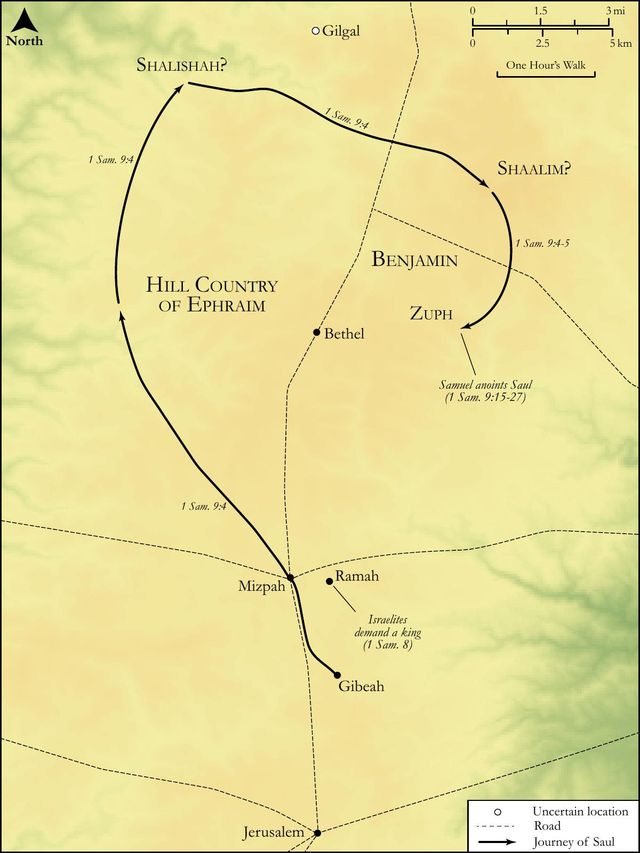
See on the biblical-era map
Study this verse
Public-domain commentary
Matthew Henry
From his Commentary on the Whole Bible. Henry comments on passages, not single verses — this entry covers 1 Samuel 9:11–17. His four-level outline is real structure in the source text, so it is rendered as structure.
Here, I. Saul, by an ordinary enquiry, is directed to Samuel, Sa1 9:11-14. Gibeah of Saul was not twenty miles from Ramah where Samuel dwelt, and was near to Mizpeh where he often judged Israel, and yet, it seems, Saul had lived so very privately, and had taken so little notice of public affairs, that he had never seen Samuel, for when he met him (Sa1 9:18) he did not know him, so that there was no cause to suspect any secret compact or collusion between them in this matter. I knew him not, says John Baptist concerning Christ, Joh 1:31. Yet I do not think it any commendation to Saul that he was a stranger to Samuel. However,
1.The maid-servants of Ramah, whom they met with at the places of drawing water, could give him and his servant intelligence concerning Samuel; and very particular they were in their directions, Sa1 9:12, Sa1 9:13. We should always be ready to give what assistance we can to those that are enquiring after God's prophets, and to further them in their enquiries. Even the maid-servants could tell them,
(1.)That there was a sacrifice that day in the high place, it being either an ordinary festival or an extraordinary day of prayer and thanksgiving, with which sacrifices were joined. The tabernacle being deprived of the ark, the altar there had not now the reputation it formerly had, nor were they confined to it, as they would be when God had again chosen a place to put his name in; and therefore now other places were allowed. Samuel had built an altar at Ramah (Sa1 7:17), and here we have him making use of that altar.
(2.)That Samuel came that day to the city, either from his circuit or from his country seat. He was such a public person that his movements were generally known.
(3.)That this was just the time of their meeting to feast before the Lord upon the sacrifice: "About this time you will find him in the street going up to the high place." They knew the hour of the solemn feast.
(4.)That the people would not eat till Samuel came, not only because he was the worthiest person, and they ought in good manners to stay for him, and he was, as some think, the maker of this feast, the sacrifice being offered at his charge and upon his account; but because, as a man of God, whoever made the feast, he must bless the sacrifice, that is, those parts of the sacrifice which they feasted upon, which may be considered,
[1.]As a common meal, and so this is an instance of the great duty of craving a blessing upon our meat before we partake of it. We cannot expect benefit from our food without that blessing, and we have no reason to expect that blessing if we do not pray for it. Thus we must give glory to God as our benefactor, and own our dependence upon him and our obligations to him. Or,
[2.]As a religious assembly. When the sacrifice was offered, which was the ceremony, Samuel blessed it, that is, he prayed over it, and offered up spiritual sacrifices with it, which were the substance; and afterwards, when the holy duties were performed, they did eat. Let the soul first be served. The feast upon the sacrifice being a sacred rite, it was requisite that it should in a particular manner be blessed, as is the Christian eucharist. They feasted in token of their reconciliation to God by virtue of the sacrifice, and their participation of the benefits of it; and Samuel blessed the feast, that is, he prayed to God to grace the solemnity with his special presence, that it might answer those great ends. Bishop Hall observes what a particular account those maid-servants could give of the usages of those sacred feasts, and infers from it that, "where there is the practice and example of piety in the better sort, there will be a reflection of it upon the meanest. It is no small advantage to live in religious places; for we shall be much to blame if all goodness fall beside us."
2.Saul and his servant followed the directions given them, and very opportunely met Samuel going to the high place, the synagogue of the city, Sa1 9:14. This seemed purely accidental, but the divine providence ordered it for the forwarding of this great event. The wise God serves very great and certain purposes by very small and casual occurrences. A sparrow falls not to the ground without our Father.
II.Samuel, by an extraordinary revelation, is informed concerning Saul. He was a seer, and therefore must see this in a way peculiar to himself.
1.God had told him, the day before, that he would, at this time, send him the man that should serve the people of Israel for such a king as they wished to have, like all the nations, Sa1 9:15, Sa1 9:16. He told him in his ear, that is, privately, by a secret whisper to his mind, or perhaps by a still small voice, some soft and gentle sounds conveyed to his ear, probably when he was praying in secret for direction in that and other affairs of the nation. He had spoken in the ears of the Lord (Sa1 8:21), and now God spoke in his ear, in token of friendship and familiarity, for he revealeth his secret to his servants the prophets, as secrets in their ear, Amo 3:7. God told him before, that it might not be a surprise to him; and perhaps it was in expectation of it that he appointed the feast and the sacrifice, for the imploring of God's blessing upon this great and important affair, though he might keep the particular occasion in his own breast, God having only told it to him in his ear. The Hebrew phrase is, He uncovered the ear of Samuel, to which some allude for the explication of the way of God's revealing himself to us; he not only speaks, but uncovers our ear. We have naturally a covering on our ears, so that we perceive not what God says (Job 33:14), but, when God will manifest himself to a soul, he uncovers the ear, says, Ephphratha, Be opened; he takes the veil from off the heart, Co2 3:16. Though God had, in displeasure, granted their request for a king, yet here he speaks tenderly of Israel; for even in wrath he remembers mercy.
(1.)He calls them again and again his people; though a peevish and provoking people, yet mine still.
(2.)He sends them a man to be captain over them, that they might not be a body without a head, and to save them out of the hand of the Philistines, which perhaps was more than many of them aimed at in desiring a king.
(3.)He does it with a gracious respect to them and to their cry: I have looked upon my people, and their cry has come unto me. He gratified them with what they cried for, as the tender mother humours the froward child, lest it should break its heart. And (as bishop Patrick observes), though he would not hear their cry to relieve them against the oppression of their kings (Sa1 8:18), yet he was so gracious as to make those kings instruments of their deliverance from the oppression of their neighbours, which was more than they had reason to expect.
2.When Saul came up towards him in the street God again whispered Samuel in the ear (Sa1 9:17): Behold the man whom I spoke to thee of! Saul being a man of unusual stature, it is natural to think that Samuel fixed his eye upon him at a distance, and perhaps looked the more wistfully towards him because the hour had now come when God would send him the man that should be king of Israel, and he fancied this might be he; but, that he might be fully satisfied, God told him expressly, That is the man that shall restrain (for magistrates are heirs of restraint) my people Israel.
Historical interpretation
Three Centuries of Reception
2 surviving comments on this verse. Each one is dated, so this reads as a timeline rather than a list.
Select a marker to jump to its quote. Markers stagger vertically where authors wrote within a few decades of each other.
However, since the rank of kingship underlies all worth and power and rule, by this title the royal power of Christ is authoritatively and primarily indicated (for the anointing of kingship, as we learn in the historical books, comes first), and all the force of the other titles depends on that of royalty. For this reason, the person who knows the separate elements included under it also knows the power encompassing these elements. But it is the kingship itself which declares what the title of Christ means.
But the Lord had revealed Samuel's ear, etc. And God the Father had revealed the secrets of His mystery to John, while the state of the Mosaic law was still standing, saying: Because after you have manifested to the world the day of the new grace compared in all respects to the legal figures as almost equal in the span of hours, I will send to you a man from the land of the son of the right hand, that is, who bears flesh not conceived by male seed, but sacred singularly by divine work, who according to his name will save the people who believe in me, eager to see God, from the power of darkness; this man baptizing and seeing anointed with the Holy Spirit, you will begin to proclaim him as the leader of my people to all.
Continue studying 1 Samuel 9:16 across the web’s major study libraries — every link below opens this exact verse, chapter, or book on the destination site.
Read & Compare
 BibleGatewayThis verse in more than 200 translations and 70 languages.
 Bible.comThe YouVersion reader — hundreds of translations, reading plans, and highlights.
 ESV.orgCrossway's official English Standard Version reader.
 NET BibleThe NET translation with 60,000+ translators' notes on every rendering decision.
 STEP BibleTyndale House's free study tool — original text, vocabulary, and scholarly resources.
 BibliaLogos Bible Software's free web reader.
 USCCBThe New American Bible (Revised Edition) with the U.S. bishops' study notes.
Commentaries
 BibleHub CommentariesDozens of classic commentaries on this verse, gathered on one page.
 StudyLightMore than 100 commentary sets — the largest collection on the web.
 BibleRefPlain-English commentary on what this verse means, verse by verse.
 Enduring WordDavid Guzik's free commentary on this chapter, widely used by Bible teachers.
 Bible Study ToolsVerse commentary alongside Greek and Hebrew study aids.
Original Language & Research
- BibleHub InterlinearThe verse word by word — original language, transliteration, and English.
- BibleHub LexiconEvery word's original-language definition and Strong's entry.
 Blue Letter BibleDeep-study tools — Strong's numbers, concordance, and word studies.
 SefariaThe Hebrew text with Rashi and centuries of Jewish commentary.
Sermons, Hymns & Audio


TrulyRandomVerse is not affiliated with these sites and doesn’t control their content. They’re linked because they’re genuinely useful.
Summary
1 Samuel 9:16 records a pivotal divine revelation to the prophet Samuel, announcing God's sovereign intention to appoint Israel's first king. This verse details God's specific instructions to Samuel concerning the imminent arrival of Saul, a man from the tribe of Benjamin, whom Samuel is to anoint as a divinely designated leader. The primary purpose of this appointment is to deliver God's people from the oppressive hand of the Philistines, a direct and compassionate response to the cries of distress that have reached God's ears, underscoring His unwavering attentiveness to His covenant people, even amidst their flawed request for a monarchy.
Context
ShowHideLiterary Context
This verse serves as a direct divine mandate from God to Samuel, meticulously preparing him for the arrival of Saul. It immediately follows God's private revelation to Samuel, informing him that "tomorrow about this time" a man from the land of Benjamin would arrive, whom Samuel was to anoint as "captain" over Israel 1 Samuel 9:15. The broader narrative context is established in 1 Samuel 8, where the elders of Israel demand a king "like all the nations" 1 Samuel 8:5. This request deeply displeased Samuel, but God instructed him to accede, interpreting it as a rejection of His direct rule over them 1 Samuel 8:7. Thus, 1 Samuel 9:16 sets the stage for the fulfillment of Israel's desire, demonstrating God's sovereign oversight even in their flawed choices, and introduces the specific individual chosen for this unprecedented role. The narrative subsequently unfolds with Saul's arrival, his fateful encounter with Samuel, the private anointing, and eventually, his public presentation and acclamation as king.
Historical & Cultural Context
The historical backdrop of 1 Samuel 9:16 is the tumultuous transition from the era of the Judges to the monarchy in Israel. This period was characterized by political instability, spiritual decline, and recurrent cycles of apostasy, divine judgment, and temporary deliverance through divinely raised judges. The Philistines, a formidable Aegean people who had settled on the southwestern coast of Canaan, represented the most persistent and militarily superior threat to Israel's existence. Their technological advantage, particularly in metallurgy, allowed them to control Israelite access to iron tools and weapons 1 Samuel 13:19-22. Israel's demand for a king was partly a pragmatic response to this existential Philistine threat and partly a desire to emulate the centralized political structures of surrounding nations, seeking a permanent, visible leader. The act of anointing, involving the pouring of oil, had been the practice in Israel since the consecration of Aaron, signifying consecration for a special office—be it priestly, prophetic, or royal—thereby imbuing the anointed individual with divine authority and legitimacy. The tribe of Benjamin, though one of the smallest in Israel 1 Samuel 9:21, had a reputation for producing fierce warriors Judges 20:16.
Key Themes
ShowHide1 Samuel 9:16 powerfully encapsulates several overarching themes central to the book of 1 Samuel and the broader Old Testament narrative. Firstly, it highlights Divine Sovereignty and Providence, demonstrating God's active hand in history, raising up leaders and orchestrating events even when human choices are imperfect or motivated by worldly desires. Despite Israel's flawed motivation for a king, God had a pre-ordained plan to provide a leader to deliver them from the Philistines, showcasing His ability to work through human instruments for His ultimate purposes. Secondly, it underscores God's Compassion and Responsiveness to the cries of His people. The phrase "for I have looked upon my people, because their cry is come unto me" echoes similar divine responses to Israel's distress throughout their history, such as in Exodus 2:23-25 when they groaned under Egyptian bondage, or in Judges 2:18 when He raised up judges in response to their oppression. This reveals God's enduring covenant faithfulness, even when His people are disobedient. Finally, it introduces the theme of Deliverance and Leadership, emphasizing Saul's initial role as a military deliverer, a function akin to the judges, before fully embracing the monarchical role. This sets the expectation for the king to be a protector and savior of his people, a theme that will be further developed throughout the history of the Israelite monarchy.
Exposition and Analysis
ShowHideKey Word Analysis
ShowHideThe verb מָשַׁח (mâshach') means "to rub with oil" or "to smear," and by extension, "to anoint." In a religious and political context, it signifies consecration, setting apart a person or object for sacred use or a special office. Here, it denotes the divine appointment of Saul as God's chosen leader. This act of anointing was not merely a ceremonial gesture but a symbolic impartation of divine authority and enablement for the task ahead. It marked Saul as God's designated representative, establishing his legitimacy in the eyes of the people and before God. This term is foundational to the concept of the "Messiah" (Hebrew: Mashiach), meaning "Anointed One," pointing to the ultimate Anointed King.
The Hebrew word נָגִיד (nâgîyd') is translated here as "captain," but its semantic range is broader, encompassing "prince," "leader," "ruler," or "commander." It often denotes someone appointed to a position of prominence or authority, particularly one designated by God. Unlike melek (מֶלֶךְ), which strictly means "king" in a dynastic sense, nâgîyd highlights the divine selection and the administrative or military leadership aspect of the role, rather than absolute monarchical power. The use of nâgîyd here emphasizes that Saul's authority originates from God's appointment, underscoring his role as a divinely chosen deliverer and leader of God's people, rather than a self-appointed or popularly elected monarch.
The primitive root יָשַׁע (yâshaʻ) means "to be open, wide, or free," and by implication, "to be safe." Causatively, it means "to free" or "to succor," encompassing concepts like defending, delivering, helping, preserving, rescuing, and bringing salvation. In this verse, it precisely defines the primary mission God has for Saul: to deliver Israel from the oppressive grip of the Philistines. This term highlights God's active intervention on behalf of His people, providing a means of physical deliverance through a human agent, foreshadowing the ultimate spiritual salvation to come.
Verse Breakdown
ShowHide"To morrow about this time I will send thee a man out of the land of Benjamin"
This clause highlights God's precise timing and sovereign control over events. Samuel is given a specific timeframe, emphasizing the immediacy and certainty of God's plan. The mention of "the land of Benjamin" is significant, not only identifying Saul's tribal origin but also foreshadowing the unexpected nature of God's choice, as Benjamin was one of the smallest tribes in Israel 1 Samuel 9:21. This detail underscores that God's choice is not based on human expectation or tribal prominence but on His own divine wisdom and purpose.
"and thou shalt anoint him [to be] captain over my people Israel"
This is the direct command to Samuel, outlining his pivotal role in the divine appointment. The act of anointing signifies consecration and divine authorization, publicly designating Saul as God's chosen leader. The phrase "my people Israel" reinforces God's continued covenant relationship with the nation, despite their request for a king. Saul is to be "captain" (nâgîyd), a leader appointed by God to guide and protect, emphasizing his divinely ordained authority and responsibility towards the covenant community.
"that he may save my people out of the hand of the Philistines"
This clause clearly states the immediate, practical purpose of Saul's appointment: deliverance from external oppression. The Philistines represented a significant and ongoing threat to Israel's existence and freedom, embodying the cycle of oppression that marked the period of the Judges. Saul's primary mission, as envisioned by God, is military salvation, a role akin to the judges who had previously delivered Israel. This highlights God's compassionate response to the distress of His people and His provision of a human agent to execute His saving will.
"for I have looked upon my people, because their cry is come unto me"
This final clause provides the divine motivation behind Saul's appointment. It reveals God's intimate awareness of His people's suffering and His empathetic response. The "cry" (צַעֲקָה, tsa'aqah') signifies a desperate plea for help, a lament of distress arising from their oppression. God's "looking upon" and hearing their cry demonstrates His active engagement with human history and His unwavering faithfulness to His covenant, even when His people's actions are imperfect. This is a powerful affirmation of God's compassionate nature and His readiness to intervene on behalf of the oppressed.
Literary Devices
ShowHideThe verse employs several significant literary devices that enrich its theological message. Divine Foreshadowing is prominently featured, as God explicitly reveals His future action ("I will send thee a man") and the specific role of the chosen leader ("save my people"). This creates a sense of divine orchestration and inevitability, building anticipation for Saul's arrival and the unfolding of God's plan. Anthropomorphism is evident in the phrases "I have looked upon my people" and "their cry is come unto me." While God is spirit and omnipresent, these expressions attribute human-like senses and actions to Him, making His compassion, attentiveness, and responsiveness relatable and immediate to the audience. This device emphasizes God's personal involvement and empathetic engagement with the human condition. Furthermore, there is an element of Divine Irony at play. Israel had demanded a king "like all the nations" 1 Samuel 8:5, seeking to conform to worldly standards. Yet, God responds by providing a leader who is distinctively "captain over my people Israel," chosen not by human preference or tribal prominence but by divine decree, and whose primary purpose is to fulfill God's redemptive plan for His covenant people. This subtly highlights the contrast between human desires and divine wisdom, demonstrating God's ability to achieve His purposes even through imperfect human instruments and motivations.
Theological and Thematic Connections
ShowHide1 Samuel 9:16 profoundly illustrates God's active involvement in human affairs, His sovereign control over history, and His compassionate response to the suffering of His people. It demonstrates that even when humanity's requests are flawed or motivated by worldly desires, God can integrate them into His overarching redemptive plan. The divine appointment of Saul, despite Israel's rejection of God's direct rule, underscores God's commitment to provide leadership and deliverance for His covenant people. This verse sets a precedent for understanding that all legitimate authority ultimately flows from God, and that leaders are accountable to Him for their stewardship of His people. It also highlights the theme of divine election, where God chooses individuals for specific purposes, often in unexpected ways, to accomplish His will on earth, showcasing His faithfulness to His covenant promises.
Reflection and Application
ShowHideThis verse offers profound insights for believers today, reminding us that God remains intimately involved in the affairs of nations and the lives of individuals. It challenges us to recognize God's sovereign hand in the raising and removing of leaders, even when circumstances seem chaotic or human choices appear misguided. Just as God heard the "cry" of Israel under Philistine oppression, He continues to hear the cries of the oppressed and suffering in our world, and He works through various means, including human leaders, to bring about justice and deliverance. This should inspire us to pray diligently for our leaders, recognizing their divine appointment Romans 13:1, and to trust in God's ultimate plan, even when we cannot fully discern its contours. Furthermore, it encourages us to cultivate a heart of compassion, echoing God's own responsiveness to human need, and to be instruments of His deliverance and care in our own spheres of influence, extending practical help and pleading the cause of the vulnerable, knowing that our actions can be part of God's broader redemptive work.
Questions for Reflection
ShowHideFAQ
ShowHideWas God pleased with Israel's request for a king, given that He provided one?
ShowHideWhile God ultimately granted Israel's request for a king, 1 Samuel 8:7 explicitly states that God told Samuel, "Hearken unto the voice of the people in all that they say unto thee: for they have not rejected thee, but they have rejected me, that I should not reign over them." This indicates that God was not pleased with the motivation behind their request, which stemmed from a desire to be "like all the nations" 1 Samuel 8:5 and a rejection of His direct rule, rather than a humble seeking of His will. However, in His sovereignty and compassion, God chose to work through their flawed request, providing a king (Saul) who would initially deliver them from the Philistines, thus integrating their desire into His larger plan for Israel's history and the eventual establishment of the Davidic covenant. This demonstrates God's ability to bring about His purposes even amidst human imperfection and rebellion, always with an eye towards His covenant faithfulness and the ultimate good of His people.
Christ-Centered Fulfillment
ShowHide1 Samuel 9:16, with its depiction of God appointing a "captain" to "save" His people, powerfully foreshadows the ultimate Anointed One, Jesus Christ. Saul, the first anointed leader, served as a deliverer from physical oppression, but his reign was ultimately flawed and temporary. He was a type of the king to come, yet insufficient to provide lasting salvation. Jesus, however, is the true and eternal "Anointed One" (Messiah/Christ), consecrated not with oil but by the Holy Spirit Luke 4:18; Acts 10:38, and appointed by God as the ultimate "Captain" and Savior. He is the one sent from God to deliver His people, not merely from Philistine oppression, but from the far greater enemies of sin, death, and the devil Hebrews 2:14-15; Colossians 1:13-14. Just as God heard the cry of Israel in their distress, He heard the cry of all humanity groaning under the weight of sin, and in response, He sent His Son John 3:16. Jesus perfectly fulfills the role of the divinely appointed leader, not only saving His people but also establishing an eternal kingdom Luke 1:32-33 and serving as the Good Shepherd who lays down His life for His sheep John 10:11. Thus, Saul's anointing and mission point forward to the perfect and everlasting salvation found in Christ, the true King and Deliverer of God's people.