


1 Samuel 9:15
Bible text: King James Version (1769 Blayney text) · Public domain
Bible text: Berean Standard Bible · Public domain
Bible text: American Standard Version (1901) · Public domain
Bible text: World English Bible, Messianic edition · Public domain
Bible text: Geneva Bible (1599) · Public domain
Bible text: Young's Literal Translation · Public domain
- וַיהוָהva·Yah·wehand YahwehH3068Conj-w ¦ N-properNoun Proper TitleוַandיהוָהYahweh
- גָּלָהga·Lahhe had uncoveredH1540V-Qal-Perf-3msVerb Qal Perfect 3rd Singular Masculine
- אֶת'et<obj.>H853DirObjMParticle Object Indicator
- אֹזֶן'O·zen[the] ear ofH241N-fscNoun Singular Feminine Construct
- שְׁמוּאֵלshe·mu·'ElSamuelH8050N-proper-mNoun Proper Masculine
- יוֹםYoma dayH3117N-msNoun Singular Masculine Absolute
- אֶחָד'e·ChadoneH259N-fsNoun Singular Feminine Absolute
- לִפְנֵיlif·Nei<to> beforeH6440Prep-l ¦ N-mpcNoun Plural Masculine Constructלִ<to>פְנֵיbefore
- בוֹאVo'cameH935V-Qal-InfVerb Qal Infinitive Construct
- שָׁאוּלsha·'UlSaulH7586N-proper-mNoun Proper Masculine
- לֵאמֹרle·Mor<to> sayingH559Prep-l ¦ V-Qal-InfVerb Qal Infinitive Constructלֵ<to>אמֹרsaying
English is a literal word-by-word gloss of the Hebrew, not the KJV's wording. Why?
This is the original text the KJV's translators worked from — each Hebrew word with its own literal English meaning in this verse, prepared by scholars at Tyndale House, Cambridge. The KJV translates whole sentences, not word by word, so its wording differs: one Hebrew word can become several English words, and the KJV may choose “the LORD” where the gloss reads “Yahweh”. Both are faithful — they answer different questions. For the KJV's own rendering, switch to the KJV text.
Details
See on the biblical-era map
Study this verse
Public-domain commentary
Matthew Henry
From his Commentary on the Whole Bible. Henry comments on passages, not single verses — this entry covers 1 Samuel 9:11–17. His four-level outline is real structure in the source text, so it is rendered as structure.
Here, I. Saul, by an ordinary enquiry, is directed to Samuel, Sa1 9:11-14. Gibeah of Saul was not twenty miles from Ramah where Samuel dwelt, and was near to Mizpeh where he often judged Israel, and yet, it seems, Saul had lived so very privately, and had taken so little notice of public affairs, that he had never seen Samuel, for when he met him (Sa1 9:18) he did not know him, so that there was no cause to suspect any secret compact or collusion between them in this matter. I knew him not, says John Baptist concerning Christ, Joh 1:31. Yet I do not think it any commendation to Saul that he was a stranger to Samuel. However,
1.The maid-servants of Ramah, whom they met with at the places of drawing water, could give him and his servant intelligence concerning Samuel; and very particular they were in their directions, Sa1 9:12, Sa1 9:13. We should always be ready to give what assistance we can to those that are enquiring after God's prophets, and to further them in their enquiries. Even the maid-servants could tell them,
(1.)That there was a sacrifice that day in the high place, it being either an ordinary festival or an extraordinary day of prayer and thanksgiving, with which sacrifices were joined. The tabernacle being deprived of the ark, the altar there had not now the reputation it formerly had, nor were they confined to it, as they would be when God had again chosen a place to put his name in; and therefore now other places were allowed. Samuel had built an altar at Ramah (Sa1 7:17), and here we have him making use of that altar.
(2.)That Samuel came that day to the city, either from his circuit or from his country seat. He was such a public person that his movements were generally known.
(3.)That this was just the time of their meeting to feast before the Lord upon the sacrifice: "About this time you will find him in the street going up to the high place." They knew the hour of the solemn feast.
(4.)That the people would not eat till Samuel came, not only because he was the worthiest person, and they ought in good manners to stay for him, and he was, as some think, the maker of this feast, the sacrifice being offered at his charge and upon his account; but because, as a man of God, whoever made the feast, he must bless the sacrifice, that is, those parts of the sacrifice which they feasted upon, which may be considered,
[1.]As a common meal, and so this is an instance of the great duty of craving a blessing upon our meat before we partake of it. We cannot expect benefit from our food without that blessing, and we have no reason to expect that blessing if we do not pray for it. Thus we must give glory to God as our benefactor, and own our dependence upon him and our obligations to him. Or,
[2.]As a religious assembly. When the sacrifice was offered, which was the ceremony, Samuel blessed it, that is, he prayed over it, and offered up spiritual sacrifices with it, which were the substance; and afterwards, when the holy duties were performed, they did eat. Let the soul first be served. The feast upon the sacrifice being a sacred rite, it was requisite that it should in a particular manner be blessed, as is the Christian eucharist. They feasted in token of their reconciliation to God by virtue of the sacrifice, and their participation of the benefits of it; and Samuel blessed the feast, that is, he prayed to God to grace the solemnity with his special presence, that it might answer those great ends. Bishop Hall observes what a particular account those maid-servants could give of the usages of those sacred feasts, and infers from it that, "where there is the practice and example of piety in the better sort, there will be a reflection of it upon the meanest. It is no small advantage to live in religious places; for we shall be much to blame if all goodness fall beside us."
2.Saul and his servant followed the directions given them, and very opportunely met Samuel going to the high place, the synagogue of the city, Sa1 9:14. This seemed purely accidental, but the divine providence ordered it for the forwarding of this great event. The wise God serves very great and certain purposes by very small and casual occurrences. A sparrow falls not to the ground without our Father.
II.Samuel, by an extraordinary revelation, is informed concerning Saul. He was a seer, and therefore must see this in a way peculiar to himself.
1.God had told him, the day before, that he would, at this time, send him the man that should serve the people of Israel for such a king as they wished to have, like all the nations, Sa1 9:15, Sa1 9:16. He told him in his ear, that is, privately, by a secret whisper to his mind, or perhaps by a still small voice, some soft and gentle sounds conveyed to his ear, probably when he was praying in secret for direction in that and other affairs of the nation. He had spoken in the ears of the Lord (Sa1 8:21), and now God spoke in his ear, in token of friendship and familiarity, for he revealeth his secret to his servants the prophets, as secrets in their ear, Amo 3:7. God told him before, that it might not be a surprise to him; and perhaps it was in expectation of it that he appointed the feast and the sacrifice, for the imploring of God's blessing upon this great and important affair, though he might keep the particular occasion in his own breast, God having only told it to him in his ear. The Hebrew phrase is, He uncovered the ear of Samuel, to which some allude for the explication of the way of God's revealing himself to us; he not only speaks, but uncovers our ear. We have naturally a covering on our ears, so that we perceive not what God says (Job 33:14), but, when God will manifest himself to a soul, he uncovers the ear, says, Ephphratha, Be opened; he takes the veil from off the heart, Co2 3:16. Though God had, in displeasure, granted their request for a king, yet here he speaks tenderly of Israel; for even in wrath he remembers mercy.
(1.)He calls them again and again his people; though a peevish and provoking people, yet mine still.
(2.)He sends them a man to be captain over them, that they might not be a body without a head, and to save them out of the hand of the Philistines, which perhaps was more than many of them aimed at in desiring a king.
(3.)He does it with a gracious respect to them and to their cry: I have looked upon my people, and their cry has come unto me. He gratified them with what they cried for, as the tender mother humours the froward child, lest it should break its heart. And (as bishop Patrick observes), though he would not hear their cry to relieve them against the oppression of their kings (Sa1 8:18), yet he was so gracious as to make those kings instruments of their deliverance from the oppression of their neighbours, which was more than they had reason to expect.
2.When Saul came up towards him in the street God again whispered Samuel in the ear (Sa1 9:17): Behold the man whom I spoke to thee of! Saul being a man of unusual stature, it is natural to think that Samuel fixed his eye upon him at a distance, and perhaps looked the more wistfully towards him because the hour had now come when God would send him the man that should be king of Israel, and he fancied this might be he; but, that he might be fully satisfied, God told him expressly, That is the man that shall restrain (for magistrates are heirs of restraint) my people Israel.
Historical interpretation
Historical reception
1 surviving comment on this verse from the historical church.
But the Lord had revealed Samuel's ear, etc. And God the Father had revealed the secrets of His mystery to John, while the state of the Mosaic law was still standing, saying: Because after you have manifested to the world the day of the new grace compared in all respects to the legal figures as almost equal in the span of hours, I will send to you a man from the land of the son of the right hand, that is, who bears flesh not conceived by male seed, but sacred singularly by divine work, who according to his name will save the people who believe in me, eager to see God, from the power of darkness; this man baptizing and seeing anointed with the Holy Spirit, you will begin to proclaim him as the leader of my people to all.
Continue studying 1 Samuel 9:15 across the web’s major study libraries — every link below opens this exact verse, chapter, or book on the destination site.
Read & Compare
 BibleGatewayThis verse in more than 200 translations and 70 languages.
 Bible.comThe YouVersion reader — hundreds of translations, reading plans, and highlights.
 ESV.orgCrossway's official English Standard Version reader.
 NET BibleThe NET translation with 60,000+ translators' notes on every rendering decision.
 STEP BibleTyndale House's free study tool — original text, vocabulary, and scholarly resources.
 BibliaLogos Bible Software's free web reader.
 USCCBThe New American Bible (Revised Edition) with the U.S. bishops' study notes.
Commentaries
 BibleHub CommentariesDozens of classic commentaries on this verse, gathered on one page.
 StudyLightMore than 100 commentary sets — the largest collection on the web.
 BibleRefPlain-English commentary on what this verse means, verse by verse.
 Enduring WordDavid Guzik's free commentary on this chapter, widely used by Bible teachers.
 Bible Study ToolsVerse commentary alongside Greek and Hebrew study aids.
Original Language & Research
- BibleHub InterlinearThe verse word by word — original language, transliteration, and English.
- BibleHub LexiconEvery word's original-language definition and Strong's entry.
 Blue Letter BibleDeep-study tools — Strong's numbers, concordance, and word studies.
 SefariaThe Hebrew text with Rashi and centuries of Jewish commentary.
Sermons, Hymns & Audio


TrulyRandomVerse is not affiliated with these sites and doesn’t control their content. They’re linked because they’re genuinely useful.
Summary
1 Samuel 9:15 marks a pivotal moment in Israel's history, revealing God's meticulous and sovereign orchestration of events leading to the anointing of the nation's first king. This verse highlights the intimate and direct communication between the LORD and His prophet Samuel, who is divinely informed a full day in advance of Saul's arrival. This pre-revelation underscores God's omniscience and His precise planning, setting the stage for Saul's unexpected encounter with Samuel and his subsequent anointing, thereby initiating Israel's transition from a judgeship to a monarchy under explicit divine guidance.
Context
ShowHideLiterary Context
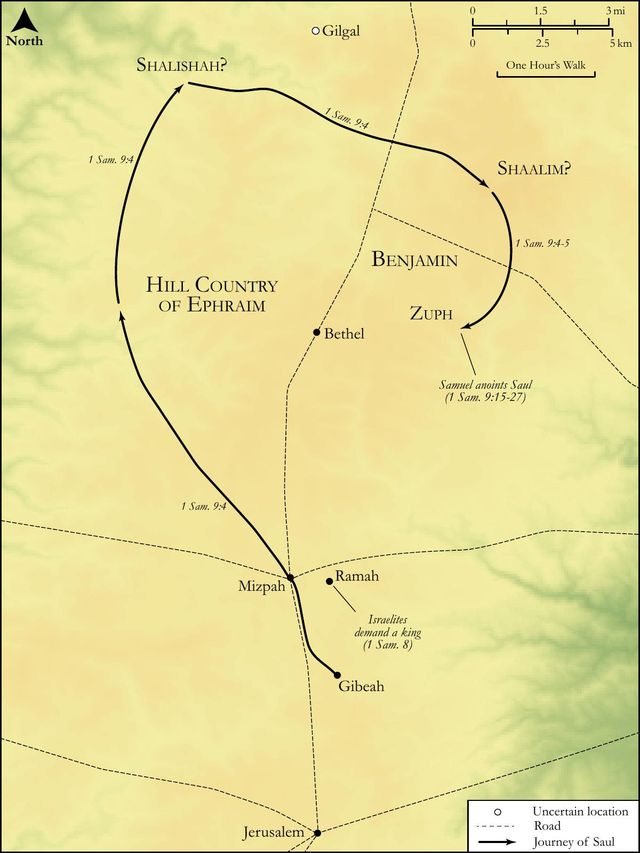
This verse is strategically positioned within the narrative of 1 Samuel 9, which meticulously details Saul's seemingly mundane search for his father's lost donkeys. The preceding verses (1 Samuel 9:3-5 and 1 Samuel 9:6-10) describe Saul's journey and his servant's suggestion to consult a "man of God"—Samuel—in the town of Zuph. While Saul is unknowingly being led by divine providence toward his destiny, 1 Samuel 9:15 provides the reader with critical, behind-the-scenes information: God has already prepared Samuel for Saul's arrival. This creates profound dramatic irony, as the reader is made privy to God's overarching plan, while Saul remains oblivious to the true significance of his journey. This narrative technique builds anticipation for the momentous encounter that will unfold in the subsequent verses (1 Samuel 9:16-17), framing Saul's "chance" meeting with Samuel not as a coincidence, but as a divinely orchestrated appointment.
Historical & Cultural Context
The period immediately preceding the establishment of the monarchy was that of the Judges, a time characterized by spiritual decline, moral chaos, and a distinct lack of centralized leadership, famously summarized by the phrase, "everyone did what was right in his own eyes" (Judges 21:25). Israel had recently endured significant defeats at the hands of the Philistines, even suffering the devastating loss of the Ark of the Covenant (1 Samuel 4). Weary of this instability and desiring to be "like all the nations," the people had clamored for a king (1 Samuel 8:5), a request initially displeasing to Samuel but ultimately permitted by God as a concession to their persistent demand. Samuel, serving as the last of the Judges and a revered prophet, was the primary conduit for divine communication. His role was crucial in guiding the nation and facilitating this monumental transition, making God's direct revelation to him concerning the first king a matter of profound national and theological significance. Culturally, prophets were understood as God's spokespersons, receiving messages often through direct audible words, visions, or dreams, which they would then convey to the people.
Key Themes
ShowHide1 Samuel 9:15 powerfully contributes to several overarching themes within 1 Samuel and the broader biblical narrative. Firstly, it highlights Divine Sovereignty, demonstrating God's active and meticulous control over human history and individual destinies, even in seemingly ordinary circumstances like a search for lost donkeys. God's plan for Israel's monarchy was established before Saul's arrival, underscoring that His purposes are not thwarted by human actions but often unfold precisely through them (Proverbs 16:9). Secondly, it emphasizes the theme of Divine Revelation and Prophetic Authority. Samuel's unique relationship with God, where the LORD speaks "in his ear," reaffirms his unparalleled role as God's trusted messenger, a consistent pattern throughout biblical history where God reveals His plans to His prophets (Amos 3:7). Finally, it introduces the theme of God's Preparation for Leadership, showing that God not only chooses leaders but meticulously prepares the way for their appointment, ensuring that His chosen instruments are ready for their divine assignments.
Exposition and Analysis
ShowHideKey Word Analysis
ShowHideThis primitive root means "to denude," "uncover," or "reveal." In this context, the Hiphil perfect form of gālāh (גָּלָה) implies a direct, clear, and intentional disclosure. The phrase "uncovered the ear" is an idiom for intimate and confidential communication. It signifies that God spoke directly and personally to Samuel, removing any veil or mystery from His intention, ensuring a private, unmistakable revelation rather than a general impression or a vision requiring interpretation.
Meaning "broadness" and concretely "the ear." This idiomatic expression, bəʾoznô, literally meaning "in his ear," profoundly reinforces the intimacy and directness of the divine communication. Unlike visions or dreams that might require interpretation, this phrase suggests an audible or deeply impressed, unmistakable word from God. It highlights the unique relationship Samuel had with the LORD, where divine secrets were shared directly and personally, ensuring Samuel's full comprehension and readiness to act.
A primitive root meaning "to say" with great latitude. This word signifies the verbal nature of God's communication to Samuel. It indicates that the revelation was not merely an impression or a feeling, but a definite, articulated message. The subsequent verses (1 Samuel 9:16-17) then provide the precise content of what God "said," emphasizing the clarity and authority of the divine instruction.
Verse Breakdown
ShowHide"Now the LORD had told Samuel"
This opening clause immediately establishes the LORD as the primary actor and initiator of the events. The Hebrew verb is in the perfect tense, indicating a completed action that occurred prior to the narrative present, emphasizing God's pre-emptive knowledge and sovereign planning. It underscores that the ensuing events are not coincidental but divinely orchestrated by God, who is actively involved in the affairs of His people.
"in his ear"
This idiomatic phrase, as explored in the Key Word Analysis, signifies an intimate, direct, and unmistakable revelation. It suggests a personal, confidential communication from God to Samuel, bypassing any need for public proclamation or interpretation at this stage. It highlights Samuel's unique prophetic status and his exceptionally close relationship with the divine, making him a trusted recipient of God's secret counsel.
"a day before Saul came"
This precise temporal marker emphasizes God's omniscience and foreknowledge. God knew not only that Saul was coming but also the exact timing of his arrival. This detail reinforces the theme of divine sovereignty, demonstrating that God prepares His servants and orchestrates circumstances well in advance to fulfill His purposes, leaving nothing to chance. It also demonstrates God's perfect timing in His divine appointments.
"saying,"
This concluding word serves as a direct transition to the specific content of God's revelation to Samuel, which is then detailed in the subsequent verses (1 Samuel 9:16-17). It signals that what follows is the direct divine instruction or prophecy that Samuel received, setting the stage for the fulfillment of God's plan for Israel's first king.
Literary Devices
ShowHideThe verse employs several significant literary devices to enhance its meaning and impact. The most prominent is Foreshadowing, as God's pre-revelation to Samuel sets the stage for the dramatic and pivotal encounter with Saul that is about to unfold. The reader is given privileged information, creating profound Dramatic Irony, where the audience is aware of Saul's true destiny and the divine orchestration of his journey, while Saul himself remains oblivious to the profound significance of his donkey hunt. This contrast heightens the anticipation for the meeting. The phrase "told Samuel in his ear" is a powerful Idiom for intimate and direct communication, emphasizing the unique prophetic relationship between God and Samuel. This idiomatic expression also serves as a form of Emphasis, drawing attention to the certainty and clarity of the divine message, leaving no doubt about its origin or authority, and affirming Samuel's unique role as God's trusted messenger.
Theological and Thematic Connections
ShowHide1 Samuel 9:15 profoundly illustrates the biblical truth of God's active and sovereign involvement in human affairs. It reveals a God who is not distant or detached, but intimately engaged, orchestrating events and preparing individuals for His purposes long before they come to fruition. This divine foresight and meticulous planning underscore His omniscience and omnipotence, assuring believers that His ultimate plan for history and for individual lives is unfolding according to His perfect will. The verse also highlights the vital role of prophets as God's chosen conduits for revelation, underscoring the importance of listening for and discerning His voice. This pattern of divine pre-revelation and preparation is a consistent theme throughout Scripture, demonstrating God's faithfulness to His covenant promises and His people, even in the midst of their human desires and shortcomings.
Reflection and Application
ShowHideThe intimate revelation God granted Samuel in 1 Samuel 9:15 offers profound encouragement and guidance for believers today. Just as God meticulously prepared Samuel for Saul's arrival, He continues to work behind the scenes in our lives, orchestrating circumstances and preparing us for future callings or challenges. This verse invites us to cultivate a posture of attentiveness, seeking to discern God's voice and direction even in the mundane or seemingly ordinary aspects of our daily lives. It reminds us that our "chance" encounters or unexpected turns might well be divine appointments, part of a larger, sovereign plan. Trusting in God's foresight liberates us from anxiety about the future, knowing that He is already there, preparing the way. Our role, like Samuel's, is to remain spiritually attuned and obedient, ready to act when His will is made clear, understanding that His ultimate purposes are always good and for His glory, even when we cannot see the full picture.
Questions for Reflection
ShowHideFAQ
ShowHideWhy did God tell Samuel "in his ear" specifically?
ShowHideThe phrase "in his ear" (Hebrew, bəʾoznô) is a powerful idiom signifying intimate, direct, and confidential communication. It suggests a clear, unmistakable revelation, not a vague dream or vision that might require interpretation. This highlights the unique and close relationship Samuel had with God as a prophet, where divine secrets were shared personally to ensure Samuel's precise understanding and readiness to execute God's will concerning the anointing of Israel's first king. It emphasizes the certainty and authority of the divine message, leaving no doubt for Samuel regarding its origin or instruction.
What was the significance of God revealing this "a day before Saul came"?
ShowHideThe specific timing—"a day before Saul came"—underscores God's precise omniscience and meticulous orchestration of events. It demonstrates that God's plan for Israel's monarchy and Saul's appointment was not a reactive measure but a pre-determined divine initiative. This foreknowledge allowed Samuel to be fully prepared, both mentally and spiritually, for Saul's arrival and the momentous task of anointing him, preventing any surprise or unpreparedness on Samuel's part. It reinforces the theme of God's sovereignty, showing that He controls time and circumstances to fulfill His purposes (Isaiah 46:10), even down to the precise timing of human encounters.
Christ-Centered Fulfillment
ShowHide1 Samuel 9:15, with its emphasis on God's sovereign foresight and pre-revelation to His prophet concerning the arrival of Israel's first king, finds its ultimate fulfillment and deepest meaning in the person and work of Jesus Christ. Just as God meticulously prepared Samuel for the arrival of an earthly king, so too did He meticulously prepare the way for the coming of the true and eternal King, Jesus. The Old Testament prophets, from Moses to Malachi, served as God's voice, revealing aspects of His redemptive plan, much like Samuel received a direct word concerning Saul. However, in Christ, God's ultimate revelation is embodied; as Hebrews 1:1-2 declares, "God, who at sundry times and in divers manners spake in time past unto the fathers by the prophets, hath in these last days spoken unto us by His Son." Jesus is not merely a prophet who receives a word from God; He is the Word made flesh (John 1:1-14), the full and final revelation of God's character and redemptive purpose. Furthermore, just as Saul was chosen and anointed for a specific earthly kingdom, Christ was chosen before the foundation of the world (1 Peter 1:18-20) to establish an everlasting spiritual kingdom (Daniel 7:13-14). His arrival was not a coincidence but the culmination of millennia of divine preparation, foreshadowed in countless prophecies and types, all pointing to the Lamb of God who takes away the sin of the world. Thus, 1 Samuel 9:15 ultimately points to the greater divine orchestration of salvation history, culminating in the pre-ordained coming of Christ, the King of kings and Lord of lords (Revelation 19:16).