


Mark 14:13
Bible text: King James Version (1769 Blayney text) · Public domain
Bible text: King James Version with Strong's numbers · Public domain
Bible text: Berean Standard Bible · Public domain
Bible text: American Standard Version (1901) · Public domain
Bible text: World English Bible, Messianic edition · Public domain
Bible text: Geneva Bible (1599) · Public domain
Bible text: Young's Literal Translation · Public domain
- καὶkaiAndG2532CONJConjunction
- ἀποστέλλειapostelleiHe sends forthG649V-PAI-3SVerb Present Active Indicative 3rd Singular
- δύοduotwoG1417A-NUIAdjective
- τῶνtōnof theG3588T-GPMDefinite article Genitive Plural Masculine
- μαθητῶνmathētōndisciplesG3101N-GPMNoun Genitive Plural Masculine
- αὐτοῦautouof HimG846P-GSMPersonal pronoun Genitive Singular Masculine
- καὶkaiandG2532CONJConjunction
- λέγειlegeisaysG3004V-PAI-3SVerb Present Active Indicative 3rd Singular
- αὐτοῖς·autoisto themG846P-DPMPersonal pronoun Dative Plural Masculine
- ὑπάγετεhupagetedo goG5217V-PAM-2PVerb Present Active Imperative 2nd Plural
- εἰςeisintoG1519PREPPreposition
- τὴνtēntheG3588T-ASFDefinite article Accusative Singular Feminine
- πόλινpolincityG4172N-ASFNoun Accusative Singular Feminine
- καὶkaiandG2532CONJConjunction
- ἀπαντήσειapantēseiwill meetG528V-FAI-3SVerb Future Active Indicative 3rd Singular
- ὑμῖνhuminyouG4771P-2DPPersonal pronoun Dative 2nd Plural
- ἄνθρωποςanthrōposa manG444N-NSMNoun Nominative Singular Masculine
- κεράμιονkeramiona pitcherG2765N-ASNNoun Accusative Singular Neuter
- ὕδατοςhudatosof waterG5204N-GSNNoun Genitive Singular Neuter
- βαστάζων·bastazōncarryingG941V-PAP-NSMVerb Present Active Participle Nominative Singular Masculine
- ἀκολουθήσατεakolouthēsatedo followG190V-AAM-2PVerb Aorist Active Imperative 2nd Plural
- αὐτῷautōhimG846P-DSMPersonal pronoun Dative Singular Masculine
English is a literal word-by-word gloss of the Greek, not the KJV's wording. Why?
This is the original text the KJV's translators worked from — each Greek word with its own literal English meaning in this verse, prepared by scholars at Tyndale House, Cambridge. The KJV translates whole sentences, not word by word, so its wording differs: one Greek word can become several English words, and the KJV may choose “charity” where the gloss reads “love”. Both are faithful — they answer different questions. For the KJV's own rendering, switch to the KJV text.
Details
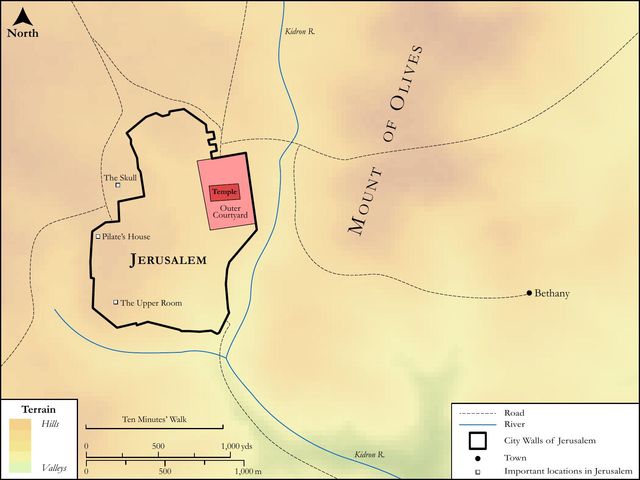
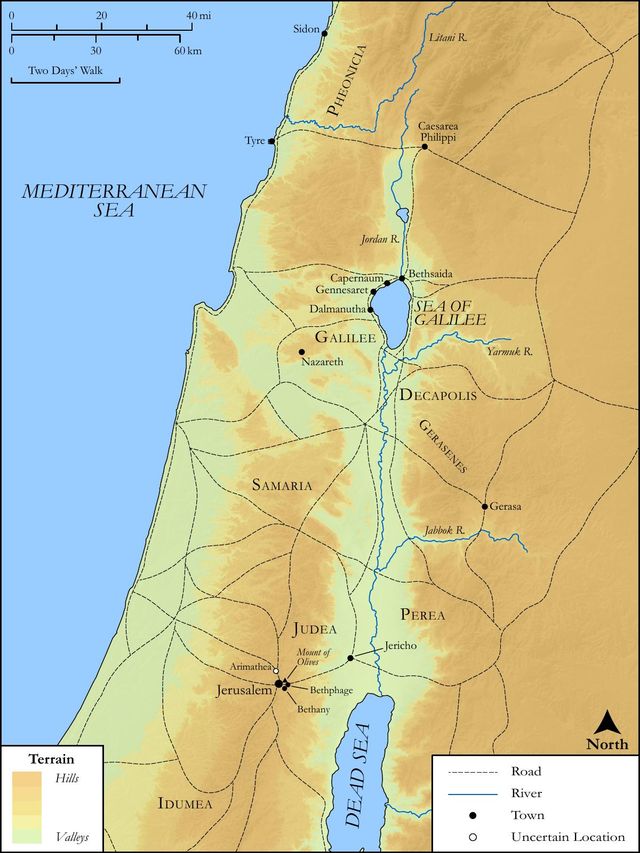
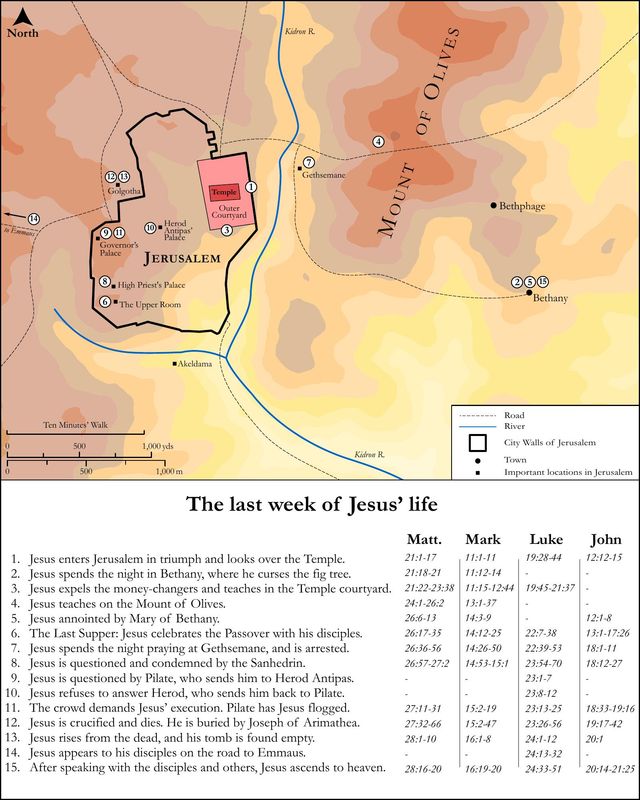
See on the biblical-era maps
Study this verse
Public-domain commentary
Matthew Henry
From his Commentary on the Whole Bible. Henry comments on passages, not single verses — this entry covers Mark 14:12–31. His three-level outline is real structure in the source text, so it is rendered as structure.
In these verses we have,
I.Christ's eating the passover with his disciples, the night before he died, with the joys and comforts of which ordinance he prepared himself for his approaching sorrows, the full prospect of which did not indispose him for that solemnity. Note, No apprehension of trouble, come or coming, should put us by, or put us out of frame for, our attendance on holy ordinances, as we have opportunity for it.
1.Christ ate the passover at the usual time when the other Jews did, as Dr. Whitby had fully made out, and not, as Dr. Hammond would have it, the night before. It was on the first day of that feast, which (taking in all the eight days of the feast) was called, The feast of unleavened bread, even that day when they killed the passover, Mar 14:12.
2.He directed his disciples how to find the place where he intended to eat the passover; and hereby gave such another proof of his infallible knowledge of things distant and future (which to us seem altogether contingent), as he had given when he sent them for the ass on which he rode in triumph (Mar 11:6); "Go into the city (for the passover must be eaten in Jerusalem), and there shall meet you a man bearing a pitcher of water (a servant sent for water to clean the rooms in his master's house); follow him, go in where he goes, enquire for his master, the good man of the house (Mar 14:14), and desire him to show you a room." No doubt, the inhabitants of Jerusalem had rooms fitted up to be let out, for this occasion, to those that came out of the country to keep the passover, and one of those Christ made use of; not any friend's house, nor any house he had formerly frequented, for then he would have said, "Go to such a friend," or, "You know where we used to be, go thither and prepare." Probably he went where he was not known, that he might be undisturbed with his disciples. Perhaps he notified it by a sign, to conceal it from Judas, that he might not know till he came to the place; and by such a sign to intimate that he will dwell in the clean heart, that is, washed as with pure water. Where he designs to come, a pitcher of water must go before him; see Isa 1:16-18.
3.He ate the passover in an upper room furnished, estrōmenon - laid with carpets (so Dr. Hammond); it would seem to have been a very handsome dining-room. Christ was far from affecting any thing that looked stately in eating his common meals; on the contrary, he chose that which was homely, sat down on the grass: but, when he was to keep a sacred feast, in honour of that he would be at the expense of as good a room as he could get. God looks not at outward pomp, but he looks at the tokens and expressions of inward reverence for a divine institution, which, it is to be feared, those want, who, to save charges, deny themselves decencies in the worship of God.
4.He ate it with the twelve, who were his family, to teach those who have the charge of families, not only families of children, but families of servants, or families of scholars, or pupils, to keep up religion among them, and worship God with them. If Christ came with the twelve, then Judas was with them, though he was at this time contriving to betray his Master; and it is plain by what follows (Mar 14:20), that he was there: he did not absent himself, lest he could have been suspected; had his seat been empty at this feast, they would have said, as Saul of David, He is not clean, surely he is not clean, Sa1 20:26. Hypocrites, though they know it is at their peril, yet crowd into special ordinances, to keep up their repute, and palliate their secret wickedness. Christ did not exclude him from the feast, though he knew his wickedness, for it was not as yet become public and scandalous. Christ, designing to put the keys of the kingdom of heaven into the hands of men, who can judge only according to outward appearance, would hereby both direct and encourage them in their admissions to his table, to be satisfied with a justifiable profession, because they cannot discern the root of bitterness till it springs up.
II.Christ's discourse with his disciples, as they were eating the passover.
It is probable that they had discourse, according to the custom of the feast, of the deliverance of Israel out of Egypt, and the preservation of the first-born, and were as pleasant as they used to be together on this occasion, till Christ told them that which would mix trembling with their joys.
1.They were pleasing themselves with the society of their Master; but he tells them that they must now presently lose him; The Son of man is betrayed; and they knew, for he had often told them, what followed - If he be betrayed, the next news you will hear of him, is, that he is crucified and slain; God hath determined it concerning him, and he agrees to it; The Son of man goes, as it is written of him, Mar 14:21. It was written in the counsels of God, and written in the prophecies of the Old Testament, not one jot or tittle of either of which can fall to the ground.
2.They were pleasing themselves with the society one of another, but Christ casts a damp upon the joy of that, by telling them, One of you that eateth with me shall betray me, Mar 14:18. Christ said this, if it might be, to startle the conscience of Judas, and to awaken him to repent of his wickedness, and to draw back (for it was not too late) from the brink of the pit. But for aught that appears, he who was most concerned in the warning, was least concerned at it. All the rest were affected with it.
(1.)They began to be sorrowful. As the remembrance of our former falls into sin, so the fear of the like again, doth often much embitter the comfort of our spiritual feasts, and damp our joy. Here were the bitter herbs, with which this passover-feast was taken.
(2.)They began to be suspicious of themselves; they said one by one, Is it I? And another said, Is it I? They are to be commended for their charity, that they were more jealous of themselves than of one another. It is the law of charity, to hope the best (Co1 13:5-7), because we assuredly know, therefore we may justly suspect, more evil by ourselves than by our brethren. They are also to be commended for their acquiescence in what Christ said; they trusted more to his words than to their own hearts; and therefore do not say, "I am sure it is not I," but, "Lord, is it I? see if there be such a way of wickedness in us, such a root of bitterness, and discover it to us, that we may pluck up that root, and stop up that way."
Now, in answer to their enquiry, Christ saith that, [1.] Which would make them easy; "It is not you, or you; it is this that now dips with me in the dish; the adversary and enemy is this wicked Judas." [2.] Which, one would think, should make Judas very uneasy. If he go on in his undertaking, it is upon the sword's point, for woe to that many by whom the Son of man is betrayed; he is undone, for every undone; his sin will soon find him out; and it were better for him that he had never been born, and had never had a being than such a miserable one as he must have. It is very probable that Judas encouraged himself in it with this thought, that his Master had often said he must be betrayed; "And if it must be done, surely God will not find fault with him that doth it, for who hath resisted his will?" As that objector argues, Rom 9:19. But Christ tells him that this will be no shelter or excuse to him; The Son of man indeed goes; as it is written of him, as a lamb to the slaughter; but woe to that man by whom he is betrayed. God's decree to permit the sins of men, and bring glory to himself out of them, do neither necessitate their sins, nor determine to them, nor will they be any excuse of the sin, or mitigation of the punishment. Christ was delivered indeed by the determinate counsel and fore-knowledge of God; but, notwithstanding that, it is with wicked hands that he is crucified and slain, Act 2:23.
III.The institution of the Lord's supper.
1.It was instituted in the close of a supper, when they were sufficiently fed with the paschal lamb, to show that in the Lord's supper there is no bodily repast intended; to preface it with such a thing, is to revive Moses again. But it is food for the soul only, and therefore a very little of that which is for the body, as much as will serve for a sign, is enough. It was at the close of the passover-supper, which by this was evangelized, and then superseded and set aside. Much of the doctrine and duty of the eucharist is illustrated to us by the law of the passover (Ex. 12); for the Old Testament institutions, though they do not bind us, yet instruct us, by the help of a gospel-key to them. And these two ordinances lying here so near together, it may be good to compare them, and observe how much shorter and plainer the institution of the Lord's supper is, than that of the passover was. Christ's yoke is easy in comparison with that of the ceremonial law, and his ordinances are more spiritual.
2.It was instituted by the example of Christ himself; not with the ceremony and solemnity of a law, as the ordinance of baptism was, after Christ's resurrection (Mat 28:19), with, Be it enacted by the authority aforesaid, by a power given to Christ in heaven and on earth (Mat 28:18); but by the practice of our Master himself, because intended for those who are already his disciples, and taken into covenant with him: but it has the obligation of the law, and was intended to remain in full force, power, and virtue, till his second coming.
3.It was instituted with blessing and giving of thanks; the gifts of common providence are to be so received (Ti1 4:4, Ti1 4:5), much more than the gifts of special grace. He blessed (Mar 14:22), and gave thanks, Mar 14:23. At his other meals, he was wont to bless, and give thanks (Mar 6:41; Mar 8:7) so remarkably, that he was known by it, Luk 24:30, Luk 24:31. And he did the same at this meal.
4.It was instituted to be a memorial of his death; and therefore he broke the bread, to show how it pleased the Lord to bruise him; and he called the wine, which is the blood of the grape, the blood of the New Testament. The death Christ died was a bloody death, and frequent mention is made of the blood, the precious blood, as the pride of our redemption; for the blood is the life, and made atonement for the soul, Lev 17:11-14. The pouring out of the blood was the most sensible indication of the pouring out of his soul, Isa 53:12. Blood has a voice (Gen 4:10); and therefore blood is so often mentioned, because it was to speak, Heb 12:24. It is called the blood of the New Testament; for the covenant of grace became a testament, and of force by the death of Christ, the testator, Heb 9:16. It is said to be shed for many, to justify many (Isa 53:11), to bring many sons to glory, Heb 2:10. It was sufficient for many, being of infinite value; it has been of use to many; we read of a great multitude which no man could number, that had all washed their robes, and made them white in the blood of the Lamb (Rev 7:9-14); and still it is a fountain opened. How comfortable is this to poor repenting sinners, that the blood of Christ is shed for many! And if for many, why not for me? If for sinners, sinners of the Gentiles, the chief of sinners, then why not for me?
5.It was instituted to be a ratification of the covenant made with us in him, and a sign of the conveyance of those benefits to us, which were purchased for us by his death; and therefore he broke the bread to them (Mar 14:22), and said, Take, eat of it: he gave the cup to them, and ordered them to drink of it, Mar 14:23. Apply the doctrine of Christ crucified to yourselves, and let it be meat and drink to your souls, strengthening, nourishing, and refreshing, to you, and the support and comfort of your spiritual life.
6.It was instituted with an eye to the happiness of heaven, and to be an earnest and fore-taste of that, and thereby to put our mouths out of taste for all the pleasures and delights of sense (Mar 14:25); I will drink no more of the fruit of the vine, as it is a bodily refreshment. I have done with it. No one, having tasted spiritual delights, straightway desires sensitive ones, for he saith, The spiritual is better (Luk 5:39); but every one that hath tasted spiritual delights, straightway desires eternal ones, for he saith, Those are better still; and therefore let me drink no more of the fruit of the vine, it is dead and flat to those that have been made to drink of the river of God's pleasures; but, Lord, hasten the day, when I shall drink it new and fresh in the kingdom of God, where it shall be for ever new, and in perfection.
7.It was closed with a hymn, Mar 14:26. Though Christ was in the midst of his enemies, yet he did not, for fear of them, omit this sweet duty of singing psalms. Paul and Silas sang, when the prisoners heard them. This was an evangelical song, and gospel times are often spoken of in the Old Testament, as times of rejoicing, and praise is expressed by singing. This was Christ's swan-like song, which he sung just before he entered upon his agony; probably, that which is usually sung, Psa 113:1-9 to 118.
IV.Christ's discourse with his disciples, as they were returning to Bethany by moonlight.
When the had sung the hymn, presently they went out. It was now near bedtime, but our Lord Jesus had his heart so much upon his suffering, that he would not come into the tabernacle of his house, norgo up into his bed, nor give sleep to his eyes, when that work was to be done, Psa 132:3, Psa 132:4. The Israelites were forbidden to go out of their houses the night that they ate the passover, for fear of the sword of the destroying angel, Exo 12:22, Exo 12:23. But because Christ, the great shepherd, was to be smitten, he went out purposely to expose himself to the sword, as a champion; they evaded the destroyer, but Christ conquered him, and brought destructions to a perpetual end.
1.Christ here foretels that in his sufferings he should be deserted by all his disciples; "You will all be offended because of me, this night. I know you will (Mar 14:27), and what I tell you now, is no other than what the scripture has told you before; I will smite the shepherd, and then the sheep will be scattered." Christ knew this before, and yet welcomed them at his table; he sees the falls and miscarriages of his disciples, and yet doth not refuse them. Nor should we be discouraged from coming to the Lord's supper, by the fear of relapsing into sin afterward; but, the greater of our danger is, the more need we have to fortify ourselves by the diligent conscientious use of holy ordinances. Christ tells them that they would be offended in him, would begin to question whether he were the Messiah or no, when they saw him overpowered by his enemies. Hitherto, they had continued with him in his temptations; though they had sometimes offended him, yet they had not been offended in him, nor turned the back upon him; but now the storm would be so great, that they would all slip their anchors, and be in danger of shipwreck. Some trials are more particular (as Rev 2:10, The devil shall cast some of you into prison); but others are more general, an hour of temptation, which shall come upon all the world, Rev 3:10. The smiting of the shepherd is often the scattering of the sheep: magistrates, ministers, masters of families, if these are, as they should be, shepherds to those under their charge, when any thing comes amiss to them, the whole flock suffers for it, and is endangered by it.
But Christ encourages them with a promise that they shall rally again, shall return both to their duty and to their comfort (Mar 14:28); "After I am risen, I will gather you in from all the places wither you are scattered, Eze 34:12. I will go before you into Galilee, will see our friends, and enjoy one another there."
2.He foretels that he should be denied particularly by Peter. When they went out to go to the mount of Olives, we may suppose that they dropped Judas (he stole away from them), whereupon the rest began to think highly of themselves, that they stuck to their Master, when Judas quitted him. But Christ tells them, that though they should be kept by his grace from Judas's apostasy, yet they would have no reason to boast of their constancy. Note, Though God keeps us from being as bad as the worst, yet we may well be ashamed to think that we are not better than we are.
(1.)Peter is confident that he should not do so ill as the rest of his disciples (Mar 14:29); Though all should be offended, all his brethren here present, yet will not I. He supposes himself not only stronger than others, but so much stronger, as to be able to receive the shock of a temptation, and bear up against it, all alone; to stand, though nobody stood by him. It is bred in the bone with us, to think well of ourselves, and trust to our own hearts.
(2.)Christ tells him that he will do worse than any of them. They will all desert him, but he will deny him; not once, but thrice; and that presently; "This day, even this night before the cock crow twice, thou wilt deny that ever thou hadst any knowledge of me, or acquaintance with me, as one ashamed and afraid to own me."
(3.)He stands to his promise; "If I should die with thee, I will not deny thee; I will adhere to thee, though it cost me my life:" and, no doubt, he thought as he said. Judas said nothing like this, when Christ told him he would betray him. He sinned by contrivance, Peter by surprise; he devised the wickedness (Mic 2:1), Peter was overtaken in this fault, Gal 6:1. It was ill done of Peter, to contradict his Master. If he had said, with fear and trembling, "Lord, give me grace to keep me from denying thee, lead me not into this temptation, deliver me from this evil," it might have been prevented: but they were all thus confident; they who said, Lord, is it I? now said, It shall never be me. Being acquitted from their fear of betraying Christ, they were now secure. But he that thinks he stands, must learn to take heed lest he fall; and he that girdeth on the harness, not boast as though he had put it off.
Historical interpretation
Nine Centuries of Reception
6 surviving comments on this verse. Each one is dated, so this reads as a timeline rather than a list.
Select a marker to jump to its quote. Markers stagger vertically where authors wrote within a few decades of each other.
But the unleavened bread which was eaten with bitterness, that is with bitter herbs, is our redemption, and the bitterness is the Passion of our Lord.
For they say, Where wilt thou that we go? to show us that we should direct our steps according to the will of God. But the Lord points out with whom He would eat the Passover, and after His custom He sends two disciples, which we have explained above; wherefore it goes on, And he sendelh forth two of his disciples, and he saith unto them, Go ye into the city.
And in a mystical sense the city is the Church, surrounded by the wall of faith, the man who meets them is the primitive people, the pitcher of water is the law of the letter.
That is, him who leads to the lofty place, where is the refreshment prepared by Christ. (John 21:15) The lord of the house is the Apostle Peter, to whom the Lord has entrusted His house, that there may be one faith under one Shepherd. The large upper-room is the wide-spread Church, in which the name of the Lord is spoken of, prepared by a variety of powers and tongues.
Nor will it be incongruous to interpret figuratively the fact that, when the Lord was about to celebrate the last Passover, he told the disciples who were sent to make preparation that they would meet a man bearing water. He thus points out the place for celebrating the Passover by the sign of water.
(de Con. Evan. ii. 80) Mark says a pitcher, Luke a two-handled vessel; one points out the kind of vessel, the other the mode of carrying it; both however mean the same truth.
And he sends two of his disciples and says to them: Go into the city, and a man carrying a jar of water will meet you. This is indeed a sign of divine foresight, because while speaking with the disciples, he knows what will happen elsewhere. When, however, the disciples are preparing for Passover, a man carrying a jar, or according to another Gospel, a pitcher of water, meets them, to show that the mystery of this Passover is to be celebrated for the perfect cleansing of the whole world. For water signifies the washing of grace, the jar indicates the frailty of those through whom the same grace was to be administered to the world. Hence, they say: “But we have this treasure in earthen vessels” (II Cor. IV). Therefore, the disciples prepare the Passover where the jar of water is brought, to signify that the time is here when the typical blood on the doorposts of the true Passover will be removed, and the baptism of the life-giving font will be consecrated to take away the sins of the world.
(ubi sup.) He means by the first day of the Passover the fourteenth day of the first month, when they threw aside leaven, and were wont to sacrifice, that is, to kill the lamb at even. The Apostle explaining this says, Christ our Passover is sacrificed for us. (1 Cor. 5:7) For although He was crucified on the next day, that is, on the fifteenth moon, yet on the night when the lamb was offered up, He committed to His disciples the mysteries of His Body and Blood, which they were to celebrate, and was seized upon and bound by the Jews; thus He consecrated the beginning of His sacrifice, that is, of His Passion.
(ubi sup.) And it is a proof of the presence of His divinity, that in speaking with His disciples, He knows what is to take place elsewhere; wherefore it follows, And his disciples went forth, and came into the city, and found as he had said unto them; and they made ready the Passover.
(ubi sup.) Or else, the water is the laver of grace, the pitcher points out the weakness of those who were to show that grace to the world.
(ubi sup.) Or else, the large upper-room is spiritually the Law, which comes forth from the narrowness of the letter, and in a lofty place, that is, in the lofty chamber of the soul, receives the Saviour. But it is designedly that the names both of the bearer of the water, and of the lord of the house, are omitted, to imply that power is given to all who wish to celebrate the true Passover, that is, to be embued with the sacraments of Christ, and to receive Him in the dwelling-place of their mind.
From the words of the disciples, Where wilt thou that we go? it seems evident that Christ had no dwelling-place, and that the disciples had no houses of their own; for if so, they would have taken Him thither.
He sends two of His disciples, that is, Peter and John, as Luke says, to a man unknown to Him, implying by this that He might, if He had pleased, have avoided His Passion. For what could not He work in other men, who influenced the mind of a person unknown to Him, so that he received them? He also gives them a sign how they were to know the house, when He adds, And there shall meet you a man bearing a pitcher of water.
He who is baptized carries the pitcher of water, and he who bears baptism upon him comes to his rest, if he lives according to his reason; and he obtains rest, as being in the house. Wherefore it is added, Follow him.
Or else, the lord of the house is the intellect, which points out the large upper room, that is, the loftiness of intelligences, and which, though it be high, yet has nothing of vain glory, or of pride, but is prepared and made level by humility. But there, that is, in such a mind Christ's Passover is prepared by Peter and John, that is by action and contemplation.
Continue studying Mark 14:13 across the web’s major study libraries — every link below opens this exact verse, chapter, or book on the destination site.
Read & Compare
 BibleGatewayThis verse in more than 200 translations and 70 languages.
 Bible.comThe YouVersion reader — hundreds of translations, reading plans, and highlights.
 ESV.orgCrossway's official English Standard Version reader.
 NET BibleThe NET translation with 60,000+ translators' notes on every rendering decision.
 STEP BibleTyndale House's free study tool — original text, vocabulary, and scholarly resources.
 BibliaLogos Bible Software's free web reader.
 USCCBThe New American Bible (Revised Edition) with the U.S. bishops' study notes.
Commentaries
 BibleHub CommentariesDozens of classic commentaries on this verse, gathered on one page.
 StudyLightMore than 100 commentary sets — the largest collection on the web.
 BibleRefPlain-English commentary on what this verse means, verse by verse.
 Enduring WordDavid Guzik's free commentary on this chapter, widely used by Bible teachers.
 Bible Study ToolsVerse commentary alongside Greek and Hebrew study aids.
Original Language & Research
- BibleHub InterlinearThe verse word by word — original language, transliteration, and English.
- BibleHub LexiconEvery word's original-language definition and Strong's entry.
 Blue Letter BibleDeep-study tools — Strong's numbers, concordance, and word studies.
 CNTR CollationThe earliest Greek manuscripts of this verse, collated letter by letter.
Sermons, Hymns & Audio


TrulyRandomVerse is not affiliated with these sites and doesn’t control their content. They’re linked because they’re genuinely useful.
Summary
Mark 14:13 details Jesus' precise and divinely foreknown instructions to two of his disciples regarding the preparation for the Passover meal, which would become known as the Last Supper. This pivotal verse reveals Jesus' sovereign control over circumstances and sets the stage for the institution of the New Covenant, emphasizing the meticulous divine orchestration of events leading to his crucifixion and resurrection.
Context
ShowHideLiterary Context
This verse immediately follows the disciples' inquiry about where they should prepare the Passover meal (Mark 14:12). It is part of the passion narrative, specifically the events leading up to the Last Supper and Jesus' arrest. The detailed instructions given by Jesus here contrast sharply with the betrayal by Judas and the disciples' later desertion, highlighting Jesus' calm authority and purposeful action even as his suffering approaches. The specific nature of Jesus' directions also serves to underscore his divine knowledge, a theme woven throughout Mark's Gospel.
Historical & Cultural Context
The setting is Jerusalem during the Passover festival, a time of immense religious significance and heightened tension. Passover commemorated Israel's liberation from slavery in Egypt, and the city would have been teeming with pilgrims. Preparing for the Passover meal involved specific rituals, including the removal of leaven and the sacrifice of a lamb. Historically, carrying water in a pitcher (a clay jar) was typically a task performed by women, who would carry jars on their heads or shoulders. Men usually carried water in wineskins. Therefore, a man bearing a pitcher of water would have been an unusual and easily identifiable sight in the bustling streets of Jerusalem, making Jesus' instruction a unique and unambiguous sign for his disciples.
Key Themes
ShowHideMark 14:13 contributes significantly to several key themes within the Gospel. Firstly, it powerfully demonstrates Jesus' divine foreknowledge and sovereignty, showing his intimate knowledge of future events and his ability to orchestrate them precisely. This echoes earlier instances where Jesus predicts his suffering and resurrection (Mark 8:31, Mark 9:31, Mark 10:33-34). Secondly, the disciples' unquestioning obedience and trust in Jesus' unconventional instructions is a vital theme, emphasizing the importance of following Christ's leading even when it seems unusual. Finally, the verse highlights the sacred preparation for a momentous event, as the Passover meal is about to be transformed into the institution of the Lord's Supper, a foundational sacrament for the church (Mark 14:22-25).
Exposition and Analysis
ShowHideKey Word Analysis
ShowHideThis verb signifies "to send out on a mission" or "to set apart." It implies a deliberate, purposeful dispatch, often with authority. Here, Jesus is not merely sending his disciples on an errand but commissioning them for a specific, divinely ordained task, underscoring the importance and sacred nature of their mission.
Meaning "a learner" or "pupil," this term identifies those who follow Jesus, committed to his teachings and way of life. The fact that Jesus sends "two" of them aligns with Jewish custom for sending witnesses or messengers, lending credibility and authority to their mission.
This refers to an "earthenware vessel" or "jar." As noted in the historical context, a man carrying such a vessel for water was highly unusual. This specific, uncommon detail serves as an unambiguous sign, demonstrating Jesus' precise knowledge and ensuring the disciples would correctly identify the designated individual.
Verse Breakdown
ShowHide"And he sendeth forth two of his disciples,"
Jesus initiates the action, demonstrating his leadership and authority. The selection of "two" disciples is significant, aligning with the Jewish principle of two witnesses or messengers, providing confirmation and mutual support for the task ahead.
"and saith unto them,"
This introduces Jesus' direct, authoritative command. The following instructions are not suggestions but specific directives that require immediate and faithful execution.
"‹Go ye into the city,"
The command to "go" implies immediate movement and engagement with the urban environment of Jerusalem. This is the first step in their precise mission, directing them to a specific location where their next instruction will be fulfilled.
"and there shall meet you a man bearing a pitcher of water:"
This is the crucial, divinely provided sign. Jesus' foreknowledge is strikingly evident here, as he knows exactly whom they will encounter and the distinctive detail that will identify him. The unusual sight of a man carrying a water pitcher ensures the disciples will recognize the correct individual without confusion.
"follow him.›"
This final, simple command requires immediate obedience and trust. The disciples are not to question or deliberate but simply to follow the man, trusting that he will lead them to the prepared location for the Passover meal.
Literary Devices
ShowHideMark 14:13 masterfully employs several literary devices. Foreshadowing is prominent, as Jesus' precise instructions about the man with the pitcher not only reveal his divine foreknowledge but also subtly hint at the meticulous divine orchestration of the events leading to his passion. The unusual detail of "a man bearing a pitcher of water" functions as a clear Symbol, an unambiguous sign given by Jesus to his disciples, which also carries a subtle Irony given the typical gender roles for water-carrying in that culture. This specific detail serves to highlight Jesus' Divine Sovereignty, demonstrating his control over seemingly random encounters and his ability to prepare the way for his purposes, even in the midst of human plans. The narrative also exhibits Conciseness and Directness, characteristic of Mark's Gospel, delivering the essential information without unnecessary embellishment, focusing on action and divine authority.
Theological and Thematic Connections
ShowHideMark 14:13 profoundly illustrates God's meticulous providence and Jesus' divine omniscience. It reveals that even the seemingly mundane details of life, such as encountering a specific individual in a bustling city, are under divine orchestration when they pertain to God's redemptive plan. This passage underscores the importance of obedient faith, where disciples are called to trust and follow Christ's unconventional guidance, knowing that His instructions, however unusual, lead to His intended purposes. The preparation for the Passover, facilitated by this divine encounter, culminates in the institution of the Lord's Supper, transforming an ancient Jewish feast into the central sacrament of the New Covenant, a testament to God's continuous work of salvation.
Reflection and Application
ShowHideMark 14:13 serves as a powerful reminder that God is intimately involved in the details of our lives, orchestrating circumstances to fulfill His perfect will. Just as Jesus provided specific, even unusual, guidance to His disciples, God often leads us in ways that require a step of faith and a willingness to trust beyond our conventional understanding. This passage encourages us to cultivate a posture of attentiveness and obedience, recognizing that divine appointments and seemingly small details can be crucial steps in God's larger plan for us and for the world. Our willingness to follow His unique directions, even when the path is unclear or unconventional, prepares us for deeper encounters with Him and enables us to participate in His redemptive work. It calls us to trust that the Lord knows the way, even when we do not, and that His timing and methods are always perfect.
Questions for Reflection
ShowHideFAQ
ShowHideWhy was a man carrying a pitcher of water so unusual?
ShowHideIn ancient Israel, carrying water from a well or spring was typically a chore performed by women, who would carry the water in pitchers or jars on their heads or shoulders. Men, when they carried liquids, usually transported them in wineskins. Therefore, a man openly carrying a pitcher of water through the city streets would have been an uncommon and easily identifiable sight, making Jesus' instruction a very precise and unambiguous sign for his disciples to follow. This unusual detail underscores Jesus' divine foreknowledge and meticulous planning for the Passover preparations, ensuring the disciples would find the exact person and place He intended, leading them to the "large upper room" (Mark 14:15).
Christ-Centered Fulfillment
ShowHideMark 14:13, while seemingly a logistical detail, is profoundly Christ-centered, revealing Jesus as the ultimate orchestrator of salvation history. The man with the pitcher is not merely a random individual but a divinely appointed sign, pointing to Jesus' sovereign control over every detail leading to his atoning work. This moment foreshadows Jesus as the host of the new covenant meal, transforming the ancient Passover into the Lord's Supper, where He Himself becomes the sacrificial Lamb (John 1:29). The "large upper room" to which the man leads them becomes the sacred space where Jesus institutes the sacrament of His body and blood, establishing the new covenant in His sacrifice (Luke 22:19-20). Thus, Jesus is not just giving directions; He is actively preparing the way for His ultimate act of love and redemption, demonstrating His divine authority as the one who fulfills all prophecy and brings about the salvation of the world through His death and resurrection (Hebrews 9:11-14).