


Matthew 26:19
Bible text: King James Version (1769 Blayney text) · Public domain
Bible text: Berean Standard Bible · Public domain
Bible text: American Standard Version (1901) · Public domain
Bible text: World English Bible, Messianic edition · Public domain
Bible text: Geneva Bible (1599) · Public domain
Bible text: Young's Literal Translation · Public domain
- καὶkaiAndG2532CONJConjunction
- ἐποίησανepoiēsandidG4160V-AAI-3PVerb Aorist Active Indicative 3rd Plural
- οἱhoitheG3588T-NPMDefinite article Nominative Plural Masculine
- μαθηταὶmathētaidisciplesG3101N-NPMNoun Nominative Plural Masculine
- ὡςhōsasG5613PRTParticle or Disjunctive
- συνέταξενsunetaxendirectedG4929V-AAI-3SVerb Aorist Active Indicative 3rd Singular
- αὐτοῖςautoisthemG846P-DPMPersonal pronoun Dative Plural Masculine
- ὁho<the>G3588T-NSMDefinite article Nominative Singular Masculine
- ἸησοῦςIēsousJesusG2424N-NSM-PNoun Nominative Singular Masculine Individual
- καὶkaiandG2532CONJConjunction
- ἡτοίμασανhētoimasanpreparedG2090V-AAI-3PVerb Aorist Active Indicative 3rd Plural
- τὸtotheG3588T-ASNDefinite article Accusative Singular Neuter
- πάσχαpaschaPassoverG3957N-ASNNoun Accusative Singular Neuter
English is a literal word-by-word gloss of the Greek, not the KJV's wording. Why?
This is the original text the KJV's translators worked from — each Greek word with its own literal English meaning in this verse, prepared by scholars at Tyndale House, Cambridge. The KJV translates whole sentences, not word by word, so its wording differs: one Greek word can become several English words, and the KJV may choose “charity” where the gloss reads “love”. Both are faithful — they answer different questions. For the KJV's own rendering, switch to the KJV text.
Details
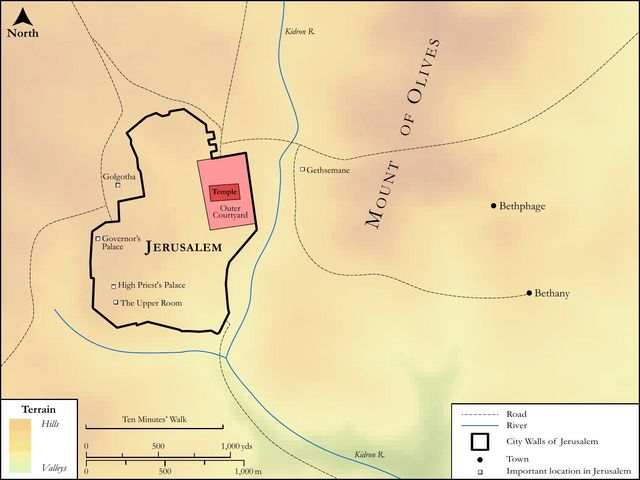
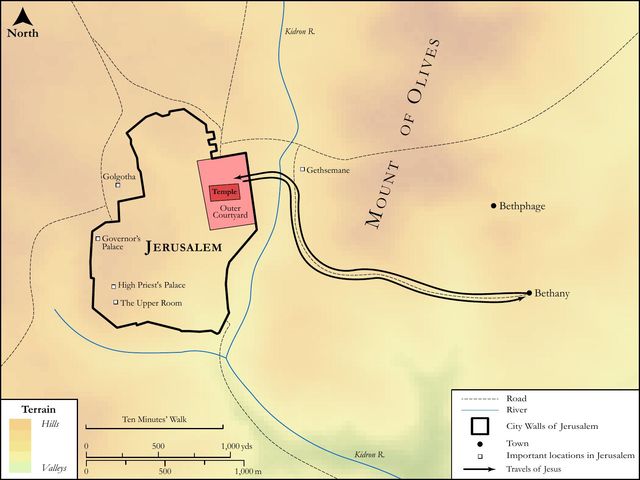
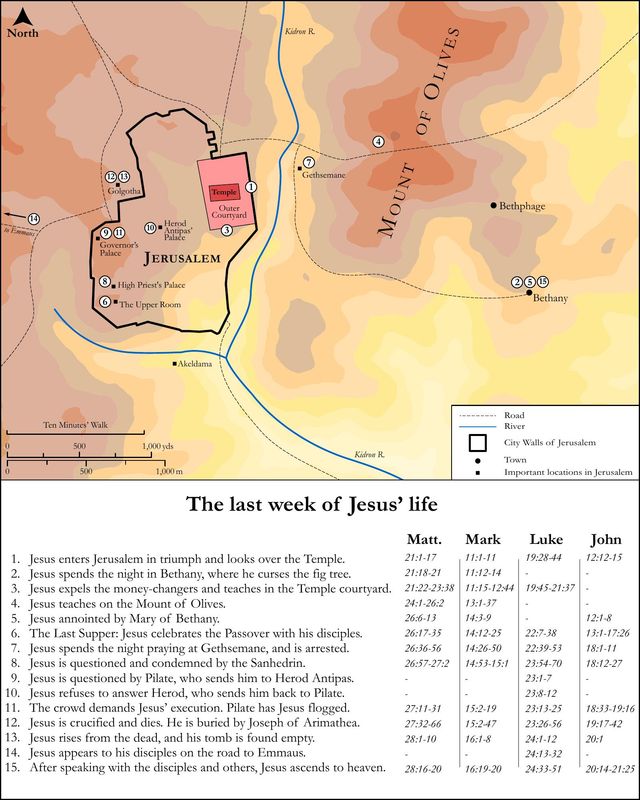
See on the biblical-era maps
Study this verse
Historical interpretation
Nine Centuries of Reception
10 surviving comments on this verse. Each one is dated, so this reads as a timeline rather than a list.
Select a marker to jump to its quote. Markers stagger vertically where authors wrote within a few decades of each other.
Or, Matthew does not name the man in whose house Christ would celebrate the Passover, because the Christian name was not yet held in honour by the believers.
By the first day of the feast of unleavened bread, he means the day before that feast for they are accustomed always to reckon the day from the evening, and he makes mention of this in which in the evening the passover must be killed; for on the fifth day of the week they came unto Him. And this one calls the day before the feast of unleavened bread, speaking of the time when they came to Him, and another saith on this wise, "Then came the day of unleavened bread, when the passover must be killed;" by the word "came," meaning this, it was nigh, it was at the doors, making mention plainly of that evening. For they began with the evening, wherefore also each adds, when the passover was killed.
And they say, "Where wilt Thou that we prepare for Thee to eat the passover?" So even from this it is manifest, that He had no house, no place of sojourning; and I suppose neither had they. For surely they would have entreated him to come there. But neither had they any, having now parted with all things.
But wherefore did He keep the passover? To indicate by all things unto the last day, that He is not opposed to the law.
And for what possible reason doth He send them to an unknown person? To show by this also that He might have avoided suffering. For He who prevailed over this man's mind, so that he received them, and that by words; what would He not have done with them that crucified Him, if it had been His will not to suffer? And what He did about the ass, this He did here also. For there too He saith, "If any man say aught unto you, ye shall say, that the Lord hath need of them;" and so likewise here, "The Master saith, I will keep the passover at thy house." But I marvel not at this only, that he received Him, being unknown, but that expecting to bring upon himself such enmity and implacable hostility, he despised the enmity of the multitude.
After this, because they knew him not, He gave them a sign, like as the prophet touching Saul, saying, "Thou shall find one going up and carrying a bottle;" and here, "carrying a pitcher." And see again the display of his power. For He did not only say, "I will keep the passover," but He adds another thing also, "My time is at hand." And this He did, at once continually reminding His disciples of the passion, so that exercised by the frequency of the prediction, they should be prepared for what was to take place; and at the same time to show to themselves, and to him that was receiving Him, and to all the Jews, which I have often mentioned, that not involuntarily doth He come to His passion. And He adds, "with my disciples," in order that both the preparation should be sufficient, and that the man should not suppose that He was concealing Himself.
(Hom. lxxxi.) Or, by the first day, he means the day before the days of unleavened bread. For the Jews always reckoned their day from the evening; and this day of which he speaks was that on the evening of which they were to kill the Passover, namely, the fifth day of the weekb.
Hence it is evident that He had neither house nor lodging. Nor, I conclude, had the disciples any, for they would surely have invited Him thither.
Or, we may say that this, to such a man, shows that He sent them to some person unknown to them, teaching them thereby that He was able to avoid His Passion. For He who prevailed with this man to entertain Him, how could He not have prevailed with those who crucified Him, had He chosen not to suffer? Indeed, I marvel not only that he entertained Him, being a stranger, but that he did it in contempt of the hatred of the multitude.
My time is at hand, this He said, both by so manifold announcements of His Passion, fortifying His disciples against the event, and at the same time showing that He undertook it voluntarily. I will keep the Passover at thy house, wherein we see, that to the very last day He was not disobedient to the Law. With my disciples, He adds, that there might be sufficient preparation made, and that he to whom He sent might not think that He desired to be concealed.
(Verse 19.) And the disciples did as Jesus had appointed them, and they prepared the Passover. In another Gospel it is written (Luke 22) that they found a large upper room furnished and prepared, and there they made ready for him. But it seems to me that the upper room is to be understood as the spiritual law, which, departing from the confines of the letter, receives the Savior in a lofty place, as Paul himself speaks (Philippians 3), that he has counted as dung and refuse whatever things he previously regarded as gain, in order to prepare a worthy dwelling for the Lord.
The other Evangelist writes that they found a large upper room furnished and ready and they made preparations there for him. It seems to me that the room symbolizes the spiritual law which, emerging from the restraints of the written record, receives the Savior in a lofty place. Paul says that what he formerly counted as gain, he now despised as loss and refuse, that he might prepare a worthy guest chamber for the Lord.
The first day of unleavened bread is the fourteenth day of the first month, when the lamb is killed, the moon is at full, and leaven is put away.
In this also the New Scripture observes the practice of the Old, in which we frequently read, 'He said unto him,' and 'In this or that place,' without any name of person or place.
And observe that with the Jews, the Passover is celebrated on the first day, and the following seven are called the days of unleavened bread; but here the first day of unleavened bread means the day of the Passover.
But perhaps some one will say, If that typical lamb bore a type of this the true lamb, how did not Christ suffer on the night on which this was always killed? It is to be noted, that on this night, He committed to His disciples the mysteries of His flesh and blood to be celebrated, and then also being seized and bound by the Jews, He hallowed the commencement of His sacrifice, i. e. His Passion. The disciples came unto him; among these no doubt was the traitor Judas.
Or, he omits the name, that all who would fain celebrate the true Passover, and receive Christ within the dwelling place of their own minds, should understand that the opportunity is afforded them.
. He says, "The first day of the feast of the unleavened bread," meaning "the day before the feast of the unleavened bread," as we would say it. They intended to eat the Pascha on Friday evening, which was called "the feast of the unleavened bread." The Lord, therefore, sends the disciples on Thursday, which the evangelist calls "the first day of the feast of the unleavened bread," being the day before the Friday on the evening of which they would eat the unleavened bread. The disciples then approach and ask, "Where wilt Thou that we prepare for Thee to eat the Pascha?" For neither they, nor He, had their own house. He sends them to a man whom they did not know and who did not know them, just as He had done before entering Jerusalem when He sent them to find the ass, showing them that He is able by His words alone to persuade even those who do not know Him at all to accept Him. He wanted to keep the Pascha, lest He appear opposed to the law. He calls His slaying His "time," so that we may learn that He was not slain unknowingly or unwillingly. And to the words, "I will keep the Pascha at thy house," He adds "with My disciples," so that there would be sufficient preparation for the large number of those who intended to eat.
(non occ.) The Evangelist having gone through the events preliminary to the Passion, namely, the announcement of it, the counsel of the Chief Priests, and the covenant for His betrayal, prosecutes the history in the order of events, saying, On the first day of unleavened bread.
Continue studying Matthew 26:19 across the web’s major study libraries — every link below opens this exact verse, chapter, or book on the destination site.
Read & Compare
 BibleGatewayThis verse in more than 200 translations and 70 languages.
 Bible.comThe YouVersion reader — hundreds of translations, reading plans, and highlights.
 ESV.orgCrossway's official English Standard Version reader.
 NET BibleThe NET translation with 60,000+ translators' notes on every rendering decision.
 STEP BibleTyndale House's free study tool — original text, vocabulary, and scholarly resources.
 BibliaLogos Bible Software's free web reader.
 USCCBThe New American Bible (Revised Edition) with the U.S. bishops' study notes.
Commentaries
 BibleHub CommentariesDozens of classic commentaries on this verse, gathered on one page.
 StudyLightMore than 100 commentary sets — the largest collection on the web.
 BibleRefPlain-English commentary on what this verse means, verse by verse.
 Enduring WordDavid Guzik's free commentary on this chapter, widely used by Bible teachers.
 Bible Study ToolsVerse commentary alongside Greek and Hebrew study aids.
Original Language & Research
- BibleHub InterlinearThe verse word by word — original language, transliteration, and English.
- BibleHub LexiconEvery word's original-language definition and Strong's entry.
 Blue Letter BibleDeep-study tools — Strong's numbers, concordance, and word studies.
 CNTR CollationThe earliest Greek manuscripts of this verse, collated letter by letter.
Sermons, Hymns & Audio


TrulyRandomVerse is not affiliated with these sites and doesn’t control their content. They’re linked because they’re genuinely useful.
Summary
Matthew 26:19 succinctly records the disciples' immediate and faithful obedience to Jesus' precise instructions for preparing the Passover meal, a pivotal act that sets the stage for the institution of the Lord's Supper and the dramatic events of Christ's passion. This verse highlights the disciples' submission to Christ's authority and the divine orchestration of the sacred meal, which would serve as the bridge between the Old Covenant's commemorative sacrifice and the New Covenant's redemptive reality.
Context
ShowHideLiterary Context
This verse is deeply embedded within the Passion Narrative of Matthew's Gospel, specifically within the events leading up to Jesus' crucifixion. It immediately follows Jesus' detailed, almost prophetic, instructions to His disciples in Matthew 26:17-18. Jesus sends two disciples into the city, providing specific, unusual directions for finding a man who will show them a large upper room, already prepared. The disciples' action in Matthew 26:19 is a direct fulfillment of these instructions, demonstrating their trust and readiness to obey. This preparation is not merely for a routine meal but for the Last Supper, an event that will profoundly redefine the ancient Passover tradition and institute the new covenant in Christ's blood, as detailed in Matthew 26:26-29. The narrative then proceeds to the betrayal by Judas and Jesus' arrest, emphasizing the solemnity and significance of this final meal.
Historical & Cultural Context
The Passover (Pesach) was one of the most significant annual festivals in ancient Israel, commemorating the Exodus from Egypt and God's deliverance of His people from slavery, as recounted in Exodus 12. It was observed on the 14th day of Nisan, beginning at twilight, followed by the Feast of Unleavened Bread for seven days. Jewish families would gather in Jerusalem to sacrifice a lamb at the Temple, then roast and eat it with unleavened bread (matzah) and bitter herbs (maror). The meal was rich in symbolism, recalling the haste of their departure and the bitterness of their bondage. By Jesus' time, the Passover had been celebrated for over a millennium, deeply ingrained in Jewish identity and religious practice. The preparations involved securing a suitable room, purchasing the lamb, preparing the unleavened bread, and ensuring all ritual requirements were met, often a complex logistical undertaking for pilgrims in Jerusalem.
Key Themes
ShowHideMatthew 26:19 contributes to several overarching themes within the Gospel. Firstly, it underscores the theme of Divine Sovereignty and Foreknowledge. Jesus' precise knowledge of the location and circumstances for the Passover preparation, even down to the man carrying the water jar (as noted in parallel accounts like Mark 14:13), highlights His omniscience and control over all events, even amidst His impending suffering and betrayal. Secondly, it emphasizes Discipleship and Obedience. The phrase "the disciples did as Jesus had appointed them" exemplifies ideal discipleship—unquestioning obedience to the Master's command, regardless of the apparent simplicity or complexity of the task. This obedience is a recurring motif in Matthew, where following Jesus' teachings is paramount for those entering the kingdom of heaven (e.g., Matthew 7:24-27). Finally, the verse serves as a crucial bridge for the theme of Transition from Old to New Covenant. The preparation of the Old Covenant Passover meal directly precedes its reinterpretation by Jesus as the New Covenant meal, the Lord's Supper, where He Himself becomes the ultimate Passover Lamb whose sacrifice atones for sin (e.g., 1 Corinthians 5:7).
Exposition and Analysis
ShowHideKey Word Analysis
ShowHideFrom the root meaning "to learn," a disciple is fundamentally a learner or pupil. In the context of Jesus' ministry, "disciples" refers to those who followed Him, committed to His teachings, and sought to emulate His life. Their action in this verse underscores their role as obedient learners who put their Master's instructions into practice.
This word signifies "to arrange jointly," "to ordain," or "to command." It conveys the idea of a precise, authoritative directive given by Jesus. It's not merely a suggestion but an instruction that carries the weight of His divine authority, indicating a specific divine plan or order that the disciples were to follow.
This verb means "to prepare" or "to make ready." It describes the practical, physical actions taken by the disciples to ensure all necessary elements for the Passover meal were in place. The use of this word emphasizes the diligent and thorough preparation required for such a significant ritual, highlighting the disciples' active participation in fulfilling Jesus' command.
Verse Breakdown
ShowHide"And the disciples did as Jesus had appointed them;"
This clause highlights the immediate and faithful response of Jesus' followers. The disciples, acting as obedient students, carried out Jesus' specific instructions without hesitation or question. This demonstrates their trust in His authority and their commitment to His will, even when the instructions might have seemed unusual or required faith in an unseen provision. Their action underscores the principle of obedience as a cornerstone of discipleship.
"and they made ready the passover."
This second clause describes the successful completion of the task. Following Jesus' appointment, the disciples diligently prepared all the necessary elements for the Passover meal. This preparation was not just a logistical exercise but a sacred act, setting the stage for the most profound reinterpretation of the Passover in history—the institution of the Lord's Supper, where the old covenant's symbolism would find its ultimate fulfillment in Christ.
Literary Devices
ShowHideMatthew 26:19 employs several subtle but significant literary devices. The Narrative Economy of the verse is striking; it condenses a potentially complex logistical undertaking into a concise statement of action and outcome, emphasizing the disciples' immediate obedience rather than the details of their labor. This economy serves to highlight the authority of Jesus' command and the faithfulness of the disciples' response. Furthermore, there is an element of Foreshadowing at play. While the verse describes the preparation of a traditional Passover, the reader, especially in retrospect, understands that this particular Passover is unique. It is the prelude to the institution of the Lord's Supper, where Jesus will transform the ancient ritual into a new covenant sacrament. The seemingly mundane act of "making ready" thus becomes a crucial, divinely orchestrated step towards the ultimate sacrifice and the establishment of a new spiritual reality. The verse also subtly uses Contrast by juxtaposing the disciples' simple obedience with the complex, divinely pre-ordained events that are about to unfold, emphasizing that even small acts of faithfulness contribute to God's grand plan.
Theological and Thematic Connections
ShowHideMatthew 26:19 serves as a powerful testament to the theme of divine sovereignty working through human obedience. The meticulous preparation for the Passover, under Jesus' specific direction, underscores that even the seemingly mundane details of life are under God's providential care. This event is not merely a historical record of a meal but a theological bridge, connecting the Old Testament's sacrificial system and the liberation from Egyptian bondage to the New Testament's ultimate sacrifice of Christ, the true Lamb of God, who liberates humanity from the bondage of sin. The disciples' ready compliance models for believers the essential posture of faith: trusting and obeying God's commands, even when the full scope of His plan is not yet revealed. Their actions pave the way for the profound theological reinterpretation of the Passover into the Lord's Supper, signifying the transition from a covenant based on law and ritual to one based on grace and the shed blood of Christ.
Reflection and Application
ShowHideMatthew 26:19 offers a profound lesson in the nature of discipleship and the significance of obedience. The disciples' simple act of "doing as Jesus had appointed them" was not glamorous, yet it was absolutely essential for the unfolding of God's redemptive plan. It reminds us that faithfulness in seemingly small or routine tasks can be profoundly significant in God's eyes. Our readiness to obey Christ's commands, whether explicit instructions from Scripture or promptings of the Holy Spirit, prepares us for deeper spiritual encounters and allows us to participate in His larger work. This verse challenges us to consider our own posture of obedience: are we quick to respond to Christ's leading, even when the purpose isn't immediately clear? Do we trust in His divine foreknowledge and provision, knowing that He orchestrates all things for His glory and our good? Just as the disciples prepared the physical space, we are called to prepare our hearts and lives for His presence and purpose, recognizing that every act of obedience, no matter how small, contributes to the grand narrative of God's kingdom.
Questions for Reflection
ShowHideFAQ
ShowHideWhat is the significance of Jesus "appointing" the disciples to prepare the Passover?
ShowHideThe significance of Jesus "appointing" the disciples (from the Greek syntássō, meaning to arrange jointly or command) lies in His divine authority and foreknowledge. This was not a casual request but a precise instruction, indicating that the preparation of this specific Passover meal was part of God's pre-ordained plan. It highlights Jesus' sovereignty over circumstances, even seemingly mundane logistical details, and underscores that the disciples' obedience was a direct fulfillment of His will. This appointment also sets the stage for the profound reinterpretation of the Passover into the Lord's Supper, demonstrating that this meal was no ordinary observance but a divinely orchestrated event of immense theological importance, bridging the Old and New Covenants.
Christ-Centered Fulfillment
ShowHideMatthew 26:19, while describing the preparation for an Old Covenant Passover, finds its ultimate Christ-centered fulfillment in the person and work of Jesus Himself. The very act of "making ready the passover" serves as the immediate prelude to Jesus' institution of the Lord's Supper, where He reinterprets the ancient symbols. The Passover lamb, whose blood protected Israel from the angel of death (Exodus 12:21-23), is perfectly fulfilled in Jesus, the true Lamb of God who takes away the sin of the world. His body, broken like the unleavened bread, and His blood, poured out like the wine, establish the new covenant in His blood, offering not merely physical deliverance but eternal salvation from sin and death. Thus, the disciples' preparation for the Passover was, in essence, a preparation for the revelation of Christ as the ultimate sacrifice, the one who perfectly fulfills all the types and shadows of the Old Testament, making a way for humanity to enter into an eternal relationship with God through His finished work on the cross (Hebrews 9:11-14).