


Judges 21:25
- בַּיָּמִיםbai·ya·Mimin the daysH3117Prep-b ¦ N-mpNoun Plural Masculine Absoluteבַּin theיָּמִיםdays
- הָהֵםha·Hem<the> thoseH1992Art ¦ Pro-3mpPronoun Personal 3rd Plural Masculineהָ<the>הֵםthose
- אֵין'einthere notH369N-mscNoun Singular Masculine Construct
- מֶלֶךְMe·lekh[was] a kingH4428N-msNoun Singular Masculine Absolute
- בְּיִשְׂרָאֵלbe·Yis·ra·'Elin IsraelH3478Prep-b ¦ N-properNoun Proper LocationבְּinיִשְׂרָאֵלIsrael
- אִישׁ'isheach manH376N-msNoun Singular Masculine Absolute
- הַיָּשָׁרhai·ya·Sharthe rightH3477Art ¦ Adj-msAdjective Singular Masculine Absoluteהַtheיָּשָׁרright
- בְּעֵינָיוbe·'ei·Navin his own eyesH5869Prep-b ¦ N-fdc ¦ 3msNoun Dual Feminine Constructבְּinעֵינָיown eyesוhis
- יַעֲשֶׂהya·'a·Sehhe will doH6213V-Qal-Imperf-3msVerb Qal Imperfect 3rd Singular Masculine
English is a literal word-by-word gloss of the Hebrew, not the KJV's wording. Why?
This is the original text the KJV's translators worked from — each Hebrew word with its own literal English meaning in this verse, prepared by scholars at Tyndale House, Cambridge. The KJV translates whole sentences, not word by word, so its wording differs: one Hebrew word can become several English words, and the KJV may choose “the LORD” where the gloss reads “Yahweh”. Both are faithful — they answer different questions. For the KJV's own rendering, switch to the KJV text.
Details
See on the biblical-era maps
Study this verse
Public-domain commentary
Matthew Henry
From his Commentary on the Whole Bible. Henry comments on passages, not single verses — this entry covers Judges 21:16–25.
We have here the method that was taken to provide the 200 Benjamites that remained with wives. And, though the tribe was reduced to a small number, they were only in care to provide each man with one wife, not with more under pretence of multiplying them the faster. They may not bestow their daughters upon them, but to save their oath, and yet marry some of their daughters to them, they put them into a way of taking them by surprise, and marrying them, which should be ratified by their parents' consent, ex post facto - afterwards. The less consideration is used before the making of a vow, the more, commonly, there is need of afterwards for the keeping of it.
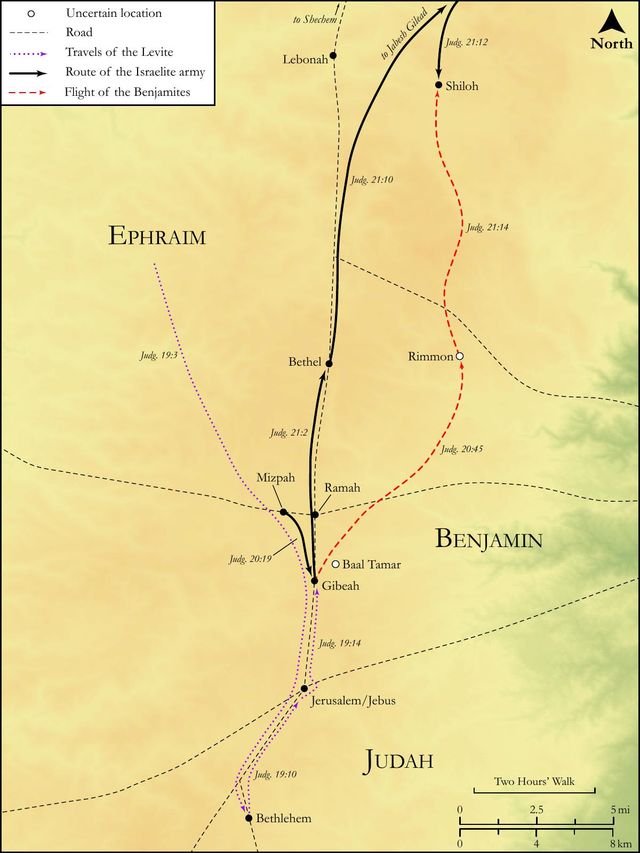
I.That which gave an opportunity for the doing of this was a public ball at Shiloh, in the fields, at which all the young ladies of that city and the parts adjacent that were so disposed met to dance, in honour of a feast of the Lord then observed, probably the feast of tabernacles (Jdg 21:19), for that feast (bishop Patrick says) was the only season wherein the Jewish virgins were allowed to dance, and that not so much for their own recreation as to express their holy joy, as David when he danced before the ark, otherwise the present melancholy posture of public affairs would have made dancing unseasonable, as Isa 22:12, Isa 22:13. The dancing was very modest and chaste. It was not mixed dancing; no men danced with these daughters of Shiloh, nor did any married women so far forget their gravity as to join with them. However their dancing thus in public made them an easy prey to those that had a design upon them, whence bishop Hall observes that the ambushes of evil spirits carry away many souls from dancing to a fearful desolation.
II.The elders of Israel gave authority to the Benjamites to do this, to lie in wait in the vineyards which surrounded the green they used to dance on, and, when they were in the midst of their sport, to come upon them, and catch every man a wife for himself, and carry them straight away to their own country, Jdg 21:20, Jdg 21:21. They knew that none of their own daughters would be there, so that the parents of these virgins could not be said to give them, for they knew nothing of the matter. A sorry salvo is better than none, to save the breaking of an oath: it were much better to be cautious in making vows, that there be not occasion afterwards, as there was here, to say before the angel that it was an error. Here was a very preposterous way of match-making, when both the mutual affection of the young people and the consent of the parents must be presumed to come after; the case was extraordinary, and may by no means be drawn into a precedent. Over hasty marriages often occasion a leisurely repentance; and what comfort can be expected from a match made either by force or fraud? The virgins of Jabesh-Gilead were taken out of the midst of blood and slaughter, but these of Shiloh out of the midst of mirth and joy; the former had reason to be thankful that they had their lives for a prey, and the latter, it is to be hoped, had no cause to complain, after a while, when they found themselves matched, not to men of broken and desperate fortunes, as they seemed to be, who were lately fetched out of a cave, but to men of the best and largest estates in the nation, as they must needs be when the lot of the whole tribe of Benjamin, which consisted of 45,600 men (Num 26:41), came to be divided again among 600, who had all by survivorship.
III.They undertook to pacify the fathers of these young women.
As to the infringement of their paternal authority, they would easily forgive it when they considered to what fair estates their daughters were matched and what mothers in Israel they were likely to be; but the oath they were bound by, not to give their daughters to Benjamites, might perhaps stick with some of them, whose consciences were tender, yet, as to that, this might satisfy them: - 1. That the necessity was urgent (Jdg 21:22): We reserved not to each man his wife, owning now that they did ill to destroy all the women, and desiring to atone for their too rigorous construction of their vow to destroy them by the most favourable construction of their vow not to match with them. "And therefore for our sakes, who were too severe, let them keep what they have got." For, 2. In strictness it was not a breach of their vow; they had sworn not to give them their daughters, but they had not sworn to fetch them back if they were forcibly taken, so that if there was any fault the elders must be responsible, not the parents. And Quod fieri non debuit, factum valet - That which ought not to have been done is yet valid when it is done. The thing was done, and is ratified only by connivance, according to the law, Num 30:4.
Lastly, In the close of all we have, 1. The settling of the tribe of Benjamin again. The few that remained returned to the inheritance of that tribe, Jdg 21:23. And soon after from among them sprang Ehud, who was famous in his generation, the second judge of Israel, Jdg 3:15. 2. The disbanding and dispersing of the army of Israel, Jdg 21:24. They did not set up for a standing army, nor pretend to make any alterations or establishments in the government; but when the affair was over for which they were called together, they quietly departed in God's peace, every man to his family. Public services must not make us think ourselves above our own private affairs and the duty of providing for our own house. 3. A repetition of the cause of these confusions, Jdg 21:25. Though God was their King, every man would be his own master, as if there was no king. Blessed be God for magistracy.
Historical interpretation
Historical reception
1 surviving comment on this verse from the historical church.
After a long time spent in this state of indecision and while I was still busily searching for the cause I have mentioned, there came to my mind the book of Judges, which tells how each man did what was right in his own eyes and gives the reason for this in these words: “In those days there was no king in Israel.” With these words in mind, then, I applied also to the present circumstances that explanation which, incredible and frightening as it may be, is quite truly pertinent when it is understood; for never before has there arisen such discord and quarreling as now among the members of the church in consequence of their turning away from the one, great and true God and only King of the universe. Each person, indeed, abandons the teachings of our Lord Jesus Christ and arrogates to himself authority in dealing with certain questions, making his own private rules and preferring to exercise leadership in opposition to the Lord to being led by the Lord.
Continue studying Judges 21:25 across the web’s major study libraries — every link below opens this exact verse, chapter, or book on the destination site.
Read & Compare
 BibleGatewayThis verse in more than 200 translations and 70 languages.
 Bible.comThe YouVersion reader — hundreds of translations, reading plans, and highlights.
 ESV.orgCrossway's official English Standard Version reader.
 NET BibleThe NET translation with 60,000+ translators' notes on every rendering decision.
 STEP BibleTyndale House's free study tool — original text, vocabulary, and scholarly resources.
 BibliaLogos Bible Software's free web reader.
 USCCBThe New American Bible (Revised Edition) with the U.S. bishops' study notes.
Commentaries
 BibleHub CommentariesDozens of classic commentaries on this verse, gathered on one page.
 StudyLightMore than 100 commentary sets — the largest collection on the web.
 BibleRefPlain-English commentary on what this verse means, verse by verse.
 Enduring WordDavid Guzik's free commentary on this chapter, widely used by Bible teachers.
 Bible Study ToolsVerse commentary alongside Greek and Hebrew study aids.
Original Language & Research
- BibleHub InterlinearThe verse word by word — original language, transliteration, and English.
- BibleHub LexiconEvery word's original-language definition and Strong's entry.
 Blue Letter BibleDeep-study tools — Strong's numbers, concordance, and word studies.
 SefariaThe Hebrew text with Rashi and centuries of Jewish commentary.
Sermons, Hymns & Audio


TrulyRandomVerse is not affiliated with these sites and doesn’t control their content. They’re linked because they’re genuinely useful.
Summary
Judges 21:25 serves as the stark and profound epilogue to the entire Book of Judges, encapsulating the pervasive moral, spiritual, and social decay that characterized Israel during this tumultuous interregnum. It succinctly articulates the root cause of the widespread anarchy and depravity: in the critical absence of a central, divinely appointed king, each individual abandoned objective divine standards and instead pursued what was subjectively "right in his own eyes," leading to a society tragically marked by disunity, violence, and a profound rejection of God's covenantal ways.
Context
ShowHideLiterary Context
Judges 21:25 functions as the climactic and summarizing statement for the entire Book of Judges, providing the interpretive lens through which the preceding narratives of escalating depravity are to be understood. It is the fourth and final recurrence of the poignant refrain, "In those days there was no king in Israel," a phrase that first appears in Judges 17:6, then in Judges 18:1, and again in Judges 19:1. This deliberate repetition creates a powerful literary device, hammering home the central problem of the era: a profound leadership vacuum that led directly to societal chaos. The verse thus serves as a lament over Israel's spiritual and political vacuum, explaining the horrific events culminating in the civil war against Benjamin and the desperate measures to preserve the tribe in Judges 19-21.
Historical & Cultural Context
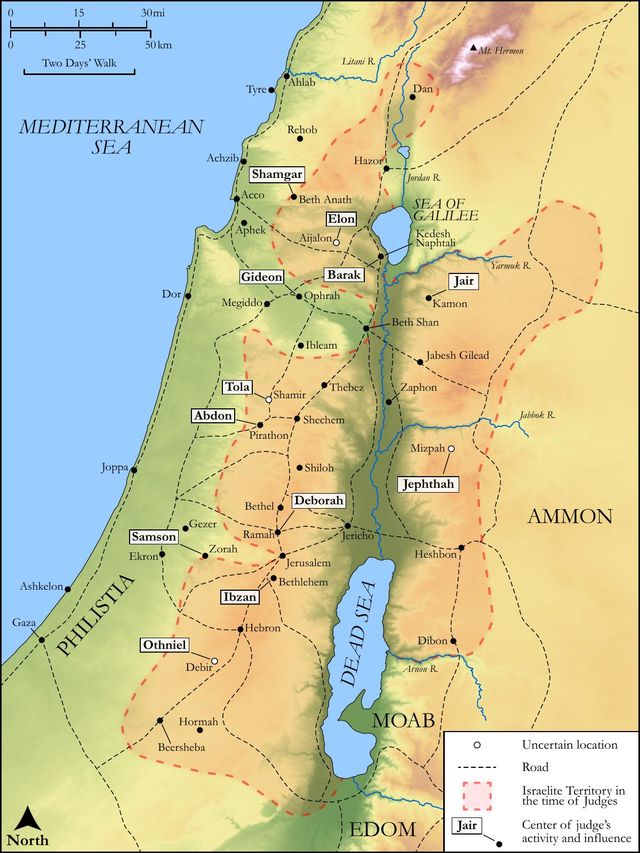
The Book of Judges chronicles the tumultuous period in Israel's history following the death of Joshua and preceding the establishment of the monarchy, roughly spanning from the late 14th to the mid-11th century BC. During this era, Israel was intended to function as a theocracy, with Yahweh as their supreme King, and His covenant laws (the Torah) as their guiding constitution, mediated through tribal elders and charismatic leaders known as "judges." However, the absence of a strong, unified human leader to consistently enforce God's laws led to tribal fragmentation, internal strife, and repeated cycles of apostasy, oppression by surrounding nations (e.g., Philistines, Moabites, Midianites), and subsequent deliverance through divinely raised judges. The phrase "no king in Israel" therefore reflects not only a political reality—the lack of a centralized human monarchy—but, more profoundly, a spiritual reality: the people had effectively rejected God's kingship over them, leading to a dangerous vacuum filled by individualistic, self-serving, and often pagan-influenced morality.
Key Themes
ShowHideThis concluding verse powerfully underscores several critical themes woven throughout the Book of Judges. Firstly, it highlights the devastating consequences of the absence of central, righteous authority, both human and divine, as the fundamental root cause of societal breakdown. Without a king to unify the tribes and uphold God's law, chaos and disunity inevitably ensued. Secondly, it starkly exposes the dangers of moral relativism and anarchy, where "every man did that which was right in his own eyes." This stands in direct opposition to God's repeated and explicit commands for His people to obey His objective statutes and judgments, not their own subjective inclinations, as articulated in Deuteronomy 12:8. The book vividly demonstrates that when objective divine truth is abandoned for subjective human preference, the result is pervasive societal decay, spiritual apostasy, and profound suffering. Finally, the verse serves as a grim commentary on the consequences of rejecting God's rule, setting the historical and theological stage for Israel's eventual demand for a human king, as seen in 1 Samuel 8:7, even if their motivations for desiring a king were initially misguided.
Exposition and Analysis
ShowHideKey Word Analysis
ShowHideThis term denotes a sovereign ruler or monarch, a figure of authority and governance. Its repeated absence in Judges 21:25, and indeed throughout the latter half of the book, signifies more than just a political void; it represents a profound spiritual and moral vacuum. In a theocracy like ancient Israel, the human king was intended to be God's representative, tasked with upholding His law, ensuring justice, and leading the people in covenant faithfulness. The lack of such a unifying figure led directly to a breakdown of central leadership, accountability, and consistent adherence to the divine covenant, culminating in fragmentation and widespread moral decline.
Meaning "straight," "upright," "just," or "proper." When applied to actions or conduct, it refers to what is morally correct, equitable, or in accordance with an established standard. The critical qualification in Judges 21:25 is that this "right" was determined "in his own eyes," rather than by God's objective, revealed standard. This highlights a fundamental perversion of justice and morality, where subjective human judgment, often driven by self-interest or expediency, usurped divine revelation as the ultimate arbiter of truth.
While literally referring to the organ of sight, the idiomatic phrase "in his own eyes" signifies "in his own opinion," "in his own estimation," or "from his own perspective." It profoundly underscores the intensely subjective, self-centered, and autonomous nature of the moral compass prevalent during this period. What appeared "right" to an individual was frequently self-serving, convenient, or aligned with the surrounding pagan practices, rather than genuinely righteous in the sight of a holy God.
Verse Breakdown
ShowHide"In those days [there was] no king in Israel"
This initial clause establishes the critical political, social, and spiritual context that undergirds the ensuing chaos and moral decay. It points to a profound leadership vacuum that emerged following the death of Joshua and the generation of elders who had personally witnessed God's mighty acts. Without a central, unifying human authority to enforce God's covenant laws, administer justice, and provide cohesive direction, the twelve tribes operated largely independently, often to their own detriment and in direct violation of divine commands. This absence of a human king also implicitly critiques the people's failure to recognize and faithfully obey God as their true and ultimate sovereign.
"every man did [that which was] right in his own eyes"
This second clause explains the devastating and inevitable consequence of the first, describing a society plunged into moral relativism and profound anarchy. Instead of adhering to the objective, unchanging, and divinely revealed will of God—the Torah—individuals and communities made decisions based solely on personal preference, self-interest, or what seemed expedient or justifiable to them. This rampant subjectivity led to a catastrophic breakdown of societal order, widespread injustice, and a rapid descent into depravity, as vividly illustrated by the preceding narratives of idolatry, violence, and sexual immorality. It signifies a profound and dangerous rejection of God's absolute authority and a perilous embrace of subjective truth.
Literary Devices
ShowHideJudges 21:25 employs several potent literary devices to convey its somber and critical message. The most prominent is Repetition, as the phrase "no king in Israel" appears four times in the latter half of the book (17:6, 18:1, 19:1, 21:25). This deliberate and recurring refrain functions as a powerful literary marker, underscoring the central problem of the era and creating a pervasive sense of escalating despair and moral decay throughout the narrative. The verse also utilizes Juxtaposition, sharply contrasting the ideal of a divinely appointed king (or, more fundamentally, God's own kingship) with the grim reality of individual moral autonomy ("every man did that which was right in his own eyes"). This contrast powerfully highlights the direct causal link between the absence of proper, God-ordained authority and the rampant rise of subjective, self-serving morality. Furthermore, this concluding verse functions as a masterful Summary Statement, encapsulating the entire narrative arc of Judges and providing a concise, yet comprehensive, explanation for the cyclical apostasy, oppression, and chaos depicted throughout the book. Finally, the phrase "right in his own eyes" functions as a profound Irony, as what people perceived or justified as "right" consistently led to horrific "wrong" outcomes, demonstrating the inherent danger and self-destructive nature of rejecting objective divine truth.
Theological and Thematic Connections
ShowHideJudges 21:25 stands as a profound theological statement, revealing the dire and inevitable consequences when humanity rejects divine authority and embraces a morality rooted solely in subjective human judgment. It vividly illustrates the inherent human tendency towards sin, self-centeredness, and moral corruption when not constrained by external, objective truth revealed by God. The verse implicitly argues for the absolute necessity of God's law and righteous leadership, not as oppressive forces, but as essential frameworks for true freedom, societal order, and human flourishing. Without God's unchanging, objective standards, society inevitably descends into chaos, where "right" becomes a fluid matter of personal preference or cultural consensus, leading inevitably to injustice, suffering, and spiritual emptiness. This foundational theological truth resonates powerfully throughout the entire biblical narrative, consistently emphasizing that true peace, order, and righteousness are found only in humble submission to God's perfect will and His sovereign rule.
Reflection and Application
ShowHideJudges 21:25 serves as a timeless and urgent warning against the perils of moral relativism and the insidious rejection of objective truth. In an age where personal opinion often trumps established fact, and individual desires frequently override communal good or divine commands, this verse remains acutely relevant, speaking directly to the contemporary human condition. It challenges us profoundly to critically examine the ultimate source of our moral compass: are we genuinely seeking what is "right" in God's eyes, as revealed in His infallible Word, or are we merely doing what feels convenient, popular, or personally justifiable in our own estimation? The pervasive chaos and suffering depicted in the Book of Judges remind us forcefully that true freedom is not found in boundless autonomy or self-determination, but rather in aligning our lives with the eternal wisdom, perfect will, and righteous authority of our Creator. This alignment demands profound humility to acknowledge a standard higher than ourselves and courageous conviction to live by it, even when it contradicts prevailing cultural norms, personal inclinations, or the allure of subjective "truth." For individuals, families, churches, and societies alike, the path of self-determined "rightness" ultimately leads to disunity, breakdown, spiritual emptiness, and tragic consequences.
Questions for Reflection
ShowHideFAQ
ShowHideWhat does "no king in Israel" truly signify in this verse?
ShowHideThe phrase "no king in Israel" in Judges 21:25 signifies far more than simply the absence of a human monarch. It points to a profound political, social, and, most critically, spiritual vacuum. In a theocracy like ancient Israel, God was meant to be their ultimate King, and His covenant laws were intended to govern every aspect of their national and personal life. The lack of a human king meant there was no central figure to unify the disparate tribes, consistently enforce God's covenant, and lead the people in collective righteousness. This leadership void led directly to tribal fragmentation, internal conflicts, and a general breakdown of societal order. Spiritually, it reflects the people's tragic failure to acknowledge and submit to God's own kingship, resulting in a state where divine authority was largely ignored or outright rejected.
What is the meaning and inherent danger of "every man did [that which was] right in his own eyes"?
ShowHideThis phrase vividly describes a state of pervasive moral relativism and profound anarchy. Instead of adhering to God's objective, unchanging, and divinely revealed standards of right and wrong as found in the Torah, each individual or community determined their own moral code based on personal opinion, convenience, self-interest, or what seemed expedient to them. The inherent danger lies in the profound fallibility, inherent sinfulness, and self-deception of human judgment. When people abandon an unchanging, external standard (like God's perfect law) for subjective truth, the inevitable result is chaos, rampant injustice, and profound depravity, as chillingly illustrated by the horrific events in the latter chapters of Judges (e.g., Judges 19). It leads to a society where there is no common ground for truth, justice, or morality, and where self-will often reigns supreme, leading to destructive outcomes.
How does this verse relate to the broader narrative and purpose of the Book of Judges?
ShowHideJudges 21:25 serves as the interpretive key and climactic summary for the entire Book of Judges. It powerfully explains why the period chronicled in the book was so turbulent, marked by cycles of apostasy, foreign oppression, and internal suffering. The repeated phrase "no king in Israel" (also found in Judges 17:6, Judges 18:1, and Judges 19:1) highlights the central problem: a profound leadership vacuum and, more importantly, a failure to submit to God's ultimate authority. The book systematically demonstrates that without proper, God-ordained leadership and, crucially, without a people's willing submission to God's ultimate authority, humanity inevitably descends into moral chaos, where individual self-will reigns supreme over divine wisdom and covenantal obligations, leading to widespread societal breakdown.
Christ-Centered Fulfillment
ShowHideJudges 21:25, with its bleak depiction of a people lost in moral anarchy due to the absence of a righteous king and their abandonment of objective truth, powerfully underscores humanity's desperate and universal need for a true and perfect King—Jesus Christ. The pervasive chaos and subjective "rightness" of "every man did that which was right in his own eyes" is the stark antithesis of the divine order, perfect righteousness, and true peace established by Christ's reign. Unlike the flawed human kings Israel would eventually seek, Jesus is the King who perfectly embodies God's will, upholds divine law, and establishes true justice and peace. He is the ultimate Lamb of God who takes away the sin of the world, directly addressing the very root of the subjective sinfulness and self-deception described in Judges. As the Light of the world, He dispels the darkness of human ignorance and self-determined morality, revealing the objective, saving truth of God's kingdom. Through His perfect life, atoning death, and glorious resurrection, Christ establishes a new covenant, not based on human fallibility or self-effort, but on His perfect obedience and sacrificial love, offering a way for humanity to be reconciled to God and truly do what is "right" in God's eyes, empowered by the indwelling Holy Spirit. He is the ultimate fulfillment of the longing for a righteous ruler, bringing not just external order but profound internal transformation, making Him the Way, the Truth, and the Life for all who believe, leading them out of the anarchy of self-rule into the glorious freedom and eternal life of His divine kingdom, where His will is perfectly done.