


Judges 21:23
Bible text: King James Version (1769 Blayney text) · Public domain
Bible text: King James Version with Strong's numbers · Public domain
Bible text: Berean Standard Bible · Public domain
Bible text: American Standard Version (1901) · Public domain
Bible text: World English Bible, Messianic edition · Public domain
Bible text: Geneva Bible (1599) · Public domain
Bible text: Young's Literal Translation · Public domain
- וַיַּעֲשׂוּvai·ya·'a·suand they didH6213Conj-w ¦ V-Qal-ConsecImperf-3mpVerb Qal Consecutive Imperfect 3rd Plural Masculineוַandיַּעֲשׂוּthey did
- כֵןkhenthusH3651AdvAdverb
- בְּנֵיbe·Nei[the] descendants ofH1121N-mpcNoun Plural Masculine Construct
- בִנְיָמִןvin·ya·MinBenjaminH1144N-proper-mNoun Proper Masculine
- וַיִּשְׂאוּvai·yis·'Uand they carried offH5375Conj-w ¦ V-Qal-ConsecImperf-3mpVerb Qal Consecutive Imperfect 3rd Plural Masculineוַandיִּשְׂאוּthey carried off
- נָשִׁיםna·ShimwivesH802N-mpNoun Plural Masculine Absolute
- לְמִסְפָּרָםle·mis·pa·Ramto their numberH4557Prep-l ¦ N-msc ¦ 3mpNoun Singular Masculine Constructלְtoמִסְפָּרָnumberםtheir
- מִןminfromH4480PrepPreposition
- הַמְּחֹלְלוֹתha·me·cho·le·Lotthe dancersH2342Art ¦ V-Piel-Prtcpl-fpVerb Piel Participle Plural Feminine Absoluteהַtheמְּחֹלְלוֹתdancers
- אֲשֶׁר'a·SherwhomH834RelParticle Relative
- גָּזָלוּga·Za·luthey seizedH1497V-Qal-Perf-3cpVerb Qal Perfect 3rd Plural common gender
- וַיֵּלְכוּvai·ye·le·Khuand they wentH1980Conj-w ¦ V-Qal-ConsecImperf-3mpVerb Qal Consecutive Imperfect 3rd Plural Masculineוַandיֵּלְכוּthey went
- וַיָּשׁוּבוּvai·ya·Shu·vuand they returnedH7725Conj-w ¦ V-Qal-ConsecImperf-3mpVerb Qal Consecutive Imperfect 3rd Plural Masculineוַandיָּשׁוּבוּthey returned
- אֶל'eltoH413PrepPreposition
- נַחֲלָתָםna·cha·la·Tamtheir inheritanceH5159N-fsc ¦ 3mpNoun Singular Feminine Constructנַחֲלָתָinheritanceםtheir
- וַיִּבְנוּvai·yiv·Nuand they rebuiltH1129Conj-w ¦ V-Qal-ConsecImperf-3mpVerb Qal Consecutive Imperfect 3rd Plural Masculineוַandיִּבְנוּthey rebuilt
- אֶת'et<obj.>H853DirObjMParticle Object Indicator
- הֶעָרִיםhe·'a·Rimthe citiesH5892Art ¦ N-mpNoun Plural Masculine Absoluteהֶtheעָרִיםcities
- וַיֵּשְׁבוּvai·ye·she·Vuand they dweltH3427Conj-w ¦ V-Qal-ConsecImperf-3mpVerb Qal Consecutive Imperfect 3rd Plural Masculineוַandיֵּשְׁבוּthey dwelt
- בָּהֶםba·Hemin <the> themPrep-b ¦ 3mpSuffix Personal 3rd Plural Masculineבָּin <the>הֶםthem
English is a literal word-by-word gloss of the Hebrew, not the KJV's wording. Why?
This is the original text the KJV's translators worked from — each Hebrew word with its own literal English meaning in this verse, prepared by scholars at Tyndale House, Cambridge. The KJV translates whole sentences, not word by word, so its wording differs: one Hebrew word can become several English words, and the KJV may choose “the LORD” where the gloss reads “Yahweh”. Both are faithful — they answer different questions. For the KJV's own rendering, switch to the KJV text.
Details
See on the biblical-era maps
Study this verse
Public-domain commentary
Matthew Henry
From his Commentary on the Whole Bible. Henry comments on passages, not single verses — this entry covers Judges 21:16–25.
We have here the method that was taken to provide the 200 Benjamites that remained with wives. And, though the tribe was reduced to a small number, they were only in care to provide each man with one wife, not with more under pretence of multiplying them the faster. They may not bestow their daughters upon them, but to save their oath, and yet marry some of their daughters to them, they put them into a way of taking them by surprise, and marrying them, which should be ratified by their parents' consent, ex post facto - afterwards. The less consideration is used before the making of a vow, the more, commonly, there is need of afterwards for the keeping of it.
I.That which gave an opportunity for the doing of this was a public ball at Shiloh, in the fields, at which all the young ladies of that city and the parts adjacent that were so disposed met to dance, in honour of a feast of the Lord then observed, probably the feast of tabernacles (Jdg 21:19), for that feast (bishop Patrick says) was the only season wherein the Jewish virgins were allowed to dance, and that not so much for their own recreation as to express their holy joy, as David when he danced before the ark, otherwise the present melancholy posture of public affairs would have made dancing unseasonable, as Isa 22:12, Isa 22:13. The dancing was very modest and chaste. It was not mixed dancing; no men danced with these daughters of Shiloh, nor did any married women so far forget their gravity as to join with them. However their dancing thus in public made them an easy prey to those that had a design upon them, whence bishop Hall observes that the ambushes of evil spirits carry away many souls from dancing to a fearful desolation.
II.The elders of Israel gave authority to the Benjamites to do this, to lie in wait in the vineyards which surrounded the green they used to dance on, and, when they were in the midst of their sport, to come upon them, and catch every man a wife for himself, and carry them straight away to their own country, Jdg 21:20, Jdg 21:21. They knew that none of their own daughters would be there, so that the parents of these virgins could not be said to give them, for they knew nothing of the matter. A sorry salvo is better than none, to save the breaking of an oath: it were much better to be cautious in making vows, that there be not occasion afterwards, as there was here, to say before the angel that it was an error. Here was a very preposterous way of match-making, when both the mutual affection of the young people and the consent of the parents must be presumed to come after; the case was extraordinary, and may by no means be drawn into a precedent. Over hasty marriages often occasion a leisurely repentance; and what comfort can be expected from a match made either by force or fraud? The virgins of Jabesh-Gilead were taken out of the midst of blood and slaughter, but these of Shiloh out of the midst of mirth and joy; the former had reason to be thankful that they had their lives for a prey, and the latter, it is to be hoped, had no cause to complain, after a while, when they found themselves matched, not to men of broken and desperate fortunes, as they seemed to be, who were lately fetched out of a cave, but to men of the best and largest estates in the nation, as they must needs be when the lot of the whole tribe of Benjamin, which consisted of 45,600 men (Num 26:41), came to be divided again among 600, who had all by survivorship.
III.They undertook to pacify the fathers of these young women.
As to the infringement of their paternal authority, they would easily forgive it when they considered to what fair estates their daughters were matched and what mothers in Israel they were likely to be; but the oath they were bound by, not to give their daughters to Benjamites, might perhaps stick with some of them, whose consciences were tender, yet, as to that, this might satisfy them: - 1. That the necessity was urgent (Jdg 21:22): We reserved not to each man his wife, owning now that they did ill to destroy all the women, and desiring to atone for their too rigorous construction of their vow to destroy them by the most favourable construction of their vow not to match with them. "And therefore for our sakes, who were too severe, let them keep what they have got." For, 2. In strictness it was not a breach of their vow; they had sworn not to give them their daughters, but they had not sworn to fetch them back if they were forcibly taken, so that if there was any fault the elders must be responsible, not the parents. And Quod fieri non debuit, factum valet - That which ought not to have been done is yet valid when it is done. The thing was done, and is ratified only by connivance, according to the law, Num 30:4.
Lastly, In the close of all we have, 1. The settling of the tribe of Benjamin again. The few that remained returned to the inheritance of that tribe, Jdg 21:23. And soon after from among them sprang Ehud, who was famous in his generation, the second judge of Israel, Jdg 3:15. 2. The disbanding and dispersing of the army of Israel, Jdg 21:24. They did not set up for a standing army, nor pretend to make any alterations or establishments in the government; but when the affair was over for which they were called together, they quietly departed in God's peace, every man to his family. Public services must not make us think ourselves above our own private affairs and the duty of providing for our own house. 3. A repetition of the cause of these confusions, Jdg 21:25. Though God was their King, every man would be his own master, as if there was no king. Blessed be God for magistracy.
Continue studying Judges 21:23 across the web’s major study libraries — every link below opens this exact verse, chapter, or book on the destination site.
Read & Compare
 BibleGatewayThis verse in more than 200 translations and 70 languages.
 Bible.comThe YouVersion reader — hundreds of translations, reading plans, and highlights.
 ESV.orgCrossway's official English Standard Version reader.
 NET BibleThe NET translation with 60,000+ translators' notes on every rendering decision.
 STEP BibleTyndale House's free study tool — original text, vocabulary, and scholarly resources.
 BibliaLogos Bible Software's free web reader.
 USCCBThe New American Bible (Revised Edition) with the U.S. bishops' study notes.
Commentaries
 BibleHub CommentariesDozens of classic commentaries on this verse, gathered on one page.
 StudyLightMore than 100 commentary sets — the largest collection on the web.
 BibleRefPlain-English commentary on what this verse means, verse by verse.
 Enduring WordDavid Guzik's free commentary on this chapter, widely used by Bible teachers.
 Bible Study ToolsVerse commentary alongside Greek and Hebrew study aids.
Original Language & Research
- BibleHub InterlinearThe verse word by word — original language, transliteration, and English.
- BibleHub LexiconEvery word's original-language definition and Strong's entry.
 Blue Letter BibleDeep-study tools — Strong's numbers, concordance, and word studies.
 SefariaThe Hebrew text with Rashi and centuries of Jewish commentary.
Sermons, Hymns & Audio


TrulyRandomVerse is not affiliated with these sites and doesn’t control their content. They’re linked because they’re genuinely useful.
Summary
Judges 21:23 provides the unsettling resolution to one of the most violent and morally ambiguous episodes in the book of Judges, detailing the final desperate act to preserve the decimated tribe of Benjamin. In accordance with a plan devised by the other Israelite tribes, the remaining Benjamite men forcibly acquired wives from among the women dancing at the annual feast in Shiloh. This ethically troubling event allowed the tribe to replenish its numbers, return to its ancestral inheritance, and begin the process of rebuilding their cities, thereby ensuring the continuity of one of Israel's foundational twelve tribes amidst a period of profound societal and spiritual decay.
Context
ShowHideLiterary Context
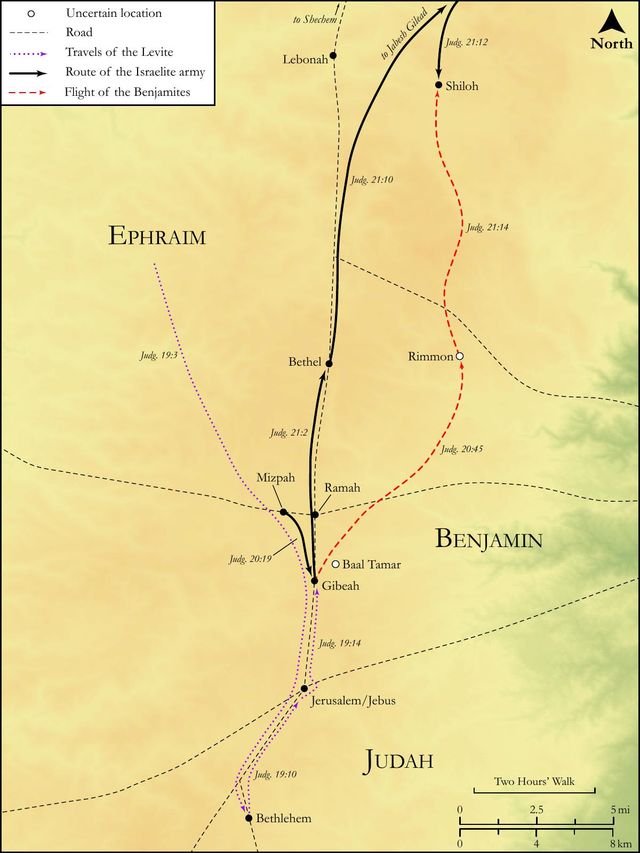
Judges 21:23 functions as the concluding scene to the harrowing narrative arc that begins in Judges 19 and extends through Judges 21. This extensive account describes a period of extreme moral depravity and social disintegration in ancient Israel. The catalyst was an unspeakable crime committed in Gibeah of Benjamin, which provoked a brutal retaliatory civil war by the other tribes against Benjamin, leading to the near-annihilation of the tribe, with only 600 men surviving (Judges 20:46-48). Following the war, the victorious Israelite tribes were gripped by remorse over Benjamin's impending extinction, especially as they had sworn a solemn oath at Mizpah not to give their daughters in marriage to any Benjamite (Judges 21:1). To circumvent this oath while ensuring Benjamin's survival, two ethically dubious strategies were implemented: first, providing wives from Jabesh-Gilead, whose inhabitants had not participated in the war and were thus deemed exempt from the oath (Judges 21:8-14); and second, the controversial plan detailed in this verse, which sanctioned the abduction of women from the annual feast at Shiloh (Judges 21:16-22). Thus, Judges 21:23 serves as the narrative's grim resolution, ensuring Benjamin's precarious survival and the continuity of the tribal structure.
Historical & Cultural Context
The events of Judges 19-21 are situated in a turbulent era of Israelite history, characterized by the absence of a central monarchy and the pervasive sentiment that "every man did that which was right in his own eyes" (Judges 21:25). Shiloh, prominently featured in this verse, was a pivotal religious center during the period of the Judges, housing the Tabernacle and the Ark of the Covenant, making it a sacred site for national gatherings. Annual feasts, such as the one described, were customary religious and social occasions, often marked by dancing and communal celebration. The women's participation in such festivities, particularly their dancing in the vineyards, made them vulnerable targets, as they were likely unescorted by male protectors and absorbed in the celebration. While the abduction of women was generally condemned under Israelite law, the extraordinary circumstances—a tribal oath preventing conventional marriage and the existential threat to an entire tribe—led the tribal leaders to condone this highly irregular and morally problematic solution. This episode starkly illustrates a society grappling with a breakdown of law, order, and moral authority, where desperate measures were undertaken to uphold perceived divine and communal obligations, even when they directly conflicted with other ethical norms.
Key Themes
ShowHideThis verse, and the broader narrative it concludes, contributes significantly to several profound themes within the book of Judges. Foremost is the Preservation of a Tribe, highlighting the desperate, albeit morally compromised, effort to prevent the complete disappearance of the tribe of Benjamin. Despite the extreme and ethically questionable means employed, the survival of one of Israel's twelve tribes was considered paramount for the continuity of the nation and its future role in God's redemptive plan, particularly given the importance of tribal lineage in Israelite identity and the unfolding of the Messianic promise. This episode also serves as a stark illustration of the Consequences of Anarchy, demonstrating how the absence of central authority and moral leadership—repeatedly summarized by the refrain "there was no king in Israel"—led to horrific violence, societal breakdown, and the adoption of desperate, morally ambiguous solutions. Finally, amidst the profound human failure and moral depravity, the narrative subtly points to Divine Providence Amidst Human Failure. Even through such dark and chaotic events, the twelve tribes, foundational to God's covenant with Israel, are preserved, ensuring the lineage from which the Messiah would eventually come, suggesting God's overarching plan endures despite human sin and the societal chaos it engenders.
Exposition and Analysis
ShowHideKey Word Analysis
ShowHideThis verb means "to lift" or "to carry," but in a broader sense, it can also mean "to take" or "to obtain." The Ground Truth data includes "marry" as one of its applications. However, in the context of Judges 21:23, especially when paired with "whom they caught" (H1497, gâzal, meaning "to pluck off, rob, take away by force"), the nuance shifts from a consensual acquisition to a forceful seizure. This specific usage emphasizes the non-consensual and predatory nature of the act, highlighting the desperate and ethically compromised means by which the Benjamites acquired their wives.
This primitive root means "to twist or whirl (in a circular or spiral manner), i.e. (specifically) to dance." It can also refer to writhing in pain or fear. In this context, it describes the joyful, celebratory activity of the women at the annual feast in Shiloh (Judges 21:21). Their engagement in this public, festive dance made them particularly vulnerable to the ambush, as they were likely focused on the celebration rather than on potential threats, underscoring the opportunistic and morally reprehensible nature of the Benjamites' actions.
This primitive root means "to build" (literally and figuratively) and includes the specific sense of "to repair" or "to set up." Following the devastating civil war that saw many Benjamite cities burned and laid waste (Judges 20:48), the act of "repaired the cities" signifies a tangible and crucial step towards the re-establishment of the tribe's infrastructure and communal life. It symbolizes the physical and social restoration of Benjamin, moving from near-annihilation to a renewed, albeit fragile, existence within their inherited territory, marking a return to normalcy and stability.
Verse Breakdown
ShowHide"And the children of Benjamin did so"
This opening clause immediately signals the execution of the controversial plan devised by the Israelite tribes. It indicates the Benjamite men's direct and immediate obedience to the counsel to acquire wives through abduction at the feast in Shiloh, underscoring their desperate situation and their reliance on the other tribes' "solution" to their existential crisis.
"and took [them] wives, according to their number, of them that danced, whom they caught"
This is the central action of the verse, detailing the forceful acquisition of wives. The Benjamites "took" (seized) wives, specifically targeting the women who were "dancing" at the annual feast. The phrase "according to their number" implies that each of the remaining 600 Benjamite men secured a wife, fulfilling the quota necessary to ensure the tribe's survival. The explicit phrase "whom they caught" emphasizes the violent, predatory nature of the act, confirming it as an abduction rather than a consensual union, highlighting the moral compromise inherent in the solution.
"and they went and returned unto their inheritance, and repaired the cities, and dwelt in them"
This final clause describes the immediate consequences and the resolution of the abduction. Having secured wives, the Benjamite men returned with them to their ancestral land. The subsequent actions—"repaired the cities, and dwelt in them"—signify the physical and social re-establishment of the tribe. It marks the end of their nomadic, displaced state and the beginning of their return to normal life, rebuilding their communities and re-populating their territory, thereby ensuring the continuity of the tribe of Benjamin within the larger Israelite nation.
Literary Devices
ShowHideJudges 21:23 serves as a crucial point of Narrative Resolution for the deeply disturbing account of the civil war against Benjamin (Judges 19-21). It brings the chaotic and violent events to a close, providing a conclusion to the question of Benjamin's survival and the restoration of the twelve-tribe structure. There is a profound sense of Irony embedded in this verse; the tribe of Benjamin, nearly wiped out due to their own egregious sin and the subsequent retaliatory violence, is preserved through another act of violence and moral compromise—the abduction of innocent women. This highlights the pervasive moral decay of the era, where desperate measures were deemed necessary, even if ethically dubious. The verse also implicitly uses Foreshadowing, as the chaotic events and the desperate need for a "solution" that bypasses divine law and moral order underscore the recurring refrain "in those days there was no king in Israel" (Judges 17:6), subtly pointing to the future necessity of a righteous king to bring order, justice, and true moral authority to the nation.
Theological and Thematic Connections
ShowHideJudges 21:23, despite its unsettling content, profoundly underscores God's mysterious sovereignty and covenant faithfulness, even amidst profound human depravity and moral compromise. While the actions of the Israelites in this chapter are not divinely sanctioned but rather a stark reflection of a society that has lost its moral compass, the preservation of Benjamin is providentially crucial for the unfolding of God's redemptive plan. The twelve tribes were integral to God's covenant with Abraham, and the near-extinction of one tribe would have fractured the national identity and potentially jeopardized the lineage through which the Messiah would eventually come. This passage serves as a stark reminder of the dangers of moral relativism and the societal breakdown that occurs when divine standards are abandoned, illustrating that even when humanity acts in its own flawed wisdom, God's ultimate purposes can still be discerned, often through the preservation of His people against all odds.
Reflection and Application
ShowHideJudges 21:23 presents a challenging paradox: a horrifying act of abduction is portrayed as a necessary step for the survival of a tribe, highlighting the deep moral compromises made in a desperate era. While we are not to emulate the actions described, the passage offers profound insights into the consequences of societal and spiritual decay. It vividly illustrates what happens when a people lose their moral compass and when "every man does what is right in his own eyes" (Judges 17:6). The desperation of the Israelites to preserve Benjamin, even through morally questionable means, highlights the deep value placed on tribal continuity within God's covenant plan, yet it simultaneously exposes the depths of human depravity when divine law is neglected. For us today, it serves as a powerful warning about the critical need for righteous leadership, unwavering adherence to God's unchanging standards, and the dangers of allowing expediency to override ethical principles. It reminds us that true restoration and healing come not from human machinations or moral compromises, but from a humble return to God's wisdom and a reliance on His sovereign grace.
Questions for Reflection
ShowHideFAQ
ShowHideWhy did the other tribes condone this abduction, given its clear ethical problems?
ShowHideThe other Israelite tribes found themselves in an impossible dilemma. After nearly annihilating Benjamin in a civil war, they realized their actions had brought one of the twelve tribes to the brink of extinction. To compound the problem, they had sworn a solemn oath at Mizpah not to give their daughters in marriage to any Benjamite (Judges 21:1). Breaking this oath was unthinkable in their cultural context, as it would be seen as violating a sacred vow before God. Faced with the choice between breaking an oath and allowing an entire tribe to vanish (a significant theological and national catastrophe), they devised two "solutions" to circumvent the oath while preserving Benjamin. The first involved providing wives from Jabesh-Gilead (Judges 21:8-14), and the second, the abduction at Shiloh, was a desperate measure to ensure the remaining 600 Benjamite men could secure wives without the other tribes directly "giving" their daughters. This reflects the moral chaos and lack of clear divine guidance in an era where "there was no king in Israel: every man did that which was right in his own eyes" (Judges 21:25).
Christ-Centered Fulfillment
ShowHideThe dark narrative of Judges 21:23, with its desperate and morally compromised resolution, powerfully underscores the profound human need for a true and righteous King, a need ultimately fulfilled in Jesus Christ. The preservation of the tribe of Benjamin, despite the ethically troubling means, was providentially crucial for the continuation of the lineage through which the Messiah would come. Indeed, King Saul, Israel's first king, would later emerge from the tribe of Benjamin (1 Samuel 9:1-2). More significantly, the chaos and "every man did what was right in his own eyes" mentality of the Judges era (Judges 17:6) highlight humanity's inability to establish true order, justice, and peace apart from divine rule. Jesus, as the true King, the Lamb of God who takes away the sin of the world, provides the perfect moral compass, the ultimate sacrifice for sin, and the just reign that the Israelites so desperately lacked. He does not resort to desperate, ethically ambiguous measures but brings genuine reconciliation and restoration, not merely for a tribe, but for all who believe (Colossians 1:19-20). In Christ, the brokenness of humanity is healed, and the true "inheritance" is secured, not by force or human cunning, but by grace and truth (Ephesians 1:11-14). He is the one who truly "repairs the cities" of our lives and souls, establishing His eternal dwelling among His people (Revelation 21:3-4), bringing an end to the spiritual anarchy that plagued Israel and continues to afflict humanity.