


Judges 21:22
Bible text: King James Version (1769 Blayney text) · Public domain
Bible text: King James Version with Strong's numbers · Public domain
Bible text: Berean Standard Bible · Public domain
Bible text: American Standard Version (1901) · Public domain
Bible text: World English Bible, Messianic edition · Public domain
Bible text: Geneva Bible (1599) · Public domain
Bible text: Young's Literal Translation · Public domain
- וְהָיָהve·ha·Yahand it will beH1961Conj-w ¦ V-Qal-ConsecPerf-3msVerb Qal Consecutive Perfect 3rd Singular Masculineוְandהָיָהit will be
- כִּיkithatH3588PrtParticle Conditional
- יָבֹאוּya·Vo·'uthey will comeH935V-Qal-Imperf-3mpVerb Qal Imperfect 3rd Plural Masculine
- אֲבוֹתָם'a·vo·Tamtheir fathersH1N-fpc ¦ 3mpNoun Plural Feminine Constructאֲבוֹתָfathersםtheir
- אוֹ'oorH176ConjConjunction
- אֲחֵיהֶם'a·chei·Hemtheir brothersH251N-mpc ¦ 3mpNoun Plural Masculine Constructאֲחֵיbrothersהֶםtheir
- לָרִיבla·rovto make a complaintH7378Prep-l ¦ V-Qal-InfVerb Qal Infinitive Constructלָtoרִיבmake a complaint
- אֵלֵינוּ'e·Lei·nuto usH413Prep ¦ 1cpPreposition Definiteאֵלֵיtoנוּus
- וְאָמַרְנוּve·'a·Mar·nuand we will sayH559Conj-w ¦ V-Qal-ConsecPerf-1cpVerb Qal Consecutive Perfect 1st Plural common genderוְandאָמַרְנוּwe will say
- אֲלֵיהֶם'a·lei·Hemto themH413Prep ¦ 3mpPreposition Definiteאֲלֵיtoהֶםthem
- חָנּוּנוּcha·Nu·nushow favor for to usH2603V-Qal-Imp-2mp ¦ 1cpVerb Qal Imperative 2nd Plural Masculineחָנּוּshow favor for toנוּus
- אוֹתָם'o·Tam<obj.> themH853DirObjM ¦ 3mpParticle Object Indicatorאוֹתָ<obj.>םthem
- כִּיkiforH3588PrtParticle Conditional
- לֹאlo'notH3808NegParticle Negative
- לָקַחְנוּla·Kach·nuwe tookH3947V-Qal-Perf-1cpVerb Qal Perfect 1st Plural common gender
- אִישׁ'isheach manH376N-msNoun Singular Masculine Absolute
- אִשְׁתּוֹ'ish·Tohis wifeH802N-fsc ¦ 3msNoun Singular Feminine Constructאִשְׁתּwifeוֹhis
- בַּמִּלְחָמָהba·mil·cha·Mahin the battleH4421Prep-b ¦ N-fsNoun Singular Feminine Absoluteבַּin theמִּלְחָמָהbattle
- כִּיkiforH3588PrtParticle Conditional
- לֹאlo'notH3808NegParticle Negative
- אַתֶּם'a·TemyouH859Pro-2mpPronoun Personal 2nd Plural Masculine
- נְתַתֶּםne·ta·Temyou gave [them]H5414V-Qal-Perf-2mpVerb Qal Perfect 2nd Plural Masculine
- לָהֶםla·Hemto <the> themPrep-l ¦ 3mpSuffix Personal 3rd Plural Masculineלָto <the>הֶםthem
- כָּעֵתka·'Etabout <the> this timeH6256Prep-k ¦ N-csNoun Singular common gender Absoluteכָּabout <the>עֵתthis time
- תֶּאְשָׁמוּte'·Sha·muyou will be guiltyH816V-Qal-Imperf-2mpVerb Qal Imperfect 2nd Plural Masculine
English is a literal word-by-word gloss of the Hebrew, not the KJV's wording. Why?
This is the original text the KJV's translators worked from — each Hebrew word with its own literal English meaning in this verse, prepared by scholars at Tyndale House, Cambridge. The KJV translates whole sentences, not word by word, so its wording differs: one Hebrew word can become several English words, and the KJV may choose “the LORD” where the gloss reads “Yahweh”. Both are faithful — they answer different questions. For the KJV's own rendering, switch to the KJV text.
Details
See on the biblical-era maps
Study this verse
Public-domain commentary
Matthew Henry
From his Commentary on the Whole Bible. Henry comments on passages, not single verses — this entry covers Judges 21:16–25.
We have here the method that was taken to provide the 200 Benjamites that remained with wives. And, though the tribe was reduced to a small number, they were only in care to provide each man with one wife, not with more under pretence of multiplying them the faster. They may not bestow their daughters upon them, but to save their oath, and yet marry some of their daughters to them, they put them into a way of taking them by surprise, and marrying them, which should be ratified by their parents' consent, ex post facto - afterwards. The less consideration is used before the making of a vow, the more, commonly, there is need of afterwards for the keeping of it.
I.That which gave an opportunity for the doing of this was a public ball at Shiloh, in the fields, at which all the young ladies of that city and the parts adjacent that were so disposed met to dance, in honour of a feast of the Lord then observed, probably the feast of tabernacles (Jdg 21:19), for that feast (bishop Patrick says) was the only season wherein the Jewish virgins were allowed to dance, and that not so much for their own recreation as to express their holy joy, as David when he danced before the ark, otherwise the present melancholy posture of public affairs would have made dancing unseasonable, as Isa 22:12, Isa 22:13. The dancing was very modest and chaste. It was not mixed dancing; no men danced with these daughters of Shiloh, nor did any married women so far forget their gravity as to join with them. However their dancing thus in public made them an easy prey to those that had a design upon them, whence bishop Hall observes that the ambushes of evil spirits carry away many souls from dancing to a fearful desolation.
II.The elders of Israel gave authority to the Benjamites to do this, to lie in wait in the vineyards which surrounded the green they used to dance on, and, when they were in the midst of their sport, to come upon them, and catch every man a wife for himself, and carry them straight away to their own country, Jdg 21:20, Jdg 21:21. They knew that none of their own daughters would be there, so that the parents of these virgins could not be said to give them, for they knew nothing of the matter. A sorry salvo is better than none, to save the breaking of an oath: it were much better to be cautious in making vows, that there be not occasion afterwards, as there was here, to say before the angel that it was an error. Here was a very preposterous way of match-making, when both the mutual affection of the young people and the consent of the parents must be presumed to come after; the case was extraordinary, and may by no means be drawn into a precedent. Over hasty marriages often occasion a leisurely repentance; and what comfort can be expected from a match made either by force or fraud? The virgins of Jabesh-Gilead were taken out of the midst of blood and slaughter, but these of Shiloh out of the midst of mirth and joy; the former had reason to be thankful that they had their lives for a prey, and the latter, it is to be hoped, had no cause to complain, after a while, when they found themselves matched, not to men of broken and desperate fortunes, as they seemed to be, who were lately fetched out of a cave, but to men of the best and largest estates in the nation, as they must needs be when the lot of the whole tribe of Benjamin, which consisted of 45,600 men (Num 26:41), came to be divided again among 600, who had all by survivorship.
III.They undertook to pacify the fathers of these young women.
As to the infringement of their paternal authority, they would easily forgive it when they considered to what fair estates their daughters were matched and what mothers in Israel they were likely to be; but the oath they were bound by, not to give their daughters to Benjamites, might perhaps stick with some of them, whose consciences were tender, yet, as to that, this might satisfy them: - 1. That the necessity was urgent (Jdg 21:22): We reserved not to each man his wife, owning now that they did ill to destroy all the women, and desiring to atone for their too rigorous construction of their vow to destroy them by the most favourable construction of their vow not to match with them. "And therefore for our sakes, who were too severe, let them keep what they have got." For, 2. In strictness it was not a breach of their vow; they had sworn not to give them their daughters, but they had not sworn to fetch them back if they were forcibly taken, so that if there was any fault the elders must be responsible, not the parents. And Quod fieri non debuit, factum valet - That which ought not to have been done is yet valid when it is done. The thing was done, and is ratified only by connivance, according to the law, Num 30:4.
Lastly, In the close of all we have, 1. The settling of the tribe of Benjamin again. The few that remained returned to the inheritance of that tribe, Jdg 21:23. And soon after from among them sprang Ehud, who was famous in his generation, the second judge of Israel, Jdg 3:15. 2. The disbanding and dispersing of the army of Israel, Jdg 21:24. They did not set up for a standing army, nor pretend to make any alterations or establishments in the government; but when the affair was over for which they were called together, they quietly departed in God's peace, every man to his family. Public services must not make us think ourselves above our own private affairs and the duty of providing for our own house. 3. A repetition of the cause of these confusions, Jdg 21:25. Though God was their King, every man would be his own master, as if there was no king. Blessed be God for magistracy.
Continue studying Judges 21:22 across the web’s major study libraries — every link below opens this exact verse, chapter, or book on the destination site.
Read & Compare
 BibleGatewayThis verse in more than 200 translations and 70 languages.
 Bible.comThe YouVersion reader — hundreds of translations, reading plans, and highlights.
 ESV.orgCrossway's official English Standard Version reader.
 NET BibleThe NET translation with 60,000+ translators' notes on every rendering decision.
 STEP BibleTyndale House's free study tool — original text, vocabulary, and scholarly resources.
 BibliaLogos Bible Software's free web reader.
 USCCBThe New American Bible (Revised Edition) with the U.S. bishops' study notes.
Commentaries
 BibleHub CommentariesDozens of classic commentaries on this verse, gathered on one page.
 StudyLightMore than 100 commentary sets — the largest collection on the web.
 BibleRefPlain-English commentary on what this verse means, verse by verse.
 Enduring WordDavid Guzik's free commentary on this chapter, widely used by Bible teachers.
 Bible Study ToolsVerse commentary alongside Greek and Hebrew study aids.
Original Language & Research
- BibleHub InterlinearThe verse word by word — original language, transliteration, and English.
- BibleHub LexiconEvery word's original-language definition and Strong's entry.
 Blue Letter BibleDeep-study tools — Strong's numbers, concordance, and word studies.
 SefariaThe Hebrew text with Rashi and centuries of Jewish commentary.
Sermons, Hymns & Audio


TrulyRandomVerse is not affiliated with these sites and doesn’t control their content. They’re linked because they’re genuinely useful.
Summary
Judges 21:22 articulates the controversial justification devised by the remaining Israelite tribes to address the families of women abducted for the surviving Benjamite men. Following a devastating civil war that nearly annihilated the tribe of Benjamin, and bound by a hasty oath not to give their daughters to Benjamin, the Israelites engineered a morally compromised plan. This verse outlines the legalistic loophole: the fathers and brothers of the seized women would not incur guilt for breaking the oath, as they did not "give" their daughters, but rather the Benjamites "took" them during a festival. It starkly illustrates the moral decay and desperate measures characteristic of a period when "every man did that which was right in his own eyes."
Context
ShowHideLiterary Context
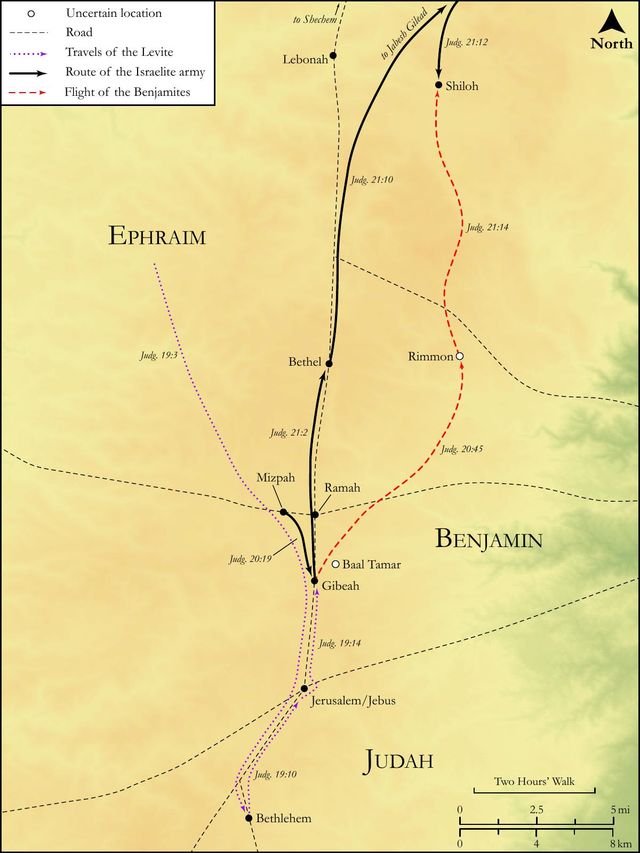
Judges 21:22 stands near the close of the book of Judges, a narrative cycle depicting Israel's repeated apostasy, oppression, repentance, and deliverance through divinely raised judges. The final chapters (Judges 19-21) recount a particularly dark episode: the Levite's concubine incident, which escalates into a brutal civil war against the tribe of Benjamin. The other tribes, having sworn a solemn oath at Mizpah not to give their daughters to any Benjamite and having nearly wiped out Benjamin (Judges 20:46-48), faced a profound dilemma: how to preserve a tribe of Israel without violating their oath? After securing 400 virgins from Jabesh-Gilead, 200 Benjamite men still lacked wives. The solution, outlined in Judges 21, involves allowing the remaining Benjamites to seize virgins from Shiloh during a festival. Verse 22 provides the pre-arranged defense for this abduction, highlighting the lengths to which the Israelites went to reconcile their oath with their desire to prevent a tribe from perishing.
Historical & Cultural Context
The period of the Judges (roughly 14th-11th centuries BC) was a transitional era in Israel's history, marked by a decentralized tribal confederacy without a central king. The recurring refrain, "In those days there was no king in Israel, but every man did that which was right in his own eyes" (Judges 17:6 and Judges 21:25), aptly describes the moral and spiritual anarchy prevalent. Oaths, particularly those sworn before God, carried immense weight in ancient Israelite society, often viewed as binding divine contracts (Numbers 30:2). The cultural norm regarding marriage involved families arranging unions and the father "giving" his daughter. The desperate measure of abduction, while morally reprehensible, was a pragmatic, albeit unrighteous, attempt to navigate the consequences of a rash oath within a patriarchal society where the preservation of tribal lineage was paramount.
Key Themes
ShowHideThis verse encapsulates several critical themes. First, it underscores the desperate measures and moral compromise that arise when human wisdom attempts to solve problems apart from divine guidance, especially in a context of spiritual decline. The Israelites, trapped by their own hasty oath, resorted to ethically dubious means to preserve the Benjamite lineage. Second, the passage highlights the weight and consequences of ill-conceived oaths. The solemn vow at Mizpah, made in anger and without divine consultation, created an impossible ethical bind, leading to a legalistic contortion to avoid perceived guilt while committing a clear injustice. Third, the proposed justification reveals a profound moral compromise and rationalization. The argument that the families would not be "guilty" because they did not "give" their daughters, but rather they were "taken," represents a focus on external adherence to the letter of the law rather than its spirit or moral implications. Finally, the narrative speaks to collective guilt and responsibility, as the entire Israelite community, having participated in the war and the oath, felt compelled to ensure Benjamin's survival, even if it meant endorsing an act of abduction.
Exposition and Analysis
ShowHideKey Word Analysis
ShowHideThis verb (H7378) signifies to contend, strive, or engage in a legal dispute. In this context, it anticipates the legal or moral challenge that the fathers and brothers of the abducted women would likely bring. The Israelites' pre-planned defense is designed to preempt or neutralize this "complaint" by offering a justification that, in their view, absolves the families of guilt, shifting the blame for the oath's circumvention.
Meaning to bend or stoop in kindness to an inferior, to be gracious, to show favor, or to have pity (H2603). The plea "Be favourable unto them for our sakes" is an appeal for clemency and understanding. It's a request for the aggrieved families to overlook the injustice and accept the situation out of compassion for the Benjamites, and perhaps for the unity and continued existence of Israel as a whole, acknowledging the extreme circumstances that led to this desperate measure.
This term (H816) denotes being culpable, incurring guilt, or bearing the penalty for a sin or transgression. The core of the justification rests on the idea that if the families did not formally "give" their daughters, they would not be held morally or legally culpable for violating the oath. This legalistic distinction attempts to shift the burden of "guilt" away from the families, creating a loophole that allowed the Benjamites to acquire wives without the families directly participating in the oath-breaking, thus avoiding the "offence" of breaking a vow.
Verse Breakdown
ShowHide"And it shall be, when their fathers or their brethren come unto us to complain,"
This clause anticipates the natural and righteous indignation of the families whose daughters would be abducted. The use of "complain" (רִיב, riv) suggests a formal grievance or legal challenge, highlighting the awareness among the Israelite leaders that their plan was ethically problematic and would provoke strong opposition, requiring a pre-emptive defense.
"that we will say unto them, Be favourable unto them for our sakes:"
This reveals the pre-meditated nature of the justification. The leaders instruct the Benjamites on what to say, appealing to the families for mercy and understanding. The phrase "for our sakes" underscores the collective responsibility felt by the other tribes to preserve Benjamin, implying that the families should show favor for the greater good of Israel's tribal integrity and the avoidance of collective shame for Benjamin's extinction.
"because we reserved not to each man his wife in the war:"
This part of the defense acknowledges the dire situation of the Benjamites. It points to the fact that the other tribes, in their zeal to punish Benjamin, had failed to ensure the survival of the tribe's lineage by not "reserving" or providing wives for the surviving men during or immediately after the war. This implicitly places some responsibility on the collective Israelite community for the current predicament, framing the abduction as a necessary consequence of their prior actions and omissions.
"for ye did not give unto them at this time, [that] ye should be guilty."
This is the crux of the legalistic loophole. The argument is that since the fathers and brothers did not formally give their daughters to the Benjamites (which would have directly violated their oath), they would not be held morally or legally culpable for the resulting unions. The Benjamites simply "took" them, thereby circumventing the oath's prohibition on 'giving'. This highlights a focus on the letter of the law over its spirit, prioritizing technical adherence to an oath over ethical conduct and the daughters' agency.
Literary Devices
ShowHideThe passage employs several literary devices that underscore its theological implications. Rationalization is central, as the Israelite leaders construct a convoluted argument to justify a morally questionable act. They attempt to absolve the families of guilt by creating a legalistic distinction between "giving" and "taking," thereby allowing the abduction to proceed without directly implicating the families in oath-breaking. This also demonstrates a profound Irony: the Israelites are attempting to uphold the letter of one oath (not to give daughters to Benjamin) by sanctioning the breaking of another, more fundamental moral law (the sanctity of persons and the prohibition against abduction and coercion). The entire narrative of Judges 19-21, culminating in this verse, serves as a powerful Exemplum or cautionary tale, illustrating the depths of moral decay and social chaos that result when a society forsakes divine authority and "every man did that which was right in his own eyes" (Judges 21:25).
Theological and Thematic Connections
ShowHideJudges 21:22 is a poignant illustration of human depravity and the consequences of abandoning God's covenant. It demonstrates the dangers of making hasty, ill-conceived vows and then attempting to navigate their repercussions through human wisdom and legalistic loopholes rather than seeking divine counsel and true repentance. The Israelites' focus on avoiding technical "guilt" while committing a grave injustice reveals a distorted understanding of righteousness, where external adherence to a rule supersedes the spirit of justice, compassion, and moral integrity. This passage serves as a stark reminder that true righteousness is not found in clever rationalizations but in wholehearted obedience to God's commands, which are rooted in love and justice. The chaos and moral compromise depicted underscore the desperate need for a righteous king and a covenant-keeping people, a theme that resonates throughout the Old Testament.
Reflection and Application
ShowHideJudges 21:22 serves as a sobering mirror, reflecting the human tendency to rationalize sin and seek loopholes to justify actions that are clearly contrary to God's character and commands. It challenges us to examine our own lives: do we prioritize external appearances or technical adherence to rules over genuine integrity, compassion, and justice? The desperate measures taken by the Israelites, born out of a self-imposed dilemma, highlight the futility of human-centric problem-solving when detached from divine wisdom. For believers today, this passage underscores the critical importance of seeking God's guidance in all decisions, making vows thoughtfully and prayerfully, and pursuing true righteousness that encompasses both the letter and the spirit of God's law. It reminds us that God desires integrity of heart and actions that reflect His justice and love, not just the avoidance of technical guilt. We are called to live by grace, not by legalistic evasion, and to trust in God's perfect plan rather than our own flawed solutions.
Questions for Reflection
ShowHideFAQ
ShowHideDoes Judges 21:22 imply God approved of the abduction of the women?
ShowHideNo, the text of Judges 21:22, and indeed the entire book of Judges, is descriptive, not prescriptive. It recounts a dark period in Israel's history where "every man did that which was right in his own eyes" (Judges 21:25). The narrative explicitly portrays the moral decay and the consequences of Israel's unfaithfulness to God. The abduction of the women, and the legalistic rationalization for it, are presented as further evidence of the Israelites' spiritual and ethical decline, not as actions condoned by God. The passage highlights human failure and the desperate measures people resort to when they abandon divine wisdom and authority.
What does this passage teach about the nature of oaths and vows?
ShowHideJudges 21:22, in the broader context of Judges 21, powerfully illustrates the serious consequences of making hasty or ill-conceived oaths. The Israelites' oath at Mizpah not to give their daughters to Benjamin (Judges 21:1) created a profound ethical dilemma after they nearly annihilated the tribe. While the Bible emphasizes the importance of fulfilling vows (Numbers 30:2), this narrative shows that vows made in anger or without divine consultation can lead to morally compromised solutions. It teaches us to be cautious and prayerful before making solemn commitments, ensuring they align with God's character and will, and to seek God's wisdom when faced with the consequences of past rash decisions.
Why was it so important for the Israelites to preserve the tribe of Benjamin?
ShowHideThe preservation of the tribe of Benjamin was deemed crucial because each of the twelve tribes was a fundamental component of the covenant people of Israel. The destruction of one tribe would have been seen as a catastrophic loss to the national and theological identity of Israel, potentially threatening the fulfillment of God's promises to Abraham regarding his descendants (Genesis 12:2-3). Despite Benjamin's egregious sin and the resulting civil war, the other tribes recognized their collective responsibility to maintain the integrity of the twelve tribes, even resorting to extreme and morally questionable measures to ensure Benjamin's survival and prevent a tribe from perishing from Israel (Judges 21:6).
Christ-Centered Fulfillment
ShowHideThe dark narrative of Judges, culminating in the moral compromise of Judges 21:22, powerfully underscores humanity's desperate need for a true King and a perfect covenant. The Israelites' attempt to navigate their self-imposed dilemma through legalistic loopholes ("ye did not give unto them at this time, [that] ye should be guilty") reveals the futility of human righteousness and self-justification. They sought to avoid technical guilt while committing a profound injustice, a stark contrast to the perfect obedience and righteousness of Jesus Christ. Where Israel failed to uphold God's law and resorted to human rationalization, Christ perfectly fulfilled every righteous requirement of the law (Matthew 5:17). He did not seek loopholes but willingly bore the full guilt of humanity's sin, becoming the ultimate sacrifice (2 Corinthians 5:21). The chaos and "every man did what was right in his own eyes" mentality of Judges (Judges 21:25) foreshadows the universal human condition apart from God, where sin reigns. Christ, the true King, brings order out of chaos, not through human compromise but through divine grace and truth. He is the one who truly takes away the sin of the world (John 1:29), offering genuine forgiveness and reconciliation where human legalism only creates further entanglement and guilt.