


Judges 21:19
Bible text: King James Version (1769 Blayney text) · Public domain
Bible text: King James Version with Strong's numbers · Public domain
Bible text: Berean Standard Bible · Public domain
Bible text: American Standard Version (1901) · Public domain
Bible text: World English Bible, Messianic edition · Public domain
Bible text: Geneva Bible (1599) · Public domain
Bible text: Young's Literal Translation · Public domain
- וַיֹּאמְרוּvai·yo·me·Ruand they saidH559Conj-w ¦ V-Qal-ConsecImperf-3mpVerb Qal Consecutive Imperfect 3rd Plural Masculineוַandיֹּאמְרוּthey said
- הִנֵּהhi·Nehhere!H2009PrtParticle Interjection
- חַגchag[the] festival ofH2282N-mscNoun Singular Masculine Construct
- יְהוָהYah·wehYahwehH3068N-properNoun Proper Title
- בְּשִׁלוֹbe·shi·Lo[is] in ShilohH7887Prep-b ¦ N-properNoun Proper Locationבְּ[is] inשִׁלוֹShiloh
- מִיָּמִיםmi·ya·Mimfrom daysH3117Prep-m ¦ N-mpNoun Plural Masculine Absoluteמִfromיָּמִיםdays
- יָמִימָהya·Mi·mahdays towardsH3117N-mp ¦ SfxNoun Plural Masculine Absoluteיָמִימָdaysהtowards
- אֲשֶׁר'a·SherwhichH834RelParticle Relative
- מִצְּפוֹנָהmi·tze·Fo·nah[is] from north -wardH6828Prep-m ¦ N-fsc ¦ SfxNoun Singular Feminine Constructמִ[is] fromצְּפוֹנָnorthה-ward
- לְבֵיתle·veitof Beth-H1008Prep-l ¦ N-properNoun Proper LocationלְofבֵיתBeth-
- אֵל'el-elH1008N-properNoun Proper Location
- מִזְרְחָהmiz·re·Chah[the] rising of towardsH4217N-msc ¦ SfxNoun Singular Masculine Constructמִזְרְחָ[the] rising ofהtowards
- הַשֶּׁמֶשׁha·She·meshthe sunH8121Art ¦ N-csNoun Singular common gender Absoluteהַtheשֶּׁמֶשׁsun
- לִמְסִלָּהlim·si·Lahof [the] highwayH4546Prep-l ¦ N-fsNoun Singular Feminine Absoluteלִofמְסִלָּה[the] highway
- הָעֹלָהha·'o·Lahwhich goes upH5927Art ¦ V-Qal-Prtcpl-fsVerb Qal Participle Singular Feminine Absoluteהָwhichעֹלָהgoes up
- מִבֵּיתmi·beitfrom Beth-H1008Prep-m ¦ N-properNoun Proper LocationמִfromבֵּיתBeth-
- אֵל'el-elH1008N-properNoun Proper Location
- שְׁכֶמָהshe·Khe·mahShechem towardsH7927N-proper ¦ SfxNoun Proper LocationשְׁכֶמָShechemהtowards
- וּמִנֶּגֶבu·mi·Ne·gevand from [the] southH5045Conj-w ¦ Prep-m ¦ N-properNoun Proper Locationוּandמִfromנֶּגֶב[the] south
- לִלְבוֹנָהlil·vo·Nahto LebonahH3829Prep-l ¦ N-properNoun Proper LocationלִtoלְבוֹנָהLebonah
English is a literal word-by-word gloss of the Hebrew, not the KJV's wording. Why?
This is the original text the KJV's translators worked from — each Hebrew word with its own literal English meaning in this verse, prepared by scholars at Tyndale House, Cambridge. The KJV translates whole sentences, not word by word, so its wording differs: one Hebrew word can become several English words, and the KJV may choose “the LORD” where the gloss reads “Yahweh”. Both are faithful — they answer different questions. For the KJV's own rendering, switch to the KJV text.
Details
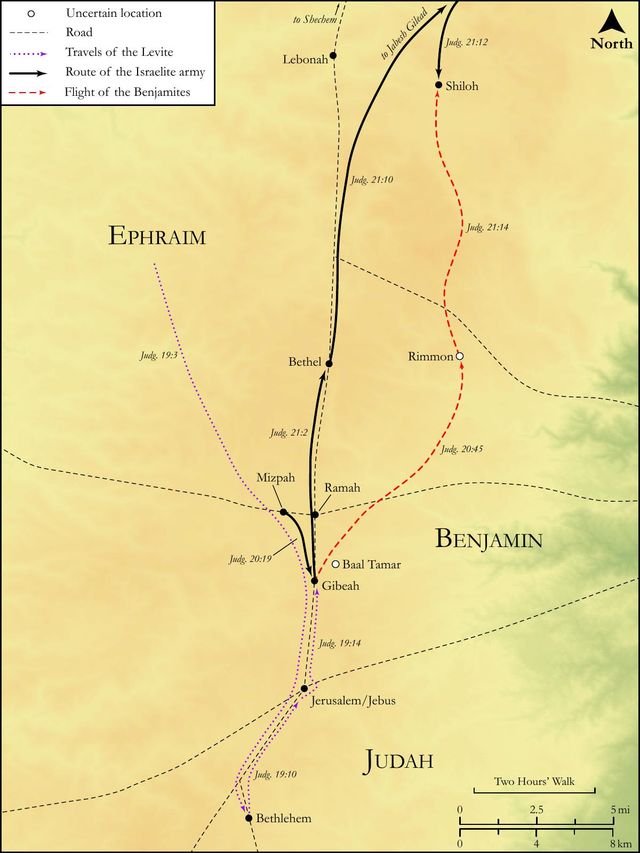
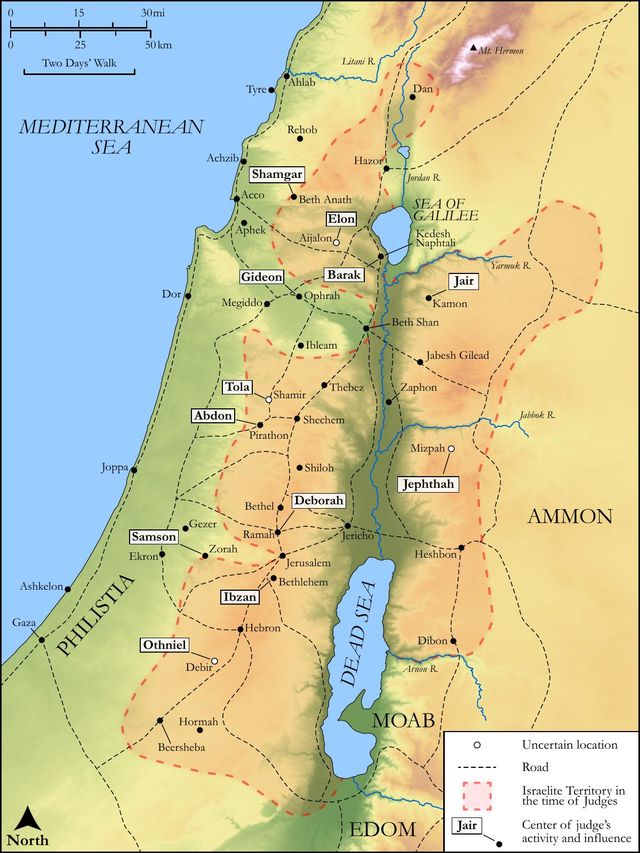
See on the biblical-era maps
Study this verse
Public-domain commentary
Matthew Henry
From his Commentary on the Whole Bible. Henry comments on passages, not single verses — this entry covers Judges 21:16–25.
We have here the method that was taken to provide the 200 Benjamites that remained with wives. And, though the tribe was reduced to a small number, they were only in care to provide each man with one wife, not with more under pretence of multiplying them the faster. They may not bestow their daughters upon them, but to save their oath, and yet marry some of their daughters to them, they put them into a way of taking them by surprise, and marrying them, which should be ratified by their parents' consent, ex post facto - afterwards. The less consideration is used before the making of a vow, the more, commonly, there is need of afterwards for the keeping of it.
I.That which gave an opportunity for the doing of this was a public ball at Shiloh, in the fields, at which all the young ladies of that city and the parts adjacent that were so disposed met to dance, in honour of a feast of the Lord then observed, probably the feast of tabernacles (Jdg 21:19), for that feast (bishop Patrick says) was the only season wherein the Jewish virgins were allowed to dance, and that not so much for their own recreation as to express their holy joy, as David when he danced before the ark, otherwise the present melancholy posture of public affairs would have made dancing unseasonable, as Isa 22:12, Isa 22:13. The dancing was very modest and chaste. It was not mixed dancing; no men danced with these daughters of Shiloh, nor did any married women so far forget their gravity as to join with them. However their dancing thus in public made them an easy prey to those that had a design upon them, whence bishop Hall observes that the ambushes of evil spirits carry away many souls from dancing to a fearful desolation.
II.The elders of Israel gave authority to the Benjamites to do this, to lie in wait in the vineyards which surrounded the green they used to dance on, and, when they were in the midst of their sport, to come upon them, and catch every man a wife for himself, and carry them straight away to their own country, Jdg 21:20, Jdg 21:21. They knew that none of their own daughters would be there, so that the parents of these virgins could not be said to give them, for they knew nothing of the matter. A sorry salvo is better than none, to save the breaking of an oath: it were much better to be cautious in making vows, that there be not occasion afterwards, as there was here, to say before the angel that it was an error. Here was a very preposterous way of match-making, when both the mutual affection of the young people and the consent of the parents must be presumed to come after; the case was extraordinary, and may by no means be drawn into a precedent. Over hasty marriages often occasion a leisurely repentance; and what comfort can be expected from a match made either by force or fraud? The virgins of Jabesh-Gilead were taken out of the midst of blood and slaughter, but these of Shiloh out of the midst of mirth and joy; the former had reason to be thankful that they had their lives for a prey, and the latter, it is to be hoped, had no cause to complain, after a while, when they found themselves matched, not to men of broken and desperate fortunes, as they seemed to be, who were lately fetched out of a cave, but to men of the best and largest estates in the nation, as they must needs be when the lot of the whole tribe of Benjamin, which consisted of 45,600 men (Num 26:41), came to be divided again among 600, who had all by survivorship.
III.They undertook to pacify the fathers of these young women.
As to the infringement of their paternal authority, they would easily forgive it when they considered to what fair estates their daughters were matched and what mothers in Israel they were likely to be; but the oath they were bound by, not to give their daughters to Benjamites, might perhaps stick with some of them, whose consciences were tender, yet, as to that, this might satisfy them: - 1. That the necessity was urgent (Jdg 21:22): We reserved not to each man his wife, owning now that they did ill to destroy all the women, and desiring to atone for their too rigorous construction of their vow to destroy them by the most favourable construction of their vow not to match with them. "And therefore for our sakes, who were too severe, let them keep what they have got." For, 2. In strictness it was not a breach of their vow; they had sworn not to give them their daughters, but they had not sworn to fetch them back if they were forcibly taken, so that if there was any fault the elders must be responsible, not the parents. And Quod fieri non debuit, factum valet - That which ought not to have been done is yet valid when it is done. The thing was done, and is ratified only by connivance, according to the law, Num 30:4.
Lastly, In the close of all we have, 1. The settling of the tribe of Benjamin again. The few that remained returned to the inheritance of that tribe, Jdg 21:23. And soon after from among them sprang Ehud, who was famous in his generation, the second judge of Israel, Jdg 3:15. 2. The disbanding and dispersing of the army of Israel, Jdg 21:24. They did not set up for a standing army, nor pretend to make any alterations or establishments in the government; but when the affair was over for which they were called together, they quietly departed in God's peace, every man to his family. Public services must not make us think ourselves above our own private affairs and the duty of providing for our own house. 3. A repetition of the cause of these confusions, Jdg 21:25. Though God was their King, every man would be his own master, as if there was no king. Blessed be God for magistracy.
Historical interpretation
Historical reception
1 surviving comment on this verse from the historical church.
The sentence, further, was that none of the people of the ancestors should give his daughter in marriage to [members of Benjamin’s tribe]. This was confirmed by a solemn oath. But relenting at having laid so hard a sentence on their brothers, they moderated their severity so as to give them in marriage those maidens that had lost their parents, whose fathers had been slain for their sins, or to give them the means of finding a wife by a raid. Because of the villainy of so foul a deed, they who had violated another’s marriage rights were shown to be unworthy to ask for marriage. But for fear that one tribe might perish from the people, they connived at the deceit.
Continue studying Judges 21:19 across the web’s major study libraries — every link below opens this exact verse, chapter, or book on the destination site.
Read & Compare
 BibleGatewayThis verse in more than 200 translations and 70 languages.
 Bible.comThe YouVersion reader — hundreds of translations, reading plans, and highlights.
 ESV.orgCrossway's official English Standard Version reader.
 NET BibleThe NET translation with 60,000+ translators' notes on every rendering decision.
 STEP BibleTyndale House's free study tool — original text, vocabulary, and scholarly resources.
 BibliaLogos Bible Software's free web reader.
 USCCBThe New American Bible (Revised Edition) with the U.S. bishops' study notes.
Commentaries
 BibleHub CommentariesDozens of classic commentaries on this verse, gathered on one page.
 StudyLightMore than 100 commentary sets — the largest collection on the web.
 BibleRefPlain-English commentary on what this verse means, verse by verse.
 Enduring WordDavid Guzik's free commentary on this chapter, widely used by Bible teachers.
 Bible Study ToolsVerse commentary alongside Greek and Hebrew study aids.
Original Language & Research
- BibleHub InterlinearThe verse word by word — original language, transliteration, and English.
- BibleHub LexiconEvery word's original-language definition and Strong's entry.
 Blue Letter BibleDeep-study tools — Strong's numbers, concordance, and word studies.
 SefariaThe Hebrew text with Rashi and centuries of Jewish commentary.
Sermons, Hymns & Audio


TrulyRandomVerse is not affiliated with these sites and doesn’t control their content. They’re linked because they’re genuinely useful.
Summary
Judges 21:19 provides the precise geographical coordinates for the annual feast of the LORD in Shiloh, a critical detail enabling the desperate and morally compromised plan devised by the remaining Israelite tribes to secure wives for the surviving men of Benjamin. This verse, situated at the culmination of the Book of Judges, underscores the profound moral and spiritual decay of the era, where even sacred institutions were leveraged for pragmatic, yet deeply flawed, human solutions to a crisis born of civil war and a rash oath.
Context
ShowHideLiterary Context
Judges 21:19 appears at the very end of the Book of Judges, concluding the devastating civil war against the tribe of Benjamin detailed in Judges 20. The preceding narrative describes the other Israelite tribes' realization that their solemn oath not to give their daughters in marriage to Benjaminite men (Judges 21:1) would lead to the complete extinction of a tribe within Israel. To avert this, and after a failed attempt to acquire wives from Jabesh-Gilead (Judges 21:8-14), the tribal leaders devised a second, highly questionable scheme: the remaining Benjaminite men were instructed to ambush women attending the annual feast in Shiloh and take them as wives. This verse precisely pinpoints the location of this feast, providing the actionable intelligence necessary for the plan to proceed and highlighting the desperate measures taken in a period marked by profound moral and spiritual decline.
Historical & Cultural Context
The period of the Judges was characterized by a cyclical pattern of apostasy, oppression, repentance, and deliverance, but it ultimately devolved into widespread moral anarchy, famously summarized by the recurring refrain, "In those days there was no king in Israel; every man did what was right in his own eyes" (as seen in Judges 17:6 and Judges 21:25). Shiloh, mentioned in this verse, was the central place of worship for Israel during much of the Judges period, housing the tabernacle and the Ark of the Covenant before the establishment of the monarchy and the temple in Jerusalem (1 Samuel 1:3). The "feast of the LORD" likely refers to one of the three annual pilgrimage festivals prescribed by God in the Mosaic Law (e.g., Deuteronomy 16:16), most probably the Feast of Tabernacles (Sukkot), which often involved dancing and celebration in the fields, making the women vulnerable to such a scheme. The detailed geographical markers (Bethel, Shechem, Lebonah) were well-known landmarks in ancient Israel, emphasizing the historical reality of the events and providing a clear mental map for the original audience, highlighting the calculated nature of the elders' plan.
Key Themes
ShowHideThis verse is integral to several major themes in the Book of Judges. Firstly, it highlights the Desperation and Moral Compromise prevalent in Israel. The abduction, though sanctioned by tribal leaders to prevent the extinction of a tribe, was a clear violation of normal marital customs and God's law regarding consent and proper marriage. It exemplifies how, in the absence of righteous leadership and adherence to divine law, even those seeking to uphold the covenant community resorted to deeply flawed and unethical means. Secondly, the verse underscores the Preservation of a Tribe, reflecting a deep-seated commitment, however misguided in its execution, to the divine promise of a numerous people and the integrity of the twelve tribes. This motivation, despite the highly questionable methods, reveals a concern for the continuity of Israel's identity and their place within God's covenant plan. Lastly, the Geographical Precision of the verse emphasizes the practical, almost tactical, nature of the instructions given to the Benjaminite survivors. This meticulous detail was essential for the success of their desperate plan, highlighting the human ingenuity and planning involved in circumventing a self-imposed dilemma, rather than seeking divine guidance for a righteous solution.
Exposition and Analysis
ShowHideKey Word Analysis
ShowHideThis term refers to one of the three great annual pilgrimage festivals (Passover, Weeks/Pentecost, Tabernacles) where all Israelite males were commanded to appear before the Lord. The context of "feast of the LORD" (H3068, Yᵉhôvâh) emphasizes its divine institution and sacred nature. The profound irony lies in a holy celebration, meant for worship and communion with God, becoming the setting for a morally dubious act of abduction, highlighting the spiritual blindness and moral decay of the era.
Shiloh was the primary religious center of Israel during the Judges period, serving as the location of the tabernacle and the Ark of the Covenant. Its significance as the place where God's presence dwelt and where national assemblies and worship took place makes its role in this narrative particularly jarring. The fact that such a plan would be executed at a site so central to Israel's covenant identity further underscores the depth of their spiritual compromise and the chaotic state of the nation.
This word (often translated as "day" or "time") is used here in the phrase "from days to days" (miyamin yamimah), emphasizing the regular, predictable nature of the feast. It highlights that the elders' plan was not a spontaneous act but a calculated strategy based on a known annual event. This predictability, meant for gathering and worship, was exploited for an unholy purpose, revealing the cunning and desperation of the leaders in their attempt to solve a problem of their own making.
Verse Breakdown
ShowHide"Then they said, Behold, [there is] a feast of the LORD in Shiloh yearly"
"They" refers to the elders and leaders of the other Israelite tribes, who were desperate to find a solution for the surviving Benjaminite men after the civil war. The declaration "Behold" (H559, ʼâmar) draws attention to the critical information about the annual feast, likely the Feast of Tabernacles, held in Shiloh, the central sanctuary. This annual gathering, a time of worship and celebration, was predictable and thus became the target for their morally questionable plan.
"[in a place] which [is] on the north side of Bethel"
This clause initiates the precise geographical triangulation, orienting the reader and the Benjaminite men towards Shiloh. Bethel (H1008, Bêyth-ʼÊl), meaning "house of God," was a significant biblical city, often associated with Jacob's dream and a place of worship, located in the territory of Benjamin. Pinpointing Shiloh in relation to Bethel provided a crucial initial reference point for the ambush.
"on the east side of the highway that goeth up from Bethel to Shechem"
This further refines the location, placing Shiloh relative to a major ancient highway (H4546, mᵉçillâh). The road connecting Bethel to Shechem (H7927, Shᵉkem) was a well-traveled route, indicating a clear and identifiable landmark. This detail suggests the Benjaminite men were to position themselves off the main road, probably in the surrounding fields or vineyards where the women would be dancing during the feast.
"and on the south of Lebonah"
The final geographical marker completes the precise description of Shiloh's location. Lebonah (H3829, Lᵉbôwnâh) was a town north of Shiloh. By providing three distinct geographical points of reference—Bethel to the south, the highway to the west, and Lebonah to the north—the elders ensured that the Benjaminite men would have no difficulty finding the exact spot for the ambush, underscoring the meticulous and calculated nature of their desperate plan.
Literary Devices
ShowHideThe primary literary device at play in Judges 21:19 is Geographical Precision. The meticulous detailing of Shiloh's location ("on the north side of Bethel, on the east side of the highway that goeth up from Bethel to Shechem, and on the south of Lebonah") serves not only to provide a clear mental map for the original audience but also to emphasize the calculated and pragmatic nature of the elders' plan. This precision highlights the human effort and strategic thinking employed to resolve a crisis that arose from human sin and a rash oath, rather than seeking a divine solution. There is also a strong element of Irony present. The "feast of the LORD," a sacred occasion meant for worship, joy, and covenant renewal, is perverted into a setting for an act of abduction. This stark contrast between the holy purpose of the feast and its unholy utilization underscores the profound moral and spiritual degradation of Israel during the period of the Judges, where even sacred institutions were defiled by human expediency.
Theological and Thematic Connections
ShowHideJudges 21:19, while seemingly a mere geographical detail, is deeply embedded in the theological landscape of the Book of Judges, serving as a stark illustration of the consequences when a people abandon divine law and leadership. The desperate measures taken by the Israelite elders to preserve the tribe of Benjamin, culminating in the orchestrated abduction at a sacred feast, reveal the profound moral and spiritual bankruptcy of an era where "every man did what was right in his own eyes." This narrative highlights the dangers of situational ethics and the futility of human schemes when divorced from God's righteous standards. It underscores that even noble intentions (like preserving a tribe) cannot justify unholy means. The story implicitly calls for a return to God's covenant, a recognition of His sovereignty, and the establishment of righteous leadership, contrasting the chaos of human self-rule with the order of divine governance.
Reflection and Application
ShowHideThe detailed geographical instructions of Judges 21:19, leading to a morally compromised solution, serve as a potent reminder of the human tendency to devise pragmatic solutions to self-inflicted problems, often at the expense of divine principles. This narrative challenges us to examine our own lives and communities: when faced with difficult circumstances or perceived crises, are we tempted to compromise biblical ethics for what appears to be a practical or immediate solution? The desperation of the elders, though understandable in their context, led them down a path that further highlighted the moral decay of their society, rather than leading to true repentance and a return to God's ways. It implicitly reminds us that true solutions to human dilemmas are found not in clever schemes but in unwavering adherence to God's commands and seeking His wisdom, even when circumstances seem dire. The story compels us to reflect on the importance of righteous leadership, clear moral discernment, and the profound consequences of a society where divine authority is disregarded and "every man does what is right in his own eyes."
Questions for Reflection
ShowHideFAQ
ShowHideWhat was the "feast of the LORD" mentioned in Judges 21:19?
ShowHideThe "feast of the LORD" (Hebrew: chag Yahweh) refers to one of the three annual pilgrimage festivals prescribed by God in the Mosaic Law, where all Israelite males were commanded to appear before the Lord at the central sanctuary. While the specific feast is not named, it is widely believed by scholars to be the Feast of Tabernacles (Sukkot), which occurred in the autumn, often involved dancing and celebration in the fields, and was a time of great joy and communal gathering. This made it a predictable and vulnerable occasion for the Benjaminite men to ambush the women. You can read about the requirements for these feasts in Deuteronomy 16:16.
Why was Shiloh so important in this period?
ShowHideShiloh was of immense religious and historical importance during the period of the Judges because it served as the central sanctuary of Israel. It was the place where the tabernacle, the portable dwelling place of God's presence, and the Ark of the Covenant were housed for a significant period after the conquest of Canaan. It was the designated location for national assemblies, sacrifices, and worship, as seen in 1 Samuel 1:3 where Elkanah went up to Shiloh yearly to worship. Its prominence as a holy site makes its use in the morally questionable plan of Judges 21 particularly poignant, highlighting the spiritual decline of the nation.
Does this story condone the abduction of women?
ShowHideAbsolutely not. The Bible, particularly in the Book of Judges, often records events as they happened, even when those events are morally reprehensible, without necessarily endorsing them. The narrative of Judges 21, including verse 19, is a descriptive account of a dark and chaotic period in Israel's history when "there was no king in Israel; every man did what was right in his own eyes" (Judges 21:25). The abduction of the women at Shiloh is presented as a desperate and morally compromised solution born out of human sin, rash oaths, and a lack of righteous leadership. It serves as a negative example, illustrating the consequences of abandoning God's law and the depths of human depravity when divine guidance is ignored. The text highlights the problem, not the solution.
Christ-Centered Fulfillment
ShowHideThe chaotic and morally compromised events of Judges 21, epitomized by the desperate plan detailed in Judges 21:19, powerfully underscore the profound need for a true King and a perfect covenant. The era of the Judges, characterized by the recurring refrain "every man did what was right in his own eyes" (Judges 21:25), reveals the utter failure of human self-governance and the inability of human schemes to truly redeem or restore. The elders' attempt to preserve a tribe through abduction at a sacred feast, though pragmatic, was a stark perversion of God's design for community and worship. This points forward to Jesus Christ, who is the ultimate King, not merely ruling over Israel, but over all creation (Matthew 28:18). Unlike the flawed leaders of Judges, Christ perfectly embodies righteousness and justice, establishing a new covenant not based on human oaths or desperate measures, but on His own sacrificial blood (Hebrews 8:6). He gathers His people, the Church, not through coercion or morally dubious acts, but through His perfect love and self-giving (Ephesians 5:25-27). The "feast of the LORD" in Shiloh, used for an unholy purpose, foreshadows the ultimate Lamb of God, Jesus, who takes away the sin of the world (John 1:29), establishing a new and true worship that is in spirit and truth, where His perfect obedience atones for all the "doing what is right in one's own eyes" that marked the era of the Judges and continues to plague humanity (Romans 5:8).