


Judges 18:1
Bible text: King James Version (1769 Blayney text) · Public domain
Bible text: King James Version with Strong's numbers · Public domain
Bible text: Berean Standard Bible · Public domain
Bible text: American Standard Version (1901) · Public domain
Bible text: World English Bible, Messianic edition · Public domain
Bible text: Geneva Bible (1599) · Public domain
Bible text: Young's Literal Translation · Public domain
- בַּיָּמִיםbai·ya·Mimin the daysH3117Prep-b ¦ N-mpNoun Plural Masculine Absoluteבַּin theיָּמִיםdays
- הָהֵםha·Hem<the> thoseH1992Art ¦ Pro-3mpPronoun Personal 3rd Plural Masculineהָ<the>הֵםthose
- אֵין'einthere notH369N-mscNoun Singular Masculine Construct
- מֶלֶךְMe·lekh[was] a kingH4428N-msNoun Singular Masculine Absolute
- בְּיִשְׂרָאֵלbe·Yis·ra·'Elin IsraelH3478Prep-b ¦ N-properNoun Proper LocationבְּinיִשְׂרָאֵלIsrael
- וּבַיָּמִיםu·vai·ya·Mimand in the daysH3117Conj-w ¦ Prep-b ¦ N-mpNoun Plural Masculine Absoluteוּandבַin theיָּמִיםdays
- הָהֵםha·Hem<the> thoseH1992Art ¦ Pro-3mpPronoun Personal 3rd Plural Masculineהָ<the>הֵםthose
- שֵׁבֶטShe·vet[the] tribe ofH7626N-mscNoun Singular Masculine Construct
- הַדָּנִיha·da·Nithe Danite[s]H1839Art ¦ N-msNoun Gentilic Singular Masculine AbsoluteהַtheדָּנִיDanite[s]
- מְבַקֶּשׁme·va·kesh[was] seekingH1245V-Piel-Prtcpl-msVerb Piel Participle Singular Masculine Absolute
- לוֹlofor <the> itselfPrep-l ¦ 3msSuffix Personal 3rd Singular Masculineלfor <the>וֹitself
- נַחֲלָהna·cha·Lahan inheritanceH5159N-fsNoun Singular Feminine Absolute
- לָשֶׁבֶתla·She·vetto dwell inH3427Prep-l ¦ V-Qal-InfVerb Qal Infinitive Constructלָtoשֶׁבֶתdwell in
- כִּיkiforH3588PrtParticle Conditional
- לֹאlo'notH3808NegParticle Negative
- נָפְלָהNa·fe·lahit had fallenH5307V-Qal-Perf-3fsVerb Qal Perfect 3rd Singular Feminine
- לּוֹloto <the> itPrep-l ¦ 3msSuffix Personal 3rd Singular Masculineלּto <the>וֹit
- עַד'aduntilH5704PrepPreposition
- הַיּוֹםhai·Yomthe dayH3117Art ¦ N-msNoun Singular Masculine Absoluteהַtheיּוֹםday
- הַהוּאha·Hu'<the> thatH1931Art ¦ Pro-3msPronoun Personal 3rd Singular Masculineהַ<the>הוּאthat
- בְּתוֹךְbe·tokhin amongH8432Prep-b ¦ N-mscNoun Singular Masculine Constructבְּinתוֹךְamong
- שִׁבְטֵיshiv·Tei[the] tribes ofH7626N-mpcNoun Plural Masculine Construct
- יִשְׂרָאֵלYis·ra·'ElIsraelH3478N-properNoun Proper Location
- בְּנַחֲלָהbe·na·cha·Lah<in> an inheritanceH5159Prep-b ¦ N-fsNoun Singular Feminine Absoluteבְּ<in>נַחֲלָהan inheritance
English is a literal word-by-word gloss of the Hebrew, not the KJV's wording. Why?
This is the original text the KJV's translators worked from — each Hebrew word with its own literal English meaning in this verse, prepared by scholars at Tyndale House, Cambridge. The KJV translates whole sentences, not word by word, so its wording differs: one Hebrew word can become several English words, and the KJV may choose “the LORD” where the gloss reads “Yahweh”. Both are faithful — they answer different questions. For the KJV's own rendering, switch to the KJV text.
Details
See on the biblical-era maps
Study this verse
Public-domain commentary
Matthew Henry
From his Commentary on the Whole Bible. Henry comments on passages, not single verses — this entry covers Judges 18:1–6.
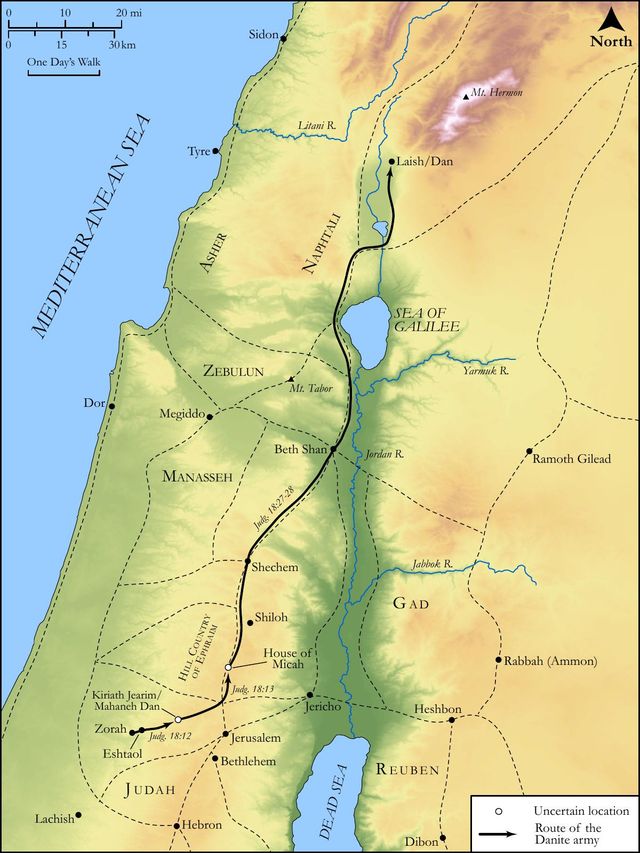
Here is, 1. The eye which these Danites had upon Laish, not the whole tribe of Dan, but one family of them, to whose lot, in the subdivision of Canaan, that city fell. Hitherto this family had sojourned with their brethren, who had taken possession of their lot, which lay between Judah and the Philistines, and had declined going to their own city, because there was no king in Israel to rule over them, Jdg 18:1. It lay a great way off, separate from the rest of their tribe; it was entirely in the enemy's hand, and therefore they would sponge upon their brethren rather than go far to provide for themselves. But at length necessity forced them to arouse themselves, and they began to think of an inheritance to dwell in. It is better to have a little of one's own than always to hang upon others. 2. The enquiry which this family of the Danites made concerning Laish: They sent five men to search the land (Jdg 18:2), that they might know the character of the country, whether it was an inheritance worth going so far for, and the posture of the people, whether the making of themselves masters of it was a thing practicable, what force was necessary in order thereunto, and which was the best way of making an attack upon it. The men they sent were men of valour, who, if they fell into their enemies' hands, knew how to look danger in the face. It is prudent to look before we leap. Dan had the subtlety of a serpent by the way (Gen 49:17), as well as the courage of a lion's whelp, leaping from Bashan, Deu 33:22. 3. The acquaintance which their spies got with Micah's priest, and the use they made of that acquaintance. It seems, they had know this Levite formerly, he having in his rambles been sometimes in their country; and, though his countenance might be altered, they knew him again by his voice, Jdg 18:3. They were surprised to find him so far off, enquired what brought him thither, and he told them (Jdg 18:4) what business he had there, and what encouragement. They, understanding that he had an oracle in his custody, desired he would tell them whether they should prosper in their present undertaking, Jdg 18:5. See their carelessness and regardlessness of God and his providence; they would not have enquired of the Lord at all if this Levite's mentioning the teraphim he had with him had not put it into their heads. Many never think of religion but just when it falls in their way and they cannot avoid it, like chance customers. See their ignorance of the divine law, that they thought God, who had forbidden the religious use of graven images, would yet own them in consulting an image, and give them an answer of peace. Should he be enquired of by them? Eze 14:3. They seem to have had a greater opinion of Micah's teraphim than of God's urim; for they had passed by Shiloh, and, for aught that appears, had not enquired there of God's high priest, but Micah's shabby Levite shall be an oracle to them. He betakes himself to his usual method of consulting his teraphim; and, whether he himself believed it or no, he humoured the thing so well that he made them believe he had an answer from God encouraging them to go on, and assuring them of good success (Jdg 18:6): "Go in peace, you shall be safe, and may be easy, for before the Lord is your way," that is, "he approves it" (as the Lord is said to know the way of the righteous with acceptation), "and therefore he will make it prosperous, his eye will be upon you for good, he will direct your way, and preserve your going out and coming in." Note, Our great care should be that our way be such as God approves, and, if it be so, we may go in peace. If God care for us, on him let us cast our care, and be satisfied that we cannot miss our way if he go before us.
Historical interpretation
Historical reception
1 surviving comment on this verse from the historical church.
Not received: They had their portions assigned them, Jos. 19. 40. But, through their own sloth, possessed as yet but a small part of it. See Judges 1. 34.
Continue studying Judges 18:1 across the web’s major study libraries — every link below opens this exact verse, chapter, or book on the destination site.
Read & Compare
 BibleGatewayThis verse in more than 200 translations and 70 languages.
 Bible.comThe YouVersion reader — hundreds of translations, reading plans, and highlights.
 ESV.orgCrossway's official English Standard Version reader.
 NET BibleThe NET translation with 60,000+ translators' notes on every rendering decision.
 STEP BibleTyndale House's free study tool — original text, vocabulary, and scholarly resources.
 BibliaLogos Bible Software's free web reader.
 USCCBThe New American Bible (Revised Edition) with the U.S. bishops' study notes.
Commentaries
 BibleHub CommentariesDozens of classic commentaries on this verse, gathered on one page.
 StudyLightMore than 100 commentary sets — the largest collection on the web.
 BibleRefPlain-English commentary on what this verse means, verse by verse.
 Enduring WordDavid Guzik's free commentary on this chapter, widely used by Bible teachers.
 Bible Study ToolsVerse commentary alongside Greek and Hebrew study aids.
Original Language & Research
- BibleHub InterlinearThe verse word by word — original language, transliteration, and English.
- BibleHub LexiconEvery word's original-language definition and Strong's entry.
 Blue Letter BibleDeep-study tools — Strong's numbers, concordance, and word studies.
 SefariaThe Hebrew text with Rashi and centuries of Jewish commentary.
Sermons, Hymns & Audio


TrulyRandomVerse is not affiliated with these sites and doesn’t control their content. They’re linked because they’re genuinely useful.
Summary
Judges 18:1 serves as a pivotal introduction to the dramatic narrative of the Danite migration, vividly encapsulating the profound spiritual and societal disarray that plagued Israel during the period of the Judges. It immediately establishes the overarching theme of a nation without a central, unifying, and righteous authority, symbolized by the recurring lament, "no king in Israel." This absence of leadership directly correlates with the practical consequence of the Danite tribe's failure to secure their divinely apportioned inheritance, compelling them to embark on a self-directed quest for new territory, thereby illustrating a pervasive pattern of incomplete obedience and human initiative divorced from divine guidance.
Context
ShowHideLiterary Context
This verse inaugurates the final major narrative segment of the Book of Judges (chapters 17-21), often considered an appendix due to its distinct content and the repetitive, ominous refrain, "In those days there was no king in Israel." This phrase, functioning as a thematic inclusio, appears four times in this concluding section, also found in Judges 17:6, Judges 19:1, and Judges 21:25. It powerfully frames the moral relativism and spiritual chaos that permeated Israel, where "every man did that which was right in his own eyes." Judges 18:1 specifically sets the stage for the Danites' violent and idolatrous expedition northward, directly preceding the account of Micah's idol and the opportunistic Levite priest, highlighting the profound consequences of a nation adrift without a king.
Historical & Cultural Context
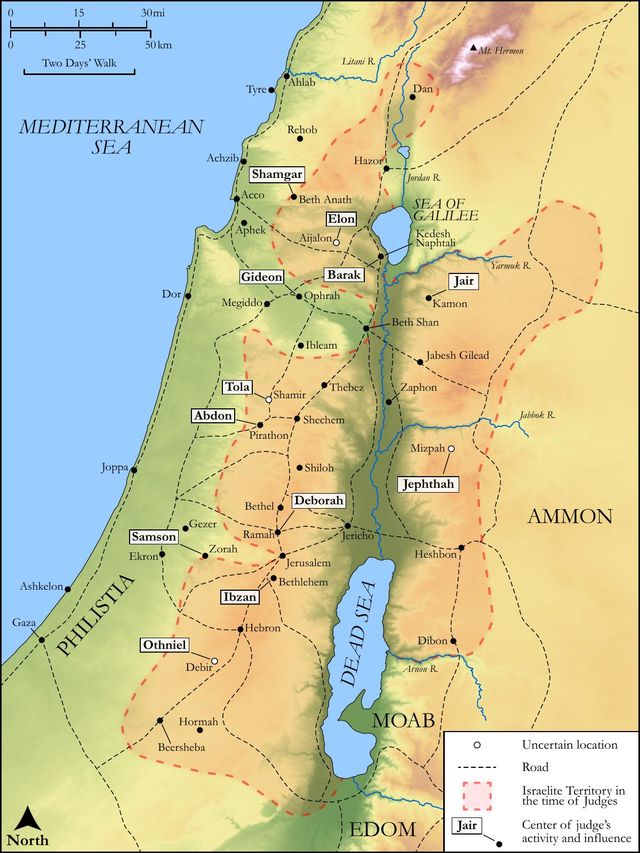
The era of the Judges, following the unified conquest under Joshua, was a transitional and tumultuous period for Israel, shifting from a divinely led military campaign to a loosely organized tribal confederacy. While Yahweh was indeed their ultimate King, a human monarch had not yet been divinely appointed, leading to a vacuum of central governmental authority. This lack of cohesive leadership fostered fragmented tribal loyalties and rendered the nation vulnerable to both internal decay and external pressures. The Danites' original inheritance, meticulously detailed in Joshua 19:40-48, was strategically challenging, bordering the formidable Philistines and Amorites. Their documented failure to fully dispossess these inhabitants, as recounted in Judges 1:34, left them unable to secure their promised land. This historical reality, a direct consequence of Israel's incomplete obedience to God's command to drive out the Canaanites, compelled the Danites to seek a more secure dwelling, precipitating their desperate northward migration.
Key Themes
ShowHideJudges 18:1 introduces and reinforces several critical themes that resonate throughout the book. Foremost among these is the Absence of Central Authority and Resultant Anarchy, powerfully underscored by the "no king in Israel" refrain. This phrase is not merely a political observation but a profound theological indictment, signifying a spiritual vacuum where God's covenant laws were largely disregarded. This disregard inevitably led to widespread moral relativism, as individuals and tribes acted according to their own flawed judgments. Another pivotal theme is Unfulfilled Inheritance and Disobedience, as the Danites' inability to fully occupy their God-given land highlights the dire consequences of Israel's incomplete obedience and lack of faith in God's power to grant them victory. Finally, the verse subtly introduces the theme of Human Initiative vs. Divine Guidance, as the Danites embark on a self-directed, pragmatic quest for land rather than seeking God's direction or relying on His strength to overcome their existing challenges within their divinely appointed territory.
Exposition and Analysis
ShowHideKey Word Analysis
ShowHideThe term מֶלֶךְ (melek) refers to a sovereign ruler. In the context of Judges, the repeated phrase "no king in Israel" transcends a mere historical observation about the absence of a human monarch (who would only be established later with Saul). It functions as a profound theological commentary, signifying a deep spiritual and moral vacuum. It indicates that Israel had largely abandoned God's rule over their lives, leading to societal breakdown and individual autonomy where "doing what was right in their own eyes" became the norm. This absence of a human king foreshadows the nation's later desire for one, while simultaneously highlighting their current failure to live under the true divine King.
The word נַחֲלָה (nachălâh) denotes an inherited possession, specifically referring to the land allotted to each tribe by divine decree and lot (Numbers 26:52-56). This was far more than mere real estate; it was a covenantal promise, a tangible sign of God's faithfulness and Israel's identity as His chosen people. The fact that the Danites' inheritance "had not fallen unto them" implies not only a practical failure to dispossess enemies but, more significantly, a theological failure to fully claim and live within the blessings and responsibilities of their covenant relationship with God.
The verb בָּקַשׁ (bâqash) means "to search out," "to strive after," or "to request." In the context of the Danites, their "seeking" an inheritance implies an active, deliberate, and self-initiated quest for a solution to their unfulfilled possession. This action is presented as a human-driven enterprise, contrasting sharply with a posture of seeking divine guidance or relying on God's power to overcome the obstacles within their originally allotted territory. It highlights a departure from covenant faithfulness towards pragmatic, self-reliant solutions.
Verse Breakdown
ShowHide"¶ In those days [there was] no king in Israel:"
This opening clause immediately establishes the prevailing socio-political and spiritual climate of the era. It is a recurring editorial comment by the Deuteronomistic historian, signaling a period of profound disunity, moral decay, and a conspicuous lack of central, God-ordained leadership. This foundational statement sets the stage for the chaotic and often violent events that follow, where human will and self-interest increasingly supplanted divine law and covenant obligations.
"and in those days the tribe of the Danites sought them an inheritance to dwell in;"
This clause introduces the specific plight of the Danite tribe. Despite having been divinely allotted land, they were actively and deliberately seeking new territory. This "seeking" underscores their proactive, human-driven attempt to resolve their predicament, rather than a renewed appeal to God for strength to conquer their assigned land or a re-engagement with the covenant promises that guaranteed their possession. It points to a tribal initiative born of desperation and a lack of faith.
"for unto that day [all their] inheritance had not fallen unto them among the tribes of Israel."
This final clause provides the crucial rationale for the Danites' quest. Their original inheritance, though divinely apportioned, remained largely unconquered or untenable. The phrase "had not fallen unto them" (Hebrew: לֹא נָפְלָה, lō' nāp̄lâ) indicates that the land had not been fully possessed or settled. This highlights their significant failure to complete the conquest and secure their portion, standing in stark contrast to other tribes who, to varying degrees, had established themselves within their allotted territories.
Literary Devices
ShowHideJudges 18:1 employs several impactful literary devices. Repetition is prominently featured with the phrase "In those days," which not only frames the entire period of the Judges as one marked by the absence of a king but also effectively emphasizes the pervasive chaotic and lawless nature of the era. This repetition also serves as a subtle Foreshadowing of Israel's future desire for a human king, even as it critiques the present state of leaderless anarchy. There is a profound Irony in the Danites' predicament: they were granted a divine inheritance but failed to possess it, compelling them to seek a new one through their own, often ungodly, means. This failure to fully occupy their God-given land, despite God's explicit promises and power, underscores the tragic consequences of Israel's disobedience and lack of faith. Furthermore, the "no king" phrase functions as a powerful Metonymy, where the absence of a political leader stands in for the deeper spiritual and moral anarchy pervading the nation, signaling a widespread rejection of God's ultimate rule.
Theological and Thematic Connections
ShowHideJudges 18:1 profoundly illustrates the dire consequences of Israel's covenant unfaithfulness and incomplete obedience. The Danites' failure to secure their inheritance reflects a broader national pattern of spiritual compromise and a profound lack of trust in God's power to enable them to fully dispossess their enemies. This verse underscores the theological truth that true security, flourishing, and rest come not from human ingenuity or strength, but from faithful adherence to God's commands and unwavering reliance on His provision. The "no king" refrain points to the deeper issue of Israel's effective rejection of God's ultimate kingship, leading to a state where moral relativism ("everyone did what was right in his own eyes") reigned supreme, resulting in societal breakdown and spiritual decay. It highlights the inherent human need for righteous leadership, both human and divine, to maintain order, uphold God's covenant, and guide a people towards their divinely appointed destiny.
Reflection and Application
ShowHideJudges 18:1 serves as a stark and timeless reminder of the dangers inherent in spiritual and moral drift when there is an absence of clear, God-ordained authority and a steadfast commitment to His revealed will. The Danites' struggle to possess their inheritance, ultimately leading them to seek new territory through their own means, mirrors our own human tendency to abandon the spiritual ground God has given us in Christ when faced with challenges, opting instead for self-devised solutions that often lead to further compromise. This verse calls us to a profound self-examination: Where in our lives might we be acting as if "there is no king," allowing personal preferences, cultural norms, or worldly pressures to dictate our actions rather than the clear commands and principles of Scripture? It challenges us to fully "possess" our spiritual inheritance in Christ, which includes walking in radical obedience, exercising unwavering faith, and standing firm against spiritual adversaries, rather than retreating from the call to live out our faith fully and courageously in a challenging world.
Questions for Reflection
ShowHideFAQ
ShowHideWhy was there "no king in Israel" at this time?
ShowHideAt this point in Israel's history, subsequent to the death of Joshua and prior to the establishment of the monarchy under Saul, Israel was structured as a tribal confederacy. God Himself was intended to be their ultimate King, ruling through His law and covenant. However, the phrase "no king in Israel" in Judges 18:1 and elsewhere in the latter part of Judges is a profound theological commentary, not merely a historical observation. It signifies that the people were largely ignoring God's rule and His covenant laws, leading to a pervasive breakdown of order, morality, and unity. This spiritual vacuum meant that "everyone did what was right in his own eyes" (Judges 17:6), resulting in the chaos, idolatry, and violence so vividly depicted throughout the book.
Why hadn't the Danites secured their inheritance?
ShowHideThe tribe of Dan's original inheritance was located in a fertile but strategically challenging area, bordering the powerful Philistines and the Amorites (Joshua 19:40-48). According to Judges 1:34, the Amorites "pressed the children of Dan into the mountain: for they would not suffer them to come down to the valley." This indicates a significant failure on the part of the Danites to fully dispossess the inhabitants of their allotted land, as God had explicitly commanded. Their inability or unwillingness to drive out these enemies, likely due to a lack of faith, military resolve, or both, meant they could not fully settle their inheritance, forcing them to seek new territory elsewhere. This failure underscores a broader theme of incomplete obedience within Israel.
How does this story relate to the broader message of Judges?
ShowHideThe story of the Danites in Judges 18 serves as a vivid and tragic illustration of the overarching themes of the entire Book of Judges. It exemplifies the devastating cycle of disobedience, oppression, and incomplete deliverance that characterized the era. The Danites' failure to secure their God-given inheritance reflects Israel's broader spiritual failure to fully obey God's commands and trust in His power. The recurring "no king in Israel" refrain highlights the profound moral and spiritual anarchy that resulted from the absence of faithful leadership and the people's widespread rejection of God's ultimate authority. The Danites' actions, marked by idolatry, violence, and self-serving ambition, are a microcosm of the widespread moral decay and self-righteous behavior that pervaded Israel when "every man did that which was right in his own eyes" (Judges 21:25).
Christ-Centered Fulfillment
ShowHideJudges 18:1, with its lamentable declaration that "In those days there was no king in Israel," powerfully foreshadows humanity's desperate and universal need for a true and righteous King, a need ultimately and perfectly fulfilled in Jesus Christ. The chaos, moral decay, and unfulfilled inheritance so characteristic of the Judges era are direct consequences of humanity's rebellion against God's rightful rule, where "every man did that which was right in his own eyes." This spiritual anarchy, a deep-seated human condition, finds its ultimate resolution in Christ, who is not merely a temporary human leader, but the eternal King of kings and Lord of lords. He perfectly embodies the righteous authority that Israel lacked, establishing a kingdom of justice, peace, and eternal order. Furthermore, the Danites' failure to possess their physical inheritance points to the deeper, imperishable spiritual inheritance that we, as believers, receive solely through Christ. While they struggled to secure their earthly portion, Christ, through His perfect obedience, atoning sacrifice, and glorious resurrection, has secured for us an imperishable, undefiled, and unfading inheritance in the heavenly realms. He has graciously delivered us from the domain of darkness and transferred us to the kingdom of His beloved Son, where our true rest and full possession are found not in a geographical location, but in Him alone (Hebrews 4:9-11). Thus, Jesus is not only the sovereign King who brings order to our lives but also the one who fully secures and enables us to possess our spiritual inheritance in God.