


Judges 18:5
- וַיֹּאמְרוּvai·Yo·me·ruand they saidH559Conj-w ¦ V-Qal-ConsecImperf-3mpVerb Qal Consecutive Imperfect 3rd Plural Masculineוַandיֹּאמְרוּthey said
- לוֹloto <the> himPrep-l ¦ 3msSuffix Personal 3rd Singular Masculineלto <the>וֹhim
- שְׁאַלshe·'alenquireH7592V-Qal-Imp-2msVerb Qal Imperative 2nd Singular Masculine
- נָאna'pleaseH4994PrtParticle Interjection
- בֵאלֹהִיםve·lo·Himby GodH430Prep-b ¦ N-mpNoun Plural Masculine AbsoluteבֵbyאלֹהִיםGod
- וְנֵדְעָהve·Ne·de·'Ahso let us knowH3045Conj-w ¦ V-Qal-Imperf-1cpVerb Qal Imperfect 1st Plural common genderוְsoנֵדְעָהlet us know
- הֲתַצְלִיחַha·tatz·Li·ach¿ will it succeedH6743Interrog ¦ V-Hiphil-Imperf-3fsVerb Hiphil Imperfect 3rd Singular Feminineהֲ¿תַצְלִיחַwill it succeed
- דַּרְכֵּנוּdar·Ke·nuour journeyH1870N-csc ¦ 1cpNoun Singular common gender Constructדַּרְכֵּjourneyנוּour
- אֲשֶׁר'a·SherwhichH834RelParticle Relative
- אֲנַחְנוּ'a·Nach·nuweH587Pro-1cpPronoun Personal 1st Plural common gender
- הֹלְכִיםho·le·Khim[are] goingH1980V-Qal-Prtcpl-mpVerb Qal Participle Plural Masculine Absolute
- עָלֶיהָ'a·Lei·haon itH5921Prep ¦ 3fsPreposition Definiteעָלֶיonהָit
English is a literal word-by-word gloss of the Hebrew, not the KJV's wording. Why?
This is the original text the KJV's translators worked from — each Hebrew word with its own literal English meaning in this verse, prepared by scholars at Tyndale House, Cambridge. The KJV translates whole sentences, not word by word, so its wording differs: one Hebrew word can become several English words, and the KJV may choose “the LORD” where the gloss reads “Yahweh”. Both are faithful — they answer different questions. For the KJV's own rendering, switch to the KJV text.
Details
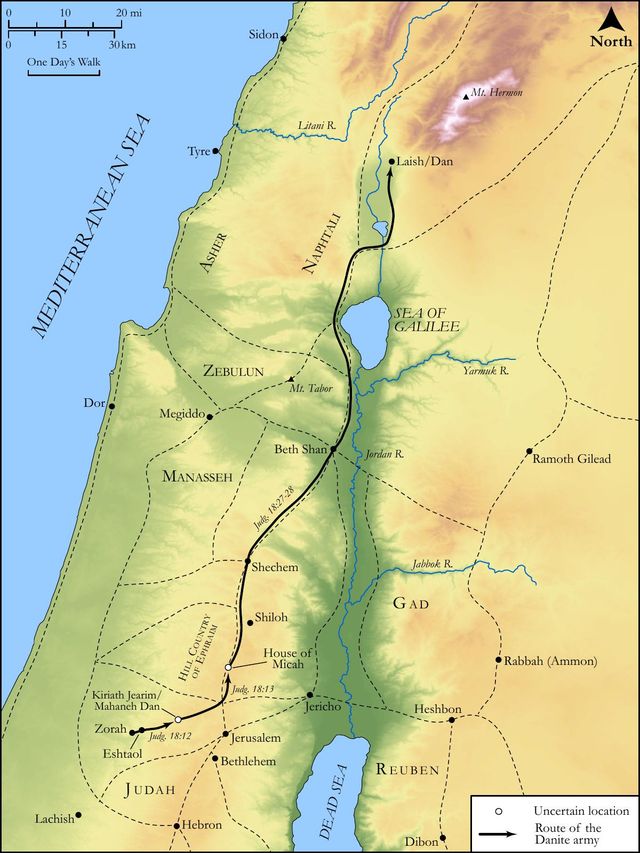
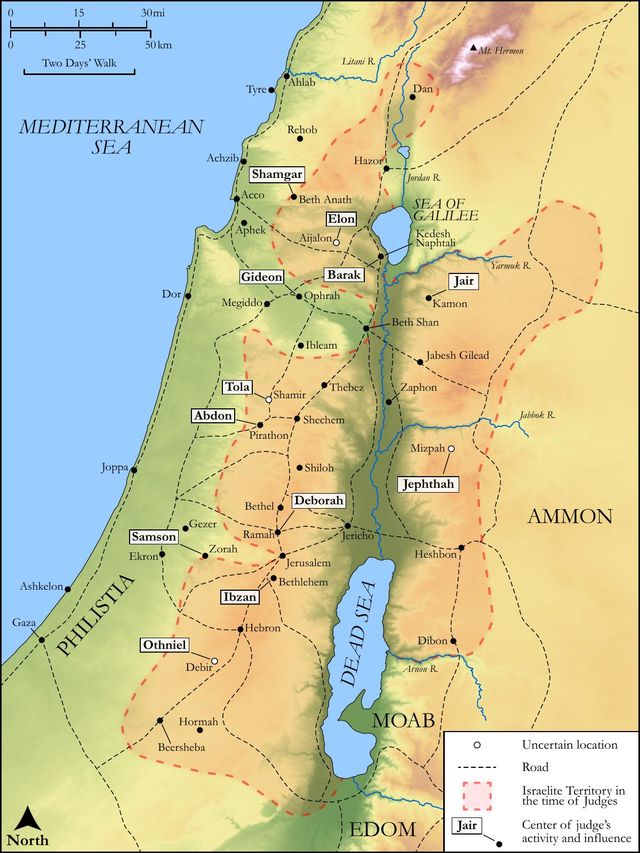
See on the biblical-era map
Study this verse
Public-domain commentary
Matthew Henry
From his Commentary on the Whole Bible. Henry comments on passages, not single verses — this entry covers Judges 18:1–6.
Here is, 1. The eye which these Danites had upon Laish, not the whole tribe of Dan, but one family of them, to whose lot, in the subdivision of Canaan, that city fell. Hitherto this family had sojourned with their brethren, who had taken possession of their lot, which lay between Judah and the Philistines, and had declined going to their own city, because there was no king in Israel to rule over them, Jdg 18:1. It lay a great way off, separate from the rest of their tribe; it was entirely in the enemy's hand, and therefore they would sponge upon their brethren rather than go far to provide for themselves. But at length necessity forced them to arouse themselves, and they began to think of an inheritance to dwell in. It is better to have a little of one's own than always to hang upon others. 2. The enquiry which this family of the Danites made concerning Laish: They sent five men to search the land (Jdg 18:2), that they might know the character of the country, whether it was an inheritance worth going so far for, and the posture of the people, whether the making of themselves masters of it was a thing practicable, what force was necessary in order thereunto, and which was the best way of making an attack upon it. The men they sent were men of valour, who, if they fell into their enemies' hands, knew how to look danger in the face. It is prudent to look before we leap. Dan had the subtlety of a serpent by the way (Gen 49:17), as well as the courage of a lion's whelp, leaping from Bashan, Deu 33:22. 3. The acquaintance which their spies got with Micah's priest, and the use they made of that acquaintance. It seems, they had know this Levite formerly, he having in his rambles been sometimes in their country; and, though his countenance might be altered, they knew him again by his voice, Jdg 18:3. They were surprised to find him so far off, enquired what brought him thither, and he told them (Jdg 18:4) what business he had there, and what encouragement. They, understanding that he had an oracle in his custody, desired he would tell them whether they should prosper in their present undertaking, Jdg 18:5. See their carelessness and regardlessness of God and his providence; they would not have enquired of the Lord at all if this Levite's mentioning the teraphim he had with him had not put it into their heads. Many never think of religion but just when it falls in their way and they cannot avoid it, like chance customers. See their ignorance of the divine law, that they thought God, who had forbidden the religious use of graven images, would yet own them in consulting an image, and give them an answer of peace. Should he be enquired of by them? Eze 14:3. They seem to have had a greater opinion of Micah's teraphim than of God's urim; for they had passed by Shiloh, and, for aught that appears, had not enquired there of God's high priest, but Micah's shabby Levite shall be an oracle to them. He betakes himself to his usual method of consulting his teraphim; and, whether he himself believed it or no, he humoured the thing so well that he made them believe he had an answer from God encouraging them to go on, and assuring them of good success (Jdg 18:6): "Go in peace, you shall be safe, and may be easy, for before the Lord is your way," that is, "he approves it" (as the Lord is said to know the way of the righteous with acceptation), "and therefore he will make it prosperous, his eye will be upon you for good, he will direct your way, and preserve your going out and coming in." Note, Our great care should be that our way be such as God approves, and, if it be so, we may go in peace. If God care for us, on him let us cast our care, and be satisfied that we cannot miss our way if he go before us.
Continue studying Judges 18:5 across the web’s major study libraries — every link below opens this exact verse, chapter, or book on the destination site.
Read & Compare
 BibleGatewayThis verse in more than 200 translations and 70 languages.
 Bible.comThe YouVersion reader — hundreds of translations, reading plans, and highlights.
 ESV.orgCrossway's official English Standard Version reader.
 NET BibleThe NET translation with 60,000+ translators' notes on every rendering decision.
 STEP BibleTyndale House's free study tool — original text, vocabulary, and scholarly resources.
 BibliaLogos Bible Software's free web reader.
 USCCBThe New American Bible (Revised Edition) with the U.S. bishops' study notes.
Commentaries
 BibleHub CommentariesDozens of classic commentaries on this verse, gathered on one page.
 StudyLightMore than 100 commentary sets — the largest collection on the web.
 BibleRefPlain-English commentary on what this verse means, verse by verse.
 Enduring WordDavid Guzik's free commentary on this chapter, widely used by Bible teachers.
 Bible Study ToolsVerse commentary alongside Greek and Hebrew study aids.
Original Language & Research
- BibleHub InterlinearThe verse word by word — original language, transliteration, and English.
- BibleHub LexiconEvery word's original-language definition and Strong's entry.
 Blue Letter BibleDeep-study tools — Strong's numbers, concordance, and word studies.
 SefariaThe Hebrew text with Rashi and centuries of Jewish commentary.
Sermons, Hymns & Audio


TrulyRandomVerse is not affiliated with these sites and doesn’t control their content. They’re linked because they’re genuinely useful.
Summary
Judges 18:5 encapsulates a critical moment in the Danite migration, vividly exposing the profound spiritual disarray and syncretism that characterized Israel during the period of the Judges. Five Danite spies, dispatched to locate new tribal territory, encounter a Levite serving as a private priest within Micah's idolatrous household. Despite the deeply compromised spiritual context, they earnestly implore the Levite to inquire of God on their behalf, seeking divine assurance that their expedition would achieve its desired success. This verse powerfully illustrates the pervasive blending of Yahwistic worship with pagan practices and the pragmatic, self-serving motivations that often overshadowed genuine covenant faithfulness in an era where "every man did that which was right in his own eyes."
Context
ShowHideLiterary Context
This verse is intricately woven into the narrative fabric of Judges 17-18, an appendix to the main body of the book that serves to underscore the moral and spiritual depths to which Israel had fallen. Chapters 17 and 18 are a continuous account, beginning with Micah's establishment of a private shrine, complete with a graven image and a molten image, and his subsequent hiring of a wandering Levite named Jonathan to serve as his personal priest. This sets the immediate stage for the arrival of the five Danite spies, who are seeking new land because they had failed to fully dispossess the inhabitants of their original inheritance in the central coastal plain Joshua 19:40-48. Their recognition of the Levite's voice, likely from previous encounters or his distinctive dialect, prompts their request for divine counsel. The narrative immediately following this verse details the Levite's affirmative (though unauthorized) oracle, leading to the Danites' violent conquest of Laish, their appropriation of Micah's idols and priest, and the establishment of a rival, idolatrous cult in their new territory, further solidifying the tragic spiritual decline depicted in this section of Judges.
Historical & Cultural Context
The period of the Judges, spanning roughly three centuries after Joshua's death (c. 14th-11th centuries BC), was a tumultuous era marked by a cyclical pattern of Israel's apostasy, divine judgment through foreign oppression, cries for deliverance, and the raising of deliverers (judges). Crucially, this was a time "when there was no king in Israel" Judges 17:6, leading to a severe lack of central religious and political authority. Consequently, the covenant stipulations given at Sinai were largely disregarded, and the nation succumbed to widespread syncretism—the blending of Yahwistic worship with the fertility cults of Canaanite Baal and Asherah. The presence of a Levite, a member of the tribe designated for priestly service to Yahweh, serving a private idolatrous shrine, exemplifies this spiritual confusion. The Danites' consultation of such a figure for "counsel of God" reflects the blurred lines between true worship and pagan divination common in this period. The desire for "prosperity" (tsalach) was a universal concern in the ancient Near East, often sought through omens, divination, or consulting various deities, and here it is applied to a military and migratory undertaking, highlighting a pragmatic, rather than purely theological, approach to divine interaction.
Key Themes
ShowHideJudges 18:5 significantly contributes to several pervasive themes within the book. Firstly, it starkly illustrates the spiritual apostasy and pervasive syncretism of the era. The Danites, ostensibly seeking guidance from "God," do so through a Levite who is actively participating in idolatry, demonstrating a profound inability or unwillingness to discern between pure Yahwistic worship and corrupted practices. This highlights the widespread spiritual blindness that plagued Israel. Secondly, the verse underscores the absence of central authority and order, a lamentable refrain throughout Judges. In the vacuum of a king or strong, unified priestly leadership, individuals and tribes operated autonomously, frequently driven by self-interest rather than covenant fidelity. The independent actions of the Danites and the rogue Levite exemplify this breakdown. Finally, it reveals a deeply pragmatic and self-serving motivation for seeking divine counsel. The Danites' primary concern is the "prosperity" of "their way," indicating a focus on successful outcomes for their own agenda—securing new territory—rather than a desire to align with God's revealed will or to fulfill their covenant obligations in the land. This contrasts sharply with the obedient and faith-filled inquiries of earlier leaders, such as Joshua, who were rebuked for failing to inquire of the Lord before making a covenant with the Gibeonites.
Exposition and Analysis
ShowHideKey Word Analysis
ShowHideThis primitive root signifies "to inquire," "to request," or "to demand." In this context, it specifically means to seek a divine oracle or revelation. The Danites are not merely asking for information but for a pronouncement from God that will validate and guide their journey. The irony lies in their seeking such a sacred act through a Levite who has compromised his priestly role by serving an idolatrous household. This highlights the spiritual confusion of the age, where the form of seeking God's will was maintained, but the purity of the means was utterly disregarded.
This primitive root is broad, meaning "to ascertain by seeing," "to perceive," "to discern," or "to have knowledge." Here, it expresses the Danites' desire for certainty and assurance regarding their venture. They want to "know" definitively whether their expedition will succeed. This emphasizes their pragmatic objective: they seek predictive knowledge for their own benefit, rather than a deeper understanding of God's character or His will for their lives in covenant obedience. Their quest for knowledge is utilitarian, focused on a favorable outcome for themselves.
This primitive root means "to push forward," "to advance," "to succeed," or "to be profitable." It conveys the idea of achieving a favorable outcome, making good progress, or experiencing success in an endeavor. The Danites' explicit concern for their "way" to be "prosperous" reveals their primary motivation: they are seeking divine validation for a venture whose success is defined in worldly terms—finding a secure and fertile territory. This underscores their focus on practical, material gain rather than spiritual fidelity or adherence to God's commands.
Verse Breakdown
ShowHide"And they said unto him, Ask counsel, we pray thee, of God"
The five Danite spies, recognizing the Levite's voice and likely his priestly attire or bearing, respectfully make their request. Their appeal to "ask counsel of God" indicates a lingering belief in Yahweh's sovereignty and His capacity to reveal His will, even amidst widespread apostasy. However, the fundamental problem is immediately apparent: the Levite, Jonathan, is serving an idolatrous shrine containing Micah's graven image and household gods Judges 17:4-5. This demonstrates the pervasive syncretism of the era, where Israelites sought divine guidance from Yahweh through illegitimate and corrupted means, blurring the sacred boundaries between true worship and pagan practices.
"that we may know whether our way which we go shall be prosperous"
The specific purpose of their inquiry is plainly stated: to determine the success of their journey. Their focus is entirely on the outcome of their expedition—finding a new, secure, and fertile territory—rather than on the righteousness of their actions, the legitimacy of their means, or whether their plan aligns with God's covenant purposes for Israel. This reveals a pragmatic, self-serving motivation, where divine counsel is sought as a tool to achieve personal or tribal success, rather than out of a desire for obedience, spiritual purity, or to glorify God. It highlights the utilitarian approach to faith prevalent during the period of the Judges.
Literary Devices
ShowHideJudges 18:5 masterfully employs Irony and Foreshadowing. The central Irony resides in the Danites' earnest request to "ask counsel of God" while simultaneously consulting a Levite who is deeply implicated in idolatry. They seek divine truth and guidance through a profoundly corrupted conduit, which starkly exposes the spiritual confusion and moral relativism that permeated Israel. This ironic situation powerfully underscores the tragic state of the nation, where even attempts at piety are fundamentally flawed and misdirected. The verse also functions as Foreshadowing, subtly hinting at the morally dubious and violent outcome of the Danite expedition. Although their "way" is indeed "prosperous" in a worldly sense (they successfully conquer Laish), this "success" is achieved through theft (of Micah's idols and priest) and violence, culminating in the establishment of a rival idolatrous cult that would persist for generations Judges 18:30-31. Thus, their "prosperous" way ultimately leads to profound spiritual decay and further national apostasy.
Theological and Thematic Connections
ShowHideJudges 18:5 serves as a potent theological warning, illustrating the profound dangers of spiritual syncretism and the pursuit of self-serving prosperity over genuine obedience to God's revealed will. While the Danites' desire for divine guidance might appear commendable on the surface, it is fundamentally corrupted by their willingness to consult a Levite who is deeply involved in idolatry. This reflects a pervasive theological problem within the book of Judges: the failure to distinguish between the holy and the profane, and the tendency to treat God as a means to an end rather than the sovereign Lord to be worshipped in truth and purity. The passage underscores the critical principle that the means by which we seek God's will are as crucial as the desire itself. True counsel from God is found in His authoritative Word and through the leading of His Holy Spirit, never through compromised or unbiblical practices. This verse stands as a stark reminder that outward religious forms or titles (such as "Levite") do not guarantee divine approval if they are detached from true covenant faithfulness and pure worship of Yahweh.
Reflection and Application
ShowHideJudges 18:5 offers a profound and enduring cautionary tale for believers in every age. While the desire for divine guidance is a commendable and essential aspect of the Christian life, this verse compels us to critically examine both the source and the motivation of our spiritual inquiries. Are we diligently seeking God's will through His revealed Word and the discerning leading of the Holy Spirit, or are we, much like the Danites, susceptible to consulting "spiritual" sources that may be compromised, or seeking answers primarily for our own pragmatic success and comfort? The Danites' explicit desire to know if "their way" would be prosperous reveals a self-centered approach to divine counsel. Our ultimate goal in seeking God's will should be to align ourselves with His divine purposes, to bring Him glory, and to live in faithful obedience, rather than merely to secure personal gain or a smooth, unhindered path. We must vigilantly guard against spiritual syncretism, ensuring that our faith remains pure and unadulterated by worldly influences or practices that contradict God's immutable truth. True prosperity, from a biblical perspective, is often found in faithfulness and obedience, even when the path is arduous, rather than in worldly success achieved at any spiritual cost.
Questions for Reflection
ShowHideFAQ
ShowHideWhy did the Danites ask a Levite involved in idolatry for counsel from God? Didn't they know better?
ShowHideThe narrative of Judges 17-18, and indeed the entire book of Judges, vividly portrays a period of profound spiritual decline and moral confusion in Israel. While the Danites likely recognized the Levite's tribal affiliation, which traditionally linked him to the pure worship of Yahweh, the concept of unadulterated covenant obedience had largely eroded. The recurring phrase "every man did that which was right in his own eyes" Judges 21:25 perfectly encapsulates the spiritual anarchy of this era. The Danites likely viewed the Levite as a legitimate religious authority figure, regardless of his specific practices or the idolatrous context of Micah's shrine. Their spiritual discernment was so clouded by syncretism—the pervasive blending of Yahwistic faith with Canaanite practices—that they saw no inherent contradiction in seeking "counsel of God" through a priest of an idol. This highlights the widespread spiritual blindness and moral relativism that characterized the period, where the form of religion was retained, but its substance, purity, and adherence to covenant law were tragically lost.
Christ-Centered Fulfillment
ShowHideJudges 18:5, with its poignant depiction of a people seeking divine counsel through compromised means for self-serving ends, powerfully anticipates the ultimate and perfect divine counsel found uniquely in Jesus Christ. The Danites sought a "prosperous way" for their physical journey, yet their spiritual path was deeply flawed and led to further apostasy. In stark contrast, Jesus is the very Word of God made flesh John 1:14, the one through whom God perfectly and fully reveals His will, wisdom, and truth. He is not a compromised intermediary but the embodiment of Truth John 14:6 and the singular Way John 14:6 to true life and ultimate prosperity in God's eternal kingdom. Unlike the Danites who sought success for their way, Christ calls us to deny ourselves, take up His cross, and follow His way, which paradoxically leads to true life and spiritual flourishing Matthew 16:24-25. He is the Good Shepherd who truly guides His sheep John 10:11 into paths of righteousness, not merely worldly success or material gain. Our "prosperity" in Christ is not guaranteed material wealth, but spiritual abundance, an unshakable peace with God, and an inheritance that is imperishable, undefiled, and unfading, kept in heaven for us 1 Peter 1:3-4. He is the ultimate High Priest, perfectly pure and holy, through whom we can now boldly draw near to the throne of grace to receive mercy and find grace to help in time of need Hebrews 4:14-16.