


Judges 18:6
Bible text: King James Version (1769 Blayney text) · Public domain
Bible text: Berean Standard Bible · Public domain
Bible text: American Standard Version (1901) · Public domain
Bible text: World English Bible, Messianic edition · Public domain
Bible text: Geneva Bible (1599) · Public domain
Bible text: Young's Literal Translation · Public domain
- וַיֹּאמֶרvai·Yo·merand he saidH559Conj-w ¦ V-Qal-ConsecImperf-3msVerb Qal Consecutive Imperfect 3rd Singular Masculineוַandיֹּאמֶרhe said
- לָהֶםla·Hemto <the> themPrep-l ¦ 3mpSuffix Personal 3rd Plural Masculineלָto <the>הֶםthem
- הַכֹּהֵןha·ko·Henthe priestH3548Art ¦ N-msNoun Singular Masculine Absoluteהַtheכֹּהֵןpriest
- לְכוּle·KhugoH1980V-Qal-Imp-2mpVerb Qal Imperative 2nd Plural Masculine
- לְשָׁלוֹםle·sha·Lomto peaceH7965Prep-l ¦ N-msNoun Singular Masculine Absoluteלְtoשָׁלוֹםpeace
- נֹכַחNo·khach[is] beforeH5227Adj-mscAdjective Numerical Singular Masculine Construct
- יְהוָהYah·wehYahwehH3068N-properNoun Proper Title
- דַּרְכְּכֶםdar·ke·Khemyour wayH1870N-csc ¦ 2mpNoun Singular common gender Constructדַּרְכְּwayכֶםyour
- אֲשֶׁר'a·SherwhichH834RelParticle Relative
- תֵּלְכוּte·le·khuyou goH1980V-Qal-Imperf-2mpVerb Qal Imperfect 2nd Plural Masculine
- בָהּVahin <the> itPrep-b ¦ 3fsSuffix Personal 3rd Singular Feminineבָin <the>הּit
English is a literal word-by-word gloss of the Hebrew, not the KJV's wording. Why?
This is the original text the KJV's translators worked from — each Hebrew word with its own literal English meaning in this verse, prepared by scholars at Tyndale House, Cambridge. The KJV translates whole sentences, not word by word, so its wording differs: one Hebrew word can become several English words, and the KJV may choose “the LORD” where the gloss reads “Yahweh”. Both are faithful — they answer different questions. For the KJV's own rendering, switch to the KJV text.
Details
See on the biblical-era maps
Study this verse
Public-domain commentary
Matthew Henry
From his Commentary on the Whole Bible. Henry comments on passages, not single verses — this entry covers Judges 18:1–6.
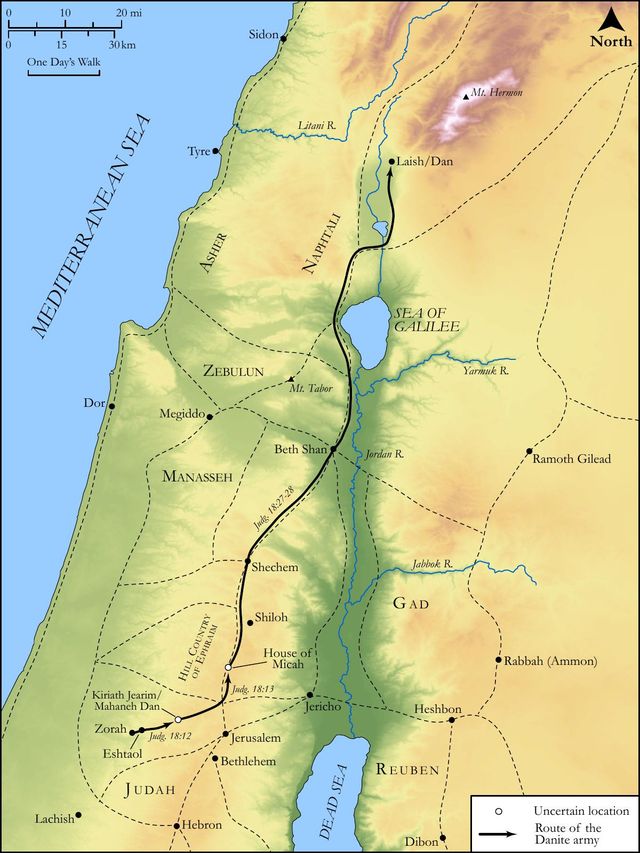
Here is, 1. The eye which these Danites had upon Laish, not the whole tribe of Dan, but one family of them, to whose lot, in the subdivision of Canaan, that city fell. Hitherto this family had sojourned with their brethren, who had taken possession of their lot, which lay between Judah and the Philistines, and had declined going to their own city, because there was no king in Israel to rule over them, Jdg 18:1. It lay a great way off, separate from the rest of their tribe; it was entirely in the enemy's hand, and therefore they would sponge upon their brethren rather than go far to provide for themselves. But at length necessity forced them to arouse themselves, and they began to think of an inheritance to dwell in. It is better to have a little of one's own than always to hang upon others. 2. The enquiry which this family of the Danites made concerning Laish: They sent five men to search the land (Jdg 18:2), that they might know the character of the country, whether it was an inheritance worth going so far for, and the posture of the people, whether the making of themselves masters of it was a thing practicable, what force was necessary in order thereunto, and which was the best way of making an attack upon it. The men they sent were men of valour, who, if they fell into their enemies' hands, knew how to look danger in the face. It is prudent to look before we leap. Dan had the subtlety of a serpent by the way (Gen 49:17), as well as the courage of a lion's whelp, leaping from Bashan, Deu 33:22. 3. The acquaintance which their spies got with Micah's priest, and the use they made of that acquaintance. It seems, they had know this Levite formerly, he having in his rambles been sometimes in their country; and, though his countenance might be altered, they knew him again by his voice, Jdg 18:3. They were surprised to find him so far off, enquired what brought him thither, and he told them (Jdg 18:4) what business he had there, and what encouragement. They, understanding that he had an oracle in his custody, desired he would tell them whether they should prosper in their present undertaking, Jdg 18:5. See their carelessness and regardlessness of God and his providence; they would not have enquired of the Lord at all if this Levite's mentioning the teraphim he had with him had not put it into their heads. Many never think of religion but just when it falls in their way and they cannot avoid it, like chance customers. See their ignorance of the divine law, that they thought God, who had forbidden the religious use of graven images, would yet own them in consulting an image, and give them an answer of peace. Should he be enquired of by them? Eze 14:3. They seem to have had a greater opinion of Micah's teraphim than of God's urim; for they had passed by Shiloh, and, for aught that appears, had not enquired there of God's high priest, but Micah's shabby Levite shall be an oracle to them. He betakes himself to his usual method of consulting his teraphim; and, whether he himself believed it or no, he humoured the thing so well that he made them believe he had an answer from God encouraging them to go on, and assuring them of good success (Jdg 18:6): "Go in peace, you shall be safe, and may be easy, for before the Lord is your way," that is, "he approves it" (as the Lord is said to know the way of the righteous with acceptation), "and therefore he will make it prosperous, his eye will be upon you for good, he will direct your way, and preserve your going out and coming in." Note, Our great care should be that our way be such as God approves, and, if it be so, we may go in peace. If God care for us, on him let us cast our care, and be satisfied that we cannot miss our way if he go before us.
Continue studying Judges 18:6 across the web’s major study libraries — every link below opens this exact verse, chapter, or book on the destination site.
Read & Compare
 BibleGatewayThis verse in more than 200 translations and 70 languages.
 Bible.comThe YouVersion reader — hundreds of translations, reading plans, and highlights.
 ESV.orgCrossway's official English Standard Version reader.
 NET BibleThe NET translation with 60,000+ translators' notes on every rendering decision.
 STEP BibleTyndale House's free study tool — original text, vocabulary, and scholarly resources.
 BibliaLogos Bible Software's free web reader.
 USCCBThe New American Bible (Revised Edition) with the U.S. bishops' study notes.
Commentaries
 BibleHub CommentariesDozens of classic commentaries on this verse, gathered on one page.
 StudyLightMore than 100 commentary sets — the largest collection on the web.
 BibleRefPlain-English commentary on what this verse means, verse by verse.
 Enduring WordDavid Guzik's free commentary on this chapter, widely used by Bible teachers.
 Bible Study ToolsVerse commentary alongside Greek and Hebrew study aids.
Original Language & Research
- BibleHub InterlinearThe verse word by word — original language, transliteration, and English.
- BibleHub LexiconEvery word's original-language definition and Strong's entry.
 Blue Letter BibleDeep-study tools — Strong's numbers, concordance, and word studies.
 SefariaThe Hebrew text with Rashi and centuries of Jewish commentary.
Sermons, Hymns & Audio


TrulyRandomVerse is not affiliated with these sites and doesn’t control their content. They’re linked because they’re genuinely useful.
Summary
Judges 18:6 encapsulates a pivotal moment of spiritual perversion and moral decay within ancient Israel, where a renegade Levite, operating outside legitimate Yahwistic worship and serving an idolatrous household, offers a deceptive assurance of divine approval to Danite spies. This pronouncement, cloaked in sacred language, tragically legitimizes a mission of violence and self-interest, serving as a stark illustration of how easily religious authority and terminology can be co-opted to validate ungodly endeavors, leading a people further from faithful obedience to the Lord.
Context
ShowHideLiterary Context
Judges 18 forms the latter half of a two-chapter appendix (Judges 17-18) that serves as a grim epilogue to the main narrative of the book, vividly illustrating the spiritual and moral anarchy prevalent in Israel during the period when "there was no king in Israel: every man did that which was right in his own eyes" (Judges 17:6 and Judges 21:25). Specifically, Judges 18 chronicles the tribe of Dan's search for new territory, a quest necessitated by their failure to fully dispossess the inhabitants of their original inheritance (Judges 1:34). During their scouting expedition, five Danite spies encounter a young Levite who has been hired by Micah to serve as a private priest for his household, which is equipped with a graven image and other idolatrous cultic objects (Judges 17:4-5). Recognizing the Levite's voice, the spies inquire about the success of their journey, and Judges 18:6 records the Levite's seemingly reassuring, yet profoundly misleading, response. This interaction sets the stage for the Danites' subsequent violent conquest of Laish and the establishment of a new, rival idolatrous cult.
Historical & Cultural Context
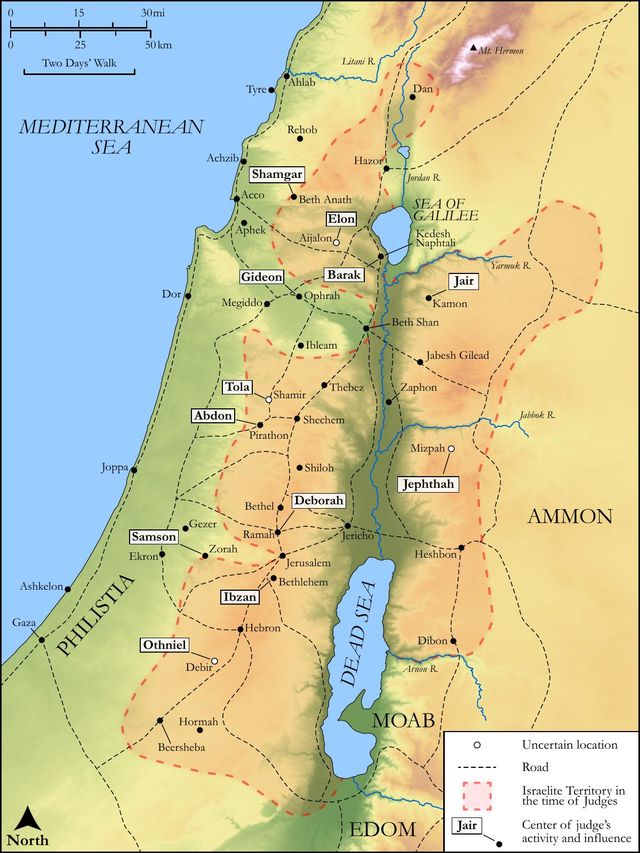
The era of the Judges (approximately 1400-1050 BC) was characterized by a recurring cycle of apostasy, divine judgment, repentance, and deliverance. Israel lacked a centralized government or king, leading to fragmented tribal identities and a widespread decline in adherence to the Mosaic covenant. Levites, who were divinely appointed to serve as spiritual guides, teachers of the Law, and ministers at the tabernacle, often struggled for sustenance and, as exemplified by Micah's Levite, sometimes resorted to private, even idolatrous, service for personal gain (Judges 17:7-13). The practice of consulting a priest or an oracle for divine guidance regarding a journey or military venture was common among the nations round about, and Israel also sought prophetic or priestly counsel. However, the legitimacy of such counsel was entirely dependent on the source's fidelity to Yahweh and His commands. The Danites' consultation of a Levite serving idols, and their ready acceptance of his "blessing," highlights a broader cultural and spiritual blindness to true divine authority and the pervasive dangers of syncretism within Israel.
Key Themes
ShowHideJudges 18:6 powerfully contributes to several key themes within the book of Judges and the broader biblical narrative. Firstly, it underscores the theme of misguided spiritual authority and false assurance. The Levite, though of the priestly tribe, is clearly compromised by his association with idolatry, yet his words carry a veneer of divine sanction. Secondly, the verse highlights human expediency over divine will. The Danites are not seeking God's righteous path but rather an easier, more convenient solution to their territorial problem, and they readily accept a "blessing" that validates their self-serving agenda. This stands in stark contrast to the covenant ideal of seeking the Lord's face for true guidance (Psalm 27:8). Thirdly, it exemplifies the pervasive spiritual and moral decay in Israel during this period. A Levite, meant to uphold God's law, serves idols for personal gain, and a tribe of Israel consults him for a venture that ultimately involves violence against an unsuspecting, peaceful people (Judges 18:7). The entire episode serves as a microcosm of the nation's failure to live up to its covenant responsibilities.
Exposition and Analysis
ShowHideKey Word Analysis
ShowHideThe Hebrew word שָׁלוֹם (shâlôwm, H7965) is rich in meaning, encompassing far more than merely the absence of conflict. It denotes a holistic sense of well-being, completeness, prosperity, health, and harmony—a comprehensive state of flourishing. When the priest says, "Go in peace," it is a common and seemingly benevolent farewell. However, in this specific context, it is deeply ironic and tragically hollow. The path the Danites are embarking on will lead to violence, destruction, and the establishment of idolatry, utterly devoid of true shâlôwm for themselves or for the innocent people of Laish. The word is used here as a superficial religious platitude, masking a journey of unrighteousness and spiritual decay.
The divine name יְהוָה (Yᵉhôvâh, H3068), often translated as "LORD" in English Bibles, refers to the self-existent, eternal God of Israel, the covenant-keeping God. The phrase "before the LORD" (Hebrew: nôkach Yᵉhôvâh, H5227 + H3068) typically signifies divine knowledge, oversight, or an action performed in God's presence, implying His approval or awareness. For example, sacrifices were offered "before the LORD" (Leviticus 1:3). In Judges 18:6, the Levite's declaration "before the LORD [is] your way" implies divine cognizance and, by extension, approval of the Danites' mission. However, given the Levite's compromised spiritual state and the unrighteous nature of the Danites' intentions, this declaration is a profound misrepresentation. It suggests that God is either indifferent or complicit in their ungodly plans, which stands in direct contradiction to His holy character and covenant demands. It is a perversion of a sacred phrase to legitimize a profane endeavor.
Verse Breakdown
ShowHide"And the priest said unto them,"
This clause identifies the speaker as the Levite from Micah's household. It is crucial to understand that while he possesses priestly lineage (H3548, kôhên), he is not functioning as a legitimate priest of Yahweh in accordance with the Mosaic Law. Instead, he is a hired functionary for an idolatrous cult, operating outside divine appointment and sanction. His authority is self-proclaimed and corrupted.
"Go in peace:"
This is a common Hebrew greeting or farewell (H7965, shâlôwm), meaning "Go well" or "May you prosper." On the surface, it sounds like a blessing, offering a sense of well-being. However, the immediate context profoundly undermines its true meaning. The "peace" offered by this compromised priest is a false peace, a deceptive assurance that will lead to violence, destruction, and spiritual decay, not genuine well-being or divine favor for either the Danites or their victims.
"before the LORD [is] your way wherein ye go."
This is the crux of the Levite's "prophecy" or assurance. He claims that the Danites' journey and their chosen path (H1870, derek) are "before the LORD" (H5227, nôkach + H3068, Yᵉhôvâh), implying divine knowledge, oversight, and, critically, divine approval. This phrase would typically inspire confidence that one's actions are aligned with God's will. Yet, the Danites' "way" is one of convenience, conquest of the innocent, and ultimately, the establishment of idolatry. The Levite's statement is a tragic example of religious language being used to sanctify sin, providing a deceptive comfort that God is somehow endorsing their unrighteous mission, thereby highlighting the profound spiritual anarchy of the Judges era.
Literary Devices
ShowHideThe primary literary device at play in Judges 18:6 is Irony. The Levite, a figure meant to uphold God's law and guide His people, is himself deeply compromised by idolatry, yet he offers a "blessing" that invokes the very name of the Lord. The greeting "Go in peace" is deeply ironic because the Danites' journey will result in anything but peace for the unsuspecting inhabitants of Laish, whom they will violently conquer. Furthermore, the declaration that their "way" is "before the LORD" is profoundly ironic, as their path is one of disobedience, self-interest, and the eventual establishment of a rival cult, which is directly contrary to God's character and covenant demands. This verse also employs Foreshadowing, hinting at the tragic outcome of the Danites' mission—not only the physical destruction of Laish but also the spiritual destruction of the Danite tribe through their embrace of idolatry, as detailed later in the chapter. The Levite himself serves as a Symbol of the widespread spiritual corruption and moral relativism that permeated Israel during the Judges period, where adherence to God's commands was replaced by self-serving expediency.
Theological and Thematic Connections
ShowHideJudges 18:6 serves as a stark warning against the dangers of seeking or accepting spiritual counsel from compromised sources and the ease with which human desires can be cloaked in religious language. It underscores the critical importance of discernment, reminding believers that not every pronouncement made "in the name of the Lord" is truly from God. The Levite's words, though seemingly pious, were devoid of divine truth and served only to validate the Danites' pre-determined, ungodly agenda. This passage highlights the pervasive theme in Judges of Israel's spiritual decline, where the absence of faithful leadership led to a populace that "did what was right in their own eyes," often with disastrous consequences. True peace and prosperity (shalom) come only from walking in the ways of the Lord, not from seeking validation for paths of self-interest or unrighteousness.
Reflection and Application
ShowHideJudges 18:6 offers a timeless lesson for believers today: the critical necessity of spiritual discernment. In an age saturated with diverse voices claiming spiritual authority, we are called to rigorously test all counsel against the unchanging truth of God's Word and the character of Christ. It is easy to seek "blessings" or "guidance" that merely affirm our pre-existing desires or plans, especially if those plans promise convenience or personal gain. This verse challenges us to ask: Are we genuinely seeking God's will, even when it demands sacrifice, repentance, or a difficult path, or are we merely seeking divine validation for our own agenda? True spiritual leadership is characterized by faithfulness to God's commands and a life that aligns with biblical truth, not by impressive titles or reassuring words divorced from righteous living. Our "way" should truly be "before the LORD" in the sense of being consecrated to Him and aligned with His holy purposes, not merely acknowledged by a compromised authority.
Questions for Reflection
ShowHideFAQ
ShowHideWho was this "priest" and why was he considered illegitimate?
ShowHideThe "priest" in Judges 18:6 was a young Levite who had been hired by a man named Micah to serve as a private priest for his household, which included a graven image and other idolatrous objects (Judges 17:4-5). While he was of the tribe of Levi, which was designated for priestly service, his role was illegitimate for several reasons. Firstly, he was not a descendant of Aaron, from whom the legitimate priesthood was established. Secondly, he was serving a private household and an idolatrous cult, rather than ministering at the tabernacle according to God's law. His service was motivated by personal gain (Judges 17:10), not out of devotion to Yahweh. Therefore, his spiritual authority was compromised and his pronouncements lacked true divine sanction.
Why did the Danites trust this Levite's counsel, even though he was associated with idolatry?
ShowHideThe Danites' trust in the Levite's counsel reflects the pervasive spiritual decline during the Judges period. They recognized his voice from a previous encounter and, upon learning he was a Levite, likely saw him as a source of divine information, regardless of his compromised context. The text implies a pragmatic, rather than principled, approach to spirituality. They were seeking a quick, convenient answer to their problem of finding new territory, and the Levite's seemingly positive assurance, "before the LORD [is] your way," was exactly what they wanted to hear. Their desperation and spiritual blindness allowed them to overlook the blatant idolatry associated with his service, prioritizing expediency over genuine discernment of God's will. This illustrates how easily people can be led astray when they prioritize their own desires over faithful obedience.
Does "before the LORD [is] your way" mean God approved of the Danites' mission?
ShowHideAbsolutely not. The phrase "before the LORD [is] your way" in this context does not signify God's approval. Instead, it is a deceptive and hollow pronouncement from a compromised spiritual authority. The Levite, serving an idolatrous cult, had no legitimate standing to speak for Yahweh, especially concerning a mission that involved violence against an innocent people and would ultimately lead to the establishment of a rival idolatrous shrine (Judges 18:27-31). The phrase simply means that their path was known to the Lord, but it was known as a path of disobedience and sin. The irony is profound: the Levite uses sacred language to legitimize an unholy endeavor, highlighting the spiritual anarchy of the time where religious forms were divorced from true righteousness. God's approval is always contingent on alignment with His holy character and commands, not on the pronouncements of false or compromised prophets.
Christ-Centered Fulfillment
ShowHideJudges 18:6, with its chilling depiction of false peace and misguided spiritual authority, points forward to the ultimate and true source of peace and divine guidance in Jesus Christ. The Levite's hollow "Go in peace" contrasts sharply with the profound peace that Christ offers, a peace not contingent on external circumstances or human validation, but rooted in reconciliation with God through His atoning sacrifice (Colossians 1:20). Unlike the Danites' "way" that was "before the LORD" only in the sense of being known to Him as a path of sin, Jesus declares, "I am the way, the truth, and the life: no man cometh unto the Father, but by me" (John 14:6). He is the only legitimate "Way" that truly stands "before the LORD" with divine approval, because His path was one of perfect obedience and self-sacrifice. Furthermore, while the Danites sought counsel from a compromised priest, believers today have direct access to the ultimate High Priest, Jesus, who is holy, innocent, undefiled, and separate from sinners (Hebrews 7:26). He offers not a deceptive blessing for a self-serving mission, but genuine guidance for a life lived in accordance with God's perfect will, leading to true shalom and abundant life (John 10:10).