


Judges 18:4
Bible text: King James Version (1769 Blayney text) · Public domain
Bible text: Berean Standard Bible · Public domain
Bible text: American Standard Version (1901) · Public domain
Bible text: World English Bible, Messianic edition · Public domain
Bible text: Geneva Bible (1599) · Public domain
Bible text: Young's Literal Translation · Public domain
- וַיֹּאמֶרvai·Yo·merand he saidH559Conj-w ¦ V-Qal-ConsecImperf-3msVerb Qal Consecutive Imperfect 3rd Singular Masculineוַandיֹּאמֶרhe said
- אֲלֵהֶם'a·le·Hemto themH413Prep ¦ 3mpPreposition Definiteאֲלֵtoהֶםthem
- כָּזֹהka·Zohlike thisH2090Prep-k ¦ PrtParticle Demonstrativeכָּlikeזֹהthis
- וְכָזֶהve·kha·Zehand like thisH2088Conj-w ¦ Prep-k ¦ PrtParticle Demonstrativeוְandכָlikeזֶהthis
- עָשָׂה'A·sahhe has doneH6213V-Qal-Perf-3msVerb Qal Perfect 3rd Singular Masculine
- לִיlifor <the> mePrep-l ¦ 1csSuffix Personal 1st Singular common genderלִfor <the>יme
- מִיכָהmi·KhahMicahH4318N-proper-mNoun Proper Masculine
- וַיִּשְׂכְּרֵנִיvai·yis·ke·Re·niand he has hired meH7936Conj-w ¦ V-Qal-ConsecImperf-3ms ¦ 1csVerb Qal Consecutive Imperfect 3rd Singular Masculineוַandיִּשְׂכְּרֵhe has hiredנִיme
- וָאֱהִיva·'e·hiand I have becomeH1961Conj-w ¦ V-Qal-ConsecImperf-1csVerb Qal Consecutive Imperfect 1st Singular common genderוָandאֱהִיI have become
- לוֹloof himPrep-l ¦ 3msSuffix Personal 3rd Singular Masculineלofוֹhim
- לְכֹהֵןle·kho·Hen<into> a priestH3548Prep-l ¦ N-msNoun Singular Masculine Absoluteלְ<into>כֹהֵןa priest
English is a literal word-by-word gloss of the Hebrew, not the KJV's wording. Why?
This is the original text the KJV's translators worked from — each Hebrew word with its own literal English meaning in this verse, prepared by scholars at Tyndale House, Cambridge. The KJV translates whole sentences, not word by word, so its wording differs: one Hebrew word can become several English words, and the KJV may choose “the LORD” where the gloss reads “Yahweh”. Both are faithful — they answer different questions. For the KJV's own rendering, switch to the KJV text.
Details
See on the biblical-era maps

Study this verse
Public-domain commentary
Matthew Henry
From his Commentary on the Whole Bible. Henry comments on passages, not single verses — this entry covers Judges 18:1–6.
Here is, 1. The eye which these Danites had upon Laish, not the whole tribe of Dan, but one family of them, to whose lot, in the subdivision of Canaan, that city fell. Hitherto this family had sojourned with their brethren, who had taken possession of their lot, which lay between Judah and the Philistines, and had declined going to their own city, because there was no king in Israel to rule over them, Jdg 18:1. It lay a great way off, separate from the rest of their tribe; it was entirely in the enemy's hand, and therefore they would sponge upon their brethren rather than go far to provide for themselves. But at length necessity forced them to arouse themselves, and they began to think of an inheritance to dwell in. It is better to have a little of one's own than always to hang upon others. 2. The enquiry which this family of the Danites made concerning Laish: They sent five men to search the land (Jdg 18:2), that they might know the character of the country, whether it was an inheritance worth going so far for, and the posture of the people, whether the making of themselves masters of it was a thing practicable, what force was necessary in order thereunto, and which was the best way of making an attack upon it. The men they sent were men of valour, who, if they fell into their enemies' hands, knew how to look danger in the face. It is prudent to look before we leap. Dan had the subtlety of a serpent by the way (Gen 49:17), as well as the courage of a lion's whelp, leaping from Bashan, Deu 33:22. 3. The acquaintance which their spies got with Micah's priest, and the use they made of that acquaintance. It seems, they had know this Levite formerly, he having in his rambles been sometimes in their country; and, though his countenance might be altered, they knew him again by his voice, Jdg 18:3. They were surprised to find him so far off, enquired what brought him thither, and he told them (Jdg 18:4) what business he had there, and what encouragement. They, understanding that he had an oracle in his custody, desired he would tell them whether they should prosper in their present undertaking, Jdg 18:5. See their carelessness and regardlessness of God and his providence; they would not have enquired of the Lord at all if this Levite's mentioning the teraphim he had with him had not put it into their heads. Many never think of religion but just when it falls in their way and they cannot avoid it, like chance customers. See their ignorance of the divine law, that they thought God, who had forbidden the religious use of graven images, would yet own them in consulting an image, and give them an answer of peace. Should he be enquired of by them? Eze 14:3. They seem to have had a greater opinion of Micah's teraphim than of God's urim; for they had passed by Shiloh, and, for aught that appears, had not enquired there of God's high priest, but Micah's shabby Levite shall be an oracle to them. He betakes himself to his usual method of consulting his teraphim; and, whether he himself believed it or no, he humoured the thing so well that he made them believe he had an answer from God encouraging them to go on, and assuring them of good success (Jdg 18:6): "Go in peace, you shall be safe, and may be easy, for before the Lord is your way," that is, "he approves it" (as the Lord is said to know the way of the righteous with acceptation), "and therefore he will make it prosperous, his eye will be upon you for good, he will direct your way, and preserve your going out and coming in." Note, Our great care should be that our way be such as God approves, and, if it be so, we may go in peace. If God care for us, on him let us cast our care, and be satisfied that we cannot miss our way if he go before us.
Continue studying Judges 18:4 across the web’s major study libraries — every link below opens this exact verse, chapter, or book on the destination site.
Read & Compare
 BibleGatewayThis verse in more than 200 translations and 70 languages.
 Bible.comThe YouVersion reader — hundreds of translations, reading plans, and highlights.
 ESV.orgCrossway's official English Standard Version reader.
 NET BibleThe NET translation with 60,000+ translators' notes on every rendering decision.
 STEP BibleTyndale House's free study tool — original text, vocabulary, and scholarly resources.
 BibliaLogos Bible Software's free web reader.
 USCCBThe New American Bible (Revised Edition) with the U.S. bishops' study notes.
Commentaries
 BibleHub CommentariesDozens of classic commentaries on this verse, gathered on one page.
 StudyLightMore than 100 commentary sets — the largest collection on the web.
 BibleRefPlain-English commentary on what this verse means, verse by verse.
 Enduring WordDavid Guzik's free commentary on this chapter, widely used by Bible teachers.
 Bible Study ToolsVerse commentary alongside Greek and Hebrew study aids.
Original Language & Research
- BibleHub InterlinearThe verse word by word — original language, transliteration, and English.
- BibleHub LexiconEvery word's original-language definition and Strong's entry.
 Blue Letter BibleDeep-study tools — Strong's numbers, concordance, and word studies.
 SefariaThe Hebrew text with Rashi and centuries of Jewish commentary.
Sermons, Hymns & Audio


TrulyRandomVerse is not affiliated with these sites and doesn’t control their content. They’re linked because they’re genuinely useful.
Summary
Judges 18:4 serves as a stark revelation of the profound spiritual decay and moral relativism prevalent in Israel during the chaotic period of the Judges. In this pivotal verse, the Levite priest, speaking to the Danite spies, candidly discloses the mercenary and transactional nature of his service to Micah, a relationship where divine calling is unceremoniously supplanted by personal gain. This admission not only exposes the Levite's compromised integrity but also foreshadows the Danites' own descent into idolatry, further illustrating the widespread abandonment of Yahweh's covenant and the absence of central spiritual authority.
Context
ShowHideLiterary Context
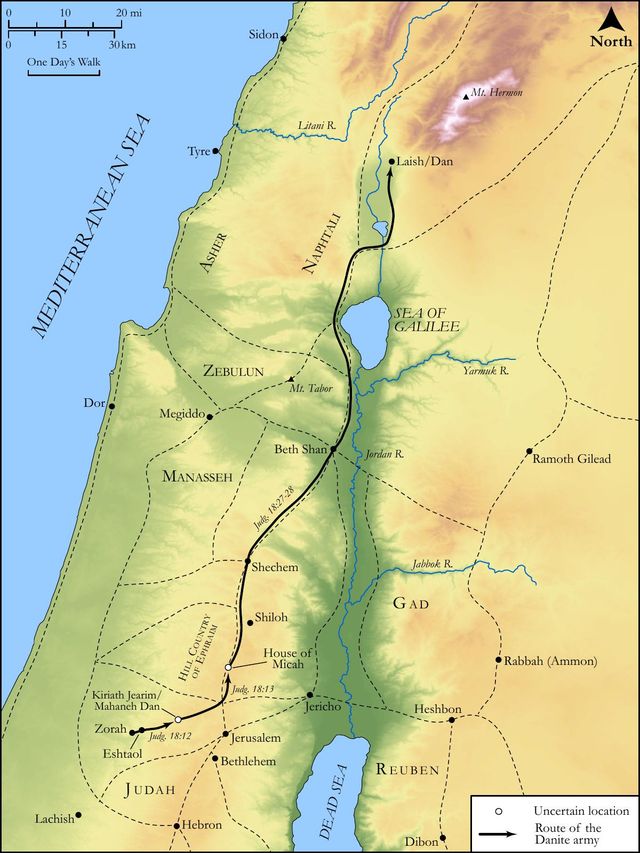
This verse is intricately woven into the narrative of the tribe of Dan's desperate search for an inheritance, detailed in Judges 18. Having failed to secure their allotted territory, five Danite spies are dispatched to scout new land. Their journey unexpectedly leads them to the house of Micah in the hill country of Ephraim, where they encounter a young Levite. This Levite had previously been lured by Micah to serve as a private priest for his personal shrine, which included an ephod, teraphim, and carved and molten images, as described in Judges 17:10-11. The spies, recognizing the Levite's voice from a previous encounter, inquire about his presence and role in this unusual setting. Judges 18:4 functions as the Levite's direct explanation, laying bare the terms of his employment and his corrupted status, immediately signaling the deep spiritual impropriety of the situation.
Historical & Cultural Context
The book of Judges consistently portrays a period of profound spiritual and political instability in Israel, famously encapsulated by the recurring refrain, "In those days there was no king in Israel: every man did that which was right in his own eyes" (Judges 17:6). This era witnessed a significant breakdown of Mosaic law and covenant fidelity. While Levites were divinely appointed to serve the LORD at the central sanctuary (the Tabernacle), the narrative of Micah and his Levite vividly illustrates the widespread deviation from this sacred mandate. Priestly service had become privatized and commercialized, often intertwined with syncretistic practices—a dangerous blending of Yahweh worship with Canaanite idolatry. The geographical setting in Ephraim, far removed from the designated Levitical cities and the central sanctuary, further underscores the decentralized and corrupted religious landscape of the time, where local cults flourished unchecked.
Key Themes
ShowHideThe narrative surrounding Judges 18:4 powerfully illuminates several critical themes. First, Religious Corruption and Syncretism are glaringly evident, as a Levite, a member of the tribe consecrated to uphold God's law, serves an idolatrous shrine rather than facilitating the true worship of Yahweh. This highlights the pervasive spiritual decay where Yahwism was diluted with pagan practices. Second, Self-Serving Spirituality emerges as a dominant motif; the Levite openly confesses he was "hired," indicating his motivation was personal gain and security, not devotion to God. Similarly, Micah's belief that having a Levite priest would bring him prosperity (Judges 17:13) reveals a transactional, rather than relational, understanding of faith. Third, the Absence of Central Authority is a foundational theme of the entire book of Judges, explicitly stated in Judges 17:6 and reiterated at the book's conclusion in Judges 21:25. This vacuum of proper spiritual and political leadership led directly to the moral relativism and widespread disobedience to God's law that characterized the era.
Exposition and Analysis
ShowHideKey Word Analysis
ShowHideThis word, often translated as "this" or "that," is repeated ("thus and thus") to indicate a specific, detailed, and established manner or arrangement. In this context, it refers to the precise terms of the Levite's employment by Micah. The repetition emphasizes that the Levite is clearly articulating the contractual nature of his service, implying a lack of shame or even an expectation that such an arrangement is normal or acceptable, further highlighting the moral decline of the era.
This verb explicitly denotes a contractual arrangement for wages or payment. In the context of the Levite's service, it is profoundly significant. The priesthood was divinely ordained as a calling, a sacred service to Yahweh and His people, supported by tithes and offerings (Deuteronomy 18:1-8), not a paid position in a commercial sense. The use of "hired" underscores the mercenary nature of the Levite's role, highlighting a profound deviation from the divinely appointed purpose and character of the Levitical priesthood. It transforms a sacred office into a mere job, devoid of spiritual integrity or genuine commitment to God's covenant.
While the term "priest" itself is neutral, its application here is deeply problematic. A true priest in Israel was consecrated to serve Yahweh at His tabernacle, offering sacrifices and mediating between God and His people according to Mosaic law. Here, the Levite functions as a "priest" for a private, idolatrous shrine, serving man-made images and a household, not the LORD. This perversion of the priestly office reflects the spiritual chaos of the Judges period, where the sacred was profaned and divine institutions were co-opted for personal gain and idolatrous practices, blurring the lines between true worship and pagan superstition.
Verse Breakdown
ShowHide"And he said unto them"
This phrase identifies the speaker as the young Levite, who is responding directly to the Danite spies' inquiry about his presence and role in Micah's household. His immediate and unhesitant explanation suggests a surprising lack of self-awareness or shame regarding the impropriety of his situation, indicating how normalized such spiritual compromise had become in that era.
"Thus and thus dealeth Micah with me"
This concise phrase serves as the Levite's summary of the specific arrangement between himself and Micah. It implies a detailed understanding of the terms of his employment, likely including the annual wage, clothing, and provisions mentioned in Judges 17:10. This statement immediately highlights the Levite's focus on the material benefits and the transactional nature of the relationship, rather than any spiritual calling or obligation to Yahweh.
"and hath hired me"
This is the crucial and damning admission. The Levite explicitly states that his service is a paid employment, a commercial transaction. This starkly contrasts with the ideal of a Levite's dedicated, uncompensated service to the LORD and the nation of Israel, which was meant to be sustained by the tithes and offerings of the people. It reveals a purely economic motivation for his priestly function, stripping it of its sacred character and reducing it to a mere job.
"and I am his priest"
This final clause states the direct outcome of the hiring: the Levite has become Micah's personal priest. This signifies a profound perversion of the Levitical office. Instead of serving the God of Israel and His covenant community in the Tabernacle, this Levite has become a functionary for a private, syncretistic cult, thereby validating Micah's idolatry and actively contributing to the spiritual decline of the nation as a whole.
Literary Devices
ShowHideThe narrative of Judges 18:4 and its surrounding context employs several powerful literary devices to underscore its theological message. Irony is profoundly evident: a Levite, from the tribe divinely designated to uphold God's law and facilitate true worship, is found serving an idolatrous shrine for personal profit. This starkly contrasts with the ideal of a dedicated, self-sacrificing priesthood, highlighting the tragic spiritual state of Israel. There is also significant Foreshadowing in this verse; the Levite's mercenary service and the Danites' encounter with Micah's idolatry directly precede the Danites' theft of Micah's idols and the Levite himself, leading to the establishment of their own idolatrous cult, which tragically persisted for generations (Judges 18:30-31). This incident serves as a microcosm of Israel's broader spiritual apostasy. Furthermore, the narrative presents a strong Contrast between the divinely ordained system of worship and the chaotic, self-serving religious practices that emerged in the absence of faithful leadership. The Levite's casual admission of being "hired" underscores the profound moral and spiritual decay of the era, where sacred duties were reduced to mere transactions.
Theological and Thematic Connections
ShowHideJudges 18:4 stands as a stark theological warning against the dangers of compromised faith and self-serving religion. The Levite's willingness to be "hired" as a private priest for an idolatrous shrine illustrates a profound departure from the covenantal obligations of the Levitical priesthood, which was meant to mediate God's law and facilitate true worship for the entire nation. This mercenary approach to sacred service highlights how easily spiritual roles can be corrupted when personal gain overshadows divine calling and obedience. It underscores the broader theme in Judges that when "every man did that which was right in his own eyes," the result was not freedom but spiritual anarchy and moral decay, leading to the proliferation of false worship and a transactional relationship with the divine. The verse challenges believers to examine their own motivations for service and worship, asking whether their faith is rooted in genuine devotion or in a desire for personal benefit or comfort.
Reflection and Application
ShowHideJudges 18:4 offers a sobering reflection on the pitfalls of spiritual compromise and the allure of convenience over conviction. The Levite's choice to serve Micah's shrine for a wage, rather than adhering to the true worship of Yahweh, serves as a powerful reminder that genuine faith cannot be transactional or self-serving. In our own lives, we are called to discern whether our spiritual practices are truly rooted in devotion to God or subtly influenced by personal gain, societal acceptance, or mere comfort. This passage challenges us to examine the integrity of our worship, ensuring it is centered on God's revealed truth and not on man-made constructs or syncretistic blends that dilute the purity of our faith. It also underscores the importance of spiritual discernment and accountability, reminding us that true leadership and service in God's kingdom are marked by faithfulness, integrity, and a selfless commitment to God's purposes, rather than by financial incentive or popular appeal.
Questions for Reflection
ShowHideFAQ
ShowHideWhy was a Levite serving a private shrine instead of the Tabernacle?
ShowHideThe narrative in Judges 18:4 and the preceding chapter illustrates the profound spiritual and political breakdown in Israel during the period of the Judges. According to Mosaic law, Levites were specifically designated to serve at the central Tabernacle (and later the Temple), facilitating national worship and upholding God's covenant. However, in this era, "there was no king in Israel; every man did what was right in his own eyes" (Judges 17:6). This lack of central authority and spiritual leadership led to widespread disobedience and decentralization of worship. The Levite in Micah's house chose personal security and a steady income over his divinely appointed duties, highlighting a mercenary approach to sacred office driven by the prevailing spiritual anarchy and self-interest of the time.
What was wrong with Micah "hiring" a priest?
ShowHideMicah's act of "hiring" a priest was fundamentally flawed on several levels. First, the priesthood in Israel was not a profession one could simply hire for. It was a hereditary office, divinely appointed to the tribe of Levi, with specific duties and a prescribed mode of support (tithes and offerings from the nation, not a private salary). Second, Micah's shrine was idolatrous, containing carved and molten images, an ephod, and teraphim, which were explicitly forbidden by God's law. By hiring a Levite, Micah sought to legitimize his illegitimate worship, believing that having a "real" priest would bring him prosperity (Judges 17:13). This reveals a transactional, superstitious understanding of God, where religious rituals and personnel were seen as tools to manipulate divine favor, rather than expressions of genuine obedience and worship.
Christ-Centered Fulfillment
ShowHideThe mercenary and compromised priesthood depicted in Judges 18:4 stands in stark contrast to the perfect, unblemished, and self-sacrificing priesthood of Jesus Christ. While the Levite served for hire, motivated by personal gain and facilitating idolatry, Christ's priesthood is eternally established, not by human appointment or monetary exchange, but by divine oath and His own perfect obedience (Hebrews 7:20-22). Unlike the Levitical priests who were flawed and died, requiring successors (Hebrews 7:23), Jesus holds His priesthood permanently, having offered Himself as the ultimate, once-for-all sacrifice for sin (Hebrews 9:11-14). He is not "hired" by humanity but freely laid down His life, not for personal gain, but for the redemption of His people (John 10:17-18). Through His perfect work, He has not only fulfilled the Old Testament priesthood but also inaugurated a new covenant where believers are made a "royal priesthood," called to declare His praises and live lives of worship and service, not for profit, but out of gratitude and devotion to Him (1 Peter 2:9). The failures of the Levite in Judges underscore our desperate need for the true High Priest, Jesus, who perfectly mediates between God and humanity, offering a relationship based on grace and truth, not transaction.