


Isaiah 30:1
Bible text: King James Version (1769 Blayney text) · Public domain
Bible text: King James Version with Strong's numbers · Public domain
Bible text: Berean Standard Bible · Public domain
Bible text: American Standard Version (1901) · Public domain
Bible text: World English Bible, Messianic edition · Public domain
Bible text: Geneva Bible (1599) · Public domain
Bible text: Young's Literal Translation · Public domain
- הוֹיHowoe to!H1945PrtParticle Interjection
- בָּנִיםba·NimchildrenH1121N-mpNoun Plural Masculine Absolute
- סוֹרְרִיםso·Rim[who are] rebelliousH5637V-Qal-Prtcpl-mpVerb Qal Participle Plural Masculine Absolute
- נְאֻםne·'um[the] utterance ofH5002N-mscNoun Singular Masculine Construct
- יְהוָהYah·wehYahwehH3068N-properNoun Proper Title
- לַעֲשׂוֹתla·'a·Sotby makingH6213Prep-l ¦ V-Qal-InfVerb Qal Infinitive Constructלַbyעֲשׂוֹתmaking
- עֵצָה'e·Tzaha planH6098N-fsNoun Singular Feminine Absolute
- וְלֹאve·Lo'and notH3808Conj-w ¦ NegParticle Negativeוְandלֹאnot
- מִנִּיmi·Nifrom meH4480Prep-m ¦ 1csPreposition Definiteמִfromנִּיme
- וְלִנְסֹךְve·lin·Sokhand by pouring outH5258Conj-w ¦ Prep-l ¦ V-Qal-InfVerb Qal Infinitive Constructוְandלִbyנְסֹךְpouring out
- מַסֵּכָהma·se·Khaha libationH4541N-fsNoun Singular Feminine Absolute
- וְלֹאve·Lo'and notH3808Conj-w ¦ NegParticle Negativeוְandלֹאnot
- רוּחִיru·Chimy spiritH7307N-csc ¦ 1fsNoun Singular common gender Constructרוּחִspiritיmy
- לְמַעַןle·Ma·'anso asH4616PrtParticle Conditional
- סְפוֹתse·Fotto addH5595V-Qal-InfVerb Qal Infinitive Construct
- חַטָּאתcha·TatsinH2403N-fsNoun Singular Feminine Absolute
- עַל'altoH5921PrepPreposition
- חַטָּאתcha·TatsinH2403N-fsNoun Singular Feminine Absolute
English is a literal word-by-word gloss of the Hebrew, not the KJV's wording. Why?
This is the original text the KJV's translators worked from — each Hebrew word with its own literal English meaning in this verse, prepared by scholars at Tyndale House, Cambridge. The KJV translates whole sentences, not word by word, so its wording differs: one Hebrew word can become several English words, and the KJV may choose “the LORD” where the gloss reads “Yahweh”. Both are faithful — they answer different questions. For the KJV's own rendering, switch to the KJV text.
Details
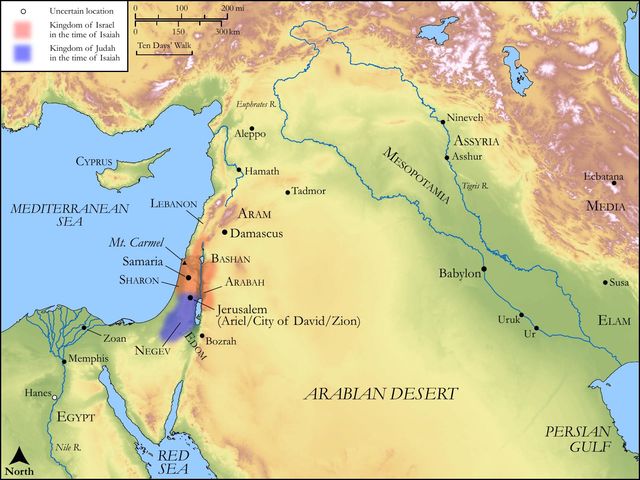
See on the biblical-era map
Study this verse
Public-domain commentary
Matthew Henry
From his Commentary on the Whole Bible. Henry comments on passages, not single verses — this entry covers Isaiah 30:1–7. His three-level outline is real structure in the source text, so it is rendered as structure.
It was often the fault and folly of the people of the Jews that, when they were insulted by their neighbours on one side, they sought for succour from their neighbours on the other side, instead of looking up to God and putting their confidence in him. Against the Israelites they sought to the Syrians, Ch2 16:2, Ch2 16:3. Against the Syrians they sought to the Assyrians, Kg2 16:7. Against the Assyrians they here sought to the Egyptians, and Rabshakeh upbraided them with so doing, Kg2 18:21. Now observe here,
I.How this sin of theirs is described, and what there was in it that was provoking to God.
When they saw themselves in danger and distress, 1. They would not consult God. They would do things of their own heads, and not advise with God, though they had a ready and certain way of doing it by Urim or prophets. They were so confident of the prudence of their own measures that they thought it needless to consult the oracle; nay, they were not willing to put it to that issue: "They take counsel among themselves, and one from another; but they do not ask counsel, much less will they take counsel, of me. They cover with a covering" (they think to secure themselves with one shelter or other, which may serve to cover them from the violence of the storm), "but not of my Spirit" (not such as God by his Spirit, in the mouth of his prophets, directed them to), "and therefore it will prove too short a covering, and a refuge of lies." 2. They could not confide in God. They did not think it enough to have God on their side, nor were they at all solicitous to make him their friend, but they strengthened themselves in the strength of Pharaoh; they thought him a powerful ally, and doubted not but to be able to cope with the Assyrian while they had him for them. The shadow of Egypt (and it was but a shadow) was the covering in which they wrapped themselves.
II.What was the evil of this sin.
1.It bespoke them rebellious children; and a woe is here denounced against them under that character, Isa 30:1. They were, in profession, God's children; but, not trusting in him, they were justly stigmatized as rebellious; for, if we distrust God's providence, we do in effect withdraw ourselves from our allegiance.
2.They added sin to sin. It was sin that brought them into distress; and then, instead of repenting, they trespassed yet more against the Lord, Ch2 28:22. And those that had abused God's mercies to them, making them the fuel of their lusts, abused their afflictions too, making them an excuse for their distrust of God; and so they make bad worse, and add sin to sin; and those that do so, as they make their own chain heavy, so it is just with God to make their plagues wonderful. Now that which aggravated their sin was,
(1.)That they took so much pains to secure the Egyptians for their allies: They walk to go down to Egypt, travel up and down to find an advantageous road thither; but they have not asked at my mouth, never considered whether God would allow and approve of it or no.
(2.)That they were at such a vast expense to do it, Isa 30:6. They load the beasts of the south (horses fetched from Egypt, which lay south from Judea) with their riches, fancying, as it is common with people in a fright, that they were safer any where than where they were. Or they sent their riches thither as bribes to Pharaoh's courtiers, to engage them in their interests, or as pay for their army. God would have helped them gratis; but, if they will have help from the Egyptians, they must pay dearly for it, and they seem willing to do so. The riches that are so spent will turn to a bad account. They carried their effects to Egypt through a land (so it may be read) of trouble and anguish, that vast howling wilderness which lay between Canaan and Egypt, whence come the lion and fiery serpent, Deu 8:15. They would venture through that dangerous wilderness, to bring what they had to Egypt. Or it may be meant of Egypt itself, which had been to Israel a house of bondage and therefore a land of trouble and anguish, and which abounded in ravenous and venomous creatures. See what dangers men run into that forsake God, and what dangers they will run into in pursuance of their carnal confidences and their expectations from the creature.
III.What would be the consequence of it.
1.The Egyptians would receive their ambassadors, would address them very respectfully, and be willing to treat with them (Isa 30:4): His princes were at Zoan, at Pharaoh's court there, and had their audience of the king, who encouraged them to depend upon his friendship and the succours he would send them. But,
2.They would not answer their expectation: They could not profit them, Isa 30:5. For God says, They shall not profit them (Isa 30:6), and every creature is that to us (and no more) which he makes it to be. The forces they were to furnish them with could not be raised in time; or, when they were raised, they were not fit for service, and they would not venture any of their veteran troops in the expedition; or the march was so long that they could not come up when they had occasion for them; or the Egyptians would not be cordial to Israel, but would secretly incline to the Assyrians, upon some account or other: The Egyptians shall help in vain, and to no purpose, Isa 30:7. They shall hinder and hurt, instead of helping. And therefore,
3.These people, that were now so fond of the Egyptians, would at length be ashamed of them, and of all their expectations from them and confidence in them (Isa 30:3): "The strength of Pharaoh, which was your pride, shall be your shame; all your neighbours will upbraid you, and you will upbraid yourselves, with your folly in trusting to it. And the shadow of Egypt, that land shadowing with wings (Isa 18:1), which was your confidence, shall be your confusion; it will not only disappoint you, and be the matter of your shame, but it will weaken all your other supports, and be an occasion of mischief to you." God afterwards threatens the ruin of Egypt for this very thing, because they had dealt treacherously with Israel and been a staff of a reed to them, Eze 29:6, Eze 29:7. The princes and ambassadors of Israel, who were so forward to court an alliance with them, when they come among them shall see so much of their weakness, or rather of their baseness, that they shall all be ashamed of a people that could not be a help or profit to them, but a shame and reproach, Isa 30:5. Those that trust in God, in his power, providence, and promise, are never made ashamed of their hope; but those that put confidence in any creature will sooner or later find it a reproach to them. God is true, and may be trusted, but every man a liar, and must be suspected. The Creator is a rock of ages, the creature a broken reed. We cannot expect too little from man nor too much from God.
IV.The use and application of all this (Isa 30:7):
"Therefore have I cried concerning this matter, this project of theirs. I have published it, that all might take notice of it. I have pressed it as one in earnest. Their strength is to sit still, in a humble dependence upon God and his goodness and a quiet submission to his will, and not to wander about and put themselves to great trouble to seek help from this and the other creature." If we sit still in a day of distress, hoping and quietly waiting for the salvation of the Lord, and using only lawful regular methods for our own preservation, this will be the strength of our souls both for services and sufferings, and it will engage divine strength for us. We weaken ourselves, and provoke God to withdraw from us, when we make flesh our arm, for then our hearts depart from the Lord. When we have tired ourselves by seeking for help from creatures we shall find it the best way of recruiting ourselves to repose in the Creator. Here I am, let him do with me as he pleases.
Historical interpretation
Two Centuries of Reception
4 surviving comments on this verse. Each one is dated, so this reads as a timeline rather than a list.
Select a marker to jump to its quote. Markers stagger vertically where authors wrote within a few decades of each other.
Reprimand is disapproval expressed in correction or strongly worded blame. The Educator resorts to this method of training when he says through Isaiah, “Woe to you, apostate children, says the Lord, that you would take counsel and not of me, and make treaties and not of my Spirit.” He flavors each pronouncement in turn with the tart spice of fear to whet the appetite of his people for salvation and make them more aware of it, just as wool to be dyed is usually steeped first in an astringent to prepare it to preserve the dye.
Moreover, in the same [Gospel] he also says, “All who have come before are thieves and robbers.” Who are such but the deserters of the faith and the transgressors of God’s church, who strive against God’s ordinance—whom the Holy Spirit rightly rebukes by the prophet, saying, “You have taken counsel, but not by me; and have made a confederacy, but not by my Spirit, to add sin to sin.”
Let every man and woman among us, whether meeting together at church or remaining at home, call upon God with much earnestness, and he will doubtless accede to these petitions. Whence does this appear evident? Because he is exceedingly desirous that we should always take refuge in him and in everything make our requests to him; [he desires that we] do nothing and speak nothing without him. For men, when we trouble them repeatedly concerning our affairs, become slothful and evasive and conduct themselves unpleasantly toward us; but with God it is quite the reverse. Not when we apply to him continually respecting our affairs, but when we fail to do so, then is he especially displeased. Hear at least what he reproves the Jews for, when he says, “You have taken counsel, but not of me, and made treaties but not by my Spirit.” For this is the custom of those who love; they desire that all the concerns of their beloved should be accomplished by means of themselves; and that they should neither do anything, nor say anything, without them.… Let us not then be slow to take refuge in him continually; and whatever be the evil, it will in any case find its appropriate solution.
(Chapter 30, Verse 1 and following) Woe to the rebellious children, says the Lord, who make plans that are not from me, who weave a web without my Spirit, adding sin upon sin. You who walk to go down to Egypt, without consulting me, hoping for help from Pharaoh's strength and relying on the protection of Egypt's shadow. But Pharaoh's strength will be your shame, and the trust in Egypt's shadow will bring you disgrace. For there will be princes in Tanis, and your messengers have reached Hanes. All are confounded over a people that cannot profit them: they were not a help, but for confusion and for a reproach. Woe to the rebellious children, saith the Lord, who have taken counsel, and not of me; and have made a league, but not by my spirit, that they might add sin to sin: Who walk to go down into Egypt, and have not asked at my mouth; to strengthen themselves in the strength of Pharaoh, and to trust in the shadow of Egypt. There will be protection from Pharaoh for you, but it will lead to confusion; and those who trust in Egypt will be put to shame. For there are princes in Zoan, and their messengers are evil. They will labor in vain to help the people, for it will not benefit them. Instead, it will bring confusion and shame. After the prophecy against Ariel and everything that has been discussed up to this point, now begins another prophecy, which is proven to have been fulfilled after one hundred and fifty years between Isaiah and Jeremiah. For he predicts that story which we read in the volume of Jeremiah (Jer. XLI), when Jerusalem was overthrown and all its wealth and princes were transferred to Babylon, a leader of royal descent was appointed over those who remained in Judah, Godolias son of Ahicam. But after he was killed by trickery with the help of the Chaldean allies, all the leaders of the warriors, and Johanan son of Carai, and Jechoniah son of Hosea, and the rest of the people from small to great, approached the Prophet Jeremiah and said to him: Let our plea fall before you, and pray to the Lord your God for all these remaining ones. Because we are few out of many, as your eyes look upon us; and let the Lord your God announce to us the way by which we must go, and the word that we must do (Jeremiah 42:2, 3). And after ten days Jeremiah responded to the word of the Lord, saying: Thus says the Lord God of Israel: If you remain quiet in this land, I will build you up and not tear you down, I will plant you and not uproot you, for I am appeased by the evil that I have done to you. Do not be afraid of the face of the king of Babylon, whom you fear in your cowardice (Ibid., X, 11). And after a little while: But if you say, 'We will not dwell in this land,' and you set your face to go to Egypt and go to live there, the sword that you fear will overtake you there, and the famine about which you are anxious will cling to you in Egypt, and there you shall die (Ibid., XLII, 13, 15, 16). The proud men answered, saying to Jeremiah: You speak lies: the Lord our God did not send you, saying: Do not go to Egypt, to live there; but Baruch the son of Neriah incites you against us, to deliver us into the hands of the Chaldeans, to kill us and make us be carried away to Babylon (Jeremiah 43:2, 3). In the end, all the leaders of the people, gathering together with the women and the little ones and the daughters of the king, not heeding the voice of the Lord, entered Egypt, taking Jeremiah and Baruch with them, and they came to Tahpanhes, so that Jeremiah prophesied as a sign of the future captivity against the disobedient people, the things contained in his book. Therefore, what was going to happen afterwards, many years before, was predicted, and they are called deserters and betrayers, the sons who, abandoning God's counsel that they had received through Jeremiah, followed their own will, and they wove a web, not by the spirit of God, which resounded through Jeremiah's mouth. But he metaphorically placed the woven web, in order to demonstrate the wicked counsel, and they did this in order to increase their past sins with the sin of contention and pride. He said, 'You who go down to Egypt, and have not asked my advice. Not that they have not asked, but that they have not wanted to listen to the counsel of the Prophet, hoping for assistance in the strength of Pharaoh, and having confidence in the protection, or shadow, of Egypt. Regarding the strength of Pharaoh, which is mentioned twice in this passage, it is written as 'Maoz' in Hebrew. We make this note so that when we read in the book of Daniel (Dan. II) about the vision of God as 'Maozim', we understand it to mean not as Porphyry imagines, the God of the village of Modim, but rather a mighty and powerful God. But Pharaoh among the Egyptians is the name of royal power; and each one is called by a special name, like Pharaoh Nechao, and Pharaoh Vafres (or Vafre): just as we use the proper names of kings for Caesar and Augustus. And it shall be, he says, that the strength of Pharaoh will be to you for confusion, and the confidence in the shadow of Egypt for shame. The same Jeremiah writes that in the city of Taphnis in Egypt he buried stones in the gateway of Pharaoh's house, and said to the men of Judah: Thus says the Lord God of hosts, the God of Israel: Behold, I will send and take Nebuchadnezzar the king of Babylon, my servant, and I will set his throne upon these stones which I have hidden, and he shall set his throne upon them. And it shall happen, as he strikes the land of Egypt, those destined for death, to death; those destined for captivity, to captivity; and those destined for the sword, to the sword. And he shall kindle a fire in the temples of the gods of Egypt, and he shall burn them, and he shall lead captives away. And the land of Egypt shall be made desolate, as a shepherd wraps himself in his cloak and departs from there in peace. And what follows: Your princes will be in Tanis, and your messengers have reached Hanes, to be read with mockery and emphasis, because they have rejected God's counsel and sent their princes to the city of Tanis in Egypt, where the royal house of Pharaoh was, and under Moses many signs and wonders were performed, as the Psalmist says: He did miracles in the land of Egypt, in the field of Tanis (Ps. LXXVII, 43). And the same Isaiah speaks against Egypt: Where are your wise men now? They will announce to you and say what the Lord of hosts has planned against Egypt. The princes of Tanis have failed, as Isaiah mentions that they failed at that time when the Lord entered Egypt on a light cloud. However, we do not read about the city of Hanes in any other place in Egypt, but from what is said: Your messengers have reached Hanes, we understand that it is the farthest city in Egypt near the Ethiopians and Blemmyas (also known as Blembas), for which the Septuagint translates as: The worst messengers will labor in vain, those who trusted in the Egyptian people, who could not help them, and became an eternal disgrace. Some people think that this place, contrary to the ten tribes in Samaria, was written because when they asked for help from the Egyptians, they were captured by the Assyrians. According to tropology: All those who, despising the religion of God, return to their own vomit, and with the name of children lost, are called shameless dogs, they make a plan, not through the Lord, and they make a pact, not through the spirit of the Lord, and they add sins to sins: so that, being overcome by enticing vices, they also receive the corruption of dogmas, and they descend into the darkness of Egypt, seeking help from Pharaoh, who reigns in Egypt, whose protection leads to everlasting disgrace and reproach. For indeed there are in Tanis, to be sure in a humble and dejected command, its worst messengers, who labor in vain over a people who cannot benefit them. For just as the salvation of the disciples helps the holy teachers, so the perdition of the seduced ones destroys their patriarchs who have turned to the aid of Egypt.
The burden of the beasts of the south. In Hebrew it is called Massa Beemoth (Al. Behemoth) of the Negeb, which the Septuagint translated as 'The Vision of the Quadrupeds in the Desert'. The superior explanation, which we have extensively explained through the replication of the historical text, is the interpretation of this place, according to the prophetic custom, that the burden, that is, the weight and burden of torment and punishment, not only came upon Babylon and the Philistines, and Moab, and Damascus, and Egypt, and the desert sea, but also upon Edom and Arabia, and the valley of Zion, and finally Tyre; but it also came upon the beasts of the south, which the Septuagint translated as quadrupeds in the desert. But the tribe of Judah, which is situated in the southern part, is bordering the wilderness; and those who rejected Jeremiah's prophecy, upon the capture of Jerusalem, refused to dwell in Judah; but they fled to the Egyptians through the desert. And rightly are they called the beasts of the South, or the quadrupeds in the wilderness, because they rejected the knowledge of God, and despising His command, fled to the idols of Egypt, having hope in Pharaoh, to whom whoever leans on, is like one leaning on a reed, which, if broken, will wound the hand of the one leaning on it. Concerning these kinds of animals, the sons of Korah spoke in the psalm: When a man is in honor, he does not understand; he is compared to the foolish animals and becomes like them (Ps. 49:13). And what follows: This is their way; their folly leads them astray, which can rightly be understood in relation to the present chapter, that their way through the desert led to their ruin. I have read, I know, that the animals of the south and the quadrupeds in the desert, who left the borders of Judah and fled into the darkness of Egypt, are referring to the spiritual wickedness in heavenly places; and the rulers of these darknesses, who lost all the wealth and former riches of Egypt in their desire. He said this. We say, according to tropology, that all those who, having abandoned the Creator, have given themselves to the errors of the world, are like quadrupeds in the desert of this age, from which they hope in vain for help, since they have abandoned the true help of God.
Continue studying Isaiah 30:1 across the web’s major study libraries — every link below opens this exact verse, chapter, or book on the destination site.
Read & Compare
 BibleGatewayThis verse in more than 200 translations and 70 languages.
 Bible.comThe YouVersion reader — hundreds of translations, reading plans, and highlights.
 ESV.orgCrossway's official English Standard Version reader.
 NET BibleThe NET translation with 60,000+ translators' notes on every rendering decision.
 STEP BibleTyndale House's free study tool — original text, vocabulary, and scholarly resources.
 BibliaLogos Bible Software's free web reader.
 USCCBThe New American Bible (Revised Edition) with the U.S. bishops' study notes.
Commentaries
 BibleHub CommentariesDozens of classic commentaries on this verse, gathered on one page.
 StudyLightMore than 100 commentary sets — the largest collection on the web.
 BibleRefPlain-English commentary on what this verse means, verse by verse.
 Enduring WordDavid Guzik's free commentary on this chapter, widely used by Bible teachers.
 Bible Study ToolsVerse commentary alongside Greek and Hebrew study aids.
Original Language & Research
- BibleHub InterlinearThe verse word by word — original language, transliteration, and English.
- BibleHub LexiconEvery word's original-language definition and Strong's entry.
 Blue Letter BibleDeep-study tools — Strong's numbers, concordance, and word studies.
 SefariaThe Hebrew text with Rashi and centuries of Jewish commentary.
Sermons, Hymns & Audio


TrulyRandomVerse is not affiliated with these sites and doesn’t control their content. They’re linked because they’re genuinely useful.
Summary
Isaiah 30:1 opens with a profound prophetic lament and declaration of judgment from the LORD against Judah, whom He sternly labels "rebellious children." This verse vividly exposes their spiritual disloyalty and deep-seated defiance, revealing their choice to seek human counsel and forge alliances independently of divine guidance. Their actions, characterized by a deliberate rejection of God's wisdom and Spirit, are condemned as a compounding of sin, illustrating a dangerous trajectory where one act of disobedience leads to deeper spiritual and moral degradation rather than true security or blessing.
Context
ShowHideLiterary Context
Isaiah 30:1 serves as the stark opening to a significant "woe oracle" (chapters 28-33), a series of pronouncements of divine judgment against Judah for their spiritual apostasy and misplaced trust. Specifically, this chapter directly addresses Judah's ill-conceived and faithless alliance with Egypt, sought as a pragmatic but ultimately futile protection against the formidable Assyrian threat. The preceding chapters, particularly Isaiah 28 and Isaiah 29, have meticulously established foundational themes of divine judgment on unfaithfulness, the inherent futility of human wisdom when divorced from God, and the eventual promise of restoration for those who genuinely repent and place their trust in the LORD. Verse 1 powerfully sets the stage for the detailed exposition of Judah's specific acts of rebellion and their dire consequences, which are meticulously unfolded throughout the remainder of the chapter.
Historical & Cultural Context
During the late 8th century BCE, the period of Isaiah's prophetic ministry, the geopolitical landscape of the nations round about Judah was dominated by the relentless expansion and military might of the Neo-Assyrian Empire. Smaller nations, including the Kingdom of Judah, found themselves in a precarious position, constantly facing the existential threat of invasion, subjugation, and forced deportation. In this climate of intense fear and political instability, it was common for beleaguered nations to seek military alliances with larger, more powerful entities, such as Egypt, for perceived security. Judah, despite God's repeated and explicit warnings delivered through Isaiah to trust solely in His divine protection, made the strategic decision to pursue a political alliance with Egypt. This choice was not merely a pragmatic political miscalculation; it constituted a profound act of spiritual rebellion, as it demonstrated a fundamental lack of faith in Yahweh's sovereign power and His unwavering commitment to protect His covenant people. By preferring human strength and worldly wisdom over divine sovereignty, they directly contravened the very essence of their covenant relationship. The "covering" mentioned in the verse can also allude to the ancient practice of making treaties or covenants, which often involved pagan rituals, oaths, or even the creation of idols, further emphasizing the spiritual defilement inherent in their actions.
Key Themes
ShowHideThis opening verse powerfully contributes to several overarching theological and narrative themes prevalent not only in the book of Isaiah but also throughout the broader prophetic literature. The primary theme is Rebellion and Disobedience, as Judah is explicitly and poignantly labeled "rebellious children," highlighting their willful, stubborn defiance against their divine Parent and covenant Lord. This deliberate rejection of God's authority leads directly to the theme of Misplaced Trust and the Futility of Human Wisdom, where Judah is condemned for seeking "counsel, but not of me," signifying their dangerous reliance on political maneuvering, foreign alliances, and human ingenuity rather than the infallible guidance of God. This theme resonates deeply throughout Scripture, finding echoes in passages such as Proverbs 3:5-6, which passionately urges absolute trust in the LORD and not in one's own understanding. Furthermore, the critical phrase "not of my spirit" introduces the profound theme of Spiritual Independence and the Rejection of Divine Inspiration, emphasizing that their plans and actions are entirely devoid of God's empowering presence, His divine sanction, and His perfect wisdom. Finally, the culminating outcome, "that they may add sin to sin," powerfully underscores the theme of Compounding Sin and Escalating Guilt, vividly illustrating how one act of disobedience or misplaced trust inevitably leads to a deeper entanglement in sin, a dangerous spiritual principle also powerfully articulated in Romans 1:24-32.
Exposition and Analysis
ShowHideKey Word Analysis
ShowHideThis exclamation serves as a potent prophetic interjection, signaling a lament, a solemn warning, or a declaration of impending judgment. It is far more than a mere expression of sorrow; it is a divine pronouncement of condemnation, often preceding a detailed enumeration of offenses and their inevitable, severe consequences. Here, its immediate placement at the beginning of the verse powerfully establishes the gravity of Judah's spiritual state and the dire repercussions that are certain to follow.
Derived from a primitive root meaning "to turn away" or "to be refractory," this word precisely describes a deliberate, willful, and stubborn defiance against legitimate authority. When applied to "children" in the context of their relationship with the LORD, it profoundly highlights the betrayal of a sacred covenant, where those who are meant to be obedient and trusting instead choose to willfully resist, deviate from, and actively oppose their Father's divine will. It conveys a deep-seated stubbornness and an unyielding unwillingness to submit.
This comprehensive term encompasses an offense, habitual sinfulness, the penalty incurred by such transgression, or even an expiatory sacrifice. In this specific context, it refers directly to Judah's transgression against God's holy law and their covenant obligations. The emphatic repetition "sin to sin" is crucial; it underscores the cumulative, escalating, and compounding nature of their disobedience, where each successive act of rebellion does not stand in isolation but rather adds to, deepens, and exacerbates their overall guilt and accelerates their spiritual decay.
Verse Breakdown
ShowHide"¶ Woe to the rebellious children, saith the LORD,"
The verse commences with an authoritative and somber prophetic declaration emanating directly from God Himself. The powerful interjection "Woe" (Hebrew: hôwy') functions as both a lament over Judah's spiritual state and an unequivocal pronouncement of divine judgment. The recipients of this severe condemnation are identified as "rebellious children," a deeply poignant and condemnatory description of the nation of Judah. As God's covenant people, they are indeed His children, yet their actions demonstrate a willful, obstinate, and stubborn defiance (Hebrew: çârar') against His ultimate authority and loving, paternal guidance, akin to disobedient and ungrateful offspring.
"that take counsel, but not of me;"
This clause precisely identifies a core aspect of their rebellion: their decision-making process is entirely independent of, and in direct opposition to, God's will. They actively seek and rely upon "counsel" (Hebrew: ʻêtsâh), encompassing advice, strategic plans, or human wisdom, but they deliberately and arrogantly exclude the LORD from their deliberations. This highlights a fundamental and dangerous lack of trust in God's sovereignty and an arrogant self-reliance, demonstrating a clear preference for human political acumen and worldly strategies over divine revelation and guidance.
"and that cover with a covering, but not of my spirit,"
This phrase extends and deepens the indictment, revealing another dimension of their faithlessness. "Cover with a covering" (Hebrew: nâçak maççêkâh) can be understood metaphorically as forming alliances or treaties, and the root of "covering" (maççêkâh) can also imply "molten image," suggesting that these alliances might even involve pagan rituals or idolatrous practices. The critical point is that these self-devised protective measures or strategic plans are explicitly "not of my spirit" (Hebrew: rûwach). This signifies that their initiatives are neither inspired nor sanctioned by God's Holy Spirit, and consequently, they utterly lack His divine empowerment, wisdom, and blessing. They are relying on human ingenuity, political expediency, or even idolatrous practices rather than the true and only source of spiritual and physical security.
"that they may add sin to sin:"
This concluding clause starkly reveals the inevitable and compounding consequence of their rebellious actions. Their initial sin of seeking counsel and forming alliances apart from God does not remain an isolated transgression. Instead, it inexorably leads to further acts of disobedience, accumulating "sin to sin" (Hebrew: chaṭṭâʼâh to chaṭṭâʼâh). This describes a perilous and accelerating trajectory of escalating guilt, deepening spiritual decay, and increasing entanglement in rebellion, where one act of transgression does not merely stand alone but actively begets another, thereby increasing their culpability and moving them further away from God's intended path.
Literary Devices
ShowHideIsaiah 30:1 masterfully employs several potent literary devices to convey its urgent and condemnatory message. The most prominent is the Woe Oracle, a characteristic prophetic form (e.g., Isaiah 5:8-23) that announces impending judgment, typically commencing with the exclamation "Woe" (Hebrew: hôwy') and meticulously detailing the specific reasons for divine wrath. This immediate declaration establishes an authoritative, somber, and unyielding tone. The poignant description of Judah as "rebellious children" is a powerful form of Personification and Metaphor, casting the entire nation in the role of disobedient offspring. This metaphor profoundly emphasizes their covenantal relationship with God as their Father and underscores the deep betrayal inherent in their actions. The phrase "cover with a covering" utilizes Repetition of a root word (Hebrew: nâçak maççêkâh), which, beyond its literal meaning of pouring or casting, functions as a profound Metaphor for forging alliances or treaties. This imagery subtly links their political maneuvering to the act of pouring out libations to false gods or creating idols, thereby signifying a dangerous reliance on human-made security rather than divine protection. Finally, the emphatic Repetition of "sin to sin" is a powerful rhetorical device that dramatically highlights the cumulative, escalating, and self-perpetuating nature of their disobedience, emphasizing how one act of rebellion inevitably leads to a deeper entanglement in spiritual decay and exponentially increased culpability before God.
Theological and Thematic Connections
ShowHideIsaiah 30:1 stands as a foundational text for understanding the profound dangers of spiritual independence and the absolute, non-negotiable necessity of divine reliance. It powerfully underscores the timeless biblical truth that authentic security, true wisdom, and lasting peace are found exclusively in God alone, never in human strategies, worldly alliances, or self-devised plans. When God's covenant people deliberately turn away from His counsel and His Spirit, they inevitably fall into a perilous cycle of escalating sin and self-inflicted harm. This verse vividly illustrates the theological principle that disobedience to God is not a static condition but a dynamic, progressive process that leads to deeper spiritual corruption and estrangement, highlighting the severe consequences of rejecting divine authority and seeking alternative, insufficient sources of guidance and protection.
Reflection and Application
ShowHideIsaiah 30:1 offers a timeless and piercing challenge for contemporary believers, compelling us to critically examine the ultimate sources of our counsel and the true objects of our trust in an increasingly complex and often chaotic world. Are we, like ancient Judah, prone to seeking pragmatic, worldly solutions to our myriad problems—whether financial, relational, professional, or personal—without genuinely and humbly seeking the LORD's guidance through His revealed Word and persistent prayer? Do we instinctively rely on our own intellect, the prevailing popular opinion, the advice of secular experts, or the trends of culture, while simultaneously neglecting the profound wisdom that flows directly from God's Spirit? This verse serves as a stark and sobering reminder that even seemingly practical or innocuous decisions, when made apart from God's explicit counsel and without reliance on His Spirit, constitute a subtle yet dangerous form of rebellion that can lead to a compounding of sin and deeper spiritual entanglement. True wisdom, lasting peace, and genuine security are found only in humble submission to God's sovereign will and an unwavering, moment-by-moment reliance on His Spirit to guide our every step, thereby preventing us from adding sin to sin and instead enabling us to walk in His righteous path.
Questions for Reflection
ShowHideFAQ
ShowHideWhat does it mean to "cover with a covering, but not of my spirit"?
ShowHideThis phrase refers to Judah's desperate attempts to secure themselves through human means and alliances that were neither sanctioned nor inspired by God. The "covering" (Hebrew: maççêkâh) can metaphorically signify a treaty or alliance, especially one that might involve pagan elements or be sealed with a "molten image" (another significant meaning of maççêkâh), representing a false and ultimately futile source of security. To do this "not of my spirit" (Hebrew: rûwach) means that their plans, protective measures, and strategic initiatives utterly lacked divine approval, inspiration, and empowering presence from God's Holy Spirit. It implies that these actions were born out of human fear, self-reliance, and a profound lack of faith, rather than humble obedience and trust in God's will. It stands in stark contrast to the divine covering and perfect protection God Himself offers to those who faithfully trust in Him, as beautifully articulated in Psalm 91:4.
Why is it so significant that they "add sin to sin"?
ShowHideThe phrase "add sin to sin" powerfully emphasizes the cumulative, escalating, and self-perpetuating nature of Judah's disobedience. Their initial act of rebellion—seeking counsel and forming alliances apart from God—was not an isolated incident but a foundational transgression that inexorably led to a deeper entanglement in sin. It suggests a dangerous progression of moral and spiritual decay, where one act of unfaithfulness or defiance begets another, thereby increasing their guilt and moving them further away from God's intended path of righteousness and blessing. This highlights the perilous spiritual trajectory of those who choose to defy God's counsel, illustrating that sin rarely remains static but tends to multiply and deepen its destructive hold, ultimately leading to death, as profoundly described in Romans 6:23.
Christ-Centered Fulfillment
ShowHideIsaiah 30:1, with its stark pronouncement of "Woe to the rebellious children" who willfully reject divine counsel and the guidance of God's Spirit, finds its profound Christ-centered fulfillment in the person and redemptive work of Jesus Christ. While ancient Judah's rebellion tragically led to a compounding of sin and an outpouring of divine judgment, Jesus perfectly embodied the obedient Son, consistently seeking and flawlessly executing the Father's will. He was the ultimate embodiment of counsel from God, being the very Word made flesh who dwelt among us (John 1:1,14). Unlike Judah, who acted "not of my spirit," Jesus was miraculously conceived by the Holy Spirit (Matthew 1:18) and performed His entire earthly ministry empowered by the Spirit, without measure (John 3:34). Crucially, He did not "add sin to sin" but was utterly "without sin" (Hebrews 4:15), becoming the perfect, spotless sacrifice who voluntarily took upon Himself the accumulated sin of all humanity. Through His atoning work on the cross, He broke the devastating cycle of sin's increase and its dominion. For those who were once "rebellious children" by nature and choice (Ephesians 2:1-3), Christ offers the glorious opportunity to be reconciled to God, to receive His indwelling Spirit (Acts 2:38), and to walk in newness of life, guided by divine counsel rather than human folly or self-reliance. Thus, the "woe" pronounced in Isaiah is transformed into abundant grace, forgiveness, and eternal salvation for all who turn in faith to Christ, the true and perfectly faithful Son.