


Hosea 4:10
- וְאָכְלוּve·'a·khe·Luand they will eatH398Conj-w ¦ V-Qal-ConsecPerf-3cpVerb Qal Consecutive Perfect 3rd Plural common genderוְandאָכְלוּthey will eat
- וְלֹאve·Lo'and notH3808Conj-w ¦ NegParticle Negativeוְandלֹאnot
- יִשְׂבָּעוּyis·Ba·'uthey will be satisfiedH7646V-Qal-Imperf-3mpVerb Qal Imperfect 3rd Plural Masculine
- הִזְנוּhiz·Nuthey will prostitute themselvesH2181V-Hiphil-Perf-3cpVerb Hiphil Perfect 3rd Plural common gender
- וְלֹאve·Lo'and notH3808Conj-w ¦ NegParticle Negativeוְandלֹאnot
- יִפְרֹצוּyif·Ro·tzuthey will increaseH6555V-Qal-Imperf-3mpVerb Qal Imperfect 3rd Plural Masculine
- כִּיkiforH3588PrtParticle Conditional
- אֶת'et<obj.>H853DirObjMParticle Object Indicator
- יְהוָהYah·wehYahwehH3068N-properNoun Proper Title
- עָזְבוּ'a·ze·Vuthey have forsakenH5800V-Qal-Perf-3cpVerb Qal Perfect 3rd Plural common gender
- לִשְׁמֹרlish·Morto keepH8104Prep-l ¦ V-Qal-InfVerb Qal Infinitive Constructלִtoשְׁמֹרkeep
English is a literal word-by-word gloss of the Hebrew, not the KJV's wording. Why?
This is the original text the KJV's translators worked from — each Hebrew word with its own literal English meaning in this verse, prepared by scholars at Tyndale House, Cambridge. The KJV translates whole sentences, not word by word, so its wording differs: one Hebrew word can become several English words, and the KJV may choose “the LORD” where the gloss reads “Yahweh”. Both are faithful — they answer different questions. For the KJV's own rendering, switch to the KJV text.
Details
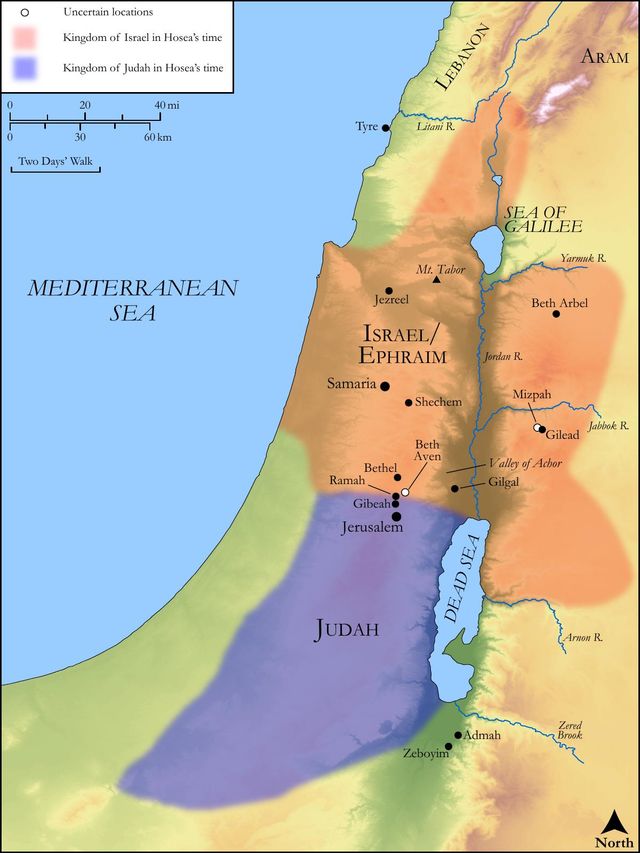
See on the biblical-era map
Study this verse
Public-domain commentary
Matthew Henry
From his Commentary on the Whole Bible. Henry comments on passages, not single verses — this entry covers Hosea 4:6–11. His two-level outline is real structure in the source text, so it is rendered as structure.
God is here proceeding in his controversy both with the priests and with the people. The people were as those that strove with the priests (Hos 4:4) when they had priests that did their duty; but the generality of them lived in the neglect of their duty, and here is a word for those priests, and for the people that love to have it so, Jer 5:31. And it is observable here how the punishment answers to the sin, and how, for the justifying of his own proceedings, God sets the one over-against the other.
I.The people strove with the priests that should have taught them the knowledge of God; justly therefore were they destroyed for lack of knowledge, Hos 4:6. Note, Those that rebel against the light can expect no other than to perish in the dark. Or it is a charge upon the priests, who should have been still teaching the people knowledge (Ecc 12:9), but they did not, or did it in such a manner that it was as if they had not done it at all, so there was no knowledge of God in the land; and because there was no vision, or none to any purpose, the people perished, Pro 29:18. Note, Ignorance is so far from being the mother of devotion that it is the mother of destruction; lack of knowledge is ruining to any person or people. They are my people that are thus destroyed; their relation to God as his people aggravates both their sin in not taking pains to get the knowledge of that God whose command they were under and with whom they were taken into covenant, and likewise the sin of those who should have taught them; God set his children to school to them, and they never minded them nor took any pains with them.
II.Both priests and people rejected knowledge; and justly therefore will God reject them.
The reason why the people did not learn, and the priests did not teach, was not because they had not the light, but because they hated it - not because they had not ways of coming to the knowledge of God and of communicating it, but because they had no heart to it; they rejected it. They desired not the knowledge of God's ways, but put it from them, and shut their eyes against the light; and therefore "I will also reject thee; I will refuse to take cognizance of thee and to own thee; you will not know me, but bid me depart; I will therefore say, Depart from me, I know you not. Thou shalt be no priest to me." 1. The priests shall be no longer admitted to the privileges, or employed in the services, of the priesthood, nor shall they ever be received again, as we find, Eze 44:13. Note, Ministers that reject knowledge, that are grossly ignorant and scandalous, ought not to be owned as ministers; but that which they seem to have should be taken away, Luk 8:18. 2. The people shall be no longer as they have been, a kingdom of priests, a royal priesthood, Exo 19:6. God's people, by rejecting knowledge, forfeit their honour and profane their own crown.
III.They forgot the law of God, neither desired nor endeavoured to retain it in mind, nor to transmit the remembrance of it to their posterity, and therefore justly will God forget them and their children, the people's children; they did not educate them, as they ought to have done, in the knowledge of God and their duty to him, and therefore God will disown them, as not in covenant with him. Note, If parents do not teach their children, when they are young, to remember their Creator, they cannot expect that their Creator should remember them. Or it may be meant of the priests' children; they shall not succeed them in the priests' office, but shall be reduced to poverty, as is threatened against Eli's house, Sa1 2:20.
IV.They dishonoured God with that which was their honour, and justly therefore will God strip them of it, Hos 4:7.
It was their honour that they were increased in number, wealth, power, and dignity. The beginning of their nation was small, but in process of time it greatly increased, and grew very considerable; the family of the priests increased wonderfully. But, as they were increased, so they sinned against God. The more populous the nation grew, the more sin was committed and the more profane they were; their wealth, honour, and power, did but make them the more daring in sin. Therefore, says God, will I change their glory into shame. Are their numbers their glory? God will diminish them and make them few. Is their wealth their glory? God will impoverish them and bring them low; so that they shall themselves be ashamed of that which they gloried in. Their priests shall be made contemptible and base, Mal 2:9. Note, That which is our honour, if we dishonour God with it, will sooner or later be turned into shame to us: for those that despise God shall be lightly esteemed, Sa1 2:30.
V.The priests ate up the sin of God's people, and therefore they shall eat and not have enough.
1.They abused the maintenance that was allowed to the priests, to the priests of the house of Aaron, by the law of God, and to the mock-priests of the calves by their constitution (Hos 4:8): They eat up the sin of my people, that is, their sin-offerings. If it be meant of the priests of the calves, it intimates their seizing that which they had no right to; they usurped the revenues of the priests, though they were no priests. If it be meant of those who were legal priests, it intimates their greediness of the profits and perquisites of their office, when they took no care at all to do the duty of it. They feasted upon their part of the offerings of the Lord, but forgot the work for which they were so well paid. They set their heart upon the people's iniquities; they lifted up their soul to them, that is, they were glad then people did commit iniquity, that they might be obliged to bring an offering to make atonement for it, which they should have their share of; the more sins the more sacrifices, and therefore they cared not how much sin people were guilty of. Instead of warning the people against sin, from the consideration of the sacrifices, which showed them what an offence sin was to God, since it needed such an expiation, they emboldened and encouraged the people to sin, since an atonement might be made at so small an expense. Thus they glutted themselves upon the sins of the people, and helped to keep up that which they should have beaten down. Note, It is a very wicked thing to be well pleased with the sins of others because, in some way or other, they may turn to our advantage.
2.God will therefore deny them his blessing upon their maintenance (Hos 4:10): They shall eat and not have enough. Though they have great plenty by the abundance of offerings that are brought in, yet they shall have no satisfaction in it. Either their food shall yield no good nourishment or their greedy appetites shall not be satisfied with it. Note, What is unlawfully gained cannot be comfortably used; no, nor that which is inordinately coveted; it is just that the desires which are insatiable should always be unsatisfied, and that those should never have enough who never know when they have enough. See Mic 6:14; Hag 1:6.
VI.The more they increased the more they sinned (Hos 4:7), and therefore though they commit whoredom, though they take the most wicked methods to multiply their people, yet they shall not increase. Though they have many wives and concubines, as Solomon had, yet they shall not have their families built up thereby in a numerous progeny, any more than he had. Note, Those that hope any way to increase by unlawful means will be disappointed. And therefore God will thus blast all their projects because they have left off to take heed to the Lord; time was when they had some regard to God, and to his authority over them and interest in them, but they have left it off; they take no heed to his word nor to his providences; they do not eye him in either. They forsake him, so as not to take heed to him; they have apostatized to such a degree that they have no manner of regard to God, but are perfectly without God in the world. Note, Those that leave off to take heed to the Lord leave off all good, and can expect no other than that all good should leave them.
VII.The people and the priests did harden one another in sin; and therefore justly shall they be sharers in the punishment (Hos 4:9):
There shall be, like people, like priest. So they were in character; people and priest were both alike ignorant and profane, regardless of God and their duty, and addicted to idolatry: and so they shall be in condition; God will bring judgments upon them, that shall be the destruction both of priest and people; the famine that deprives the people of their meat shall deprive the priests of their meat-offerings, Joe 1:9. It is part of the description of a universal desolation that it shall be as with the people, so with the priest, Isa 24:2. God's judgments, when they come with commission, will make no difference. Note, Sharers in sin must expect to be sharers in ruin. Thus God will punish them both for their ways, and reward them for their doings. God will cause their doings to return upon them (so the word is); when a sin is committed the sinner thinks it is gone and he shall hear no more of it, but he shall find it called over again, and made to return, either to his humiliation or to his condemnation.
VIII.They indulged themselves in the delights of sense, to hold up their hearts; but they shall find that they take away their hearts (Hos 4:11):
Whoredom, and wine, and new wine take away the heart. Some join this with the foregoing words. They have forsaken the Lord, to take heed to whoredom, and wine, and new wine. Or, Because these have taken away their heart. Their sensual pleasures have taken them off from their devotions and drowned all that is good in them. Or we may take it as a distinct sentence, containing a great truth which we see confirmed by every day's experience, that drunkenness and uncleanness are sins which besot and infatuate men, weaken and enfeeble them. They take away both the understanding and the courage.
Historical interpretation
Historical reception
4 surviving comments on this verse. Each one is dated, so this reads as a timeline rather than a list.
Select a marker to jump to its quote. Markers stagger vertically where authors wrote within a few decades of each other.
Desire is insatiable, and the more it is felt, the more it creates in those who enjoy it a greater hunger. On the contrary: “Blessed are the ones who hunger and thirst for righteousness, for they will be satisfied.” For righteousness satisfies, while wickedness—because it has no substance—deceives by fraud those who feed on vain things and leaves empty the stomachs of those who hunger. “They played the whore continually.” In fornication they run out of strength, yet the ardent desire of the fornication does not make a pause. The ten tribes played the whore with the idols of Jeroboam son of Naboth.
"And they shall eat, and not be satisfied: and they have committed fornication, and have not ceased: because they have forsaken the Lord in not keeping him: fornication, and wine, and drunkenness take away the heart. My people hath consulted their stocks, and their staff hath declared unto them: for the spirit of fornication hath deceived them, and they have committed fornication against their God." "And they shall eat, and not be filled:" "they have committed fornication, and shall not be directed: because they have forsaken the Lord, to keep not his law: fornication, and wine, and drunkenness take away the heart of my people. They consulted their wood, and their staff answered them: for the spirit of fornication hath deceived them" "and they have committed fornication against their God." Insatiable pleasure is created, and the more one is captured by it, the more hunger it creates. On the contrary, blessed are the hungry and thirsty for justice, for they will be satisfied. As justice satisfies, so too does iniquity, having no substance, delude those who consume it deceitfully and leave the stomachs of the devourers empty. They have committed fornication and have not ceased. Their strength fails in fornication, and the desire to fornicate does not rest. They committed fornication with the idols of Jeroboam, the son of Nebat, and left their Lord God, not keeping what he had commanded, saying: "You shall worship the Lord your God, and him only shall you serve" (Deuteronomy 6:13), but it should be read emphatically: Fornication and wine and drunkenness take away the heart. For just as wine and drunkenness make him who drinks thereof incapable of his own mind, so does fornication and pleasure pervert the senses and weaken the spirit; and it turns a rational man into a brute animal, so that he pursues brothels, dens of vice, and places of debauchery. And when his heart is stirred out of its place, he holds wood and stones as gods, and worships the works of his own hands. Hence the prophet, as if amazed and bewildered, speaks: “My people who were once called by my name have asked counsel of a wooden idol, and have sought intuition from rods, which the Greeks call divination by rods." Therefore in Ezekiel we read that Nebuchadnezzar mixed his rods against Ammon and Jerusalem, and a rod went forth against Jerusalem (Ezek. 25): and the cause of this madness of fornication is the spirit that deceived them, so that they might fornicate against their God. But he calls fornication idolatry, according to what we read in Jeremiah: "And they committed adultery with wood and stone, and I said, After they have committed adultery with all these things, return to me, but she did not return with all her heart, but with lies." And again: "You have left me and said, I will go on every high hill, and under every green tree I will spread myself in my fornication" (Jer. 3:5, 6). And in the Psalm it is said: 'You have destroyed all who commit fornication away from you' (Ps. 72:27). For the beginning of fornication is the invention of idols. Heretics are never satisfied with their own error, and do not cease from the disgracefulness of fornication. They do not keep the holy Law and Scriptures, abandon the Lord, become insane and inebriated, and, with the judgment of their mind destroyed, worship idols which they themselves have fashioned from their hearts and are possessed by the spirit of fornication.
A remnant from Israel has been preserved. Since the judgment does not go entirely to the priest, he adds, “They eat, but they are not satisfied.” This means either emigration and captivity for those leaders of Israel or, because of Christ, desolation of Judea by the hands of Romans.… For among those Israelites brought then by Shalmaneser and Tiglath-pileser III to Assyria and Media, very few could offer to the priests the things prescribed by the law.
“They kept the whoredom” means that they [Israel’s leaders] got ready to preserve the error for those who were under their authority. Yet they should rather have removed and thrown it from their midst. For it is the vigilance of the teachers which should eagerly remove what hurts the people and turn down without delay what is hateful to God. By refusing to do this, they allow the works of error to stay somehow and to keep. Yet they confirm rather the contrary, when the minds of those who teach receive nothing but wine and drunkenness. For how will the disciples keep vigil, and how will they be able to point the eye of the understanding to God in nature and in truth, if the instructors and the teachers of useful things will still encourage them to err?
Continue studying Hosea 4:10 across the web’s major study libraries — every link below opens this exact verse, chapter, or book on the destination site.
Read & Compare
 BibleGatewayThis verse in more than 200 translations and 70 languages.
 Bible.comThe YouVersion reader — hundreds of translations, reading plans, and highlights.
 ESV.orgCrossway's official English Standard Version reader.
 NET BibleThe NET translation with 60,000+ translators' notes on every rendering decision.
 STEP BibleTyndale House's free study tool — original text, vocabulary, and scholarly resources.
 BibliaLogos Bible Software's free web reader.
 USCCBThe New American Bible (Revised Edition) with the U.S. bishops' study notes.
Commentaries
 BibleHub CommentariesDozens of classic commentaries on this verse, gathered on one page.
 StudyLightMore than 100 commentary sets — the largest collection on the web.
 BibleRefPlain-English commentary on what this verse means, verse by verse.
 Enduring WordDavid Guzik's free commentary on this chapter, widely used by Bible teachers.
 Bible Study ToolsVerse commentary alongside Greek and Hebrew study aids.
Original Language & Research
- BibleHub InterlinearThe verse word by word — original language, transliteration, and English.
- BibleHub LexiconEvery word's original-language definition and Strong's entry.
 Blue Letter BibleDeep-study tools — Strong's numbers, concordance, and word studies.
 SefariaThe Hebrew text with Rashi and centuries of Jewish commentary.
Sermons, Hymns & Audio


TrulyRandomVerse is not affiliated with these sites and doesn’t control their content. They’re linked because they’re genuinely useful.
Summary
Hosea 4:10 powerfully articulates the dire consequences of Israel's spiritual unfaithfulness, revealing that their pursuit of physical gratification and idolatrous practices will lead to perpetual dissatisfaction and barrenness. This futility is a direct and inevitable result of their deliberate abandonment of the Lord and their refusal to heed His divine instruction, underscoring the deep spiritual decay that permeated the nation.
Context
ShowHideLiterary Context
Hosea 4 marks a pivotal shift in the book, moving from the allegorical portrayal of God's covenant relationship with unfaithful Israel (chapters 1-3) to a direct divine indictment against the nation. The chapter opens with a comprehensive legal charge against Israel, declaring that "there is no truth, nor mercy, nor knowledge of God in the land" (Hosea 4:1). This moral and spiritual vacuum has led to widespread societal breakdown, including swearing, lying, murder, stealing, and adultery (Hosea 4:2). The land itself mourns, and all its inhabitants languish, from animals to fish (Hosea 4:3). The prophet then turns his attention to the priests, who, instead of guiding the people, have become complicit in their sin, even profiting from their iniquity (Hosea 4:6-8). Verse 10 specifically details the futile outcomes of their self-serving and idolatrous behaviors, directly linking their lack of satisfaction and increase to their abandonment of the LORD.
Historical & Cultural Context
The book of Hosea prophesies primarily to the Northern Kingdom of Israel (Ephraim) during the 8th century BCE, a period marked by significant political instability, oppression, and rampant religious syncretism. Following the death of Jeroboam II, a succession of weak and short-lived kings led to internal strife and external pressures from Assyria. Culturally, Israel had largely abandoned the Mosaic covenant, integrating Canaanite Baal worship into their religious practices. This involved fertility cults, ritual prostitution, and a focus on material prosperity rather than covenant faithfulness. The people believed that Baal, not Yahweh, was the source of agricultural abundance and fertility. The "whoredom" mentioned in Hosea is thus both literal (cultic prostitution) and, more significantly, metaphorical for Israel's spiritual adultery in turning away from the exclusive worship of Yahweh to pursue idolatry and foreign alliances. Their actions were a direct violation of the first commandment and the covenant relationship established at Sinai.
Key Themes
ShowHideHosea 4:10 encapsulates several major themes prevalent throughout the book. Firstly, it highlights the futility of sinful pursuits, demonstrating that seeking satisfaction apart from God, whether through physical indulgence or idolatrous practices, inevitably leads to emptiness and dissatisfaction. The promise of blessing and multiplication under the covenant is reversed due to their unfaithfulness. Secondly, the verse underscores the concept of spiritual barrenness resulting from spiritual "whoredom." Despite engaging in acts intended to bring increase (both literal and ritualistic), the nation experiences a lack of true growth, blessing, or lasting fruitfulness, contrasting sharply with the covenant promises of multiplication for obedience (Deuteronomy 28:1-14). Finally, the verse explicitly states the consequences of abandoning God, identifying the root cause of their plight: "because they have left off to take heed to the LORD." This neglect of God's instruction, His covenant, and His very presence results in a life devoid of true blessing, satisfaction, and divine guidance, echoing the prophetic warnings found in other books, such as Jeremiah 2:13, where Israel is condemned for forsaking God, "the fountain of living waters," for broken cisterns.
Exposition and Analysis
ShowHideKey Word Analysis
ShowHideThis primitive root signifies "to commit adultery," often of the female, and less frequently, simple fornication. Crucially, in a prophetic context like Hosea, its primary meaning is figurative: "to commit idolatry." The Jewish people are regarded as the "spouse of Jehovah," and their turning to other gods is a profound act of spiritual infidelity. This word encompasses the full spectrum of unfaithfulness, from literal prostitution to the deepest spiritual betrayal of God's covenant.
This primitive root means "to sate" or "to fill to satisfaction," whether literally or figuratively. In Hosea 4:10, the negative "not have enough" indicates a perpetual state of unfulfillment, a hunger that can never be truly satisfied by their pursuits. Despite their consumption, they remain empty, highlighting the inherent inadequacy of seeking satisfaction outside of God.
Derived from the verb "to be," this is the self-Existent or Eternal God, the personal covenant name of God for Israel. Its presence here emphasizes that Israel's failure is not merely a breaking of rules, but a betrayal of a deeply personal and exclusive relationship with their divine Husband. Their "leaving off to take heed to the LORD" is a rejection of the very source of life, blessing, and true knowledge.
Verse Breakdown
ShowHide"For they shall eat, and not have enough:"
This clause describes a state of perpetual dissatisfaction despite consumption. It speaks to the futility of seeking fulfillment in material indulgence or worldly pleasures when divorced from a right relationship with God. Their physical acts of eating, which should bring sustenance and contentment, instead lead to an insatiable hunger, symbolizing a deeper spiritual emptiness.
"they shall commit whoredom, and shall not increase:"
This part directly links their spiritual and literal promiscuity ("whoredom," zânâh) to a lack of true growth or fruitfulness. In a culture where fertility and progeny were seen as divine blessings, the inability to "increase" (Hebrew, pârats, to break out, spread, or grow) in the context of their immoral and idolatrous practices signifies divine judgment. Their pursuit of false fertility through pagan rituals yields only barrenness, both physically and spiritually, contrasting sharply with God's covenant promises of multiplication.
"because they have left off to take heed to the LORD."
This final clause provides the explicit reason for the preceding judgments. Their dissatisfaction and barrenness are not arbitrary punishments but direct consequences of their deliberate abandonment of God. "Left off" (Hebrew, ʻâzab, to forsake or relinquish) and "take heed" (Hebrew, shâmar, to guard, observe, or attend to) together mean they ceased to pay attention to, obey, or care about Yahweh and His commands. This spiritual neglect is the root cause of their national and personal decay.
Literary Devices
ShowHideHosea 4:10 employs several potent literary devices to convey its message. The most prominent is Parallelism, specifically Antithetical Parallelism, where the first two clauses present a cause-and-effect relationship in parallel structure: "eat, and not have enough" followed by "commit whoredom, and shall not increase." Each phrase describes a pursuit and its opposite, negative outcome, emphasizing the futility. Metaphor is central to the verse, particularly the use of "whoredom" to represent Israel's idolatry and spiritual infidelity to Yahweh. This powerful imagery conveys the depth of their betrayal, likening it to marital unfaithfulness. The verse also functions as a clear statement of Cause and Effect, explicitly linking Israel's spiritual neglect ("because they have left off to take heed to the LORD") to the negative consequences of dissatisfaction and barrenness. Finally, there is an element of Irony in the verse: the very acts (eating for satisfaction, whoredom for increase) that Israel pursues to find fulfillment or prosperity are precisely what lead to their opposite outcomes – insatiable hunger and barrenness.
Theological and Thematic Connections
ShowHideHosea 4:10 serves as a profound theological statement on the nature of true satisfaction and the devastating consequences of covenant unfaithfulness. It underscores the biblical truth that genuine fulfillment and lasting blessing are found exclusively in a devoted relationship with the one true God, Yahweh. When humanity, like ancient Israel, turns away from the Lord to pursue self-gratification, idolatry, or worldly desires, these pursuits become a source of perpetual emptiness rather than the promised satisfaction. This verse highlights God's unwavering commitment to His covenant, even as He pronounces judgment for its violation, revealing His justice intertwined with His desire for His people's return. It is a timeless warning against spiritual apathy and the deceptive allure of anything that replaces God as the ultimate source of life and joy.
Reflection and Application
ShowHideHosea 4:10 resonates deeply with contemporary life, offering a timeless warning against misplaced priorities and the pursuit of false satisfactions. In a world saturated with consumerism and the constant pursuit of more—more possessions, more experiences, more validation—this verse reminds us that true "enoughness" is not found in accumulation or indulgence, but in spiritual contentment derived from a relationship with God. Similarly, the "whoredom" of our age might manifest not just in sexual immorality, but in any devotion or pursuit that displaces God from the center of our lives—be it career, reputation, entertainment, or even ministry itself when it becomes an idol. When we "leave off to take heed to the LORD," we inevitably find ourselves in a cycle of dissatisfaction, always consuming but never truly full, always striving but never truly increasing in what truly matters. This verse calls us to a radical re-evaluation of our desires and allegiances, urging us to re-center our lives on God as the sole source of lasting joy, purpose, and true abundance.
Questions for Reflection
ShowHideFAQ
ShowHideDoes "whoredom" in Hosea 4:10 refer only to literal sexual immorality?
ShowHideWhile "whoredom" (Hebrew, zânâh) certainly includes literal sexual immorality and cultic prostitution, in the prophetic context of Hosea, its primary and more profound meaning is spiritual adultery. Israel, as the covenant bride of Yahweh, had turned away from exclusive devotion to Him and engaged in idolatry, worshipping foreign gods like Baal. This betrayal of their covenant relationship is consistently depicted as spiritual prostitution throughout the book of Hosea. Thus, the verse refers to both the physical acts of immorality prevalent in their society and, more significantly, the nation's profound unfaithfulness to God through idolatry and reliance on foreign alliances, which were also considered acts of spiritual "whoredom" against the Lord (Hosea 1:2).
How does "not have enough" relate to "not increase" in this verse?
ShowHideThese two phrases describe different facets of the same divine judgment and futility. "Not have enough" (Hebrew, sâbaʻ) speaks to a perpetual state of dissatisfaction despite consumption or indulgence. It highlights the inherent emptiness of seeking fulfillment outside of God; no matter how much they "eat," they remain spiritually hungry. "Not increase" (Hebrew, pârats) refers to a lack of true growth, blessing, or fruitfulness, particularly in the context of their "whoredom." In ancient Israel, fertility and multiplication were seen as blessings from God. Their idolatrous practices, often tied to fertility cults, were meant to bring increase, but instead, they resulted in barrenness. Together, the phrases illustrate a comprehensive judgment: their pursuits yield neither personal satisfaction nor communal prosperity, a direct consequence of their spiritual abandonment of the LORD.
Christ-Centered Fulfillment
ShowHideHosea 4:10, with its stark portrayal of Israel's spiritual barrenness and perpetual dissatisfaction due to their abandonment of the LORD, finds its ultimate resolution and fulfillment in Jesus Christ. Israel's "whoredom" was their turning away from the true God to false idols, seeking life and satisfaction where it could not be found. Jesus, as the true and faithful Bridegroom, comes to reclaim His unfaithful people, offering the true "increase" and "enoughness" that the old covenant system, broken by human sin, could not provide. He is the "bread of life" who declares, "whoever comes to me shall not hunger, and whoever believes in me shall never thirst" (John 6:35), directly addressing the "eat, and not have enough" curse. Furthermore, Jesus embodies the perfect "taking heed to the LORD," living a life of absolute obedience and devotion to the Father, thus reversing Israel's failure to "take heed." Through His atoning sacrifice, He cleanses us from our spiritual "whoredom" (idolatry and sin) and imputes His righteousness, enabling us to bear true spiritual fruit (increase) through the Holy Spirit (John 15:5). In Christ, the insatiable hunger of the human heart is finally satisfied, and true, eternal fruitfulness is made possible, not through human effort or false gods, but through union with Him, the one who perfectly fulfilled the Law and restored our relationship with the Father.