


Judges 18:2
Bible text: King James Version (1769 Blayney text) · Public domain
Bible text: King James Version with Strong's numbers · Public domain
Bible text: Berean Standard Bible · Public domain
Bible text: American Standard Version (1901) · Public domain
Bible text: World English Bible, Messianic edition · Public domain
Bible text: Geneva Bible (1599) · Public domain
Bible text: Young's Literal Translation · Public domain
- וַיִּשְׁלְחוּvai·yish·le·Chuand they sentH7971Conj-w ¦ V-Qal-ConsecImperf-3mpVerb Qal Consecutive Imperfect 3rd Plural Masculineוַandיִּשְׁלְחוּthey sent
- בְנֵיve·nei[the] descendants ofH1121N-mpcNoun Plural Masculine Construct
- דָןdanDanH1835N-properNoun Proper Location
- מִמִּשְׁפַּחְתָּםmi·mish·pach·Tamfrom their tribeH4940Prep-m ¦ N-fsc ¦ 3mpNoun Singular Feminine Constructמִfromמִּשְׁפַּחְתָּtribeםtheir
- חֲמִשָּׁהcha·mi·ShahfiveH2568N-csNoun Singular common gender Absolute
- אֲנָשִׁים'a·na·ShimmenH582N-mpNoun Plural Masculine Absolute
- מִקְצוֹתָםmik·tzo·Tamfrom their endsH7098Prep-m ¦ N-fpc ¦ 3mpNoun Plural Feminine Constructמִfromקְצוֹתָendsםtheir
- אֲנָשִׁים'a·na·ShimmenH582N-mpNoun Plural Masculine Absolute
- בְּנֵיbe·neisons ofH1121N-mpcNoun Plural Masculine Construct
- חַיִלCha·yilstrengthH2428N-msNoun Singular Masculine Absolute
- מִצָּרְעָהmi·tza·re·'Ahfrom ZorahH6881Prep-m ¦ N-properNoun Proper LocationמִfromצָּרְעָהZorah
- וּמֵאֶשְׁתָּאֹלu·me·'esh·ta·'Oland from EshtaolH847Conj-w ¦ Prep-m ¦ N-properNoun Proper LocationוּandמֵfromאֶשְׁתָּאֹלEshtaol
- לְרַגֵּלle·ra·Gelto spy outH7270Prep-l ¦ V-Piel-InfVerb Piel Infinitive Constructלְtoרַגֵּלspy out
- אֶת'et<obj.>H853DirObjMParticle Object Indicator
- הָאָרֶץha·'A·retzthe landH776Art ¦ N-fsNoun Singular Feminine Absoluteהָtheאָרֶץland
- וּלְחָקְרָהּu·le·cha·ke·Rahand to explore itH2713Conj-w ¦ Prep-l ¦ V-Qal-Inf ¦ 3fsVerb Qal Infinitive Constructוּandלְtoחָקְרָexploreהּit
- וַיֹּאמְרוּvai·yo·me·Ruand they saidH559Conj-w ¦ V-Qal-ConsecImperf-3mpVerb Qal Consecutive Imperfect 3rd Plural Masculineוַandיֹּאמְרוּthey said
- אֲלֵהֶם'a·le·Hemto themH413Prep ¦ 3mpPreposition Definiteאֲלֵtoהֶםthem
- לְכוּle·KhugoH1980V-Qal-Imp-2mpVerb Qal Imperative 2nd Plural Masculine
- חִקְרוּchik·RuexploreH2713V-Qal-Imp-2mpVerb Qal Imperative 2nd Plural Masculine
- אֶת'et<obj.>H853DirObjMParticle Object Indicator
- הָאָרֶץha·'A·retzthe landH776Art ¦ N-fsNoun Singular Feminine Absoluteהָtheאָרֶץland
- וַיָּבֹאוּvai·ya·Vo·'uand they wentH935Conj-w ¦ V-Qal-ConsecImperf-3mpVerb Qal Consecutive Imperfect 3rd Plural Masculineוַandיָּבֹאוּthey went
- הַרhar[the] hill country ofH2022N-mscNoun Singular Masculine Construct
- אֶפְרַיִם'ef·Ra·yimEphraimH669N-proper-mNoun Proper Masculine
- עַד'adtoH5704PrepPreposition
- בֵּיתbeit[the] house ofH1004N-mscNoun Singular Masculine Construct
- מִיכָהmi·KhahMicahH4318N-proper-mNoun Proper Masculine
- וַיָּלִינוּvai·ya·Li·nuand they spent [the] nightH3885Conj-w ¦ V-Qal-ConsecImperf-3mpVerb Qal Consecutive Imperfect 3rd Plural Masculineוַandיָּלִינוּthey spent [the] night
- שָׁםShamthereH8033AdvAdverb
English is a literal word-by-word gloss of the Hebrew, not the KJV's wording. Why?
This is the original text the KJV's translators worked from — each Hebrew word with its own literal English meaning in this verse, prepared by scholars at Tyndale House, Cambridge. The KJV translates whole sentences, not word by word, so its wording differs: one Hebrew word can become several English words, and the KJV may choose “the LORD” where the gloss reads “Yahweh”. Both are faithful — they answer different questions. For the KJV's own rendering, switch to the KJV text.
Details
See on the biblical-era maps

Study this verse
Public-domain commentary
Matthew Henry
From his Commentary on the Whole Bible. Henry comments on passages, not single verses — this entry covers Judges 18:1–6.
Here is, 1. The eye which these Danites had upon Laish, not the whole tribe of Dan, but one family of them, to whose lot, in the subdivision of Canaan, that city fell. Hitherto this family had sojourned with their brethren, who had taken possession of their lot, which lay between Judah and the Philistines, and had declined going to their own city, because there was no king in Israel to rule over them, Jdg 18:1. It lay a great way off, separate from the rest of their tribe; it was entirely in the enemy's hand, and therefore they would sponge upon their brethren rather than go far to provide for themselves. But at length necessity forced them to arouse themselves, and they began to think of an inheritance to dwell in. It is better to have a little of one's own than always to hang upon others. 2. The enquiry which this family of the Danites made concerning Laish: They sent five men to search the land (Jdg 18:2), that they might know the character of the country, whether it was an inheritance worth going so far for, and the posture of the people, whether the making of themselves masters of it was a thing practicable, what force was necessary in order thereunto, and which was the best way of making an attack upon it. The men they sent were men of valour, who, if they fell into their enemies' hands, knew how to look danger in the face. It is prudent to look before we leap. Dan had the subtlety of a serpent by the way (Gen 49:17), as well as the courage of a lion's whelp, leaping from Bashan, Deu 33:22. 3. The acquaintance which their spies got with Micah's priest, and the use they made of that acquaintance. It seems, they had know this Levite formerly, he having in his rambles been sometimes in their country; and, though his countenance might be altered, they knew him again by his voice, Jdg 18:3. They were surprised to find him so far off, enquired what brought him thither, and he told them (Jdg 18:4) what business he had there, and what encouragement. They, understanding that he had an oracle in his custody, desired he would tell them whether they should prosper in their present undertaking, Jdg 18:5. See their carelessness and regardlessness of God and his providence; they would not have enquired of the Lord at all if this Levite's mentioning the teraphim he had with him had not put it into their heads. Many never think of religion but just when it falls in their way and they cannot avoid it, like chance customers. See their ignorance of the divine law, that they thought God, who had forbidden the religious use of graven images, would yet own them in consulting an image, and give them an answer of peace. Should he be enquired of by them? Eze 14:3. They seem to have had a greater opinion of Micah's teraphim than of God's urim; for they had passed by Shiloh, and, for aught that appears, had not enquired there of God's high priest, but Micah's shabby Levite shall be an oracle to them. He betakes himself to his usual method of consulting his teraphim; and, whether he himself believed it or no, he humoured the thing so well that he made them believe he had an answer from God encouraging them to go on, and assuring them of good success (Jdg 18:6): "Go in peace, you shall be safe, and may be easy, for before the Lord is your way," that is, "he approves it" (as the Lord is said to know the way of the righteous with acceptation), "and therefore he will make it prosperous, his eye will be upon you for good, he will direct your way, and preserve your going out and coming in." Note, Our great care should be that our way be such as God approves, and, if it be so, we may go in peace. If God care for us, on him let us cast our care, and be satisfied that we cannot miss our way if he go before us.
Continue studying Judges 18:2 across the web’s major study libraries — every link below opens this exact verse, chapter, or book on the destination site.
Read & Compare
 BibleGatewayThis verse in more than 200 translations and 70 languages.
 Bible.comThe YouVersion reader — hundreds of translations, reading plans, and highlights.
 ESV.orgCrossway's official English Standard Version reader.
 NET BibleThe NET translation with 60,000+ translators' notes on every rendering decision.
 STEP BibleTyndale House's free study tool — original text, vocabulary, and scholarly resources.
 BibliaLogos Bible Software's free web reader.
 USCCBThe New American Bible (Revised Edition) with the U.S. bishops' study notes.
Commentaries
 BibleHub CommentariesDozens of classic commentaries on this verse, gathered on one page.
 StudyLightMore than 100 commentary sets — the largest collection on the web.
 BibleRefPlain-English commentary on what this verse means, verse by verse.
 Enduring WordDavid Guzik's free commentary on this chapter, widely used by Bible teachers.
 Bible Study ToolsVerse commentary alongside Greek and Hebrew study aids.
Original Language & Research
- BibleHub InterlinearThe verse word by word — original language, transliteration, and English.
- BibleHub LexiconEvery word's original-language definition and Strong's entry.
 Blue Letter BibleDeep-study tools — Strong's numbers, concordance, and word studies.
 SefariaThe Hebrew text with Rashi and centuries of Jewish commentary.
Sermons, Hymns & Audio


TrulyRandomVerse is not affiliated with these sites and doesn’t control their content. They’re linked because they’re genuinely useful.
Summary
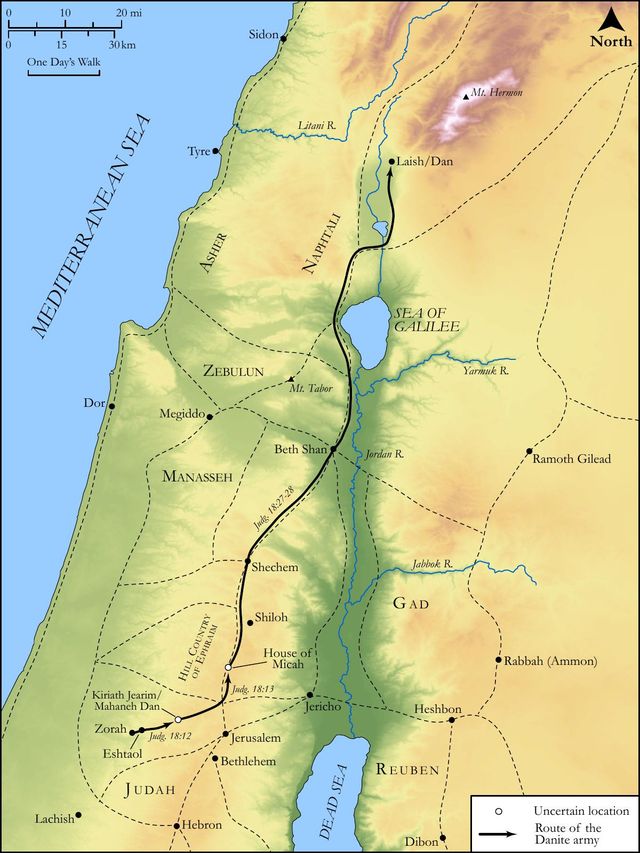
Judges 18:2 carries forward the somber narrative of the Danite tribe's desperate quest for a new homeland, driven by their failure to secure their divinely allotted inheritance. This verse details the dispatch of five capable men from their original, contested territories of Zorah and Eshtaol on a reconnaissance mission. Their journey, however, takes an ominous turn as they arrive at Mount Ephraim and lodge at the house of Micah, a place already established in the preceding chapter as a hub of personal idolatry and spiritual compromise, thereby setting the stage for the Danites' own descent into apostasy and highlighting the pervasive moral and religious decline of the era.
Context
ShowHideLiterary Context
Judges 18:2 is situated within the "appendix" of the Book of Judges (chapters 17-21), which serves as a stark illustration of the moral and spiritual chaos prevalent during the period when "there was no king in Israel: every man did that which was right in his own eyes" (Judges 17:6). This specific verse immediately follows the introduction of Micah's idolatrous household and his hired Levite priest in Judges 17, creating a direct narrative link. The Danites' arrival at Micah's house is not coincidental but a pivotal plot point that seamlessly connects their land-seeking mission to the existing spiritual decay, foreshadowing their eventual adoption of Micah's idolatrous practices and their establishment in their new territory (Judges 18:30-31).
Historical & Cultural Context
The Book of Judges chronicles the tumultuous era between the conquest of Canaan and the establishment of the monarchy. Despite receiving specific land allotments, many Israelite tribes, including Dan, failed to fully dispossess the indigenous inhabitants, leading to ongoing conflict and compromise. The tribe of Dan, in particular, faced significant pressure from the Philistines and Amorites in their coastal inheritance around Zorah and Eshtaol (Judges 1:34). This historical failure provides the immediate impetus for their search for a new, less contested territory. Culturally, this period was marked by a decline in central authority, a weakening of the covenant relationship with Yahweh, and the proliferation of localized religious practices, including syncretism and private idolatry, as exemplified by Micah's shrine.
Key Themes
ShowHideThe verse profoundly contributes to several key themes within Judges. Firstly, it highlights The Quest for a Home and the Failure of Inheritance, as the Danites' inability to secure their God-given territory leads them to seek an easier, self-determined solution, rather than trusting in divine strength for conquest. This contrasts sharply with the initial mandate of complete obedience in the land. Secondly, it underscores Human Initiative Over Divine Guidance, as the Danites undertake this critical mission without any recorded consultation with Yahweh, the ark, or a legitimate priest, illustrating a reliance on human strength and strategy over divine counsel. This is a recurring motif of spiritual decline in Judges, echoing the sentiment of Judges 17:6. Finally, the detail of lodging at Micah's house serves as a potent Foreshadowing of Idolatry and Spiritual Compromise. The narrative deliberately links the Danites' physical journey for land with a spiritual descent, indicating that their pursuit of convenience will lead to the adoption of the very spiritual corruption they encounter, ultimately establishing a center of idolatry in their new home (Judges 18:30).
Exposition and Analysis
ShowHideKey Word Analysis
ShowHideThe KJV phrase "men of valour" translates the Hebrew 'anshei chayil' (אַנְשֵׁי חַיִל). The term chayil (H2428) is rich in meaning, encompassing "a force, whether of men, means or other resources; an army, wealth, virtue, valor, strength." While it denotes the physical and strategic competence of these five men for a dangerous reconnaissance mission, it does not inherently imply spiritual integrity or adherence to God's law. In the context of Judges, where human strength often operates independently of divine will, this "valour" is presented as a human attribute that, though effective in worldly terms, ultimately leads to spiritual compromise when not submitted to God.
The verb râgal (H7270) means "to walk along; but only in specifically, applications, to reconnoiter, to be atale-bearer (i.e. slander); to lead about; backbite, search, slander, (e-) spy (out), teach to go, view." While the broader context of "spying out the land" might evoke the divinely commanded mission in Numbers 13, here râgal highlights the Danites' self-directed search for security. Their mission is driven by human expediency, seeking an alternative to the challenges God had given them, rather than relying on His strength to conquer their allotted territory.
The term bayith (H1004), translated as "house" in "the house of Micah," signifies not merely a dwelling but can also refer to a "family," "household," or even a "temple." As described in Judges 17, Micah's "house" was a private sanctuary containing a carved image, a molten image, an ephod, and teraphim, served by a hired Levite priest. Its mention here immediately signals to the reader the spiritual dangers awaiting the Danites. It represents the widespread idolatry and religious syncretism that characterized the period, and the Danites' encounter with it is far from incidental; it is the catalyst for their own spiritual demise.
Verse Breakdown
ShowHide"And the children of Dan sent of their family five men from their coasts, men of valour, from Zorah, and from Eshtaol"
This opening clause establishes the identity of the actors (the tribe of Dan), their desperate situation (forced to send men from their contested, original inheritance, Zorah and Eshtaol, which they failed to fully conquer as per Judges 1:34), and the human quality of their chosen agents ("men of valour"). The emphasis is on human initiative and strength in response to a divinely-ordained but humanly-failed mission.
"to spy out the land, and to search it; and they said unto them, Go, search the land"
This segment reveals the specific purpose of the mission: reconnaissance for a new territory. The repetition of "spy out the land, and to search it" and the direct command "Go, search the land" underscores the deliberate and urgent nature of their quest for an alternative, easier settlement. This pursuit of a self-determined solution highlights their departure from relying on God to help them overcome the challenges in their original inheritance.
"who when they came to mount Ephraim, to the house of Micah, they lodged there"
This final clause is the narrative pivot, strategically connecting the Danites' physical journey to the spiritual corruption detailed in the preceding chapter. Their journey leads them to Mount Ephraim, a central region of Israel, and specifically to the "house of Micah." Their decision to lodge there is highly significant, as it sets the stage for their encounter with Micah's idolatry, which they will later appropriate and carry to their new home (Judges 18:30-31), thus fulfilling the dramatic irony of their search for a "secure" place leading them to spiritual ruin.
Literary Devices
ShowHideJudges 18:2 employs several potent literary devices. Foreshadowing is paramount, as the Danites' lodging at "the house of Micah" immediately signals their impending spiritual compromise and adoption of idolatry, a theme that unfolds throughout the rest of the chapter. This seemingly simple act of seeking shelter becomes a narrative trigger for their moral decline. There is also a subtle Irony at play: the "men of valour" (אַנְשֵׁי חַיִל), chosen for their strength and capability, demonstrate a profound spiritual weakness and lack of discernment, ultimately leading their tribe into apostasy. Their physical prowess is contrasted with their spiritual vulnerability. Furthermore, the verse uses Juxtaposition by placing the Danites' human-driven quest for a secure physical home directly alongside the spiritual decay represented by Micah's idolatrous shrine, highlighting the moral and theological decline of the era and the dangers of seeking solutions apart from divine guidance. The narrative itself also functions as a Microcosm of the broader book of Judges, illustrating the cycle of disobedience, human self-reliance, and spiritual degradation that characterized the period when "there was no king in Israel."
Theological and Thematic Connections
ShowHideJudges 18:2 serves as a profound theological commentary on the consequences of incomplete obedience and the dangers of human self-reliance. The Danites' failure to fully dispossess their enemies from their allotted inheritance, as detailed in Judges 1:34, leads them to abandon God's original plan in favor of a human-devised solution. Their search for an "easier" path, devoid of divine consultation, ultimately leads them not to true security but to spiritual degradation. This narrative starkly illustrates the principle that seeking convenience over conviction, or pragmatic solutions over faithful obedience, inevitably leads to spiritual compromise and a departure from God's intended blessing. It underscores the pervasive theme in Judges that when "every man did that which was right in his own eyes," the result was societal and spiritual chaos, rather than peace and prosperity.
Reflection and Application
ShowHideThe narrative of Judges 18:2 offers a timeless cautionary tale for believers today. Like the Danites, we often face "coasts" or challenges in our lives—difficulties, opposition, or perceived limitations—that tempt us to abandon the path God has set before us in favor of what appears to be an easier, more pragmatic solution. The Danites, despite their "valour," chose to rely on their own ingenuity to find a new inheritance, bypassing divine counsel. This verse challenges us to examine whether our own "solutions" to life's problems are rooted in faithful obedience to God's revealed will or in a desire for convenience and human comfort. True security and lasting blessing are found not in avoiding difficulty or seeking an easier path, but in trusting God's strength to overcome obstacles within His will. The spiritual compromise that began with their lodging at Micah's house reminds us that seemingly small deviations from God's path can lead to significant spiritual detriment, illustrating how a pursuit of perceived safety can ironically lead to profound spiritual danger. It calls us to cultivate discernment and prioritize God's wisdom over our own perceived cleverness.
Questions for Reflection
ShowHideFAQ
ShowHideWhy were the Danites looking for new land?
ShowHideThe Danites were looking for new land because they had failed to fully dispossess the indigenous inhabitants, specifically the Philistines and Amorites, from the territory originally allotted to them by God around Zorah and Eshtaol (Judges 1:34). Facing constant pressure and unable to secure their inheritance, they decided to seek a new, less contested territory, rather than relying on God to help them conquer their challenges. This decision reflects a broader theme in Judges of Israel's incomplete obedience and reliance on human strength over divine power, a pattern that ultimately led to their spiritual decline.
What is the significance of "the house of Micah" in this verse?
ShowHideThe "house of Micah" is profoundly significant because it directly links the Danites' physical journey to the spiritual decay described in the preceding chapter, Judges 17. Micah had established a private shrine with an idol, an ephod, and teraphim, and had hired a Levite to serve as his personal priest. The Danites' lodging there is not accidental; it is a narrative device that immediately foreshadows their encounter with, and eventual adoption of, these idolatrous practices. Their decision to appropriate Micah's idol and priest for their own new settlement (Judges 18:30-31) marks a tragic descent into apostasy, illustrating the pervasive spiritual compromise of the era when "every man did that which was right in his own eyes" (Judges 17:6).
Christ-Centered Fulfillment
ShowHideThe Danites' desperate search for a secure inheritance and true rest, driven by their failure to fully occupy the land God had given them, finds its ultimate fulfillment and contrast in Jesus Christ. While the Danites sought a physical home through human ingenuity, leading to spiritual compromise and idolatry, Christ offers humanity the true spiritual inheritance and rest that our souls long for. He is the one who perfectly fulfills God's promises, providing a secure and eternal dwelling place not of this world (John 14:2-3). Unlike the Danites who failed to dispossess their enemies, Jesus, the greater Joshua, has decisively conquered sin, death, and the devil, offering true victory and freedom from spiritual bondage (Colossians 2:15). Our "inheritance" is not a piece of land to be conquered by human "valour," but a spiritual reality in Christ, "an inheritance incorruptible, and undefiled, and that fades not away, reserved in heaven for you" (1 Peter 1:4). The Danites' tragic embrace of idolatry at Micah's house stands in stark contrast to the call to worship God in spirit and truth through Christ, who is the only way to the Father and the sole object of true worship (John 4:24; John 14:6). In Christ, we find true rest for our souls, a rest that the Danites, in their human-driven quest, could never attain (Matthew 11:28-29). He is the true King who brings order to the chaos of "every man doing what is right in his own eyes," establishing His righteous reign in the hearts of those who believe (Luke 17:21).