


Joshua 2:1
Bible text: King James Version (1769 Blayney text) · Public domain
Bible text: King James Version with Strong's numbers · Public domain
Bible text: Berean Standard Bible · Public domain
Bible text: American Standard Version (1901) · Public domain
Bible text: World English Bible, Messianic edition · Public domain
Bible text: Geneva Bible (1599) · Public domain
Bible text: Young's Literal Translation · Public domain
- וַיִּשְׁלַחvai·yish·Lachand he sentH7971Conj-w ¦ V-Qal-ConsecImperf-3msVerb Qal Consecutive Imperfect 3rd Singular Masculineוַandיִּשְׁלַחhe sent
- יְהוֹשֻׁעַye·ho·Shu·a'JoshuaH3091N-proper-mNoun Proper Masculine
- בִּןbin[the] son ofH1121N-mscNoun Singular Masculine Construct
- נוּןnunNunH5126N-proper-mNoun Proper Masculine
- מִןminfromH4480PrepPreposition
- הַשִּׁטִּיםha·shi·Tim<the> ShittimH7851Art ¦ N-properNoun Proper Locationהַ<the>שִּׁטִּיםShittim
- שְׁנַיִםshe·na·yimtwoH8147Adj-cdAdjective Numerical Dual common gender Absolute
- אֲנָשִׁים'a·na·ShimmenH582N-mpNoun Plural Masculine Absolute
- מְרַגְּלִיםme·ra·ge·LimspiesH7270V-Piel-Prtcpl-mpVerb Piel Participle Plural Masculine Absolute
- חֶרֶשׁChe·reshsecretlyH2791N-csNoun Singular common gender Absolute
- לֵאמֹרle·Mor<to> sayingH559Prep-l ¦ V-Qal-InfVerb Qal Infinitive Constructלֵ<to>אמֹרsaying
- לְכוּle·KhugoH1980V-Qal-Imp-2mpVerb Qal Imperative 2nd Plural Masculine
- רְאוּre·'UseeH7200V-Qal-Imp-2mpVerb Qal Imperative 2nd Plural Masculine
- אֶת'et<obj.>H853DirObjMParticle Object Indicator
- הָאָרֶץha·'A·retzthe landH776Art ¦ N-fsNoun Singular Feminine Absoluteהָtheאָרֶץland
- וְאֶתve·'Etand <obj.>H853Conj-w ¦ DirObjMParticle Object Indicatorוְandאֶת<obj.>
- יְרִיחוֹye·ri·ChoJerichoH3405N-properNoun Proper Location
- וַיֵּלְכוּvai·Ye·le·Khuand they wentH1980Conj-w ¦ V-Qal-ConsecImperf-3mpVerb Qal Consecutive Imperfect 3rd Plural Masculineוַandיֵּלְכוּthey went
- וַיָּבֹאוּVai·ya·vo·'uand they wentH935Conj-w ¦ V-Qal-ConsecImperf-3mpVerb Qal Consecutive Imperfect 3rd Plural Masculineוַandיָּבֹאוּthey went
- בֵּיתbeit[the] house ofH1004N-mscNoun Singular Masculine Construct
- אִשָּׁה'i·Shaha womanH802N-fsNoun Singular Feminine Absolute
- זוֹנָהzo·Naha prostituteH2181V-Qal-Prtcpl-fsVerb Qal Participle Singular Feminine Absolute
- וּשְׁמָהּu·she·Mahand her nameH8034Conj-w ¦ N-msc ¦ 3fsNoun Singular Masculine Constructוּandשְׁמָnameהּher
- רָחָבra·Chav[was] RahabH7343N-proper-fNoun Proper Feminine
- וַיִּשְׁכְּבוּvai·yish·ke·vuand they lay downH7901Conj-w ¦ V-Qal-ConsecImperf-3mpVerb Qal Consecutive Imperfect 3rd Plural Masculineוַandיִּשְׁכְּבוּthey lay down
- שָׁמָּהSha·mahthere <towards>H8033Adv ¦ SfxAdverbשָׁמָּthereה<towards>
English is a literal word-by-word gloss of the Hebrew, not the KJV's wording. Why?
This is the original text the KJV's translators worked from — each Hebrew word with its own literal English meaning in this verse, prepared by scholars at Tyndale House, Cambridge. The KJV translates whole sentences, not word by word, so its wording differs: one Hebrew word can become several English words, and the KJV may choose “the LORD” where the gloss reads “Yahweh”. Both are faithful — they answer different questions. For the KJV's own rendering, switch to the KJV text.
Details
See on the biblical-era map
Study this verse
Public-domain commentary
Matthew Henry
From his Commentary on the Whole Bible. Henry comments on passages, not single verses — this entry covers Joshua 2:1–7. His four-level outline is real structure in the source text, so it is rendered as structure.
In these verses we have,
I.The prudence of Joshua, in sending spies to observe this important pass, which was likely to be disputed at the entrance of Israel into Canaan (v. 1). Go view the land, even Jericho. Moses had sent spies (Num. 13) Joshua himself was one of them and it proved of ill consequence. Yet Joshua now sent spies, not, as the former were sent, to survey the whole land, but Jericho only; not to bring the account to the whole congregation, but to Joshua only, who, like a watchful general, was continually projecting for the public good, and, was particularly careful to take the first step well and not to stumble at the threshold. It was not fit that Joshua should venture over Jordan, to make his remarks incognito - in disguise; but he sends two men (two young men, says the Septuagint), to view the land, that from their report he might take his measures in attacking Jericho. Observe,
1.There is no remedy, but great men must see with other people's eyes, which makes it very necessary that they be cautious in the choice of those they employ, since so much often depends upon their fidelity.
2.Faith in God's promise ought not to supersede but encourage our diligence in the use of proper means. Joshua is sure he has God with him, and yet sends men before him. We do not trust God, but tempt him, if our expectations slacken our endeavours.
3.See how ready these men were to go upon this hazardous enterprise. Though they put their lives in their hands yet they ventured in obedience to Joshua their general, in zeal for the service of the camp, and in dependence upon the power of that God who, being the keeper of Israel in general, is the protector of every particular Israelite in the way of his duty.
II.The providence of God directing the spies to the house of Rahab.
How they got over Jordan we are not told; but into Jericho they came, which was about seven or eight miles from the river, and there seeking for a convenient inn were directed to the house of Rahab, here called a harlot, a woman that had formerly been of ill fame, the reproach of which stuck to her name, though of late she had repented and reformed. Simon the leper (Mat 26:6), though cleansed from his leprosy, wore the reproach of it in his name at long as he lived; so Rahab the harlot; and she is so called in the New Testament, where both her faith and her good works are praised, to teach us,
1.That the greatness of sin is no bar to pardoning mercy if it be truly repented of in time. We read of publicans and harlots entering into the kingdom of the Messiah, and being welcomed to all the privileged of that kingdom, Mat 21:31.
2.That there are many who before their conversion were very wicked and vile, and yet afterwards come to great eminence in faith and holiness.
3.Even those that through grace have repented of the sins of their youth must expect to bear the reproach of them, and when they hear of their old faults must renew their repentance, and, as an evidence of that, hear of them patiently. God's Israel, for aught that appears, had but one friend, but one well-wisher in all Jericho, and that was Rahab a harlot. God has often served his own purposes and his church's interests by men of different morals. Had these scouts gone to any other house than this they would certainly have been betrayed and put to death without mercy. But God knew where they had a friend that would be true to them, though they did not, and directed them thither. Thus that which seems to us most contingent and accidental is often over-ruled by the divine providence to serve its great ends. And those that faithfully acknowledge God in their ways he will guide with his eye. See Jer 36:19, Jer 36:26.
III.The piety of Rahab in receiving and protecting these Israelites.
Those that keep public-houses entertain all comers, and think themselves obliged to be civil to their guests. But Rahab showed her guests more than common civility, and went upon an uncommon principle in what she did; it was by faith that she received those with peace against whom her king and country had denounced war, Heb 11:31.
1.She bade them welcome to her house; they lodged there, though it appears by what she said to them (Jos 2:9) she knew both whence they came and what their business was.
2.Perceiving that they were observed coming into the city, and that umbrage was taken at it, she hid them upon the roof of the house, which was flat, and covered them with stalks of flax (Jos 2:6), so that, if the officers should come thither to search for them, there they might lie undiscovered. By these stalks of flax, which she herself had lain in order upon the roof to dry in the sun, in order to the beating of it and making it ready for the wheel, it appears she had one of the good characters of the virtuous woman, however in others of them she might be deficient, that she sought wool and flax, and wrought willingly with her hands, Pro 31:13. From this instance of her honest industry one would hope that, whatever she had been formerly, she was not now a harlot.
3.When she was examined concerning them, she denied they were in her house, turned off the officers that had a warrant to search for them with a sham, and so secured them. No marvel that the king of Jericho sent to enquire after them (Jos 2:2, Jos 2:3); he had cause to fear when the enemy was at his door, and his fear made him suspicious and jealous of all strangers. He had reason to demand from Rahab that she should bring forth the men to be dealt with as spies; but Rahab not only disowned that she knew them, or knew where they were, but, that no further search might be made for them in the city, told the pursuers they had gone away again and in all probability might be overtaken, Jos 2:4, Jos 2:5. Now,
(1.)We are sure this was a good work: it is canonized by the apostle (Jam 2:25), where she is said to be justified by works, and this is specified, that she received the messengers, and sent them out another way, and she did it by faith, such a faith as set her above the fear of man, even of the wrath of the king. She believed, upon the report she had heard of the wonders wrought for Israel, that their God was the only true God, and that therefore their declared design upon Canaan would undoubtedly take effect and in this faith she sided with them, protected them, and courted their favour. Had she said, "I believe God is yours and Canaan yours, but I dare not show you any kindness," her faith had been dead and inactive, and would not have justified her. But by this it appeared to be both alive and lively, that she exposed herself to the utmost peril, even of life, in obedience to her faith. Note, Those only are true believers that can find in their hearts to venture for God; and those that by faith take the Lord for their God take his people for their people, and cast in their lot among them. Those that have God for their refuge and hiding-place must testify their gratitude by their readiness to shelter his people when there is occasion. Let my outcasts dwell with thee, Isa 16:3, Isa 16:4. And we must be glad of an opportunity of testifying the sincerity and zeal of our love to God by hazardous services to his church and kingdom among men. But,
(2.)There is that in it which it is not easy to justify, and yet it must be justified, or else it could not be so good a work as to justify her.
[1.]It is plain that she betrayed her country by harbouring the enemies of it, and aiding those that were designing its destruction, which could not consist with her allegiance to her prince and her affection and duty to the community she was a member of. But that which justifies her in this is that she knew the Lord had given Israel this land (Jos 2:9), knew it by the incontestable miracles God had wrought for them, which confirmed that grant; and her obligations to God were higher than her obligations to any other. If she knew God had given them this land, it would have been a sin to join with those that hindered them from possessing it. But, since no such grant of any land to any people can now be proved, this will by no means justify any such treacherous practices against the public welfare.
[2.]It is plain that she deceived the officers that examined her with an untruth - That she knew not whence the men were, that they had gone out, that she knew not whither they had gone. What shall we say to this? If she had either told the truth or been silent, she would have betrayed the spies, and this would certainly have been a great sin; and it does not appear that she had any other way of concealing them that by this ironical direction to the officers to pursue them another way, which if they would suffer themselves to be deceived by, let them be deceived. None are bound to accuse themselves, or their friends, of that which, though enquired after as a crime, they know to be a virtue. This case was altogether extraordinary, and therefore cannot be drawn into a precedent; and that my be justified here which would be by no means lawful in a common case. Rahab knew, by what was already done on the other side Jordan, that no mercy was to be shown to the Canaanites, and thence inferred that, if mercy was not owing them, truth was not; those that might be destroyed might be deceived. Yet divines generally conceive that it was a sin, which however admitted of this extenuation, that being a Canaanite she was not better taught the evil of lying; but God accepted her faith and pardoned her infirmity. However it was in this case, we are sure it is our duty to speak every man the truth to his neighbour, to dread and detest lying, and never to do evil, that evil, that good may come of it, Rom 3:8. But God accepts what is sincerely and honestly intended, though there be a mixture of frailty and folly in it, and is not extreme to mark what we do amiss. Some suggest that what she said might possibly be true of some other men.
Historical interpretation
Five Centuries of Reception
8 surviving comments on this verse. Each one is dated, so this reads as a timeline rather than a list.
Select a marker to jump to its quote. Markers stagger vertically where authors wrote within a few decades of each other.
On account of her faith and hospitality, Rahab the harlot was saved. For when spies were sent by Joshua, the son of Nun, to Jericho, the king of the country ascertained that they had come to spy out their land, and sent men to seize them, in order that, when taken, they might be put to death. But the hospitable Rahab receiving them, concealed them on the roof of her house under some stalks of flax. And when the men sent by the king arrived and said, "There came men unto you who are to spy out our land; bring them forth, for so the king commands," she answered them, "The two men whom you seek came unto me, but quickly departed again and are gone," thus not discovering the spies to them. Then she said to the men, "I know assuredly that the Lord your God has given you this city, for the fear and dread of you have fallen on its inhabitants. When therefore you shall have taken it, keep ye me and the house of my father in safety." And they said to her, "It shall be as you have spoken to us. As soon, therefore, as you know that we are at hand, you shall gather all your family under your roof, and they shall be preserved, but all that are found outside of your dwelling shall perish." Moreover, they gave her a sign to this effect, that she should hang forth from her house a scarlet thread. And thus they made it manifest that redemption should flow through the blood of the Lord to all them that believe and hope in God. You see, beloved, that there was not only faith, but prophecy, in this woman.
Nevertheless, our Jesus [Joshua] sends spies to the king of Jericho, and they are received hospitably by a prostitute. But the prostitute who received the spies sent by Jesus [Joshua] was no longer a prostitute since she received them. Indeed, everyone of us was a prostitute in his heart as long as he lived according to the desires and lusts of the flesh.
Meanwhile, the spies are sent by Jesus [Joshua] to Jericho and are received by the prostitute Rahab. Those spies, who are sent before the face of Jesus [Joshua], can also be considered the messengers of God, just as it is written, “Behold, I send my messenger before your face who will prepare your paths.” This passage, fulfilled invisibly through others, was fulfilled visibly through John, about whom this was also written. Because the scribes and Pharisees did not believe him, the Lord spoke concerning the baptism of John and said that the “prostitutes and publicans who believed” were baptized. The same thing is fulfilled in the fact that the prostitute received the spies of Jesus [Joshua] and is snatched away and brought back from the destruction of every hostile nation.
“And Joshua the son of Nun,” it says, “sent two spies from Shittim, saying to them ‘Go up and survey the land and Jericho.’ When they arrived in Jericho, the two young men entered the house of a prostitute by the name of Rahab and stayed there as guests.” Pay attention to the structure of this mystery, most beloved brothers, and ask yourselves why men as great as these, for whom the Lord had performed such marvels and miracles, entered the house of a woman of ill repute, as if they were unable to lodge elsewhere. They did this not by chance, I believe, but intentionally by prophetic design. For I find this prostitute in many places, not only as a hostess of saints but also as their bride. The most holy prophet Hosea, for instance, was commanded by the Lord to accept a harlot as his wife: “For the Lord said to me, ‘Take for your wife a prostitute and generate children of prostitution.’ ” Even our Lord and Savior himself, when he had sat down by the well in Samaria, conversed with an immoral woman to whom no one had previously spoken there. After he said to her, “You have had five husbands and the one you have now is not your husband,” she believed that he was the Messiah, that is, she confessed him to be the Christ. Then there was the harlot who washed the Savior’s feet with her tears and wiped them with her hair and anointed them while kissing them. Let us see, therefore, what our hostess represents. This Rahab, although she is called a prostitute, nevertheless is a sign of the virgin church, considered as a foreshadow of the coming realities at the end of the age, where she alone is preserved to life among all who are perishing. For even when it was said to the prophet Hosea, “Take for your wife a prostitute,” surely then the image of the church as coming from the Gentiles was being prefigured, given that the people were to be gathered from the harlotry of the nations and from prostitution with idols, for, it says, “they prostituted themselves to strange gods.” Indeed, she is called “the church” because the Greek word ecclesia means “gathering of the people.” And just as the apostle says, “An unfaithful wife is sanctified through her faithful husband,” so also is the church, coming from the infidelity of the Gentiles and prostitution with idols, sanctified through the body of Christ, of which we are members, as we learn from the same apostolic author. Because the church, as I have often said, gathered from the multitude of Gentiles, was then called a prostitute, therefore the church is found in the figure of Rahab, the hostess of saints.
We have been following so far the historical interpretation, and you perceive how from the history itself we are ascending upward gradually to a mystical understanding. Jesus [Joshua], the leader, who had led the people out of Egypt; Jesus [Joshua], whose name means Savior, after the death and burial of Moses in the land of Moab in the land of Arabia—that is, after the law was dead—Jesus desires to lead his people into the gospel and sends out two men on secret mission to Jericho. Two messengers he sends: one to the circumcised; the other to the Gentiles, Peter and Paul. Jericho seeks to kill them; the harlot takes them in, meaning, of course, the church gathered together from the Gentiles.
Rahab; what is the force of her name? We have been following the historical sense; let us now reflect upon the anagogic significance of the name. Rahab thus admits of two interpretations: the name may imply either a “broad space” or, better, “pride.” Consider, therefore, its impact. She who formerly walked the broad, spacious road to death, she whose pride was driving her to destruction, was later converted unto humility.
Moreover, Joshua sends two spies to the city of Jericho, and they are received by a harlot. Joshua sent two spies because the true Joshua was going to give two commands of love. In truth, what else do the men whom the true Joshua sends announce to us except that we should love God and our neighbor?
Rahab was a harlot who secretly admitted the spies of Joshua when they visited Jericho and let them out by another exit so that they should not be captured. Her name means “pride.” She was converted by God’s generosity and deserved to obtain mercy. She is a type of the church, which takes in souls endangered by the vice of pride, and lets them out into life by another route, the way of humility and patience.
Continue studying Joshua 2:1 across the web’s major study libraries — every link below opens this exact verse, chapter, or book on the destination site.
Read & Compare
 BibleGatewayThis verse in more than 200 translations and 70 languages.
 Bible.comThe YouVersion reader — hundreds of translations, reading plans, and highlights.
 ESV.orgCrossway's official English Standard Version reader.
 NET BibleThe NET translation with 60,000+ translators' notes on every rendering decision.
 STEP BibleTyndale House's free study tool — original text, vocabulary, and scholarly resources.
 BibliaLogos Bible Software's free web reader.
 USCCBThe New American Bible (Revised Edition) with the U.S. bishops' study notes.
Commentaries
 BibleHub CommentariesDozens of classic commentaries on this verse, gathered on one page.
 StudyLightMore than 100 commentary sets — the largest collection on the web.
 BibleRefPlain-English commentary on what this verse means, verse by verse.
 Enduring WordDavid Guzik's free commentary on this chapter, widely used by Bible teachers.
 Bible Study ToolsVerse commentary alongside Greek and Hebrew study aids.
Original Language & Research
- BibleHub InterlinearThe verse word by word — original language, transliteration, and English.
- BibleHub LexiconEvery word's original-language definition and Strong's entry.
 Blue Letter BibleDeep-study tools — Strong's numbers, concordance, and word studies.
 SefariaThe Hebrew text with Rashi and centuries of Jewish commentary.
Sermons, Hymns & Audio


TrulyRandomVerse is not affiliated with these sites and doesn’t control their content. They’re linked because they’re genuinely useful.
Summary
Joshua 2:1 initiates the Israelite campaign to conquer Canaan, immediately following God's powerful charge to Joshua to be strong and courageous. This pivotal verse details Joshua's strategic decision to dispatch two men from Shittim on a clandestine reconnaissance mission to Jericho, the formidable gateway city to the Promised Land. Their journey leads them to an unexpected refuge: the house of Rahab, a harlot, an encounter that will prove divinely instrumental in the unfolding narrative and the miraculous fall of Jericho.
Context
ShowHideLiterary Context
Joshua 2:1 serves as the immediate practical outworking of the divine commission given to Joshua in Joshua 1. In the preceding chapter, God reiterates His covenant promises regarding the land and commands Joshua to lead with unwavering courage and strict obedience to the Law. This verse marks the crucial transition from divine instruction and national preparation to concrete, strategic action, demonstrating Joshua's prudent leadership. The sending of spies here deliberately echoes the earlier, disastrous reconnaissance mission in Numbers 13, but with a profound difference: this mission, characterized by faith and strategic wisdom, leads to success, highlighting the new generation's readiness and Joshua's effective leadership in contrast to the previous generation's failure. The immediate narrative flow in Joshua 2 will then describe Rahab's courageous actions in protecting the spies, her profound confession of faith in the God of Israel, and the covenant made with her, which directly sets the stage for the miraculous crossing of the Jordan River in Joshua 3.
Historical & Cultural Context
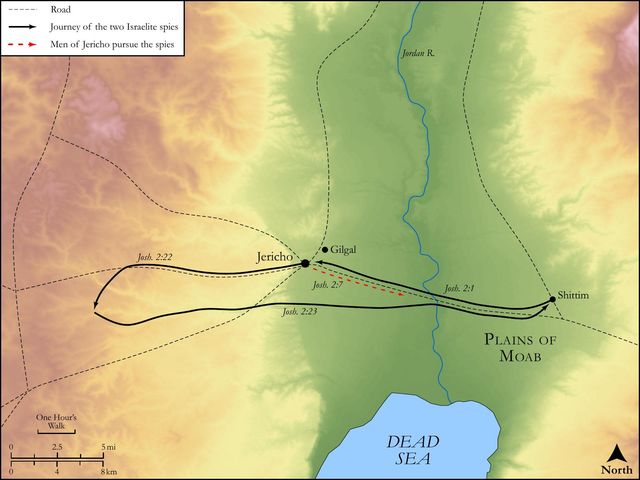
At the time of this verse, the Israelites were encamped at Shittim (also known as Abel-Shittim), located on the plains of Moab, east of the Jordan River. This strategic location was their final staging ground before entering the promised land of Canaan, directly opposite the city of Jericho. Jericho itself was one of the oldest continuously inhabited cities in the world, known for its formidable fortifications and strategic position at a key pass leading into the central highlands of Canaan. Its massive walls and strategic location made it a significant initial obstacle for any invading force. In war, reconnaissance missions like the one described, as when Moses sent twelve men to spy out the land of Canaan, were common and absolutely crucial for gathering intelligence on enemy defenses, troop movements, and the general morale of the populace. The identification of Rahab as a "harlot" (Hebrew: zonah) is significant. While some interpretations have attempted to redefine this as "innkeeper," the consistent biblical witness in both the Old and New Testaments (e.g., Hebrews 11:31 and James 2:25) confirms her profession. Her house, likely built into or near the city wall, would have been a convenient and inconspicuous place for travelers, including spies, to seek lodging, making her an unlikely but divinely chosen instrument in God's overarching plan.
Key Themes
ShowHideThis verse introduces several foundational themes that permeate the entire book of Joshua. First, it underscores the intricate interplay between Strategic Preparation and Human Responsibility alongside Divine Sovereignty. Even with God's explicit and unwavering promise of victory and the land (Joshua 1:3), Joshua does not act recklessly or presume upon God's power. His decision to send spies demonstrates prudent military leadership and the profound biblical principle that human effort, wisdom, and diligent planning are not antithetical to divine promise but often work in conjunction with it. Second, the introduction of Rahab, a Canaanite harlot, powerfully highlights Divine Providence and Unexpected Instruments. Her presence in the narrative immediately showcases God's expansive grace and His sovereign ability to use anyone, regardless of their social standing, moral background, or ethnic origin, to accomplish His redemptive purposes. Her pivotal role profoundly foreshadows the future inclusion of Gentiles into God's covenant people. Third, the theme of Faith and Obedience is subtly introduced through Joshua's obedient action and will be dramatically demonstrated through Rahab's subsequent choices. Her willingness to believe in the God of Israel and act decisively on that belief (Joshua 2:9-11) sets her apart and marks her as a profound example of genuine, active faith.
Exposition and Analysis
ShowHideKey Word Analysis
ShowHideThis name, meaning "Jehovah-saved" or "Yahweh is salvation," is highly significant. It connects Joshua directly to the divine purpose of leading Israel into the Promised Land, a land of salvation and rest. As the successor to Moses, Joshua embodies the new generation's readiness to trust and obey God, in contrast to the previous generation's failure. His name itself points to the salvific work of God through human leadership.
This adverb denotes an action performed "silently," "stealthily," or "clandestinely." It emphasizes the covert nature of the spies' mission. Joshua's intent was not to openly provoke Jericho or prematurely alert its inhabitants, but to gather vital intelligence discreetly. This detail highlights Joshua's military acumen and his understanding of the need for strategic advantage, even when operating under a divine mandate for victory. It also immediately builds narrative tension, setting the stage for the dramatic events of concealment and deception that follow.
This term unequivocally refers to a prostitute or one who commits fornication. While some interpretations have sought to soften its meaning to "innkeeper," the consistent use of zânâh in the Old Testament and the New Testament's explicit references to Rahab as a "harlot" (e.g., Hebrews 11:31 and James 2:25) confirm her profession. This detail is profoundly crucial for understanding the radical nature of God's grace and His willingness to use those on the social and moral margins of society for His redemptive purposes. It magnifies the power of a faith that transcends societal boundaries and personal failings, demonstrating God's inclusive love.
Verse Breakdown
ShowHide"And Joshua the son of Nun sent out of Shittim two men to spy secretly, saying, Go view the land, even Jericho."
This opening clause immediately establishes Joshua's decisive leadership and strategic initiative. Following God's powerful charge in Joshua 1, Joshua takes concrete, prudent action. The dispatch of "two men" suggests a small, agile team, optimized for discreet operation. Their mission is clearly and precisely defined: to "view the land," with a specific focus on Jericho, which is identified as the primary obstacle and first target city. This demonstrates a harmonious blend of divine command and human prudence, as Joshua seeks vital intelligence even when assured of ultimate victory.
"And they went, and came into an harlot's house, named Rahab, and lodged there."
This second clause swiftly introduces the central human character of the ensuing narrative: Rahab. The fact that the spies "came into a harlot's house" is a pivotal and divinely orchestrated detail. Such a dwelling, often situated on the city wall or easily accessible to various travelers, would have been a natural, less suspicious place for outsiders to seek lodging. The explicit naming of "Rahab" elevates her from an anonymous figure to a specific individual of profound importance, signaling her crucial role in God's unfolding plan. Their "lodging there" sets the immediate stage for the dramatic events of the chapter, where Rahab's remarkable faith and courageous actions will directly impact the success of the mission and, ultimately, her own salvation and that of her family.
Literary Devices
ShowHideJoshua 2:1 employs several significant literary devices that enrich its meaning and narrative impact. Foreshadowing is prominently featured, as the abrupt introduction of Rahab, a Canaanite harlot, subtly hints at the unexpected and unconventional ways God will work to achieve His purposes, particularly the inclusion of outsiders into His covenant. Her house being the divinely chosen lodging place for the spies immediately sets the stage for her pivotal and surprising role in the narrative. There is also a strong element of Narrative Parallel to the earlier, ill-fated spy mission in Numbers 13, which implicitly invites the reader to compare and contrast the outcomes, thereby highlighting Joshua's successful and faith-filled leadership and the different spirit of this new generation. The description of the spies' mission as "secretly" (Hebrew: cheresh) masterfully creates Suspense, immediately drawing the reader into the clandestine and perilous nature of their task, building anticipation for the dangers they might face and the crucial intelligence they might uncover. Finally, the explicit naming and description of Rahab and her profession serve as a powerful form of Character Introduction, immediately establishing a key figure who will play a crucial, albeit surprising, role in the unfolding divine drama of Israel's conquest and God's expansive grace.
Theological and Thematic Connections
ShowHideJoshua 2:1 powerfully illustrates the intricate interplay between divine sovereignty and human responsibility. God had already promised Joshua victory and the land, yet Joshua, as a wise and obedient leader, still takes proactive, strategic steps by sending spies. This is not indicative of a lack of faith, but rather an exercise of wisdom and obedience, demonstrating the profound biblical principle that God often works through human means and careful planning. The introduction of Rahab, a Canaanite harlot, is a profound testament to God's expansive grace and His sovereign ability to use the most unlikely individuals for His redemptive purposes. Her story profoundly foreshadows the universal scope of God's salvation, extending beyond the chosen nation of Israel to include Gentiles who respond in faith. It underscores that God's plan is not limited by human social constructs or moral failings, but is accomplished through His sovereign choice and the transformative power of genuine faith.
Reflection and Application
ShowHideJoshua 2:1 offers profound and enduring lessons for contemporary believers. It reminds us that while God's promises are absolutely sure and His sovereignty is absolute, He often calls us to exercise wisdom, diligence, and strategic planning in our personal lives, our ministries, and our communities. We are not called to passive inactivity, expecting God to do everything without our engagement, but rather to act responsibly and prudently, trusting that He will powerfully work through our Spirit-led efforts. This verse also profoundly challenges our preconceptions and biases about who God can use for His divine purposes. The introduction of Rahab, an overlooked and socially outcast figure in her society, powerfully highlights God's radical grace and His willingness to embrace, empower, and transform those whom society might deem unworthy or beyond redemption. It encourages us to look beyond superficial judgments and societal labels, recognizing God's redemptive hand at work in the most unexpected places and through the most unexpected people. Our mission, like Joshua's, requires both unwavering faith in God's unfailing promises and practical, Spirit-led action in the world.
Questions for Reflection
ShowHideFAQ
ShowHideWhy did Joshua send spies if God had already promised him victory?
ShowHideJoshua's decision to send spies, despite God's explicit promise of victory and possession of the land in Joshua 1, demonstrates a crucial biblical principle: divine sovereignty does not negate human responsibility or prudent action. God's promises are absolutely sure, but He often works through human wisdom, diligence, and obedience. Sending spies was a strategic military action, allowing Joshua to gather vital intelligence on Jericho's formidable defenses, assess the morale of its inhabitants, and plan the most effective approach for the impending conquest. This act was not a sign of a lack of faith, but rather an exercise of wise and responsible leadership, aligning human effort with God's divine and sovereign plan. It profoundly illustrates that God's people are called to be active, engaged participants in His work, not passive recipients awaiting miraculous intervention without effort.
What is the significance of Rahab being a "harlot"?
ShowHideThe fact that Rahab is explicitly identified as a "harlot" (Hebrew: zânâh) is profoundly significant for several compelling reasons. First, it powerfully highlights the radical and expansive nature of God's grace, which extends to those on the social, moral, and ethnic margins of society. God chose to use an unexpected and seemingly unworthy individual to play a pivotal role in the conquest of Jericho and, remarkably, in the very lineage of Christ. Second, it profoundly underscores the theme of faith transcending social status, moral background, and ethnic origin. Despite her profession and Canaanite identity, Rahab demonstrates remarkable and active faith in the God of Israel (Joshua 2:9-11), recognizing His supreme power and sovereignty. Her inclusion in the "hall of faith" in Hebrews 11:31 and her commendation in James 2:25 emphasize that her faith, expressed through her courageous actions, was genuine, transformative, and salvific. Her story stands as a powerful testament to God's inclusive love and His boundless ability to redeem and transform lives, no matter the past.
Christ-Centered Fulfillment
ShowHideJoshua 2:1, with its introduction of Rahab, offers a compelling and profound foreshadowing of Christ's redemptive work and the expansive nature of God's new covenant. Just as the Israelite spies, representing God's chosen people, found unexpected refuge and salvation in the house of a Gentile harlot, so too does the gospel of Jesus Christ extend salvation to all humanity, regardless of their past sins, social standing, or ethnic heritage. Rahab's remarkable faith, expressed in her turning from her own people and embracing the God of Israel, profoundly prefigures the inclusion of Gentiles into God's family through faith in Christ, powerfully breaking down the dividing wall of hostility that once separated Jew and Gentile (Ephesians 2:14). Her unlikely and divinely orchestrated place in the lineage of David and ultimately of Jesus Christ (Matthew 1:5) powerfully illustrates that God's grace transcends all human social boundaries, moral failings, and ethnic distinctions. Christ, the ultimate Joshua (whose name, like Joshua's, means "Yahweh saves"), leads His people not into a physical land of promise, but into spiritual freedom, eternal life, and a new creation. He offers salvation to all who, like Rahab, hear of His mighty deeds, acknowledge His sovereignty, and respond in genuine faith, trusting in His atoning blood for their redemption and finding eternal refuge in His house, which is the Church, His body.