


Joshua 2:2
Bible text: King James Version (1769 Blayney text) · Public domain
Bible text: Berean Standard Bible · Public domain
Bible text: American Standard Version (1901) · Public domain
Bible text: World English Bible, Messianic edition · Public domain
Bible text: Geneva Bible (1599) · Public domain
Bible text: Young's Literal Translation · Public domain
- וַיֵּאָמַרvai·Ye·'a·Marand it was toldH559Conj-w ¦ V-Niphal-ConsecImperf-3msVerb Niphal Consecutive Imperfect 3rd Singular Masculineוַandיֵּאָמַרit was told
- לְמֶלֶךְle·Me·lekhto [the] king ofH4428Prep-l ¦ N-mscNoun Singular Masculine Constructלְtoמֶלֶךְ[the] king of
- יְרִיחוֹye·ri·ChoJerichoH3405N-properNoun Proper Location
- לֵאמֹרle·Mor<to> sayingH559Prep-l ¦ V-Qal-InfVerb Qal Infinitive Constructלֵ<to>אמֹרsaying
- הִנֵּהhi·Nehhere!H2009PrtParticle Interjection
- אֲנָשִׁים'A·na·shimmenH582N-mpNoun Plural Masculine Absolute
- בָּאוּBa·'uthey have comeH935V-Qal-Perf-3cpVerb Qal Perfect 3rd Plural common gender
- הֵנָּהHe·nahhitherH2008AdvAdverb
- הַלַּיְלָהha·Lay·lahthis nightH3915Art ¦ N-msNoun Singular Masculine Absoluteהַthisלַּיְלָהnight
- מִבְּנֵיmi·be·Neifrom [the] people ofH1121Prep-m ¦ N-mpcNoun Plural Masculine Constructמִfromבְּנֵי[the] people of
- יִשְׂרָאֵלYis·ra·'ElIsraelH3478N-properNoun Proper Location
- לַחְפֹּרlach·Porto spy outH2658Prep-l ¦ V-Qal-InfVerb Qal Infinitive Constructלַtoחְפֹּרspy out
- אֶת'et<obj.>H853DirObjMParticle Object Indicator
- הָאָרֶץha·'A·retzthe landH776Art ¦ N-fsNoun Singular Feminine Absoluteהָtheאָרֶץland
English is a literal word-by-word gloss of the Hebrew, not the KJV's wording. Why?
This is the original text the KJV's translators worked from — each Hebrew word with its own literal English meaning in this verse, prepared by scholars at Tyndale House, Cambridge. The KJV translates whole sentences, not word by word, so its wording differs: one Hebrew word can become several English words, and the KJV may choose “the LORD” where the gloss reads “Yahweh”. Both are faithful — they answer different questions. For the KJV's own rendering, switch to the KJV text.
Details
See on the biblical-era map
Study this verse
Public-domain commentary
Matthew Henry
From his Commentary on the Whole Bible. Henry comments on passages, not single verses — this entry covers Joshua 2:1–7. His four-level outline is real structure in the source text, so it is rendered as structure.
In these verses we have,
I.The prudence of Joshua, in sending spies to observe this important pass, which was likely to be disputed at the entrance of Israel into Canaan (v. 1). Go view the land, even Jericho. Moses had sent spies (Num. 13) Joshua himself was one of them and it proved of ill consequence. Yet Joshua now sent spies, not, as the former were sent, to survey the whole land, but Jericho only; not to bring the account to the whole congregation, but to Joshua only, who, like a watchful general, was continually projecting for the public good, and, was particularly careful to take the first step well and not to stumble at the threshold. It was not fit that Joshua should venture over Jordan, to make his remarks incognito - in disguise; but he sends two men (two young men, says the Septuagint), to view the land, that from their report he might take his measures in attacking Jericho. Observe,
1.There is no remedy, but great men must see with other people's eyes, which makes it very necessary that they be cautious in the choice of those they employ, since so much often depends upon their fidelity.
2.Faith in God's promise ought not to supersede but encourage our diligence in the use of proper means. Joshua is sure he has God with him, and yet sends men before him. We do not trust God, but tempt him, if our expectations slacken our endeavours.
3.See how ready these men were to go upon this hazardous enterprise. Though they put their lives in their hands yet they ventured in obedience to Joshua their general, in zeal for the service of the camp, and in dependence upon the power of that God who, being the keeper of Israel in general, is the protector of every particular Israelite in the way of his duty.
II.The providence of God directing the spies to the house of Rahab.
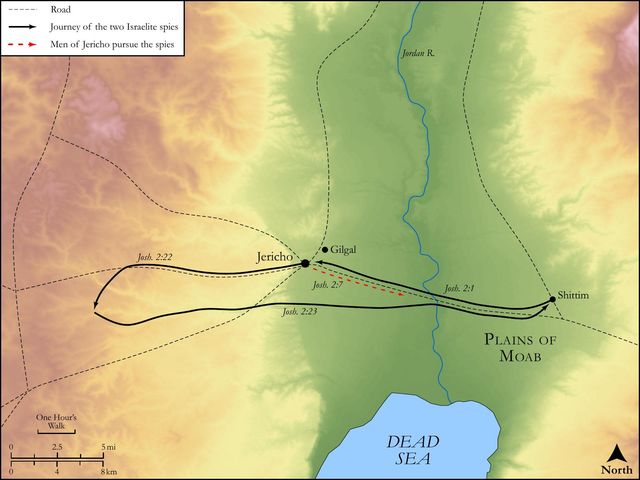
How they got over Jordan we are not told; but into Jericho they came, which was about seven or eight miles from the river, and there seeking for a convenient inn were directed to the house of Rahab, here called a harlot, a woman that had formerly been of ill fame, the reproach of which stuck to her name, though of late she had repented and reformed. Simon the leper (Mat 26:6), though cleansed from his leprosy, wore the reproach of it in his name at long as he lived; so Rahab the harlot; and she is so called in the New Testament, where both her faith and her good works are praised, to teach us,
1.That the greatness of sin is no bar to pardoning mercy if it be truly repented of in time. We read of publicans and harlots entering into the kingdom of the Messiah, and being welcomed to all the privileged of that kingdom, Mat 21:31.
2.That there are many who before their conversion were very wicked and vile, and yet afterwards come to great eminence in faith and holiness.
3.Even those that through grace have repented of the sins of their youth must expect to bear the reproach of them, and when they hear of their old faults must renew their repentance, and, as an evidence of that, hear of them patiently. God's Israel, for aught that appears, had but one friend, but one well-wisher in all Jericho, and that was Rahab a harlot. God has often served his own purposes and his church's interests by men of different morals. Had these scouts gone to any other house than this they would certainly have been betrayed and put to death without mercy. But God knew where they had a friend that would be true to them, though they did not, and directed them thither. Thus that which seems to us most contingent and accidental is often over-ruled by the divine providence to serve its great ends. And those that faithfully acknowledge God in their ways he will guide with his eye. See Jer 36:19, Jer 36:26.
III.The piety of Rahab in receiving and protecting these Israelites.
Those that keep public-houses entertain all comers, and think themselves obliged to be civil to their guests. But Rahab showed her guests more than common civility, and went upon an uncommon principle in what she did; it was by faith that she received those with peace against whom her king and country had denounced war, Heb 11:31.
1.She bade them welcome to her house; they lodged there, though it appears by what she said to them (Jos 2:9) she knew both whence they came and what their business was.
2.Perceiving that they were observed coming into the city, and that umbrage was taken at it, she hid them upon the roof of the house, which was flat, and covered them with stalks of flax (Jos 2:6), so that, if the officers should come thither to search for them, there they might lie undiscovered. By these stalks of flax, which she herself had lain in order upon the roof to dry in the sun, in order to the beating of it and making it ready for the wheel, it appears she had one of the good characters of the virtuous woman, however in others of them she might be deficient, that she sought wool and flax, and wrought willingly with her hands, Pro 31:13. From this instance of her honest industry one would hope that, whatever she had been formerly, she was not now a harlot.
3.When she was examined concerning them, she denied they were in her house, turned off the officers that had a warrant to search for them with a sham, and so secured them. No marvel that the king of Jericho sent to enquire after them (Jos 2:2, Jos 2:3); he had cause to fear when the enemy was at his door, and his fear made him suspicious and jealous of all strangers. He had reason to demand from Rahab that she should bring forth the men to be dealt with as spies; but Rahab not only disowned that she knew them, or knew where they were, but, that no further search might be made for them in the city, told the pursuers they had gone away again and in all probability might be overtaken, Jos 2:4, Jos 2:5. Now,
(1.)We are sure this was a good work: it is canonized by the apostle (Jam 2:25), where she is said to be justified by works, and this is specified, that she received the messengers, and sent them out another way, and she did it by faith, such a faith as set her above the fear of man, even of the wrath of the king. She believed, upon the report she had heard of the wonders wrought for Israel, that their God was the only true God, and that therefore their declared design upon Canaan would undoubtedly take effect and in this faith she sided with them, protected them, and courted their favour. Had she said, "I believe God is yours and Canaan yours, but I dare not show you any kindness," her faith had been dead and inactive, and would not have justified her. But by this it appeared to be both alive and lively, that she exposed herself to the utmost peril, even of life, in obedience to her faith. Note, Those only are true believers that can find in their hearts to venture for God; and those that by faith take the Lord for their God take his people for their people, and cast in their lot among them. Those that have God for their refuge and hiding-place must testify their gratitude by their readiness to shelter his people when there is occasion. Let my outcasts dwell with thee, Isa 16:3, Isa 16:4. And we must be glad of an opportunity of testifying the sincerity and zeal of our love to God by hazardous services to his church and kingdom among men. But,
(2.)There is that in it which it is not easy to justify, and yet it must be justified, or else it could not be so good a work as to justify her.
[1.]It is plain that she betrayed her country by harbouring the enemies of it, and aiding those that were designing its destruction, which could not consist with her allegiance to her prince and her affection and duty to the community she was a member of. But that which justifies her in this is that she knew the Lord had given Israel this land (Jos 2:9), knew it by the incontestable miracles God had wrought for them, which confirmed that grant; and her obligations to God were higher than her obligations to any other. If she knew God had given them this land, it would have been a sin to join with those that hindered them from possessing it. But, since no such grant of any land to any people can now be proved, this will by no means justify any such treacherous practices against the public welfare.
[2.]It is plain that she deceived the officers that examined her with an untruth - That she knew not whence the men were, that they had gone out, that she knew not whither they had gone. What shall we say to this? If she had either told the truth or been silent, she would have betrayed the spies, and this would certainly have been a great sin; and it does not appear that she had any other way of concealing them that by this ironical direction to the officers to pursue them another way, which if they would suffer themselves to be deceived by, let them be deceived. None are bound to accuse themselves, or their friends, of that which, though enquired after as a crime, they know to be a virtue. This case was altogether extraordinary, and therefore cannot be drawn into a precedent; and that my be justified here which would be by no means lawful in a common case. Rahab knew, by what was already done on the other side Jordan, that no mercy was to be shown to the Canaanites, and thence inferred that, if mercy was not owing them, truth was not; those that might be destroyed might be deceived. Yet divines generally conceive that it was a sin, which however admitted of this extenuation, that being a Canaanite she was not better taught the evil of lying; but God accepted her faith and pardoned her infirmity. However it was in this case, we are sure it is our duty to speak every man the truth to his neighbour, to dread and detest lying, and never to do evil, that evil, that good may come of it, Rom 3:8. But God accepts what is sincerely and honestly intended, though there be a mixture of frailty and folly in it, and is not extreme to mark what we do amiss. Some suggest that what she said might possibly be true of some other men.
Historical interpretation
Five Centuries of Reception
8 surviving comments on this verse. Each one is dated, so this reads as a timeline rather than a list.
Select a marker to jump to its quote. Markers stagger vertically where authors wrote within a few decades of each other.
On account of her faith and hospitality, Rahab the harlot was saved. For when spies were sent by Joshua, the son of Nun, to Jericho, the king of the country ascertained that they had come to spy out their land, and sent men to seize them, in order that, when taken, they might be put to death. But the hospitable Rahab receiving them, concealed them on the roof of her house under some stalks of flax. And when the men sent by the king arrived and said, "There came men unto you who are to spy out our land; bring them forth, for so the king commands," she answered them, "The two men whom you seek came unto me, but quickly departed again and are gone," thus not discovering the spies to them. Then she said to the men, "I know assuredly that the Lord your God has given you this city, for the fear and dread of you have fallen on its inhabitants. When therefore you shall have taken it, keep ye me and the house of my father in safety." And they said to her, "It shall be as you have spoken to us. As soon, therefore, as you know that we are at hand, you shall gather all your family under your roof, and they shall be preserved, but all that are found outside of your dwelling shall perish." Moreover, they gave her a sign to this effect, that she should hang forth from her house a scarlet thread. And thus they made it manifest that redemption should flow through the blood of the Lord to all them that believe and hope in God. You see, beloved, that there was not only faith, but prophecy, in this woman.
Nevertheless, our Jesus [Joshua] sends spies to the king of Jericho, and they are received hospitably by a prostitute. But the prostitute who received the spies sent by Jesus [Joshua] was no longer a prostitute since she received them. Indeed, everyone of us was a prostitute in his heart as long as he lived according to the desires and lusts of the flesh.
Meanwhile, the spies are sent by Jesus [Joshua] to Jericho and are received by the prostitute Rahab. Those spies, who are sent before the face of Jesus [Joshua], can also be considered the messengers of God, just as it is written, “Behold, I send my messenger before your face who will prepare your paths.” This passage, fulfilled invisibly through others, was fulfilled visibly through John, about whom this was also written. Because the scribes and Pharisees did not believe him, the Lord spoke concerning the baptism of John and said that the “prostitutes and publicans who believed” were baptized. The same thing is fulfilled in the fact that the prostitute received the spies of Jesus [Joshua] and is snatched away and brought back from the destruction of every hostile nation.
“And Joshua the son of Nun,” it says, “sent two spies from Shittim, saying to them ‘Go up and survey the land and Jericho.’ When they arrived in Jericho, the two young men entered the house of a prostitute by the name of Rahab and stayed there as guests.” Pay attention to the structure of this mystery, most beloved brothers, and ask yourselves why men as great as these, for whom the Lord had performed such marvels and miracles, entered the house of a woman of ill repute, as if they were unable to lodge elsewhere. They did this not by chance, I believe, but intentionally by prophetic design. For I find this prostitute in many places, not only as a hostess of saints but also as their bride. The most holy prophet Hosea, for instance, was commanded by the Lord to accept a harlot as his wife: “For the Lord said to me, ‘Take for your wife a prostitute and generate children of prostitution.’ ” Even our Lord and Savior himself, when he had sat down by the well in Samaria, conversed with an immoral woman to whom no one had previously spoken there. After he said to her, “You have had five husbands and the one you have now is not your husband,” she believed that he was the Messiah, that is, she confessed him to be the Christ. Then there was the harlot who washed the Savior’s feet with her tears and wiped them with her hair and anointed them while kissing them. Let us see, therefore, what our hostess represents. This Rahab, although she is called a prostitute, nevertheless is a sign of the virgin church, considered as a foreshadow of the coming realities at the end of the age, where she alone is preserved to life among all who are perishing. For even when it was said to the prophet Hosea, “Take for your wife a prostitute,” surely then the image of the church as coming from the Gentiles was being prefigured, given that the people were to be gathered from the harlotry of the nations and from prostitution with idols, for, it says, “they prostituted themselves to strange gods.” Indeed, she is called “the church” because the Greek word ecclesia means “gathering of the people.” And just as the apostle says, “An unfaithful wife is sanctified through her faithful husband,” so also is the church, coming from the infidelity of the Gentiles and prostitution with idols, sanctified through the body of Christ, of which we are members, as we learn from the same apostolic author. Because the church, as I have often said, gathered from the multitude of Gentiles, was then called a prostitute, therefore the church is found in the figure of Rahab, the hostess of saints.
We have been following so far the historical interpretation, and you perceive how from the history itself we are ascending upward gradually to a mystical understanding. Jesus [Joshua], the leader, who had led the people out of Egypt; Jesus [Joshua], whose name means Savior, after the death and burial of Moses in the land of Moab in the land of Arabia—that is, after the law was dead—Jesus desires to lead his people into the gospel and sends out two men on secret mission to Jericho. Two messengers he sends: one to the circumcised; the other to the Gentiles, Peter and Paul. Jericho seeks to kill them; the harlot takes them in, meaning, of course, the church gathered together from the Gentiles.
Rahab; what is the force of her name? We have been following the historical sense; let us now reflect upon the anagogic significance of the name. Rahab thus admits of two interpretations: the name may imply either a “broad space” or, better, “pride.” Consider, therefore, its impact. She who formerly walked the broad, spacious road to death, she whose pride was driving her to destruction, was later converted unto humility.
Moreover, Joshua sends two spies to the city of Jericho, and they are received by a harlot. Joshua sent two spies because the true Joshua was going to give two commands of love. In truth, what else do the men whom the true Joshua sends announce to us except that we should love God and our neighbor?
Rahab was a harlot who secretly admitted the spies of Joshua when they visited Jericho and let them out by another exit so that they should not be captured. Her name means “pride.” She was converted by God’s generosity and deserved to obtain mercy. She is a type of the church, which takes in souls endangered by the vice of pride, and lets them out into life by another route, the way of humility and patience.
Continue studying Joshua 2:2 across the web’s major study libraries — every link below opens this exact verse, chapter, or book on the destination site.
Read & Compare
 BibleGatewayThis verse in more than 200 translations and 70 languages.
 Bible.comThe YouVersion reader — hundreds of translations, reading plans, and highlights.
 ESV.orgCrossway's official English Standard Version reader.
 NET BibleThe NET translation with 60,000+ translators' notes on every rendering decision.
 STEP BibleTyndale House's free study tool — original text, vocabulary, and scholarly resources.
 BibliaLogos Bible Software's free web reader.
 USCCBThe New American Bible (Revised Edition) with the U.S. bishops' study notes.
Commentaries
 BibleHub CommentariesDozens of classic commentaries on this verse, gathered on one page.
 StudyLightMore than 100 commentary sets — the largest collection on the web.
 BibleRefPlain-English commentary on what this verse means, verse by verse.
 Enduring WordDavid Guzik's free commentary on this chapter, widely used by Bible teachers.
 Bible Study ToolsVerse commentary alongside Greek and Hebrew study aids.
Original Language & Research
- BibleHub InterlinearThe verse word by word — original language, transliteration, and English.
- BibleHub LexiconEvery word's original-language definition and Strong's entry.
 Blue Letter BibleDeep-study tools — Strong's numbers, concordance, and word studies.
 SefariaThe Hebrew text with Rashi and centuries of Jewish commentary.
Sermons, Hymns & Audio


TrulyRandomVerse is not affiliated with these sites and doesn’t control their content. They’re linked because they’re genuinely useful.
Summary
Joshua 2:2 immediately reveals the discovery of the Israelite spies by the king of Jericho, a critical development that injects palpable tension into the narrative and underscores the formidable vigilance of the city against the approaching invaders. This swift report initiates a chain of events that highlights the perilous nature of the reconnaissance mission, setting the stage for Rahab's pivotal intervention and demonstrating the divine orchestration at play even amidst human opposition and strategic maneuvers in the unfolding conquest of Canaan.
Context
ShowHideLiterary Context
This verse directly follows Joshua 2:1, where Joshua, demonstrating astute leadership, dispatches two men from Shittim to "view the country, even Jericho." The immediate report to the king in Joshua 2:2 establishes the high stakes and the formidable intelligence network within Jericho, contrasting sharply with the relative secrecy implied in the previous verse. The narrative then swiftly transitions to Joshua 2:3, where the king demands the spies' surrender, leading directly to Rahab's courageous act of concealment. This rapid sequence of discovery and response is crucial, as it introduces Rahab, a key figure in the subsequent fall of Jericho and a testament to God's ability to work through unexpected individuals, even those outside the covenant community. The entire chapter functions as an essential prelude to the crossing of the Jordan and the initial assault on Canaan, serving as a theological counterpoint to the earlier, faithless spying mission in Numbers 13, which resulted in forty years of wilderness wandering due to unbelief.
Historical & Cultural Context
Jericho, often referred to as "the City of Palm Trees," was one of the oldest continually inhabited cities in the world, strategically located near a perennial spring at a key crossroads, making it a formidable stronghold guarding the eastern approach to central Canaan. Its defensive capabilities were renowned, with archaeological evidence suggesting a robust double-wall system designed to withstand prolonged sieges. In the land of Canaan, city-states maintained sophisticated intelligence networks and vigilant watchmen to protect against invaders, and the king's immediate awareness of foreign presence, especially from a known hostile group like the Israelites, was typical and expected. The mention of "men...of the children of Israel" indicates that the spies' identity was either known or strongly suspected, possibly due to their appearance, language, or the pervasive atmosphere of fear and anticipation surrounding Israel's advance. The king's authority was absolute, and his command to "search out the country" (as reported to him) would have been taken with utmost seriousness by his subjects, underscoring the immediate and grave danger faced by the spies upon their discovery.
Key Themes
ShowHideJoshua 2:2 significantly contributes to several overarching themes in the book of Joshua. Firstly, it highlights Vigilance and Awareness on the part of the enemy, demonstrating that the conquest would not be without fierce opposition or strategic challenges. The king's swift knowledge of the spies underscores the formidable nature of the Canaanite resistance and their preparedness. Secondly, it subtly introduces the theme of Divine Sovereignty Amidst Human Action. While Joshua takes practical, human steps by sending spies, God's plan is ultimately sovereign and works through, and often despite, human efforts and obstacles. Even the enemy's immediate awareness serves to set the stage for the miraculous nature of Jericho's eventual fall, as depicted vividly in Joshua 6:20. Thirdly, this incident marks the Beginning of Conquest, transitioning Israel from a wandering people to an active invading force. It represents the first direct intelligence gathering and confrontation, signaling the decisive shift from preparation to the active execution of God's command to take the land, as outlined in Joshua 1:2-9.
Exposition and Analysis
ShowHideKey Word Analysis
ShowHide(ʼâmar), a primitive root meaning "to say, declare, report." While the specific grammatical form in the Hebrew text (Hophal imperfect) is often associated with the root nagad (to tell), the KJV assigns H559 here, indicating the core meaning of conveying information. The passive voice ("it was told") emphasizes that the information reached the king not through his direct inquiry but through his existing intelligence network, highlighting the efficiency and vigilance of Jericho's defenses. The immediacy implied by the waw consecutive adds to the tension, indicating a rapid dissemination of critical news.
(châphar), a primitive root meaning "to pry into; by implication, to delve, to explore." This verb signifies a deliberate, investigative purpose, often with hostile or strategic intent, going beyond a casual glance to a thorough examination. The king's report accurately identifies the spies' objective, underscoring the threat they posed to the city and the understanding of their reconnaissance mission.
(layil), meaning "night." The specification "to night" (literally "at night") is significant. It highlights the spies' attempt to enter covertly under the cover of darkness, yet their movements were still detected. This detail further emphasizes the extreme vigilance of Jericho's watchmen and the effectiveness of their security measures, making the spies' situation even more precarious.
Verse Breakdown
ShowHide"And it was told the king of Jericho"
This opening phrase immediately establishes the central conflict: the spies' clandestine presence has been discovered by the highest authority in the city. The passive voice ("it was told") suggests an established, efficient intelligence network within Jericho, indicating the city's alertness and its palpable fear of the approaching Israelites. This swift discovery creates immediate tension and highlights the perilous situation of the spies.
"saying, Behold, there came men in hither to night"
This clause provides the specific content of the report delivered to the king. The interjection "Behold" (הִנֵּה, hinneh) draws attention to the urgency and significance of the news, signaling an immediate threat. The detail "to night" specifies the timing of the spies' entry, indicating that their movements were observed shortly after their arrival under the cover of darkness, further emphasizing the vigilance of Jericho's watchmen and the city's comprehensive surveillance.
"of the children of Israel to search out the country"
This final part of the report identifies the intruders and their precise purpose. The phrase "of the children of Israel" confirms the spies' identity, indicating that the king and his informants understood the larger geopolitical context of Israel's impending invasion and the threat they represented. Their mission, "to search out the country," is correctly identified as reconnaissance, confirming the hostile intent and the strategic nature of their presence, setting the stage for the king's subsequent actions.
Literary Devices
ShowHideThe verse effectively employs Suspense by immediately revealing the discovery of the spies, creating an urgent sense of danger for Joshua's men and raising the stakes of their mission. This swift revelation also utilizes Foreshadowing, hinting at the challenges and divine interventions that will be necessary for the conquest of Jericho, as human efforts alone appear insufficient against such vigilance. There is an element of Dramatic Irony as the king believes he is taking decisive action to thwart the Israelite threat, yet his very actions (demanding the spies) will inadvertently lead to Rahab's intervention, which ultimately serves God's larger plan for the city's downfall. The efficient intelligence network of Jericho, highlighted by the passive "it was told," also serves as a point of Contrast with the seemingly insurmountable defenses and human vigilance of the city, which will later fall not by human might but by divine power, emphasizing God's ultimate sovereignty over human strength and strategic planning.
Theological and Thematic Connections
ShowHideJoshua 2:2 serves as a powerful reminder that even when God's people are engaged in His work, they will inevitably encounter opposition and vigilant adversaries. The king of Jericho's immediate awareness of the spies underscores the reality of spiritual warfare, where the "enemy" is often alert to the movements and intentions of God's kingdom. Yet, this verse also subtly introduces the profound theme of divine sovereignty working through human circumstances. The discovery of the spies, rather than thwarting God's plan, becomes the very catalyst for Rahab's crucial intervention, demonstrating how God can use unexpected individuals and seemingly negative events to advance His purposes. This narrative highlights that God's plan is not contingent on perfect human execution or the absence of opposition, but rather unfolds through and often in spite of such challenges, ultimately revealing His power, faithfulness, and ability to turn the enemy's vigilance into an opportunity for His glory.
Reflection and Application
ShowHideThe immediate discovery of the spies in Joshua 2:2 offers a profound lesson for believers today. Just as the king of Jericho was vigilant against an external threat, so too is our spiritual adversary, the devil, constantly alert to our movements and intentions. We are called to be "sober-minded; be watchful" (as 1 Peter 5:8 exhorts), recognizing that our spiritual journey is not without opposition or strategic challenges from the forces of darkness. Yet, this verse also provides immense encouragement: even when our plans are exposed, or we face seemingly insurmountable obstacles and vigilant enemies, God remains sovereign. His purposes will prevail, often through unexpected means and individuals (like Rahab), turning what appears to be a setback into a divine setup. Our task is to remain faithful to our mission, trusting that God will orchestrate events, even the awareness of our adversaries, for His ultimate glory and the advancement of His kingdom. This narrative encourages us to press on in faith, knowing that divine providence is at work, turning potential setbacks into opportunities for God's power to be displayed.
Questions for Reflection
ShowHideFAQ
ShowHideWas it common for ancient cities like Jericho to have such an efficient intelligence network?
ShowHideYes, it was very common and indeed crucial for survival among the Canaanite city-states. City-states like Jericho, often situated at strategic crossroads, maintained vigilant watchmen on their walls and internal intelligence systems to detect foreign infiltrators, spies, or approaching armies. The immediate report to the king in Joshua 2:2 reflects a standard defensive posture. Any unknown individuals entering a fortified city, especially at night, would have been immediately suspect, particularly given the widespread knowledge of Israel's advance and their recent victories. This vigilance underscores the danger the spies faced and highlights the formidable nature of the cities Israel was about to confront, making Rahab's actions even more remarkable.
Christ-Centered Fulfillment
ShowHideJoshua 2:2, with its depiction of spies sent into enemy territory and their immediate discovery, finds profound Christ-centered fulfillment in the person and mission of Jesus. Just as Joshua sent men to "search out the country" of Jericho, so God the Father sent His Son, Jesus, into the "country" of a world hostile and enslaved by sin, as beautifully articulated in John 3:16. Jesus, the ultimate "spy" and redeemer, entered enemy territory—the domain of darkness and death—not to gather intelligence for a military conquest, but to secure salvation and liberation for humanity. His presence was also immediately "told" and recognized by the spiritual "king of this world" (John 12:31) and his earthly agents, who sought to capture and destroy Him, as seen in the malicious plots of the Pharisees and Herod (Matthew 2:13-16 and Matthew 26:3-4). Yet, just as the king of Jericho's vigilance ultimately served God's plan for Rahab's salvation and the city's fall, so too did the opposition Jesus faced, culminating in His crucifixion, become the very means by which He triumphed over sin, death, and the powers of darkness (Colossians 2:15). His "reconnaissance" mission was not for information, but for redemption, securing a spiritual "Promised Land" for all who believe, a new covenant established through His blood, ushering in eternal life and true freedom (Hebrews 9:15).