


Joshua 2:6
Bible text: King James Version (1769 Blayney text) · Public domain
Bible text: Berean Standard Bible · Public domain
Bible text: American Standard Version (1901) · Public domain
Bible text: World English Bible, Messianic edition · Public domain
Bible text: Geneva Bible (1599) · Public domain
Bible text: Young's Literal Translation · Public domain
- וְהִיאve·Hi'and sheH1931Conj-w ¦ Pro-3fsPronoun Personal 3rd Singular Feminineוְandהִיאshe
- הֶעֱלָתַםhe·'e·La·tamshe had taken up themH5927V-Hiphil-Perf-3fs ¦ 3mpVerb Hiphil Perfect 3rd Singular Feminineהֶעֱלָתַshe had taken upםthem
- הַגָּגָהha·Ga·gahthe roof towardsH1406Art ¦ N-ms ¦ SfxNoun Singular Masculine Absoluteהַtheגָּגָroofהtowards
- וַתִּטְמְנֵםva·tit·me·Nemand she had hidden themH2934Conj-w ¦ V-Qal-ConsecImperf-3fs ¦ 3mpVerb Qal Consecutive Imperfect 3rd Singular Feminineוַandתִּטְמְנֵshe had hiddenםthem
- בְּפִשְׁתֵּיbe·fish·Teiamong [the] flax<es> ofH6593Prep-b ¦ N-mpcNoun Plural Masculine Constructבְּamongפִשְׁתֵּי[the] flax<es> of
- הָעֵץha·'Etzthe treeH6086Art ¦ N-msNoun Singular Masculine Absoluteהָtheעֵץtree
- הָעֲרֻכוֹתha·'a·ru·Khotthat had been arrangedH6186Art ¦ V-Qal-PassPrtcpl-fpVerb Qal Participle Passive Plural Feminine Absoluteהָthatעֲרֻכוֹתhad been arranged
- לָהּlahby <the> herPrep-l ¦ 3fsSuffix Personal 3rd Singular Feminineלָby <the>הּher
- עַל'alonH5921PrepPreposition
- הַגָּגha·Gagthe roofH1406Art ¦ N-msNoun Singular Masculine Absoluteהַtheגָּגroof
English is a literal word-by-word gloss of the Hebrew, not the KJV's wording. Why?
This is the original text the KJV's translators worked from — each Hebrew word with its own literal English meaning in this verse, prepared by scholars at Tyndale House, Cambridge. The KJV translates whole sentences, not word by word, so its wording differs: one Hebrew word can become several English words, and the KJV may choose “the LORD” where the gloss reads “Yahweh”. Both are faithful — they answer different questions. For the KJV's own rendering, switch to the KJV text.
Details
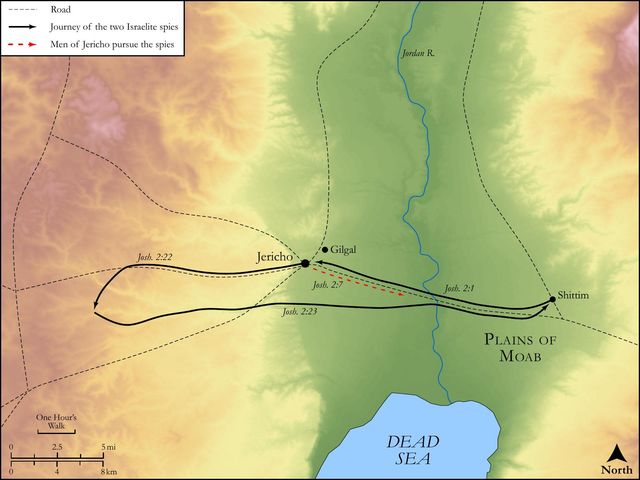
See on the biblical-era map
Study this verse
Public-domain commentary
Matthew Henry
From his Commentary on the Whole Bible. Henry comments on passages, not single verses — this entry covers Joshua 2:1–7. His four-level outline is real structure in the source text, so it is rendered as structure.
In these verses we have,
I.The prudence of Joshua, in sending spies to observe this important pass, which was likely to be disputed at the entrance of Israel into Canaan (v. 1). Go view the land, even Jericho. Moses had sent spies (Num. 13) Joshua himself was one of them and it proved of ill consequence. Yet Joshua now sent spies, not, as the former were sent, to survey the whole land, but Jericho only; not to bring the account to the whole congregation, but to Joshua only, who, like a watchful general, was continually projecting for the public good, and, was particularly careful to take the first step well and not to stumble at the threshold. It was not fit that Joshua should venture over Jordan, to make his remarks incognito - in disguise; but he sends two men (two young men, says the Septuagint), to view the land, that from their report he might take his measures in attacking Jericho. Observe,
1.There is no remedy, but great men must see with other people's eyes, which makes it very necessary that they be cautious in the choice of those they employ, since so much often depends upon their fidelity.
2.Faith in God's promise ought not to supersede but encourage our diligence in the use of proper means. Joshua is sure he has God with him, and yet sends men before him. We do not trust God, but tempt him, if our expectations slacken our endeavours.
3.See how ready these men were to go upon this hazardous enterprise. Though they put their lives in their hands yet they ventured in obedience to Joshua their general, in zeal for the service of the camp, and in dependence upon the power of that God who, being the keeper of Israel in general, is the protector of every particular Israelite in the way of his duty.
II.The providence of God directing the spies to the house of Rahab.
How they got over Jordan we are not told; but into Jericho they came, which was about seven or eight miles from the river, and there seeking for a convenient inn were directed to the house of Rahab, here called a harlot, a woman that had formerly been of ill fame, the reproach of which stuck to her name, though of late she had repented and reformed. Simon the leper (Mat 26:6), though cleansed from his leprosy, wore the reproach of it in his name at long as he lived; so Rahab the harlot; and she is so called in the New Testament, where both her faith and her good works are praised, to teach us,
1.That the greatness of sin is no bar to pardoning mercy if it be truly repented of in time. We read of publicans and harlots entering into the kingdom of the Messiah, and being welcomed to all the privileged of that kingdom, Mat 21:31.
2.That there are many who before their conversion were very wicked and vile, and yet afterwards come to great eminence in faith and holiness.
3.Even those that through grace have repented of the sins of their youth must expect to bear the reproach of them, and when they hear of their old faults must renew their repentance, and, as an evidence of that, hear of them patiently. God's Israel, for aught that appears, had but one friend, but one well-wisher in all Jericho, and that was Rahab a harlot. God has often served his own purposes and his church's interests by men of different morals. Had these scouts gone to any other house than this they would certainly have been betrayed and put to death without mercy. But God knew where they had a friend that would be true to them, though they did not, and directed them thither. Thus that which seems to us most contingent and accidental is often over-ruled by the divine providence to serve its great ends. And those that faithfully acknowledge God in their ways he will guide with his eye. See Jer 36:19, Jer 36:26.
III.The piety of Rahab in receiving and protecting these Israelites.
Those that keep public-houses entertain all comers, and think themselves obliged to be civil to their guests. But Rahab showed her guests more than common civility, and went upon an uncommon principle in what she did; it was by faith that she received those with peace against whom her king and country had denounced war, Heb 11:31.
1.She bade them welcome to her house; they lodged there, though it appears by what she said to them (Jos 2:9) she knew both whence they came and what their business was.
2.Perceiving that they were observed coming into the city, and that umbrage was taken at it, she hid them upon the roof of the house, which was flat, and covered them with stalks of flax (Jos 2:6), so that, if the officers should come thither to search for them, there they might lie undiscovered. By these stalks of flax, which she herself had lain in order upon the roof to dry in the sun, in order to the beating of it and making it ready for the wheel, it appears she had one of the good characters of the virtuous woman, however in others of them she might be deficient, that she sought wool and flax, and wrought willingly with her hands, Pro 31:13. From this instance of her honest industry one would hope that, whatever she had been formerly, she was not now a harlot.
3.When she was examined concerning them, she denied they were in her house, turned off the officers that had a warrant to search for them with a sham, and so secured them. No marvel that the king of Jericho sent to enquire after them (Jos 2:2, Jos 2:3); he had cause to fear when the enemy was at his door, and his fear made him suspicious and jealous of all strangers. He had reason to demand from Rahab that she should bring forth the men to be dealt with as spies; but Rahab not only disowned that she knew them, or knew where they were, but, that no further search might be made for them in the city, told the pursuers they had gone away again and in all probability might be overtaken, Jos 2:4, Jos 2:5. Now,
(1.)We are sure this was a good work: it is canonized by the apostle (Jam 2:25), where she is said to be justified by works, and this is specified, that she received the messengers, and sent them out another way, and she did it by faith, such a faith as set her above the fear of man, even of the wrath of the king. She believed, upon the report she had heard of the wonders wrought for Israel, that their God was the only true God, and that therefore their declared design upon Canaan would undoubtedly take effect and in this faith she sided with them, protected them, and courted their favour. Had she said, "I believe God is yours and Canaan yours, but I dare not show you any kindness," her faith had been dead and inactive, and would not have justified her. But by this it appeared to be both alive and lively, that she exposed herself to the utmost peril, even of life, in obedience to her faith. Note, Those only are true believers that can find in their hearts to venture for God; and those that by faith take the Lord for their God take his people for their people, and cast in their lot among them. Those that have God for their refuge and hiding-place must testify their gratitude by their readiness to shelter his people when there is occasion. Let my outcasts dwell with thee, Isa 16:3, Isa 16:4. And we must be glad of an opportunity of testifying the sincerity and zeal of our love to God by hazardous services to his church and kingdom among men. But,
(2.)There is that in it which it is not easy to justify, and yet it must be justified, or else it could not be so good a work as to justify her.
[1.]It is plain that she betrayed her country by harbouring the enemies of it, and aiding those that were designing its destruction, which could not consist with her allegiance to her prince and her affection and duty to the community she was a member of. But that which justifies her in this is that she knew the Lord had given Israel this land (Jos 2:9), knew it by the incontestable miracles God had wrought for them, which confirmed that grant; and her obligations to God were higher than her obligations to any other. If she knew God had given them this land, it would have been a sin to join with those that hindered them from possessing it. But, since no such grant of any land to any people can now be proved, this will by no means justify any such treacherous practices against the public welfare.
[2.]It is plain that she deceived the officers that examined her with an untruth - That she knew not whence the men were, that they had gone out, that she knew not whither they had gone. What shall we say to this? If she had either told the truth or been silent, she would have betrayed the spies, and this would certainly have been a great sin; and it does not appear that she had any other way of concealing them that by this ironical direction to the officers to pursue them another way, which if they would suffer themselves to be deceived by, let them be deceived. None are bound to accuse themselves, or their friends, of that which, though enquired after as a crime, they know to be a virtue. This case was altogether extraordinary, and therefore cannot be drawn into a precedent; and that my be justified here which would be by no means lawful in a common case. Rahab knew, by what was already done on the other side Jordan, that no mercy was to be shown to the Canaanites, and thence inferred that, if mercy was not owing them, truth was not; those that might be destroyed might be deceived. Yet divines generally conceive that it was a sin, which however admitted of this extenuation, that being a Canaanite she was not better taught the evil of lying; but God accepted her faith and pardoned her infirmity. However it was in this case, we are sure it is our duty to speak every man the truth to his neighbour, to dread and detest lying, and never to do evil, that evil, that good may come of it, Rom 3:8. But God accepts what is sincerely and honestly intended, though there be a mixture of frailty and folly in it, and is not extreme to mark what we do amiss. Some suggest that what she said might possibly be true of some other men.
Historical interpretation
Three Centuries of Reception
2 surviving comments on this verse. Each one is dated, so this reads as a timeline rather than a list.
Select a marker to jump to its quote. Markers stagger vertically where authors wrote within a few decades of each other.
On account of her faith and hospitality, Rahab the harlot was saved. For when spies were sent by Joshua, the son of Nun, to Jericho, the king of the country ascertained that they had come to spy out their land, and sent men to seize them, in order that, when taken, they might be put to death. But the hospitable Rahab receiving them, concealed them on the roof of her house under some stalks of flax. And when the men sent by the king arrived and said, "There came men unto you who are to spy out our land; bring them forth, for so the king commands," she answered them, "The two men whom you seek came unto me, but quickly departed again and are gone," thus not discovering the spies to them. Then she said to the men, "I know assuredly that the Lord your God has given you this city, for the fear and dread of you have fallen on its inhabitants. When therefore you shall have taken it, keep ye me and the house of my father in safety." And they said to her, "It shall be as you have spoken to us. As soon, therefore, as you know that we are at hand, you shall gather all your family under your roof, and they shall be preserved, but all that are found outside of your dwelling shall perish." Moreover, they gave her a sign to this effect, that she should hang forth from her house a scarlet thread. And thus they made it manifest that redemption should flow through the blood of the Lord to all them that believe and hope in God. You see, beloved, that there was not only faith, but prophecy, in this woman.
“I will be mindful of Rahab,” of Rahab, that harlot who lodged Jesus’ [Joshua’s] secret agents, who lived in Jericho where Jesus [Joshua] had come and had dispatched the two spies. Jericho, that collapsed in seven days, is a type of this world, and as such is determined to kill the secret agents. Because, therefore, Jericho is bent upon killing the spies, Rahab, the harlot, alone received them, lodged them not on the ground floor but in the upper story of the roof—or, in other words, in the sublimity of her faith. She hid them under her stalks of flax.…
She believes in Jesus, and those whom Jericho is determined to destroy she protects in safety on her own roof. She harbors them on the roof—in the loftiness of her faith—and hides them under the stems of flax. Even though she is a harlot, she covers them with flax.
Flax with much labor and care becomes of dazzling whiteness. You yourselves know that flax grows from the soil and that when it has come forth from the ground, it is black; it has no beauty; it has no use. First, it is pulled up from the ground, broken, then twisted, afterwards washed. Next, it is pounded; finally, combed, and after so much care and hard work, it finally becomes white. Here, then, is the meaning: this harlot took the messengers in and covered them with her flax so that these agents might turn her flax into dazzling whiteness.
Continue studying Joshua 2:6 across the web’s major study libraries — every link below opens this exact verse, chapter, or book on the destination site.
Read & Compare
 BibleGatewayThis verse in more than 200 translations and 70 languages.
 Bible.comThe YouVersion reader — hundreds of translations, reading plans, and highlights.
 ESV.orgCrossway's official English Standard Version reader.
 NET BibleThe NET translation with 60,000+ translators' notes on every rendering decision.
 STEP BibleTyndale House's free study tool — original text, vocabulary, and scholarly resources.
 BibliaLogos Bible Software's free web reader.
 USCCBThe New American Bible (Revised Edition) with the U.S. bishops' study notes.
Commentaries
 BibleHub CommentariesDozens of classic commentaries on this verse, gathered on one page.
 StudyLightMore than 100 commentary sets — the largest collection on the web.
 BibleRefPlain-English commentary on what this verse means, verse by verse.
 Enduring WordDavid Guzik's free commentary on this chapter, widely used by Bible teachers.
 Bible Study ToolsVerse commentary alongside Greek and Hebrew study aids.
Original Language & Research
- BibleHub InterlinearThe verse word by word — original language, transliteration, and English.
- BibleHub LexiconEvery word's original-language definition and Strong's entry.
 Blue Letter BibleDeep-study tools — Strong's numbers, concordance, and word studies.
 SefariaThe Hebrew text with Rashi and centuries of Jewish commentary.
Sermons, Hymns & Audio


TrulyRandomVerse is not affiliated with these sites and doesn’t control their content. They’re linked because they’re genuinely useful.
Summary
Joshua 2:6 meticulously details Rahab's shrewd and decisive action to protect the Israelite spies from the king of Jericho's search party. Having swiftly led the two men to the flat roof of her house, she ingeniously concealed them beneath carefully arranged stalks of flax. This act, rooted in her burgeoning faith in the God of Israel, demonstrates not only her quick thinking and courage but also her immediate commitment to His people, setting the stage for the spies' safe return and ultimately securing her own salvation and that of her family during the subsequent destruction of Jericho.
Context
ShowHideLiterary Context
This verse is a pivotal moment within the broader narrative of Joshua 2, which chronicles the initial reconnaissance mission of two Israelite spies into the formidable city of Jericho. It immediately follows Rahab's initial, deceptive encounter with the king's messengers in Joshua 2:4-5, where she skillfully misdirected them by claiming the spies had already departed. Verse 6 then reveals the true extent of her commitment and ingenuity, detailing the proactive measures she took to ensure their safety. This act of concealment is indispensable, directly enabling the spies' later escape from the city and their crucial report back to Joshua, which, in turn, informs the strategic planning for the conquest of Jericho. Rahab's actions here establish her as an unexpected yet instrumental figure in the unfolding divine plan, an unlikely ally whose faith and courage directly influence the success of Israel's initial foray into the Promised Land.
Historical & Cultural Context
The setting is ancient Jericho, a heavily fortified Canaanite city, prior to its miraculous fall. Rooftops in the land of Canaan were integral to daily life, serving multiple practical purposes beyond mere shelter. They functioned as additional living spaces, areas for social gatherings, and, crucially, as platforms for drying agricultural products. Flax (Hebrew: pishteh) was a ubiquitous crop cultivated throughout the region for its versatile fibers, which were essential for producing linen, ropes, and various textiles. After harvesting, flax stalks were commonly laid out on these flat rooftops to dry and bleach in the sun, a process known as "retting," which prepared them for processing. This established cultural practice made Rahab's chosen hiding place appear entirely natural and inconspicuous to anyone searching her house, cleverly exploiting a common domestic activity. Furthermore, Rahab's house was likely integrated into or situated very near the city wall, as suggested by Joshua 2:15, offering both convenient access for the spies and a strategic vantage point for her.
Key Themes
ShowHideJoshua 2:6 powerfully illuminates several profound theological and narrative themes. Firstly, it underscores Rahab's Demonstrable Faith and Action. Her prior confession of faith in the God of Israel, articulated with remarkable clarity in Joshua 2:9-11, is immediately substantiated by tangible, life-threatening action to protect His servants. This active, obedient faith, far beyond mere intellectual assent, is later celebrated in the New Testament as exemplary (e.g., Hebrews 11:31 and James 2:25). Secondly, the verse highlights Divine Providence, showcasing God's sovereign hand at work through an unexpected and seemingly ordinary individual. God orchestrates events through Rahab, a Canaanite harlot, to protect His chosen instruments, demonstrating His ability to work through anyone, regardless of their background or social standing, to advance His redemptive plan for Israel and, ultimately, for all nations. The mundane act of drying flax becomes an extraordinary means of divine protection, illustrating how God uses the ordinary for His extraordinary purposes.
Exposition and Analysis
ShowHideKey Word Analysis
ShowHideThis term (H1406) refers to the flat top of a house, a common architectural feature in Israel and Canaan. As provided by the Strong's data, it is "probably by reduplication from גָּאָה; a roof; by analogy, the top of an altar; roof (of the house), (house) top (of the house)." Its flat, accessible nature made it a versatile space for various domestic activities, including drying crops, sleeping, and even worship. The presence of drying flax on such a roof would have been a normal sight, making it a plausible and inconspicuous place for Rahab to hide the spies.
This verb (H2934) is a primitive root meaning "to hide (by covering over); hide, lay privily, in secret." It implies a deliberate and effective act of concealment, suggesting that Rahab did not merely cover the spies superficially but ensured they were completely out of sight and unsuspected. The use of this word emphasizes the success and thoroughness of her deceptive strategy, ensuring the spies' safety.
This noun (H6593) derives from a root suggesting "comminuting," and refers to "linen (i.e. the thread, as carded); flax, linen." In this context, "stalks of flax" would have been the raw, harvested plant material, laid out to dry before processing into linen. This specific detail grounds the narrative in the everyday realities of ancient life, making Rahab's hiding place appear natural and unremarkable to outsiders, thereby significantly enhancing the effectiveness of her ruse.
Verse Breakdown
ShowHide"But she had brought them up to the roof of the house"
This opening clause immediately highlights Rahab's swift and decisive action. Upon realizing the danger the spies were in, she did not hesitate but quickly led them to the most suitable and discreet hiding place within her dwelling – the flat roof. This demonstrates her quick thinking, resourcefulness, and unwavering commitment to protecting the men.
"and hid them with the stalks of flax"
This phrase specifies the ingenious method of concealment Rahab employed. She utilized readily available agricultural material – flax stalks – to cover the spies. This detail not only underscores her resourcefulness but also emphasizes the commonality of such materials on rooftops, which would have helped the hiding place appear perfectly natural and avoid drawing any suspicion from the king's search party.
"which she had laid in order upon the roof."
This final, crucial phrase provides a vital piece of information. It indicates that the flax was not haphazardly strewn but was already "laid in order," strongly suggesting it was part of a routine drying process. This pre-existing, orderly arrangement made the hiding place seem perfectly normal and unsuspicious to anyone observing or searching, further underscoring Rahab's cunning and foresight in creating a believable disguise for the hidden men, effectively turning an ordinary domestic scene into an extraordinary act of salvation.
Literary Devices
ShowHideThe narrative in Joshua 2:6 masterfully employs several effective literary devices. There is a profound sense of Irony, as Rahab, a Canaanite harlot, an outsider and seemingly an enemy, becomes the unexpected instrument of salvation for Israelite spies. Her actions defy the expectations of her own people and risk her life for God's chosen nation, subverting conventional roles and highlighting God's unconventional methods of working. The meticulous description of the "stalks of flax... laid in order" serves as powerful Verisimilitude, lending an air of authenticity and realism to the account by grounding it in the mundane, everyday details of ancient life. This ordinary detail becomes a crucial element in God's extraordinary plan. Furthermore, the entire episode functions as Foreshadowing, subtly hinting at God's broader redemptive plan to include Gentiles within His covenant community, a theme that becomes much more explicit in later biblical history and culminates in the New Testament. The seemingly insignificant flax stalks, used to hide God's agents, subtly symbolize how God often employs ordinary means and unlikely individuals to accomplish His profound divine purposes.
Theological and Thematic Connections
ShowHideJoshua 2:6 profoundly underscores the theological truth that God can and does use anyone, regardless of their past, social standing, or ethnic background, to accomplish His divine purposes. Rahab's act of hiding the spies, though involving deception, is ultimately presented as an act of courageous faith in the God of Israel, whom she recognized as the true and sovereign Lord over all. Her actions highlight the biblical principle that genuine faith is not merely intellectual assent but is active and demonstrated through works, even when those works involve difficult moral choices made in extraordinary, life-or-death circumstances. This episode serves as an early testament to God's expansive and inclusive grace, extending salvation beyond the strict boundaries of Israel to those who believe and respond to His power, foreshadowing a broader redemptive scope.
Reflection and Application
ShowHideRahab's story in Joshua 2:6 offers profound and challenging lessons for contemporary believers. It compels us to re-examine the very nature of true faith, illustrating that it is not a passive intellectual agreement but a courageous, active trust in God that prompts us to respond obediently, even when faced with risky or morally complex situations. Rahab, an outsider from a condemned city, demonstrated a faith that literally put her life on the line, choosing to recognize God's sovereignty over her own king and city. This should inspire us to deeply examine our own willingness to act on our convictions, to step out in faith even when it means defying prevailing cultural norms or risking personal comfort and security. Furthermore, Rahab's inclusion in God's unfolding redemptive plan serves as a powerful reminder that God's grace is boundless, reaching across social, ethnic, and moral divides to redeem, transform, and use those who turn to Him. We are called to be instruments of God's providence, recognizing that He can use ordinary people and ordinary circumstances to achieve His extraordinary divine purposes, often in ways we least expect.
Questions for Reflection
ShowHideFAQ
ShowHideWas Rahab justified in lying to the king's men to protect the spies?
ShowHideThe biblical text does not explicitly condemn Rahab for her deception, nor does it present her lie as a general ethical principle to be followed. Instead, the New Testament commends her for her faith (e.g., Hebrews 11:31 and James 2:25). Her actions, including the lie, were driven by a profound and active faith in the God of Israel and a fervent desire to protect His messengers, ultimately leading to the salvation of her family. While the Bible consistently upholds truthfulness as a virtue, Rahab's situation was an extreme case of conflict between two moral imperatives: protecting innocent lives (the spies) and telling the truth to those who sought to harm them. The narrative focuses on her faith and its miraculous outcome, rather than providing a blanket justification for deception. It highlights that God, in His sovereignty, can and does work through imperfect means and individuals to accomplish His perfect will, often in morally complex situations where choices are not clear-cut.
Christ-Centered Fulfillment
ShowHideRahab's narrative, particularly her decisive act of hiding the spies in Joshua 2:6, profoundly prefigures the expansive grace and redemptive work of Jesus Christ. As a Canaanite harlot, Rahab represents the quintessential outsider, a Gentile sinner, yet she is miraculously brought into the covenant community of Israel through her active faith. This foreshadows the glorious New Testament revelation that salvation is not limited by ethnicity, social status, or past sin, but is freely offered to all who believe in Christ, Jew and Gentile alike, demonstrating God's impartiality (Romans 10:12-13). Her remarkable inclusion in the lineage of Jesus Christ (Matthew 1:5) is a powerful testament to God's universal plan to redeem a people for Himself from every nation, tribe, and tongue, gathering them into His eternal kingdom (Revelation 7:9-10). Just as Rahab's faith led her to shelter God's messengers and ultimately secured her salvation from physical destruction, so faith in Jesus, the ultimate "Lamb of God who takes away the sin of the world" (John 1:29), provides spiritual refuge and eternal salvation from the judgment to come. Her story beautifully illustrates that God's sovereign plan of redemption unfolds through unexpected individuals and seemingly ordinary circumstances, ultimately culminating in Christ, who broke down the dividing wall of hostility and reconciled all to God through His sacrificial death on the cross (Ephesians 2:14-16).