


Isaiah 16:3
Bible text: King James Version (1769 Blayney text) · Public domain
Bible text: King James Version with Strong's numbers · Public domain
Bible text: Berean Standard Bible · Public domain
Bible text: American Standard Version (1901) · Public domain
Bible text: World English Bible, Messianic edition · Public domain
Bible text: Geneva Bible (1599) · Public domain
Bible text: Young's Literal Translation · Public domain
- הָבִיאִיha·vi·'ubringH935V-Hiphil-Imp-2fsVerb Hiphil Imperative 2nd Singular Feminine
- עֵצָה'e·TzahcounselH6098N-fsNoun Singular Feminine Absolute
- עֲשׂוּ'a·SumakeH6213V-Qal-Imp-2mpVerb Qal Imperative 2nd Plural Masculine
- פְלִילָהfe·li·Laha decisionH6415N-fsNoun Singular Feminine Absolute
- שִׁיתִיShi·timakeH7896V-Qal-Imp-2fsVerb Qal Imperative 2nd Singular Feminine
- כַלַּיִלkha·La·yillike <the> nightH3915Prep-k ¦ N-msNoun Singular Masculine Absoluteכַlike <the>לַּיִלnight
- צִלֵּךְtzi·Lekhyour shadeH6738N-msc ¦ 2fsNoun Singular Masculine Constructצִלֵּshadeךְyour
- בְּתוֹךְbe·Tokhin [the] middle ofH8432Prep-b ¦ N-mscNoun Singular Masculine Constructבְּinתוֹךְ[the] middle of
- צָהֳרָיִםtzo·ho·Ra·yim[the] noon<s>H6672N-mdNoun Dual Masculine Absolute
- סַתְּרִיsa·te·RihideH5641V-Piel-Imp-2fsVerb Piel Imperative 2nd Singular Feminine
- נִדָּחִיםni·da·ChimoutcastsH5080V-Niphal-Prtcpl-mpVerb Niphal Participle Plural Masculine Absolute
- נֹדֵדno·Deda fugitiveH5074V-Qal-Prtcpl-msVerb Qal Participle Singular Masculine Absolute
- אַל'almay notH408NegParticle Negative
- תְּגַלִּיte·ga·Liyou exposeH1540V-Piel-Imperf-2fsVerb Piel Imperfect 2nd Singular Feminine
English is a literal word-by-word gloss of the Hebrew, not the KJV's wording. Why?
This is the original text the KJV's translators worked from — each Hebrew word with its own literal English meaning in this verse, prepared by scholars at Tyndale House, Cambridge. The KJV translates whole sentences, not word by word, so its wording differs: one Hebrew word can become several English words, and the KJV may choose “the LORD” where the gloss reads “Yahweh”. Both are faithful — they answer different questions. For the KJV's own rendering, switch to the KJV text.
Details
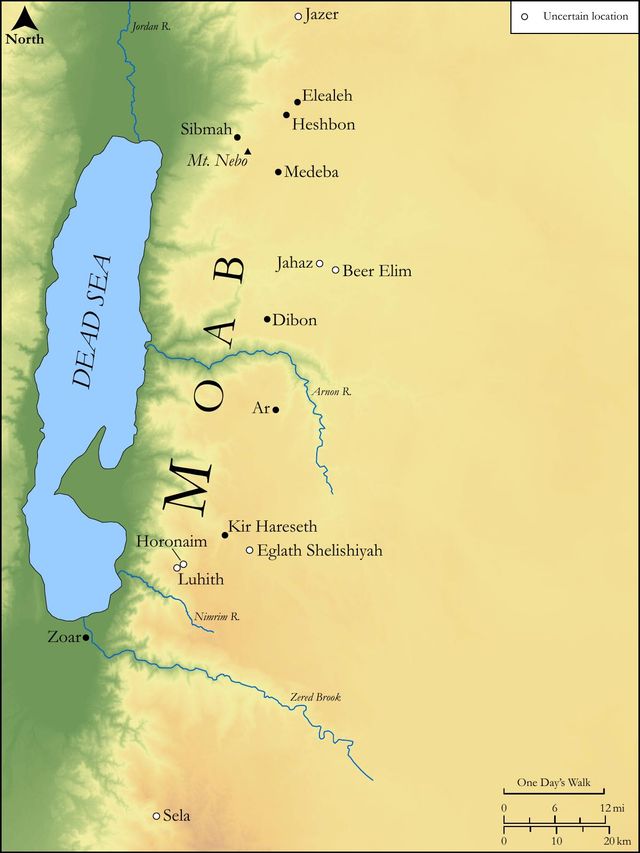
See on the biblical-era map
Study this verse
Public-domain commentary
Matthew Henry
From his Commentary on the Whole Bible. Henry comments on passages, not single verses — this entry covers Isaiah 16:1–5. His four-level outline is real structure in the source text, so it is rendered as structure.
God has made it to appear that he delights not in the ruin of sinners by telling them what they may do to prevent the ruin; so he does here to Moab.
I.He advises them to be just to the house of David, and to pay the tribute they had formerly covenanted to pay to the kings of his line (Isa 16:1): Send you the lamb to the ruler of the land. David made the Moabites tributaries to him, Sa2 8:2. They became his servants, and brought gifts. Afterwards they paid their tribute to the kings of Israel (Kg2 3:4), and paid it in lambs. Now the prophet requires them to pay it to Hezekiah. Let it be raised and levied from all parts of the country, from Selah, a frontier city of Moab on the one side, to the wilderness, a boundary of the kingdom on the other side: and let it be sent, where it should be sent, to the mount of the daughter of Zion, the city of David. Some take it as an advice to send a lamb for a sacrifice to God, the ruler of the earth (so it may be read), the Lord of the whole earth, ruler of all lands, the land of Moab as well as the land of Israel, "Send it to the temple built on Mount Zion." And some think it is in this sense spoken ironically, upbraiding the Moabites with their folly in delaying to repent and make their peace with God. "Now you would be glad to send a lamb to Mount Zion, to make the God of Israel your friend; but it is too late: the decree has gone forth, the consumption is determined, and the daughters of Moab shall be cast out as a wandering bird," Isa 16:2. I rather take it as good advice seriously given, like that of Daniel to Nebuchadnezzar when he was reading him his doom, Dan 4:27. Break off thy sins by righteousness, if it may be a lengthening of thy tranquillity. And it is applicable to the great gospel duty of submission to Christ, as the ruler of the land, and our ruler: "Send him the lamb, the best you have, yourselves a living sacrifice. When you come to God, the great ruler, come in the name of the Lamb, the Lamb of God. For else it shall be" (so we may read it) "that, as a wandering bird cast out of the nest, so shall the daughters of Moab be. If you will not pay your quit-rent, your just tribute to the king of Judah, you shall be turned out of your houses: The daughters of Moab (the country villages, or the women of your country) shall flutter about the fords of Arnon, attempting that way to make their escape to some other land, like a wandering bird thrown out of the nest half-fledged." Those that will not submit to Christ, nor be gathered under the shadow of his wings, shall be as a bird that wanders from her nest, that shall either be snatched up by the next bird of prey or shall wander endlessly in continual frights. Those that will not yield to the fear of God shall be made to yield to the fear of every thing else.
II.He advises them to be kind to the seed of Israel (Isa 16:3):
"Take counsel, call a convention, and consult among yourselves what is fit to be done in the present critical juncture; and you will find it your best way to execute judgment, to reverse all the unrighteous decrees you have made, by which you have put hardships upon the people of God, and, in token of your repentance for them, study now how to oblige them, and this shall be accepted of God more than all burnt-offering and sacrifice."
1.The prophet foresaw some storm coming upon the people of God, perhaps the good people of the ten tribes, or of the two and a half on the other side Jordan, whose country joined to that of Moab, and who, by the merciful providence of God, escaped the fury of the Assyrian army, had their lives given them for a prey, and were reserved for better times, but were put to the utmost extremity to shift for their own safety. The danger and trouble they were in were like the scorching heat at noon; the face of the spoiler was very fierce upon them and the oppressor and extortioner were ready to swallow them up after stripping them of what they had.
2.He bespeaks a shelter for them in the land of Moab, when their own land was made too hot for them. This judgment they must execute; thus wisely must they do for themselves, and thus kindly must they deal with the people of God. If they would themselves continue in their habitations, let them now open their doors to the distressed dispersed members of God's church, and be to them like a cool shade to those that bear the burden and heat of the day. Let them not discover those that absconded among them, nor deliver them up to the pursuers that made search for them: "Betray not him that wandereth, nor deliver him up" (as the Edomites did, Oba 1:13, Oba 1:14), "but hide the outcasts." This was that good work by which Rahab's faith was justified, and proved to be sincere, Heb 11:31. "Nay, do not only hide them for a time, but, if there be occasion, let them be naturalized: Let my outcasts dwell with thee, Moab (Isa 16:4); find a lodging for them and be thou a covert to them. Let them be taken under the protection of the government, though they are but poor, and likely to be a charge to thee." Note,
(1.)It is often the lot even of those who are Israelites indeed to be outcasts, driven out of house and harbour by persecution or war, Heb 11:37.
(2.)God owns them when men reject and disown them. They are outcasts, but they are my outcasts. The Lord knows those that are his wherever he finds them, even where no one else knows them.
(3.)God will find a rest and shelter for his outcasts; for, though they are persecuted, they are not forsaken. He will himself be their dwelling-place if they have no other, and in him they shall be at home.
(4.)God can, when he pleases, raise up friends for his people even among Moabites, when they can find none in all the land of Israel that can and dare shelter them. The earth often helps the woman, Rev 12:16.
(5.)Those that expect to find favour when they are in trouble themselves must show favour to those that are in trouble; and what service is done to God's outcasts shall no doubt be recompensed one way or other.
3.He assures them of the mercy God had in store for his people.
(1.)That they should not long need their kindness, or be troublesome to them: For the extortioner is almost at an end already, and the spoiler ceases. God's people shall not be long outcasts; they shall have tribulation ten days (Rev 2:10), and that is all. The spoiler would never cease spoiling if he might have his will; but God has him in a chain. Hitherto he shall go, but no further.
(2.)That they should, ere long, be in a capacity to return their kindness (Isa 16:5): "Though the throne of the ten tribes be sunk and overturned, yet the throne of David shall be established in mercy, by the mercy they receive from God and the mercy they show to others; and by the same methods may your throne be established if you please." It would engage great men to be kind to the people of God if they would but observe, as they easily might, how often such conduct brings the blessing of God upon kingdoms and families. "Make Hezekiah your friend, for you will find it your interest to do so upon the account both of the grace of God in him and the presence of God with him. He shall sit upon the throne in truth, and then he does indeed sit in honour and sit firmly. Then he shall sit judging, and will then be a protector to those that have been a shelter to the people of God." And see in him the character of a good magistrate.
[1.]He shall seek judgment; that is, he shall seek occasions of doing right to those that are wronged, and shall punish the injurious even before they are complained of: or he shall diligently search into every cause brought before him, that he may find where the right lies.
[2.]He shall hasten righteousness, and not delay to do justice, nor keep those long waiting that make application to him for the redress of their grievances. Though he seeks judgment, and deliberates upon it, yet he does not, under pretence of deliberation, stay the progress of the streams of justice. Let the Moabites take example by this, and then assure themselves that their state shall be established.
Historical interpretation
Historical reception
1 surviving comment on this verse from the historical church.
(Verse 3,4) This is a plan, gather a council: place your shadow as if it were night in the middle of the day, hide those who are fleeing, and do not disclose the wanderers. My outcasts will dwell with you: Moab, be their hiding place from the face of the destroyer, for the dust is at an end, the wretched one is consumed, the one who trampled on the earth has ceased. Instead of 'wretched' in Hebrew, 'Sod' is read, which can also be understood as 'destroyer'. It speaks to Moab, so that it may find a plan for salvation, and to the gathered elders, so that it may gather a council of salvation. He said, 'Will I see, and be saved, and earn God's mercy? In the bright light, and the open flight of my people, you should be like night and shadow, accept those fleeing, and do not betray the wanderers.' And immediately he explains why he said this: 'My refugees will dwell with you. For Jerusalem has been devastated, and all of Judaea that borders on Moab, my people will migrate to you. Therefore, be their refuge, and do not fear the attack of the destroyer, for he will pass quickly like dust: and the one who trampled the entire land and subjected it under his feet will be wiped away by a blowing breeze.' Some interpret this place wrongly about the Antichrist, thinking that the Saints at that time will pass to the Arabs because of the proximity of the city of Jerusalem, and now they are being warned not to betray those who are fleeing to them.
Continue studying Isaiah 16:3 across the web’s major study libraries — every link below opens this exact verse, chapter, or book on the destination site.
Read & Compare
 BibleGatewayThis verse in more than 200 translations and 70 languages.
 Bible.comThe YouVersion reader — hundreds of translations, reading plans, and highlights.
 ESV.orgCrossway's official English Standard Version reader.
 NET BibleThe NET translation with 60,000+ translators' notes on every rendering decision.
 STEP BibleTyndale House's free study tool — original text, vocabulary, and scholarly resources.
 BibliaLogos Bible Software's free web reader.
 USCCBThe New American Bible (Revised Edition) with the U.S. bishops' study notes.
Commentaries
 BibleHub CommentariesDozens of classic commentaries on this verse, gathered on one page.
 StudyLightMore than 100 commentary sets — the largest collection on the web.
 BibleRefPlain-English commentary on what this verse means, verse by verse.
 Enduring WordDavid Guzik's free commentary on this chapter, widely used by Bible teachers.
 Bible Study ToolsVerse commentary alongside Greek and Hebrew study aids.
Original Language & Research
- BibleHub InterlinearThe verse word by word — original language, transliteration, and English.
- BibleHub LexiconEvery word's original-language definition and Strong's entry.
 Blue Letter BibleDeep-study tools — Strong's numbers, concordance, and word studies.
 SefariaThe Hebrew text with Rashi and centuries of Jewish commentary.
Sermons, Hymns & Audio


TrulyRandomVerse is not affiliated with these sites and doesn’t control their content. They’re linked because they’re genuinely useful.
Summary
Isaiah 16:3 issues a profound and urgent prophetic appeal, calling upon those in positions of authority—likely Judah or any benevolent power—to extend radical compassion and righteous judgment towards the vulnerable and displaced Moabite refugees. Set against the backdrop of Moab's impending desolation, the verse implores the powerful to provide comprehensive sanctuary, shielding fugitives from exposure and betrayal, thereby embodying divine principles of mercy and just governance in a time of severe humanitarian crisis.
Context
ShowHideLiterary Context
This verse is intricately woven into the "oracle concerning Moab," which spans Isaiah chapters 15 and 16. Chapter 15 vividly depicts the widespread devastation and lamentation across Moab, portraying its inhabitants as desperate refugees fleeing their destroyed homeland. Isaiah 16:1-5 then presents a complex scenario: a plea for refuge from Moab, a potential offer of tribute (perhaps a "lamb to the ruler of the land" in Isaiah 16:1), and a direct appeal for Judah to act justly. Verse 3, specifically, serves as a powerful humanitarian injunction, urging the potential protectors to offer sanctuary to the fleeing Moabites rather than exploiting their extreme vulnerability. This ethical imperative immediately precedes a significant messianic promise in Isaiah 16:5, which grounds the call for justice and compassion in the righteous and steadfast character of God and His future king.
Historical & Cultural Context
The oracle against Moab is typically situated within the tumultuous 8th century BCE, a period dominated by the relentless expansion of the Assyrian Empire. Moab, a nation located east of the Dead Sea, frequently found itself caught between the geopolitical ambitions of larger powers like Assyria, Egypt, and Judah. In times of war and invasion, the plight of refugees was a common and dire reality. The nations of that day, while often brutal, also held to customs regarding the treatment of sojourners and the helpless, sometimes even extending to those from enemy nations. The concept of asylum and hospitality, though not always perfectly practiced, was a significant moral consideration. The imagery of "noonday" (Hebrew: tsôhar') in the verse is particularly poignant, evoking the scorching heat and open exposure of the desert landscape common to the region, symbolizing the extreme danger and vulnerability faced by those without shelter. The prophet's plea underscores the dire circumstances of those fleeing for their lives, highlighting a moral imperative to protect the defenseless, a principle deeply embedded in Old Testament law concerning the sojourner and the needy, as seen in passages like Deuteronomy 10:18-19.
Key Themes
ShowHideIsaiah 16:3 powerfully articulates several core themes central to biblical ethics and theology. Firstly, it emphasizes the imperative of compassion for the vulnerable, urging those with power to shelter and protect the defenseless and displaced. The commands to "hide the outcasts; bewray not him that wandereth" directly address the moral obligation to provide refuge and avoid betraying fugitives, reflecting God's own character as a protector of the lowly, as beautifully expressed in Psalm 146:9. Secondly, the verse calls for righteous judgment and wise counsel, underscoring the necessity of ethical and discerning decision-making, particularly when dealing with those in dire circumstances. "Take counsel, execute judgment" implies that true governance is characterized by integrity and equity, ensuring that decisions serve justice rather than oppression or self-interest. Lastly, the vivid imagery of "make thy shadow as the night in the midst of the noonday" conveys the theme of profound and absolute protection. Just as the coolness of night offers respite from the oppressive midday sun, so too should the shelter provided be comprehensive and life-saving, offering complete safety from overwhelming threats and reflecting the divine promise of refuge found in passages like Psalm 91:1.
Exposition and Analysis
ShowHideKey Word Analysis
ShowHideThis word signifies "advice; by implication, plan; also prudence." In this context, it calls for thoughtful and ethical deliberation, implying that decisions regarding the vulnerable should not be impulsive or self-serving but carefully considered and guided by wisdom and justice. It suggests a strategic and moral approach to governance and aid, emphasizing the need for leaders to seek and apply sound, righteous judgment.
This term literally means "shade" or "shadow" but frequently carries the figurative meaning of "protection" or "defense." Here, it is used metaphorically to represent a comprehensive and life-saving refuge. The imagery of a shadow in the intense "noonday" heat emphasizes the critical need for shelter from overwhelming danger, highlighting the profound and essential nature of the protection being sought—a complete covering that offers relief and safety.
An archaic English translation of a primitive root meaning "to denude (especially in a disgraceful sense); by implication, to exile; figuratively, to reveal." In this verse, "bewray not" means "do not betray" or "do not expose." It is a powerful injunction against revealing the location or identity of those seeking refuge, emphasizing the sacred trust involved in offering sanctuary and the severe moral failing of betraying a fugitive to their pursuers or oppressors.
Verse Breakdown
ShowHide"Take counsel, execute judgment;"
This initial imperative calls upon those in positions of authority to engage in thoughtful deliberation and to implement decisions that are just and righteous. "Counsel" (H6098) implies wisdom and careful consideration, while "judgment" (H6415) refers to the act of rendering justice, particularly in legal or ethical matters. The combined phrase urges leaders to govern with integrity and equity, ensuring that their actions are rooted in divine principles of fairness, especially when dealing with the vulnerable.
"make thy shadow as the night in the midst of the noonday;"
This is a vivid and powerful metaphorical command to provide profound and absolute protection. "Shadow" (H6738) symbolizes refuge, and "night" (H3915) offers relief from the oppressive "noonday" (H6672) heat, which represents extreme danger or distress. The imagery conveys the idea of offering complete, life-saving shelter from overwhelming and immediate threats, a sanctuary so absolute it transforms perilous exposure into secure concealment.
"hide the outcasts;"
This is a direct, compassionate command to provide sanctuary and concealment. "Hide" (H5641) means to conceal or keep secret, while "outcasts" (H5080) refers to those who have been driven away, expelled, or are fleeing from persecution or disaster. It emphasizes the moral obligation to actively provide a safe haven for the displaced and vulnerable, ensuring their anonymity and security from those who would harm them.
"bewray not him that wandereth."
This is a stern and unequivocal prohibition against betrayal. "Bewray" (H1540) means to reveal, expose, or betray, and "him that wandereth" (H5074) refers to a fugitive, exile, or one who is roving and without a fixed home, desperately seeking safety. The command underscores the sanctity of providing refuge and the severe moral failing of exposing or betraying those who have sought protection, highlighting the profound trust placed in the protector.
Literary Devices
ShowHideIsaiah 16:3 is profoundly impactful due to its strategic use of several literary devices. The prophet employs a strong Imperative Mood, using direct commands ("Take counsel," "execute judgment," "make thy shadow," "hide," "bewray not") to convey the urgency, moral weight, and non-negotiable nature of the plea. The most striking device is the powerful Metaphor and Imagery found in "make thy shadow as the night in the midst of the noonday." This vivid image contrasts the oppressive, life-threatening heat and exposure of midday with the cool, protective darkness of night, symbolizing a desperate need for profound and absolute refuge. It is an example of Hyperbole in its intensity, emphasizing the life-or-death nature of the protection required and the overwhelming danger faced by the fugitives. The verse also utilizes Parallelism in its structure, particularly in the final two clauses ("hide the outcasts; bewray not him that wandereth"), where two related commands reinforce the central theme of protecting the vulnerable and avoiding betrayal, creating a sense of rhetorical emphasis and moral clarity.
Theological and Thematic Connections
ShowHideThis verse resonates deeply with the biblical emphasis on God's character as a protector of the vulnerable and a God of justice. It challenges humanity to reflect divine attributes by extending compassion, hospitality, and righteous judgment, especially towards those who are overlooked, displaced, or suffering. The plea for profound protection echoes the many psalms where God is depicted as a refuge and a stronghold for His people, demonstrating that human acts of mercy are a participation in God's own benevolent rule. The call to "take counsel, execute judgment" underscores that true leadership, whether national or individual, is measured by its commitment to equity and care for the weakest members of society, aligning with the broader prophetic tradition that champions justice as integral to true worship and obedience to God.
Reflection and Application
ShowHideIsaiah 16:3 offers a timeless and challenging call to action for individuals, communities, and nations in every generation. It compels us to examine our posture towards those who are vulnerable, displaced, or seeking refuge. In a world marked by ongoing humanitarian crises, conflict, and natural disasters, the command to "hide the outcasts" and "bewray not him that wandereth" directly applies to our responsibility to offer shelter and help to the fugitive and the lowly. It is a summons to move beyond mere sympathy to active, sacrificial compassion, becoming a "shadow as the night" – a source of profound safety and relief – for those in desperate need. Furthermore, the directive to "take counsel, execute judgment" reminds us that our decisions, whether personal or collective, must be rooted in wisdom, justice, and empathy, prioritizing human dignity and well-being over self-interest, fear, or political expediency. This verse challenges us to embody God's character of mercy and justice in tangible ways, transforming our communities into places of refuge and hope, reflecting the very heart of God for the oppressed.
Questions for Reflection
ShowHideFAQ
ShowHideWhat is the historical context of the "outcasts" and "wanderers" mentioned in this verse?
ShowHideThe "outcasts" (H5080, nâdach') and "wanderers" (H5074, nâdad') in Isaiah 16:3 primarily refer to the Moabite refugees fleeing the devastation prophesied in Isaiah chapter 15. This destruction was likely caused by an invading power, most probably the Assyrian Empire, which was the dominant force of Isaiah's time. These terms describe people who have been driven from their homes, expelled, or are in flight, desperately seeking safety and refuge from war, famine, or other calamities. The prophet is appealing to Judah, or perhaps any benevolent authority, to offer them sanctuary rather than betraying their vulnerable state, reflecting a broader biblical concern for the plight of the displaced.
Why is the imagery of "shadow as the night in the midst of the noonday" so significant?
ShowHideThis imagery is profoundly significant because it conveys the extreme urgency and life-saving nature of the protection being requested. "Noonday" (H6672, tsôhar') signified the hottest, most exposed, and often most dangerous part of the day, symbolizing intense distress, vulnerability, or overwhelming threat. "Night" (H3915, layil') provides relief from this oppressive heat and offers concealment and safety. Therefore, to "make thy shadow as the night in the midst of the noonday" means to provide absolute, comprehensive, and life-sustaining refuge from the most severe and immediate dangers. It emphasizes that the shelter must be as complete and effective as the darkness of night is in shielding one from the scorching midday sun, highlighting the desperate need for profound intervention and care that transforms peril into peace.
Christ-Centered Fulfillment
ShowHideIsaiah 16:3 finds its ultimate and perfect fulfillment in the person and redemptive work of Jesus Christ, who flawlessly embodies the call to righteous judgment, profound protection, and compassionate refuge. While the verse directly addresses human responsibility, it points to the divine standard of mercy that Christ perfectly exemplified. Jesus Himself became the ultimate "shadow as the night in the midst of the noonday" for humanity, offering complete spiritual and eternal refuge from the scorching judgment of sin and the oppressive power of death. He is the one who "hides the outcasts" and "bewrays not him that wandereth," welcoming all who are spiritually displaced, lost, and vulnerable into His kingdom. His earthly ministry was characterized by taking "counsel" from the Father and executing "judgment" with perfect justice and boundless mercy, particularly towards the lowly and downtrodden, as seen in His healing of the sick and His profound compassion for the weary crowds (e.g., Matthew 9:36). Furthermore, Jesus commands His followers to extend this same radical compassion, identifying with the "least of these" as if ministering directly to Him (e.g., Matthew 25:35-40). Through His atoning sacrifice on the cross, Christ provides the ultimate sanctuary, inviting all who wander in sin and despair to find rest and security in Him, becoming our eternal refuge and the perfect fulfillment of Isaiah's plea for a compassionate and unfailing protector (e.g., Hebrews 6:18).