


Numbers 13:21
Bible text: King James Version (1769 Blayney text) · Public domain
Bible text: Berean Standard Bible · Public domain
Bible text: American Standard Version (1901) · Public domain
Bible text: World English Bible, Messianic edition · Public domain
Bible text: Geneva Bible (1599) · Public domain
Bible text: Young's Literal Translation · Public domain
- וַיַּעֲלוּvai·ya·'a·Luand they went upH5927Conj-w ¦ V-Qal-ConsecImperf-3mpVerb Qal Consecutive Imperfect 3rd Plural Masculineוַandיַּעֲלוּthey went up
- וַיָּתֻרוּvai·ya·Tu·ruand they spied outH8446Conj-w ¦ V-Qal-ConsecImperf-3mpVerb Qal Consecutive Imperfect 3rd Plural Masculineוַandיָּתֻרוּthey spied out
- אֶת'et<obj.>H853DirObjMParticle Object Indicator
- הָאָרֶץha·'A·retzthe landH776Art ¦ N-fsNoun Singular Feminine Absoluteהָtheאָרֶץland
- מִמִּדְבַּרmi·mid·barfrom [the] wilderness ofH4057Prep-m ¦ N-mscNoun Singular Masculine Constructמִfromמִּדְבַּר[the] wilderness of
- צִןtzinZinH6790N-properNoun Proper Location
- עַד'adtoH5704PrepPreposition
- רְחֹבre·ChoRehobH7340N-properNoun Proper Location
- לְבֹאle·Vo'LeboH935V-Qal-InfVerb Qal Infinitive Construct
- חֲמָתcha·MatHamathH2574N-properNoun Proper Location
English is a literal word-by-word gloss of the Hebrew, not the KJV's wording. Why?
This is the original text the KJV's translators worked from — each Hebrew word with its own literal English meaning in this verse, prepared by scholars at Tyndale House, Cambridge. The KJV translates whole sentences, not word by word, so its wording differs: one Hebrew word can become several English words, and the KJV may choose “the LORD” where the gloss reads “Yahweh”. Both are faithful — they answer different questions. For the KJV's own rendering, switch to the KJV text.
Details
See on the biblical-era maps
Study this verse
Public-domain commentary
Matthew Henry
From his Commentary on the Whole Bible. Henry comments on passages, not single verses — this entry covers Numbers 13:21–25.
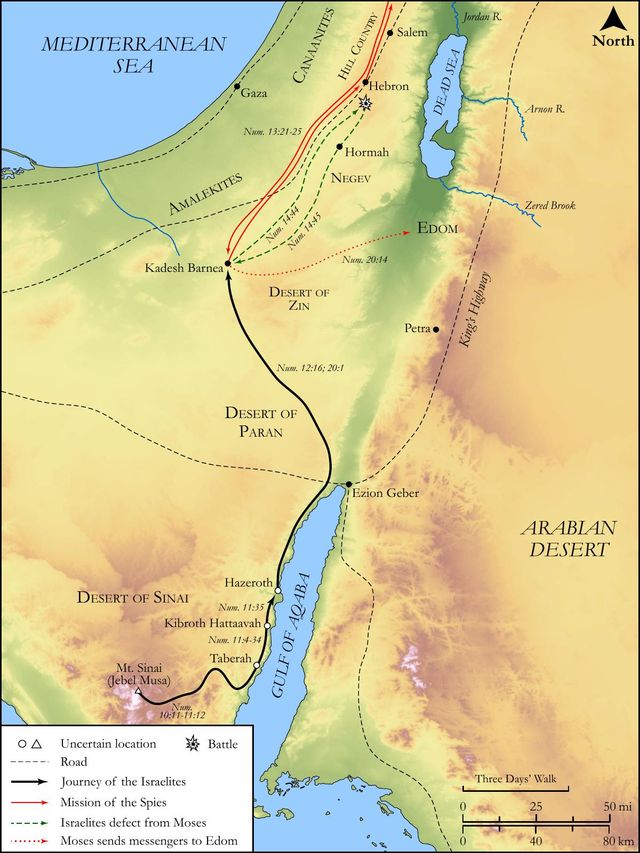
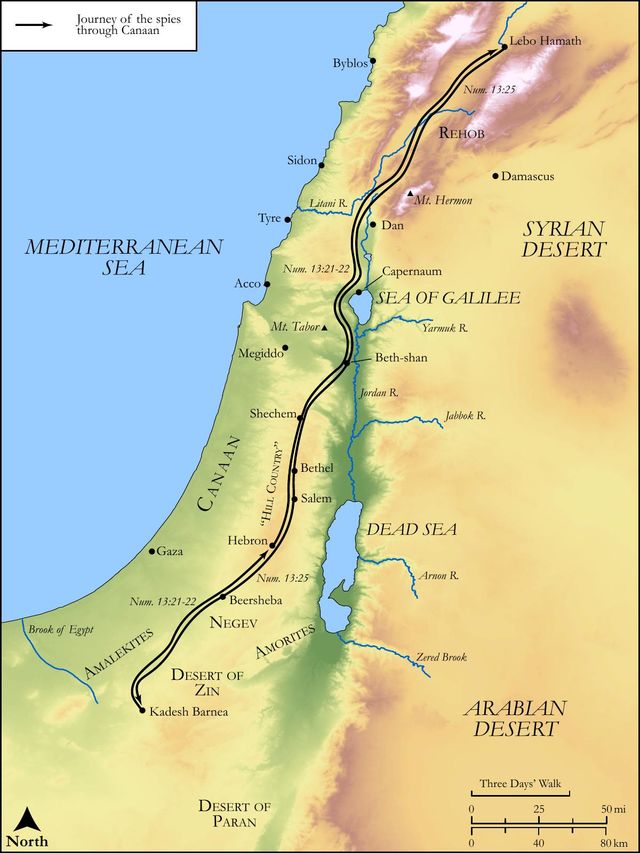
We have here a short account of the survey which the spies made of the promised land. 1. They went quite through it, from Zin in the south, to Rehob, near Hamath, in the north, Num 13:21. See Num 34:3, Num 34:8. It is probable that they did not go altogether in a body, lest they should be suspected and taken up, which there would be the more danger of if the Canaanites knew (and one would think they could not but know) how near the Israelites were to them; but they divided themselves into several companies, and so passed unsuspected, as way-faring men. 2. They took particular notice of Hebron (Num 13:22), probably because near there was the field of Machpelah, where the patriarchs were buried (Gen 23:2), whose dead bodies did, as it were, keep possession of that land for their posterity. To this sepulchre they made a particular visit, and found the adjoining city in the possession of the sons of Anak, who are here named. In that place where they expected the greatest encouragements they met with the greatest discouragements. Where the bodies of their ancestors kept possession for them the giants kept possession against them. They ascended by the south, and came to Hebron, that is, "Caleb," say the Jews, "in particular," for to his being there we find express reference, Jos 14:9, Jos 14:12, Jos 14:13. But that others of the spies were there too appears by their description of the Anakim, v. 33. 3. They brought a bunch of grapes with them, and some other of the fruits of the land, as a proof of the extraordinary goodness of the country. Probably they furnished themselves with these fruits when they were leaving the country and returning. The cluster of grapes was so large and so heavy that they hung it upon a bar, and carried it between two of them, Num 13:23, Num 13:24. The place whence they took it was, from this circumstance, called the valley of the cluster, that famous cluster which was to Israel both the earnest and the specimen of all the fruits of Canaan. Such are the present comforts which we have in communion with God, foretastes of the fulness of joy we expect in the heavenly Canaan. We may see by them what heaven is.
Continue studying Numbers 13:21 across the web’s major study libraries — every link below opens this exact verse, chapter, or book on the destination site.
Read & Compare
 BibleGatewayThis verse in more than 200 translations and 70 languages.
 Bible.comThe YouVersion reader — hundreds of translations, reading plans, and highlights.
 ESV.orgCrossway's official English Standard Version reader.
 NET BibleThe NET translation with 60,000+ translators' notes on every rendering decision.
 STEP BibleTyndale House's free study tool — original text, vocabulary, and scholarly resources.
 BibliaLogos Bible Software's free web reader.
 USCCBThe New American Bible (Revised Edition) with the U.S. bishops' study notes.
Commentaries
 BibleHub CommentariesDozens of classic commentaries on this verse, gathered on one page.
 StudyLightMore than 100 commentary sets — the largest collection on the web.
 BibleRefPlain-English commentary on what this verse means, verse by verse.
 Enduring WordDavid Guzik's free commentary on this chapter, widely used by Bible teachers.
 Bible Study ToolsVerse commentary alongside Greek and Hebrew study aids.
Original Language & Research
- BibleHub InterlinearThe verse word by word — original language, transliteration, and English.
- BibleHub LexiconEvery word's original-language definition and Strong's entry.
 Blue Letter BibleDeep-study tools — Strong's numbers, concordance, and word studies.
 SefariaThe Hebrew text with Rashi and centuries of Jewish commentary.
Sermons, Hymns & Audio


TrulyRandomVerse is not affiliated with these sites and doesn’t control their content. They’re linked because they’re genuinely useful.
Summary
Numbers 13:21 meticulously chronicles the extensive geographical scope of the reconnaissance mission undertaken by the twelve spies dispatched by Moses into the land of Canaan. This verse precisely delineates their journey from the southern reaches of the wilderness of Zin to the far northern city of Rehob, near Hamath, thereby emphasizing the immense breadth and thoroughness of their exploration across the territory God had promised to the Israelites as their inheritance.
Context
ShowHideLiterary Context
Numbers 13 marks a pivotal juncture in Israel's wilderness sojourn, as they arrive at the very threshold of the Promised Land. The preceding chapters meticulously detail their organization, census, and the establishment of foundational laws, all serving to prepare them for this momentous entry. The divine instruction to send spies, as articulated in Numbers 13:1-2, though later recalled by Moses as originating from the people's request in Deuteronomy 1:22, sets the stage for a critical decision that will profoundly shape Israel's immediate future. Verse 21 specifically describes the vast physical extent of the spies' mission, underscoring their diligence in fulfilling the detailed directive to assess the land's fertility, the strength of its inhabitants, and the nature of its cities, as outlined in Numbers 13:18-20. This precise geographical detail not only highlights the gravity and comprehensive nature of their intelligence-gathering task but also foreshadows the fateful report that will precipitate a crisis of faith, as recorded in Numbers 13:27-33.
Historical & Cultural Context
Among the kings and captains of that day, conducting reconnaissance missions was a standard and indispensable military practice preceding any major campaign, invasion, or settlement. Leaders routinely dispatched scouts to gather vital intelligence regarding enemy strength, terrain features, available resources, and potential strategic challenges. The Israelites, poised to inherit a land already populated by diverse peoples, would naturally undertake such a mission. The geographical markers cited—the "wilderness of Zin" and "Rehob, as men come to Hamath"—were recognized boundaries of the traditional Canaanite territory. The wilderness of Zin was a notably harsh, arid region situated south of the Dead Sea, bordering Edom, effectively serving as the natural southern frontier. Rehob, located near the strategically significant Aramaean city of Hamath (modern Hama in Syria), represented the traditional northernmost extent of the Canaanite land, stretching into what is now Lebanon and Syria. This extensive journey, spanning hundreds of miles, would have been exceptionally arduous and fraught with danger, demanding considerable time and effort, thereby emphasizing the thoroughness and gravity expected of such a critical intelligence-gathering operation.
Key Themes
ShowHideThis verse, despite its seemingly straightforward geographical description, contributes significantly to several overarching themes within the book of Numbers and the broader Pentateuchal narrative. Firstly, it powerfully emphasizes the vastness and richness of the Promised Land, demonstrating unequivocally that God's provision for His covenant people was not meager but abundant and expansive, stretching from the southern desert to the northern fertile plains. Secondly, it highlights the theme of preparation for conquest, as this reconnaissance was an essential strategic precursor to the Israelites' entry into and possession of their divine inheritance. This meticulous preparation, however, would soon be tragically overshadowed by a profound crisis of faith. Thirdly, the thoroughness of the spies' "searching" underscores the pervasive theme of human assessment versus divine promise. While the spies diligently gathered factual data, their ultimate and fatal error lay in prioritizing their fearful human perception of the formidable obstacles over God's unfailing promise and omnipotent power to deliver the land, a failure vividly depicted in Numbers 14.
Exposition and Analysis
ShowHideKey Word Analysis
ShowHideThis verb, a primitive root, signifies more than a cursory glance; it denotes a thorough, systematic exploration or investigation. It implies a detailed reconnaissance, a "scouting out" with the specific intent to gather comprehensive information. The spies were not merely traversing the land but actively surveying, observing, and assessing its features, resources, and inhabitants with a deliberate purpose.
Derived from a root meaning "to drive," this term refers to a pasture or open field where cattle are driven, and by implication, a desert. In this context, the "wilderness of Zin" designates a specific arid, desolate region. Its inclusion emphasizes the full south-to-north sweep of the spies' mission, starting from the challenging, uninhabited southern frontier.
From a root meaning "walled," Hamath refers to a significant city and region in Syria, far to the north. Its mention in conjunction with Rehob ("as men come to Hamath") serves as a well-known geographical marker, signifying the extreme northernmost extent of the territory explored by the spies. This detail underscores that they traversed the entire length of the land traditionally understood as Canaan.
Verse Breakdown
ShowHide"¶ So they went up,"
This phrase indicates a significant change in elevation, marking the commencement of the spies' physical entry into the promised territory. It suggests movement from the lower-lying wilderness encampment to the generally higher plateau of the land of Canaan.
"and searched the land"
This is the central action of the verse, highlighting the explicit purpose and comprehensive nature of their mission. It emphasizes that their task was not simply to travel through but to actively investigate, gather intelligence, and assess the land, its resources, and its inhabitants.
"from the wilderness of Zin unto Rehob, as men come to Hamath."
This clause precisely delineates the vast geographical scope of the spies' reconnaissance. It establishes the southern boundary (the wilderness of Zin) and the northern boundary (Rehob, situated near the well-known city of Hamath), thereby indicating that the spies traversed the entire length of the land God had promised to Israel, from its southernmost desert fringes to its northernmost fertile valleys.
Literary Devices
ShowHideNumbers 13:21 masterfully employs several literary devices to convey its profound meaning and significance. Geographical Delineation is preeminent, as the verse meticulously names the specific southern and northern boundaries of the spies' journey—the "wilderness of Zin" and "Rehob, as men come to Hamath." This precise naming serves to emphasize both the immense vastness of the territory and the comprehensive nature of the spies' mission, underscoring that they truly covered the entire promised inheritance. The phrase "as men come to Hamath" functions as a crucial Topographical Marker, utilizing a well-known, distant city (Hamath) to further specify the location of Rehob and underscore its extreme northern position, making the geographical extent clear to the original audience. While not strictly hyperbole, the statement of covering the land "from the wilderness of Zin unto Rehob" functions as a Merism, a rhetorical device where two contrasting parts or extremes represent a complete whole (i.e., from one end to the other). This effectively stresses the totality and exhaustiveness of the area surveyed. Furthermore, the thoroughness of this exploration serves as a powerful form of Foreshadowing, setting the stage for the detailed report the spies will subsequently deliver. The exhaustive nature of their search makes their ensuing fear and tragic lack of faith, despite having witnessed the inherent goodness and challenges of the land, all the more poignant and devastating.
Theological and Thematic Connections
ShowHideNumbers 13:21, though a seemingly simple geographical detail, carries profound theological significance. It fundamentally underscores the meticulousness of God's provision and the immense scope of the inheritance He intended for His people. The sheer vastness of the land, stretching from Zin to Hamath, reflects the boundless generosity and unwavering faithfulness of God's covenant promises, first made to Abraham, that his descendants would indeed possess a specific, expansive territory. The thoroughness of the spies' search, therefore, becomes a tangible testament to the reality of God's promise—a land truly worth investigating and fighting for. However, this verse also subtly yet powerfully sets up the tragic contrast between God's magnificent provision and the Israelites' subsequent catastrophic failure of faith. They meticulously observed the land, its goodness, and its formidable challenges, but their human assessment of the obstacles ultimately overshadowed their trust in the divine Promise-Giver, leading directly to a generation's prolonged wilderness wandering.
Reflection and Application
ShowHideNumbers 13:21 serves as a powerful and enduring reminder that while diligent preparation, thorough understanding, and meticulous assessment are undeniably valuable and often necessary steps in discerning and pursuing God's call, they must always be firmly anchored in unwavering faith in His promises. The spies meticulously "searched the land," gathering all the pertinent facts and details, yet their comprehensive report was ultimately corrupted and tainted by fear and unbelief, leading to disastrous, generation-spanning consequences for the entire nation. This narrative profoundly challenges us to examine our own lives: Do we, in our contemporary contexts, allow our human assessment of obstacles—the "giants" in our own metaphorical "land"—to overshadow our foundational trust in God's omnipotent power and unfailing faithfulness? The vastness of the Promised Land, thoroughly explored and documented, speaks volumes about the boundless generosity and abundant provision of God. We are indeed called to "search" (to prepare diligently, to plan wisely, to learn thoroughly), but we must always remember that our ultimate success, our true inheritance, and our ability to overcome depend not on our limited strength or finite wisdom, but solely on God's infinite ability to fulfill His word, even when the challenges appear utterly insurmountable. This verse profoundly encourages us to couple our human diligence with an unshakeable divine reliance, trusting that God's promises are infinitely larger and more powerful than any perceived obstacle.
Questions for Reflection
ShowHideFAQ
ShowHideWhy did Moses send spies if God had already promised the land?
ShowHideThe sending of spies was not an indication of a fundamental lack of faith in God's promise, but rather a common and strategic military and logistical reconnaissance. In ancient warfare, it was standard practice to gather intelligence on the terrain, the strength of the inhabitants, and the nature of their cities before embarking on an invasion or settlement. This mission was intended to inform the Israelites' military strategy, identify potential challenges, and perhaps even boost the morale of the people by showing them the goodness and abundance of the land God was giving them. While God had indeed promised the land, He often works through human means and preparation. The fundamental problem arose not from the act of spying itself, but from the spies' and the people's subsequent lack of faith in God's power to overcome the formidable obstacles they reported, as vividly detailed in Numbers 14.
What was the significance of "Rehob, as men come to Hamath"?
ShowHideThis phrase is absolutely crucial for precisely defining the northernmost extent of the land of Canaan that the spies explored. The "wilderness of Zin" marked the southern boundary, and "Rehob, as men come to Hamath" marked the northern boundary. Hamath was a well-known and highly significant Aramaean city-state located in what is modern-day Syria, far to the north of Israel's eventual settled territory. By referencing Rehob in relation to Hamath, the text emphasizes that the spies covered the entire length of the traditionally understood promised territory, from its southernmost desert fringes to its northernmost fertile valleys. This highlights the immense vastness of the land God had promised and the thoroughness of the spies' mission, underscoring the magnitude of the inheritance that was within reach of the Israelites had they possessed faith.
Christ-Centered Fulfillment
ShowHideNumbers 13:21, with its meticulous detailing of the extensive physical boundaries of the Promised Land, finds its profound and ultimate Christ-centered fulfillment in the spiritual inheritance and boundless blessings offered to humanity through Jesus Christ. The physical land of Canaan, though vast and rich, served as but a type and shadow of the ultimate spiritual "rest" and "inheritance" that believers enter into by faith in Christ. While the spies diligently surveyed a geographical territory, Christ leads His people into a spiritual reality that transcends all earthly borders and limitations. The tragic failure of the Israelites to enter the physical land due to their unbelief (Hebrews 3:19) stands in stark contrast to the secure, eternal "rest" that is now freely available to all who believe in Jesus (Hebrews 4:1-11). The "land" in the New Covenant becomes the expansive Kingdom of God, into which believers are miraculously delivered from the domain of darkness (Colossians 1:13). The thoroughness of the spies' search for a physical inheritance is infinitely superseded by the completeness and richness of the spiritual inheritance we receive in Christ, which includes "every spiritual blessing in the heavenly places" (Ephesians 1:3) and the glorious promise of eternal life. Jesus Himself is the true "Lamb of God" who perfectly leads His people into the ultimate promised land, not through physical conquest, but through His atoning sacrifice, offering true and lasting rest for our weary souls (Matthew 11:28-30).